






Abstract
To propel and institutionalise AI for science, university libraries are strategically developing specialised Research Support Services (RSS). This paper presents a research study that aims to identify and understand user requirements for RSS during the research paradigm shifting. Due to the exploratory nature of this study, a case study approach is adopted as the overarching methodology. Overall, 25 participants were approached and interviewed, including library managers, librarians and researchers. The analysis of interview data involves a thematic approach and uses two analytic tools: coding for tagging and interpreting data, and a concept map for visualising and demonstrating the progress of analysis. As a result, 10 user requirements are identified and then categorised into 5 themes: promoting AI4S readiness, formulating research ideas, building a collaborative network, conducting research, and publishing results. Furthermore, to support RSS development, the analysis indicates that libraries should consider three major challenges, namely technical limitations of AI algorithms, AI ethics and data property issues, and concerns about over-reliance. Also, intensified user requirements for specialised information and services should be paid great attention to. Although this study is designed for university libraries in China, the research results can be shared across national borders and provide useful indications for university libraries around the world when developing similar services.
Keywords
Introduction
Artificial intelligence (AI) is not a single technology but rather an evolving concept with multiple dimensions (Cox, 2023). While AI applications are increasingly prevalent in daily life (e.g. driverless taxi, intelligent chatbot on the mobile phone), they are revolutionising the scientific landscape at an unexpected speed. By improving data analysis, automating tasks and enabling new research methodologies, AI improves the efficiency, scope and quality of scientific discoveries (Monyela and Tella, 2024). This impact is particularly salient in fields such as healthcare (Davenport and Kalakota, 2019; Jiang et al., 2017; Yu et al., 2018), finance (Bahoo et al., 2024; Weber et al., 2024), and education (Chen et al., 2020; Pedró et al., 2019).
As an emerging group of information technologies, AI is one of the important forces reshaping academic culture and practices (Becher and Trowler, 2001). In this context, AI for Science (AI4S) has arisen as the most advanced scientific paradigm, reflecting the increasing convergence and deepening integration of AI with scientific research. While a universally accepted definition of AI4S has yet to be established, it is widely deemed as an approach that promotes intelligent research automation, facilitates human-AI collaboration, enables high-speed computational analysis, supports non-deterministic problem-solving, fosters interdisciplinary convergence across multiple research paradigms and strengthens the linkage between scientific exploration and engineering workflows (Van Noorden and Perkel, 2023).
AI4S puts researchers under pressure to keep pace with changes (Awan et al., 2022), leading to a strong impetus for university libraries to transform their research support services (RSS). In response to perceived shifts in the needs of the academic community, libraries are developing RSS in diverse ways (Kennan et al., 2014). Compared to traditional library services, RSS play an indispensable role in facilitating research activities, where librarians are actively engaged throughout the entire research lifecycle (Chen and Zhou, 2021).
In response to the national AI development strategy and the rapid advancement of AI for Science (AI4S), an increasing number of Chinese university libraries have begun to integrate AI tools into their RSS. These initiatives primarily include the provision of academic databases with AI-powered functionalities (e.g. intelligent literature retrieval and analysis tools), the organisation of training workshops on AI literacy, and in some leading institutions, the pilot implementation of large language model-based academic consulting services. However, despite these emerging practices, most libraries are still at an exploratory stage, focusing on the availability of AI tools, with limited systematic investigation into what researchers actually require from such services, when they need them, and how they prefer to access them. This supply-oriented approach risks creating a disconnect between library investments and actual user expectations, underscoring the urgent need for a user-centric investigation as presented in this study.
The development of RSS should be grounded in clear user requirements, specifying the services users expect, their timing and delivery modes. Through systematic user consultation, university libraries can establish service priorities and formulate effective strategies. Although existing literature has addressed RSS development, emerging user requirements in the context of AI4S remain underexplored. This gap is particularly problematic given the rapid advancement of AI4S. Without an updated understanding of these evolving needs, libraries risk developing RSS that are misaligned with actual research practices, potentially rendering services obsolete or ineffective as AI-driven workflows reshape academic expectations.
Due to an incomplete understanding of user requirements, many RSS are currently designed from a management perspective rather than a user-centred one. A systematic view of user requirements is fundamental and indispensable in the highly-organised library service development. Therefore, this article reports on a research study that aims to identify, describe and understand users’ RSS requirements in Chinese university libraries. The following research questions were formulated to guide the research design as well as data collection and analysis:
Literature review
AI4S
AI is increasingly integrated into scientific discovery to enhance and accelerate research, assisting scientists in generating hypotheses, designing experiments, collecting and interpreting vast amounts of data and gaining insights unattainable through the traditional scientific method (Wang et al., 2023). AI4S now stands as the foremost scientific paradigm, signifying the profound convergence and deepening integration of AI with scientific research.
The very first definition of AI was proposed by McCarthy et al. (1956) at the Dartmouth Conference. In this proposal, AI was envisioned as “a machine” that was made to simulate and precisely describe “every aspect of learning or any other feature of intelligence.” Since then, a global surge in AI-related research has been initiated. The subsequent advancement of AI-driven scientific research has evolved through several sequential phases, and has now entered a profound Convergence Era (Mitchell, 2022; Russell and Norving, 2020).
This era is marked by the rapid and deep integration of advanced AI methodologies—particularly deep learning
First of all, AI-aided data collection and curation are considered constructive. Due to the substantial volume and complexity of the datasets generated from research activities, AI technologies underpin advanced data collection and curation, encompassing selection (Hinton and Salakhutdinov, 2006), annotation (Ratner et al., 2017), generation (Littman, 2015) and refinement processes (Bergenstråhle et al., 2022). Besides, AI creates conditions conducive to more meaningful representations of scientific data. Three emerging strategies, including geometric priors (Townshend et al., 2021), self-supervised learning (The LIGO Scientific Collaboration and the Virgo Collaboration, et al., 2017) and language modelling (Biswas et al., 2021), are utilised to retain as much information as possible while remaining simple and accessible.
Secondly, AI has demonstrated significant promise in testable hypotheses formulation, which remains a laborious process. Not only can AI methods generate hypotheses by identifying candidate symbolic expressions from uproarious observation, but also assist in research design and experimental evaluation (Wang et al., 2023). Furthermore, the advent of deep learning has positioned AI-driven experimentation and simulation as viable alternatives. Although experimental validation remains a critical yet costly, impractical, and potentially life-threatening endeavour (Dance, 2009), computer simulation, as a promising alternative, offers a promising approach to bridge observation with hypotheses, leading to more efficient testing and flexible experimentation (Gao et al., 2022; Segler et al., 2018).
AI technologies have fundamentally reshaped the research activities, introducing transformative paradigms. Accordingly, research support is expected to be provided from university libraries, which makes the transformation of RSS imperative and appealing.
RSS
RSS is defined as anything undertaken by a library to support and facilitate research within its parent institution (Hoffman, 2016; Voog and Wiklund, 2013). Over the past two decades, RSS have emerged as a significant research topic, reflected in a growing body of literature (Hussain and Rafiq, 2025). Since a well-organised support system is substantial for high-quality scientific research, university libraries are considered an indispensable component, playing a pivotal role in supporting scholarly activity and knowledge management (Chen and Zhou, 2021; Pulford et al., 2020).
Different from reference services, which typically do not involve librarians in the research processes, RSS positions librarians as members of the research team, contributing to various stages of the research lifecycle (Hoffman, 2016; Tang and Zhang, 2019). Rather than focusing primarily on information retrieval and discovery based on academic collections and resources, RSS encompass a range of supportive activities. Historically, university libraries have offered diverse forms of RSS, including subjective librarian services (Borrego et al., 2018), research data services (Tenopir et al., 2019; Zar Kyaw et al., 2025), digital scholarship services (Li et al., 2020; Zhou et al., 2019), bibliometrics services (Shoaib et al., 2023), open science services (Liu and Liu, 2023) and so on.
In addition to examining the content of RSS, existing literature also reveals empirical studies that investigated its implementation across different contexts. University libraries in countries such as the USA, UK, Australia, Canada, Switzerland, Netherlands, Singapore and China have made considerable efforts to offer RSS (Ho et al., 2026; Si et al., 2019; Tang and Zhang, 2019), especially those related to research data management (Tenopir et al., 2019; Zar Kyaw et al., 2025), open access (Liu and Liu, 2023), research consultations (Rogers and Carrier, 2017), scholarly publishing (Li et al., 2018; Lund et al., 2023), research tools (Siddaiah, 2017), and training (Hussain and Sudir, 2025; Taylor and Simon, 2026).
Existing literature suggests that RSS are challenging to investigate, identify and categorise due to their interconnected nature. Consequently, the research lifecycle model is frequently employed as a framework to examine RSS and their interactions, helping to develop a more comprehensive understanding of researchers’ requirements (Hussain and Rafiq, 2025; Si et al., 2019). The research lifecycle refers to a cyclical research process that consists of several primary phases, such as research idea proposal, research conducting and implementation, results publication and dissemination and preservation (Gessner et al., 2017).
To encompass all stages of the research process, several distinct research lifecycle models have been proposed in the literature. For example, Zhou et al. (2019) introduced a five-stage model that describes services corresponding to research ideas formulation, research collaboration construction, proposal, conduction and publication. Similarly, Maxwell (2016) divided research into phases of Planning, Project, Publication and e-Preservation, and outlines the services which the library should provide along with other potential partners on the campus.
Development of RSS towards AI4S
While research on RSS has been extensively discussed and is quite prevalent, existing studies have largely remained grounded in the data-intensive research paradigm (Zhou et al., 2019). The rise of AI4S has fundamentally reshaped research practices, from hypothesis generation and data analysis to scholarly communication, creating an urgent need for library RSS to evolve accordingly.
In response to this new paradigm, a growing body of literature has begun to discuss the changing role of libraries and the upgrading of library services in the context of AI4S (Cox, 2023; Hosier and Cantwell-Jurkovic, 2025; Jimenez et al., 2024), with the development of RSS recognised as a key component of this transformation (Hussain and Rafiq, 2025; Zhou et al., 2019). However, the majority of these discussions remain largely speculative. They tend to focus on generic prospects, potential scenarios and desirable future directions, primarily by theoretical reflections and speculation rather than grounded investigations of current practices (Cox et al., 2019; Hosier and Cantwell-Jurkovic, 2025; Razack et al., 2021).
What is notably absent in the literature is systematic, empirical research that moves beyond guessing and predicting, and engages directly with the realities of service implementation. In particular, there is a striking lack of in-depth, user-centred studies that explore emerging user requirements. What researchers truly need from AI4S-enabled RSS? How they interact with AI tools in their workflows? Whether they perceive libraries as relevant providers of such support? Without this empirical grounding, service development risks being disconnected from actual user practices.
Therefore, the concrete development, practical operationalisation, and sustainable maintenance of RSS in the AI4S era remain largely unclear and in need of further investigation, especially from a user-centric perspective.
Research methodology and design
Research design
To effectively respond to the research questions, this study adopted an inductive qualitative approach and included two inductive stages: a literature review and a case study. In the pre-review, a generic review was undertaken to understand RSS development in university libraries during the research paradigm shift. As a result, AI4S was considered to be a dominating research paradigm in the near future, which could significantly change scientific discoveries and research behaviours. It was indicated that user requirements should be comprehensively understood and captured, and meanwhile, long-term strategies of RSS towards AI4S have to be envisioned by university libraries.
The literature review was conducted during October and December 2024. Academic works in English and Chinese were retrieved, collected and analysed. Three academic databases were selected and systematically searched. Web of Science and Scopus were used and searched for the retrieval of English articles. Chinese works were collected from China National Knowledge Infrastructure (CNKI), the most popular and inclusive database of Chinese academic publications.
(“AI” or “AI for Science” or “AI4S” or “artificial intelligence” or “machine learning” or “data mining”) and (“research support” or “data management” or “digital scholarship” or “digital humanities”) and librar*
The search strategy was designed to be as inclusive as possible, with the purpose of including as many relevant and useful articles as possible. There was a chance that this inclusive strategy would return a substantial number of irrelevant publications. Thus, an exclusion criteria list was designed for manual screening: (1) duplicate articles from different databases would be identified and removed; (2) articles not specifically focused on RSS in university libraries would be excluded; (3) position papers and subjective opinion papers lacking adequate and justifiable theoretical support would also be discarded.
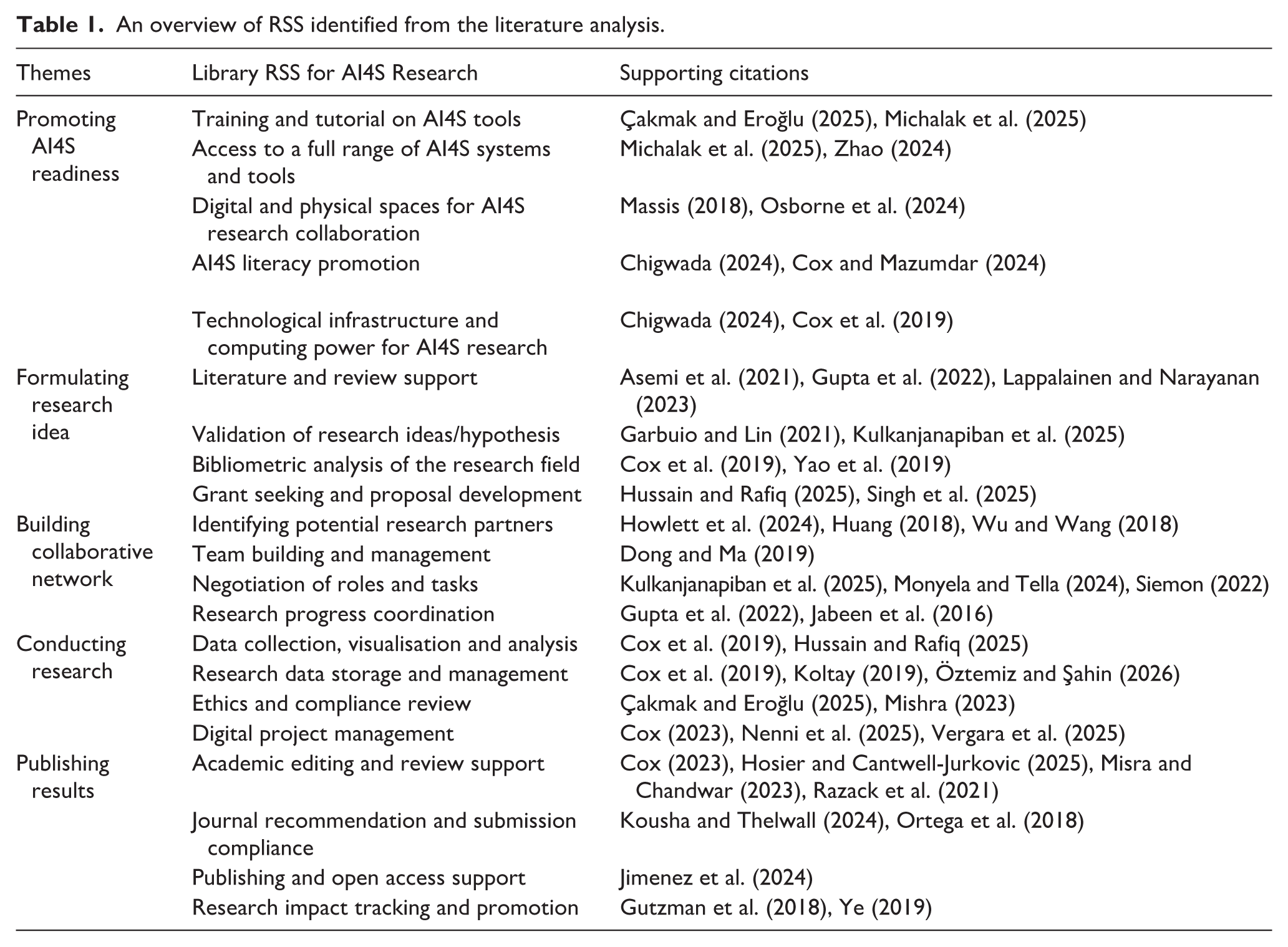
As illustrated in Table 1, the literature review provided an overview of general RDMS requirements that served as a basis for the case study investigation. In this part of the work, five themes of user requirements emerged.
An overview of RSS identified from the literature analysis.
The case study was designed as the following stage
A case study, which refers to the use of a descriptive research approach, is considered insightful and an extensively used research approach in social sciences (Gioia, 2021; Mabry, 2008; Yin, 2003), being verified applicable in library and information science in particular (Fidel, 1984; Ngulube, 2022). Case study research is motivated by unbidden and context-rich empirical observations, with the aim of delineating and examining the presence of a complex phenomenon (Corley et al., 2021; Yin, 2003).
As an illustrative case study, this study serves primarily to uncover new and unfamiliar events and provide evidence about the user requirements of RSS, which is interesting and attractive to both researchers and practitioners. Rather than a multi-case study, a single-case study tends to delve as deeply as possible, thereby leading to a better understanding of the current situation and a better achievement of research objectives.
Located in the southeast of China alongside the seaside, Xiamen University is considered one of the most excellent universities in China. Xiamen University Library (XUL) has a historical significance which can be traced back to 1921. With its comprehensive collections (over 1.48 million physical and digital holdings) and pioneering innovation and services (e.g. AI-integrated services and virtual reference systems), it collectively exemplifies the evolution, resource management strategies and adaptive modernisation of academic libraries, offering tangible insights into institutional resilience and technological integration within higher education contexts. Given that many of China’s university libraries are attempting to integrate AI into modernised services, Xiamen University Library is expected to become a “showcase” from which other university libraries can learn and seek insights and guidance.
Interview data collection
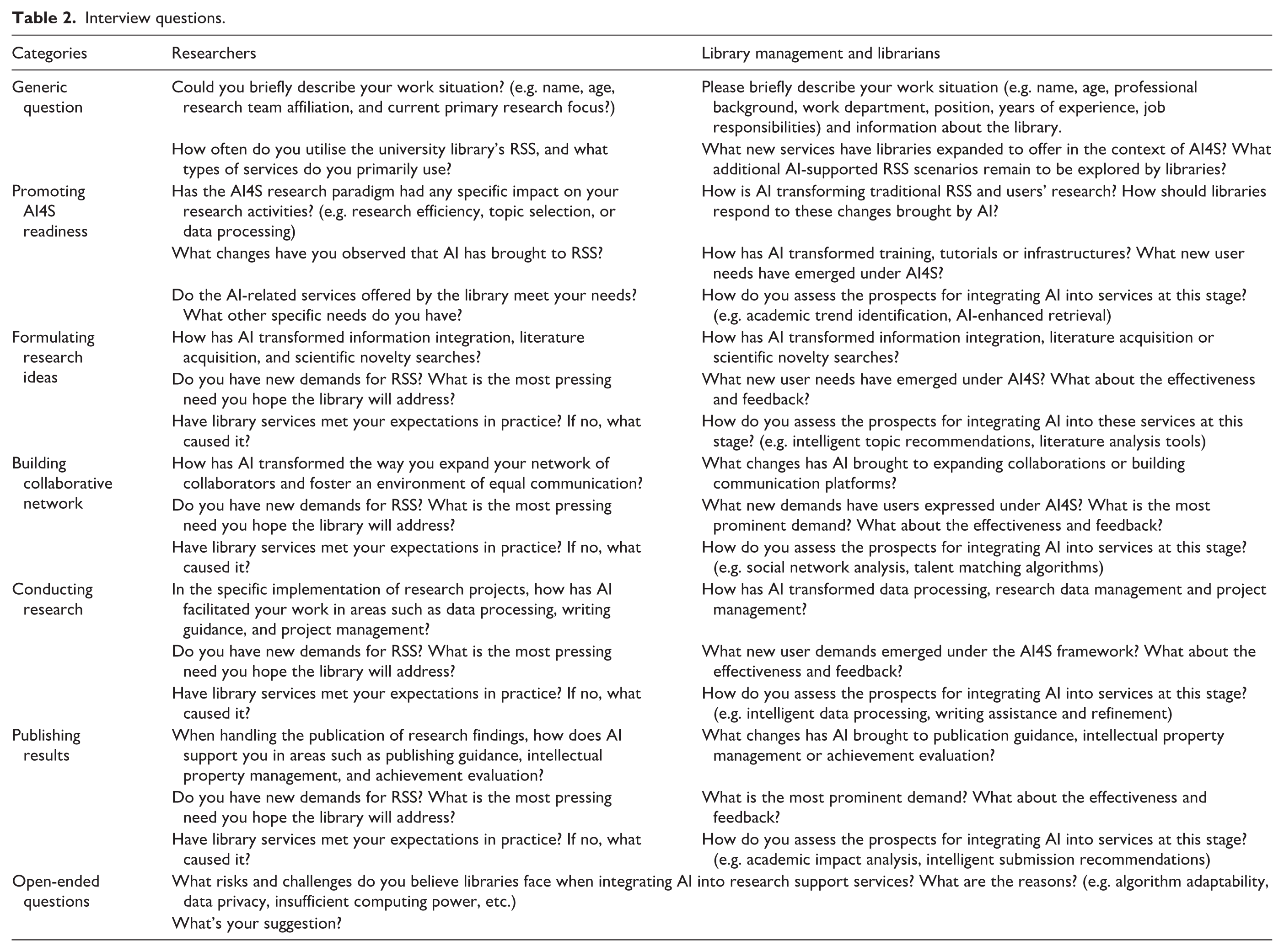
The case study employed an inductive and exploitative qualitative approach, using a semi-structured interview and a thematic analysis. The semi-structured interview questions were specially designed according to the RSS requirements identified and listed in the literature review (summarised in Table 2). It was worth noting that the interview scripts were designed for two types of interviewees: one for researchers, the other for library management and librarians.
Interview questions.
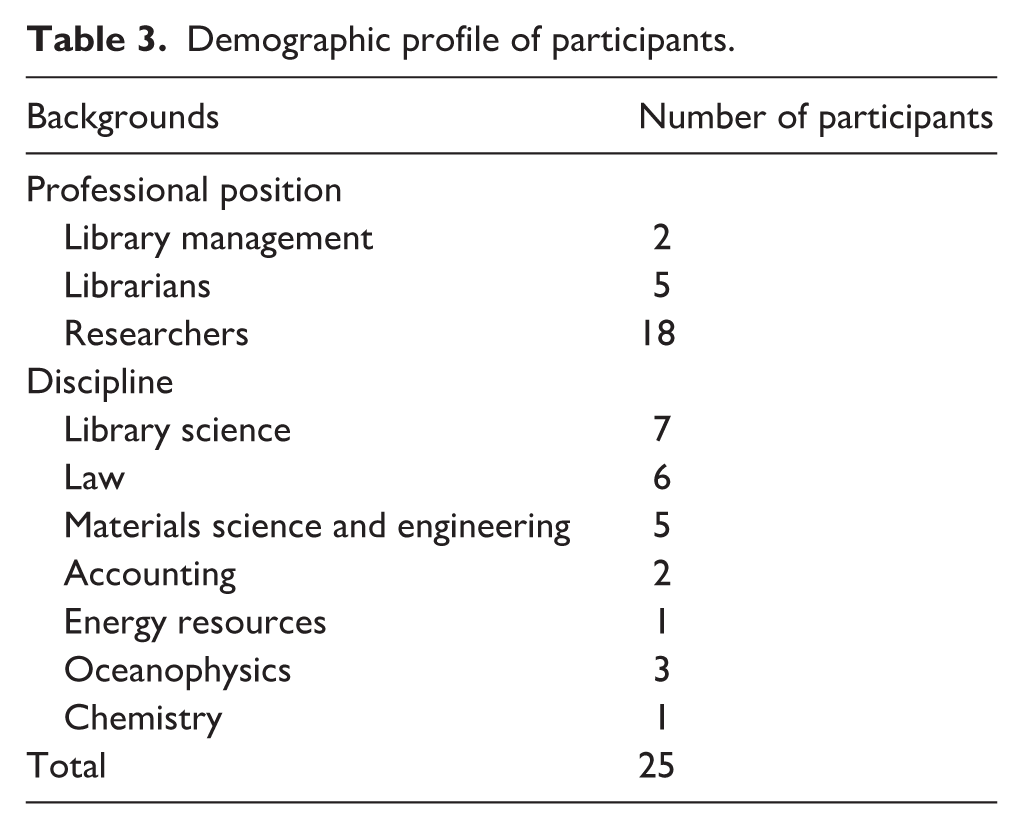
The interview was conducted in December 2024. The research team managed to reach 25 interviewees, including 18 researchers and 7 library management and librarians. The demographic information of the interviewees is shown in Table 3. Each interview lasted 22–70 minutes. With the participants’ consent, all the interviews were recorded and then manually transcribed into Word documents.
Demographic profile of participants.
Interview data analysis
The analysis of interview data employed a thematic analysis method. Two thematic analysis tools were used: coding and theoretical representation. The analysis of the qualitative data used a qualitative data analysis application, MAXQDA 2022, to examine, interpret and constantly compare emerging codes. To include as many evocative codes as possible, the coding process was designed to be inductive. Inductive coding is exploratory and data-driven, allowing researchers to remain open-minded to new themes that may arise from the text data (Fereday and Muir-Cochrane, 2006).
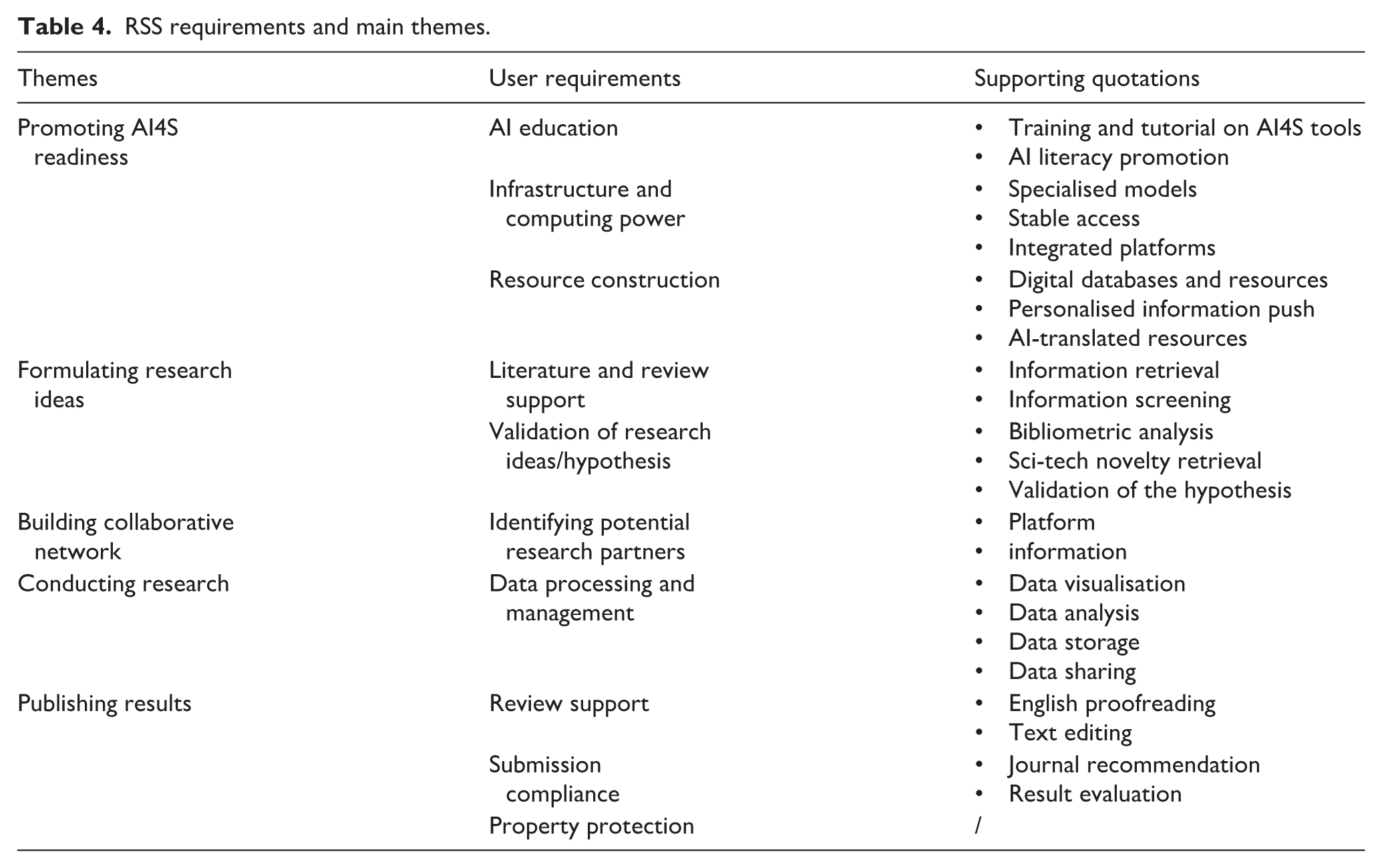
To ensure methodological rigour in textual data coding, this study employed an approach encompassing three established strategies. (1) Theoretical foundation. As mentioned in the preceding section, the coding is based on a prior development of theoretical propositions to guide data collection and data analysis (Yin, 2003). (2) Iterative coding development. After pre-coding of several interview scripts, all preliminary codes derived from initial transcripts underwent three revision cycles—provisional, revised and final. (3) Integrated coding methods. The interview transcripts were coded using three types of coding: open coding, axial coding and selective coding. As illustrated in Table 4, the analysis of interview data pointed to 10 user requirements of RSS, which emerged in five main themes: promoting AI readiness, formulating research ideas, building collaborative networks, conducting research, and publishing results.
RSS requirements and main themes.
Research findings
In the following section, user requirements for RSS were identified, presented and discussed based on interview data analysis, leading to a direct response to RQ1 specifically. Responses to RQ2 were designed to be discussed in Section 5, which was developed based on the research findings.
In this study, the analysis of 25 interview transcripts pointed to 10 RSS, which emerged in the following five themes. Correlated with the previous literature review and tentative framework, the research findings were supported by existing studies. The five themes are as follows.
Promoting AI4S Readiness: University libraries are considered to play a salient role in promoting the AI4S readiness for researchers by designing and delivering AI education programmes, including ethical considerations, research integrity, information access, equity, knowledge innovation and protection (Chigwada, 2024; Cox and Mazumdar, 2024). Besides, university libraries are expected to contribute to AI-related resource construction as well as technological infrastructure and computing power development (Cox et al., 2019; Michalak et al., 2025).
Formulating Research Ideas: At this research stage, librarians serve as research assistants, efficiently identifying relevant studies from large collections of articles gathered from various databases and bibliographic searches, thereby significantly reducing the time and effort required for comprehensive literature retrieval, screening and analysis (Gupta et al., 2022). Besides, research grant application support is highly demanded (Singh et al., 2025), such as grant information analysis and proposal development.
Building Collaborative Network: Since research collaboration relationships among various disciplines are increasing, university libraries are expected to offer effective RSS, such as potential partnership identification services (Howlett et al., 2024; Huang, 2018; Wu and Wang, 2018).
Conducting Research: During the research conduction, RSS about the data processing and management are highly demanded, including data storage, data analysis and data visualisation (Cox et al., 2019; Hussain and Rafiq, 2025). Furthermore, university libraries are expected to help with ethics and compliance review (Mishra, 2023).
Publishing Results: AI4S RSS are widely used at this stage, especially for “improving grammar and syntax, and improving writing for new or early-career researchers and for non-native English speakers” (Hosier and Cantwell-Jurkovic, 2025). Although there are still concerns about how to use AI appropriately, user requirements about submission assistance, open access support, research impact promotion and property protection are frequently mentioned.
Promoting AI4S readiness
Promoting AI4S readiness is considered “necessary” (Interview 10 and 19), “extremely significant” (Interview 5), “effective” (Interview 18 and 19), and useful (Interview 20 and 21). The interview data analysis revealed three RSS requirements:
AI4S literacy education
Resource construction
Technological infrastructure and computing power
It is arguably that AI-supported search does not remove the need for information literacy. Since data and information provided by AI can be “inaccurate” (Interview 19), AI4S literacy is relied on in the process of using AI as an auxiliary tool to enhance research efficiency (Interview 18). It should be highly noted that the capability of using AI correctly determines how effectively it can contribute to scientific research. In this case, XUL are born to serve as an advisor and educator. As shown in the interview data, there is a growing preference for “lectures with concrete themes” (Interview 14 and 21), including “guidance on writing formal and standard text” (Interview 9) and “training on retrieval tools and databases” (Interview 11, 18, and 20), rather than comprehensive, systematic training programmes (Interview 21). While a wealth of video tutorials is provided on online platforms, live lectures are considered more beneficial, as they are designed for more “personalised interaction and immediate feedback” (Interview 21).
Development of resource construction, especially digital academic resources and personalised information recommendations, is requested by most participants. “Digitising books is essential, as it serves a foundation for supplementary reference materials . . . By employing AI technologies, standardised keywords can be indexed, and full-text retrieval should be enabled, thereby achieving deep utilisation of library resources” (Interview 14). Drawing on a broad collection of user data of library resources, AI are able to provide personalised recommendations for resources (Interview 4, 16, 19, 21) and news (Interview 12) that tend to align with researchers’ research interests and individual preferences.
But I think the best aspect of AI is its ability to predict—it can anticipate what you might need in the future. I believe this is where it truly excels. Take TikTok, for instance. The precise recommendation is a result of the AI algorithms that can tailor content to users’ preferences. This is why I see it as a way that could significantly enhance researchers’ experience (of library services) in the future. (Interview 16)
Although technological infrastructure and computing power are the foundation of AI4S RSS, stable access to AI4S systems and tools can be challenging, which makes researchers think about the possibility of “purchasing access to commercial general language models” (Interview 10). Especially, integrated AI models into the library platform, functioning as an AI assistant for databases, are mentioned. This service is designed to “accelerate the learning curve for research novices, enabling them to more rapidly navigate and utilise database resources effectively” (Interview 11). Furthermore, interview participants demonstrated a growing demand for domain-specific models, which would outweigh their reliance on general large language models to some extent. Trained on dedicated literature from various disciplines, these specialised models would be capable of delivering “more expert and precise information” (Interview 16) within their respective domains.
To our expectation, whether specialised models can be developed is interesting. For instance, services tailored for computer science, automation, or electrical engineering would be quite distinct. If it can offer such differentiated services and resources, I believe they would be quite useful. (Interview 16)
Formulating research ideas
As the start stage of the research process, research idea formulation based on numerous and various resources can be consequential and affect the following research processes. The interview data analysis revealed two major RSS requirements:
Literature and review support
Validation of research ideas/hypothesis
Literature and review support services are expected, including AI retrieval and AI screening. Allowing natural language search and multiple rounds of dialogue, AI retrieval is deemed “a smarter search engine” (Interview 8). The most paramount benefit lies in search convenience enhancement, “developing a systematic search strategy” (Interview 15) and “enabling precise results with just a rough description” (Interview 18), which can save a substantial amount of time. Though initial search results tend not to be highly accurate, with multiple rounds of questioning and refinement, it is able to provide a relatively useful answer ultimately. Furthermore, the main ideas of literature are captured and summarised by AI to “facilitate efficient screening” (Interview 14, 21) and provide “a barely satisfactory literature review” (Interview 5, 17) I also use AI to ask questions during my regular studies. Traditionally, we’d use search engines to look things up, but often the results we get aren’t very relevant to the answers we’re looking for. However, when using AI now, the content it provides is usually quite relevant. And even if it’s not, you can tell it how to adjust, and it generally gives you a pretty satisfactory response. In this sense, it largely replaces search engines by consolidating information for you. (Interview 21)
Furthermore, AI-based RSS can play a role as a collaborative partner for brainstorming (Interview 20). As revealed in interviews, researchers expect to engage with AI to discuss and validate research ideas, including “the selection of analytical theories” (Interview 14). Since the imperative to establish a project’s innovation, significance and practical feasibility presents a major challenge, AI tools offer significant support by helping researchers to critique and validate their hypotheses, thereby refining research questions and enhancing the overall robustness of study plans from their inception.
The predictive capacity of AI constitutes its fundamental advantage. By analysing historical data to evaluate the potential of ongoing research and estimate its success probability, AI directly addresses the inherent uncertainties in innovation. This capability for probabilistic reasoning distinguishes it from mere classification algorithms. Therefore, leveraging AI for forecasting project outcomes prior to their initiation—and even prior to human ideation—represents a promising direction, as it can guide resource allocation and prevent redundant efforts. (Interview 16)
Building a collaborative network
Conventionally, research collaboration relies on ingrained cognitive patterns and pre-existing rational networks. Yet, the growing emphasis on interdisciplinary studies necessitates cross-disciplinary collaborations to explore unfamiliar fields, generating a pressing need for comprehensive intelligence on potential partners and their research domains. The requirement of identifying potential research partners emerges from the interviews.
According to interview participants, XUL is expected to develop a scholarly collaboration platform, which will display the research achievements and interests of prominent scholars across disciplines, achieving a consolidation of academic profiles (Interview 10, 19). By leveraging extensive data collection, analysis and matching algorithms, the platform is designed to “perform exact queries and personalised recommendations” (Interview 10), effectively mitigating the transaction costs associated with identifying suitable research collaborators.
However, despite the algorithmic recommendations, a notable portion of respondents expressed neutrality or scepticism. While AI matching relies on quantifiable criteria, successful collaboration is inherently limited by these algorithms and is ultimately contingent upon in-depth and interpersonal communication (Interview 16).
Conducting research
widely regarded as the central stage of the research process. This centrality necessitates robust research support services, primarily encompassing data management and ethics and compliance review. Libraries are requested to provide research data management services to support data-centric research. Collected research data needs to be processed, analysed and visualised through a set of procedures with the assistance of librarians. The initial phase of data processing, particularly the manual extraction of information from large volumes of unstructured text and massive amounts of data, tends to “involve tedious, repetitive and time-consuming tasks” (Interview 21). AI-driven approaches, especially those leveraging large language models, offer a powerful solution as the task aligns closely with their core functional strengths in pattern recognition and information retrieval (Interview 13, 14).
During data analysis, executable code frameworks can be generated by AI from natural language descriptions (Interview 14). Although subsequent modifications are often necessary, this capability significantly accelerates the development. Particularly in complex analytical scenarios, AI can perform analyses that might be beyond a researcher’s technical skills (Interview 15), thereby empowering a broader range of scholars’ engagement in complex research.
Data processing services are likely needed across the humanities, social sciences, and STEM fields today. For quantitative analysis, I believe AI tools can genuinely assist you in writing code, which I find quite helpful. Personally speaking, I think that having no understanding of languages like Python is still problematic. You need to know some fundamentals, then combine that knowledge with these tools to complete your analysis. (Interview 14)
AI demonstrates a significant capacity for synthesising professional technical roadmaps from user-described concepts. While human input remains essential for defining the conceptual direction, AI excels at translating these ideas into visually coherent and aesthetically structured diagrams, overcoming the challenges of unclear manual sketches. The primary advantage of this approach lies in “enhancing the comprehensibility and communicative efficacy of complex technical information” (Interview 21).
Publishing results
At the stage of concluding research, several requirements of RSS emerge before results publishing, including:
Writing support
Submission assistance
Property protection.
For non-native researchers, “academic writing in English poses a considerable challenge” (Interview 11), which may potentially fail to reflect the intended meaning and research findings. Before the application of AI tools, researchers may be compelled to resort to professional editing agencies, thereby creating a dual burden of significant time commitment and financial cost (Interview 14). Consequently, this concern drives a massive demand for libraries to provide AI-powered writing assistance tools, which can help scholars align their papers with general academic writing standards (Interview 7, 16, 19, 21).
AI excels at polishing academic papers. For instance, upon completing a project, AI can help optimise the content and structure of your final report. Overall, I find AI to be a highly useful tool—the key lies in how effectively you utilise it. (Interview 19)
The identification of a suitable publication journal is a critical and time-consuming step in the research lifecycle. As revealed in the interviews, researchers expect RSS to evolve from merely providing basic journal information to recommending aligned journals, especially English journals, based on manuscript titles, abstracts and keywords (Interview 16, 19). Journal information curated by libraries is generally perceived as highly authoritative and accurate. Thus, developing a systematic framework for journal recommendation by “establishing specific criteria to various departments and disciplines” (Interview 20) could provide significant value.
Furthermore, although concerns exist regarding data security when submitting sensitive research details to AI systems, there is a “greater willingness to trust AI applications that are locally deployed and institutionally supported by libraries” (Interview 15). Such assistance in publishing results is designed to save researchers significant time, thereby enhancing both efficiency and the potential for acceptance.
The protection of intellectual property rights enters a critical yet challenging phase following research publication. To address this, AI-based monitoring systems offer a promising approach to address this gap by enabling automated scanning for potential infringement across large-scale digital sources, thereby supporting rights enforcement (Interview 5). While the final determination regarding infringement and subsequent enforcement actions appropriately remains with researchers, RSS are expected to perform preliminary assessments of suspected cases.
Discussion
The research results reveal 10 RSS requirements, which respond to the first research question. Furthermore, in response to the second research question, the interview data analysis indicates three major implications.
Challenges of RSS development
Firstly, it is noteworthy that although the transformation and development of RSS in university libraries are imperative to address evolving user requirements in the AI era, the accompanying difficulties and challenges remain formidable and cannot be overlooked. These challenges now constitute significant impediments to the library’s institutional transformation.
Intrinsic technical limitations of AI algorithms
AI ethics and data property
Concerns about the erosion of individual capabilities due to over-reliance
The technical limitations of AI algorithms are evident and cannot be overlooked, leading to user concerns and scepticism about AI4S. Highly dependent on their training datasets, AI tools exhibit different performance. Particularly in scientific research, without reliable academic databases as crucial learning material, their outputs tend to be “inaccurate” (Interview 9, 16, 22), “incredible” (Interview 12, 15, 16, 17, 18) and “obsolete” (Interview 7). Furthermore, as revealed by interview participants, data leakage is inevitable. Despite providing explicit directives against utilising conversation content for model training, users “remain unaware whether such data is ultimately exploited” (Interview 14). Also, no technology company can offer absolute assurance against data leakage, given the inherent bugs present in any complex technological infrastructure.
Research ethics faces significant and novel challenges with the integration of AI tools. Taking literature reviews as an example, “the direct incorporation of AI-generated literature reviews raises questions about plagiarism” (Interview 10). Besides, whether the formal acknowledgement and disclosure of the use of AI to assist manuscript editing is mandated and obligated is still pending. Although disclosure requirements for AI assistance are advocated by some scholars, “the operational implications and associated costs require further systematic investigation” (Interview 16). Particularly, reliable verification of such usage remains challenging.
Another significant concern is whether the use of AI truly benefits research fostering. As evidenced by the interview data, a notable contingent of scholars—particularly those engaged in educational roles—expressed apprehension that excessive dependence on AI-driven tools may inadvertently lead to the erosion of autonomous critical thinking and analytical reasoning capabilities. This apprehension underscores a deeper anxiety regarding the potential trade-off between technological convenience and the preservation of essential cognitive skills that form the cornerstone of rigorous academic inquiry.
Pursuit of personalised services
The advent of AI technologies has intensified the user requirement for specialised information and services. While significant requirements for RSS are acknowledged, concerns regarding its effectiveness and quality remain. A prevalent view among researchers is that “existing library services are perceived as largely rudimentary” (Interview 15, 17), mainly beneficial for research novices or users with limited AI proficiency. RSS addressing highly specialised or complex research inquiries is either underdeveloped or, where available, exhibits constrained effectiveness.
Consequently, users are demonstrating increased demand for more personalised RSS. They seek resource recommendations with greater domain-specific relevance (Interview 21). Furthermore, compared to general-AI large language models, researchers show “stronger preference for specialised models” (Interview 5, 8,14), which are “trained on authoritative academic datasets” (Interview 16) that offer enhanced accessibility within the research lifecycle. Indeed, the development of domain-adapted AI tools is perceived as better aligned with researchers’ operational requirements.
Theoretical contributions
The findings presented above not only summarise user-derived requirements for RSS but also offer several points of critical departure from prior research, thereby advancing our understanding of library service transformation in the AI4S era. While existing literature has extensively discussed the potential of AI to reshape library services (Cox, 2023), such discussions have largely remained speculative. In contrast, our findings provide empirical evidence that this potential is significantly constrained by tangible challenges, including technical limitations, ethical concerns, and fears of cognitive erosion, which may fundamentally affect user acceptance of AI-enabled RSS. Furthermore, our study challenges the assumption that researchers will naturally turn to libraries for AI-driven support. As shown in previous discussion, researchers perceive existing library services as rudimentary and prefer domain-specialised models trained on authoritative academic datasets, suggesting that libraries cannot rely on their traditional legitimacy but must actively reestablish relevance in the AI4S era.
Our study also contributes to the emerging discourse on AI ethics in libraries by grounding ethical concerns in actual user voices. While issues such as data leakage, plagiarism and disclosure requirements have been recognised in previous work (Van Noorden and Perkel, 2023), our findings reveal that these concerns directly shape researchers’ willingness to engage with library-mediated AI services. Additionally, the apprehension about the erosion of individual critical thinking skills, particularly among educator-researchers, adds a new dimension largely overlooked in library and information science literature. Collectively, these contributions reframe the research problem: the question is not simply how libraries can develop AI-enabled RSS, but whether and under what conditions users will actually adopt such services.
Conclusion
This article reports a research study, which is designed for RSS development in university libraries in China. Based on the analysis of 25 interview transcripts, this paper pointed to 10 core requirements of research support services. These requirements are categorised into five themes, corresponding to one foundational support area and four major stages of the research project lifecycle: promoting AI4S readiness, formulating research ideas, building a collaborative network, conducting research and publishing results.
Furthermore, the research findings inform the strategic development of RSS at Ximen University Library. The rapid advancement of AI technologies presents several key challenges, including intrinsic technical limitations of AI algorithms, AI ethics and data property and concerns about the erosion of individual capabilities due to over-reliance. Concurrently, the proliferation of AI technologies has also raised user expectations for more specialised support, thereby intensifying requirements. These unanticipated insights, beyond the initial research design, represent valuable and critical direction for further exploration.
This study employs a single-case design, with data collected exclusively from users of Xiamen University Library. While this approach allows for an in-depth, context-rich exploration of user requirements, it inevitably limits the generalisability of the findings to other institutional settings. Different types of universities, which vary in research intensity, disciplinary composition and technological infrastructure, may present distinct user needs and service challenges. Therefore, future research should extend this work by adopting a multi-case or cross-institutional design, encompassing a diverse range of university libraries across different regions and institutional tiers. Such an approach would enable the development of a more robust and generalisable model of user requirements for AI4S-enabled RSS.
It is worth emphasising that this study carries significant value, which is not only suitable for universities in China but also for those around the world. Specifically, these research results are expected to provide useful instructions for those university libraries that are in the critical stage of research support services development.
Footnotes

Ethical considerations
The data used in this article is anonymised information data, which is exempt from ethical review. The reason is that it complies with Article 32 of the “Notice on Issuing the Measures for Ethical Review of Research Involving Human Life Sciences and Medicine” issued by the Chinese government, which specifically states that “research conducted using anonymized information data that does not cause harm to the human body and does not involve sensitive personal information or commercial interests can be exempted from ethical review.”
Funding
The authors disclosed receipt of the following financial support for the research, authorship, and/or publication of this article: This work is supported by Key Project of the National Social Science Fund of China (2024), titled “Research on Research Support Services of University Libraries for AI for Science (AI4S)” (Grant No. 24ATQ008).
Declaration of conflicting interests
The authors declared no potential conflicts of interest with respect to the research, authorship, and/or publication of this article.
Data availability statement
The datasets generated during and analysed during the current study are available from the corresponding author on request.*