






Abstract
We previously developed a health-related quality of life (HRQOL) tool for children with systemic lupus erythematosus (SLE) that is valid in English for the United States, called Simple Measure of Impact of Lupus Erythematosus in Youngsters (SMILEY). In order to determine the effect of SLE on the well-being of children, adolescents and their parents and examine the response to treatment modalities, it is critical to have an HRQOL tool that is applicable for different cultures. After validation in US English, we reported the translation and cultural adaptation process undertaken by our team to make SMILEY available in the following 13 accepted modern language variants: Danish, Dutch, French (France), German (Germany), Hebrew, Italian, Portuguese (Brazil), Slovene, Spanish (USA and Puerto Rico), Spanish (Spain), Spanish (Argentina), Spanish (Mexico) and Turkish. In this report we will describe the translation and adaptation of SMILEY into Afrikaans, Xhosa, Arabic (Saudi Arabia), Arabic (Egypt), Chinese, Czech, English (UK), German (Austria), German (Switzerland), Greek, Hindi, Hungarian, Japanese, Romanian, Serbian and Spanish for Venezuela. We followed the earlier reported procedure in this study consisting of: establishing collaborative relationships with different physicians caring for children with rheumatic diseases; forward and back translation of SMILEY and revisions; and cultural adaptation of SMILEY content.
Introduction
Pediatric systemic lupus erythematosus (SLE) in children is a chronic multisystem disease that affects the health-related quality of life (HRQOL) of children from all cultures. HRQOL has been designated as a fundamental constituent of a core set of outcome measures for the assessment of treatment response in children with SLE. 1 In order to determine the effect of SLE on the well-being of children, adolescents and their parents and assess the response to treatment modalities, it is critical to have an HRQOL tool that is applicable for different cultures.
We have previously reported the development and validation of the Simple Measure of Impact of Lupus Erythematosus in Youngsters (SMILEY) in US English 2 HRQOL measure for children. In a previous manuscript we reported the translation and cultural adaptation process undertaken by our team of SMILEY in the following 13 language variants: Danish, Dutch, French (France), German (Germany), Hebrew, Italian, Portuguese (Brazil), Slovene, Spanish (USA and Puerto Rico), Spanish (Spain), Spanish (Argentina), Spanish (Mexico) and Turkish. 3 We conducted a rigorous process of forward and back translations, revisions and reviews so that it is culturally suitable for the children from a particular country. In the following report we will describe the translation and adaptation of SMILEY into 16 additional language variants listed here: Afrikaans, Xhosa, Arabic (Saudi Arabia), Arabic (Egypt), Chinese, Czech, English (UK), German (Austria), German (Switzerland), Greek, Hindi, Hungarian, Japanese, Romanian, Serbian and Spanish for Venezuela. Cross-cultural validation comprises translation, cultural adjustment and subsequent validation for each culture.4,5
Materials and methods
Translation and adaptation for cultural suitability of US English SMILEY
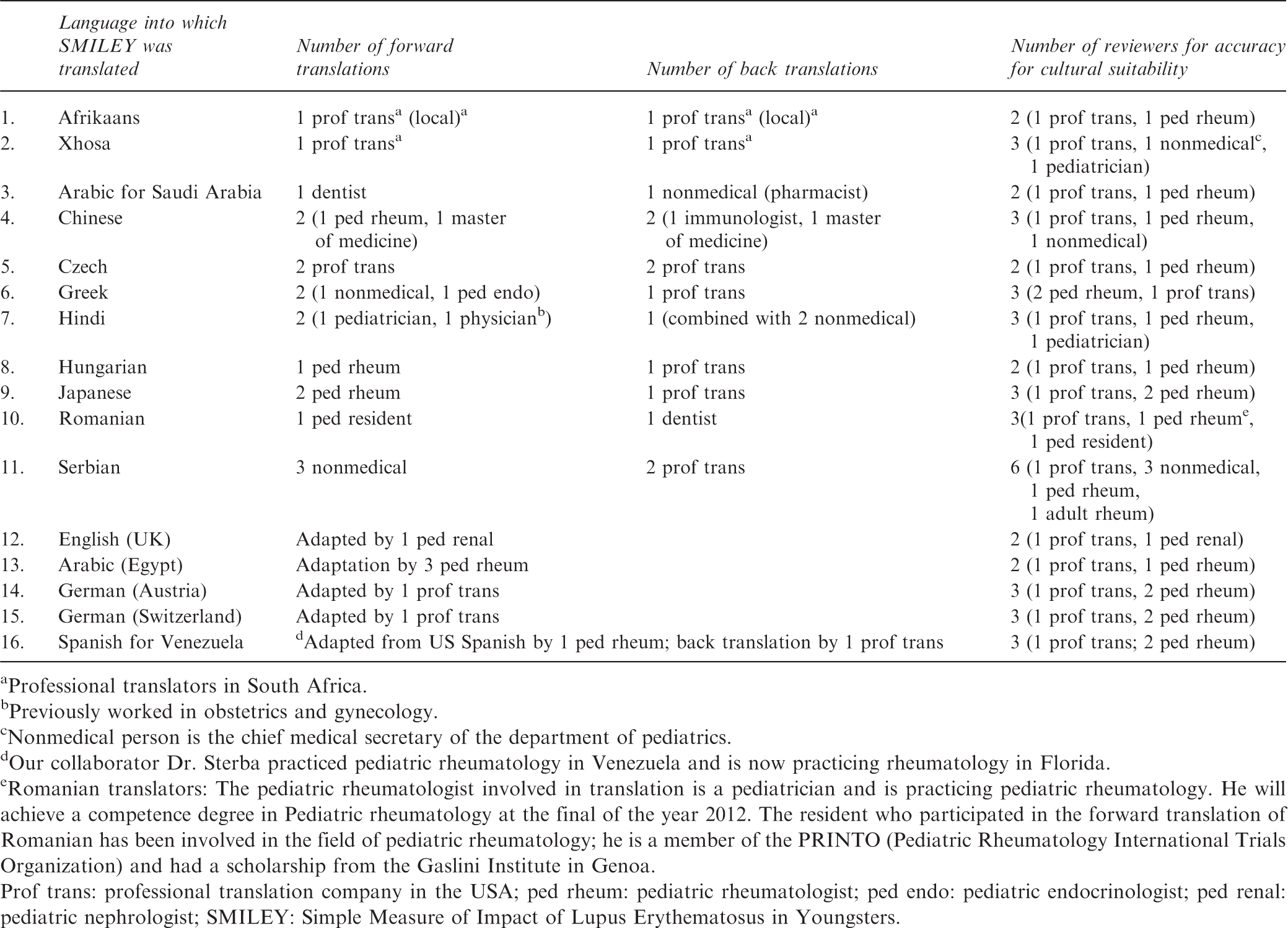
Professional translators in South Africa.
Previously worked in obstetrics and gynecology.
Nonmedical person is the chief medical secretary of the department of pediatrics.
Our collaborator Dr. Sterba practiced pediatric rheumatology in Venezuela and is now practicing rheumatology in Florida.
Romanian translators: The pediatric rheumatologist involved in translation is a pediatrician and is practicing pediatric rheumatology. He will achieve a competence degree in Pediatric rheumatology at the final of the year 2012. The resident who participated in the forward translation of Romanian has been involved in the field of pediatric rheumatology; he is a member of the PRINTO (Pediatric Rheumatology International Trials Organization) and had a scholarship from the Gaslini Institute in Genoa.
Prof trans: professional translation company in the USA; ped rheum: pediatric rheumatologist; ped endo: pediatric endocrinologist; ped renal: pediatric nephrologist; SMILEY: Simple Measure of Impact of Lupus Erythematosus in Youngsters.
Translations were performed by professional translators, bilingual speakers of the local language and/or pediatric rheumatologists from that country. In order to ensure that all our translations are accurate and appropriate, we obtained reviews and the final approval by our professional translation company for all the 16 language variants. We used the same professional translation company as we did in the previous study. 3 In order to make sure that the translated SMILEY corresponded to the US English SMILEY and was culturally sound, whenever possible we got additional translations and/or reviews from pediatric rheumatologists and/or other native speakers and/or physicians from each country (who also are native speakers of that language). The team involved in the translation process reviewed the final adaptation to make certain that it corresponded to US English in semantic, colloquial and theoretical terms.
Scales used
The US English SMILEY version is a concise, easily comprehensible scale that is valid 2 and developed from qualitative research on patients with SLE and their parents. 6 The child and parent SMILEY are parallel forms and each consists of 24 items with answers in the form of faces. The four domains are: effect on self (five items), limitations (eight items), social (four items) and burden of SLE (seven items). Scores for each item can range from one to five, and the summative score is transformed to a percentage. Higher scores correspond to better HRQOL. 2 The questions ask the subject to consider the past month. If more than 50% of the items are left blank, the questionnaire cannot be scored. 2 The first two questions are about overall HRQOL, and present SLE status and their answers are integrated into the domain or final scores.
Results
We first set up a collaborative relationship with 20 physicians caring for children with rheumatic diseases from 16 different institutions.
Following the process described above, the translations/adaptations of SMILEY into 16 language variants were performed (Table 1). The forward and back translations for Afrikaans, Xhosa and Czech were conducted by professional translators. Two native speakers (one nonmedical and one pediatrician) reviewed the Xhosa version. The pediatric rheumatologist arranged a meeting between the two native speakers, and the team finalized the version.
Arabic, Romanian and Hindi translations were reviewed by a pediatric rheumatologist and professional translator. Chinese and Greek translations were arranged by our collaborators in their countries. Hungarian and Japanese versions were created by pediatric rheumatologists and professional translators. For the creation of the Serbian version, the pediatric rheumatologist arranged two meetings with the translators for developing the final unified Serbian version. This pediatric rheumatologist was involved in the adaptation of the Serbian version of the Childhood Health Assessment Questionnaire and the Childhood Health Questionnaire. 7
English for the UK was adapted by our collaborator in the UK from the US English SMILEY, and the adaptation was reviewed by their institutional review board in the UK as well as our professional translation company. The German versions for Austria and Switzerland were adapted from the German SMILEY for Germany. Arabic (Egypt) was adapted from Arabic (Saudi Arabia) as arranged by our collaborator in Egypt.
All the reviews were conducted by a pediatric physician and the professional translation company to ascertain that the translations were culturally suitable for children and parents from their country. The number of forward and back translations and reviews obtained for each of the translations are listed in Table 1.
Discussion
In this report, we have described the cross-cultural adaptation of US English SMILEY into 16 language variants. We have meticulously performed these translations and adaptations following the methodology reported in our previous paper. 2 The next step is to determine the validity of these versions. An international multicenter study is ongoing in order to determine the validity of the SMILEY translations in some countries. As part of that study, subjects are being probed about the relevance and comprehensibility of SMILEY. We applied rigorous methodology as in our previous paper to complete the translations/adaptations. We tried to get either pediatric rheumatologists/other physicians or nonmedical native speakers to perform the forward and back translations since the translation/adaptation must be appropriate for the patient and the parent from that country. In other cases we used a professional translation service for forward and back translation. In order to hold our process to the highest standard, we had a physician and our translation company review all of the translations, make changes as necessary and approve the version.
There are few pediatric rheumatologists in the world, and in several European, Asian and African countries, pediatric rheumatology is not yet recognized as an official field. Pediatricians and nephrologists also take care of children with rheumatic diseases.
Currently there are 29 translations of SMILEY available in the following language variants: Afrikaans, Xhosa, Arabic (Saudi Arabia), Arabic (Egypt), Chinese, Czech, English (UK), German (Austria), German (Switzerland), Greek, Hindi, Hungarian, Japanese and Romanian are reported here; and Danish, Dutch, French (France), German (Germany), Hebrew, Italian, Portuguese (Brazil), Serbian, Slovene, Spanish (USA and Puerto Rico), Spanish (Spain), Spanish (Argentina), Spanish (Mexico), Spanish (Venezuela) and Turkish have been reported in an earlier publication. 3
Although individualized aggressive therapeutic regimens have improved survival in children with SLE, it is often at the expense of increased morbidity and impaired HRQOL. SLE still remains a potentially life-threatening illness and is associated with devastating complications including disease flare, severe disability and organ damage. These different versions of SMILEY will enable us to clearly elucidate ethnic and geographic differences in the impact of SLE across the world. Since SMILEY was developed from patients’ responses, we think it will be the most specific and sensitive assessment measure for children with SLE. SMILEY will enable us to interpret patients’ feelings and identify problems that need to be targeted by health professionals in the different languages spoken by children.
Footnotes
Note
Acknowledgements
We would like to acknowledge the following individuals for their assistance in the process of translation and adaptation: Dr. N. Sharma, pediatrician, Georgia, USA; Dr. R. Sharma, USA; Kiran Bindra, nonmedical, USA; Hassan Ahmad, nonmedical, USA; Dr. Ayoubi, dentist, New York, USA; Doaa Ayoubi, nonmedical, USA; N. Wong, student, USA; Jarmila Tolimatova, clinical psychologist, Czech Republic; Prof. F. Kanakoudi-Tsakalidou, professor emeritus in pediatrics/pediatric immunology, Greece; Nikola Susic, Filip Susic and Tamara Isailovic, students, Serbia; Dr. Nonqaba Makiwane, MbChB, DCH(SA), PCert Occ Med, UK; Nonzwakazi Mbelebele, bookkeeping certificate, secretarial diploma, South Africa; and Richard Bertelsmann, language practitioner, South Africa.

Funding
The research was supported by the Arthritis Foundation Investigator Award (2007–2011, with no cost extension until October 2012).
Conflict of interest statement
The authors have no conflicts of interest to declare.
References
Supplementary Material
Please find the following supplemental material available below.
For Open Access articles published under a Creative Commons License, all supplemental material carries the same license as the article it is associated with.
For non-Open Access articles published, all supplemental material carries a non-exclusive license, and permission requests for re-use of supplemental material or any part of supplemental material shall be sent directly to the copyright owner as specified in the copyright notice associated with the article.
