







Abstract

Sir,
Hydroxychloroquine (HCQ) is a disease-modifying antirheumatic drug used in the treatment of systemic lupus erythematosus (SLE) and rheumatoid arthritis (RA).1–3 SLE and RA carry an increased cardiovascular morbidity and mortality risk because of the inflammatory nature of these diseases.4–6 While HCQ has been shown to lessen the cardiovascular risk associated with SLE and RA, 7 we believe direct cardiotoxic effects can occur with prolonged HCQ therapy.
A literature search found 17 reports of cardiomyopathy (four fatal) associated with HCQ therapy.8–11 Among these 17 HCQ cardiomyopathy reports, 13 had a diagnosis of SLE; the remainder had RA. Patient ages ranged from 31 to 88 years. Dosage levels before hospitalization were generally ≤400 mg per day. The total dose collected from 10 of the 17 reports ranged from 290 to 4380 g, with a median dosage of 1825 g, or 12.5 years of continuous therapy at 400 mg per day. Figure 1 shows the duration of HCQ treatment at the time cardiotoxicity was detected, with only two of 16 cases occurring before three years. All patients who survived had improvement of cardiomyopathy upon HCQ discontinuation.
Duration of hydroxychloroquine (HCQ) treatment before cardiotoxicity detected, 16 patients (treatment duration information missing for one patient).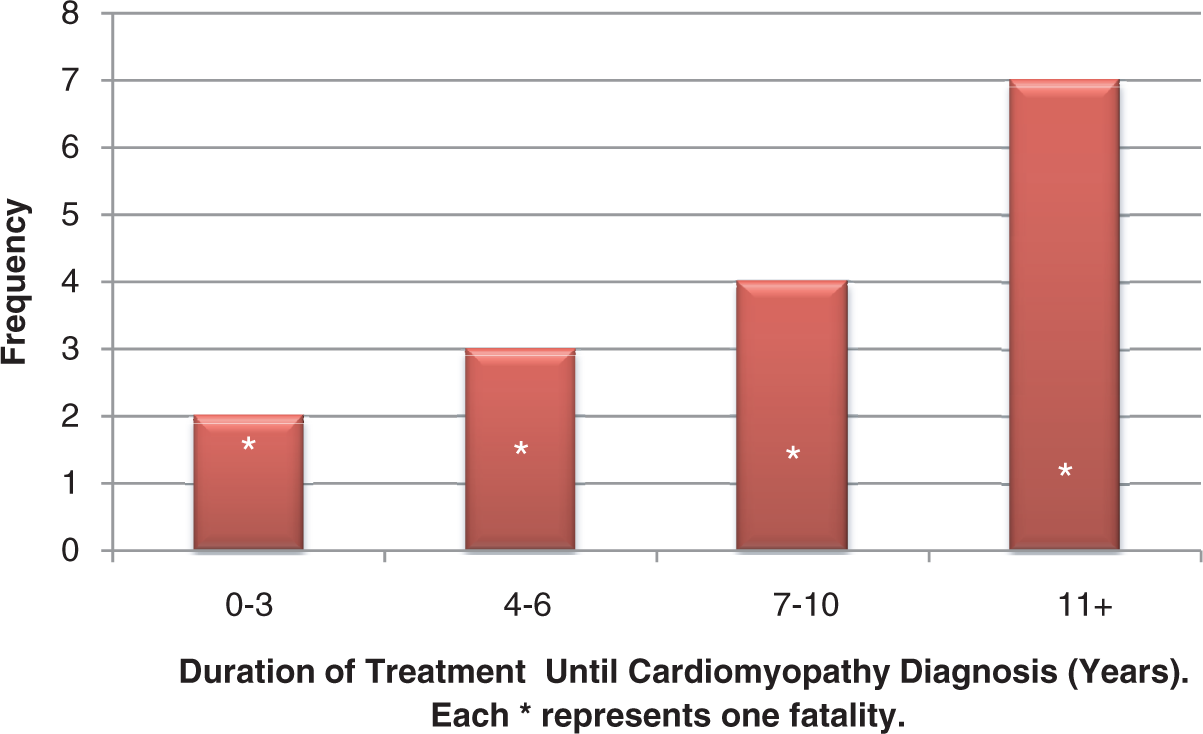
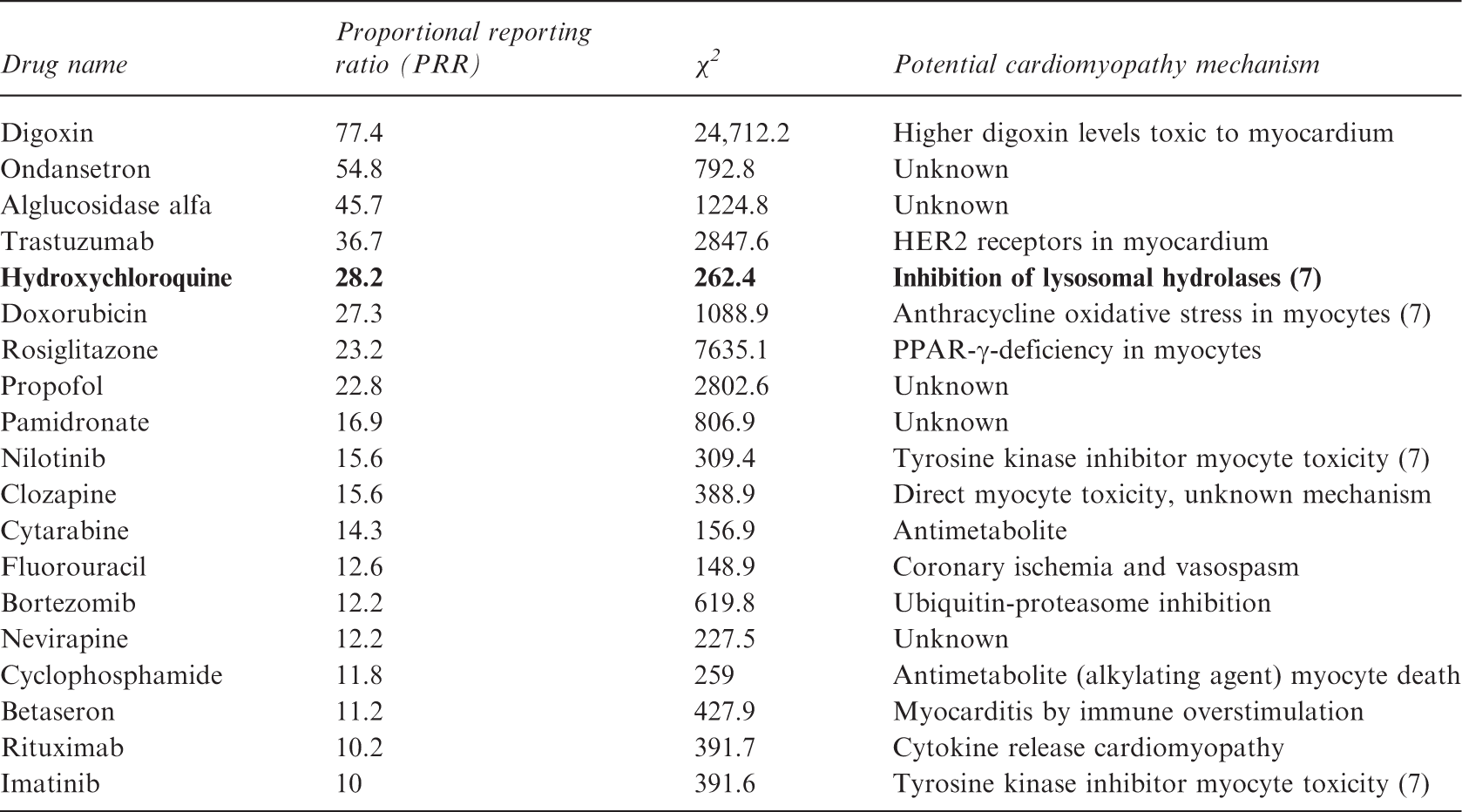
HCQ is fifth among drugs generating cardiomyopathy signals in MedWatch
The reports of HCQ-associated cardiomyopathy motivated an investigation of cases reported to MedWatch, the U.S. Food and Drug Administration’s (FDA) Adverse Event Reporting System (AERS). MedWatch is a voluntary reporting system for serious adverse events associated with FDA-regulated drugs and biologics. Information submitted by healthcare professionals and consumers through MedWatch is publicly disseminated via the AERS database. AERS reports are reviewed by the Center for Drug Evaluation and Research and the Center for Biologics Evaluation to monitor product safety. The AERS data are limited by the voluntary submission requirements, the ability of non-healthcare professionals to submit adverse event reports, and permitting reports without causality proven between the product and the adverse event. These attributes constitute many of the weaknesses in this study. More than 600,000 reports were submitted to the FDA MedWatch system in 2010, with healthcare professionals and consumers each constituting roughly half of the reporters (51.4% vs. 48.6%, respectively).
12
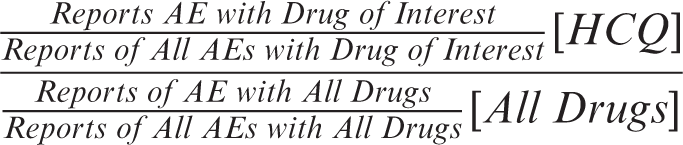
These data allow calculation of the proportional reporting ratio
13
(PRR) as a signal for association of cardiomyopathy with a given drug, measuring the disproportionality of a particular adverse event (AE) occurring for a drug with respect to the same AE occurring in all drugs. The PRR is calculated as:
Drugs with proportional reporting ratios greater than 10 calculated from MedWatch database
Measures to prevent HCQ toxicity: Cardiac screening and drug holidays
First, greater awareness of HCQ cardiotoxicity is needed. Early detection may be lifesaving, since our 17-case review showed cardiac status improved in all cases where HCQ was discontinued. There are currently no screening guidelines for HCQ cardiotoxicity. Newton-Cheh et al. suggested an annual electrocardiogram (ECG). 11 Cotroneo et al. observed that abnormalities detectable by ECG such as atrioventricular block and bundle branch block precede HCQ cardiomyopathy. 10 Our data show HCQ cardiomyopathy mostly occurs after three years of therapy. Questioning patients on HCQ regarding symptoms suggesting cardiac compromise including dyspnea on exertion should be a component of management, especially for patients on HCQ doses >400 mg/day. The safety of HCQ may be increased by therapeutic holidays for some patients on HCQ therapy, for example, those patients with cutaneous lupus erythematosus who may not need HCQ therapy during the winter months.
Footnotes
Funding
This research received no specific grant from any funding agency in the public, commercial, or not-for-profit sectors.
Conflict of interest statement
The authors have no conflicts of interest to declare.