






Abstract
Background
Systemic lupus erythematosus (SLE) or lupus is an autoimmune disorder whose cause and reason for disproportionate impact on minorities remains enigmatic. Furthermore, statistics describing lupus incidence and prevalence are outdated and often based on small samples. To begin to address this disparity this report describes preliminary data to be utilized in the development of a state-wide lupus registry in South Carolina.
Methods
A prospective survey and retrospective data from the South Carolina Budget and Control Board Office of Research & Statistics were used to capture data pertaining to knowledge of lupus, prevalence, and access to lupus care.
Results
Retrospective ORS data indicated there were 11,690 individuals living with lupus in 2014 with the average direct cost of $69,999.40 in medical care. Prospective surveys (N = 325), in over 16 locations in South Carolina, showed 31% knew someone with lupus, 16% had been diagnosed with lupus, and 50% did not know of a medical facility that treated lupus.
Conclusion
A lupus registry and repository will provide ongoing access for researchers on the impact of lupus on communities in South Carolina. Lupus is highly prevalent, but disproportionately represented in terms of patient information and participation in clinical trials, so it is also expected that this preliminary work will provide an ongoing process in which the medical community can better engage lupus patients.
Introduction
The number of people living with lupus is estimated to be at least five million worldwide with more than 100,000 new cases developing every year, though it is likely that these estimates are low.1–4 Lupus is not a reportable disease and most rates are estimates extrapolated from small studies and are dependent on self-report, so the exact number of people affected is unknown. However, it is estimated that there are greater than 250,000 individuals living with lupus in the United States. 1 , 5 Lupus and other autoimmune diseases are identified when one’s immune system loses its ability to differentiate between foreign substances and its own cells and tissues, causing the body to attack itself. Lupus has a wide spectrum of clinical presentations, which are characterized by remissions and exacerbations. Systemic Lupus Erythematosus (SLE) is the most diverse of the autoimmune diseases because it can affect any part of the body—most commonly the skin, joints, blood, and kidneys—and can be life-threatening. 6 In the United States, the highest lupus morbidity and mortality rates are among African American women. 5 , 7 , 8 Specifically, SLE affects approximately 1 in 250 African American women of childbearing age and African Americans have three to four times higher prevalence of lupus, are at risk for developing lupus at an earlier age, and have increased lupus-related disease activity, damage, and mortality compared to Whites.9–12
In the United States there are 3 state-wide lupus registries—California, Michigan, and Georgia—which aim to assess regional incidence and prevalence of cases of SLE to better characterize lupus patients.13–16 The target population for these programs included regions with a population of more than one million residents and a large proportion of those populations being African American or other racial/ethnic minorities (e.g. high proportion of Asians and Hispanic found in the California registry). 17 For this reason, South Carolina is an excellent location for the upstart of a new lupus registry due to its growing population and large proportion of African Americans, many of which identify as Gullah/Geechee sea islanders (an African American culture localized to the sea islands and coast of the southeastern United States).
The purpose of the current study was to conduct a community assessment to gain insight into the prevalence of SLE, availability of resources for those diagnosed with SLE, and describe the need for a SLE registry in South Carolina.
Methods
Data collection
Primary data collection
Eligible participants were adults aged 18 years and older and were currently living in South Carolina. Participants were given the option to complete the survey in-person, by phone, or online. Table 2 and Table 3 show the outlets used to reach participants. Participants were identified using local lupus support group leaders who distributed the surveys among their attendees and within their communities. Surveys completed during local SLE support group meetings included incentives in the form of $25 gift cards, given away as prizes. Additionally, volunteers were recruited and trained to help administer the survey in designated areas of South Carolina (SC) and Georgia (GA) (see Table 1), since many South Carolina residents live close to the SC-GA border and seek out services and activities across state lines. Survey responses pertaining to disease experience relied on self-report. Each component of the survey included an open-ended question, allowing for more in-depth responses. Additional data were obtained from patients on the types of care and services they received.
South Carolina locations reached.
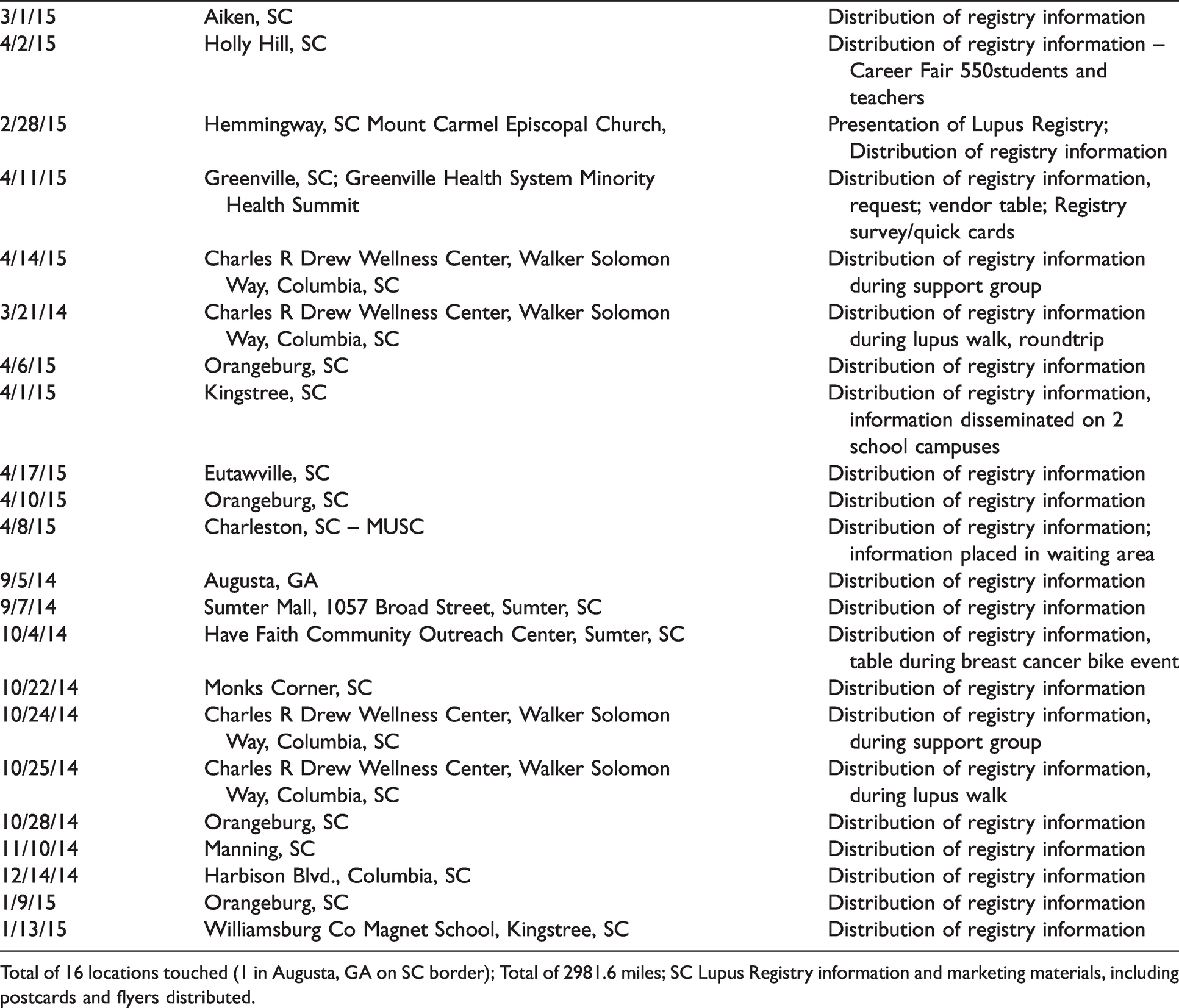
Total of 16 locations touched (1 in Augusta, GA on SC border); Total of 2981.6 miles; SC Lupus Registry information and marketing materials, including postcards and flyers distributed.
Social media recruitment outlets.

External media and local events attended.
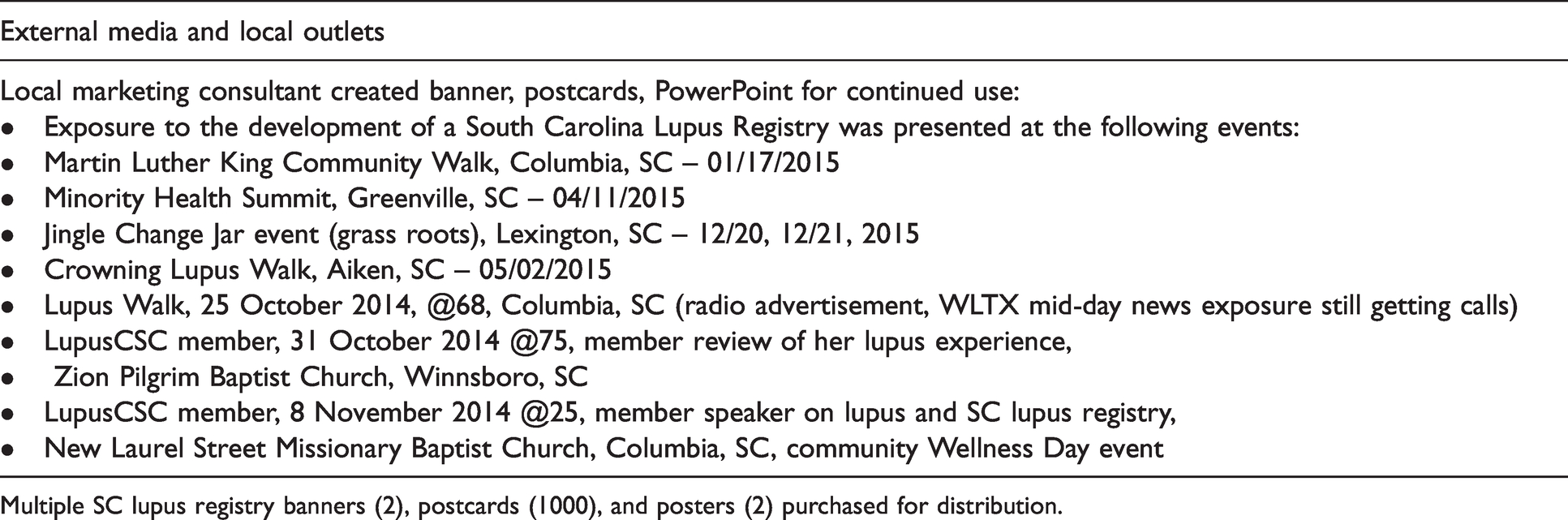
Multiple SC lupus registry banners (2), postcards (1000), and posters (2) purchased for distribution.
Secondary data collection
To assess healthcare utilization and health-related administrative data related to lupus patients, data was requested from the South Carolina Budget and Control Board Office of Research & Statistics (ORS) for individuals 18 years and older who had diagnosis of SLE based upon ACR disease criteria. 18 Data was composed of aggregated inpatient data elements and information specific to SLE including, but not limited to the following: health care professional and facility, encounter-level variables, payer level variables, number of cases in Columbia (SC state capital) and surrounding areas, number of outpatient cases, direct cost of complete medical care, number of Medicare recipients, number of uninsured, estimated number of medical facilities that specialize in SLE care, and number of SLE-related deaths.
Research activities were approved by the Medical University of South Carolina institutional review board, and informed consent was obtained from all participants prior to data collection.
Statistics
Data collected were categorized according to the age of those diagnosed with SLE, types of health services being rendered and requested by SLE patients, as well as information about medical, social and family history; physical exam findings; current resources; attitudes toward participation in clinical trials; and health problems associated with diagnosis of SLE.
Results
Using retrospective data from ORS (1996–2013), there were 66,007 individuals identified as living with lupus. The number of outpatient cases of SLE in South Carolina was 864 and the average direct cost of medical care to SLE patients in South Carolina was $69,999.40. Prospectively, 16 communities in South Carolina were reached during the study (see Table 1). SLE awareness materials and the concept of developing a SLE registry was discussed with community stakeholders in order to obtain feedback on the initiative. As a result of these efforts, 325 surveys were completed—269 in-person and 56 online. Of the 325 responses, 125 (38%) reported currently knowing someone diagnosed with SLE, 101 respondents (31%) reported knowing a person in the past who had been diagnosed with SLE, and 52 (16%) reported that they had been diagnosed with SLE themselves.
Discussion
The data obtained from the SC ORS suggests that the average medical spending for a South Carolina SLE patient per year was nearly $70,000 which is more than 7 times the national average for annual medical spending of $9,402. 19 However, these findings are consistent with a recent systematic review that found annual direct costs associated with SLE ranged from $2,214 to $16,876. 20 The prevalence of SLE in South Carolina according to the data provide by the ORS is 24 per 100,000 individuals. This falls at the low end of prevalence rates observed in other studies; 21 however, ORS data may not include all diagnosed cases of SLE in South Carolina since SLE is not a reportable disease. This information, combined with the primary data collected regarding awareness of those diagnosed with lupus, presents an undeniable need to develop a registry to better assist individuals who are affected by SLE. Without a directed and designated SLE registry, those afflicted with SLE and their families do not have an outlet to provide their personal medical history and information. This is the first initiative to compile a comprehensive database of patients with lupus in South Carolina, in support of development of a statewide registry for this enigmatic and debilitating disease.
The development of registries in other states have provided valuable information on the prevalence and incidence of SLE, especially in minority populations. 14 , 22 , 23 SLE registries in California, Georgia, Michigan, New York, and by the Indian Health Services use data sources ranging from clinical records, community organizations, administrative databases, and commercial laboratories. 22 , 23 These studies range in prevalence of SLE from 62.2 to 178 per 100,000 person-years and incidence of 4.6 to 7.4 per 100,000 person-years. 14 , 17 , 22 , 23 In addition to prevalence and incidence estimates, registries can be helpful to develop meaningful interventions for those impacted by SLE. In a study conducted by Feldman et al. (2013), minority women from medically underserved environments reported a desire for SLE education, peer support, and assistance navigating the healthcare system to better their health outcomes. At the conclusion of this qualitative study, the authors suggest that those who are newly diagnosed with SLE would have an immediate benefit of interventions. 21 This study highlights the importance of identifying individuals affected by SLE, particularly in minority and underserved populations experiencing the greatest burden of SLE.
This study has several strengths and weaknesses. Strengths include a novel design and mixed methods approach. Participants gained access to the survey as well as SLE-related resources online and in-person at community events. These platforms provided an invaluable audience to acquire first-hand observations and comments from those who are impacted by SLE. For example, many people stated that they have not heard of SLE while others mentioned that a family member passed from SLE complications. Though the findings of this study support the development and initiation of an SLE registry in South Carolina, there are limitations that should be addressed. First, in painful chronic diseases, such as SLE, accurately assessing perceived or actual signs of disease can be difficult and reliance on self-report introduces the possibility of misclassification. There is the potential for recall bias during primary data collection. Additionally, there was a small sample size of individuals who completed the survey.
Second, certain requested data from ORS was not available, such as health care professional and facility, encounter-level variables, SLE payer level variables, number of cases of SLE in Columbia and surrounding areas, number of outpatient cases of SLE, direct cost of complete medical care of SLE patients, number of SLE patients receiving Medicare, number of uninsured SLE patients, estimated number of medical facilities that specialize in SLE care, and number of SLE-related deaths. The SC ORS has limited information that can be obtained through medical provider data which does not capture all health visits—only inpatient hospitalizations and certain outpatient episodes (i.e. outpatient surgery, emergency room, labor and delivery, chemotherapy, radiation therapy, imaging, lithotripsy and observation). Other variables would have been valuable to understand access and quality of care for individuals living with SLE. However, it does indicate the incredible need for this data to be collected for SLE patients, and the ultimate goal was to obtain data from the community itself and use that data to assess disease burden in South Carolina. Though these are limitations, they also highlight the potential of a South Carolina SLE registry to serve as an invaluable resource. The data collected could be used to develop activities that encourage patient participation in clinical trials, health promotion, and other healthcare initiatives focused on assisting with SLE disease management. Moreover, this data can inform the public, physicians, academic researchers, and other health professionals in South Carolina about the status, numbers, estimated medical costs, and types of medical care being obtained by those diagnosed with SLE while also establishing the infrastructure of a registry and repository.
Footnotes
Declaration of conflicting interests
The author(s) declared no potential conflicts of interest with respect to the research, authorship, and/or publication of this article.
Funding
The author(s) disclosed receipt of the following financial support for the research, authorship, and/or publication of this article: This project was partially supported by an ASPIRE grant from the Office of the Vice President for Research at the University of South Carolina. The S.C. Budget and Control Board Office of Research & Statistics (ORS) provided data based on study application. The contents are solely the responsibility of the authors and do not necessarily represent the official views of the University, S.C. Budget and Control Office, or the South Carolina citizens who participated.
