






Abstract
Introduction
Systemic lupus erythematosus (SLE) is a relapsing and remitting multiorgan disease associated with significant morbidity and mortality. The survival rate of patients with SLE has recently improved, which was associated with increased morbidity and hospitalization rates. Therefore, this study aimed to examine the rate and causes of hospitalization in patients with SLE and explore factors associated with increased length of stay (LOS).
Methods
Patients who visited rheumatology clinics (Tawam hospital, United Arab Emirates (UAE)) and fulfilled the American College of Rheumatology (ACR) SLE criteria were identified. Retrospective charts were reviewed to determine previous admissions. Demographic data, reason for hospitalization, duration of hospitalization, intensive care unit (ICU) admission, number of specialist consultations, medications used, and SLE characteristics at time of admission were collected. The hospitalization rate was calculated as the number of hospitalized patients divided by the total number of patients with the disease. We performed multivariable regression analysis for factors associated with increased LOS.
Results
A total of 91 patients with SLE (88 women and 3 men) met the inclusion criteria with a mean disease duration of 10.2 years (SD 5.5). A total of 222 admissions were identified, and 66 of 91 patients were admitted at least once. The mean crude hospitalization rate calculated was 29.8%. The primary reason for admission was pregnancy (29%), SLE activity (24%), and infection (20%). When combining primary and secondary reasons, the proportion of admissions due to SLE activity increased to 32%. The mean LOS was 5.9 (SD 6.0) days. About 7% of admitted patients required ICU admission. In multivariable analysis, patients with lupus nephritis, complications during hospitalization, and increased number of specialists consultations and who were admitted to ICU and started new medication were all associated with increased LOS.
Conclusion
A significant proportion of patients with SLE were hospitalized during their disease course. The hospitalization rate in this study appears to be higher than those reported elsewhere. Disease flare is the leading cause of admission in patients with SLE in this relatively young cohort. Lupus nephritis has been found to be significantly related to longer LOS. Measurements taken to reduce the incidence and severity of flares would likely decrease hospitalization rate and LOS in patients with SLE.
Introduction
Systemic lupus erythematosus (SLE) is a relapsing and remitting autoimmune disease involving multiple organ systems with varying severity, leading to organ failure, and death. 1 The survival rate of SLE patients has improved over the last 20 years, which is likely due to an increased awareness of disease, early diagnosis, and effective use of immunosuppressive medications.2–4 The improved survival in patients with SLE is also associated with ecologic increase in morbidity and hospitalization. 5 Studies have found rate of hospital admissions per year varying from 5 to 18%.6–9 Several factors are associated with hospitalization including disease flare-up, infections, adverse drug reactions, and thromboembolic disease.6–12
Few studies have been conducted in populations located from the Middle East and North Africa regions. Heller et al.’s study in Saudi Arabia showed that 37% of SLE admissions were secondary to non-renal SLE flare, another 21% due to renal flare, and 16% from infections. 13 In Tunisia, Jallouli et al. also found that SLE activity was responsible for 43% of admissions, and in half of those patients, SLE was diagnosed during admission. 10
In general, increased length of hospital stay (LOS) is associated with higher risk of inpatient complications and poor clinical outcome.14,15 A study of 251 patients with lupus by Teh CL and Ling GR reported that increased LOS was significantly associated with poor outcome (mortality). 16 In populations with lupus, a small number of studies have reported LOS, ranging from 4 to 11 days.6,10,11 Lee et al. reported no difference in LOS between admissions for SLE flare versus other causes. 6 Factors associated with LOS in SLE patients are not well studied overall, and no such studies have been conducted in the United Arab Emirates (UAE).
This study aimed to examine the rate and causes of hospitalization in SLE patients. Additionally, it explored the factors associated with LOS in a setting of a tertiary care teaching hospital in the UAE. It may provide insight into the health and economic burden of SLE patients.
Methods
Patients
All adult patients (aged >18 years) who fulfill the ACR criteria for SLE and were followed up in the rheumatology clinic of Tawam Hospital between 2016 and 2018 were included. Tawam Hospital is the largest tertiary care teaching facility in the Eastern Medical Region of the UAE. It is located in Al Ain, Abu Dhabi Emirates and has a 461-bed capacity. The hospital has >21,500 admissions annually. The hospital provides all services of a modern teaching hospital, including specialized rheumatology services.
Data collection
We identified all SLE patients in our electronic health records who were actively served in the rheumatology clinic from 2016 to 2018. They fulfilled the classification criteria of American College of Rheumatology (ACR). 17 Retrospective chart reviews were conducted from January 2009 to April 2018 (i.e., the observation period) for previous admissions in this hospital or any other hospital of the Abu Dhabi Health Services Company (SEHA, Emirates of Abu Dhabi). Patients’ records in different SEHA hospitals are connected by a unique medical record numbers. All authors were involved in the chart review using a unified “REDCap” electronic data capture tools hosted at UAE University.
Data were collected on demographics, date of diagnosis, number and nature of SLE criteria fulfilled over the years, reason for hospitalization, SLE features at the time of admission, LOS, complications during hospitalization, intensive care unit (ICU) admission, number of specialty consultations used by the admitting team (this refers to the number of specialties, other than the admitting, that were requested to evaluate the patient), immunosuppressive medications and steroids used before admission, and any changes in treatment during admission. Data on readmission or death within 3 months of discharge were collected. The reason for admission was categorized as SLE activity, infection, pregnancy-related admission, adverse drug event, or others (medical, surgical, or gynecological admissions) based on the admitting physician. SLE activity admission referred to admission for severe lupus flare and were further classified into lupus nephritis, arthritis, neuropsychiatric lupus, hematological manifestation, pulmonary manifestation, and cardiovascular manifestation. Pregnancy-related admissions refer to all admissions to obstetrics wards for pregnancy-related conditions. Sometimes there will be more than one reason for admission based on the admitting physician; hence, we used the primary and secondary causes of admission.
Statistical analysis
Continuous variables were reported as mean ± standard deviation (SD), categorical variables were reported as frequencies and percentages. The hospitalization rate each year was calculated as the number of hospitalized patients divided by the total number of patients with the disease. The calculated mean of all yearly hospitalization rate was used as the crude hospitalization rate. Multivariable regression analysis was used to examine factors associated with LOS. Statistical significance was set at P < 0.05. First, bivariate analysis was used to identify individual variables that were significantly associated with LOS. Significant variables were entered into a multivariable regression model. Statistical analysis was performed using IBM SPSS Statistics for Windows version 26 (IBM Corp., Armonk, NY, USA).
The ethical approval of this study was granted by the Human Research Ethical Committee, Tawam Hospital.
Results
Ninety-one SLE patients met the inclusion criteria for our study. Table 1 describes the demographic and clinical features of this cohort. Patients were predominantly female (n=88/91, 96.7%). The mean age at diagnosis was 26.6 years (SD 11.3) and the mean disease duration was 10.2 years (SD 5.5). Based on the SLE ACR diagnostic criteria, this cohort met an average of 5.6 out of a possible 11 criteria. Lupus-related medical history included arthritis (59%), lupus nephritis (41%), serositis (14%), and neuropsychiatric SLE (NPSLE, 11%). At the time of admission, the most commonly used SLE medications were hydroxychloroquine (84%), corticosteroid (69%), mycophenolate mofetil (34%), and azathioprine (30%).
Characteristics of all patients (N=91) in this cohort.

NPSLE = neuropsychiatric systemic lupus erythematosus. ANA= Anti-nuclear antibody. DsDNA= Double Stranded DNA antibody.
During the observation period, 66 of 91 patients (72.5%) were admitted at least once, with a total of 222 admissions. Table 2 presents the number of patients diagnosed with SLE, admissions in each observation year, and yearly hospitalization rate. In Table 2, the mean crude hospitalization rate calculated was 29.8%. The primary reason for admission was SLE activity (24%), pregnancy (29%), infection (20%), adverse drug event (1%), and others (medical, surgical, or gynecological admissions) (26%). In 41 admissions, a secondary reason of hospitalization was reported. When primary and secondary reasons are combined, the proportion of admission due to SLE activity increased to 32% of admissions (Figure 1). Among those admitted primarily for SLE activity, specific lupus manifestations were lupus nephritis (50%), hematologic conditions (36%), arthritis (21%), and NPSLE (19%) (Figure 2).
Hospitalization rate (2009–2017).


Causes of admissions to the hospital among SLE patients. SLE = systemic lupus erythematosus.

Active manifestations during admission associated with SLE activity (n = 71 admissions). SLE = systemic lupus erythematosus. NPSLE = neuropsychiatric systemic lupus erythematosus.
The mean LOS was 5.9 days (SD 6.0). When admissions related to pregnancy were excluded, the mean LOS increased to 6.4 days (SD 6.3). Among the 222 hospitalizations, new medications were started in 14% of patients, with rituximab as the most common SLE treatments initiated (3.6% of all admissions), followed by cyclophosphamide (1.4%). Another 16% of patients received pulse steroids of methylprednisolone (250 mg or higher) during their admission. Additional medical attention included single specialist consultation (38%), three consultations (16%), and ICU admission (7%). Complications recorded during hospitalization, but were not present at presentation, included new infections (4%), acute coronary syndrome/congestive heart failure (1%), thromboembolic disease (0.5%), and other miscellaneous events (12%) (e.g., acute pancreatitis). Within 3 months of hospital discharge, 24% of patients were readmitted, and two deaths were reported.
Table 3 presents the results of the bivariate analysis for independent variables associated with LOS. These significant variables (P ≤ 0.05) were included in the multivariable model. Table 4 presents the multivariable model, showing patients with active lupus nephritis were more likely to have longer LOS. Similarly, predictors for an increased LOS included: number of consultations, presence of complications during hospitalization, admission to ICU, and starting new medication. A linear regression model of these factors yielded an adjusted R squared of 0.525. The multivariable model predicted that the presence of active lupus nephritis will increase the LOS by 2 days, as denoted by the unstandardized coefficient B (Table 4). Likewise, an ICU admission and the presence of a new complication during the hospitalization predicted an increase in the LOS by 3.7 and 3.2 days, respectively.
Bivariate analysis for dependent variable of length of stay.
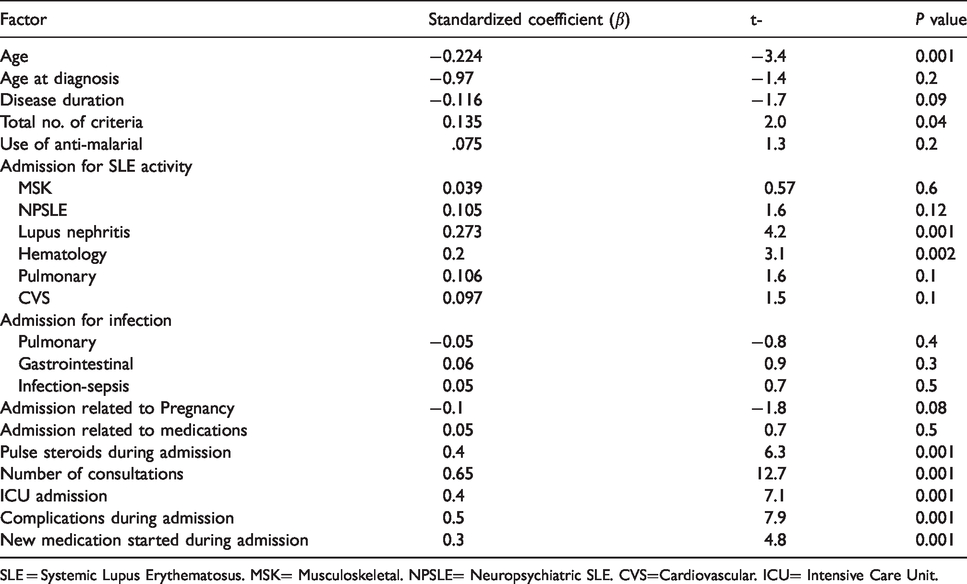
SLE = Systemic Lupus Erythematosus. MSK= Musculoskeletal. NPSLE= Neuropsychiatric SLE. CVS=Cardiovascular. ICU= Intensive Care Unit.
Multivariable regression analysis for dependent variable of length of stay.a
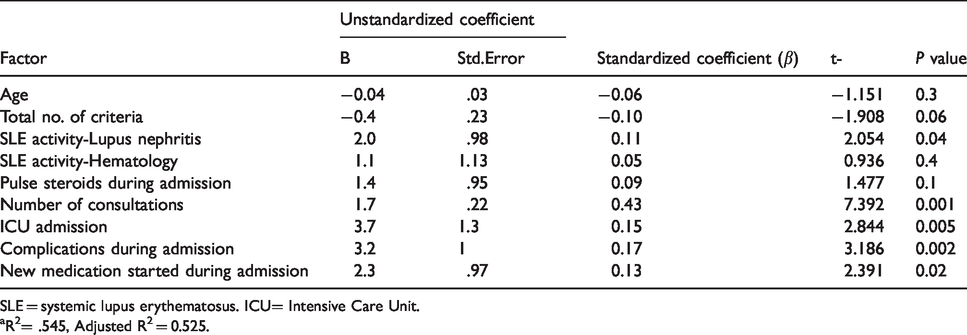
SLE = systemic lupus erythematosus. ICU= Intensive Care Unit.
aR2= .545, Adjusted R2 = 0.525.
Discussion
In this retrospective study, we described the frequency and rate of hospitalization of 91 SLE patients followed in our teaching hospital in the UAE. The reasons for admission and factors that predicted the LOS were also examined. In this study, the mean annual hospitalization rate was 29.8%, which was similar to the rate reported by Aringer et al. in Denmark (25%). Our result is higher than the 7.6% reported from the “1000 Faces of Lupus” cohort in Canada. 9 In another Canadian study, Lee et al. reported an annual rate ranging from 8.6% to 18.9%. 6 The differences in rates from our study is likely to be related to the reasons for admission used in these studies. For example, the “1000 Faces of Lupus” study limited their admissions only to those related to SLE flare-up and did not include admissions for other reasons. 9 Disease duration, and follow-up period, may also have been different. It may be worth mentioning that the hospitalization in recent years, in our hospital, was almost double or triple that of 2009–2010. This is likely due to fluctuation in rheumatology services coverage. The hospital lost 2 rheumatologists earlier and some SLE cases were seen elsewhere. Lately, the hospital gained the service of 4 rheumatologists.
Various medical and surgical reasons for admission accounted for 26% of events. If patients were being treated by non-rheumatologists, then it is possible that these physicians were more conservative and admitted these SLE patients when they reported other health conditions. The average age at diagnosis in our population was 26.6 years, which is younger than those reported in similar studies (33.3–43.8 years).6,8,9,11,12 The relative youth of our cohort maybe a factor in having a higher rate of hospitalization than reported in the literature. It suggests a connection between younger age at onset and the severity of SLE.18,19
About one-quarter of our cohort had SLE disease flare as the reason for admission. When combining SLE flare from primary and secondary reasons, this condition rose to about one-third of admissions and was the most common reason. This finding is similar to that of Gu et al. from a Canadian academic health center in which SLE flare was responsible for 21% of hospital admission. 12 However, our finding is less than those reported in Asia, where 58% to 71% of admissions were related to SLE flare-up.11,20 The study by Heller et al. in Saudi Arabia, with a similar ethnic population, reported that 37% of admissions were related to flare-up. 13 In other western studies, the proportions due to flare were slightly lower than ours: Busch et al. reported 15% (Denmark) 7 and Lee et al. reported 17.5% (Canada). 6 The higher and lower differences are likely to be related to differences in population (ethnicity and disease severity), reasons of admissions (e.g., Edward et al. excluded admissions related to pregnancy 11 ), and to differences in the health care systems. Recurrent disease flares are associated with a substantial risk for morbidity and cumulative damage.21,22 They are associated with a poor prognosis of SLE.23,24 Prevention of flares might improve morbidity and prolong life in lupus patients. 25 Considering the number of hospitalizations because of flares, measures to reduce them are desirable. Interventions may include close observation, improving patient compliance with therapy, and treat-to-target approach.26,27 EULAR recommends that physicians treating SLE patients “should aim at remission or low disease activity” 28 to improve patient’s outcome and prevent flares.
The mean LOS was 5.9 days and the duration increased to 6.4 days when excluding pregnancy admissions. The LOS in SLE patients is higher than the overall average LOS for all admissions in Tawam Hospital (5.4 days). 29 Our reported length of hospitalization was similar to one reported by Busch et al. (6.4 days). 7 The reported LOS varied among different studies (4-11 days).6,7,10,11,30,31 The shorter LOS in other studies may be attributed to better health care services or to the disease severity in our patients. In our study, the reasons for extended hospitalization was significantly related to clinical factors as we reported in the multivariable analysis.
Hospital admissions increases the direct and indirect cost of SLE. 30 They have indirect consequences such as an increased risk of infection, and greater cost of care.14,15 Krishnan E’s study reported that LOS was associated with increased number of procedures during admission and hospital charges. 31 In this study, we explored predictors in hospital records that were associated with LOS. We found that admission for SLE activity, particularly active renal nephritis, were associated with a significant increase in the LOS. Lupus nephritis is associated with serious morbidity and mortality. 32 We discovered that lupus nephritis was responsible for 50% of SLE flares that required admission (Figure 2). In a post hoc bivariate analysis, active lupus nephritis was significantly associated with starting a new medication during admission (P = 0.009, data not shown). Lupus nephritis may be mitigated through close observation and achieving treatment targets. 25 Other variables were also found to be significantly associated with an increased LOS, including number of consultations, admission to ICU, use of pulse steroids, and addition of a new immunosuppressive medication. Since these predictors are indirect indicators of disease severity, increasing LOS may be associated with the severity of SLE. The predictors in this regression model were relatively strong; they were able to explain half of the variance for the outcome LOS (adjusted R squared = 0.525).
There were several limitations in this study. This is a retrospective study and our data collection was limited to the available information in the electronic medical record, which may have been missing or incomplete. Missing data may involve patient-reported symptoms or organ involvement. One important missing data, in this study, is the formal measurement of disease activity using known measures such as the Systemic Lupus Erythematosus Disease Activity Index (SLEDAI) and measures of disease damage such as Systemic Lupus International Collaborating Clinics/American College of Rheumatology (SLICC/ACR) Damage Index (SDI). Those measures were not available in the charts nor they were calculated during chart review. We had a 9-year observation period, however, our criteria selected for a survival cohort. We limited our selection to SLE patients seen in the rheumatology clinic from 2016 to 2018, which probably excluded patients who died before this time, during the observation period.
In conclusion, this study successfully examined the rate and causes of hospitalization in patients with SLE and explored factors associated with LOS. The rate of hospitalization in our study of patients with SLE in the UAE appears to be slightly higher than that reported elsewhere. Disease flare is the leading reason of admission of SLE patients in this relatively young cohort. Lupus nephritis has been found to be strongly related to longer LOS, which may present a significant economic burden to the patient and the community. Measures taken to reduce the incidence and severity of flares would likely decrease hospitalization and LOS in SLE patients.
Footnotes
Acknowledgements
Editorial support (English Language and spelling) was performed by Enago, Crimson Interactive Inc. This assistant was funded by the United Arab Emirates University.
Declaration of conflicting interests
The author(s) declared no potential conflicts of interest with respect to the research, authorship, and/or publication of this article.
Funding
The author(s) disclosed receipt of the following financial support for the research, authorship and/or publication of this article: This research was partially funded by unrestricted grant, United Arab Emirates University.
