






Abstract
Introduction
The clinical presentation of childhood-onset systemic lupus erythematosus (SLE) is generally perceived to differ from that of adult-onset SLE.
Objective
We aimed to compare the demographic and clinical manifestation between childhood-onset vs. adult-onset SLE in a cohort of Indonesian patients at tertiary care centers.
Methods
This retrospective study included patients in the Hasan Sadikin Lupus Registry from 2008 until December 2017. The demographics, clinical presentations, and outcomes were compared between childhood-onset SLE (<18 years old) (Group 1) and adult-onset SLE (≥18 years old) (Group 2).
Results
Eight hundred seventy patients were involved into this study. The proportion of childhood-onset SLE was 20% (174 patients). The mean age of group 1 versus group 2 was 13.56 ± 3.04 vs 30.41 ± 8.54 years. The following clinical manifestations at SLE diagnosis were significantly more common in childhood-onset than in adult-onset SLE patients: hematological disorder (p = 0.033) and arthritis (p = 0.006). While discoid rash (p = 0.036) and photosensitivity (p < 0.001) were significantly found higher in adult-onset SLE. Cyclophosphamide therapy was significantly more common to be used in childhood-onset (38.5% vs 21.0%, p = <0.001). However, frequency of mortality on follow-up tended to be higher in childhood-onset group (11.5% vs 7.0%, p = 0.208).
Conclusion
Arthritis and hematologic involvements at SLE diagnosis were more prominent in childhood-onset compared to adult-onset patients, and mortality in childhood-onset SLE during follow-up relatively higher. This data may suggest the need for more aggressive management approach to childhood-onset patients with SLE.
Introduction
Systemic lupus erythematosus (SLE) is a chronic autoimmune disease with unknown etiology which affects both children and adults. 1 However, the incidence of SLE in childhood was relatively rare and diagnosis prior to the age of 16 years is around 15–20%.2,3 Age of onset modifies expression of the disease by organ involvement and serological findings in SLE; hence, the clinical presentation in children is generally considered to be different from adults. 4 Childhood-onset SLE has a more aggressive disease course and also greater morbidity and mortality than adult-onset SLE. Therefore, early recognition of disease and diagnosis which lead to optimal management are keys to a better outcome of disease. 1
Previous study presented distinctive clinical features of SLE in different age classes in childhood-onset SLE. 4 Another study also demonstrated genetic and ethnicity could influence clinical features of childhood SLE. 5 A multiracial cohort study in the USA found higher genetic risk for lupus was associated with more severe clinical features in SLE. They also presented that proteinuria, malar rash, anti-dsDNA antibody, hemolytic anemia, arthritis, and leucopenia were found to be more common in childhood-onset SLE. 6 A study from the United Kingdom (UK) showed that Black African/Caribbean juvenile-SLE (jSLE) patients were presented by more “classical” laboratory and clinical features in comparison to White Caucasian or Asian patients at the time of diagnosis; they frequently had renal involvement. 7 A study in Korean population found fever, oral ulcers, nephritis, anemia, and thrombocytopenia were more common in juvenile-onset SLE (<18 years old) patients in comparison to adult (18–50 years old) or late-onset SLE (>50 years old); however the frequency of malar rash, discoid rash, alopecia, arthritis, arthralgia, pleuritis, pericarditis, CNS involvement, and Raynaud’s phenomenon was similar among the groups. 8 Disease onset was generally more severe in childhood-onset SLE, but the prognosis of childhood-onset SLE was reported comparable to adult SLE. 9
To date, there is no epidemiological study presenting the comparison of demographic, clinical manifestation, and outcomes both in childhood- and adult-onset SLE among Indonesian patients. Hence, our study addressed to compare these based on SLE cohort study of Indonesian patients conducted in a tertiary care center.
Method
Population
This retrospective study included patients enrolled in the Hasan Sadikin Lupus Registry (HSLR), which was initiated in 2016. HSLR database included retrospectively the data of SLE outpatients and inpatients who came to Department of Pediatrics and Rheumatology Clinic, Hasan Sadikin Hospital, Indonesia from 2008 to 2017.
Case definition and inclusion criteria
All patients were Indonesians who met American College of Rheumatology revised criteria for the classification of SLE.10,11 The childhood-onset SLE was defined as diagnosed SLE at 18 years old or younger (Group 1), and the adult-onset was older than 18 years when diagnosed with SLE (Group 2) as number of sample based on group 174 vs 696 patients, respectively.
Variables construction
The database form included patient’s gender, age of onset, disease duration, and the clinical manifestations at diagnosis. Autoantibody profiles were based on the available data, performed in local laboratory, when they were diagnosed. The result was defined as negative or positive based on the referenced value given by the laboratory. Mortality of any causes of the patients related or not related to SLE was documented.
Statistical analysis
We used proportions and percentages for demographic, clinical, and serological variables, while mean and median were for continuous data. For statistical analyses, we used Chi-square and Fisher’s exact tests to determine any significant differences in all categorical data and Mann–Whitney U test for continuous data. p-value of 0.05 or less was considered as significant. Statistical analysis was performed by using SPSS 22.0 version.
Study approval
This study was approved by the Ethical Committee of Faculty of Medicine, University of Padjadjaran with registration number 407/UN6.KEP/EC/2018.
Result
Basic demographic data
Demographic profile of childhood-onset and adult-onset of systemic lupus erythematosus.

Clinical manifestations
The following clinical manifestations at diagnosis were more common in childhood-onset SLE (Group 1) than in adult-onset SLE (Group 2) patients: arthritis (69.5% vs 68%, p = 0.006) and hematological involvement (77.6% vs 57.3%, p = 0.033). While following manifestations were found more common in adult: photosensitivity (59.8% vs 48.3.0%, p <0.001) and discoid rash (33.3% vs 30.5%, p = 0.036).
Antibody profiles
Clinical manifestation and autoantibody at systemic lupus erythematosus diagnosed of childhood-onset and adult-onset lupus patients.
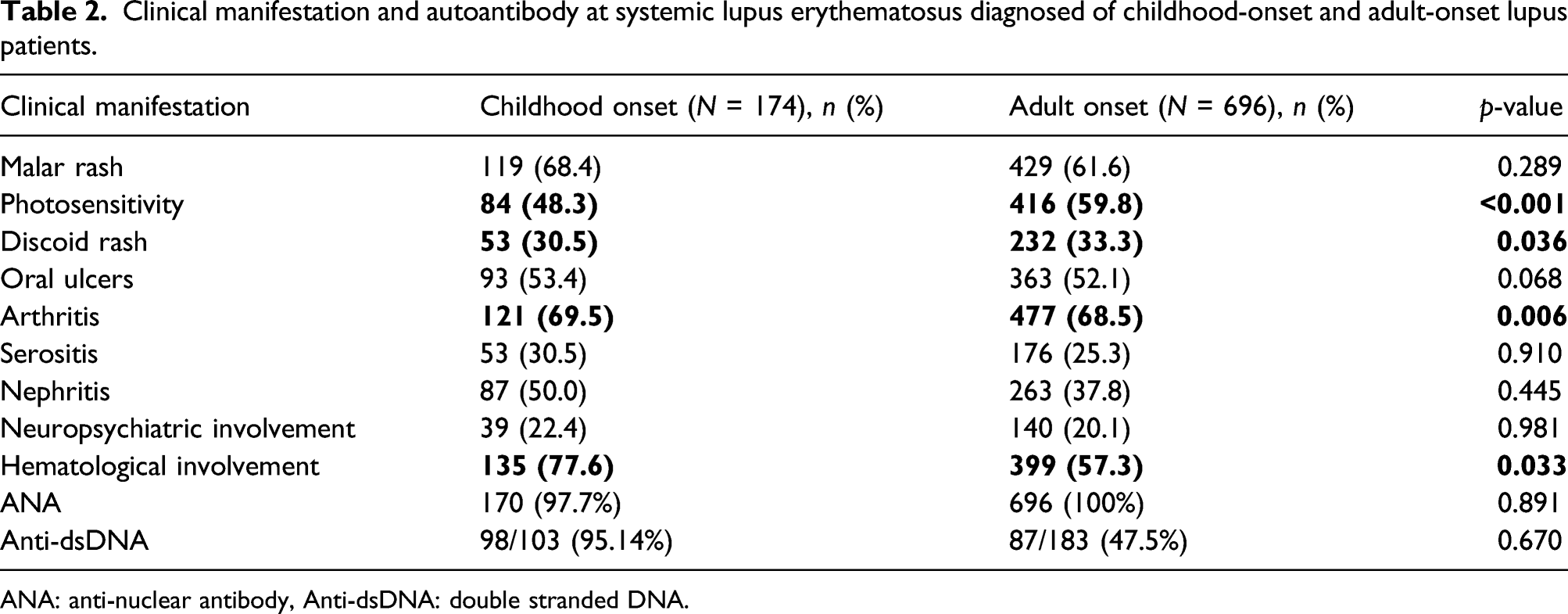
ANA: anti-nuclear antibody, Anti-dsDNA: double stranded DNA.
Treatment and mortality
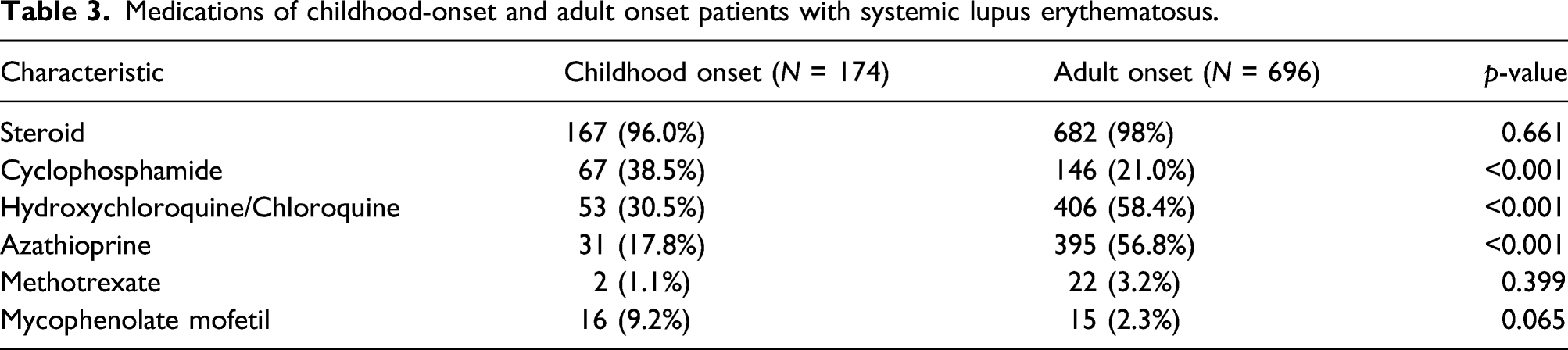
Medications of childhood-onset and adult onset patients with systemic lupus erythematosus.
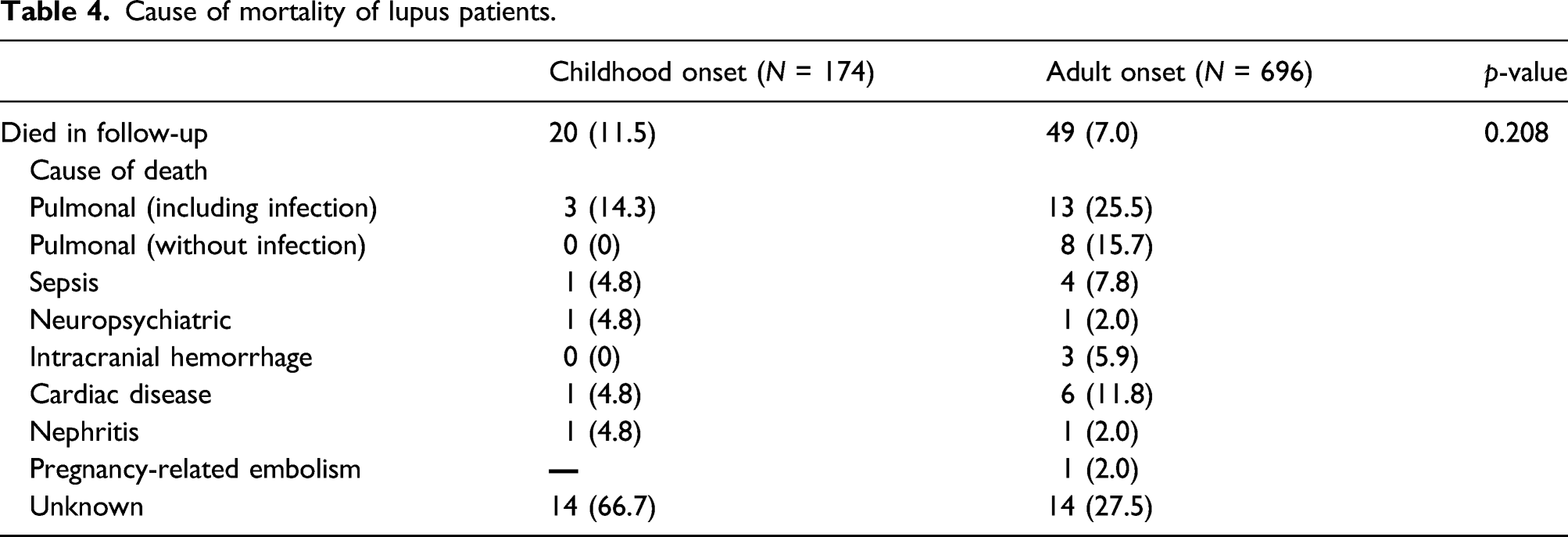
Cause of mortality of lupus patients.
Discussion
The true prevalence of childhood lupus is still unknown due to the differences in the cutoff age; however, the prevalence rates of 1.89–25.7/100,000 per year have been recorded, with greater prevalence in Asian, Latin, African-American, and Native American children. 12 In our lupus cohort database, we found 20% (174 out of 870) of SLE patients were diagnosed at 18 years old or younger, higher than in the previous studies.13–15 Among them, 20 (20%) patients were diagnosed with SLE at 10 years old or younger, and the youngest patient was 1 year old. Diagnosis of SLE prior to 10 years old was uncommon. 16 Benseler et al. reported 6 to 618.9 cases per 100,000 children less than 10 years old of same sex, age, and ethnic were diagnosed with lupus. 17
The ratio of female to male in childhood-onset SLE is various. In our cohort, it was 14:1. The proportion of childhood-onset male to female SLE patients was lower than adult-onset patients. This result was similar as reported in several studies.18–20
Previous studies that have compared childhood-versus adult-onset SLE showed varying results in terms of clinical manifestations,1,4,18–22 but numerous studies have demonstrated that disease activity was generally more severe in childhood-onset SLE.9,15,19,23,24 Most studies supported our finding that renal involvement, and hematological involvement were more common in children with SLE.15,19,22,25–27 However, the frequency of skin involvement including malar rash was reported to be similar in both groups. 1 Our study found that arthritis and hematological involvements were more common in childhood-onset than in adult-onset SLE patients, while photosensitivity and discoid rash were more common significantly in adult-onset group. The frequency of mucocutaneous lupus without systemic feature is very low in children. 28 Neuropsychiatric involvement has been reported common in adult patients with SLE than childhood-onset of SLE. 18 This was similar to our finding which showed no significant difference in neuropsychiatric manifestations between the two groups. It is possible that neuropsychiatric symptoms are more commonly manifested later on during the disease and not as a presenting manifestation.29,30
Most of studies showed no difference in the prevalence of ANA between childhood and adult-onset of SLE; however Mina et al. reported a higher prevalence of anti-dsDNA antibodies in childhood with SLE in comparison to adult SLE patients (61–93% vs 25–78%). 23 Our study found lower anti-dsDNA result than several studies. Although only small portion of our subjects tested for anti-dsDNA, the test should be compared by other studies.18,19,25
Children and juvenile SLE have unique problems related to growth and development that affect both the need for and the impact of aggressive therapy, which was associated with higher medication iatrogenic effects. 31 Sinha et al. suggested more aggressive therapy to the child lupus patients with the high active index on renal biopsy for their better outcome. 32 Cyclophosphamide therapy significantly reduced proteinuria among childhood SLE patients and increased creatinine clearance among those with decreased function prior to therapy, as well as prevented progression of renal scarring. 33 In our setting, the involvement of renal in SLE as well as the use of cyclophosphamide was more common in childhood-onset SLE; however, there was no complete data regarding the renal biopsy of those patients. Younger age at onset of SLE has greater disease severity,22,27 with the more severe prognosis than adult, 9 as they have longer duration of diseases from age of diagnoses. 10 We found that both childhood and adult-SLE patients had the similar median duration of disease; however, the mortality was different in both groups, with higher prevalence in childhood-onset SLE. This finding is similar to several studies13,14,18,34; nevertheless, it may indicate earlier diagnosis and treatment of SLE should be undergone to reduce the worsening of disease outcome. 32
The limitation of our study was the incomplete data of antibody profiles of the patients as not all patients had complete serologic tests due to financial limitations. Data on renal biopsy was not collected, since only a few patients underwent kidney biopsy in this center. The other limitation was the unavailability of the exact cause of death of some patients. There was no autopsy done to confirm cause of death on these patients. Furthermore, some patients died outside of the hospital, without knowing the cause of death to be recorded.
Conclusion
Arthritis and hematological involvements at diagnosis were more prominent in childhood-onset compared to adult-onset SLE. Mortality in childhood-onset is relatively higher than in adult-onset. This data may suggest a need for more aggressive management approach to childhood-onset patients with SLE.
Footnotes
Declaration of conflicting interests
The author(s) declared no potential conflicts of interest with respect to the research, authorship, and/or publication of this article.
Funding
The author(s) disclosed receipt of the following financial support for the research, authorship, and/or publication of this article: This project was supported by Internal Research Grant of University of Padjadjaran.
