







Abstract
Objective
This study examined the lived experiences of women with lupus and their primary support persons to better understand the effects associated with navigating university/college with lupus.
Methods
Five women with lupus and five primary support persons (n = 10) were recruited from Southern Ontario. One-on-one semi-structured interviews were conducted with participants. Reflexive thematic analysis was used to analyze verbatim transcripts.
Results
Two salient themes, (1) Lupus is a part of me, and (2) Lupus does not exist in a bubble, were identified, each with associated sub-themes. Lupus is a part of me discussed how lupus was part of participants everyday lives and how it became their new normal following symptom onset. Lupus does not exist in a bubble explored the ongoing challenges individuals and support persons experienced due to the lack of knowledge within healthcare, education, and society.
Conclusions
Women with lupus who are navigating university endure unique challenges in addition to school-related demands. Similarly, primary support persons who assisted throughout this navigation period encountered several individual and situational hardships due to the nature of lupus. Education for healthcare professionals, universities, and individuals with lived experience is warranted, along with more support services, to help navigate university/college more effectively.
Introduction
Women are disproportionally affected by lupus and account for 90% of all lupus cases. 1 In addition to the symptoms associated with lupus, obtaining a diagnosis before the age of 18 leads to challenges within school, 2 and transitions between pediatric and adult care. 3 When examining the relationship between the effects of lupus and school, the majority of research has focused on children in elementary school,2,4 adolescents in high school,2,4 or adults with systemic lupus erythematosus reflecting on their education years retrospectively, 5 with only one study exploring the effects of lupus on university or college-aged students. 6 The transition into, and navigation through, university or college for any student can be psychologically demanding and can negatively influence mental health 7 ; however, for students with chronic illnesses, such as lupus, the effects of these transitions and school-related demands may be exacerbated by their lupus and lack of support available. 8 For example, a college student with lupus discussed the challenges associated with walking to/from classes, carrying her books and managing her course load due to her fluctuating lupus symptoms (e.g., fatigue). These symptoms also caused challenges socializing which led to feelings of isolation. 6
Unfortunately, there is a paucity of information regarding women navigating university/college and the role of their primary support persons. Understanding their experiences will provide an in-depth understanding of the effects of lupus on students, which in turn may inform policy to increase support services while attending university/college. As such, the purpose of this study was to examine the lived experiences of students/recent graduates who are women with lupus navigating university/college, as well as their primary support persons. Specifically, this study aimed to uncover the effects associated with living and coping with lupus for both individuals with lupus and their primary support persons during this transitional period.
Methods
Design
The theoretical orientation which guided this study was interpretive phenomenology, “a method designed to understand people’s lived experiences and how they make sense of it in the context of their personal and social worlds”. 9 (p. 3) This study was approved by the Wilfrid Laurier University research ethics board (REB#8744).
Participant recruitment
Inclusion criteria.
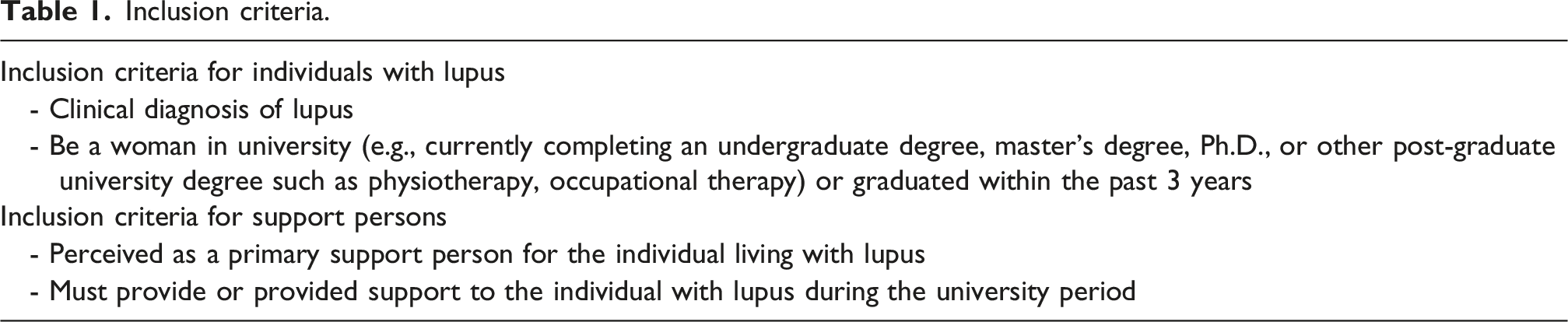
Data collection & analysis
Following informed consent, each participant was emailed a background questionnaire to assess eligibility and to provide context prior to the one-on-one semi-structured interviews. Interviews were conducted via Zoom (n = 9) or over-the-phone (n = 1). The interview lengths were dependent on the depth of participants’ responses (range = 35 to 102 min). All participants were interviewed individually. The interview guide for the participants with lupus included questions concerning sociodemographic information, diagnosis, symptoms and treatments, and experiences navigating university and support services. Primary support persons’ interview guide included sociodemographic information, information about the participant with lupus, and their supportive role. All interviews were audio recorded and then transcribed verbatim using Microsoft Word software. Pseudonyms were utilized to protect the anonymity of each participant, while other identifying information was removed from transcripts. Braun and Clarke’s, 11 six steps to reflexive thematic analysis were used to identify, analyze, and report themes and sub-themes within the data collected (see, Braun & Clarke, 2019 11 for more detailed information on this analysis). Aligning with the theoretical orientation of interpretive phenomenology, analysis began with an idiographic focus, whereby each author read and re-read each transcript to gain an in-depth understanding of each participants lived experience, prior to identifying patterns across cases. Primarily inductive coding techniques were implemented, and themes were generated interpretively. All participants lived experiences, and the reflexive role of each author was considered throughout. This process contributed to the credibility of the results. Multiple modes of data collection (field notes, member checks, triangulation, reflexive journaling) were also utilized to promote credibility and confirmability. 12
Results
Participant demographic information.
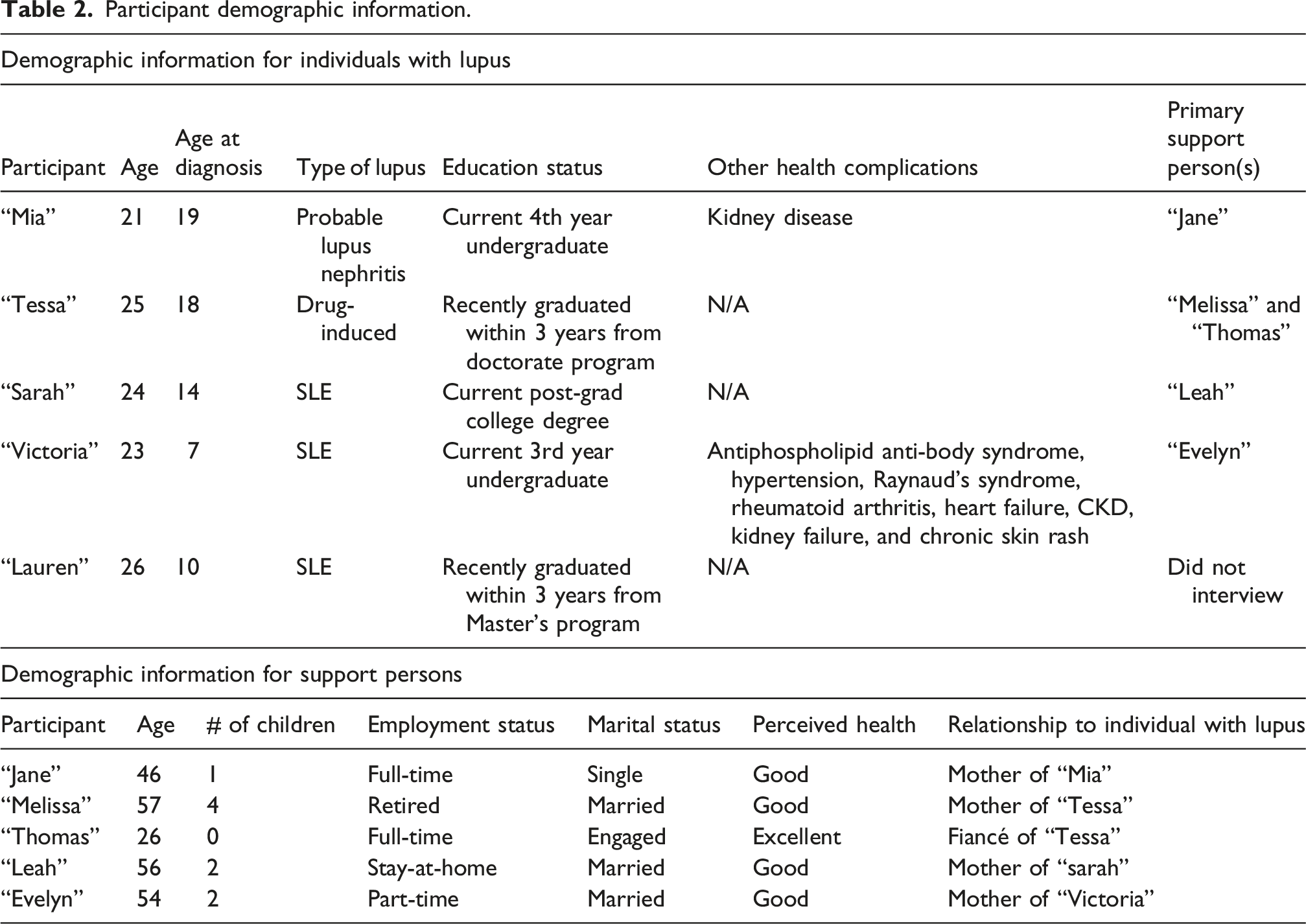
Themes and sub-themes.

Theme 1: Lupus is a part of me
Themes, sub-themes, and illustrative quotes.

The unpredictability of living with lupus
Participants described lupus as an inherently individualized condition, whereby no two experiences with the disease are the same. While there were some shared symptoms (e.g., fatigue), differences in diagnosis journeys, symptom presentation, and disease progression contributed to an overall agreement that lupus is unpredictable.
For starters, the unpredictability associated with lupus was reflected in participants diagnosis journeys, which were varied considerably in both timing and process. For example, two participants were diagnosed with lupus early in childhood, one participant during adolescent years, and two during their undergraduate degrees. However, regardless of timing, most participants (n = 4) described the diagnostic process as challenging, as it involved being misdiagnosed or feeling dismissed by healthcare providers. The individual diagnostic pathways shaped how participants made sense of their illness, as those who were misdiagnosed or dismissed by healthcare professionals reflected on prolonged feelings of uncertainty and frustration which in turn affected other aspects of their lives (e.g., academics, social life, etc.).
Variability was also evident in symptom presentation and severity across participants. Although all participants with lupus experienced fatigue (n = 5), other symptoms (e.g., hair loss, swelling, neurological deficits), the severity of symptoms, and the development of additional health complications (e.g., high blood pressure, Raynaud’s kidney issues, heart issues) varied across participants. Participants described how this variability extended beyond physical symptoms and influenced their mental health, social lives, ability to participate in sports and physical activity, relationships, and overall university experiences. As such, due to the unpredictable and ever-changing nature of their lupus, participants expressed an overarching lack of control over their bodies and daily functioning.
The individualized nature of lupus was further reflected when discussing treatment and general effects of the disease. For example, Sarah and Lauren discussed the effects of prednisone and hydroxychloroquine and described how treatment related side effects impacted their independence and ability to complete daily activities. Likewise, Tessa and Victoria highlighted how their comorbid health complications restricted their freedom, such as their ability to be outside, travel, and consume what they wanted. These experiences highlighted how lupus manifested in distinct ways, reinforcing the sense that each participant was navigating a unique illness trajectory.
Lastly, due to the varying effects experienced by all participants with lupus, participants implemented varying coping strategies to manage their health and monitor symptoms. Among the most common were diet (n = 3) and exercise (n = 5). Other strategies included buying hair extensions to hide the hair loss from treatment (n = 1), social support from friends, family or therapists (n = 2), avoidance (n = 1), and positive thinking/self-talk (n = 1). The diversity of these strategies reflected participants’ ongoing efforts to adapt to an illness that was unpredictable, requiring continual adjustment to their changing physical and emotional needs.
“Ebbs and flows”
“Ebbs and flows” or the continuous change occurring was consistent among participants’ lupus experiences. For example, participants described intermittent symptoms throughout their disease course when differentiating between “good days” and “bad days”. On good days, most participants described having relatively no symptoms and “feeling normal” (Mia). In contrast, participants described bad days as feeling extremely fatigued (n = 5), unable to get out of bed (n = 5) and having difficulty completing tasks (n = 5). Victoria summarized the stark difference between the two as follows: “You can catch me on a good day, or a really bad day, and you’ll see two completely different people”. Participants with lupus also described exacerbating factors (e.g., stress, weather) which often contributed to severe flare-ups. These flare-ups affected participants with lupus ability to attend classes as participants described the lack of energy to drive or walk to campus (n = 4) or an inability to focus due to pain (n = 3). During the interviews, participants mentioned they were either experiencing periodic mild symptoms or were in complete remission, further highlighting the ebbs and flows of lupus.
Ebbs and flows of support from primary support persons was also evident during active and inactive periods. For example, Sarah talked about the difference in support she received from her mother during her diagnosis, in comparison to when she had been living with lupus for a longer period of time. Two other participants (Lauren & Mia) shared the lessened support from their mothers while at university compared to at home.
In sum, the ebbs and flows of the participants’ lupus experiences as evidenced by their fluctuating symptoms and the varying levels of support received made daily living and disease management intermittently unpredictable and difficult to navigate.
“All about perspective”
This sub-theme discussed participants with lupus and their primary support persons shift in perspective following the diagnosis. Specifically, all participants shared their shift to more positive outlooks when referring to their diagnosis, proposed advice for others in similar situations, and overall reflections on their lupus experiences. When participants with lupus were asked about their initial reactions to their diagnosis, responses varied. Some participants with lupus described feeling shocked (n = 3) and heartbroken (n = 2), whereas others were naive to the severity of the disease (n = 2) or relieved to finally have a diagnosis (n = 1). Reactions of primary support persons also varied. Some primary support persons described feeling scared (n = 3) or frightened due to a lack of understanding of what the future would like for the person with lupus (n = 2). However, after processing the diagnosis, all participants expressed a shift to more positive outlooks. For example, Jane who was originally fearful for her daughter’s future, later stated lupus should just be viewed as a lifestyle change. Other participants felt similarly after being educated on what having lupus really meant.
Due to the shift in mindset, participants were able to identify other positives that emerged because of lupus. For example, participants with lupus described living healthier lives (n = 3) and being more in tune with their bodies (n = 1). Likewise, participants described ways lupus contributed to their personal growth, such as knowing when to ask for help (n = 5) and enhanced self-confidence (n = 1), knowledge (n = 5), and independence (n = 1). Primary support persons were also able to identify positives from lupus. One primary support person indicated she was more appreciative when spending quality time with her daughter, while others shared feeling grateful for their own health and the importance of living a healthy lifestyle.
By reflecting on their experiences with lupus, participants were able to share advice for others currently seeking a diagnosis or navigating their own journeys with lupus. Most participants recommended taking it day by day (n = 3), being kind to oneself (n = 2), and surrounding oneself with supportive people (n = 4). One participant with lupus (Lauren) specifically tailored her advice to university students and emphasized the importance of prioritizing time and energy. Primary support persons also shared advice for others, and all emphasized the importance of leaning on others and asking for help when needed (n = 5).
Theme 2: Lupus does not exist in a bubble
This theme discussed the external factors that impacted the experiences of the participants with lupus as well as the influence lupus had on others. From this theme, two sub-themes developed. The first sub-theme, “Lack of knowledge and awareness”, discussed the challenges individuals with lupus and support persons experienced within healthcare, education and society. The second sub-theme “Advocacy. A lot of advocacy” provided advice for others living and caring for lupus and the importance of advocating within healthcare and education. Like theme 1, each sub-theme is described below, and illustrative quotes are listed in Table 4.
Lack of knowledge and awareness
Regardless of geographical location, participants with lupus and support persons experienced a lack of knowledge and awareness when interacting with healthcare professionals, educational staff and friends, negatively influencing their experiences with lupus. Three participants with lupus (Mia, Victora & Sarah) described having their symptoms and concerns dismissed by healthcare professionals. For one participant (Victoria) this led to emergency heart valve replacement surgery as the doctors dismissed the severity of her flu-like symptoms. One primary support person (Melissa) described her frustration due to the lack of knowledge her daughter’s nurses possessed when she was admitted to the hospital during a flare. Similar experiences were described by other support persons (n = 3).
Participants with lupus and support persons expressed noteworthy challenges within university due to professors and support staff not recognizing the complexities of lupus. For one participant (Tessa) the chair of the department wanted to kick her out of her program for missing too much school despite being in the hospital. This lack of regard from university staff was experienced by other participants as well (n = 3). To help manage their lupus while at university, some participants searched for support groups to join but were unsuccessful (n = 2). In terms of academic accommodations, some participants (n = 2) were unaware they qualified due to the language used by learning support centres. Other participants expressed the burdensome process associated with seeking accommodations deterring them from getting the support they needed (n = 2). Participants with lupus and support persons discussed how the invisible nature of lupus elevated their challenges when seeking support. Two participants (Victoria & Tessa) were fortunate to attend universities with exceptional accommodation services and described how beneficial this was for them. Specifically, Tessa discussed the stark difference between her experience in her undergraduate degree compared to graduate school, as she went from being disregarded with no accommodations to being fully accepted and supported.
Participants also discussed challenges due to the lack of knowledge friends and family members had regarding the needs of someone living with lupus. All participants with lupus described challenges during university as they could not socialize (e.g., go out for dinner, go to a party etc.) with their friends due the limitations (e.g., dietary restrictions, fatigue) they experienced from lupus. Participants with lupus also experienced challenges with family members as they would continuously forget about their dietary restrictions (n = 1) or not understand why they were tired. This caused participants with lupus to feel isolated and alone.
“Advocacy. A lot of advocacy”
Due to the lack of knowledge and awareness surrounding lupus, participants with lupus and primary support persons emphasized the importance of advocacy and fighting for their needs within the healthcare and education system. Specifically, support persons (Melissa & Evelyn) stressed the importance of advocating for their daughters at medical appointments and advised healthcare professionals to trust the parents because they know their children best. For participants with lupus (n = 2) they reminisced about their early days of diagnosis and wished they advocated harder for themselves and thus advised others living with lupus to not be afraid to question their doctors.
Outside of a healthcare setting, participants also emphasized the importance of advocacy within university/college. Within the interviews participants with lupus and support persons were asked to provide advice for others living or caring for lupus or advice for the education system regarding support for individuals with lupus. Consistent with the advice for others within healthcare, all participants (n = 10) advised people with lupus to be vocal and advocate for their needs when interacting with professors and other education staff, as this is something they had not always done for themselves. Specifically, support persons (n = 3) stressed how they wished they advocated harder for the individuals living with lupus so that they would have received more support by the university/college. In terms of the advice for universities themselves, all participants indicated the need for increased awareness and better advertising strategies. Two participants (Mia & Victoria) advised universities to form support groups for students living with chronic illness to help connect students and make them feel less isolated. Other suggestions included simplifying the application process for accessible learning services (n = 3) and educating professors and accessibility staff on the needs of students with chronic illnesses, such as lupus (n = 2).
Discussion
This study explored the lived experiences of young adult women navigating university/college and their primary support persons to better understand the effects of navigating through this transitional period. Results highlighted although all participants’ journeys with lupus were unique, they experienced similar challenges such as extreme fatigue and pain interfering with their ability to attend classes and socialize with others while at university. Likewise, several participants reported inadequate support while at university due to professors and other educational staff not recognizing the needs of individuals living with lupus. The lack of knowledge about lupus was also evident within healthcare further exacerbating the effects experienced by all participants. To help mitigate the effects experienced by other university students with chronic illnesses, participants recommended universities simplify the process associated with applying for academic accommodations and offer support groups to help connect those with similar experiences.
To our knowledge, this is one of the first studies to explore the experiences of women navigating university/college and their primary support persons. Several other studies have explored the experiences of younger individuals with lupus within elementary school,2,4 or high school2,4; however, limited studies have focused on those within university/college. Agarwal and Kumar, 6 is one of the only other studies to focus on this population. The results of our study were consistent with Agarwal and Kumur emphasizing the varying needs of persons living with lupus despite having the same diagnosis. Agarwal and Kumur also provided implications for universities which consisted of offering support groups for students living with lupus and increasing awareness and understanding of lupus for professors, students, and other educational staff. However, it is important to recognize Agarwal and Kumur conducted a singular case study and thus only considered the experiences of one student living with lupus. As such, our study adds to the current knowledge base regarding the experiences of those living with lupus within university/college and may be used to (1) help educate professors, students, and other staff on the needs of students living with lupus and (2) how to adjust accommodation services to better meet the needs of students living with invisible chronic illnesses. Although our study builds on the results from Agarwal and Kumur, 6 future research should continue to explore university aged students with lupus to aid in service development and enhancement for this population.
In addition to interviewing university/college aged women with lupus we also interviewed their primary support persons. From our understanding this is one of the first studies to consider the role of primary support persons in the context of university/college aged students with lupus; however, primary support persons have been explored within the context of other chronic illnesses. 13 Primary support persons or caregivers serve as advocates and provide physical, emotional and financial support and are deemed essential for anyone living with a chronic illness. 13 Within our study the role of primary support persons varied between participants; however, like the results of previous studies, they all served as a critical source of support for participants with lupus. Primary support persons emphasized being an advocate for their care recipients with lupus and wished healthcare professionals would trust their knowledge as they know their care recipients best particularly during diagnosis and early stages of disease navigation. The notion of healthcare professionals trusting or honouring the knowledge of primary support persons is seemingly novel within the context of individuals with lupus; however, has been discussed among other populations. 14 Rao and Raj, 15 explored this concept qualitatively from the perspective of twenty physicians. Results indicated establishing trust between caregivers and physicians is complex; however, physicians are more apt to trust caregivers when they demonstrate reliability, competence and fidelity.16–18 Nonetheless, the process of determining if a caregiving possessed these qualities was ambiguous and varied from physician to physician. 15 Within our study, participants with lupus and primary support persons advised others to advocate for their needs and ask questions to ensure their concerns were not being dismissed as many participants did not believe their physicians valued or trusted their opinions. Future research should continue to explore the relationship between primary support persons (caregivers) and physicians to help ensure the voices of primary support persons are being heard.
Despite noteworthy contributions to the literature, this study is not without limitations. Although participants provided detailed accounts of their experiences with lupus the results of our study are not intended to be representative of all university/college aged students living with lupus or primary support persons. For example, our study was restricted to women and their primary support persons and thus the results may not be transferable to men living with lupus within university/college or primary support persons of men with lupus. It would be worthwhile for future research to explore the experiences of university/college aged men with lupus and their primary support persons to understand their experiences during this transitional period. Nonetheless, our study has several practical implications. Due to the paucity of information on university/college aged students with lupus the results of our study could be used to help educate and inform university/college staff and students on the effects experienced by students living with lupus. Further, the results of our study may help accessible learning centres within university/college refine their services to better meet the needs of students living with invisible chronic illnesses, such as lupus. Lastly, due to the challenges associated with navigating university life expressed by all participants it may be worthwhile for universities/colleges to have a primary point of contact for students with chronic illnesses to help mitigate some of the challenges associated with navigating university.
Conclusion
This was the first study to consider the role of primary support persons in the context of university/college aged students with lupus. Our findings suggest women in university/college with lupus experience a variety of effects (e.g., physical, psychological, social) which are exacerbated due to the lack of knowledge professors, healthcare professionals, students, and other education staff possess regarding the needs of individuals with lupus. All primary support persons played an integral role due to the lack of external support provided within most university/colleges. Participants advised universities’/colleges’ to enhance advertisements/education and simplify the application process for accessible learning services and offer support groups for students living with chronic illnesses to more effectively navigate post-secondary education.
Footnotes

Ethical considerations
This study was approved by the research ethics board at Wilfrid Laurier University (REB#8744). All participants provided informed consent prior to participation.
Author contributions
AI is the main author of this paper. She contributed to the qualitative analysis and did most of the writing. A2 did all data collection. All authors contributed to the design of the study and were involved during multiple rounds of analysis. All authors were involved in the writing of the paper.
Funding
The authors received no financial support for the research, authorship, and/or publication of this article.
Declaration of conflicting interests
The authors declared no potential conflicts of interest with respect to the research, authorship, and/or publication of this article.
Data Availability Statement
The qualitative data supporting the findings of this study are not publicly available due to privacy restrictions.