







Abstract
This article departs from the view in which ignorance is seen as necessarily detrimental and analyses how specified ignorance (here called ‘nonknowledge’) can even serve as a productive resource. By using the example of cleaning up contaminated land in a timely and effective manner, it is argued that nonknowledge is a useful resource; in some instances, on a par with knowledge in its importance. The article discusses some of the strategies used to cope with ongoing situations involving ignorance in the remediation of areas containing multiple contaminant sources and plumes. Analysis of these processes indicates that planning and policymaking may benefit when limits to knowledge are openly acknowledged.
Revitalization of contaminated industrial land
All over the world, industrial, military and mining activities have led to severe contaminations in soil, groundwater and surface waters. Problems related to these contaminations, such as the reduction of ecosystem functionalities or the endangerment of human health, have led to many clean-up and revitalization strategies as well as novel technologies to support clean-up processes. In particular, sites characterized by a complexity of soil and groundwater contamination and a heterogeneous mix of stakeholder interests involved pose difficult technical and management challenges, especially in terms of risk management, policy issues and reuse (cf. Bleicher and Gross, 2011, Frauenstein, 2010, Stuczynski et al., 2009). Today, the potential reuse of such abandoned industrial sites (often referred to as brownfields) is increasingly seen as an important strategy for slowing down the consumption of so-called greenfields, that is, undeveloped natural areas or land used for agriculture.
Consequently, in the 1990s, numerous research projects have been carried out at the European level with the aim at contributing to the formulation of goals for the remediation of contaminated areas within European environmental policy. In the US, those issues are addressed by the national environmental programme, called ‘superfund’, which was established in the 1980s. 1 When contaminants are discovered, however, the actors involved are forced to deal with substances that are time-consuming to investigate and expensive to remove (cf. Bleicher and Gross, 2010; de Sousa, 2008). A related problem to be dealt with is the reuse of these brownfields by interested investors, given that the remediation of contaminated sites in a short-term perspective is more expensive than locating to a greenfield site (in a long-term perspective, the latter is more expensive for society). When it comes to planning and handling processes of revitalizing industrially altered landscapes, the official strategy of both policymakers and engineers is to use known and observable ‘facts’ in policy and risk assessment deliberations (Huber, 2010; Pender, 2001; Stirling, 2007). If historical data for actuarial prediction to fall back on in evaluating them are not available, risk assessments are themselves at risk of becoming some type of ‘magical incantations’ (Nader, 2010: 316) to appease the concerned parties involved.
As an alternative, we suggest accepting that whenever new knowledge is acquired about contaminants, it often leads to greater awareness about what is not known, since many of the contaminants are very hard to detect in soil and groundwater investigations conducted prior to site remediation or are only discovered in situ during an actual clean-up process (Frickel and Vincent, 2011; Gross, 2010a). To put it in more general terms, and as Barbara Adam (1998: 54) has suggested: ‘the visible phenomena making up the landscapes have the invisible constitutive activities inescapably embedded within them’. Thus understood, dealing with ignorance almost becomes the norm. This view departs from the notion that ignorance is always a source of uncertainty or necessarily something detrimental. It has parallels with Michael Power’s (2004) suggestion of adopting a politics of uncertainty that might encourage more understanding of expert fallibility and the difficulty of knowing current and future unknowns. Unlike Power’s approach, we also address the possibility to creatively use and manufacture specified forms of ignorance. In this article, we highlight one particular strategy for dealing with different shades of ‘invisible constitutive activities’, as Adam (1998) called it, and, in doing so, differentiate between nonknowledge and ignorance.
Central to this strategy used by actors involved in remediation projects is to take ignorance actively into account by deciding about its relevance during the general decision-making process. Based on a case study of the remediation of regionally contaminated aquifers in eastern Germany, this article focuses on the acknowledgement of ignorance and openness to unexpected events. This acknowledgement that unexpected things can happen at any time while digging is in progress is what we are alluding to in the title of this article, which is a translation of an old German miners’ proverb ‘Vor der Hacke ist es duster.’ It basically means that you never know what is going to turn up next since there is always darkness in front of the tool used by the miner to move forward. Many of the actors we interviewed in our study referred to this proverb to sum up their approach: you know roughly what might turn up, but you don’t know exactly when, where or how much – it’s always dark in front of the pickaxe. This, however, renders obsolete the idea that mistakes and failures always need to be based on decision-makers’ wrong choices or other human mishaps. Instead, if ignorance is taken seriously and unavoidably, the meanings of blame and finger-pointing may change and, in some cases, even lose their target (cf. Gross, 2012; Kempner et al., 2011; McGoey, 2012). We thus suggest that straightforward and honest acknowledgement of the limits of knowledge among the actors involved needs to be viewed as an important part of successful remediation projects when ignorance is a daily reality to be faced and addressed.
The inevitability of ignorance
It is clear to most practitioners and engineers that scientific knowledge and, indeed, research in general is always limited by ignorance. Put in positive terms, science is always driven forward by reference to some acknowledged state of ignorance. Consequently, actors in science and engineering sometimes need to decide to act in spite of (sometimes) well-defined ignorance, or what has more recently been called ‘nonknowledge’, a term used to refer to the possibility of becoming knowledgeable about one’s own ignorance (Gross, 2010b). Unlike the term ‘ignorance’, nonknowledge (a literal translation of the German Nichtwissen) points to symmetry between knowledge (Wissen) and knowledge about what is not known but is sufficiently well-defined. The ambivalence of the term ‘ignorance’, with its additional connotation of actively ignoring something, makes nonknowledge more precise as a specified form of the unknown to describe decisions towards an uncertain future. 2 ‘Ignorance’ as a generic term can be defined as knowledge about the limits of knowledge in a certain area. We refer to positive nonknowledge as a type of ignorance where the limits and the borders of knowing are intentionally taken into account for acting or planning. We can talk about negative nonknowledge as a type of ignorance where the perceived limits of knowing are intentionally not taken into account for planning or action. It can remain latent or be developed into active nonknowledge, where it will be taken into account. Nescience, in turn, is the complete absence of knowledge that can only be discovered in hindsight and, thus, belongs to a different epistemic class than other types of not knowing (cf. Gross, 2010b). 3 As we will show later in the article, these different types of not knowing can be temporally connected in the analysis of decision-making processes.
More generally, attempts to grasp notions such as ignorance are spurred by the well-known paradox that the acquisition of new knowledge leads to an increment of the perceived amount of nonknowledge, since every state of knowledge generates yet more intimations of what is not known. Thus, the understanding of ignorance and nonknowledge here clearly differs from the classical notion of uncertainty introduced by Knight (1921). 4 For Knight, uncertainty points to what is not comprehensible and therefore cannot be part of risk calculation. The aim here is rather to illustrate how ignorance is specified by the actors themselves so that it can be used in a meaningful and constructive way. To be sure, this should not imply that ignorance is generally something positive – as strategic uses of hiding or holding back knowledge forcefully show (Kempner et al., 2011; Murphy, 2006; Stocking and Holstein, 2009) – but that there are instances where it can have positive value, such as in cases where actuarial predictions and risk assessments are not available. 5
In the following, we aim to contribute to ongoing debates on how to deal successfully with the fact of knowing that you can never know exactly what to expect, exemplified with remediation processes on contaminated sites. Whereas having faith in total control and complete knowledge of ecological systems and social processes implies an ability to act only when everything is known in advance, an ‘experimental approach’ that takes nonknowledge into account (cf. Gross et al., 2003) makes it possible to accommodate different factors in spite of knowledge gaps. In this sense, an experimental approach can be conceived of as a way of coordinating the activities of diverse actors in ecological remediation and sanitation processes that are embarked upon in spite of uncertainties and are continued despite an acknowledged awareness of ignorance, so that the project as a whole does not have to be interrupted. 6 We will analyse these ways of coping with the unknown in our case study by outlining some strategies for dealing with ignorance, focusing on the process of negotiation and renegotiation of project design among heterogeneous actors as they sought to handle surprises.
Data, methods and research context
Research data on the decision-making process within the remediation project analysed come from various sources, including informal meetings, observing activities at the site, minutes from previous meetings, published material, evaluations of archive materials, contracts, field notes and semi-structured interviews with 17 stakeholders involved in the process. Information used in the writing of this article also stems from numerous field trips to the site undertaken between April 2006 and December 2007 during the main phase of the revitalization process. Data collection and the findings presented in this article are part of a larger project entitled ‘Research on Remediation of Regionally Contaminated Aquifers’ (acronym based on the German title: SAFIRA II), funded by the German Federal Ministry of Education and Research (BMBF) from 2006 to 2012. In this project, scientists are engaged in developing technical solutions and management concepts for the revitalization of contaminated sites. We began our work by interviewing scientists previously involved in other revitalization programmes as well as policymakers and decision-makers in different federal states in Germany, in order to gain an overall understanding of the topic. The transcribed interviews and material were codified using the qualitative text analysis program MaxQDA (cf. Kuckartz et al., 2007). We identified a set of recurring themes, which were compared and discussed until a coding scheme was agreed on. In addition, we used the standard methodology of content analysis to identify text passages relating to predefined themes and categories (Corbin, 2007; Lewins and Silver, 2007) based on the theoretical concepts of positive and negative nonknowledge and ignorance. In general, nonknowledge as an acknowledgement of ignorance can be identified when analysis of documents and interview sequences reveals that a decision had been taken to act after or in the light of an event that was communicated as ‘surprising’ and where the actors became aware that they did not have sufficient knowledge about something. Nonknowledge also exists when an actor knows that insufficient knowledge is available regarding a specific research question but is nonetheless able to identify the point of reference of what is not known. Our overall coding scheme contained categories developed from the interviews and categories developed from the theoretical concept. As part of the analysis, the coded segments were linked to each other in order to illustrate possible causal or temporal relations between the categories. In the course of this, we found that an expectation of surprising events (as a trigger for becoming aware of one’s ignorance) was a part of the actors’ own strategies.
Long-term contaminants and lightning-fast remediation practices
The pressure to revitalize and maintain the few thriving industrial regions in eastern Germany after the political change in 1990 is becoming an increasingly pivotal issue there. One such industrial site is located in the town of Weissandt-Gölzau in the federal state of Saxony-Anhalt. It hosts a very prosperous industrial area that, nonetheless, contains large numbers of contaminants in its soil and groundwater, resulting from a rich industrial heritage. By the end of the 19th century, coal mining had become the main industry in the community of Weissandt-Gölzau. In the 1920s, brown coal refining was added to its core industries, which included a carbonization plant for fuel and tar distillation. During the Nazi era, coal was converted into gasoline and diesel in a process called liquefaction (Coal-To-Liquids, CTL) as part of the Nazi strategy to make Germany independent from fossil fuels from abroad. Current contamination is mainly the result of two activities: one was the emptying of flammable liquids and chemicals from oil tankers and factory storage facilities directly into the ground at the end of World War II in order to avert the danger of fire-bombing by allied fighter jets; the other was the disposal of untreated industrial waste on the company’s premises (common practice at the time in all industrialized countries), so that these dump sites are a permanent source of contaminants that seep into the groundwater. This practice of dumping harmful substances continued until the 1950s when coal mining and liquefaction was halted and the processing of raw materials changed from coal to oil. In the course of these restructuring processes, many parts of the industrial facilities were rebuilt, buildings were demolished, sinks filled and other buildings constructed in the same place. Little documentation (archive materials or maps) exists about these changes, accidents and former dump sites and much of what little information might have existed disappeared when responsibilities were reallocated after 1990. Many of the events can only be reconstructed by interviewing people who have lived in the area long enough to remember some of the activities on these sites.
Only after 1990, with the overall socio-economic changes in the region and the fundamental restructuring of the local industrial economy in Weissandt-Gölzau (mainly the process of the privatization of production facilities and land), did contamination become an issue. Today, Weissandt-Gölzau hosts two large companies with global operations as well as dozens of smaller ones. In the restructuring and consolidation phase, which lasted about 10 years, not all parts of the industrial area were used; some were left deserted as brownfield sites.
Because they were aware of the location’s former industrial use (and were almost certainly suspicious of past environmental practices), both existing and new private enterprises in the industrial area had a keen interest in establishing the status of contamination and the environmental hazards to be faced. Thus, between 1990 and 1996, local companies contracted specialized engineering firms to investigate water and soil contamination (for an overview, see Figure 1). No contamination could be proven to exist on the sites owned by the companies, but open questions concerning contaminations on other parts of the area were addressed within the reports. Thus, nonknowledge was revealed. Due to increased production, the larger companies on the site began to extend their premises during the late 1990s onto the nearby brownfield areas. It was only in 1998 that one of the companies had to deal unexpectedly with contamination (e.g. heavily contaminated soil as well as old subterranean constructions) once they started digging the foundations for a new building on their property. This event also attracted the attention of the local and regional administration and raised awareness of the unknown.
Timeline of activities at the Weissandt-Gölzau industrial site since 1990.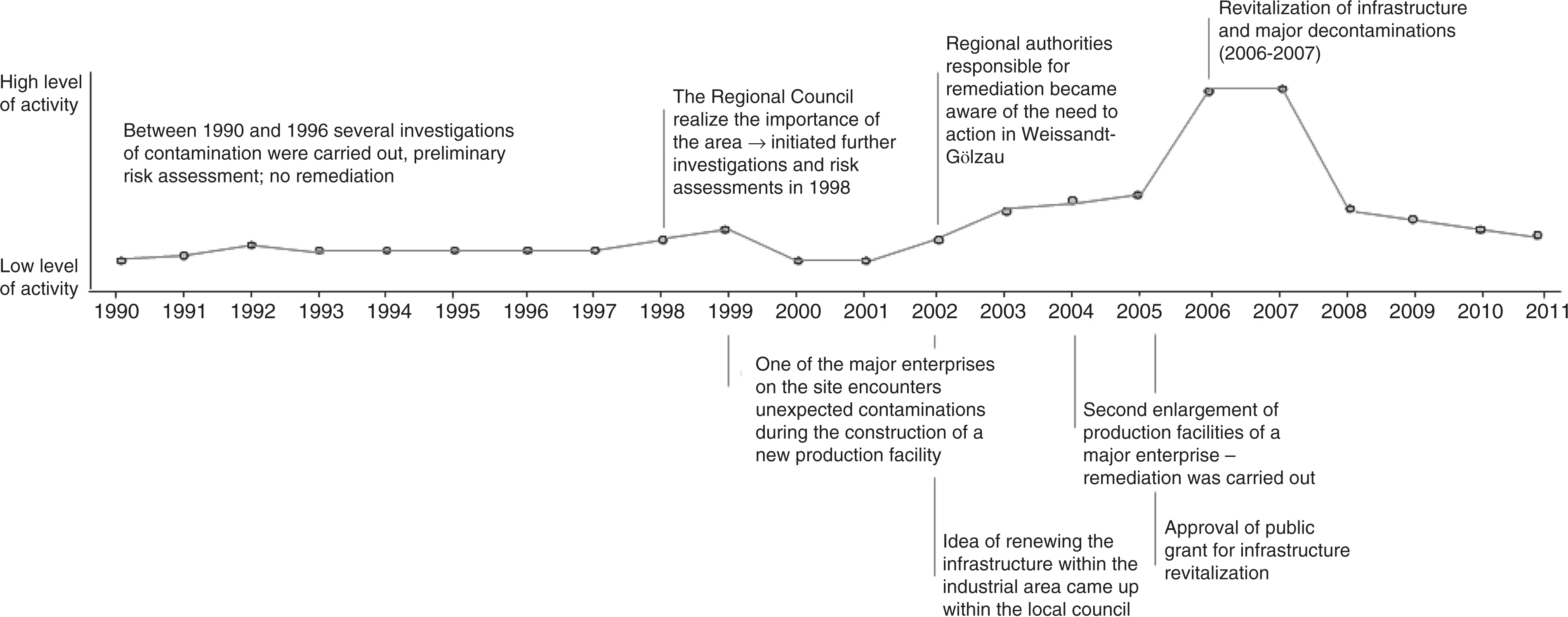
In 2002, the political representatives of the community decided to improve the existing roads and walkways as well as the sewage and rainwater drainage systems on the site to make the whole area accessible to large trucks and more attractive to new investors. The improvement in those infrastructures between 2005 and 2007 was one of the most important activities yet to occur on the site. Indeed, it was the biggest investment project in the context of remediation measures there and was accomplished by many heterogeneous actors.
Due to general knowledge of the specific challenges of decontamination, but also because of specific knowledge of the site’s industrial history and the investigations that had been conducted since 1990, not only the community, but also the relevant regional and district authorities, were aware that construction activities in the industrial area would have to deal with a degree of contamination of unknown dimensions.
On account of the historical development of the area and knowledge about anticipated surprises with regard to contaminants, one could say that the actors involved were aware of their own ignorance (contamination of unknown dimensions). As the principal manager of the locally contracted construction company explained: ‘Sometimes different remediation measures were all undertaken simultaneously. Sometimes, though, we didn’t know what we should plan because we had no investigations to build on’ (interview 5). This awareness influenced decisions taken by the stakeholders involved from the project’s very early stages. A central strategy to deal with the anticipated consequences of unforeseen events was the communication of these facts through collateral clauses (see later) within contracts between project partners and similar administrative instruments. Within those documents, it was stated that knowledge about contaminations is limited and unexpected events are likely. As one interviewee commented, this situation was a major reason for some companies not to become a project partner, which shows that the decision to deal with unknowns was evaluated differently by different stakeholders.
Reframing known unknowns through stakeholder partnership
The institutional context for remediation projects and stakeholder decisions in Saxony-Anhalt is defined by national regulations as well as by federal state regulations. In Germany, the regulation concerning the remediation of contaminated sites is harmonized within the Federal Soil Protection Act of 1998. Decisions on remediation processes and projects have to follow its principles and regulations, which include the ‘polluter pays’ principle, specific limits for hazardous substances (target values), procedures to be followed in remediation projects and the institutions that have to be involved in decision-making processes. Federal state and regional authorities are defined as being responsible for the administration of risk prevention and remediation. For the eastern German federal states, a second regulation exists at the national level, the Exemption from Pollution Liability. 7 The aim of this regulation is to support the remediation of environmental pollution resulting from past industrial activities (prior to 1990) and, in so doing, to promote economic investment.
In general, two criteria have to be fulfilled to receive a grant from this public money, regardless of property transfer: first, the pollution needs to have been caused prior to July 1990; and, second, money will only be spent if economic development follows the cleaning up. Due to the fact that communities as land-owners usually develop housing or public green space, they cannot apply for funding for the cleaning up of their property under this regulation. Within the case study, this situation demanded specific contractual constellations, as we will show later in this article. In Saxony-Anhalt, this funding is administered by the State Authority for Exemption from Pollution Liability (LAF), which decides on financial support in consultation with the relevant environmental administration and provides support for local and regional authorities as well as land-owners and investors by employing experts in remediation.
Contamination and its removal generate enormous costs, which cannot be precisely foreseen because knowledge about it is often limited. However, in order to remove as much contaminated soil as possible and to keep costs as low as possible, specialized knowledge about strategies and techniques for dealing with contaminants is, of course, crucial. Many stakeholders, institutions and their representatives were involved in the project, representing a variety of interests, practices and resources. The five most important stakeholders were: 1) the community, a local authority with little financial or specialized professional expertise; 2) the LAF, which made funding sources available as well as professional expertise; 3) the Bitterfeld Advanced Training and Project Management Society (BQP), the management firm overseeing the infrastructure and remediation project; 4) the Central German Association for Remediation and Disposal (MDSE), a federal state enterprise owning most of the pieces of land in the industrial area on which the new infrastructure was to be built (former streets but also vacant land, later used for water storage infrastructure); and, lastly, 5) the administrative authorities.
When the community decided to realize the plan, BQP took over (by contract) the project management, the organization of the building permissions from local and regional administration, and the application of public funding for infrastructure investments, hiring planners, engineers and construction companies. BQP also quite quickly came up with the idea to involve the LAF to support the decontamination part and negotiated their engagement within the project. The latter was not an easy task because, at this time, the area did not have a high priority for the LAF. One major argument was the already-existing and prospering enterprises that seemed to guarantee a high return on investment. Another argument for the LAF’s engagement was that existing roads were the property of the state-owned MDSE. By legal act, all property of this enterprise is exempted from liability because all contaminations stem from the time before July 1990. Thus, the LAF could spend public money for decontamination work. As the constellation at this point was very unusual – a community planned to build infrastructures at the property of a company and a state agency planned to finance the decontamination – a contract was set up between these actors for the time of the project. This overall contract pointed to the potential of unexpected contaminations and by doing so expressed nonknowledge. The building activities then went hand in hand with decontamination activities. The LAF was responsible for all activities concerning decontamination, including financing and hiring contractors for carrying out the work, and the BQP managed all other building activities. Many more actors were involved in implementing the infrastructure project; they were bound by contracts for precisely defined tasks and organized in a hierarchical system. Thus, engineering companies planned the infrastructure and evaluated soil quality, a consulting company carried out investigations and evaluations of contamination in order to generate more detailed knowledge of the contaminants, and a construction company removed contaminated material. Investigation, planning, permission and building had to be built one upon the other, but due to the time frame given by the infrastructure funding programme, they were realized almost simultaneously. This situation demanded major efforts in coordination and communication.
In almost every interview we conducted, the challenge of not knowing each detail was expressed as an extremely important issue, and it was one that also came up repeatedly in the weekly planning meetings we attended. However, the driving parties – the community, LAF and BQP – were well aware that doing nothing could easily mean a loss of company investments or even the migration of companies to other regions, triggering higher rates of unemployment. The regional situation and the common idea that an improvement in the environmental situation would form the basis for economic development facilitated agreement on the project, despite the existence of divergent institutional, financial and other logics and interests. The time pressure, partially amplified by the time frame of specific public funding programmes, helped to ensure that conflicting interests were put on hold. Instead, common goals were pursued. This type of cooperation among the stakeholders involved was fundamental to the success of the project.
Nonknowledge and new knowledge
All the actors we interviewed stated that they knew before they began that they would have to cooperate with one another should they unexpectedly encounter contaminants – surprises that all the actors involved anticipated. Nescience about the key parameters meant that it was impossible to undertake feasible risk assessments. Given the predetermined time frame of the project and the limited budget available, the actors furthermore knew that, at best, they would have to make decisions based on nonknowledge. The following statement from a state authority official – from whom one might perhaps least expect a show of openness about limits to knowledge – clearly indicates that it was obvious to all involved that something had to be done, since doing nothing or waiting for proper knowledge would be the worst of all possible decisions: In such a complex situation we cannot say exactly what type of measures we need in order to take action against these hazards. We just don’t know, although [name of an engineering company] has conducted research on the issue since 2003. The basic research done by [name of academic research institute], with its more technical aspects, has also been integrated to help evaluate different variants. But we still can’t say exactly what is going on with the groundwater. And yet we need to do something, don’t we? So what is our dimension for doing something? This [i.e. not knowing] doesn’t mean that we can stop the process and tell everybody to wait until we have a risk assessment. (Interview 6)
Furthermore, it often turned out that contaminated soil was not limited to road construction, but was also on neighbouring property. In such situations, the project partners LAF and BQP often decided to clean up this area too because, in a long-term view, the neighbouring contamination would have re-contaminated the cleaned-up part, that is, they did know what potentially could happen, but did not know when and if at all. Therefore, they again used their nonknowledge actively for decision-making and acting.
Although such events slowed down some of the other activities for a while, quick disposal solutions were able to be found at least for the tanks and metal containers, while construction work in other places was able to continue unhindered.
In one situation, the ‘whole philosophy of the project had to be rethought’ (interview 8), as the representative from the engineering company in charge of the project stated. In October 2006, a rain storage reservoir should have been constructed in a vacant place. When the construction company removed the topsoil, workers reported that the subsoil did not seem ‘normal’ in their view. The actors involved knew, then, what they did not know and were able to use this type of (positive) nonknowledge as a basis for further planning and action. On the basis of the detected knowledge, the soil was evaluated, concluding that the whole area was heavily contaminated with liquid tar. This incident led the actors to ask why there was tar present and not just soil. Based on research in the archives, the specialist companies were able to establish that the tar came from a nearby landfill where residues from the carbonization plant had been stored since the 1920s. Thus, the nonknowledge that emerged from a general state of ignorance was able to be transformed into new knowledge. As a result of intense discussions and negotiations, the construction work continued, but a full layer of top soil measuring more than one meter in depth had to be removed and disposed of at a waste site for hazardous materials. The representative from the regional administration explained: Construction and cleaning up has to be understood as a continuous process. They [the workers on the ground] started to remove the material, and when they did so, they found that the subsoil was totally different from what we expected. The problem is that tar, which turns to liquid at a certain temperature, makes it necessary to use another type of water barrier for the rain storage reservoir … At times like these, we have to act first and get the permits changed later. (Interview 12)
Interestingly, these types of decisions – of course, without our ignorance terminology used in this article – were covered by the initial contract (on this, see also later). All these incidents pushed up the project costs, but the overall process continued. This was not least because in the contract between the main actors, it was defined that remediation costs would be covered by the public fund managed by the LAF. Certainly, the situation would have been different if the costs for infrastructure had risen, since these types of costs would have to be covered by the community itself. Another reason might have facilitated spending additional money quite easily in this period: once a project has been started, it seems more legitimate to spend more money to finalize it than stopping it in the middle of the process. In the next section, we will take a closer look at some of the strategies adopted by the different actors to deal with the unknown and at how the unknown influenced the decisions that were taken.
Communicating ignorance in close temporal proximity
As is the case with the decontamination project in Weissandt-Gölzau, projects are often undertaken on a tight budget in terms of both time and money, so they cannot be postponed until every detail of future planning is precisely known. To be sure, this should not imply that actors should start acting without doing research on open questions. This would indeed be irresponsible action. Rather, by negotiating the relevance of nonknowledge, actors can conclude that it is impossible to generate knowledge before taking action, but that knowledge will be created while acting. Disclosing the limits of knowledge as part of scientists’ and engineers’ communication with other stakeholders can thus be understood as an important step towards completing projects such as the decontamination of soil in an old industrial area successfully. Thus, clear communication of well-defined ignorance (nonknowledge) can be viewed as an important part of the process of making development projects a success and, thus, an important parcel in the toolkit of futures methods.
As the interviews with the actors and the analysis of minutes from planning meetings reveal, the overall strategy for dealing with unexpected events was based in each case on a precise definition of what was unknown; this made it possible to devise flexible procedures that would absorb a certain amount of the uncertainty around unknown factors. The work contracts and permits contained special clauses that addressed unknown factors – so-called collateral clauses. These are agreements between joint contractors to pool their guarantees when handling a large project. These agreements, which we want to define as part of a set of ‘strategies of coverage’, have so far not been developed in the case of remediation projects, although they are common in some fields of construction. These strategies for dealing with nonknowledge were developed specifically for this site’s remediation process. What was developed were the preconditions for making flexible adjustments, such as getting permits altered to fit the new circumstances (administration), changing the construction plans (engineering companies) and, last but not least, redeploying capital for the remediation project (the LAF). One major factor that helped to create such an ‘experimental attitude’ was an explicit agreement on shared objectives, which was reached at an early stage in the project and fixed within a contract. As a major representative of the LAF put it: ‘Early on, you have to get the right people to the table: people who trust each other and also have some credibility for actors outside the project’ (interview 5). In the remediation project at Weissandt-Gölzau, the ‘right people at the table’ seemed to have trusted each other enough to be reassured that being open and honest about their own ignorance would not have a negative effect on the climate of cooperation or on their own personal credibility or that of their company. In other words, the ‘standards of expertise’ were embedded in the long-standing experience of cooperation with the respective engineering companies. These ‘standards’ were integrated within the work routines and given additional emphasis by the explicit agreement at Weissandt-Gölzau to move on despite the existence of ignorance.
The fact that the stakeholder representatives acknowledged their own ignorance also benefited the direct flow of information among the actors, which was seen as a precondition for dealing successfully with nonknowledge. An important issue in successfully coordinating ecological remediation projects is the institutionalization of information exchange. Although this might seem obvious at first sight, regular consultations among all institutions and actors involved for the purpose of exchanging information, discussing new developments and agreeing on strategies for adapting to them are not the norm in many projects dealing with contaminants. It also means that all the actors involved must communicate their own ignorance, seeing it not as a matter of avoidable failures, but as a normal way of dealing with contaminants. The question of liability in this moment cannot be transferred to a single project partner, but has to be dealt with by all parties involved. This observation goes contrary to the prevailing thought regarding the belief that communicating ‘uncertainty is taken to be opting out of accountability’ (Douglas, 1992: 30). Instead, in our case the acknowledgement of nonknowledge helped distributing liability to all parties involved in order to account for potential mishaps.
Outlook: Nonknowledge as virtue
The approach outlined earlier to accommodate project plans despite the existence of unknowns can be understood as a means of embarking on processes involving ignorance and seeing them through without any major disruptions. Seen in this way, dealing with the unknown in the remediation of contaminated sites appears as a normal part of the overall process rather than as an anomaly or as an indicator of failure. Many activities in Weissandt-Gölzau seem to include ignorance and nonknowledge explicitly in planning processes. Acting in the face of ignorance is about accepting that things can go wrong or that the unexpected can occur. This requires preparedness and organizational measures for absorbing uncertainty, as well as the development of strategies to deal with the unknown, including a functioning network of actors and regular consultations based on relationships of trust.
Because the actors involved in the remediation process have to deal with a large number of unknowns, decision-makers are usually hesitant to agree to projects aimed at cleaning up contaminated areas. By contrast, the need for action in Weissandt-Gölzau was recognized and acted upon by decision-makers due to the generally weak state of the economy in Saxony-Anhalt. This factor certainly supported the other actors’ willingness to take action: doing nothing was clearly regarded as the worst decision possible. However, as we have tried to show in this study, the integrity of the process in Weissandt-Gölzau was successful mainly because nonknowledge was skilfully incorporated into planning and implementation. An important prerequisite for pursuing such a goal is that the actors involved need to be prepared to act despite the existence of ignorance. Without this, the opportunity to create visions of shared futures instead of finger-pointing and blame-shifting will have gambled away. Improved understanding of such opportunities demands further reflection on nonknowledge dynamics and the structural and legal support that actors need to display their knowledge gaps. After all, the areas discussed in this article have shown that acknowledging one’s ignorance about what is going on ‘in front of the pickaxe' so that it can be transformed into nonknowledge is often a virtue.
Footnotes
Funding
This research was completed within the SAFIRA II program, funded by the German Federal Ministry of Education and Research (BMBF).