







Abstract
Although social cognitive career theory has been tested in relation to Holland’s RIASEC types, few studies have examined the role of time perspective across RIASEC themes. Four hundred and thirty-five students participated in this study. Data were collected on the time perspective dimensions, learning experiences, self-efficacy, outcome expectations, and interests across each of the RIASEC areas identified by Holland. The findings, besides a substantial confirmation of SCCT foreknown causal relationships, indicated a significant role of present-hedonistic and future temporal perspectives in Investigative and Social areas. The results evidenced the role of time perspective among persons’ inputs influencing self-efficacy and outcome expectations in the social cognitive framework of interests’ formation.
Keywords
The primary purpose of this research is to advance the empirical literature on social cognitive career theory (SCCT) (Lent et al., 1994) including time perspective among persons’ inputs. The main focus of this study is on how the Zimbardo time perspective (Zimbardo and Boyd, 1999) constructs are related to learning experiences, self-efficacy, outcome expectations, and interests in the overall SCCT model. Our proposed models address the effects of time perspective related to SCCT constructs across Holland’s (1997) RIASEC (Realistic, Investigative, Artistic, Social, Enterprising, Conventional) fields of interest.
Time perspective can be defined as “the manner in which individuals, and cultures, partition the flow of human experience into distinct temporal categories of past, present and future” (Zimbardo et al., 1997: 1008). Wallace and Rabin (1960) and Fraisse (1963) summarized almost a century of work on time in psychology. Nurmi (1991) made a wide review of adolescents’ future orientation in terms of motivation, planning, and evaluation.
During adolescence, the subjective awareness of personal past, present, and future may have implications for several psychosocial outcomes related to identity, motivation, coping, interpersonal interactions, and risk behaviors (Laghi et al., 2012). Adolescents seem to be more responsive to experiences that produce immediate satisfaction, but have lesser reward value over the long term. Their behavior contrasts with that of peers who endorsed a future time perspective that focused on a cost/benefit analysis framed by consideration of abstract options and contingencies (Laghi et al., 2013).
Identity formation during adolescence is influenced by exploration and commitment concerning future-oriented interests (Bosma, 1985; Marcia, 1980). Adolescents anticipate future events and outcomes, like the ones linked to career, giving them personal meanings and relating personal standards to these events (Bandura, 1986; Gainor, 2006; Laghi et al., 2011). Consequently, interests and motives have a reference to future events (Nuttin, 1985). Time perspective has been empirically related to locus of control and theory of attribution (Platt and Eisenman, 1968; Thayer et al., 1975; Wolf and Savickas, 1985), achievement motivation (Epley and Ricks, 1963; Heckhausen, 1967; Nisan, 1972; Raynor and Rubin, 1971; Shell and Husman, 2001), delay of gratification (Bembenutty and Karabenick, 2004; Klineberg, 1968), study persistence (De Voider and Lens, 1982), and career decision-making (Savickas et al., 1984). Individual time perspective development is embedded in socio-cultural context (Laghi et al., 2013; Le Shan, 1952), showing that lower class views the future as being uncertain (Phan, 2009).
Time perspective is a nonconscious process used for encoding, storing and recalling events, as well as in forming expectations, goals and imaginative views (D’Alessio et al., 2003). The representation of the present is strictly related to the construction of the past and to the anticipation of the future. Some people are influenced in their decision-making by analogous situations that have occurred in the past, recalling experienced costs and benefits; others are mainly driven by outcome expectations (Laghi et al., 2009a, 2009b, 2012). Zimbardo and Boyd (1999) subdivided past, present, and future orientation into five dimensions: past-positive, past-negative, present-fatalistic, present-hedonistic, and future. Past-positive is marked by a warm, sentimental and positive view of one’s past, giving rise to nostalgic feelings. Past-negative reflects a pessimistic, negative or aversive attitude towards the past and possibly the experience of traumatic life events not yet resolved. Present-fatalistic is characterized by a hopeless and helpless attitude towards the future and belief that exterior forces (others, luck, God) determine one’s fate leaving no chance to change events. Present-hedonistic is associated with the desire for spontaneous and immediate pleasure with slight regard to risk or concern for future consequences and the tendency to avoid engagement and effort. Future reflects planning for, and achievement of, future goals and is characterized by perseverance and a marked attention to responsibility and by a reward dependence that occurs as a result of achieving specific, long-term goals, avoiding distractions which divert attention from what are considered one’s main goals.
Super’s (1974) model of adolescent career maturity emphasizes the role of time perspective in the development of concrete career choices and involvement in the form of planful attitudes toward the future (Crites, 1978; Super, 1983). Adolescents must balance their own personal Time perspective and a social time perspective expressed by a synthesis of contextual proscriptions, values, and deadlines. Personal learning experiences influence these first steps of life planning. Engagement in a new task directs the student to find similar tasks among past learning experiences (Eccles, 2005). If successful learning experiences can be found, self-efficacy is reinforced, thus offering cognitive and meta-cognitive strategies which enhance good performance possibilities.
Developmental transformations and increasing cognitive abilities to represent and anticipate events allow the direct assessment of self-efficacy. Adolescents’ self-efficacy is influenced by experiences with caregivers in early childhood. The quality of childhood memories has an important impact on the formation of self-efficacy-related internal representations. These representations not only reflect past experiences but may be considered as a changing reconstruction of what happened in the past, based on current life circumstances and in connection with the affective vicissitudes that are typical of the adolescent age. Autobiographical memories are affected by the adolescents’ current circumstances and current view of themselves (Henry et al., 1994). Thanks to his/her new abilities of hypothetical deductive thinking, an adolescent can anticipate possibilities and life scenarios that do not exist irrespective of his/her practical experience, so he/she can work out his/her intentions and future projects (Laghi et al., 2009a). Self-efficacy and outcome expectations can hence be analyzed by means of the three time dimensions of past, present, and future.
The present study explores the degree to which the data fit SCCT’s interest model for each RIASEC type, where Zimbardo time perspective’s dimensions (past-positive = PP, past-negative = PN, present-hedonistic = PH, present-fatalistic = PF, future = F) were considered as factors directly influencing one’s learning experiences (PA = performance accomplishments, VL = vicarious learning, VP = verbal persuasion, PEA = physiological/emotional arousal) and self-efficacy (SE) and hence indirectly influencing outcome expectations ( = OE) and interests ( = INT) (see Figure 1 for a graphical representation of the model). Time perspective, considered as a person’s input, is hypothesized to influence learning experiences across all Holland themes, with no relevant differences based on the area of interest since the casual paths reflect the way through which time perspectives relates to experiences in any field of interest. The effects are expected to be positively significant for past time perspectives (positive and negative), since past time orientations include by definition a strong consideration of experiences (Zimbardo and Boyd, 1999). Fatalistic attitude, for its external locus of control, is expected to negatively influence those learning experiences which enhance self-efficacy (personal accomplishments, vicarious learning, verbal persuasion) while strengthening physiological/emotional arousal. Present-hedonistic and future time perspectives, on the contrary, should have the opposite effect, even if less pronounced since poorly rooted in the past experiences. Furthermore we hypothesize a direct effect of time perspective dimensions on self-efficacy beliefs. This hypothesis is based on Bandura’s (1997) self-efficacy theory, which advances a tripartite temporal influence on behavioral self-regulation as generated by efficacy beliefs grounded in past experiences, current appraisals, and reflections on future options. Past time perspectives (positive and negative) are expected to have a negative direct influence on vocational self-efficacy, since they both denote an attention addressed toward the past with little space for vocational engagement. Present-fatalistic is expected to directly lower self-efficacy for the negative influence that fatalism plays on personal resources and efficacy beliefs. Present-hedonistic should be the most significant direct predictor of self-efficacy for its optimistic attitude. Future time perspective is expected to directly positively influence self-efficacy, even if less than present-hedonistic and only for those Holland themes, like Enterprising and Investigative, with a stronger correlation with sense of responsibility and long-term investment. Causal model of vocational interests with time perspective.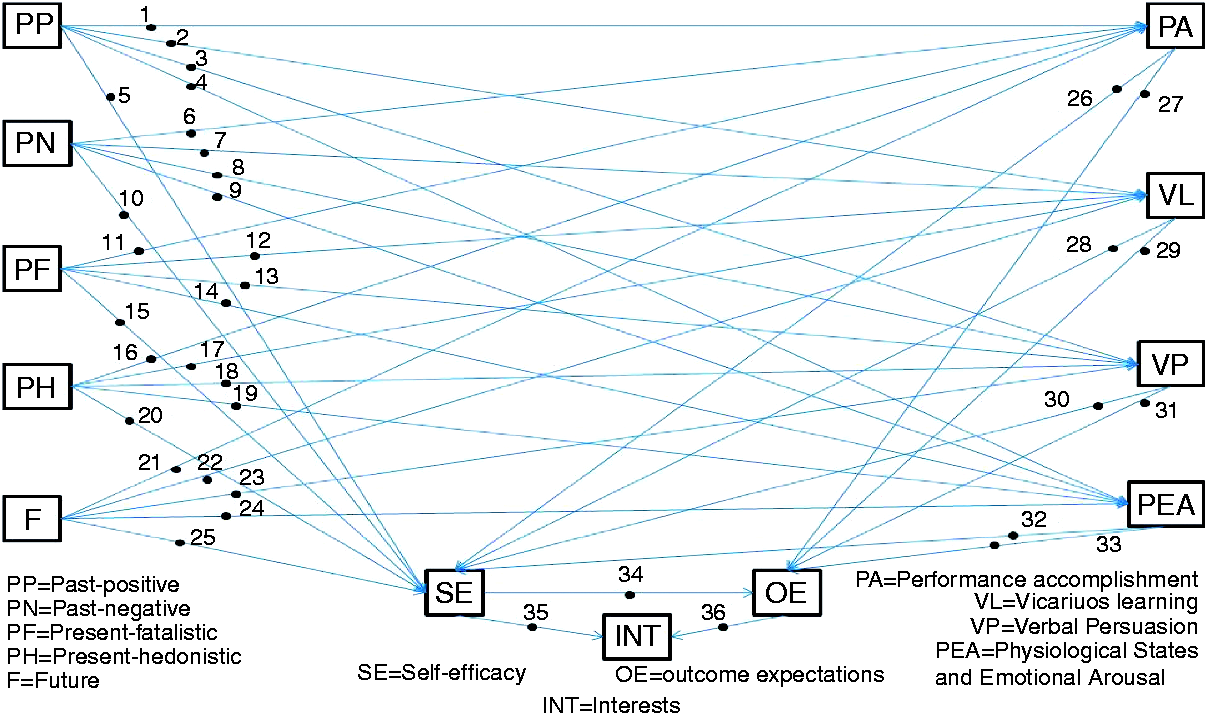
On the whole, even if no literature can be addressed to hypothesize the effect of time perspective indicators on socio-cognitive variables, as an exploratory analyses, we can expect that interests are mainly influenced by future time perspective. This hypothesis can be justified considering future’s characteristics of responsibility, perseverance, and achievement of long-term goals. This hypothesis should be verified especially for those Holland areas where Future perspective plays a more significant role, like Enterprising and Investigative ones. The optimistic and well-being attitude of present-hedonistic is expected to be a factor that can contribute to interests’ formation especially for Social and Artistic areas, while present-fatalistic attitude is expected to weaken interests across all Holland domains. Past time perspectives, both positive and negative, are expected to weakly influence interests’ formation across all Holland domains, since past orientation is scarcely linked to career planning independently from the field of application.
According to Betz and Hackett (1981), we expect gender differences in vocational socio-cognitive variables, since SCCT models (Lent et al., 1994; Betz, 2006, 2007, 2008) consider gender as a person input affecting individual exposure to learning experiences (Lindley and Borgen, 2002; Williams and Subich, 2006; Tokar et al., 2007). Males traditionally report higher values on Realistic and Investigative socio-cognitive variables, while Social area is traditionally feminine. Gender differences are expected to emerge when considering time perspective as a person’s input affecting learning experiences and self-efficacy, since the gendered nature of time perspective (Keough et al., 1999) will influence the way through which Learning experience are taken in account in the process of self-efficacy formation.
Methods
Participants
The target sample consisted of 435 Italian adolescents aged 17 to 19 years attending high schools in the Center of Italy (Lazio). The schools were selected on the basis of their willingness to participate in the study (N = 6). They were from urban, suburban, and more rural areas within a small geographic radius, reflecting the full socio-economic spectrum of the region. In total, 198 were males (46%) and 237 were females (54%). The mean age was 17.56 years (SD = 0.7). The subjects were attending their final year of different high schools. About 25% were enrolled in science-focused schools, 17% in classical education schools, 25% in industrial schools, 17% in liberal arts-focused schools, 16% in teacher-training schools.
Procedure
Participation was obtained through an informed consent procedure asking for active consent from students. Questionnaires were administered in the classroom during lesson time at the end of the first semester. They took approximately 30 min to complete. Vocational experts introduced the questionnaires, giving instructions on their compilation, explaining that they were voluntary and responses were anonymous and confidential. Examples were given to clarify differences among social-cognitive constructs that were operationalized in a single instrument. Experts were at the students’ disposal during the questionnaires’ administration to answer questions and give explanation. All students responded to the same questionnaire packet.
Measures
Demographics
An Identifying Information Form was used to collect demographic information such as age, gender, and type of school.
Time perspective
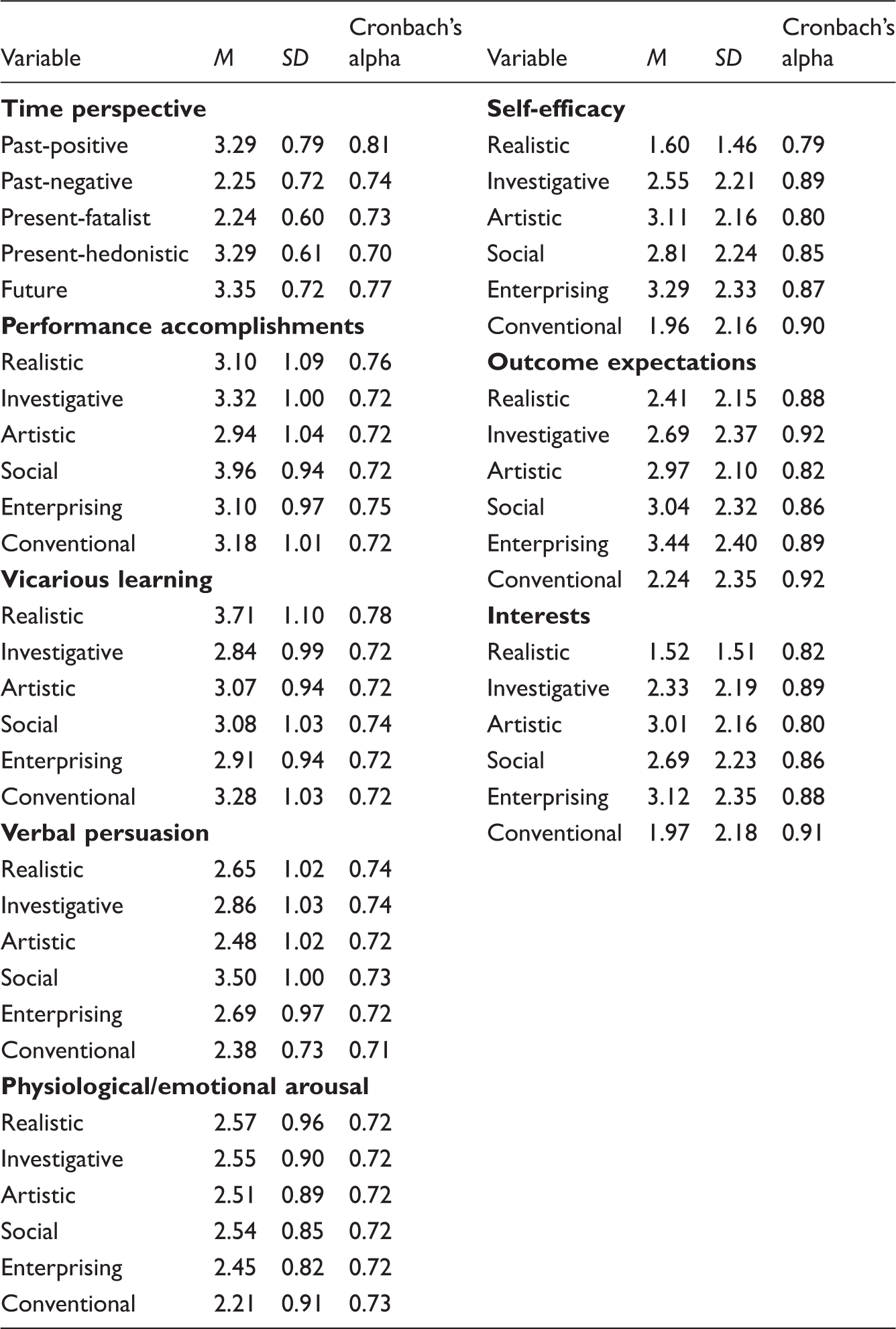
Means, standard deviations, and internal consistency estimates for observed variables.
Learning experiences
These were measured with the Learning Experiences Questionnaire (LEQ) (Schaub, 2004) in its validated Italian version (Laghi et al., 2007), consisting of 120 items investigating Bandura’s (1986) four sources of self-efficacy information (i.e. performance accomplishments, vicarious learning, verbal persuasion, and physiological/emotional arousal) for each of Holland’s (1997) RIASEC themes. Each of the four types of learning experiences was assessed with five items, using a 6-point Likert-type scale. Reliability and validity of the instrument in its Italian version have been shown to be satisfactory. The instrument has good psychometric properties (internal reliability ranges from 0.71 to 0.76). Divergent validity estimates indicated that scores were not related to age, gender, and type of school, whereas convergent validity was supported via correlations with different measures of self-efficacy (Laghi et al., 2007). The alpha coefficients for this study are reported in Table 1.
Self-efficacy, outcome expectations, interests
These were all measured with an instrument created and validated in its Italian version by Lent et al. (2003) consisting of a set of 42 occupational titles, 7 titles for each of Holland’s domains. For each occupation, participants were asked to express their self-efficacy, outcome expectations, and interests using a 10-point scale. Operationalizing different constructs in a single instrument, with identical items and response options, with the risk of a high level of overlap in the measures, can yield large effects of common method bias accounting for much of the relations among these variables. Following Lent and Brown’s recommendations (2006), we ensured that scale instructions and verbal anchors properly oriented participants to the construct at hand. Examples were given before questionnaires’ administration to clarify differences among constructs referred to the same occupational title. The Italian version of the instrument has good psychometric properties and many studies have found this scale to be a valid and reliable measure in Italian context (Lent et al., 2003). Lent et al. reported alpha coefficients ranging from 0.82 (Artistic theme) to 0.94 (Investigative theme) for the self-efficacy scales; and from 0.91 (Investigative theme) to 0.94 (Conventional theme) for the outcome expectation scales and found interrelationships among self-efficacy, outcome expectations, and interests that were consistent with SCCT.
Data analysis
Preliminary analysis
As a preliminary analysis, we checked the skewness and kurtosis of all variables. Overall, all variables seemed to conform to the normal distribution.
Gender differences in structural models were tested running multi-group analysis (males vs. females) for each RIASEC theme. Those RIASEC areas where fit significantly improves considering gendered groups were subsequently analysed as separated structural models for males and females.
Path analysis
All path models were analyzed with LISREL 8.30 (Jöreskog and Sörbom, 1999), using maximum likelihood estimation procedures. For each tested model we reported χ2, as an absolute fit index (good fit between zero value and two times the degrees of freedom). We also reported two more incremental fit indexes—the non-normed fit index (NNFI) and the comparative fit index (CFI)—and the root mean square error of approximation (RMSEA). Higher CFI and NNFI values (in the range from 0.97 to 1.00 for a good fit) and lower RMSEA values (in the range from 0.00 to 0.05 for a good fit) are assumed to evaluate model fit (Schermelleh-Engell et al., 2003). There were two missing values (belonging to different participants and different variables), that have been substituted with sample means.
Results
Descriptive statistics and preliminary analysis
The internal consistencies (Cronbach’s alpha) were satisfactory for each subscale as shown in Table 1 (Cronbach’s alpha coefficients range from 0.70 to 0.92). Data in Table 1 for men and women participants can be obtained directly from the first author.
Multigroup analysis (males vs. females) for each RIASEC theme were run to compare data fit as referred to gendered separate groups (50 degrees of freedom) and to a whole group formed by males and females (86 degrees of freedom). χ2 differences thus obtained were compared to values corresponding to the fit improvement due to the difference of degrees of freedom (36 degrees of freedom). Thresholds for significance were chosen in correspondence with p = 0.01, Δχ2 = 58.62, and p = 0.05, Δχ2 = 51.00. Realistic area reported the most significant gender difference, Δχ2 = 63.77; p < 0.001; followed by Enterprising, Δχ2 = 55.69; p < 0.01, and Artistic, Δχ2 = 54.81; p < 0.01 areas; no significant gender differences were found for Social, Δχ2 = 47.83; p = 0.09, Conventional, Δχ2 = 47.22; p = 0.10, and Investigative themes, Δχ2 = 44.29; p = 0.16. Based on these preliminary findings subsequent analysis were run differentiating by gender in Realistic, Artistic, and Enterprising, while considering only one group of participants for Investigative, Social, and Conventional areas.
Path coefficients and fit statics for nine RIASEC models.

Degrees of freedom = 25, *p < 0.05, **p < 0.01.
Effects of time perspective on learning experiences
As shown in Table 2, both past-positive and past-negative temporal perspectives positively influence in a significant way most of the learning experiences dimensions (paths 1, 2, 3, 4, 6, 7, 8, 9). Present-fatalistic has mainly a negative influence on those learning experiences which enhance self-efficacy (performance accomplishments, vicarious learning, verbal persuasion) (paths 11, 12, 13), while it is a significant positive predictor of physiological and emotional arousal (path 14). Present-hedonistic shows generally a little influence on Learning experiences (paths 16, 17, 18, 19), except for the Social area and—only for males—in the Artistic and Enterprising areas where it acts as a significant reinforcement of those learning experiences which enhance self-efficacy (paths 16, 17, 18). A significant positive influence of future was found on performance accomplishments (path 21) in Investigative, Social, and Conventional areas and—only for males—in the Artistic one. Females, contrary to males, reported a significant negative influence of future on vicarious learning (path 22) and verbal persuasion (path 23) in Realistic, Artistic, and Enterprising areas.
Effects of time perspective on self-efficacy
Summary of effects of time perspective on self-efficacy, outcome expectations and interests.

p < 0.05, **p < 0.01.
Effects of time perspective on outcome expectations
As reported in Table 3, past time perspectives, both positive and negative, and present-fatalistic do not show significant influences on outcome expectations, with the only exception for females in the Artistic field, where past-positive time perspective significantly enhances outcome expectations and present-fatalistic weakens them. Present-hedonistic and future are significant predictors of outcome expectations in Social and Investigative themes and, only for males, in Enterprising one. Present-hedonistic shows also a significant role for Artistic and Artistic masculine outcome expectations.
Effects of time perspective on interests
Time perspective indirectly influences interests as a combination of its effects on self-efficacy and on outcome expectations. It has thus been found (Table 3) that feminine artistic interests are significantly influenced by past-positive in a positive way and by present-fatalistic in a negative way. No other significant effect emerged on interests by past-positive, past-negative, and present-fatalistic perspectives. Present-hedonistic and future are significant positive predictors of Investigative and Social interests, and only for males significant positive influences resulted exerted in the Artistic area by present-hedonistic and in the Enterprising one by present-hedonistic and future.
Robust significant causal paths resulted between self-efficacy and outcome expectations (path 34); self-efficacy and interests (path 35); outcome expectations and interests (path 36). Performance accomplishments resulted to be the main learning experiences positively influencing self-efficacy (path 26) and negatively directly influencing outcome expectations (path 27). These path coefficients (26, 27) are significant for most of the Holland’s areas. On the contrary, paths 28 and 29, linking vicarious learning to self-efficacy and outcome expectations, resulted to be nonsignificant across all Holland's areas. Verbal persuasion significantly influences self-efficacy (path 30), with the only exception of the Realistic area. Its positive direct effect on outcome expectations (path 31) resulted to be significant for Social and Conventional areas, and, only for males, in the Realistic one; while only for females in the Artistic area. Physiological/emotional arousal significantly influences self-efficacy (path 32) with the exception of Realistic and Social areas. A significant positive direct effect of physiological/emotional arousal has been found on outcome expectations (path 33) only for females in the Realistic area.
Conclusions and implications
SCCT’s hypotheses (Lent et al., 1994) found substantial verification in the analyzed sample, both for the core of social-cognitive career theory and for the role of learning experiences as predictors of self-efficacy and outcome expectations. Several significant causal paths were found linking time perspective dimensions to learning experiences and self-efficacy across RIASEC themes. SCCT has been tested in relation to Holland’s (1997) RIASEC types (Betz et al., 1996; Betz and Rottinghaus, 2006; Fouad et al., 2002; Lent et al., 2003; Rottinghaus et al., 2003a, 2003b; Smith and Fouad, 1999; Schaub and Tokar, 2005).
On the whole, future and present-hedonistic time perspectives were found to be the mostly contributing indicators to interests’ formation. Future perspective plays the larger role for Enterprising interests, followed by Social and Investigative ones. This result can be understood considering those future perspective characteristics (planning, perseverance, responsibility, conscientiousness), which are strictly coherent with Enterprising, Social (in its aspects of care), and Investigative themes. Analogously, an attitude oriented to enjoyment and pleasure in the present (present-hedonistic) resulted to have a positive effect on interests’ formation for the analyzed sample, especially in the Social and Artistic domains. This result can be interpreted considering Social and Artistic areas in their aesthetic and pro-social aspects which appear to be strictly linked to present-hedonistic time perspective.
Adolescents with a dominant present time perspective are primarily oriented towards living for the moment and adopt behaviors that meet immediate desire. Additionally, although they may be most likely to engage in a broad spectrum of high-risk behaviors, such as risky driving, substance abuse, delinquency, and unprotected sexual practices, they seem to be more responsive to experiences that produce immediate satisfaction (Laghi et al., 2012, 2013).
By contrast, adolescents who endorsed a future time perspective that focused on a cost/benefit analysis framed by consideration of abstract options and contingencies. These adolescents were found to get successful results both academically and in their careers.
Sex differences emerged across the different casual paths of the models. As a general trend, males showed to be advantaged in the role played by time perspective within socio-cognitive mechanism. The positive contribute of future and present-hedonistic perspectives is more pronounced and extended for males, while the negative role of present-fatalistic emerges mainly for females. Males appear to better integrate and harmonize past, present, and future frames to recall learning experiences and form their own self-efficacy beliefs, outcome expectations, and interests.
Some useful implications for vocational theories and interventions can be obtained from the present study. Performance accomplishments and verbal persuasion confirmed their significant role as sources of self-efficacy, while vicarious learning has shown to be largely nonsignificant as a direct predictor of self-efficacy. This can be taken in consideration when organizing interventions to enhance self-efficacy based on exposition to learning experiences like the one considered by Betz and Schifano (2000). Performance accomplishments must be accompanied by verbal persuasion if the intervention aims to generate adequate expectations and hence interests.
Vocational specialists can furthermore analyze if low self-efficacy levels are due to time perspective influence, like for instance present-fatalistic perspective that resulted to negatively influence self-efficacy, especially for females. High level self-efficacy beliefs, as well, can be analyzed under this perspective. Realistic female interests, for instance, can be analyzed if originated by past-negative perspective. If vocational interventions are designed to modify those casual relationships that emerged as disadvantageous for self-efficacy beliefs, outcome expectations and interests, the present study suggests different actions: strengthening time perspective role in Conventional area and overwhelming female gap in the contribution of time perspective in Realistic, Artistic, and Enterprising areas can be two general indications to be developed.
Limitations of the study
Although a consideration of the role of time perspective in SCCT can be an important contribution to the literature, some limitations must be considered when drawing conclusions. The geographical assortment of the sample (Central Italy) is very limited. Therefore, this social cognitive approach should be tested in different socio-cultural contexts. Even if precautions have been taken to avoid overlapping results due to the use of the same instrument to measure different socio-cognitive variables, further strategies (e.g. confirmatory factor analysis) should have been taken in consideration to examine the latent structure underlying the set of measures (e.g. Lent et al., 2003). Linked measurement procedure anyway should be avoided if possible.
Different time perspective instruments can be considered within socio-cognitive framework. The significant role of future time perspective suggests to consider other instruments which take in greater consideration such dimension, distinguishing for instance between a negative and a positive attitude toward future (eg. Adolescent Time Inventory; Worrell et al., 2013). Having considered time perspective indicators separately does not give a global indication on individual differences in temporal perspective. It could be useful to consider, as person’s input in SCCT, the way through which participants are able to balance their different temporal orientation components, as opposed to a bias towards one particular time frame (Boniwell and Zimbardo, 2004; Drake et al., 2008).
Time perspective is expected to play a role not only in the interest model considered in this study. The choice model of SCCT and studies on well-being as related to job satisfaction seem to be suitable to be considered for further studies. However, results should be replicated in other independent samples in order to increase the confidence in reliability and generalizability.
Footnotes
Declaration of Conflicting Interests
The author(s) declared no potential conflicts of interest with respect to the research, authorship, and/or publication of this article.
Funding
The author(s) received no financial support for the research, authorship, and/or publication of this article.