







Abstract
The purpose of studies presented in this article was to develop and validate a short version of the Future Anxiety scale. The Future Anxiety scale consists of 29 items; it measures the tendency to think about the future with anxiety and uncertainty and to anticipate disasters in the future. We developed a short form of this scale—the Dark Future scale—on a total sample of 2285 Polish adults across two studies. In Study 1, we examined the reliability and factor structure of the Future Anxiety scale. In Study 2, we cross-validated the reliability, factor structure, and validity of the Dark Future scale. The validity of the Dark Future scale was assessed based on the correlations of this instrument with the Future Negative scale, the Future Time Perspective scale, the Zimbardo Time Perspective Inventory, and the Carpe Diem scale.
The aim of the current study is to present the development and validation of a short version of the Future Anxiety scale (Zaleski, 1996). This scale is based on the author’s original conception of future anxiety. In psychology, future is usually understood in accordance with Lewin’s (1942) concept of “life space,” as consisting of several dimensions (e.g., Fraisse, 1963; Nurmi, 2005; Nuttin and Lens, 1985; Strathman and Joireman, 2005; Urien, 2007), such as future time perspective, hope, and future anxiety. According to Zaleski (1996), future anxiety refers to attitudes toward the future in which negative cognitive and emotional processes outweigh positive ones and in which fear is stronger than hope. It is a fear of future events and a feeling that dangerous or adverse changes may occur in the future.
It is obvious that each type of fear somehow relates to the future, but future anxiety refers to a distant rather than proximate perspective as well as to personal preoccupation with, worry about, and fear of possible or anticipated unfavorable changes in the future. In extreme cases, it may turn into panic. Compared to other anxiety concepts, future anxiety is of a cognitive rather than emotional character—that is, people seem to be aware of it. According to Zaleski (1996), the basis of future anxiety is personality traits that determine the way of responding to fear, personal experiences, and current events. Support for such approach can be found in works by authors such as Eysenck (1992) or Sorrentino et al. (1992). In his hypervigilance theory, Eysenck (1992) postulated that the main function of fear is the early detection of threat signals, whereas Sorrentino et al. (1992) proposed the concept of uncertainty orientation, understood as the tendency of some people to perceive life as an unknown.
How is the future anxiety different from other similar concepts, such as general anxiety, fear, future time perspective, and worry? Anxiety is defined as an unspecified and unpleasant feeling of danger, subjectively experienced as negative tension, which is linked with physiological changes (Eysenck, 2000; Lader and Marks, 1973; Lewis and Haviland-Jones, 2000). Future anxiety can be described as the kind of anxiety that concerns the future in general. Fear differs from anxiety in that it is caused by a recognizable stimulus (Lewis and Haviland-Jones, 2000). Moreover, fear is linked with self-preservation behaviors, such as escape and avoidance (Lang et al., 1997). As in the case of the distinction between anxiety and fear, we can speak about future anxiety as a general feeling concerning the future—as opposed, for example, to future examination fear. The mental location of an aversive situation in the closer or more distant future is what discriminates future anxiety as we understand it from general anxiety or its other specific kinds referred to in the literature.
Future time perspective is a relatively stable tendency to concentrate on the future—to think about the future, to plan, and to formulate goals (see Zimbardo and Boyd, 1999, 2008). Positive and negative future time perspective means, respectively, a focus on positively or negatively evaluated future (Carelli et al., 2011). Future anxiety as defined by Zaleski (1996) is one of the basic elements—one could even say, the most important element—of negative future time perspective. When speaking about a negative attitude toward the future, we usually mean a fear of the future. Anger, aversion, and a feeling of helplessness are other examples of negative emotions related to negative future time perspective (see Carelli et al., 2011; Zimbardo et al., 2012).
As regards worry, its relationship with future anxiety will depend on the definition of worry. Traditionally, worry is conceptualized as a subconstruct of anxiety (Boehnke et al., 1998; Furnham et al., 2012; Spielberger et al., 1980; Thielsch et al., 2015; Wisocki et al., 1986). Boehnke et al. (1998) defined it as cognition that an object (self, in-group, society, world) will diverge from its desired state. Research results indeed indicate a significant relationship between anxiety and worry, but it is not the case that worry and anxiety always coexist. Some types of worries are associated with emotions other than anxiety, for example, with anger. Schwartz et al. (2000) noted that worry is accompanied by anxiety in cases when a person expects problems with reducing the discrepancy between the actual state and the desired state. By contrast, when a person has a problem-solving orientation, worries do not necessarily occur together with anxiety. Similarly, future anxiety is not always accompanied by worry.
Psychologists’ interest in future anxiety stems from actual social and political processes and events. The constant threat of terrorism, open or latent conflicts between groups, nations, and countries, or the global warming effect with its already visible consequences are some of them. Also a range of health problems, social alienation, the status of minorities, and massive dislocation of people from endangered areas preoccupy scholars more than ever before. The major question that emerges is how strong this future anxiety must be in order to motivate individuals and groups for preventive, anticipatory constructive actions and solutions. The level of future anxiety should be assessed first. The Future Anxiety scale is a useful tool to measure that significant psychological construct important for human functioning.
Moreover, it should be noted that the Future Anxiety scale fills a gap in in the set of available temporal measurement methods, focused mainly on positive attitudes toward the future: optimism, hope, goal planning. It is quite surprising that this negative aspect of time perspective has been so conspicuously overlooked by psychologists, the notable exception being the Future Negative (FN) scale constructed by Carelli et al. (2011) as part of the Swedish adaptation of the Zimbardo Time Perspective Inventory (S-ZTPI). The FN scale consists of 10 items covering restrain from planning, lack of faith in the possibility of goal attainment, and thinking with fear of one’s own actions in the future. FN score correlates positively with past negative time perspective and fatalistic time perspective, measured by means of the ZTPI (Zimbardo and Boyd, 1999).
In the existing research, the Future Anxiety scale has been used, for example, in the context of influence strategies. In one study (Zaleski et al., 1997), high future anxiety was related to manipulative treatment of others and harder power strategies in the superior–subordinate relations, which French and Raven (1959) called hard influence tactics. Another finding worth mentioning is that those high in future anxiety were more pessimistic when predicting future solutions to global problems (Zaleski et al., 1994). In other study by Bujnowska (2016), the parents of disabled children had higher future anxiety than the parents of healthy children.
The Future Anxiety scale is quite often used in research, but its length (29 items) makes it time consuming, especially when it is used in a battery together with other instruments. A measure should be as short as possible, as long as it maintains validity, meets psychometric standards, and motivates people to give honest and free answers (Worthington and Whittaker, 2006). That is why we decided to develop a short version of this scale. Two studies were conducted. In Study 1, we performed a confirmatory factor analysis to check if the one-factor model of the Future Anxiety scale fits the data. Next, we examined the factor structure of the Future Anxiety scale by means of an exploratory factor analysis (EFA), and we reduced the number of items. In Study 2, we cross-validated the factorial structure and examined the construct validity of the short version of the Future Anxiety scale by correlating it with the Future Time Perspective scale (Carstensen and Lang, 1996), Future Negative scale (Carelli et al., 2011), ZTPI (Zimbardo and Boyd, 1999), and Carpe Diem scale (Sobol-Kwapinska, 2013).
Study 1
Method
Participants and procedure
The participants in this study were a group of 990 Polish adults 1 (526 females and 464 males) from the general population (18–70 years old, M = 34.25, SD = 14.75). In the group, 1.4% of the people had primary school, 8.9% had middle-school education, 34.6% had vocational education and 55.1% had higher vocational and university education. The participants lived in villages (36.2%), in small towns (12.8%), in medium-sized town (19.8%), in large towns (18.5%), and in big cities (12.7%). As regards the relationship status, 52.1% of the participants were married, 28.4% were single, and 19.5% were in open relationships. The study was carried out online in May and June 2015. Participation was voluntary and remunerated with small-value shopping vouchers. Ethical standards for Internet-based research (Birnbaum, 2007) were met.
We wanted to obtain two independent samples: Sample 1 for CFA and Sample 2 for EFA. That is why we ordered the data by participants’ gender and age. Sample 1 (n = 495, for CFA) consisted of participants with even case numbers, and Sample 2 (n = 495, for EFA) was composed of participants with odd case numbers.
Materials
Future Anxiety scale
The 29-item Future Anxiety scale (Zaleski, 1996) is a self-report measure of the tendency to think about the future with anxiety, uncertainty, and aversion as well as to experience a fear of anticipated failures (the longer, 56-item preliminary experimental version was developed based on answers obtained from 95 subjects to the following question: “What do you fear when thinking of the future”; Zaleski, 1996: 169). The higher the score, the stronger is the future anxiety that the person feels. Cronbach’s alpha equal to 0.92 (Zaleski, 1996) attests to the high internal validity of the instrument.
The instruction for respondents was as follows: “The statements below concern your attitude towards the future. Read them carefully. If a given statement accurately describes your attitude, indicate number ‘6’ on the attached scale. If the statement is not a true description of your attitude, indicate ‘0’. Each statement may reflect your attitude to a different degree. Indicate the number that most accurately defines your point of view. There are no ‘right’ or ‘wrong’ answers. All answers are valuable, provided they are sincere. Scale: 0—Decidedly false; 1—False; 2—Somewhat false; 3—Hard to say; 4—Somewhat true; 5—True; 6—Decidedly true.”
Results and discussion
Summary of goodness of fit for different models of the Future Anxiety scale.
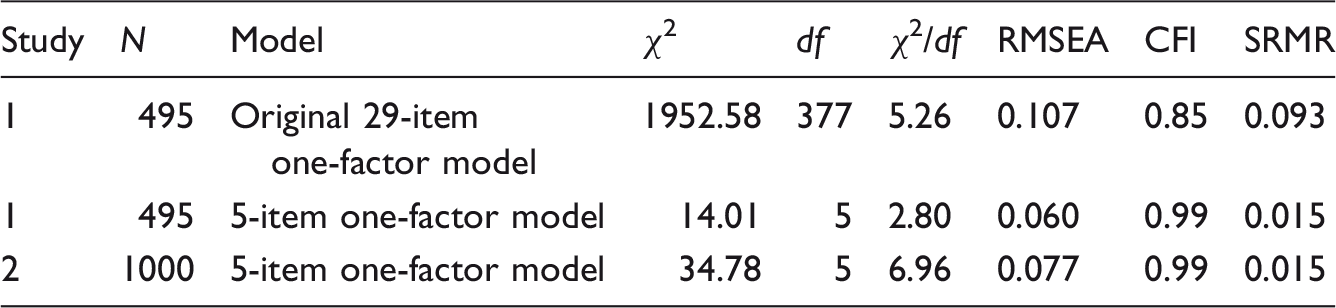
Note: RMSEA: root mean square error of approximation; CFI: comparative fit index; SRMR: standardized root mean square residual.
Therefore, in the next step, we performed an EFA, a principal axis factor extraction with a Promax (oblique) rotation, in order to test the one-factor structure of the Future Anxiety scale. This kind of EFA is recommended by researchers (among others Reise et al., 2000; Russell, 2002; Widaman, 1993; Ziegler, 2014). The obtained Kaiser–Meyer–Olkin (KMO; Kaiser, 1970) index value of 0.96 suggested that the correlation matrix was very well suited for factorial analysis (see Kaiser and Rice, 1974). The Bartlett’s sphericity index of chi-square approximation was 9674.37, df(406), p < 0.001. In choosing the number of factors, we relied on the amount of common factor variance, the scree test (Cattell, 1966), and the content of the factors (Fabrigar et al., 1999; Russell, 2002; Ziegler, 2014). Results suggested a one-factor solution, which accounts for 48.16% of the total variance.
Means, standard deviations, and discrimination indices of items for the Dark Future scale (N = 495).

In the next step of development and validation of the Dark Future scale (Study 2), we replicated the factor structure and reliability of this scale on the other sample of adults and examined the correlations between the Dark Future scale and other instruments measuring time perspective.
Study 2
Method
Participants and procedure
The participants were 1000 Polish adults (50% female, 50% male; aged 18–70 years, M = 42.50, SD = 14.98). In this group, 2.5% had elementary education, 7.7% had middle-school education, 42.5% had vocational education, and 47.3% had higher vocational or university education. The participants lived in villages (24.3%), in small towns (23.7%), in medium-sized town (15.7%), in large towns (24.6%), and in big cities (11.7%). As regards their relationship status, 48.9% were married, 31.6% were single, and 19.5% were in open relationships. Participation in the study was voluntary. The research was conducted online, between September and November 2015. The participants received shopping vouchers as a form of remuneration. Ethical standards were maintained (Birnbaum, 2007).
Materials
Pearson correlations between the Dark Future scale and other time perspective scales (N = 1000).
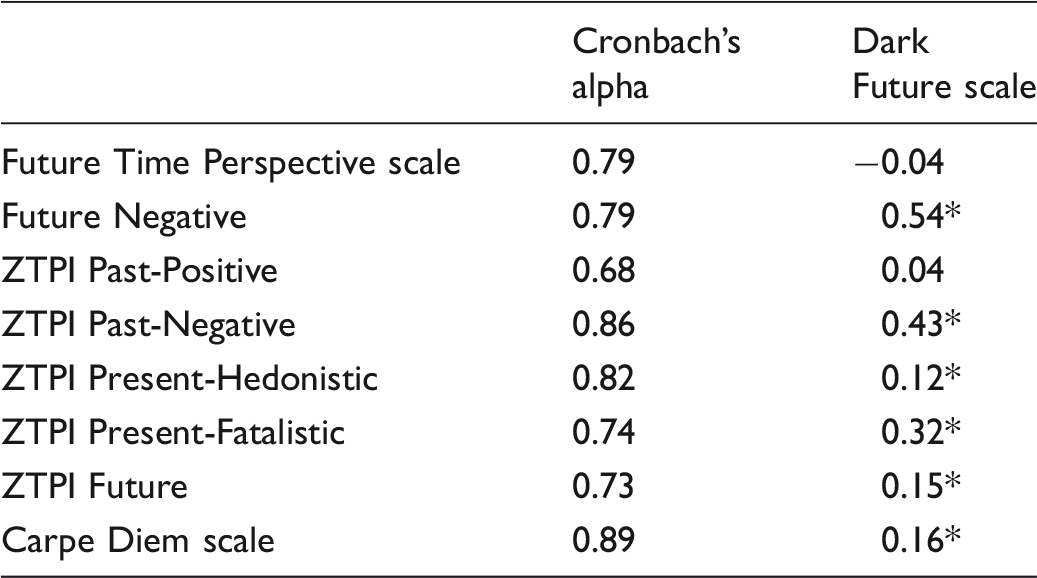
Note: ZTPI: Zimbardo Time Perspective Inventory.
p < 0.001.
Dark Future scale
We used the Dark Future scale to measure future anxiety. The instruction and Likert-type scale for responding were the same as in the Future Anxiety scale described above.
Future Time Perspective scale
The Future Time Perspective scale (Carstensen and Lang, 1996) measures the extent of perceiving the future as more expansive (high scores) or limited (low scores). This scale consists of 10 items (e.g., “My future seems infinite to me”). The respondent indicates his or her answers on a 7-point scale (from 1 = very untrue to 7 = very true). We used a Polish translation of the Future Time Perspective scale.
Future Negative scale
The Future Negative scale (Carelli et al., 2011) consists of 10 items. It measures the tendency to concentrate on the negatively evaluated future and the feeling of inability to pursue goals (e.g., “Usually, I do not know how I will be able to fulfill my goals in life.”). Two items are from the Future scale of the Zimbardo Time Perspective Inventory (Zimbardo and Boyd, 1999). Participants give their responses on a 5-point Likert scale (1 = very uncharacteristic, 5 = very characteristic). We used a Polish translation of the Future Negative scale (see Przepiorka and Sobol-Kwapinska, 2016).
Zimbardo Time Perspective Inventory
The Zimbardo Time Perspective Inventory (Zimbardo and Boyd, 1999) measures five types of time perspective by means of the following subscales: Past-Negative (focus on the negatively evaluated past), Present-Hedonistic (focus on pleasure “here and now”), Future (a tendency to think about the future), Past-Positive (focus on the positively evaluated past), and Present-Fatalistic (living with a belief that life is determined by fate). Participants give their answers on 5-point scales (from 1 = very untrue to 5 = very true). We used the Polish translation of the Zimbardo Time Perspective Inventory in this study (Sobol-Kwapinska and Jankowski, 2016).
Carpe Diem scale
The Carpe Diem scale (Sobol-Kwapinska, 2013) assesses active and positive focus on the present, combined with perceiving each “here and now” as precious and important. This scale consists of 12 items (e.g., “What happens in the present is very vital for my life”) with a 5-point answer scale (from 1 = very untrue to 5 = very true).
Results and discussion
First, we performed a CFA for the Dark Future scale to confirm the model fit. The results are also reported in Table 1 for easier comparison. The one-factor model has a good fit to the data; the reliability for the Dark Future scale was 0.90, very similar to that found in Study 1.
In the next step, we tested the validation of the Dark Future scale by correlating it with measures of other types of time perspectives. We postulated that the Dark Future scale would correlate positively with the Future Negative scale and strongly positively with the ZTPI Past-Negative scale (see Carelli et al., 2011; Zimbardo and Boyd, 1999). We also hypothesized that Dark Future scale would correlate negatively with the Future Time Perspective scale and the ZTPI Future scale because these two scales measure positive attitudes toward the future and focus on activity related to the future—formulating aims and planning (see Zimbardo and Boyd, 1999, 2008). According to our speculations, the Dark Future scale should be negatively linked with the tendency to concentrate on the “here and now” measured by the Carpe Diem scale—individuals who are focusing on the present tend not to worry about the future because their mind is occupied with what is happening in the present moment (see Sobol-Kwapinska et al., 2016a).
Table 3 presents the Pearson correlations between the Dark Future scale and other constructs. What is worth noting is that age does not correlate with future anxiety, whereas gender affected the results: males showed lower future anxiety than females (t = 5.22, p < 0.001). The assumption regarding the positive relationship between future anxiety and negative attitudes toward future goals was supported. Similarly, there was also a positive correlation between future anxiety and focus on negatively evaluated past. This is consistent with the fact that, as revealed by other studies (e.g., Zimbardo and Boyd, 1999, 2008; Zimbardo et al., 2012), a negative view of one’s past is linked with a negative assessment of the future. Yet, contrary to our expectations, the Dark Future scale did not correlate negatively with the Future Time Perspective scale and the ZTPI Future scale. There was a significant positive correlation between future anxiety and the tendency to plan and think about the future. Also contrary to our assumptions, future anxiety correlated positively with Carpe Diem time perspective. To sum up, these findings provide sufficient support for the construct validity of the Dark Future scale.
We also examined the test–retest reliability of the Dark Future scale on a sample of Polish adults. The group of participants consisted of 2952 Polish adults (34.9% were female and 65.1% male; the average age was 48.52 years, SD = 15.30, range: 18–75 years). The test–retest reliability of the Dark Future scale over a one-month interval was r = 0.618 (p < 0.001). It appears that scores on this scale are relatively stable.
General discussion
This article presented two studies intended to develop a short version of the Future Anxiety scale—the Dark Future scale. The results of our studies suggest that the 5-item Dark Future scale has good psychometric properties. The test–retest reliability over a one-month period was adequate. This indicates that future anxiety is relatively stable in the Polish sample. As regards the factor structure of the Dark Future scale, confirmatory factor analysis indicated that a model with one factor had a relatively good fit to the data for the Dark Future scale.
When interpreting the relationship between future anxiety and other psychological variables it is worth referring to the conception of micro and macro worries. Micro worries there are worries about oneself and about close relationships, while macro worries are related to society and the world (Boehnke et al., 1998). As in the case of worry, in the cognitive aspect of future anxiety we can distinguished the object that anxiety is linked with and domain—the sphere of life that anxiety is related to. The Dark Future scale consists of items that refer to the self (object) and are mostly general, not related to specific life domains. Only the last item contains a reference to goal realization.
The hypothesized negative relations of future anxiety with the perception of the future as an open space full of possibilities, planning, and focusing on the present were not confirmed. This finding may be interpreted as showing that future anxiety does not necessarily determine thinking about the future as a limited space. According to the classic Yerkes–Dodson law (see Broadhurst, 1957), some amount of fear may have constructive properties as well as motivate the person to work and formulating goals (Seijts, 1998). This supposition is also confirmed by the positive correlation between future anxiety and the tendency to frequently think about the future. Speculating along the same lines, future anxiety may have a motivational value by inducing the person to plan and act accordingly, for example, in ecology, weight control, and alcohol or drug usage. The question arises of how intense the anxiety should be in order to be a motive rather than a hindrance of action.
When measured by the Dark Future scale, future anxiety was correlated positively with the tendency to focus on negatively evaluated future. This is understandable because anxiety is a negative emotion. The correlation, however, was not very high. This means that future anxiety can be to a large extent a state, dependent on life circumstances.
Contrary to our expectations, future anxiety measured by the Dark Future scale positively correlated with Carpe Diem. Perhaps individuals with high scores positively evaluate the present time, but it is more frightening for them to think that the good present times could worsen in the future. This may also suggest that both Carpe Diem and future anxiety involve some kind of tension. Carpe Diem involves pressure to profit and take advantage of life as much as possible, while future anxiety means tension evoked by expecting future threats. This result can also be interpreted as suggesting that the construct measured by the Dark Future scale is largely related to the conviction of the elusiveness and value of present time. This is consistent with the theoretical predictions (Zaleski, 1994, 1996) that future anxiety leads to a focus on current issues in order to defend oneself against negative emotions. This can also explain the positive correlation between future anxiety and hedonistic focus on the present. Fatalistic time perspective, which means passivity “here and now” and a feeling that life is out of control, was the present time perspective that was the most strongly related to future anxiety.
It is said that the human being is oriented towards the future. According to the existentialists, there is a certain unfulfillment embedded in human nature because a person is thrown in time and space, always with a gap ahead that cannot be filled as one strives for goals—constantly disappearing horizons that can never be achieved (see Hermans and Hermans-Jansen, 1995).
The fact that a person is faced by an ambiguous space is inextricably linked with some fear of it. People differ in the tendency to feel anxiety, and this fear is also situationally conditioned. A certain level of fear for the future mobilizes effort, gives vividness to experience, and enriches life. However, fear often makes functioning seriously difficult, especially in problematic and stressful situations. Some people have a personality predisposition to react with fear to a variety of life situations. Sometimes, such a tendency leads to the development of psychosomatic disorders; therefore, determining the level of fear for the future may be important in their prevention. This kind of prevention can help to identify individuals at risk of such disorders. This kind of action could be helpful in psychological assessment—for example, for psychologists working in health care or for primary care physicians. Finding a high level of anxiety could also help in formulating a diagnosis in the case of patient with ailments of uncertain origins, for example, migraine headaches, back pain, etc.
It seems that the Dark Future scale could be applied especially in work with people with psychosomatic problems and with people who will soon be confronted with a stressful life experience (e.g., patients awaiting surgery, students before the examination session, people facing important life decisions, etc.). Diagnosing very high fear of the future in such people would be a clue to psychological work aimed, first of all, at reducing the paralyzing and increasing tension connected with the fear of the future. In addition, as mentioned before, the Dark Future scale fills the gap caused by the scarcity of methods available for research on the negative future time perspective. This scale can be an excellent complement to the study, for example, Zimbardo Time Perspective Inventory (Zimbardo and Boyd, 1999).
As regards the limitations of our research, it can be mentioned that the sample was composed only of Internet users. In further investigations, the validation of the Dark Future scale should be performed using samples that represent a variety of populations. It would be also important to use data from other assessment methods (e.g., observational data, physiological measures), not only self-report.
Conclusion
In the current study, a short form of the Future Anxiety scale was developed. The Dark Future scale is a short and reliable method for measuring future anxiety. It offers a way to describe the subjective state of many people facing dangers and thinking of adverse events in their personal life as well as in a broader, global context.
Footnotes
Declaration of Conflicting Interests
The author(s) declared no potential conflicts of interest with respect to the research, authorship, and/or publication of this article.
Funding
The author(s) disclosed receipt of the following financial support for the research, authorship, and/or publication of this article: The research was supported by the grant “Forms of the present time orientation” 2014/14/M/HS6/00910 from the National Science Centre (Poland).