







Abstract
This work poses difficulties in the use of the generation concept as a social research instrument, due to its complex and multidimensional nature. A complexity by which is not a concept widely used in a current Sociology that focuses more on the mathematisation. But some social processes cannot be reduced to algorithms. For the theoretical review we have used contributions from Sociology, Philosophy and History, because it is of a transversal disciplinary nature, and we have applied it to the identification of Spanish generations in the 20th century. Inspired by Ortega’s theses and Strauss and Howe empirical development implemented for American society, the resulting model presents six generations with different collective identities that reflect the social changes in the history of Spain during the last century. A model that, after being tested in sectorial investigations, may constitute a useful new tool for the analysis of social change.
Introduction
The generation concept has been used throughout the 20th century, generally, to analyse the problems related to the younger generation as a social category; or, at most, to talk about generational clashes. However, for it to be a fully operational concept we understand that it should be free from ‘youth’ or ‘new generation’ bias.
As a starting point, we should use the generation concept in a general sense, within a wider conceptual-semantic field, which includes the demographic cohort, the Course of Life, life cycle, life history, life span and life stage, 1 for three reasons. First of all, because during the last decades of the 20th century another age segment has emerged, that of the elderly (with this field linked to ageing), with issues that go beyond those of youth regarding the ‘social problem’, which requires an analysis of the more complex intergenerational relationships which have arisen from the youth versus adult dichotomy. Second, because some transversal age problems have emerged, for which it may be beneficial to analyse the generation concept; as an example, we could mention challenges that have risen from the Welfare State crisis, which has stimulated strong intergenerational cooperation mechanisms to deal with some of its effects. And in third place, the situation created by the new demographic dynamics and the rise in life expectancy 2 allowing various generations (three or even more) to be peers and contemporaries at the same time.
Thus, this generation concept is multidimensional, and therefore, difficult to define and to put into practice. However, being aware of these difficulties, we are also aware of the need for efficient tools for the analysis of social evolution. We have proof that, apart from the main values in each period, and among those assigned to individuals due to belonging to certain social groups (classes or status groups), certain socio-historical landmarks that play a part in shaping minds ‘because they draw their attention and stimulate emotion in millions of individuals during critical education phases, such as childhood and adolescence’ (Baigorri, 2008).
Over and above the need to discuss the concept, the final aim of this work is to suggest a model that identifies the contemporaneous generations during the 20th century in Spain, using both the biological dimension (proximity of years of birth or ‘date areas’ according to Ortega y Gasset), and social, economical and cultural (which circumstances contribute to the creation of individual awareness at period during their lifetime, when they are able to assimilate more and are more easily influenced).
The methodology used includes a wide review of literature about the use of the concept; a definition of the key socio-historical and cultural events in Spain during the 20th century; and a comparative study of the generational models which already exist, have been contrasted and successfully applied to the analysis of social phenomenon (Becker, 1977, 1992, 2000, 2012; Strauss and Howe, 1991, 1997).
Thus, in the first part of the article we deal with the development of theories that have been made regarding the generation concept. Basically from sociology, but without ignoring substantial contributions from other disciplines. In the second part we go through the existing generational models that put the concept into operation and apply it to social analysis. The third part is an exercise in specification of the previous steps by presenting an appropriate generational model for the analysis of social evolution in Spain during the 20th century. Finally we examine the most controversial and problematic aspects that the concept application presents, because, as we have already stated, it is not without limits.
Theoretical framework
The generation concept, in no man’s land
The generation concept is extremely ambiguous. Although we are approaching it from a sociological point of view, it is impossible to rule out other disciplines since the principle is interwoven between the positive Comtean sociology, the philosophy of history and literary criticism.
We can find two schools in the sociological origin of the concept: the French positivist and the German historicist. The founder of the first, Auguste Comte, develops a mechanical, linear concept, based on the amount of time required for one generation to substitute another: 30 years would be the time needed for this to happen (Comte, 1838: 625). While the historicist school does not focus on the mechanical continuity and succession of generations, but precisely on the discontinuity that each one imposes on the course of history (Dilthey, 1875). What would therefore be important is the bonding quality that unites members from one generation who have shared political, social, intellectual or artistic events.
This rupture with Comtean positivism presents an almost unsolvable methodological difficulty, because the key is not now in objectively establishing the ‘amount of time’ needed to determine the change from one generation to another, but to identify how ‘the quality of shared socio-historical experiences’ influences people’s lives.
Within literary criticism the original proposal by Julius Petersen in his Die literarischen Generationen (1930) is outstanding, where he rejects the basic biological facts about the generation and looks more deeply into historical aspects, where he identifies eight key factors: heritage, date of birth, educational factors, personal community, common generational experiences, political leadership, generational language and exhaustion of the previous generation. The approach will be criticised by Julian Marias because of considering it to be confusing, due to adding such diverse variables that would make a definite conclusion, about what a generation really is, more difficult (Marias, 1949: 23).
Gertrude Stein will inadvertently provide grounds for the concept, by putting emphasis on the social–historical aspects that connect to what she called a ‘lost generation’: those writers (Dos Passos, Pound, Caldwell, Faulkner, Hemingway, Steinbeck and Scott Fitzgerald, mainly) who narrate the story of the deep economic depression and the United States social development following the 1929 crisis. They all lived in Paris and other European cities between the end of the First World War (1918) and the Great Depression (1929), which unites them because they had all seen the horrors of war.
The original proposals of Ortega and Mannheim
These more or less rigorous approaches, be it from a literary or sociological point of view, create a turning point in the important work of José Ortega and Karl Mannheim.
Ortega’s definition of generation implies the coexistence of various generations at the same time in history, which creates the need for the distinction between peers (being the same age) and contemporary (living at the same time). What is decisive in the idea of generations is not what happens, but that they overlap one another. Five periods of 15 years are identified, which correspond to five stages of life: (1) Childhood (the first 15 years), (2) youth (15–30), (3) early maturity (30–45), (4) maturity (45–60) and (5) the elderly (from the age of 60 to 75).
For the author, in En torno a Galileo, ‘generations act at the same time […] related to the same topics […] but at different ages and, because of that, in a different way’ (Ortegay, 1964: 49). Each of these generations moves at two levels: ‘one consists in accepting and learning from the previous experience of older generations, the other would be to let their own spontaneity flow’ when there is sufficient homogeneity between what is inherited and their own life experiences, the generation lives in a cumulative periods; but when there are big differences the generations live times of separation, which the author calls ‘combat generation' (Ortega, 1966: 149) Completas. The results are quite different: ‘In the first case, young people are conditioned by the elderly in politics, science, arts […]; those are the times of the elderly. In the second it is not a matter of conserving but of substitution, then the elderly are ‘swept aside by the youngsters’. These are the times of younger generations and ‘constructive belligerence’, say in El Tema de nuestro tiempo (Ortega y Gasset, 1966: 149). This change of pace between cumulative times and constructive belligerence, and times of the elderly and youngsters, is the driving force of history for Ortega. It is that difference in meaning which causes change, the innovation. When there is a very big change we talk about a historical crisis. In this context a ‘decisive generation’ may appear: that is able to build the foundations of a new society, and new guidelines that later generations will be either accept (or reject).
Although it is certainly Ortega who does the earliest reprocessing of primitive theories, the preponderance of the Frankfurt School in the western canon has made the work by Mannheim be taken as the most frequently applied basis. Also, unlike Ortega, for whom the generations’ theory is a philosophy of history, Mannheim presents his proposal as a knowledge sociology (Sánchez De La Yncera, 1993)
Mannheim sets up the generation concept, based not so much on the date of birth as on sharing the same situation, that is the point at which the time when history and living conditions are connected. This sharing involves the creation of a link between generations, consisting of interruptions in the historical process, discontinuity experienced at a time in life when the socialising process is not complete, and therefore, the frameworks used to interpret reality are still flexible.
Mannheim looks deeper into the generation concept by using three aspects: position, connection and generational alliance. The ‘generational position’ is based on the existence of the biological rhythm: ‘One finds oneself in a similar position to that of others in the historical current of social events due to belonging to a generation, born in the same year’ (Mannheim, 1993: 208). To be included in a generational position individuals must be subject to the same decisive socio-historical factors, cope with the same obstacles as well as the same opportunities. And that is why you must not only be the same age as your peers, but also have been born in the same social–historical context. People born in the same year do not belong to the same generational situation, but belong to different social classes, societies and cultures, that are subject to different socio-structural forces.
The ‘generational link’ is something more than belonging to a particular socio-historical unit; it involves ‘any direct link […], participation in the common destiny of that unit’ (Mannheim, 1993: 221). This refers to both tangible and intangible aspects of culture, and is related to those peers, who (actively and passively) participate in the social and spiritual tendencies at that time.
Different, even opposite generational units can be found within the generation link. Ghiardo (2014) explains how Mannheim’s precision, regarding generational unity is shared by Bourdieu. Both share the idea that generations are something more than age groups. And more than thinking of an Orteguian type of collective identity model, it would be more appropriate to talk about identities, habitus according to Bourdieu, as social–historical life experiences depend ‘on their position in social time and space’ (Ghiardo, 2014: 25).
For Mannheim, in essence, the generation understood only in terms of age, in being close in years of birth, ‘does not explain any sociological phenomenon’. There is a need to include the effects of having been subjected to deciding factors of historical forces at some time during their lifetime, when they still may be highly influenced and the socialisation process has not concluded. And even this is not the cause of just one collective identity, just one view of the world; on the contrary, it depends on people’s social status, on the economic, social and cultural conditions they move in. These are the factors that will determine ‘possible ways of gaining experience and awareness’ (Mannheim, 1993: 24).
Sociology of generations…or the generation conflict?
Approaches to generation analysis from historical aspects will be no less ambiguous. Alan Spitzer (1973: 354) points out that ‘their developments, being an interesting resource for historians, social scientists also fall into the tendency, (…) of a slippery and ambiguous, use that blurs differences’. Following the work by Troll (1970), Kertzer (1983) reorganises the elements, which constitute the generation concept, into four categories. And although he warns against mixing sociologists’ definitions, the fact is that modern historians based their approaches on sociological contributions. Thus, Ciccheli et al. (2006) analysing the language used in the American sociological literature, between 1940 and 2000, have identified four approaches related to age, generation, life cycle and life course, that do not share the use of the same vocabulary, that is to say, that epistemologically or methodologically do apply clearly different approaches to the crossroads between individual and collective temporary matters. And that is because the concept of generations is actually used even in antithetical senses sometimes.
We could divide the sociological approaches into two types: on the one hand, a ‘promise’ approach to the concept, managing it in a colourful way, usually as a mere support to create certain theses. That would be the richest and most creative sociological approach and we can find it in David Riesman, Charles Wright Mills, Georges Lapassade, Daniel Bell and Alvin Toffler. Riesman dedicates one chapter of his book ‘Abundance For What?’ to reflecting on the generations, which ‘are not produced in batches, like cakes, but are constantly being born. And only in certain countries and at certain times do historical events […] lead to a generation gap and not to a smooth and silent chain of events’ (Riesman, 1965: 341) as Comte pointed out.
For his part Lapassade (1963) goes back to the question of generations as a fundamental component of his thesis on the ‘unfinished nature of mankind’. The author develops his concept of ‘endless adolescence’ based on the evidence provided by another sociologist, Berger (1960) interested in setting limits on the size of generations. Espina (2007) suggests that Wright Mills also began to apply this totally free concept to generations, to the extent that the work by Ortega was included in the theoretical model, which is the idea that the individual can only understand their own experience and evaluate their own destiny by situating themselves in their own period; from which they can learn about their own possibilities in life if they know about those of all those individuals who find themselves in the same circumstances. (Wright, 1961: 25).
Bell (1962) also works on the issue. In the chapter on ‘The end of ideologies’ dedicated to the state of mind of three generations, there is an attempt to apply the Orteguian model. Toffler also elaborated on the generation concept. In Future Shock (Toffler, 1971), and based on the work by the communication theorist James Carey (1967), he raises the question of how social difference has ceased to be spatial and has become temporary: close or distant societies are starting to look more like one another, but the different age cohorts, faced with an increase in acceleration, are hardly recognisable, already pointing to a rise in intergenerational conflict. In the Third Wave (Toffler, 1982) textually includes the Orteguian idea that ‘some generations are born to create a civilisation, while others are born to maintain it’ (Toffler, 1982: 355).
The second approach from sociology is more pragmatic, seeking to explicitly resolve the methodological problems presented by the topic. Although it has not so much been directed towards resolving problems related to the generation concept, as towards defining new clearly differentiated concepts; and in this sense we can say that the results, from an academic point of view, are higher than average.
Samuel Noah Eisenstadt (1956) was the first person to try a systematic mechanism, within the framework of his research on young people from different countries. His book From Generation to Generation: Age Groups and Social Structure is considered by some to be one of the basic classical texts (Eyerman and Bryan, 1998); although other specialists do not pay so much attention to it (Kertzer, 1983).
Other authors chose to extract clearly distinguishable components from the generation meta-concept, although in actual fact, they were difficult to differentiate. That is what happened to Norman Ryder (1965: 845), who defines a cohort as ‘an aggregate of individuals, (within a specific population) who experience the same events during the same periods of time’ presenting it as the most efficient tool for social change research.
There have been attempts during centuries at positively addressing the unresolved basic methodological difficulties, and the question of how long a generation lasts, although, without any significant agreements (Berger, 1960).
Another suggestion to overcome the limitations between the structure and the individual is the paradigm of the Family Life Cycle by Erik Erikson (1980). Although specifically referring to the change in domestic roles and based on a psychologist parameter, he tries to reconcile comprehension of the meeting points between the social structure and situations of a temporary nature. But, as Elder (1998: 6) said in a negative observation ‘it does not situate people according to their development status and their historical context’.
The ‘Life Course’ by Glenn Elder is a significant attempt to overcome the limits of Eisenstadt, who created a common theoretical framework, which includes the interactions and interdependency between: (a) the biological and psychological development of the individual; (b) the social–historical frameworks within which life unfolds, as well as models of life styles that society, as a whole, creates; (c) the individual life styles, which are led within the framework of commitments and possibilities defined by (a) and (b). These approximations, in general, have been closely followed by European and Latin American authors, with interesting advances in Swiss sociology (Cavalli and Lalive D’Epinay, 2009). Although these research projects stop revolving around the younger generation to focus on the older generation, generally in ageing processes.
For the French researcher Claudine Attias-Donfut (1998), who has worked hardest on the conceptualisation of the concept over the last decades, the sociological concept of generations is a sociological concept of time, although there are difficulties in finding a balance for different views of the generation term. Distinguishing between the four generational terminologies: the genealogical (linked to relationship and kinship structures and the concept developed by Eisenstadt); the historical (linked to the power transition processes, which would be affected by the difference between the average age of father and son); the demographic (referring to cohorts in the sense used by Ryder) and the sociological in itself, which is that which is related to Mannheim’s conceptualisation and, therefore to Ortega (Attias-Donfut, 1991), although he shows a greater interest in intergenerational relationships in his later work (Attias-Donfut, 2000).
Pier Paolo Donati, the Italian sociologist partially follows the work by Attias-Donfut, which he calls Relational Sociology, but slightly separates from the four categorisations. For Donati (1999: 33) the strictly sociological generation concept ‘should not be confused’ with the demographic cohort, nor with the more anthropological kind of age group or structural-functionalism (age group), not even, in his opinion, with Manheimm’s ‘generational unity’, which he defines as a ‘age subgroup, which creates and directs social and cultural changes’.
Another significant structuring attempt was that of the English sociologist, Philip Abrams, for whom individualism and society are socially created, so there is a need to know their interactions within time. Connecting identity and generation as the ‘period of time during which a personality is created, based on resources and meanings that are socially and historically available’ (Abrams, 1982: 240). Following the accordion approaches by Bloch (1949), a generation can last for 10 years or may last for various centuries, as occurs in pre-modern societies. ‘They end when big historical events empty the previous system of content, so that the beginning of the next generation is always the result of the lack of continuity in the dominating historical and institutional world at that time’ (Abrams, 1982: 240).
All the more recent approaches coincide in pointing to the generation concept as a variable geometrical idea. For example, the French sociologist Marc Devriese (1989) approaches the concept from a multidisciplinary definition, covering different aspects. He addresses family conflicts between parents and children and juvenile–adult social conflicts taking the psychoanalytical concept of the Oedipus complex into consideration, and he studies the entrance and exit of members of the pyramid age, their dynamics and interactions from a demographic perspective. The generation (although it depends on the biological birth and death rhythms) would indicate a common stance of individuals on a historical level of the social process, expressing a subjective difference according to the levels of awareness: older individuals, faced with any historical event, will create relationships by finding similarities in their memory and reorganising content and meaning; while for youngsters it will be their first experience without any previous references to build on. Thus, there is a subjective difference, which separates individuals, depending on their experience and the impact of their interpretation of events. However, Devriese does not face the decision of choosing a way either; he rather suggests ‘thinking generationally’ (Devriese, 1989: 15), and perhaps it is the most appropriate way of reacting to this problem. Therefore, we found nothing new to help us put the concepts into practice, apart from his encyclopaedic multidisciplinary approach.
On the other hand, the analysis of the generational conflict specifically focuses on the decade of the 1960s and goes from psychoanalysts to functional approaches. One of the fundamental contributions is the concept of the generation gap (generation abyss), which was made popular by the anthropologist Margaret Mead (1970). And work by Alfred Sauvy, the sociologist and demographer, especially ‘La montée des jeunes’ (1959), made people in France and throughout all of the Western world aware of the apparently contradictory, but closely related realities: of the impact of the Baby Boom on the transition of generations and ageing. From the psychoanalytical theory, Gerard Mendel, after announcing the end of the patriarch society (Mendel, 1968) published a complicated but shocking essay on the subsequent generational crisis (Mendel, 1972).
Along another line, in 1963, a collective volume, paying homage to Gaston Berger (founder of the modern prospective) gathered the earliest contributions about the emerging intergenerational conflict, in such different areas as the former colonies in Africa and rural France. There is a hypothesis that the conflict between generations is not a permanent phenomenon, and should not be considered to be the cause of social change, because the younger generations are not always agents of social change, and because generational conflicts are sometimes secondary circumstances related to structural problems (De Maupéou, 1964).
Philip Abrams (1970) analysed the generational conflicts in the English-speaking world, such as the appropriate transient rites in the Industrial Society, while for Feuer (1969: 173), even being standard processes, they do not occur as events in modernisation, but more as a result of a key social factor: the existence of a ‘gerentocratic’ generation, which blocks the natural flow of generations. 3
The intergenerational conflict currently has various interpretations, the most outstanding being the warning by the environmental economist Lester Thurow (1996) in the US, pointing the spotlight at the budget for the elderly (a rise in Medicare funds) in comparison to finance for university student education (an increase in university fees).
In Europe, the sociologist Henk Becker (2000, 2012) has been warning about the risk, as of 2010, of Baby Boom cohorts reaching the age of 65. These relatively well educated and healthy cohorts, with substantial pension and health rights (called Lucky Devils by Becker, 2012), make those cohorts born after 1985, who should join the work market on the same dates, have to pay a lot of extra taxes during an over 40-year long working life (generation known as Unlucky Dogs). For Becker the unequal redistribution of encumbrances could be the cause of intergenerational conflicts. In Tepe and Vanhuysse (2009) tendencies towards gerontocracy are suggested in countries with mature welfare states; the power of the older generations facing the younger would be proof of the over-representation of the first in all political and social institutions. From an economic point of view, on the other hand, at least in Spain, Boersch-Supan et al. (2011) do not see any risk of conflict between generations.
In this itinerary we should not ignore the radical criticism that some authors (Purhonen, 2016) make starting with Bourdieu (1985), understanding that the generation concept would blur that of the social class. But that perspective does not help our intention of creating working models.
From theory to praxis
Introduction to the Strauss and Howe model
Despite all efforts made during more than a century related to the generation concept, the fact is that it is one thing to theorise and quite another to apply it to understanding or resolving social problems (Corsten, 1999). The evidence that generations, cohort studies, lifetime and stages of life are totally distinct in theory, but difficult to distinguish in research praxis, makes it necessary to reinstate all of these elements. Along this line, the American historians William Strauss and Neil Howe have developed one of the most ambitious attempts at the practical application, not the current classification of the American society, but over and above that, and taking into consideration that is a more appropriate dictum for sociology than history, in an attempt to predict future processes.
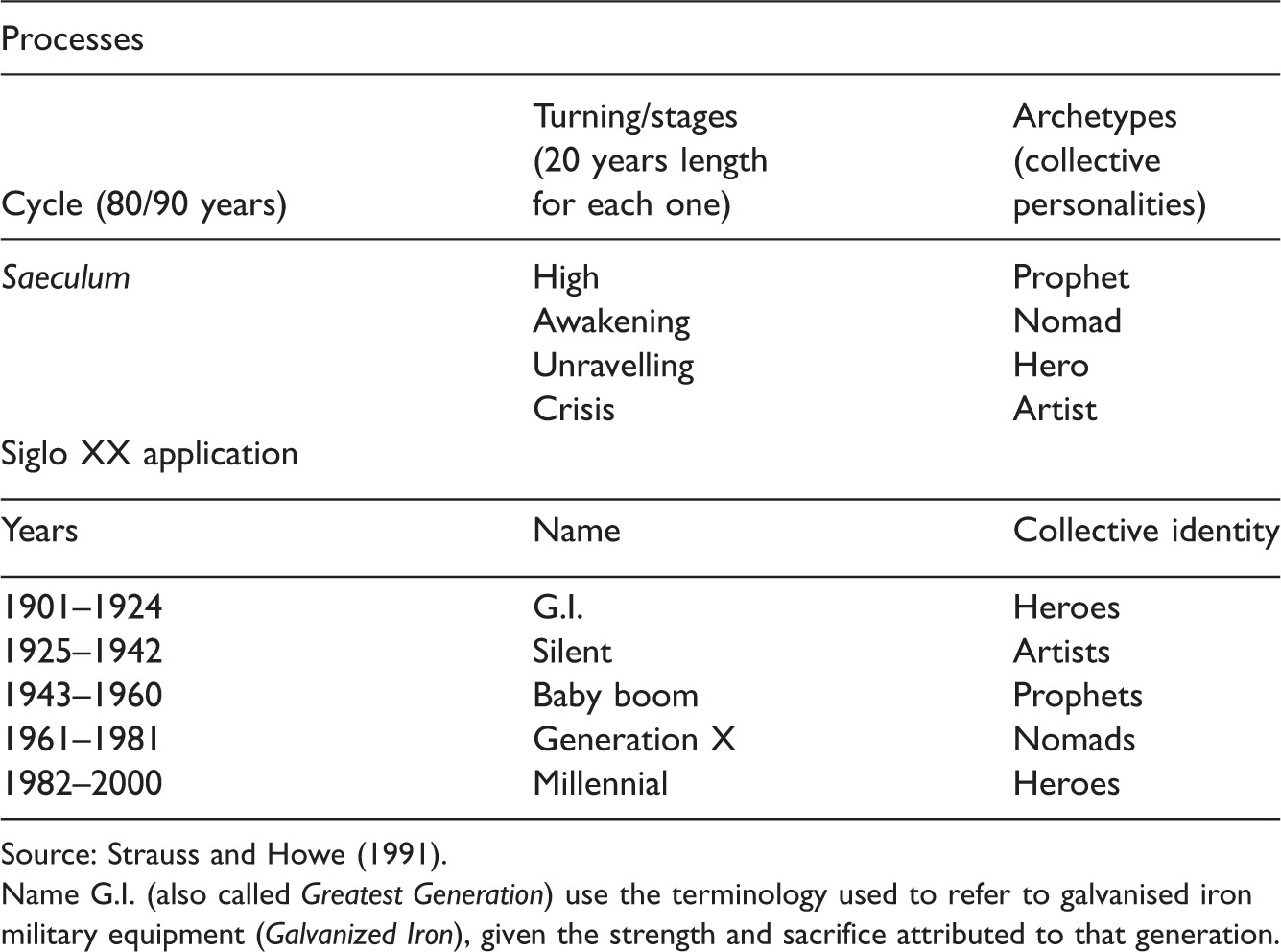
Strauss and Howe (1991, 1997) and Howe and Strauss (1992) reassemble all these elements, which have gradually been destroying the generation theory. They redevelop it and combine it with cyclical models in the style of the historian Arnold Toynbee or the sociologist Pitirim Sorokin. Their model recognises four 20-year phases of generational cycles, which would be repeated in a recurrent way throughout the history of the United States, from 1584 until now, and will continue into the future. According to the authors, this cyclical ‘saeculum’ of approximately 80/90 years is not only in the United States, but may be found in other advanced Western countries (Table 1).
In the model there are four basic concepts; some are part of the traditional generation theory, and others are new:
The turning, stages or changes, each one of approximately 20 years, make complete generational cycles. They are called The High, the Awakening, the Unravelling, and the Crisis, depending on whether they express stability or economic and institutional crisis. The life stages correspond to the four stages in the life of each individual, which have a length of about 20 years: Children (0–20 years old), young adults age (21–41 years old), middle age (42–62 years old) and elderly (63–83 years old).
4
The generation cohort, made up of a group of people, who feel that they are part of a special place in history because of shared experiences, live the life cycle at the same time and the same stage of the life cycle. The generational archetype expresses the collective identity of one generation. These identities (prophets, nomads, heroes and artists in their terminology) are the result of a greater or lesser presence of strong institutions and social order, which, at the same time allows different kinds of individualism and personal freedom, or new life styles. Synthesis of the generational model by Strauss and Howe. Source: Strauss and Howe (1991). Name G.I. (also called Greatest Generation) use the terminology used to refer to galvanised iron military equipment (Galvanized Iron), given the strength and sacrifice attributed to that generation.
Other empirical approaches
Advertisers and marketers have developed generation models (which tend to appear in the media before the Academy) that they want to add to the presented model.
US Generations in Strauss and Howe versus Carlson.
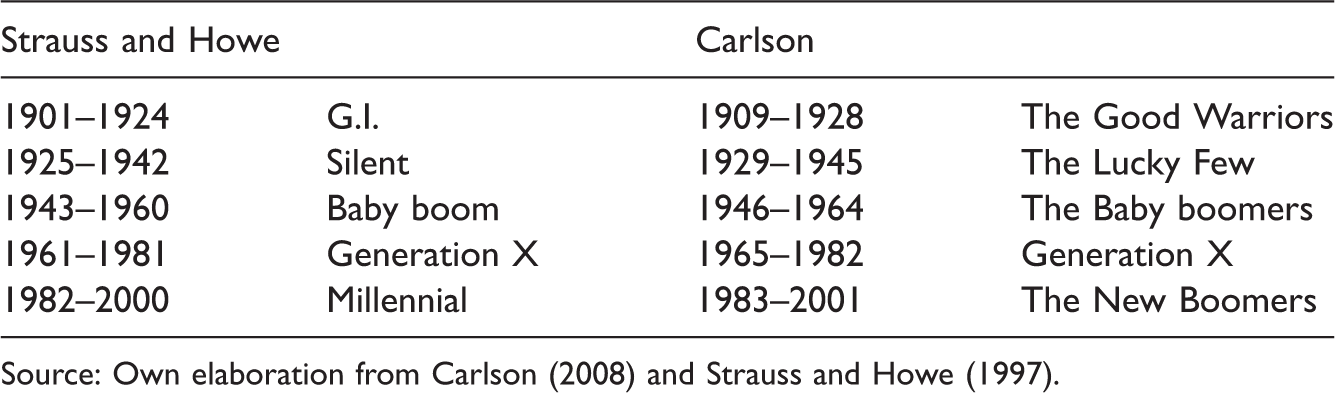
Source: Own elaboration from Carlson (2008) and Strauss and Howe (1997).
As an additional more solid proposal, to that of Strauss and Howe, and in this case related to demography, we find the sociologist Elwood Carlson (2008, 2009). However, although some of the names and the entry and exit years for each cohort have been partially modified (not maintaining the normal number of 18 years), and some of their names, the model put forward is basically the same as Strauss and Howe for the 20th century (Table 2).
Outside of the United States the model has been applied with different results. So, the Canadian Census Office extended the number of generations to seven for living cohorts in the 2011 Census (Statistique Canada, 2012).
What is obviously different is Dutch sociologist, Henk Becker’s approach (1992, 1997), which avoids both the historicist approach of Strauss and Howe and that of marketing. His work is directed towards understanding the role in organisations, of the generations, which Bontekoning (2008) also applies to the intergenerational conflict in organisations (Table 3). Although Becker also recognises five living generations for the Netherlands, he slightly modifies the temporary cohort location and size, as well as some names.
US generations versus Dutch generations.
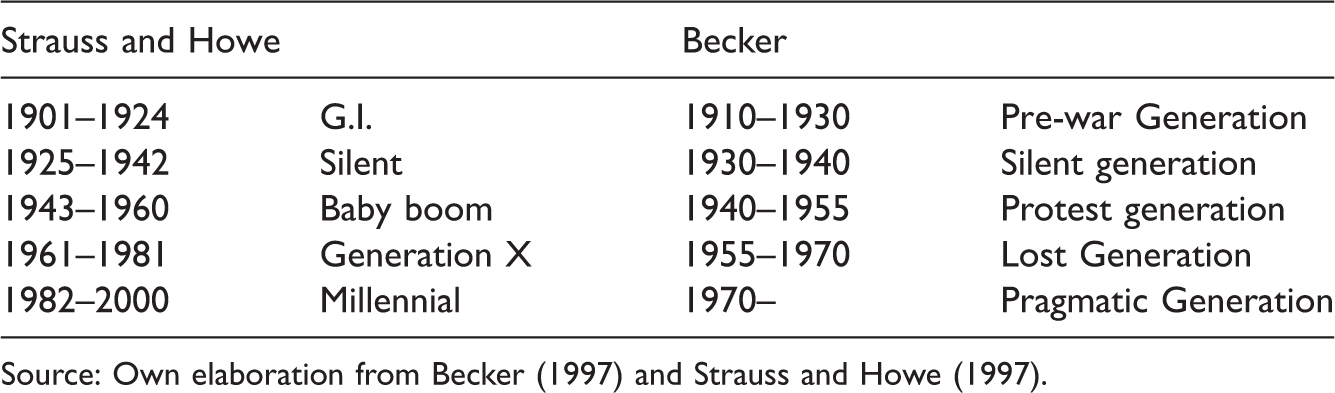
Source: Own elaboration from Becker (1997) and Strauss and Howe (1997).
Generations US, Dutch and Spanish.
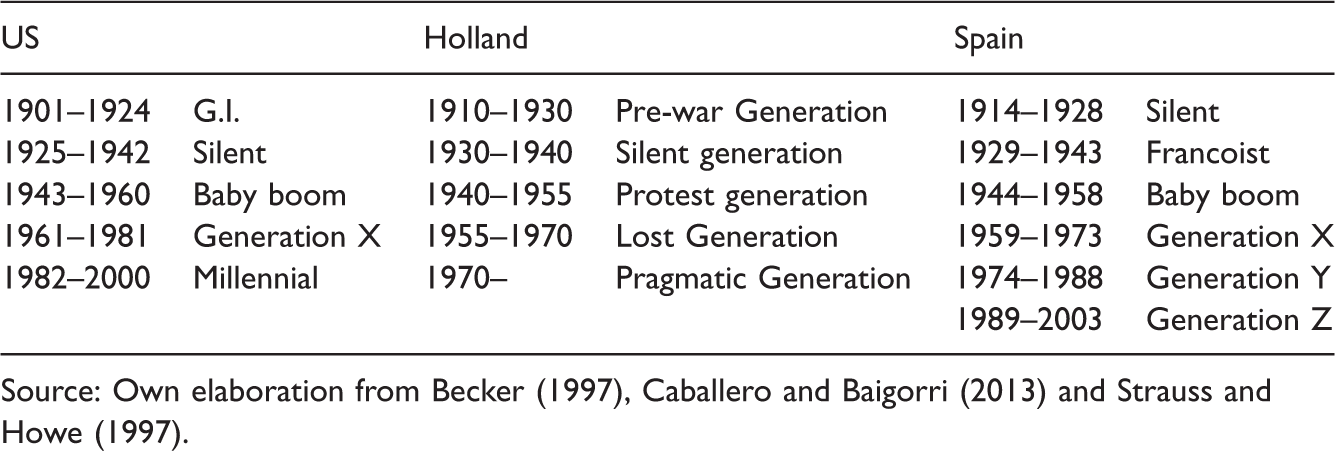
Source: Own elaboration from Becker (1997), Caballero and Baigorri (2013) and Strauss and Howe (1997).
However, and although we can find interesting contributions (especially because of what they have as an indication of the need to include the concept), none of the cases mentioned suggest an analytical structure for Spanish generations alive today.
Results: A proposal for a generational classification of 20th century Spanish society
Being aware, as stated above, of the operational limits of the concept, we have tried to create an adaptation of the Strauss and Howe model for the Spanish case. Basically the American model would be adapted, except for the existence of a specifically Spanish generational split, between the Silent Generation and the Baby Boomers, marked by the interruption of the Dictatorship of Franco and what the institutionalisation process involves (repression, post-war hunger, cultural decline, a reverse in customs, international isolation, etc.). So, those born between 1929 and 1943 are considered to be the Francoist Generation in terms of their socialisation being so greatly affected by the elements mentioned (which undoubtedly created a resilient need to adapt for millions of families), as well as the ideological image efficiently transmitted through cultural broadcasting mechanisms. The introduction of this change in our model makes classification by cohorts coincide, to a large extent with the proposal made by Becker for the Netherlands (Table 4).
According to the age (using the 15-year-old cohorts of Ortega y Gasset) as well as the main historical, economic, cultural, and social, etc., events that occurred, we think, it is possible to distinguish the following generational heritage, within the 20th century.
Conclusions and discussion
This paper has highlighted the difficulties of implementing a concept – that of generation – which, although little used in sociology, is an increasingly necessary variable in social analysis.
We believe that old/young dialectics should be developed on more complex bases than traditional ones, taking into account the weight of the generations. There is a common thread in social sciences literature – the vision of generational confrontation as a young/old dialectic. Young people represent the idea of change and the most progressive ideas; facing them are the ‘elders’, representing conservatism (Cornelis et al., 2009). But we have observed that at different historical moments of the 20th century, the roles of older people and of the youth have been unequal. Sticking specifically to the case of Spain, in which we are interested, in the most recent periods of civil unrest, for example ‘los indignados’ (‘the indignants’) of 15-M, also known as the Spanish Revolution, or in the separatist conflict in Catalonia, 5 a new concept has emerged – the ‘yayoflautas’, 6 a name used pejoratively to describe the many retirees (belonging to what we call the ‘Francoist Generation’) who have participated in such unrest.
There are also people of that generation among the intellectual leaders of recent revolts. The philosopher Agustín García Calvo, who participated intensely in the early stage of the 15-M movement, participated during his youth in the social protests in the heart of the Franco dictatorship towards the end of the 1960s (Ruiz, 2016). We see, therefore, generational connections that overlap mere age groups.
However, the generality of such approaches ties in nicely with explanations relating to age groups, as can be seen in Fernández et al. (2013). They regard recent global revolts as part of a ‘thread’ that would connect successive cohorts of former youth, practically until the protests which originated in Seattle (1999).
But there have not been continued protests and there is not a continuous cycle. In reality, different cycles of revolts are not emboldened by the same generation, and therefore the results are very different. The cycle of protests at the turn of the century generated a strengthening of Civil Society. But, noting the case of the Spanish protest movements of 2011, these generated new political parties (Podemos and Ciudadanos) which have broken the bipartisan hegemony. Interestingly, it is a result which, in a way, is similar to that of the late 1960s (although the social and political structure is not comparable, since there was a dictatorship in Spain at that time). Then, the revolts also gave rise to the appearance of new political organisations (of Maoist inspiration, the Greens, etc.).
In this respect, we believe that our work contributes to overcoming this analysis based on mere young/old dialectics. And to better understand those dynamics according to the generational ‘identities’ of Ortega y Gasset and/or of the ‘generational units’ of Mannheim.
Another important factor which is subject to discussion is undoubtedly the time a generation lasts. The social acceleration discussion 7 and the increasing delay in the access to the stage of maturity for individuals, through the extension of the ‘social placenta’ (Baigorri et al., 2004: 43) in the most advanced societies, enable us to point out that it may be necessary to increase the number of cohorts that are considered part of a generation. We have also pointed out the incipient importance that an increase in life expectancy should have in these models. For the same reason, a cyclical generational model composed of a number of fixed cohorts that could express recurrent archetypes will be increasingly questionable.
By way of conclusion, we understand that the concept has passed through cyclical phases of aggregation of elements and other phases of deconstruction and clearing. Over time, however, three fundamental dimensions have been present that constitute its essence: biology (the dates or the range of dates during which they are born); demographic (which includes cohorts and age groups, especially those stages of life in which the conscience of individuals is more vulnerable – childhood and adolescence); and historical/cultural socio-structuring factors that mark the consciences and endow the generation with certain, or certain collective, identities.
One might think that with the advent of the Telematics Society and the stage of maturity of cultural and economic globalisation, that generations would tend to be global. The complexity of these processes, however, forces us to be cautious and to think, rather than in terms of global identities, in terms of glocal identities, the result of the particular recombination between global and local that these processes have in each society – historical events of global impact, passed through the filter of local culture, and embraced by individuals through the processes of socialisation.
We understand that generations are defined by what they do or have done. The socio-structuring marking that occurs in childhood and adolescence is expressed with all its meaning in adulthood, a unique moment in which a generation should be named; so that only since reaching maturity can the identifying character be defined, the modus operandi of a generation. Any attempt to anticipate attitudes and values is a speculative exercise rather than a rigorous task of positive prediction. That is why mistakes have been made in projections with respect to successive new generations since the mid-20th century. For example, the generations that were strongly ‘criticised’ for their hedonism and inability to adopt responsibilities in the 1960s now constitute the strands of the Establishment, whose fundamental structure they try to preserve by replacing their predecessors and, in turn, criticising the hedonism of subsequent generations.
We must, therefore, understand the generations model as a more appropriate tool for the analysis of living processes, or socio-historical analysis, than for the construction of predictive models of the type carried out by Strauss and Howe. Naturally, empirical applications remain in other spheres, beyond those tested in Caballero (2015).
Footnotes
Declaration of Conflicting Interests
The author(s) declared no potential conflicts of interest with respect to the research, authorship, and/or publication of this article.
Funding
The author(s) disclosed receipt of the following financial support for the research, authorship, and/or publication of this article: This work has benefited with Grant for Funding Research Groups SEJ023-GR15188 of Junta de Extremadura (Spain) and European Regional Development Fund.