






Abstract
When thinking about time and migration, time appears to be the obvious unchangeable independent variable—linear, uniform, and constant—affecting migrants’ experiences. However, what if we reimagine time as a dependent variable affected by migration? Time, thus, is not linear but layered, malleable, and potentially even liquid. Migrants weave time with space, generating past, present, and future, forming multiple simultaneous “heres,” “theres,” and “in-betweens.” A subset of migrants, temporary labor migrants, provides an interesting opportunity to consider how migration affects time (including the perception of time). States permit temporary labor migrants to immigrate only because they consent to emigrate after a predetermined, contracted period. In this paper, we consider what it means to enter into such “migration time” arrangements that warp, transform, and curtail time for migrants, their children, employers, community members, left-behind families, and the state. Migrants’ children who typically exist outside state-brokered labor migration deals develop alternate timescapes from their migrant parents. Based on the analysis of interview data and complementary follow-up conversations with 43 temporary labor migrants in Israel from 11 different countries, we examine how the migration process creates nonlinear time and how migrants discover, lament, manage, enjoy, and struggle with multiple timescapes. Building on the work of Saulo Cwerner, we replicate his model on time and migration to show general patterns for immigrants and modes particular to temporary labor migrants including time ruptures, freedom time (short-term opportunities), and ambiguous time (fuzzy continuities).
Introduction
When people migrate, they traverse space, encountering a host of new orientation challenges. However, migration offers an intriguing purview to consider the fixedness of time. By traversing spatial borders, migrants are also bending and reimaging time. This is especially true for temporary labor migrants (TLMs), a subset of migrants whose very existence is defined by their relationship to time: TLMs may only come if they promise to leave after a delimited time. We can think spatially about migration as directional: immigrants (in-migrants) move unidirectionally while transnational migrants shuttle (in space or minds) between “here” and “there.” Temporary labor migration is different, less about occupying or moving between spaces and more about limits, opportunities, and in-betweenness of time as the state extends and TLMs accept contractual obligations to come and leave after a determined time. From a state perspective, there is no expectation of sharing destiny or history, as with other migrants. TLMs exist in a bracketed time during which they engage in mélanges of temporal connectedness with the home country, the receiving country, and a spectrum of migrant, personal, and familial timescapes. 1 The degree, scope, and effect of this deterritorializing time is not well understood, as research focused on spatial, not temporal, dis/orientation (Sassen, 2000; Zhou, 2015). “Temporal re-ordering” of migrants is critical to their incorporation into the body politic (Golden, 2002). Golden (2002) describes the state immigrant incorporation 2 (absorption in Israeli parlance) programs as a kind of temporal express program for immigrants to learn Israeli ways of life quickly, progressing from know-nothing newcomers to competent citizens. For TLMs, there is no need for incorporation mechanisms as their presence is defined by their expected emigration. State TLMs’ policies allow “… specific labour market demands … to be met in the short-term, without making longer-term commitments, and in a way that in principle reassures the … electorate that the government retains control over immigration” (Black, 2004). Each state adopts a temporary labor migration scheme that complements its own economic, social, political, and historical needs, retaining state control over conditions of employment including entry, exit, and time extensions; migrants’ wishes are, largely, immaterial (Harper and Zubida, 2013).
Through the simultaneity of transnationalism, migrants live their lives abroad while imagining, remembering, and digitally sharing experiences of home in a layered, nonlinear, mode. In this way, as Zhou (2015: 165) observes, time is a “rhetorical, ideological and institutional construct” and “lived reality.” These temporal logics extend beyond the neo-liberal rationales of labor migration for the purpose of remittance accumulation (Zhou, 2015). Adam (2008: 7) takes up these questions and calls for a reimagination of thinking about time into multidimensional timescapes in which “identities are forged, sustained discarded and reworked … in relation to significant others … understanding the significance in people’s lives.” These simultaneous, interconnected, interactive temporal constructs generate multiple realities for migrants and their left-behind families. For example, Christmas is a regular workday in the receiving state but a national and familial holiday in the sending state. Migrants may work that day and remember, imagine, and check-in via skype with family members to celebrate from abroad and create a makeshift celebration with coreligionists at nontraditional times. The day thus would include a regular workday, a regular virtual holiday, an invented local holiday, and memories of holidays past, all within the same 24-hour period. This is a result of transnationalism and is common to all immigrants (Cwerner, 2001; Griffiths et al., 2013). Accordingly, time is not linear but relational and entwined so that the past, present, and future are interrelated and dependent on individual and collective contexts (Adam, 1994). This certainly may pose problems if one-time temporary migrants become permanent residents, and their alternate timescapes do not match their new realities or if they return to home countries that are different from memory or familial descriptions. Pasts, presents, and futures collapse (or merge) so that what we remember affects what we do, which influences how we feel about things that are yet to happen. Barbara Adam (1994: 13) observes: We can grasp time in its complexity only if we seek the relations between time, temporality, tempo and timing, between clock time, chronology, social time and time- consciousness, between motion, process, change, continuity and the temporal modalities of past, present and future, between time as resource, as ordering principle and as becoming of the possible, or between any combination of these.
Framework
We use the Israeli case of TLMs to think about the relationship between migration and time and how migration affects time and the perception of time. Migration is more than the spatial distance from those left behind but, also, a temporal opportunity separate from the typical life trajectory during which time can layer, multiply, stretch, and bend. We are concerned with the time from thought inception to the end of the migrant experience, whether it be return, new migration, settlement, or death, rather than the chronologic time when one migrates, duration of migrant sojourns, or lifecycle stations during migration. Building on Cwerner’s times of migration concept (2001) which reveals multiple layers of time, we consider migrants’ temporal modes and discover three time-based modes embedded in the experience of TLMs: (1) rupture time (end of migrant sojourns) (2) freedom time (short-term opportunities), and (3) ambiguous time (fuzzy time continuities). We will show how migration provides insight into how time bends, transforms, transcends, and corrupts normalized, linear modes of thinking about time.
TLMs in Israel 3
Israel is home to a large number of TLMs, some of whom have become de facto permanent residents. The 2019 State Population and Immigration Authority report asserts that there are now 118,000 TLMs of whom 101,000 are legally present and about 17,000 have fallen out of legal status (PIBA Foreigners summary, 2019). 4 Israel is one of the world’s leaders in the use of contracted TLMs. Migrants from Asia, Africa, Latin America, and Eastern Europe comprise as much as 5% of total population and 10% of the labor force in Israel (Nathan, 2011). 5 Current TLMs’ policy covers those TLMs arriving through a series of bilateral national agreements, ad hoc agreements, and irregular labor.
For most of Israel’s history, Palestinian day-laborers comprised the bulk of “foreign labor.” Following the 1988 closure of the borders with the Occupied Territories as a result of the Palestinian uprising, Intifada, Israel began recruiting and contracting large numbers of TLMs to supplant Palestinian workers. As profitability increased, employers demanded more TLMs (Bartram, 2004). Over time, employers pushed policymakers to expand visas for caregiving. Israel operates an indenturing program whereby specific manpower firms receive a given number of visas for migrants per year to work in a limited number of fields. (These have changed over time but have included agriculture, construction, hospitality, ethnic cookery/catering, nursing/caregiving.) To ensure rotating temporary migrants, the visas are time-delimited and may only be renewed a set number of times, forcing repatriation at the visa sunset (Harper and Zubida, 2017a). Caregivers’ regulations are special and have evolved over the last decade and are now predicated on the lifespan of employers/clients. Some caregivers stay far beyond initial expectations: 559 caregivers have been employed in Israel for over 16 years, legally, with state-issued permits. Additionally, 2228 TLMs have been employed between 12 and 16 years (Kav l’oved, 2019).
If contracts expire or are cancelled or workers fall out of status, migrants cannot adjust status as Israeli law does not offer immigration status adjustments. Only Jews or family members related to Jews can make citizenship or permanent residency claims. 6 The citizenship of Palestinian Citizens of Israel7 citizenship is predicated on the presence or relationships to those present at the establishment of the state. Although most TLMs come alone, some form families in Israel. Their children are often stateless. Although the children live at the periphery of Israeli society, migrants’ children mostly self-identify as Israelis and are socialized as Israelis through the school system (Zubida et al. 2013). In the early 2000s, the Israeli Interior Ministry estimated there were about 1200 children of migrant workers in Israel with precarious immigration status and an additional 2500 children of refugees/asylum-seekers from Sudan, South Sudan, and Eritrea who arrived in Israel via Egypt with undetermined status. Finding political stalemate, the state – with the pressure from the Supreme Court and civic engagement – established a national committee to determine the status of the TLMs’ children. The committee proposed allowing 800 children meeting specific eligibility criteria to remain in Israel and deporting 400 other children who were deemed to have insufficient ties to Israel. In 2010, the government adopted decision #2183 (see Prime Minister’s communique: https://www.gov.il/he/departments/policies/2010_des2183) and implemented the plan (Shapira, 2010).
Thus, migrants (and their children) cannot adjust legal status, regardless of acculturation or birthplace. Since status cannot be adjusted, Israel uses deportation as the primary mechanism to compel repatriation, and many workers choose to work without valid permits (Harper and Zubida 2017a). Migrants lacking residency status risk detention and deportation for improved remunerative conditions and extended stays (Interview with Hanna Zohar, August 2011; Kemp, 2007; Willen, 2007; Willen, 2019). Contrary to the government’s stated intentions for temporary labor infusions characterized by time-delimited worker rotation and some migrants’ assumed acceptance of predetermined, limited tenures, the reality is that many migrants (and their descendants) are becoming permanent parts of the Israeli population.
Methodology
Our findings emerge from semi-structured hour-long interviews conducted in Israel with 43 migrants from 11 countries about their thoughts, experiences, and opinions about life in Israel. We located interview partners through open announcements at community-based organizations and advertising at churches and the central bus station (known migrant meeting places). The interviews followed approved human subjects’ protocols. We performed follow-up interviews to member-check, develop less understood themes, and when our interview partners contacted us during their deportation proceedings. Interview data were transcribed, coded, and analyzed using standard procedures for qualitative research.
Times of migration
Sociologist Saulo Cwerner’s (2001) seminal work on migration and time describes that migrants have parallel time modes in which they must adjust to local understandings of time, live a life far from the ones they love (and thus on an alternate life timeline), generate communities which live separately from the dominant society and also from the home country, and finally carve out their own paths (see Figure 1). Cwerner (2001) showed that time was not a simple place-marker in migration stories, but an active element that shaped and was shaped by migration. The degree of attachment through memories and social connections links people to home countries and away from receiving countries (Erdal and Ezzati, 2015). Migration uproots “temporal mechanisms,” the social and political processes that work through time to reproduce norms of the family, citizenship, health, work, etc. (Freeman, 2005: 57). By disrupting the chrono-normative life trajectories, time offers a new prism through which to consider migrant lives. Cwerner’s (2001) examination of asylum-seekers in London surfaced a “resorting,” exposing temporalities much in the way that sociologist Latour (1993: 76) observed that “(i)t is the sorting that makes the times, not the times that make the sorting.” Cwerner (2001) offers eight distinct modes of migrant-interpreted time. These modes challenge the hegemony of universal clock time and reveal the “new dynamics/opportunities that drive and constitute economic globalization … denationalized temporalities” (Sassen, 2000: 20). By shifting the locus of understanding from a general sense to the individual, we can gain insight into how TLMs experience time. However, Cwerner’s (2001) analysis suggests that there are temporal experiences particular to migrants and cautions that migration is but a reference point in a person’s life, “not as a totalising social condition that crucially determines every aspect of social and cultural life” (Cwerner, 2001: 15). We posit that in stressing the humanity of migrants, Cwerner discounts their migrant experience, which uproots, reorients, and layers timescapes, thus generating new understandings of themselves and their relationships to others. Time as migrants includes notions like Clayton and Vickers’ (2019) and Turnbull’s (2016) “waiting time” and could consist of some “wasted time” (Clayton and Vickers, 2019), but TLMs are not just idling, waiting to return. Migration time both creates and alters life-trajectories. Seeking employment is one of the main reasons people become labor migrants. TLMs are certainly workers but are also someone’s sons or daughters or spouses/partners. By leaving loved ones behind, TLMs may never become spouses or parents, and relationships may dissolve or new relationships may supplant old ones. Migration time thus is not just a “time out” from past normal life, but a unique timescape, a provoked disruption of chrono-normative trajectories. Cwerner (2001) thus misses fundamental experiences of some migrants, especially TLMs, whose tenure as migrants is defined by return date. As feminist legal scholar Grabham (2014: 4) observes, “temporalities are the result of connecting and filing, so that if we change the classification, a new temporality emerges.” To this end, we will explore time as a prism through which to understand the migration experience. We introduce our concept of “migration time” to generate a frame for discussion of temporal-migration space, extending beyond Cwerner’s (2001) times of migration to unpack temporal modes unique to TLMs.
Migration time
Being a migrant means separation in space and time from left-behind people and communities. As foreign residents, migrants live for a delimited period as if they belonged to the receiving state, thus unlike tourists with very limited rights and responsibilities, but also not with the spectrum of rights and responsibilities of citizens/natives. By emigrating, migrants might also acquire rights and obligations in their home countries, reframing their life experiences. We term this block of time when people are migrants: “migration time.” This migration time can be conceptualized as the multiple layered time experiences of migrants (Griffiths et al., 2013) or, as the chronologic period beginning with the process of emigration and having no end (immigration) or a definite end (return migration) and all of the stages in between. TLMs can have a state-determined “migration time” because their tenures are delimited; this can, of course, be revoked if migrants leave regular migration status or the state changes the rules. Since there is no “monolithic migrant,” there can be no monolithic “migration time.”
Migration time begins long before people traverse a border. People start/describe/feel/sense their migration experience by preparing documents; physical items; mental state; familial, social, and economic responsibilities; personal health (i.e. getting glasses or seeing a doctor, etc.); learning about the new place; even taking classes about migration (e.g. in the Philippines, see Rodriguez, 2010), etc. The process includes the physical packing, traveling, and leaving and then the arriving and processing through passport control and/or traversing political borders. Migrants then set up their new life and engage in the new society. Living as a foreigner (whether acculturating in some ways or not) is an unfolding process as is developing new strategies and networks away from those left behind. At some point, migrants may consider returning (which may or may not transpire). If migrants decide to return (or the state makes that decision for migrants through deportation), there is the preparation for leaving, which may mirror the initial emigration experience. This process includes the preparation of documents; physical items; mental state; familial, social, and economic responsibilities; personal health; learning about the new place (if migrating to a new country). It may also involve making preparations for the return to the sending state (where much may have happened in the migrant’s absence and thus requires new resources, knowledge, connections, etc.) as well as the physical packing, leaving, traveling and then, arriving and processing through passport control and political borders. Migrants must establish new lives in old settings by reinserting their new selves into their former communities. Life as a returnee (whether acculturating in some ways or not) is, again, an evolving process. Returnees must now learn to develop new strategies and networks away from those left behind (in the receiving country where they had been TLMs.). Finally, people process their memories of what happened in their former lives as migrants, which may or may not lead to future migrant experiences or to encouraging (or inhibiting) others from becoming migrants. Each segment of migration time layers and influences the times that follow and the memories of those coming before.
Time during migration
The TLMs we interviewed, perhaps because of the particular Israeli context, experienced a wider range of temporal expressions than Cwerner (2001) describes, managing chronologic synchronicities and asynchronicities, bureaucratic timetables that meaningfully distort or disrupt life trajectories, temporal expansions and compressions (see Figure 1). For example, in what Cwerner calls ‘strange times', the learning of new rhythms and calendars, are accentuated by the fact that Israel functions on two completely different national calendars: Jewish and Gregorian. The Jewish calendar is lunar-based with months of varying lengths and even “makeup months” every few years. According to the Jewish custom, holidays, including the Sabbath, are non-working days that begin at night and end the night of the next day. The Sabbath runs from Friday night until Saturday night; Sunday is a regular workday. Christian holidays are known, but not celebrated as national rest or fest days. Simultaneously, Israel also observes the Gregorian calendar (the norm in most of the world) for commercial matters. Thus, two separate and distinct concepts of time legally and socially exist side by side. The Jewish calendar rules life within Israel and, mostly, the Gregorian one relates to interaction with the rest of the world (Dowty, 1998). 8
Since most migrants are Christian, they must adjust to the Israeli–Jewish calendar for private life. They attend Church on Saturday, not Sunday, the Christian sabbath. Although Israeli law provides time off for religious practice, their holidays are not officially recognized, and migrants must work around the Israeli calendar to celebrate them.
Secondly, like Cwerner’s (2001) asylum-seekers, TLMs are subject to parallel sets of time laws, rules, restrictions, registrations, and verifications, which the government does not impose on citizens. These time rules generate temporal alienation and impose alternative time schemes for achieving goals. Employment is a lifeline since residency permits are tethered to having a job. Employment conditions are functionally different, even as labor law is applied to all regardless of immigration status (Interview with Iris Maayan, 2011). Employers and TLMs attempt to maximize earnings by increasing work through extraordinary measures. In a government oversight hearing on the use of drugs to provide “energy” to Thai agricultural workers for extended workdays, the government slammed employers for trying to stretch working time for migrants, stating that “Thai workers are not capable of working more than Israeli workers” (Nathan, 2010: 8). TLMs risk deportation by working beyond their visas and must account for time rules about work times, payments, and social benefits.
Children of TLMs live on the periphery of society, and their time horizons are unclear. Status adjustment is impossible unless one of the parents is an Israeli citizen. At one point, the immigration police infrequently detained (leading to deportation) parents if their children accompanied them, and as a result, parents often considered the children as “a visa.” In our field research, migrants carried their children’s birth certificates as identification or went shopping only when accompanied by their children. Similar findings appeared in a documentary of TLMs interacting with immigration police (no longer available on youtube) entitled “I am my mommy’s visa” and in Willen (2019). However, as national policy changed, the perception of children as a path to permanence evaporated.
Children, pregnancy, and birthing compromise women’s abilities to do their jobs, their stated purpose as TLMs. Mothers have few options, none of which include status adjustment or citizenship, and all are tied to a five-year clock. 9 New mothers may leave Israel within the first 63 months of their contract or remain in Israel with their child until the end of the 63 months, or they can leave Israel, give birth in their home countries, and return to Israel without the child. However, neither mothers nor children gain any additional residency rights beyond those in the work permit, and the mothers must incorporate their workload and childcare and the existence of suitable conditions in their workplace. After 63 months, Israel-born TLMs’ children may not remain in Israel in any case, even if the last employer requested continued employment. Those surpassing 62 months, must leave Israel with the child(ren) 15 weeks from the birth date. Forcing children to be separated from their parents or risk deportation is legally, ethically, and socially complicated and potentially dangerous for parents and children.
The labor migration system generates relationships between time, money, and space. Migrants request visas through manpower companies that receive a set number of state-awarded time-delimited work permits. Since work permits in Israel are connected to specific jobs, migration time transpires only if there is a job. However, after arrival, TLMs might fall out of status and become irregular migrants. Paying for visas to Israel is technically illegal, but migrants typically pay “processing fees” to offshore companies. Money thus “buys” an allotment of time. Visas are generally non-renewable except for caregiving. The law allows caregiving visa renewals for continuous employment with the same employer for up to 63 months or as long as the client lives. A caregiver employed in Israel less than 50 months may work with a new client and exceed the 63 months period, with the approval of the interior minister and an expert opinion asserting the employee is crucial to the client’s well-being. Workers may not request extensions or start another position after 51 months. So, caregivers may sometimes abandon employers and search for a new client after, say, 45 months of employment in an attempt to extend their stay in Israel beyond the 51 months. Once their last employer–client dies, migrants lose the right to claim additional time (Nathan, 2011). Therefore, migrants’ time becomes intertwined with the actual days of life of their last client.
Migrants are out of sync with their left-behind lives, although modern communication and transportation modes facilitate transnationalism, allowing migrants to traverse the globe through words, images, and video synchronously. Technology lifts social relationships from their local contexts of interaction and, in the process, restructures those relationships across time and space (Giddens, 1990). Giddens’ (1990: 18) posits that this “disembedding,” “… tears space away from place by fostering relations between ‘absent’ others, locationally distant from any given situation of face-to-face interaction.” This time–space compression and disconnection allow migrants to participate in home country events synchronously through skype/facetime/etc. or telephone calls or asynchronously through recounts, photos, or videos. A migrant explains that through … the computer and cameras and communication and my friends, I feel I am at home like the Philippines. I am not from here. I am not from there any more … My children don’t know me … They don’t call me Mommy … We needed money … Money cannot buy time. I cannot go back to the years when I was younger. I was a pharmacist in the Philippines. I worked so hard. Here I can make more money in one month than in six months at home … You have to work hard for the first two years, to make sure that you can pay back your loan. You are only working for them … You know your family is depending on you. We are difficult for go back to Myanmar. That’s why we stay here. Just we stay here. 2010 when change, we hope when change comes to the government, maybe this will be good and we can go back. If no, then we have to stay here in Israel … So we don’t know. We stay or we go. Church is on Saturdays … We celebrate Purim and Channukah in the Church, for the children. They know it from school. They want it.
All people at some point in their lives experience dislocation and question their life trajectories and, also, moments of resiliency. For migrants, these challenges and moments of strength may transpire during their migration time. We tend to think of migration, especially temporary labor migration, as a set plan: go, achieve, return. Real life is messier, and migration tenures may be unclear. The end of sojourn may not be as definitive as planned since people can and do get deported or get sick or die or change plans and must leave, and, of course, lives and time use morph through being abroad. However, as listed in Figure 2, there are temporal aspects that are unique to TLMs as their visas are delimited and initial migration is predicated on temporary stays and emigration. (Please see Figure 2). TLMs experience an end to their migration experience through what we are calling rupture time, short-term opportunities through freedom time, and time continuities and in-betweenness through ambiguous time. These three temporal elements are intrinsic parts of TLMs’ experience, rendering TLMs different from natives and other immigrants in several ways. First, TLMs must consider the agreement to return as a pivotal part of the migration experience, not merely as a choice. Not complying with the terms of the agreement has implications for migrant. Any benefit or opportunities during their stay can only be perceived as a limited one, as their legal status is delimited in time and rights. The ambiguity of being physically present but socially apart in the receiving state and being physically apart and socially apart and yet always present in thought to those in the sending state, renders TLMs never quite present in either state.
Rupture time
There are two important dates for TLMs: the first day and the last day of the contract. The last day is more important as every moment until departure is a ticking clock toward the promised return and achieving the intended goal, commonly unfulfilled, of work abroad. Typically, the goal is about money, whether paying off debts, accruing funds for future investments or caring for family (Harper and Zubida, 2014). TLMs anticipate the future as the return to the sending country is the reason for migration. Rupture means the end of time as a TLM in the receiving state. The final moment - rupture time - whether normal and expected or unanticipated transforms TLMs into returning migrants. The rupture will be felt leading up to emigration, at the point of departure, and when the migrant returns to the home country or becomes a migrant in a third country. Predetermined rupture is built into the close of the work contract when migrants are expected to return to their home countries. When visas end, the result can be resignation to the anticipated plan, as an Indian caregiver explains “My time will be up and I will go home.” This does not mean that for some TLMs, the predetermined rupture is not emotionally, psychologically, and socially stressful. A South African TLM states that when the time comes for her to go home, she will not want to because of her child, I think it will be a living hell for my son … I mean it would be a psychological problem. It will be a big problems. There would be a lot of changes. It is good to be here in Israel because it is easy to earn money. There is one thing not good, you know, because we are now illegal. So, we are like they are treating us like animals. Before when I was pregnant with my first baby, three months pregnant, my husband took, took, (the immigration police) took him. They sent him to the Philippines. I stay here alone. After four years, they bring him back here. I cannot stay here like this. But in here, if I can already enter in Israel, Israel is an open country. Then you have good, good relation with Canada so I can already cross country. I think, Israel, like, like other countries should, when, should apply the law just like in Canada, if you stay there for two years, you will be an immigrant … I think they deserve to be an immigrant. They already spent most of their time here, and one way or another they already help the families in Israel because they do their labor here! 11:33 11:38 11:42 11:44
Freedom time
Migration is a networked activity where one person leaving affects others in both the sending state and the receiving state. Leaving behind families and communities can be painful, and entering new societies with new languages, cultures, politics, social hierarchies, and temporalities, can be disorienting, dislocating, and disturbing. Migration literature frequently concerns this negative face of labor migration—forced separation, violence, humiliation, victimization, indentured labor, lack of mobility, constraining work schedules, fear of and actual deportation, etc., primarily, the lack of agency. Our research partners recounted such negative experiences while also comparing life in their home countries with life in Israel, good and bad, mentioning time-based advantages as TLMs. We are intrigued by this perception of migration time as a positive experience, including individual stories of using migration to seek opportunity or identity development as well as the search for dignity amid miserable migration tenures. Most labor migrants emigrate from states with precarious access to food or shelter, medical care, freedom of expression, and/or assembly. These states may be rife with both state-sponsored and everyday street violence. By being in Israel, TLMs recounted how they regained lost parts of the clock. For example, one interviewee observed that he and his family could enjoy nighttime in Israel, but not in his home country. He had children in Israel and his home country. He worried about the physical safety of his children in the home country, but not about his children in Israel. My children are out late at night … You know how the Israeli kids are, out at 2, 3 in the night. You can’t do that at home. You can’t be out then. It’s too dangerous … People shooting on the street. It’s just too dangerous … I don’t worry about them at all here in Israel at night. Not at all … not at all.
Migration time can provide both demeaning, sexually harassing experiences, and also positive, transformative experiences, especially for women. Some TLMs reported coming from subservient, patriarchal hierarchies where opportunities for self-actualization were limited. Once abroad, these women could make decisions about their own lives. To the extent possible within their employment contracts, these women could now structure their personal time. (As observed by Willen (2019), Clayton and Vickers (2019), and Zhou (2015), this is harder for parents arranging precarious childcare.) Women may not have such agency and independent decision-making over time in their home states. Many TLMs described having different lives in Israel. A Nepalese woman working as a caregiver painted a picture of her life in Nepal as constricting. She observed that being in Israel offered new social opportunities and independence. If we were home, we would never go out. Here, we go to work but then we go to our friends’ houses. We stay overnight. We even have an apartment for all of us to share to make parties and just to eat food and rest on the weekends. We could never do that at home. We decide our time.
Ambiguous time
Psychologist Pauline Boss (1993), in thinking about her father’s estrangement from his family of origin based in Switzerland after emigrating to the United States, developed the idea of ambiguous loss. Boss (1993) posits that absence generates feelings of loss that cannot be resolved as the missing are neither dead nor present and so cannot be mourned. Thus, left behind families cannot find closure in unresolved absences coming from immigration, imprisonment, battlefield missing-in-action, etc. In our research, we see that TLMs, too, are in limbo, also unable to find closure, ambiguously caught between the life that came before (Green, 1999) and the present life. This is different from what Anderson (1991) and Boyarin (1994) describe as “meanwhile,” a functional understanding that life continues elsewhere without you. Ambiguous times are those instances where TLMs are somewhere in the background, even as they are spatially excluded. Life continues elsewhere, and TLM can only participate through asynchronous or virtual modes. Migrants described leaving skype on for hours to “share” a day with left-behind families, passively observing and being observed by their families. This created conflicting feelings about remote relationships. One long-time separated migrant states that her frequent skype conversations with her husband keep their relationship strong. Another stated that her children are now distant since they only communicate over skype. Still, another says that although skyping her mother is good, she regrets perhaps never seeing her mother again. Mirroring the mixed findings in the literature, remote relationships appear sufficient for some; for others, “care-by-skype” provokes feelings of failure and guilt (Madianou and Miller, 2011; Varshaver and Rocheva, 2014; Vertovec, 2004). Even return may not offer the anticipated reprieve. A Colombian TLM explained that the place he left no longer existed: … at some point I understood that everything I long for, these are things that do not exist anymore, I long for my youth, I long even for my childhood and even I would have gone back to Colombia, my friends already have children, they have a different life. So, at some point I just realized that I need to live with what I have.

Cwerner modes of time. Source: Based on Saulo Cwerner (2001).
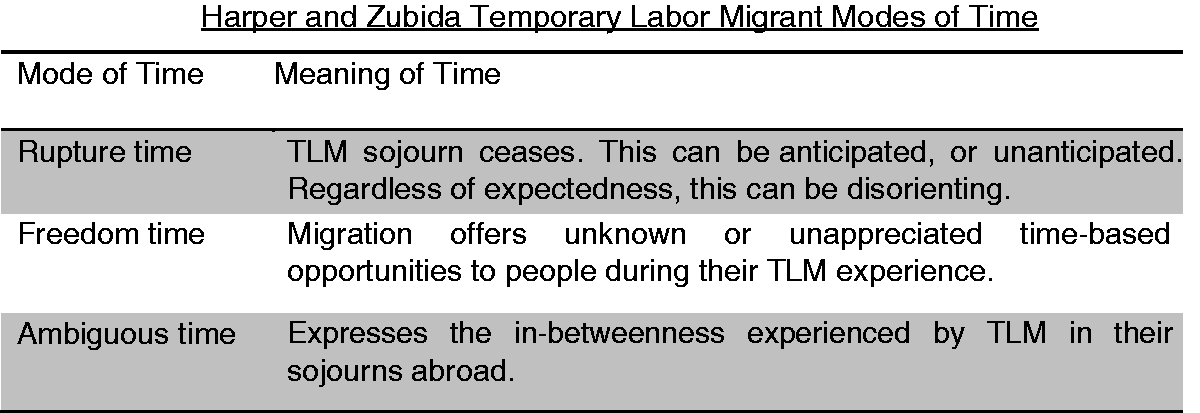
Harper and Zubida TLM Modes of Time.
Finally, some TLMs explained that migration had irrevocably changed them saying, “I’m different than when I came here” or had observed that TLM experiences would affect them even after return, saying, “I will remember my life in Israel.” These laments reflect a somewhat fuzzy identity development—affected by the stress of compressed time and fear of rupture, opportunities and sensing ambiguous loss over missed time, relationships and self—for the person who initially came to Israel and the person who would return, dragging memories and an evolving identity. Similar to what Cwerner (2001) observed with Brazilians in London, we found that migration is a period of exploration and discovery, challenges and resilience, pride for earning ability that far exceeded salaries in their home countries, community development, and also exhaustion, loneliness, separation, dislocation, and loss. All of these experiences affected their identity, not really belonging to the home or host state, living in between, trying to salvage old relationships and make new relationships, and understandings of self.
Conclusions
Migration alters time and the perception of time. It generates juxtapositions between migrants, those left behind, and those in the receiving state. These fundamentally different and, in some cases, contradictory conceptions of time have significant implications for immigrant incorporation and exclusion and should inform TLM policies. What does it mean for democracy when “strangers” have been sharing space but not time for perhaps even decades? If adjustment of status is not an option, as it is not in many ethnic states, what does it mean for migrants when their time runs out? How does that affect their children who have been experiencing fundamentally different time than their parents, other migrants, and their native peers? What happens when migrants use alternate timescapes to contest their own liminal existence?
We have found that migrants may inhabit/imagine/live alternative/parallel timescapes, but they also live in real communities with other migrants and natives alike. Moreover, migrants are often abused, forced into seeking work abroad, lonely, chastised, and subjected to discrimination, racism, sexism, and overall unpleasantness. However, our interview partners unveiled a positive perspective of migration, the creation of timescapes providing opportunities that would not otherwise exist. Much like Willen’s (2019) findings with migrants under threat of deportation and Clayton and Vickers’ (2019) examination of migrants awaiting determination of status and deportation, we found it intriguing that even when TLMs were forced into leaving loved ones behind, working in suboptimal conditions, confronted by racism/discrimination/sexism/overall abuse, some found resilience, dignity, identity transformation, and even unknown time. Through much pain, they found agency and identity and refused to be subjects. They crafted their own stories. The learning that came from migration time, including experimentation in freedom time and the strength emerging from anticipating (and experiencing) rupture and enduring ambiguous loss, the waiting for return or losing left-behind families or the life created in Israel generated resiliency and also, unfortunately, personal pain and destructiveness (as in Willen, 2019; Turnbull, 2016). As Golden (2002) observed, migrants can benefit from a temporally ordered mechanism of belonging, herding them into an imagined shared past or destiny or a civic present. Reimagining time is a critical issue for the incorporation of TLMs who become de facto permanent residents and also for those who return to their home countries.
Footnotes
Acknowledgements
The authors would like to thank the editors and the anonymous reviewers for their helpful comments. We thank our interviewees for sharing their thoughts and our research assistants for their help. We thank Antonia Layard for comments on a previous version. We also thank Melanie Griffiths, the members of panels at The social life of time: power, discrimination and transformation conference (2018), the Western Political Science Association annual meeting (2016) and the COST EastBordNet for insightful exchanges about issues of time and migration. Any errors are, of course, our own.
Declaration of Conflicting Interests
The author(s) declared no potential conflicts of interest with respect to the research, authorship, and/or publication of this article.
Funding
The author(s) disclosed receipt of the following financial support for the research, authorship, and/or publication of this article: Support for this project was provided by a PSC-CUNY Award, jointly funded by The Professional Staff Congress and The City University of New York.
