







Abstract

The purpose of this note is to show how the MOVER algorithm for a ratio of two independently estimated quantities, recently published by Donner and Zou, 1 requires modification to cope with the general case in which the lower and upper confidence limits for the numerator can take either sign.
The MOVER
2
(Method Of Variance Estimates Recovery) algorithm as originally formulated relates to a difference (or sum) of two independently estimated parameters. Suppose that for i = 1 and 2, θi has maximum likelihood estimate

MOVER may be extended to ratios and products by log transformation, but this process fails when it would involve taking the log of zero or a negative number. A purpose-built CI for the ratio R = θ1/θ2 was formulated by Zou and co-workers.1,6–8 We refer to this as MOVER-R (MOVER for a ratio) 9 – a distinctive label is needed because the formulae bear little resemblance to the original ‘square-and-add’ formulae above. MOVER-R was conceived as a generalisation of Fieller’s theorem, using local variance estimates reconstructed as described above. Earlier, Dube et al. 10 gave equivalent formulae, specifically designed for asymmetrical intervals for θi, i = 1, 2, in a context where θ1 and θ2 are necessarily strictly positive. Consider f(r) = θ1 − rθ2 for arbitrary r ∈ (−∞, ∞), where θ1 and θ2 are estimated independently. Equating the MOVER limits for f(r) to 0 leads to quadratic equations in r. Choosing appropriate roots of these quadratics leads to the required interval (RL, RU) for R. For wider applicability, we let θ1 take either sign, but always require θ2 to be positive.
Sometimes, including in the context of the GRADE 11 (Grading of Recommendations Assessment, Development and Evaluation) system, an absolute risk difference (RD) is derived from independent estimates of relative risk (RR) (often from a meta-analysis) and baseline risk (BR): RD = BR × (RR − 1). The interval for the RD should reflect the uncertainty of both the BR and the RR, but an interval derived in the obvious manner from lower and upper limits for the two parameters is much too wide. Because the RD is derived as a product here, we identify θ1 = RR − 1 and θ2 = 1/BR, then R = θ1/θ2 represents the RD. Newcombe and Bender 12 give illustrative examples, both with RR > 1 and RR < 1. The latter is the usual case of a beneficial intervention.
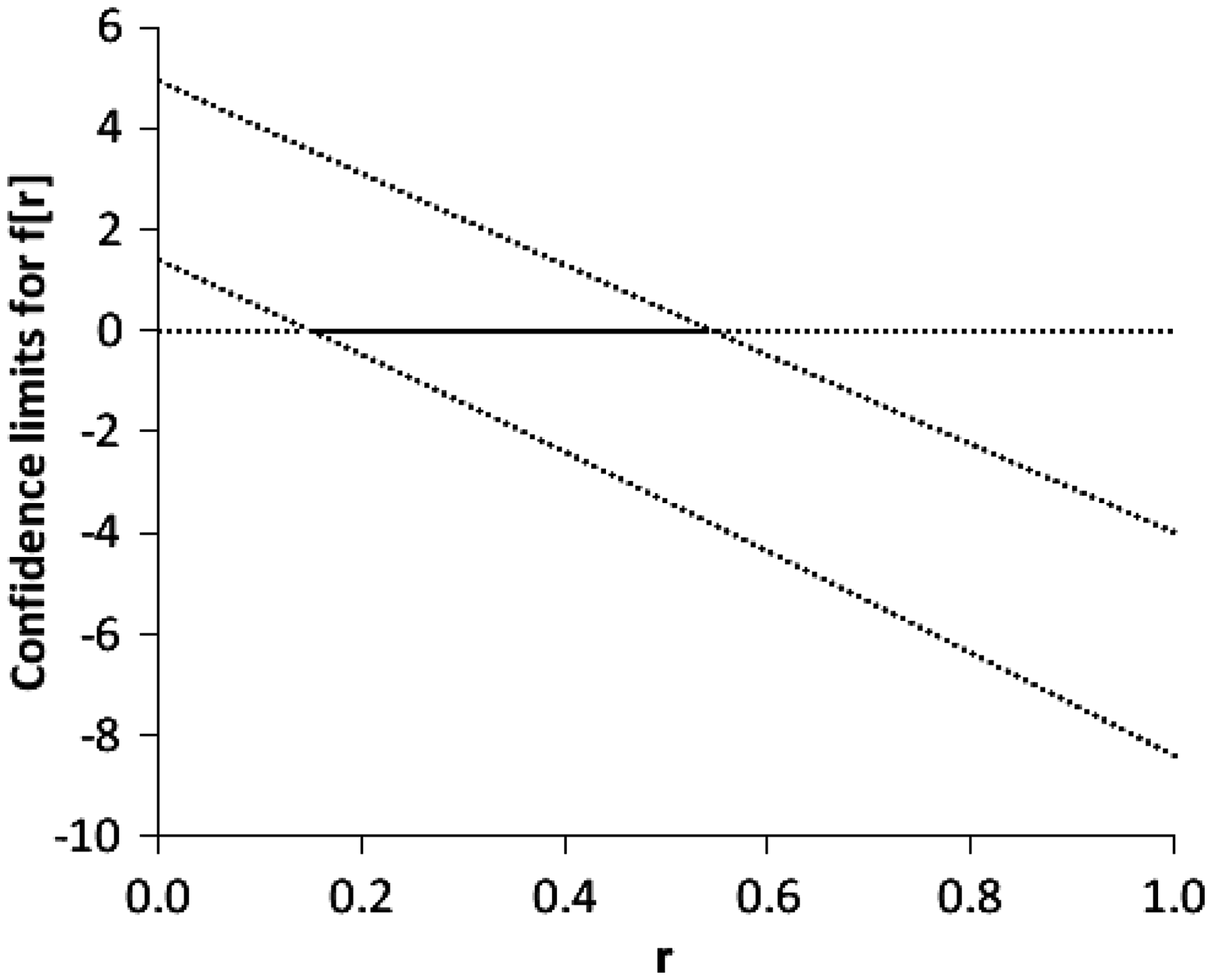
The published MOVER-R algorithm works directly for the case of a statistically significant increase in risk. Arzola and Wieczorek 13 evaluated the use of low-dose bupivacaine (≤8 mg) in spinal anaesthesia for elective caesarean section. Whilst use of a low dose instead of the conventional dose (>8 mg) may help prevent hypotension resulting from spinal anaesthesia, it may compromise anaesthetic efficacy. In a meta-analysis, the need for analgesic supplementation during surgery was higher (RR = 3.76, 95% CI 2.38 to 5.92) in women receiving the low dose compared to the conventional dose. The BR of needing analgesic supplementation during surgery is 175/1610 = 0.109 (95% CI 0.094 to 0.125). 14 The resulting RD is 0.109 × 2.76 = 0.301. MOVER-R leads to the interval (0.149, 0.546): using low-dose bupivacaine leads to the need for analgesic supplementation in an additional 30% of women compared to the conventional dose, with 95% CI 15 to 55%.
Figure 1 shows how the limits for the RD are derived from limits for the RR and BR. Here, Derivation of the confidence interval for the absolute risk difference calculated from the relative risk (assumed >1 here) and baseline risk. Source data from Arzola and Wieczorek.
13
The calculations for the example above use formulae for the lower and upper limits published by Donner and Zou
1
:
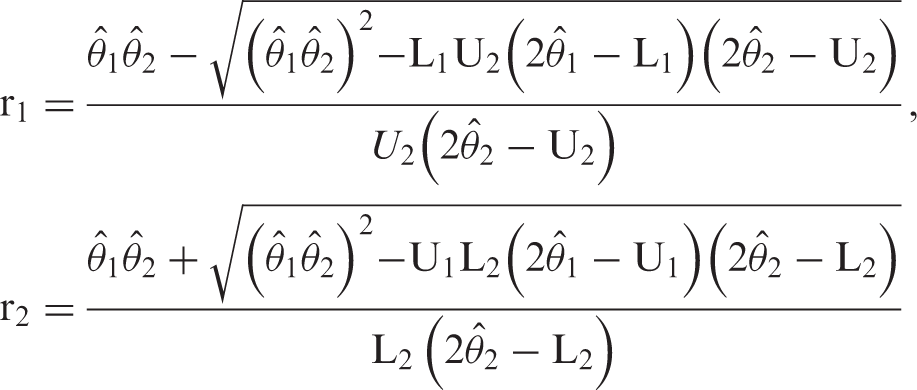
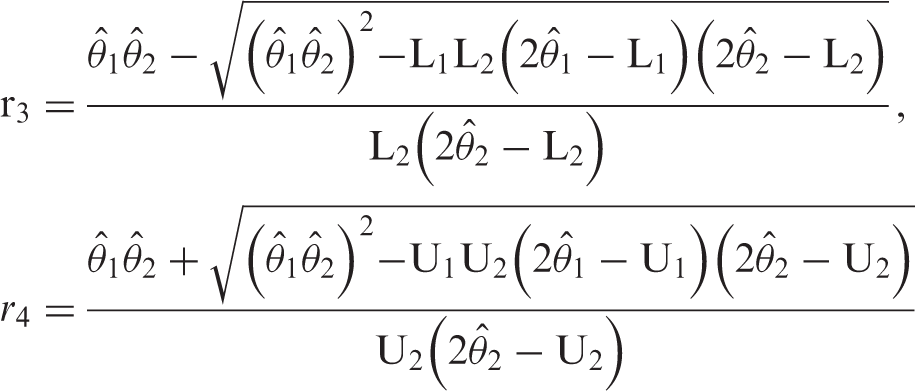

Examples of calculation of MOVER-R intervals for the absolute risk difference R = θ1/θ2 derived from the baseline rate and the relative risk.
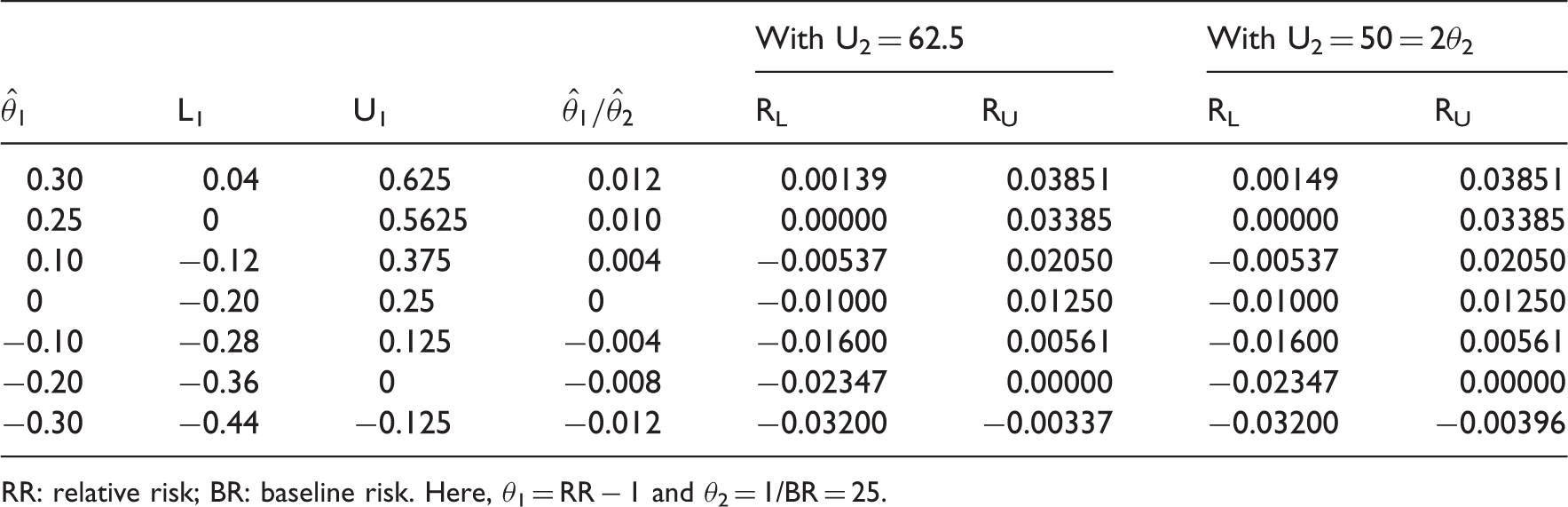
RR: relative risk; BR: baseline risk. Here, θ1 = RR − 1 and θ2 = 1/BR = 25.
An MS Excel spreadsheet
Coverage of a MOVER-R interval for R = θ1/θ2 can only be as good as the coverage of the intervals used for θ1 and θ2. Fagerland and Newcombe 15 showed that the performance of MOVER-R intervals for ratios of proportions derived from Wilson 14 intervals is comparable to that of the score method 16 which requires iteration. This finding provides some evidence that MOVER-R, like MOVER-D, is likely to propagate favourable coverage properties.
A more general approach to combining two or more parameters, Propagating Imprecision (PropImp) is described by Newcombe.9[chap. 13],17 If an estimated odds ratio is available instead of a RR, the corresponding formula is RD = BR – 1/[1 + (1/BR – 1)/OR]. However, in this formula, the two parameters, the BR and OR are interlocked in such a way that the MOVER algorithms are inapplicable and only PropImp gives a solution.
Footnotes
Acknowledgements
I am deeply indebted to Ralf Bender, Head of Department of Medical Biometry, Institute for Quality and Efficiency in Health Care (IQWiG), Cologne, and Professor of Medical Statistics and Epidemiology, Faculty of Medicine, University of Cologne, for drawing my attention to the evidence-based healthcare papers considered in this article, and for many helpful comments on this article and accompanying spreadsheet.
Declaration of conflicting interests
The author(s) declared no potential conflicts of interest with respect to the research, authorship, and/or publication of this article.
Funding
The author(s) received no financial support for the research, authorship, and/or publication of this article.