






Abstract
The maximal procedure is a restricted randomization method that maximizes the number of feasible allocation sequences under the constraints of the maximum tolerated imbalance and the allocation sequence length. It assigns an equal probability to all feasible sequences. However, its implementation is not easy due to the lack of the Markovian property of the conditional allocation probabilities. In this paper, we propose the asymptotic maximal procedure, which replaces the sequence-length-dependent conditional allocation probabilities with their asymptotic values. The new randomization procedure is compared with the original maximal procedure and few other randomization procedures with the maximum tolerated imbalance via simulations and is found to be a practical choice for future clinical trials.
Keywords
1 Introduction
The maximal procedure is a randomization method proposed by Berger et al. in 2003, aiming to minimize the treatment allocation predictability while retaining the maximum tolerated imbalance (MTI). 1 Like the big stick design, 2 Chen’s biased coin design with imbalance tolerance 3 and the block urn design, 4 the maximal procedure has been considered as a better alternative to the commonly used permuted block randomization due to the improvement in the allocation randomness measured by the proportion of deterministic assignments and the correct guess probability.1,4–7 A treatment assignment is deterministic when the conditional allocation probability equals to 1.0 for one treatment arm and zero for the other arm(s). The correct guess probability is defined based on the Blackwell–Hodges optimal guessing strategy, 8 which equals to the conditional allocation probability for the least assigned treatment arm with regard to the target allocation. Among the aforementioned restricted randomization designs, the permuted block randomization has the highest proportion of deterministic assignments and the highest correct guess probability and has been considered as the most vulnerable design for selection bias.5–7,9,10 For a two-arm balanced trial using a block size of 4, 6, or 8, the proportion of deterministic assignment is 33, 25, or 20%, respectively. 11 Some investigators advocate varying block sizes for the putative benefit in allocation randomness. 12 Quantitative analyses indicate that such benefit does not exist.7,13 In fact, with the maximal imbalance determined by the largest block size, mixing with smaller blocks only increases the proportion of deterministic assignments and the correct guess probability. All MTI procedures use deterministic assignments when the MTI is reached. The difference is in how they respond to imbalances smaller than the MTI. The big stick design takes no action. Chen’s procedure uses a prespecified biased coin probability, such as 0.7, favoring reducing the imbalance. The block urn design and the maximal procedure use an imbalance-adaptive biased coin probability favoring reducing the imbalance. Both the big stick design and Chen’s procedure were defined for two-arm balanced trials only.2,3 The maximal procedure and the block urn design are generally applicable to two or multi-arm trials with balanced or unbalanced allocations.1,4 When both the proportion of deterministic assignments and the correct guess probability are taken into account, the maximal procedure and the block urn design offer better properties than the big stick design and Chen’s procedure.4,5
Unlike the block urn design, which uses an urn model to generate the conditional allocation probability, the maximal procedure obtains the conditional allocation probability by placing a uniform distribution on all feasible allocation sequences. This property is desirable when an assumption-free randomization test for the equality of the treatments is used. In this case, the test statistic is computed for all feasible sequences and compared to the observed one to obtain the p-value. 13 Theoretically speaking, for equal allocation trials, a precise randomization test requires each pair of mirroring sequences, such as ABAABAB and BABBABA, which have the same probability being selected. While this condition could be difficult to verify for other randomization sequences, it has been ensured under the maximal procedure, because all feasible allocation sequences will have the same chance being selected. In addition, for unequal allocation trials, the maximal procedure has more feasible allocation sequences than the block urn design does in most cases. 4 More feasible allocation sequences result in lower allocation predictability and makes the randomization test to be more powerful. 1 This uniform distribution on all feasible sequences comes with a price, however. It eliminates the Markovian property from the maximal procedure, 1 meaning that the conditional allocation probabilities depend not only on the current imbalance level but also on the sequence length.14,15 In 2008, Salama et al. 16 proposed a two-step process for the generation of the maximal procedure allocation sequences. However, due to the lack of the Markovian property, an explicit formula for the calculation of the conditional allocation probability remains missing, thereby causing difficulties in the implementation of the maximal procedure. Recently, Berger et al. 14 proposed a modification on the maximal procedure by dropping the terminal balance requirement. However, the details of the algorithm for the calculation of the conditional allocation probability have not been revealed and a computer application for the generation of the allocation sequence for this modified maximal procedure is under development. 14 In this paper, the asymptotic maximal procedure is proposed by replacing the sequence-length-dependent conditional allocation probabilities with their asymptotic values. The new randomization procedure is then compared to both the original maximal procedure and other MTI procedures based on the proportion of deterministic assignments and the correct guess probability. In Section 2, the performance of the maximal procedure is explored with the focus on the impact of the sequence length on the conditional allocation probability and the overall allocation randomness of the maximal procedure. In Section 3, the asymptotic maximal procedure is defined and its conditional allocation probabilities are provided. Section 4 presents the simulation results comparing the asymptotic maximal procedure with other MTI procedures, followed by discussions in Section 5.
2 Background
The maximal procedure assigns an equal probability to all feasible allocation sequences under the constraints of the target allocation ratio, the sequence length, the MTI, and perfect terminal balance. While the maximal procedure’s statistical properties are desirable, they do not directly lead to a generalizable implementation method. Salama et al.
16
provided an algorithm for the construction of maximal procedure allocation sequences using a graphical approach. Shown in Figure 1 is an example for a two-arm trial with a balanced allocation, a final sequence length of 10, and Maximal procedure feasible allocation sequences and conditional allocation probabilities (two-arm equal allocation, MTI = 3, sequence length b = 10). MTI: maximum tolerated imbalance.
Figure 1 indicates that both the number of sequences from a node to the terminal point and the conditional allocation probability from the current node to the next node are affected not only by the imbalance level of the current node but also the distance between the current node and the terminal point. For example, nodes (2,1), (3,2), and (4,3) all have an imbalance level of 1; the conditional allocation probabilities for assigning the current subject to arm A at the three nodes are 7/17, 2/5, and 1/3, respectively. In practice, the sequence length must be prespecified in order to calculate the conditional allocation probability and to generate the maximal procedure randomization sequence. The sequence length represents the number of subjects to be randomized in the trial or the stratum. Restricted randomization is often stratified by some important baseline covariates, such as site, baseline disease severity category, and age group. It is well known that in a sequential clinical trial, investigators cannot predict the baseline stratification information for the next patient. Therefore, the actual size of a stratum remains unknown until the end of the trial. Possible solutions for this problem are combining several short allocation sequences together or using a sufficiently long sequence for each stratum. Both ways cannot guarantee that the stratum size at the end of the study matches the planned sequence length. In other words, the perfectly balanced terminal point is unlikely to achieve in each stratum.
Maximal procedure allocation sequence example (two-arm trial with a balanced allocation, a sequence length of 10, and MTI of 3).

MTI: maximum tolerated imbalance.
(nA,nB): allocation node with nA and nB subjects previously enrolled in arms A and B, respectively.
Deterministic assignment.
This example does not reflect the superior allocation randomness of the maximal procedure. It is clear that the values of the 10 random numbers played a role. It is possible that with another set of random numbers, one can obtain an allocation sequence with only one deterministic assignment, which occurs at the end of the sequence. It is also clear that the expected number of deterministic assignments for adhering to the MTI condition is proportional to the sequence length, while those needed for the terminal balance is independent of the sequence length. Therefore, as the sequence length increases, the expected proportion of deterministic assignments should decrease. To quantitatively evaluate the impact of the sequence length on the allocation randomness of the maximal procedure, a simulation study is conducted with the results shown in Figure 2.
Allocation randomness for maximal procedure (two-arm equal allocation, MTI = 3, simulation 50,000 per scenario). (a) Deterministic assignments and (b) correct guess probability. MTI: maximum tolerated imbalance.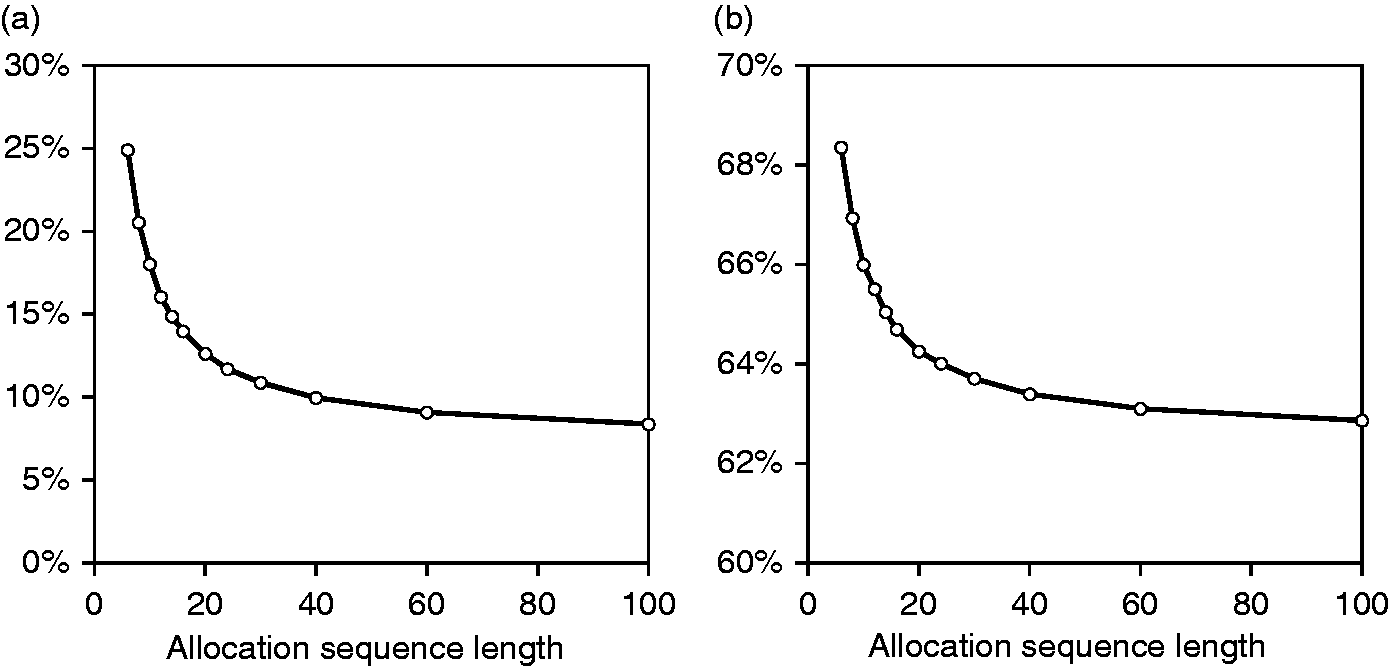
Figure 2 indicates that both the proportion of deterministic assignments and the correct guess probability decrease as the allocation sequence length increases. The superior allocation randomness of the maximal procedure is available only when the allocation sequence length is sufficiently large. When
Knowing that the constraint of the terminal balance is unnecessary due to the uncertainty of the actual stratum size in sequence trials, and that the allocation randomness improves as the sequence length increases, it is reasonable to use maximal procedure with an infinity sequences length for all strata, disregards the actual sample/stratum size at the end of the study. This leads to the concept of the asymptotic maximal procedure.
3 Method
3.1 Notations
As depicted in Figure 1, let b denote the sequence length,
3.2 The feasible sequence number and the conditional allocation probability
Denote
Examples for the above six scenarios there are
Number of feasible sequences and conditional allocation probabilities for maximal procedure in two-arm equal allocation trials.

MTI: maximum tolerated imbalance.
j = allocation wave number.
k = treatment imbalance level.
pj,k = conditional allocation probability for assigning the next subject to treatment A.
sj,k = number of feasible sequences to the balanced terminal node.
With minor modification, the strategy of using the allocation wave j and treatment imbalance k to calculate the conditional allocation probability for the maximal procedure applies to unequal allocations. Consider a two-arm trial with allocation ratio
Here function Allocation wave and treatment imbalance for maximal procedure sequences (two-arm, 3:2 allocation, MTI = 6, sequence length b = 20). MTI: maximum tolerated imbalance.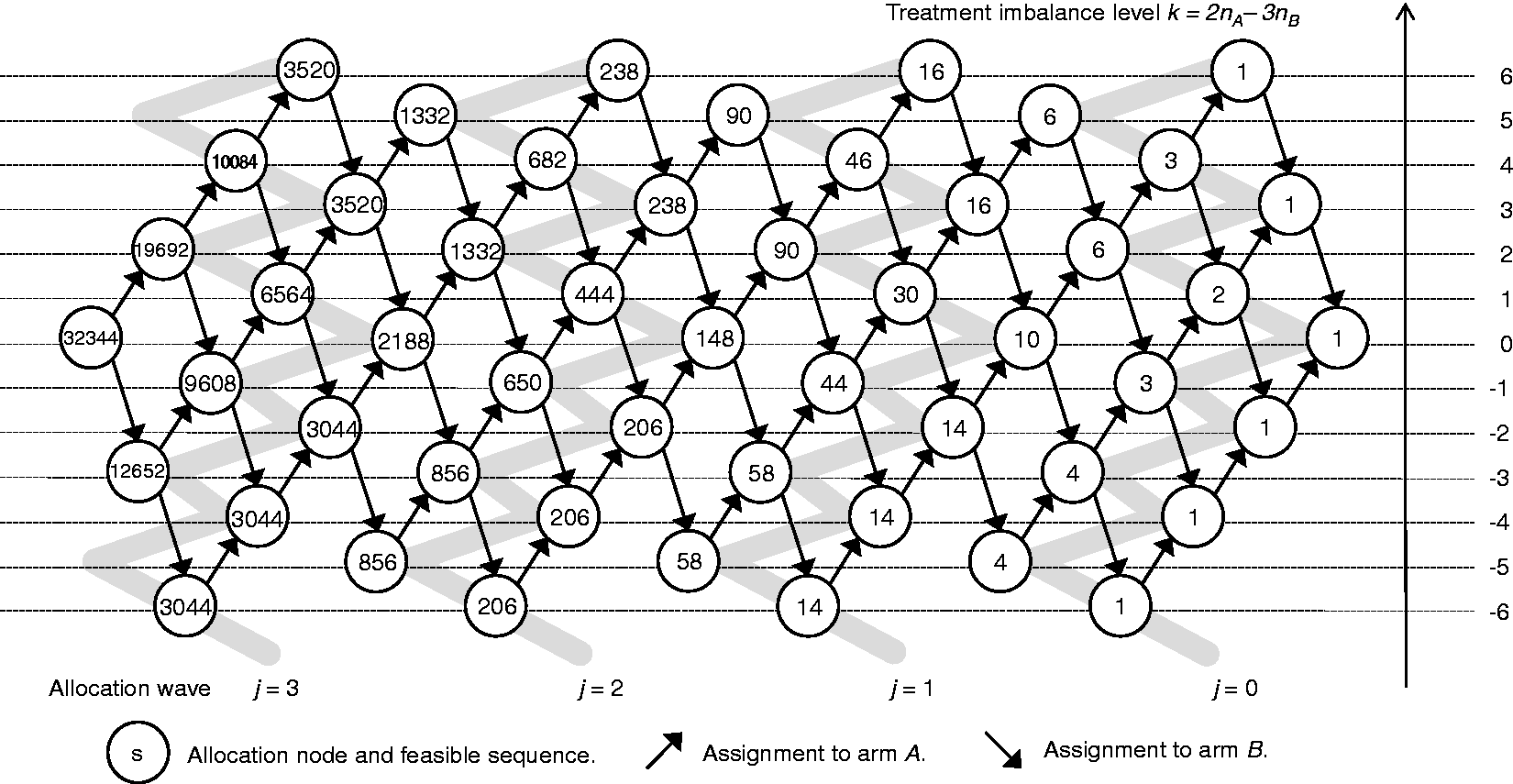
Number of feasible sequences and conditional allocation probabilities for maximal procedure in two-arm trials with 3:2 allocation and MTI = 6.

MTI: maximum tolerated imbalance.
As shown in Table 3, when MTI is enforced in trials with unequal allocation, a deterministic assignment for a treatment arm is used when otherwise the imbalance will go beyond the MTI. For example, at
Figures 1 and 3 also indicate that the number of allocation nodes between two consecutive waves with the same imbalance level equals the minimal number of treatment assignments in a balanced set. For example, in Figure 1 with 1:1 allocation, two treatment assignments are made from nodej+1,k to nodejk. In Figure 3 with 2:3 allocation, it takes five treatment assignments.
3.3 Asymptotic conditional allocation probability
The entries listed in Tables 2 and 3 show that with a given allocation wave j, the conditional allocation probability
For two-arm balanced trials, it is always the case that
This leads to
In other words, the ratio between the feasible allocation sequence numbers for the two nodes in consecutive allocation waves with the same imbalance level converges to a constant
Similarly, for
With j large enough, based on equation (4), there are
Likewise, for
With j large enough, based on equation (4), there are
Asymptotic values of the conditional allocation probabilities can be calculated from equations (2) and equations (5) to (9) and
Conditional allocation probability and allocation randomness for asymptotic maximal procedure.

MTI: maximum tolerated imbalance.
Allocation randomness are evaluated with sample size = 100, simulation = 50,000 per scenario.
Conditional allocation probability pA equals 0 or 1.
Guess the next assignment being the least represented arm based on the target allocation.
4 Results
With the treatment imbalance contained by the MTI, the comparison of different randomization designs focuses on the allocation randomness. The proportion of deterministic assignments and the correct guess probability are two commonly used measures for allocation randomness. Figure 4(a) and (b) compares six randomization designs with 1:1 allocation, Comparison of allocation randomness. (a) Deterministic assignments (1:1 allocation, MTI = 3), (b) correct guess probability (1:1 allocation, MTI = 3), (c) deterministic assignments (2:1 allocation, MTI = 6), and (d) correct guess probability (2:1 allocation, MTI = 6). Simulation: 20,000 per scenario. AMP: asymptotic maximal procedure; BSD: big stick design; BUD: block urn design; Chen: Chen’s procedure with biased coin probability of 0.65; MP: maximal procedure; MTI: maximum tolerated imbalance; PBD: permuted block design.
Figures 4(c) and (d) show the simulation results for unequal allocation 2:1 with MTI of 6 (equivalent to block size of 9 in permuted block randomization) and sample size varying from 9 to 99. Once again, the permuted block randomization has the worst performance. The maximal procedure has good performance when the sample size is larger than 40. The block urn design and the asymptotic maximal procedure have the same low proportion of deterministic assignments. The asymptotic maximal procedure has a lower correct guess probability. The big stick design and Chen’s procedure are not included in this comparison as both were not defined for unequal allocations.
5 Discussion
Restricted randomization designs are applied in clinical trials to consistently control the treatment imbalances for the purpose of preventing potential chronological biases. Behind any gain in treatment balance there is a cost in allocation randomness. However, for the same amount of gain in treatment balance defined by the MTI, different randomization designs pay different costs in the allocation randomness.
The obvious inferiority of the permuted block randomization is the consequence of the enforced balance at the end of each block. Under the control of the MTI throughout the study, the periodical perfect block end balance does not add gains in treatment balance, but does add deterministic assignments, making the permuted block randomization the most vulnerable design to selection bias. We noticed that easy-to-use is often the only reason for using the permuted block randomization in clinical trial practice. In reality, the big stick design and Chen’s procedure are even easier than the permuted block randomization. With several better and easy-to-use alternatives available, such as the asymptotic maximal procedure and the block urn design shown in Figure 4, investigators should stop using the permuted block randomization in order to better prevent selection bias and protect the integrity of the trial.10,14,15,17 The fact that the permuted block randomization remains the most commonly used method in clinical trial practice calls for more efforts to disclose its inferiority and its potential damages, and to introduce better alternatives to investigators. The asymptotic maximal procedure significantly improves the performance of the original maximal procedure. It reduces the proportion of deterministic assignments by releasing the enforced terminal balance, and more importantly, provides the Markovian property for easy implementation.
The proportion of deterministic assignments and the correct guess probability are two related and competing measures of allocation randomness for all MTI procedures and are affected by the conditional allocation probability used when the imbalance is within the MTI boundaries. In general, a high biased coin probability (i.e. close to 1.0) increases the correct guess probability and meanwhile makes the imbalance more likely being reduced before achieving the MTI, and therefore, is less likely to trigger deterministic assignments. On the other hand, a small biased coin probability (i.e. close to 0.5) can reduce the correct guess probability, and at the same time, increase the chance for calling deterministic assignments to contain the imbalance. The big stick design uses complete randomization when imbalance is within the MTI. Therefore, it has the lowest correct guess probability and relatively higher proportion of deterministic assignments. Chen’s procedure uses a fixed biased coin probability for all treatment imbalances within the MTI. When MTI is small, there are few discrete levels of imbalance between zero and MTI, so a properly selected biased coin probability yields good performances. Simulation study suggests that
The equal probability for all feasible allocation sequences is a desirable property of the maximal procedure, especially when a randomization test is considered. This property is inherited by the asymptotic maximal procedure. For example, consider an asymptotic maximal procedure for a two-arm balanced allocation trial with a sequence length
The asymptotic maximal procedure is not perfect. First, it cannot accurately target unequal allocations involving irrational numbers, such as
With the superior allocation randomness, the Markovian property and the conditional allocation probability provided in Table 4 allowing easy implementation, and the desirable equal allocation sequence probability, the asymptotic maximal procedure is an attractive randomization design.
Footnotes
Acknowledgement
The authors thank the anonymous reviewers for their careful review and great comments for this manuscript.
Declaration of conflicting interests
The author(s) declared no potential conflicts of interest with respect to the research, authorship, and/or publication of this article.
Funding
The author(s) disclosed receipt of the following financial support for the research, authorship, and/or publication of this article: Wenle Zhao’s research is partly supported by the NIH/NINDS grants U01NS0059041 (NETT), and U01NS087748 (StrokeNet). Zhenning Yu’s research is supported by the NIH/NINDS grant U01NS087748 (StrokeNet).