







Abstract
The presentation of science in the mass media is one of the most important questions facing social scientists who analyse science. Accordingly, media coverage of science has been a constant focal point in the respective literature, and a flurry of such publications has appeared in the past few years. Yet the activity and growth of the respective research have not been accompanied by systematic overviews. This article aims to provide such an overview by means of a meta-analysis: it analyses existing studies systematically and provides an empirical overview of the literature. The analysis shows that while the research field grew significantly in the past few years and employs a variety of research strategies and methods, it has been biased in three ways: mainly natural sciences (and namely biosciences and medicine), Western countries, and print media have been analysed.
1. Why a meta-analysis of research on science and the media is necessary
The presentation of science in the mass media is one of the central questions facing social scientists who analyse science. The mass media constitute the most important forum for the public sphere in modern societies, providing an organising framework for societal self-observation, allowing a large number of citizens to inform themselves about political, economic, and other developments, and contributing significantly to how society forms opinions (e.g., Ferree et al., 2002: 10; Gerhards and Neidhardt, 1991). Furthermore, the mass media have almost monopolised communication about many issues nowadays and become an exclusive source of information for many people (Luhmann, 1995: 9).
This is particularly true for scientific issues. Science is now a highly specialised, differentiated enterprise (Stichweh, 1988) that historically generated and discussed its findings mostly within the scientific community and did not consider society at large as a relevant audience (Weingart, 2005). Science coverage in the mass media was and still remains the major channel that bridges the gap between science and the general public. Most people, including many decision-makers, acquire their information about science mainly, or even exclusively, from the mass media (cf. Schenk and Sonje, 1999: 9ff.). Accordingly, scholars argue that media coverage contributes strongly to science’s public image and, more importantly, influences its legitimation, public support, and funding (Weingart, 2005). As a result, scientists are nowadays expected, and often willing, to communicate with the mass media. Indeed, many scientific institutions are establishing professional interfaces to deal with media demands (Peters et al., 2008a, 2008b). Science has also become a major mass media topic (cf. Felt, Nowotny and Taschwer, 1995: 244; Nelkin, 1992, 1995: 31ff.), and scientific experts have become participants in media debates on topics as diverse as foreign politics, climate change, and health (cf. Peters, 1994; Stehr, 1992).
This (perceived) relevance of the mass media’s science coverage has left a clear mark in the social studies of science, and analysis of this coverage has become an important research strand. A large number of articles has been published, media coverage of science is a focal point in several scholarly journals – such as this one – and a number of introductory publications for the field have been written (e.g., Bauer and Bucchi, 2007; Bucchi and Trench, 2008).
Yet the activity and growth of research on science coverage in the media have not been accompanied sufficiently by systematic overviews. The number of articles available on the topic has made it difficult to keep track of research activity. An analysis of the strengths and weaknesses, points of emphasis, and blind spots in the entire field is even more challenging. Several research bibliographies on mass media communication on science exist (e.g., Dunwoody, Baldrica and Long, 1993), but provide little more than lists of, and in some cases annotations on, references. The few review articles, for example by Bruce V. Lewenstein (1995b) or Michael F. Weigold (2001), have a much broader focus on science communication and include theoretical models, the presentation of science in museums, characteristics of science journalists as well as public opinion on science and technology. These bibliographies and review articles are also over nine years old, which is problematic as we will see that most studies have been published more recently.
This article takes a different – meta-analytical – approach towards assessing the research on the media’s science coverage: it provides an empirical analysis of existing studies. This approach follows similar and recent analyses in other fields, such as risk communication (Gurabardhi, Gutteling and Kuttschreuter, 2004), communication on public health issues (Snyder and Hamilton, 2002), and debates about the European Union (Machill, Beiler and Fischer, 2006; see also Machill, Beiler and Zenker, 2008). These meta-analyses select and analyse existing studies systematically in order to provide a synopsis of a given research field, which is also the goal of this article. After presenting the methodology and data used in this meta-analysis in Section 2, we provide an empirical overview of the literature on mass media coverage of science in Section 3. We will describe the temporal development of the research field and outline which scientific disciplines, countries, and kinds of mass media are typically analysed using which methodology and particular methods. We thereby identify aspects and topics that are already very well researched as well as those that have not yet received much scholarly attention. In Section 4, we discuss the results and suggest directions for further research.
2. Research design and data selection
Before analysing empirical studies dealing with the representation of science in the mass media, we need to define both concepts. In so doing, we employ a rather broad understanding of science and mass media in order to accommodate different facets of both that are found in the literature.
We define mass media following Burkart (1998) and McQuail (2005) as means of communication that distribute content, such as written text, pictures, and sound, to an anonymous and spatially diverse public via technical means. This includes printed media such as newspapers, magazines, books, or comic books, broadcasting media such as radio, television, or film, as well as (sections of) the internet. We aimed to analyse any scholarly publication that, at least partially, deals with the representation of science – i.e., of scientific disciplines, research fields, scientific questions, or scientific applications – in these media. We excluded publications that deal only with the media representation of natural phenomena (climate change, tsunami waves, spreading viruses, etc.) without also mentioning the respective sciences. We also excluded publications that focus only on the strategic communication of actors (such as Lederbogen and Trebbe, 2003) or the effects of media coverage (such as Nisbet et al., 2002) without analysing the nature of media coverage itself, as well as studies focussing on interpersonal communication between scientists (such as Bohlin, 2004; Gunnarsdottir, 2005) or between scientists and citizens at “consensus conferences,” etc. (cf. Joss, 2003; Joss and Bellucci, 2002) if they did not also deal with science coverage.
Based on these definitions, the next step was to decide how to acquire the publications necessary to conduct a meta-analysis. We had to be systematic, as we intended to later generalise our interpretations to make statements about the entire research field, and could envision the following three sampling methodologies: a) to acquire every relevant publication on the issue, b) to take a random sample, or c) to select the most relevant publications. The first two strategies were not feasible, as they required prior knowledge about the entire basic population and the ability to acquire, understand, and analyse all publications. This degree of prior knowledge about all studies, beginning from the first publications on science coverage in the mass media, be it in journals or books, in English or in any other language, simply does not exist.
We therefore chose the third path of selecting and analysing the most relevant publications. In order to do so, we relied on the Social Sciences Citation Index (SSCI), a multidisciplinary database developed by the Institute for Scientific Information (ISI). 1 It contains full-text articles from some 1700 social scientific journals, spanning fifty disciplines as diverse as anthropology, sociology, criminology, law, and library sciences (for another meta-analysis using the SSCI, see Gurabardhi et al., 2004: 326ff.).
Using the SSCI for such an analysis has both advantages and disadvantages, but in our view, the positive aspects outweigh the downside: on the one hand, this database has some limitations, the most notable being that it does not represent all disciplines equally well and that its coverage of English language and US- or UK-based journals is better than that of other publications. On the other hand, using it to meta-analyse the research field seems sensible for several reasons: first, the SSCI aims to include the most relevant journals of each field, and undoubtedly covers each discipline’s leading journals such as the “American Journal of Sociology,” the “Journal of Communication” or the “American Political Science Review.” Second, it increasingly seems to serve as a point of information and orientation for many scholars, committees etc. and, thereby, increases in relevance within the scientific community.
We retrieved publications from the SSCI in several steps, using a thorough selection procedure to ensure that no relevant texts were left out. In a first step, we constructed a very large text corpus that resulted from a rather general keyword search in the database. We used the search string “(science* OR arts OR humanities) AND (media OR news OR press OR television OR radio OR internet OR web OR mediatization)” in a full-text search for all available original articles, editorial materials, proceedings papers, research notes, discussions, letters, and reprints. We did not restrict our search to certain dates of publication, language, or country of origin; all texts from 1956 to 2009 were included. 2 Based on this selection, we produced an enormous preliminary sample containing more than 4000 publications, and then screened each publication individually. We first read the publication’s title and abstract to determine its suitability. If the title and abstract were inconclusive, we read the text itself. If an article conformed to the criteria formulated above, i.e., if it contained an empirical study of the representation of science in the mass media, we included it in the final text corpus of the meta-analysis. Most articles from our broad initial sample did not meet our criteria and were left out.
Concentrating on journal articles alone, however, could bias the results in several ways. Spatial limits on journal articles are rather rigid, leading to shorter texts and possibly to a systematic analytical bias – for example, authors of journal articles might prefer (or be forced) to present their research in “least publishable units,” choosing to publish single case studies rather than comparative, complex, or elaborate research designs. These latter designs might be more common in book publications, so we added a selection of books to the journal articles. Their selection, however, was not easy: in contrast to the SSCI’s citation data, such as “impact factors,” which provide a (rough) measure for the relevance of different journals, no such hierarchy exists amongst books. We therefore implemented a broad search, using the aforementioned search string in “Google Books.” 3 We then individually screened all books that met the search criteria. We excluded so-called “grey literature,” i.e., books without ISBN numbers or that did not appear in a recognisable publishing house, as well as books that did not present empirical studies on science in the mass media. We included the remaining (rather few) books in the analysis.
Eventually, the final sample consisted of 215 publications, 201 journal articles and 14 books. 4 We coded information about these publications into an electronic codesheet containing 58 mostly standardised variables, but also some open (text) variables that allowed us to enter in more detailed characteristics of the coded publications. We coded information about the publication itself (author, title, journal, publication date), about the text’s subject (scientific discipline(s), media type, country of focus, period of analysis), and about its methodology (cross-sectional, longitudinal, case study, qualitative vs. quantitative, random or other sampling strategy). We also coded some, albeit necessarily rather sketchy, information about the study’s results (did the authors search for and/or find biased reporting; how was the scientific topic evaluated in the mass media; what frames, if any, were found, etc.). Two coders pre-tested the coding scheme, discussed coding decisions, and finally coded the publications.
3. Results
In the following section, we describe research on media coverage of science focussing on three major elements of our meta-analysis: time, topic (scientific disciplines, countries, and types of mass media), and methodology.
The research field over time: Rising attention
Social scientific attention to media coverage of science has risen continuously over the past decades. Figure 1 demonstrates two supporting indicators: first, it shows the annual number of published articles dealing with this issue from 1956 onwards. We see that very few articles appeared until the late 1980s, that there was a significant rise in the 1990s, and an additional increase between 2000 and 2009. Presumably, these increases were institutionally backed by the rising number of media scientists doing work and by the creation of the main science communication journals (“Science Communication” was established in 1979, “Public Understanding of Science” in 1992).
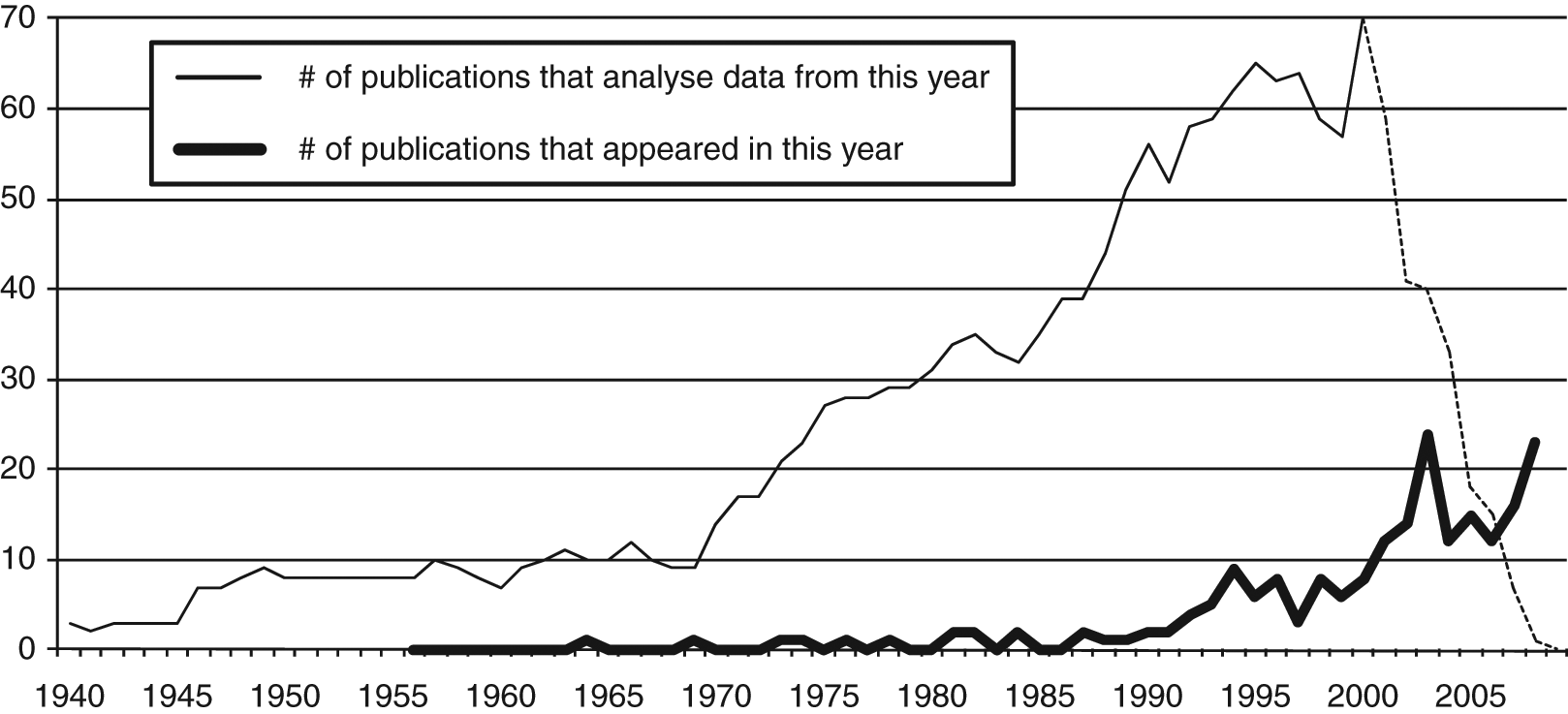
Number of relevant articles published in a given year and number of relevant articles analysing media data from a given year.
The increase is even more pronounced when looking at the number of publications that analyse the media coverage from a specific year (e.g., how many scientific articles and books scrutinise the media’s coverage of science in 1971?). The analysis shows that there has been a steady increase from the 1940s onwards, and that the numbers rose sharply from the 1970s on, presumably due to debates about the hazards of nuclear energy (e.g., Freudenberg and Rosa, 1984), the simultaneous emergence of deep-rooted critiques of science (Restivo, 1995: 96), and the subsequent shift to a more “socially responsive technocratic doctrine” (Elzinga and Jamison, 1995: 588). Even when factoring in that fewer journals existed in the 1960s and that a smaller percentage of these journals might be included in the SSCI nowadays, the rise in the number of relevant articles is still remarkable and indicates an increasing interest in mass media coverage of science.
The analytical focus: Natural sciences, Western countries, and print media
All of these publications analyse mass media coverage of science, and many share further characteristics, such as their choices of specific scientific disciplines, countries, and mass media types. We first analyse the scientific disciplines receiving scholarly attention and notice that almost all publications focus on only one scientific discipline. Among the 215 publications analysed here, 192 or 89.3% are single-discipline analyses. Secondly, the general spectrum of these scientific disciplines is relatively broad: it ranges from stem cell research (e.g., Leydesdorff and Hellsten, 2005; Nisbet, Brossard and Kroepsch, 2003) to genomics (e.g., Kua, Reder and Grossel, 2004; O’Mahony and Schäfer, 2005; Schäfer, 2009), cloning (Holliman, 2004; Horst, 2005; Neresini, 2000), cold fusion (e.g., Lewenstein, 1995a; Simon, 2001), research on climate change (Boykoff, 2007, 2008), space research (Clark and Illman, 2003), particle physics (Schäfer, 2009), and nanotechnology (e.g., Cobb, 2005; Lee, Scheufele and Lewenstein, 2005).
Which scientific disciplines were analysed? (in %)
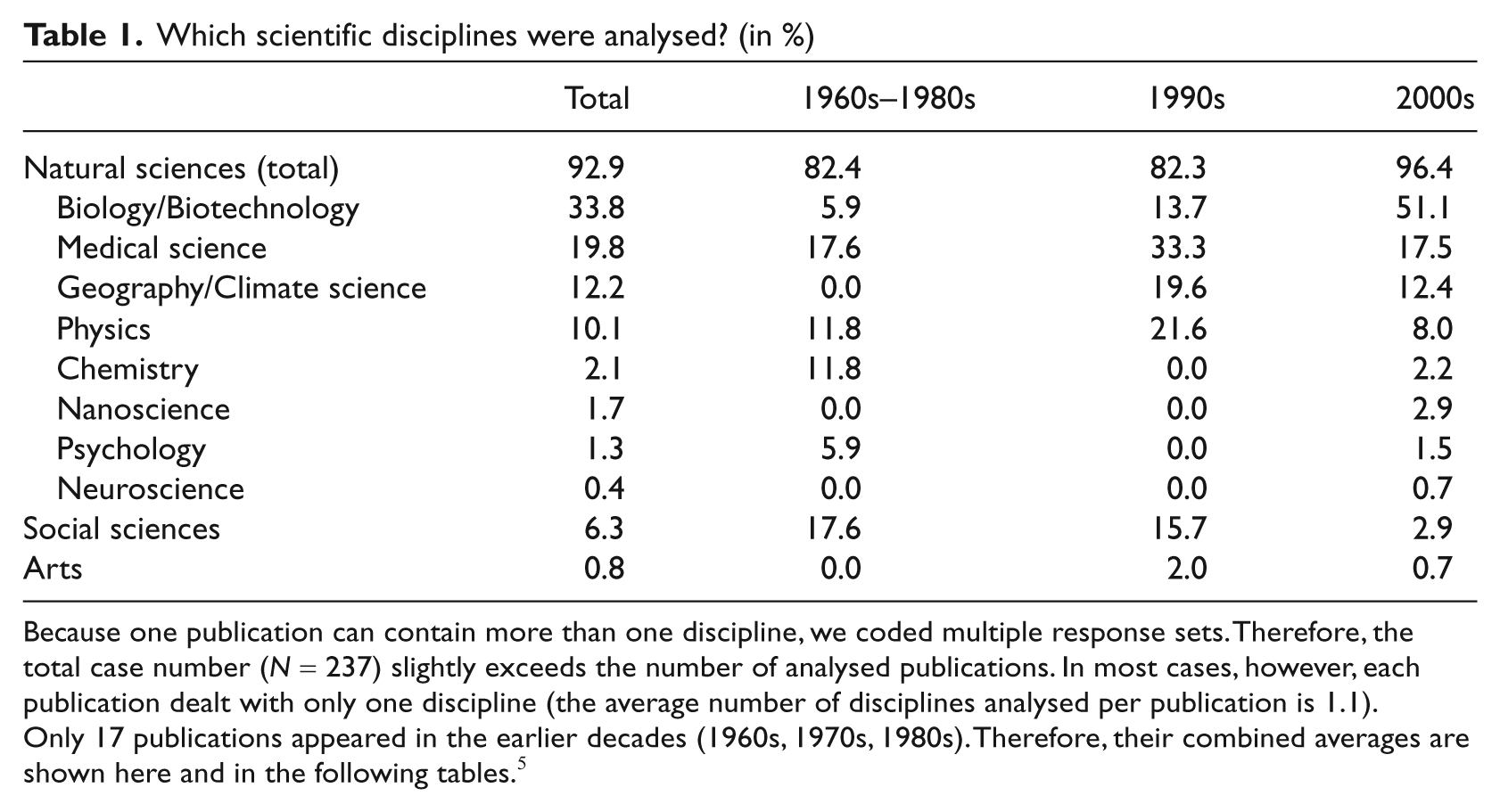
Because one publication can contain more than one discipline, we coded multiple response sets. Therefore, the total case number (N = 237) slightly exceeds the number of analysed publications. In most cases, however, each publication dealt with only one discipline (the average number of disciplines analysed per publication is 1.1).
Only 17 publications appeared in the earlier decades (1960s, 1970s, 1980s). Therefore, their combined averages are shown here and in the following tables. 5
Within this generally broad field, however, we can discern several dominant features: the relevant studies almost exclusively cover the natural sciences, which account for close to 93% of all analysed disciplines. We can also see that this figure has grown over time, from 82% from the 1960s to the 1990s to 96% since 2000. Within the natural scientific disciplines, biological research and biotechnology are by far the most prominent, due to a large – and also significantly rising – number of studies on issues like (human) cloning, genomics, and stem cell research. Publications also analyse mass media coverage of medical research quite often, followed by sciences dealing with the description and prognosis of climate change and its effects – although scholarly attention for media coverage of these fields peaked in the 1990s and seems to have dropped off slightly since.
In turn, only very few studies take up media coverage of social sciences, humanities and/or the arts. Studies such as “Reporting of Social Science in the National Media” (Weiss and Singer, 1988) or “Political Scientists as Color Commentators” (Brewer and Sigelman, 2002) remain exceptions rather than the rule, particularly in the last decade when publications on social sciences, humanities and/or the arts in the media account for only about 4% of the sample.
Furthermore, most studies analyse only one country, which is the case for 179 publications or 83%. In all analysed decades, we find a clear and not shrinking bias towards media coverage of science in Western countries, namely Western Europe, North America, and Oceania. 6 There is diversity within the Western world though, with studies ranging from the US (e.g., Hornig, 1993; Hornig Priest, 2001; Nisbet and Lewenstein, 2001, 2002; Nisbet et al., 2003; Ten Eyck and Williment, 2003; Ten Eyck, Thompson and Priest, 2001) to the UK (e.g., Anderson et al., 2005; Bauer et al., 1995; Cook, Robbins and Pieri, 2006), Finland (Valiverronen, 2004), the Netherlands (Gutteling, 2002; Hijmans, Pleijter and Wester, 2003), Greece (Dimopoulos and Koulaidis, 2002), Italy (e.g., Bucchi and Mazzolini, 2003; Neresini, 2000), Germany (e.g., Kohring and Matthes, 2002; Milde and Ruhrmann, 2006; Ruhrmann, 1992), Australia (e.g., Caulfield, Bubela and Murdoch, 2007; Edmond and Mercer, 1999; Hay and Israel, 2001), and New Zealand (e.g., Bell, 1994a, 1994b; Michelle, 2007). Also, the inner composition of studies on the Western media changed over time: attention to US coverage of science shrunk continuously, although it still is the subject of every third publication on the issue. In contrast, more scholars have examined European countries, particularly the UK and also Germany.
Which countries were analysed? (in %)
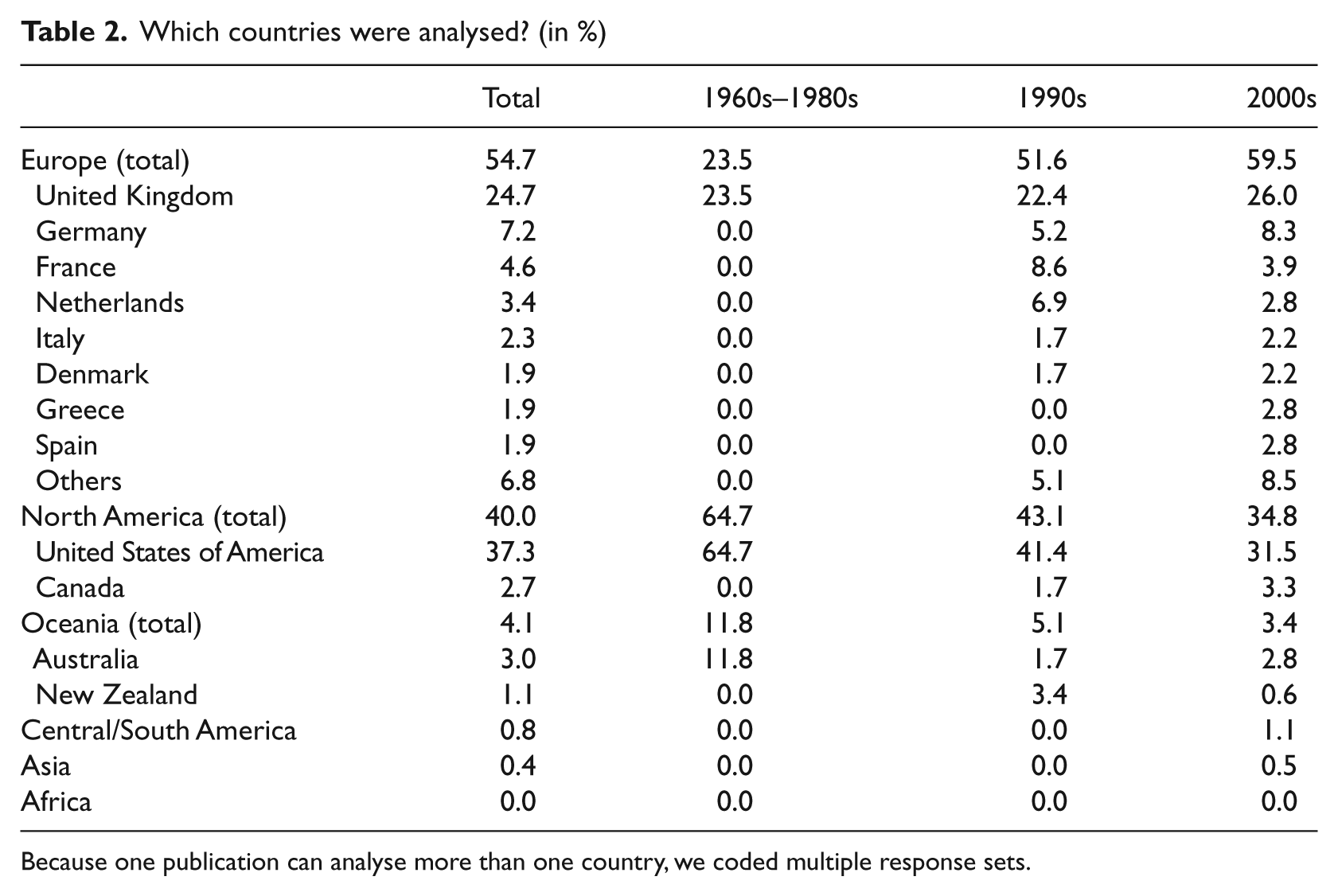
Because one publication can analyse more than one country, we coded multiple response sets.
It is noteworthy, however, that at no point in time do we find more than 1.6% of analyses on non-Western countries. Studies on the media’s coverage of science in Eastern European countries such as Bulgaria (e.g., Bauer et al., 2006), in South American countries such as Colombia (e.g., Parales-Quenza, 2004) or in Asian countries such as India (e.g., Dutt and Garg, 2000) are extremely rare, and there are no studies on African countries in our sample.
In terms of the analysed media type, there is also a clear, and even constantly growing, bias towards print media, with 70.7% of all analysed publications analysing exclusively print media (i.e., not comparing them to any other type of medium). When we add in comparative articles in which printed media are analyzed amongst others, print media are the focus of more than three-quarters of all publications. Within print media, authors tend to analyse national elite (or quality) newspapers and broadsheets such as the “New York Times” in the US, “The Times” in the UK, “Le Monde” in France, and the “Frankfurter Allgemeine Zeitung” in Germany particularly often – since 2000, they have been analysed in more than half of all publications (e.g., Bucchi and Mazzolini, 2003; Hampel et al., 1998; Major and Atwood, 2004).
While quality newspapers may be justifiable sources for analysis owing to their relevance as opinion leaders and inter-media agenda setters, this focus, and the resulting neglect of other media, does not reflect the overall relevance of different media in science communication. This is true for alternative print media in that very few studies exist on publications like popular fiction (Mellor, 2003) or comic books (Locke, 2005). It is particularly striking for broadcasting media. Studies on science films (e.g., Kirby, 2003; Medina-Domenech and Menendez-Navarro, 2005; Weingart, Muhl and Pansegrau, 2003) and television (e.g., Banks and Tankel, 1990; Boykoff, 2008; de Cheveigné and Veron, 1996) account for less than one-sixth of all analysed publications, and even received less attention over time. Moreover, analyses of science presentations on the internet are still rare, although attention seems to be growing lately (e.g., Gerhards and Schäfer, 2010; Lederbogen and Trebbe, 2003; Triunfol and Hines, 2004).
Which mass media types were analysed? (% of articles analysing this medium)
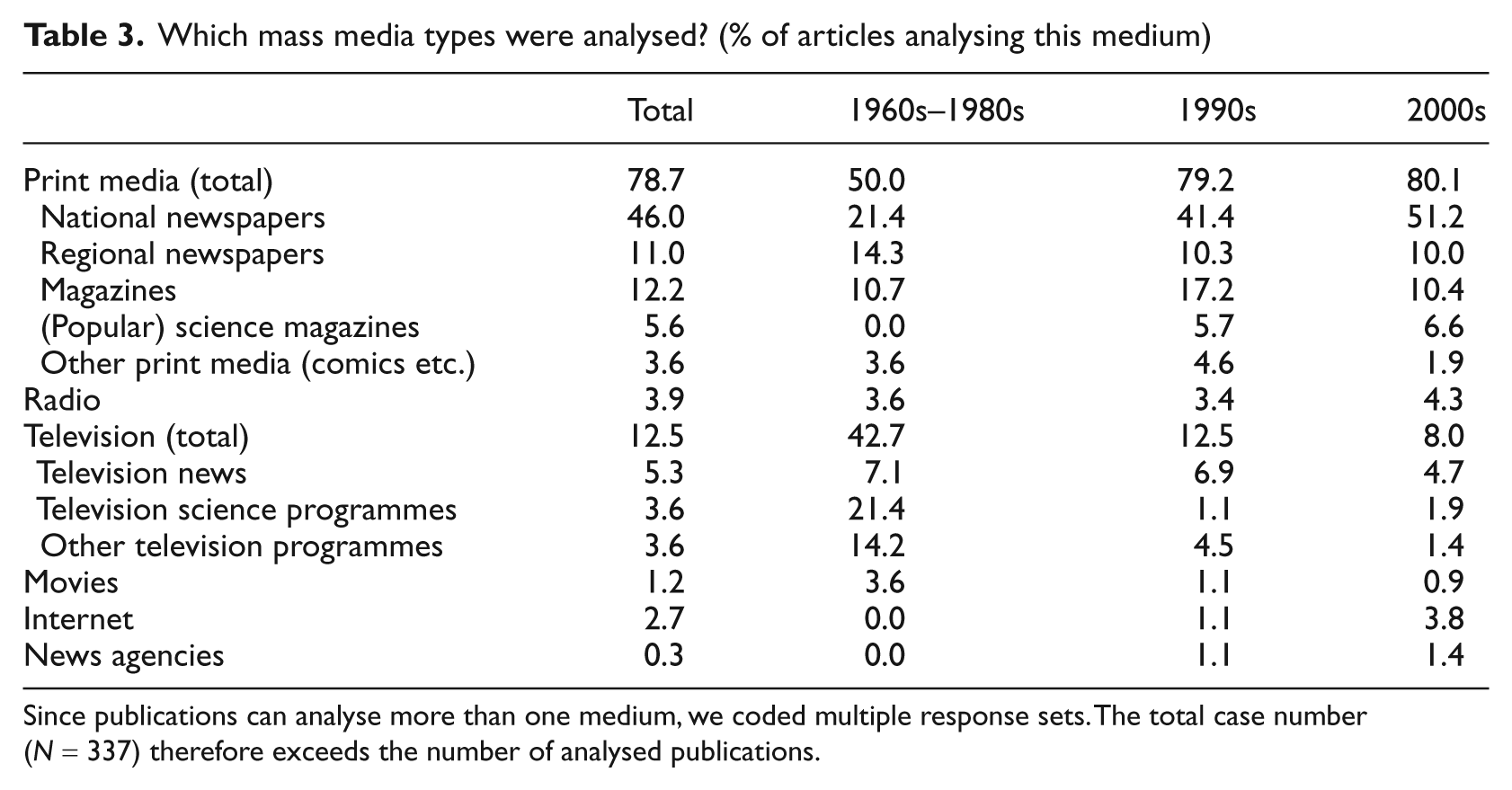
Since publications can analyse more than one medium, we coded multiple response sets. The total case number (N = 337) therefore exceeds the number of analysed publications.
Methodological approaches
The analysed studies also differ in their research designs and methodological approaches. In terms of methodology, social scientific research can be done quantitatively, i.e., striving for representative data and analysing it with statistical tools, or qualitatively, i.e., aiming to analyse cases considered to be particularly relevant and approaching them with interpretative and hermeneutic means. Both methodologies have strengths and weaknesses: while quantitative data analysis can incorporate large amounts of data and therefore lends itself more easily to generalisation, it is weak in in-depth interpretation. The opposite is true for qualitative analysis. A combination of both approaches may therefore be a particularly promising way of doing research.
When we look at our data, we find that both quantitative and qualitative approaches are represented rather strongly in the literature, and their relative representation remains roughly constant over time. Approximately half of all publications use quantitative methods, whereas 38.9% take a qualitative approach. It is notable, however, that only 8.1% of publications combine both research strategies in one study.
As well as the specific methodology used, studies vary in their research designs, such as case studies, which focus on science coverage of one issue in one national context and within a given (mostly short) period of time; cross-sectional studies, which compare different scientific disciplines and/or different countries and/or different media with one another; longitudinal studies, which analyse the temporal development of coverage over time; 7 and publications combining both cross-sectional and longitudinal elements in one analysis.
Which methodology and research design were used? (in %)
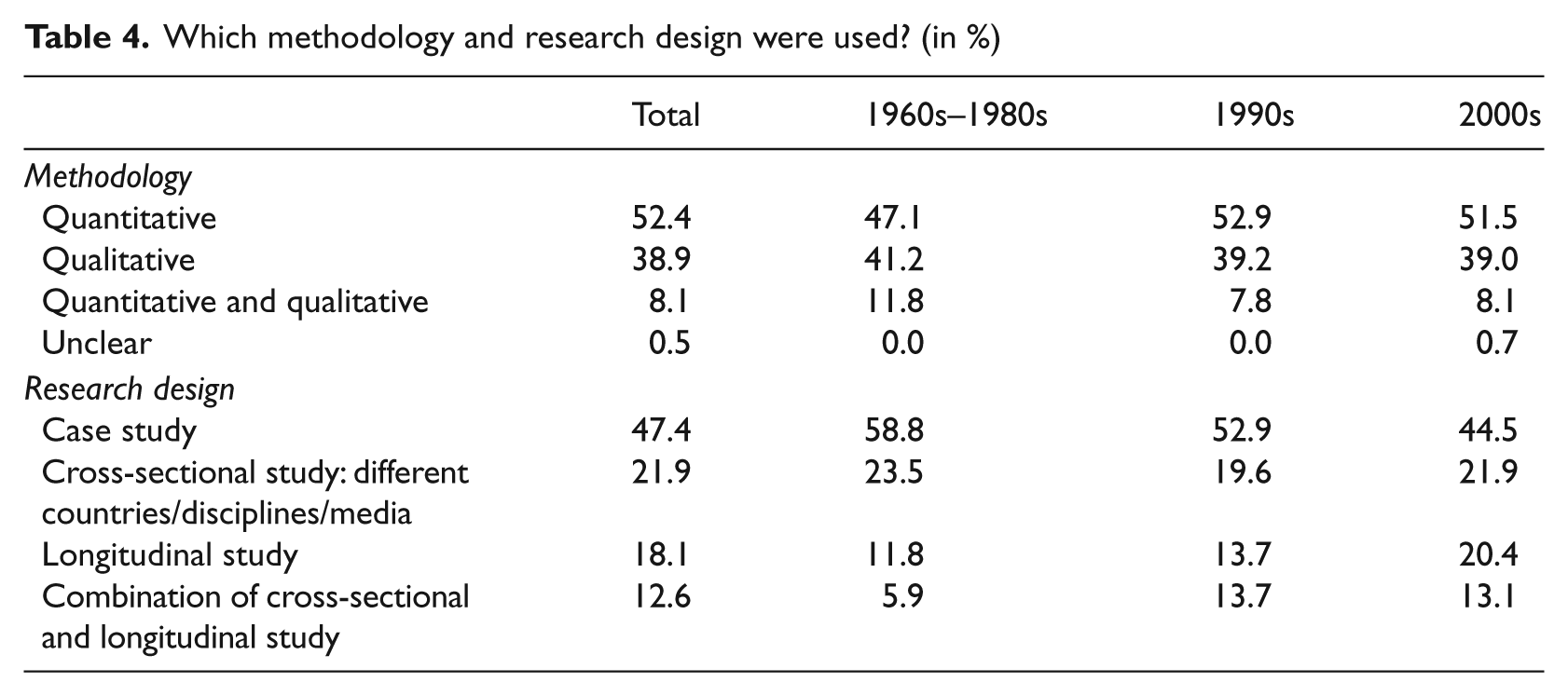
In the research on mass media science coverage, case studies represent the largest, albeit shrinking, group, accounting for almost half of all publications. Both cross-sectional and longitudinal studies account for some 20% of all publications, and 12.6% combine elements from both. On the positive side, this means that comparative, i.e., cross-sectional and/or longitudinal studies make up more than every second analysis. Also, the number of longitudinal and combined longitudinal/cross-sectional studies is rising. Yet the nature of these comparisons reveals some shortcomings: almost all comparative studies compare different media types and mainly different kinds of print media. There is still a general lack of studies comparing disciplines and/or countries.
4. Discussion
Our meta-analysis of studies dealing with the media’s coverage of science has shown that this field of research received a large and growing amount of social scientific attention over the last decades. We found that researchers are using a mixture of research designs and methods; we found a significant number of longitudinal studies (certainly due to now available full-text databases such as “LexisNexis”) and also many studies that compare different media outlets. This is a positive characteristic of the research: by making temporal or cross-media comparisons and by applying contextual information to their respective findings, these studies are well equipped to offer nuanced interpretations and to judge absolute results in relative terms.
Our analysis also found some biases and limitations of the field. Although many scholars write about science in the media, the writing as a whole is rather one-sided in several important aspects: first, scholars analyse media coverage mostly in the natural sciences and neglect social sciences and humanities – even though the latter also deal with topics relevant to society at large, receive major funding they should be held accountable for, and are present in the mass media (Wormer, 2005).
Second, the media coverage in Western countries is most often analysed, with almost no African, South American, or Asian countries in the literature. This contrasts sharply to descriptions of science as a global system, e.g., of an “astonishing growth of international scientific collaboration” (Stichweh, 1996: 334) or an ongoing transnationalisation of scientific organisations (Held et al., 1999: 57). Many scholars think that science is already working on a global basis and that its outcomes are produced in and affect countries around the world (Beck, 1992, 2007). This is not reflected in the research.
Third, print media are the most prominent media type analysed, due certainly to the accessibility of databases and the relative ease of analysis which, unlike television analysis, does not require sound or moving image coding. Nonetheless, this is a major shortcoming in that people use audiovisual media, such as radio broadcasting, television, and the internet on a daily basis for longer periods of time than they read newspapers (e.g., Dreier, 2009; Humphreys, 2009; IP International Marketing Committee, 2008; Kleinsteuber, 2009). Furthermore, television has different, and often stronger, effects on audiences than do newspapers (e.g., McQuail, 2005: 455ff.).
We therefore recommend that the analysis shift away from a sole focus on the natural sciences, Western countries, and print media. So far, however, all three biases have persisted over time. From the 1960s to the 2000s, between 80 and 90 per cent of publications dealt with natural sciences, practically all focussed on Western countries, and a clear and even growing majority analysed print media. There has been no trend towards a broader set of disciplines, the inclusion of more and particularly non-Western countries, or a stronger emphasis on audiovisual media and the internet, at least not yet.
Footnotes
Acknowledgements
The author would like to thank Andreas Schmidt for his help in collecting and coding the articles that were analysed here, Ana Ivanova for her assistance in data analysis, Sarah Pleger for preparing the tables, and Joanna Schenke for proof-reading the manuscript.