







Abstract
With a general decline in people’s choosing to pursue science and engineering degrees there has never been a greater need to raise the awareness of lesser known fields such as acoustics. Given this context, a large-scale public engagement project, the ‘Aeolus project’, was created to raise awareness of acoustics science through a major collaboration between an acclaimed artist and acoustics researchers. It centred on touring the large singing sculpture Aeolus during 2011/12, though the project also included an extensive outreach programme of talks, exhibitions, community workshops and resources for schools. Described here are the motivations behind the project and the artwork itself, the ways in which scientists and an artist collaborated, and the public engagement activities designed as part of the project. Evaluation results suggest that the project achieved its goal of inspiring interest in the discipline of acoustics through the exploration of an otherworldly work of art.
Keywords
1. Introduction
During 2011/12 the spectacular singing sculpture Aeolus toured the UK as the centrepiece of a major public engagement project to promote the science of acoustics. Conceived by the artist Luke Jerram and developed in consultation with acoustics researchers at the University of Salford and the University of Southampton, Aeolus was designed to function as a giant Aeolian harp producing beautiful and unearthly sounds alongside the visual spectacle of a 6.1 m tall, 9.5 tonne stainless steel arch of 310 internally reflective tubes, some linked by a web of nylon wires to an external ~40 m diameter ring of 16 listening posts. Figure 1 shows the central arch of Aeolus sited at Lyme Park National Trust, Derbyshire, UK.
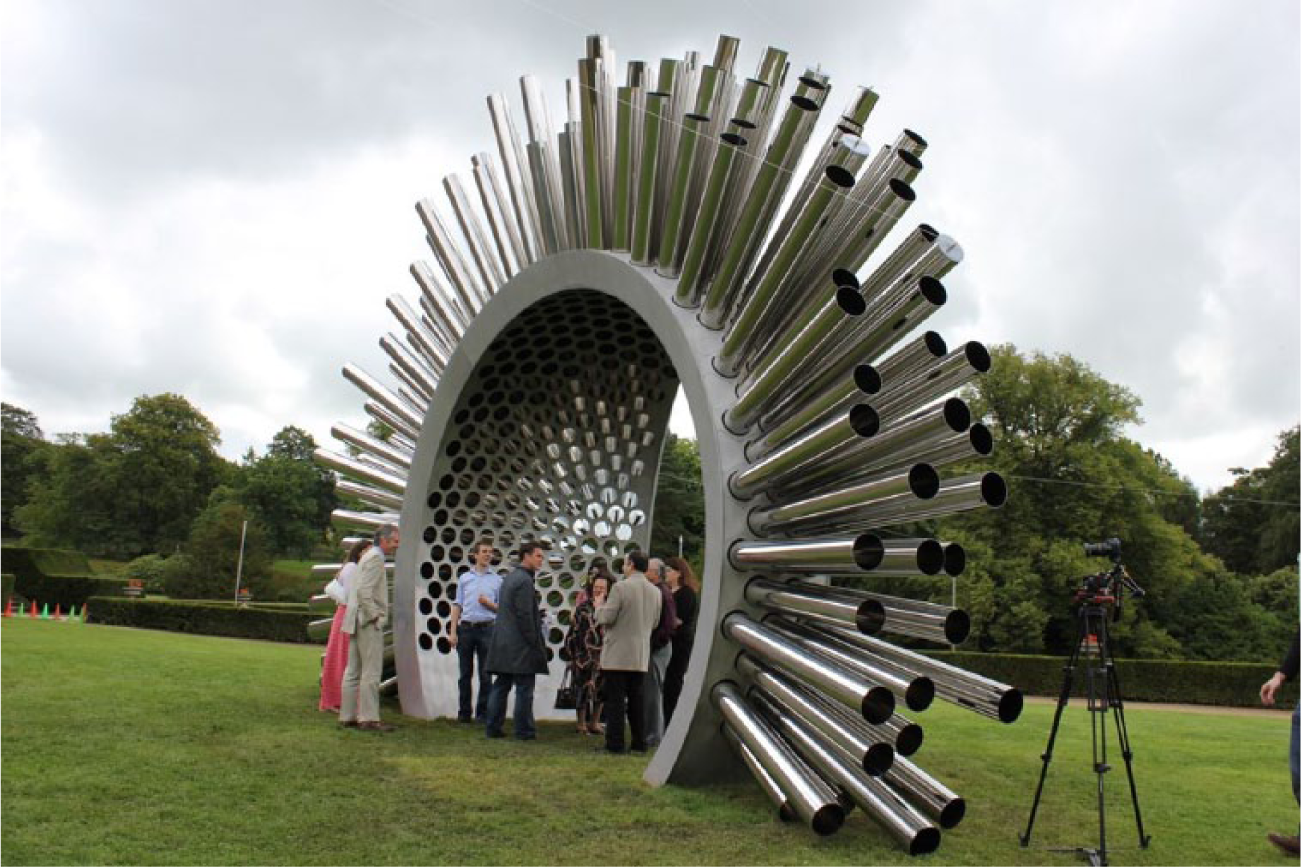
Aeolus at Lyme Park, Derbyshire, UK.
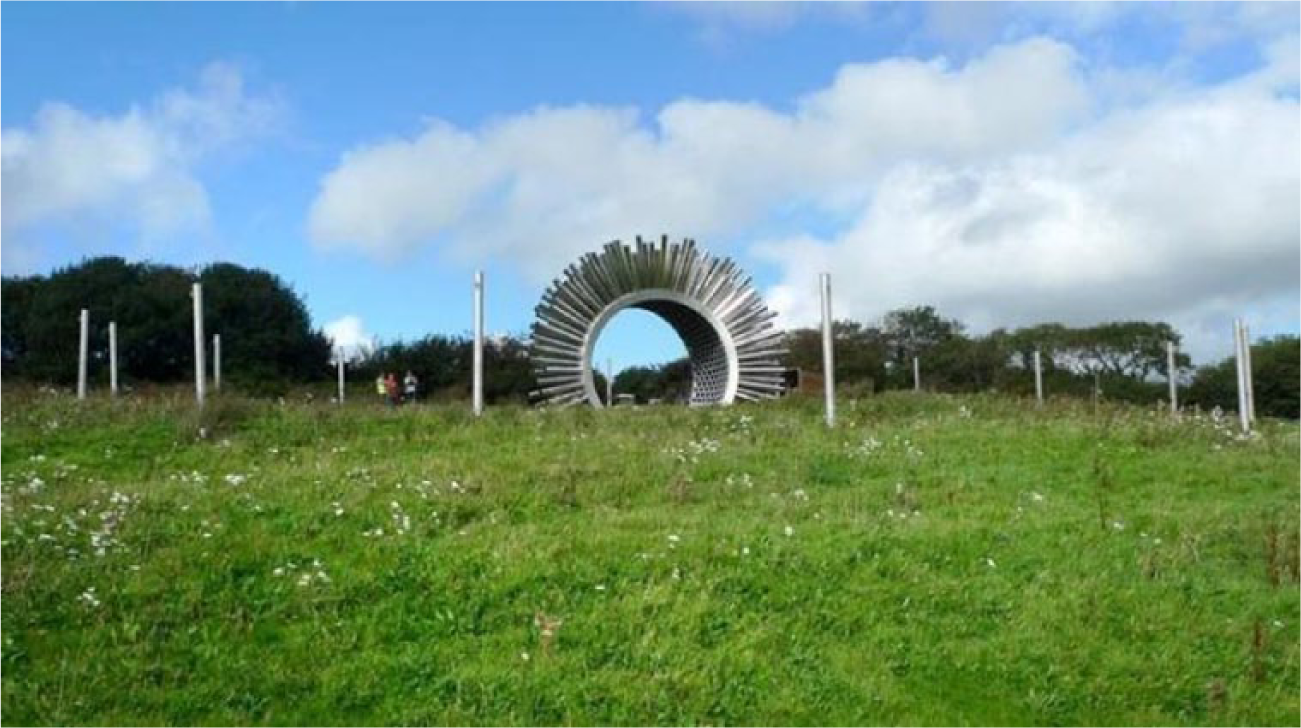
Aeolus at the Eden Project, Cornwall, UK. Note that Aeolus is surrounded by 16 listening posts, to which are attached long nylon strings leading to membranes/lids on tubes of the arch.
This paper will describe the motivations behind the Aeolus project and its implementation, including the development of the Aeolus sculpture and tour, the public’s and media’s responses and a range of accompanying outreach activities.
Aeolus was funded as part of the Engineering and Physical Sciences Research Council (EPSRC)’s Partnerships for Public Engagement (PPE) scheme, a programme aimed at developing interactions with the public to promote a better understanding of issues and opportunities that arise from scientific research. A key aim of Aeolus was to create a greater awareness of the existence of acoustic science and engender a greater appreciation of its contribution to quality of life. The PPE grant scheme has since ended. EPSRC grant applications now require a detailed ‘pathways to impact’ statement that can include public engagement activities. Impact indicators assessed as part of the Research Excellence Framework include cultural, social and economic benefits of research to society. Aeolus especially highlighted the cultural link between art and acoustic science. This link provided an opportunity for a wider reach than a typical science exhibit, as will be discussed later.
Since the mid 1990s there has been overall a marked decrease in UK and US institutions offering degree programmes in science and engineering, and conversely a rise in the popularity of degree programmes in arts and media (Ramsden, 2012; DARPA, 2010). This is despite the fact that science is generally perceived very positively with typically 80% to 90% of the general public believing science makes a valuable contribution to society and 68% believing jobs in science are very interesting. Although a significant proportion of the public proactively seek to engage with science activities for leisure (e.g. 22% of UK adults visit a science museum annually), there has been a decline in the percentage of people who feel informed about science (Ipsos MORI, 2011; OST/Wellcome, 2000).
However, there is evidence that high profile science public engagement activities to widen science engagement via the mainstream media and very accessible presentation do work. This has been demonstrated by a recent resurgence in physics recruitment in the UK (McWhinnie, 2012) that has in part been attributed to popular television and radio programmes and personalities presenting aspects of science in very accessible and enjoyable ways. It is within this context that a number of innovative outreach projects specifically targeted at promoting acoustics have developed. A key feature among all of them has been presenting interactive demonstrations that stimulate awe and curiosity (Howard, 2012) or enfranchise the public in scientific research to relay the field’s relevance. Some notable examples being the IMPRINTS project (Mydlarz et al., 2008) which encouraged the public to assess soundscapes with mobile phones or the Terrible Sounds project (Cox, 2008) where the public rated horrible sounds online. Public engagement to promote acoustics presents some special challenges and opportunities. In the experience of this paper’s authors, many schoolchildren and adults are unaware of acoustics as a research field, with ‘something to do with guitars’ being a common response in workshops where the question ‘what is acoustics?’ is raised. When discussing ‘the science of sound’ many people are surprised as to the diversity of backgrounds of people employed, the range of career paths and its relevance to the economy and quality of life.
To its advantage acoustics can (with appropriate presentation) have a very broad appeal beyond scientifically inclined people, given the field’s close relationship with art and culture. Drioli (2006), Crettaz von Roten and Moeschler (2007) and others have discussed the use of art as a means to communicate and promote science in science museums, galleries and science festivals, due to “its ability to immediately involve people emotionally and to activate processes of participation and dialogue” (Drioli, 2006: 8). Likewise, Aeolus’ sensorial aspects and aesthetic appeal attracted attention from diverse attitudinal groups and inspired broad conversations about acoustics.
Aeolus aimed to engender awe, fascination and wonder in those who may not otherwise be scientifically motivated to find out about the science of sound. Aeolus also highlighted the interconnected relationship of science and art by providing a dramatic illustration that acoustics can be fun, creative and artistic. A key advantage of working with an acclaimed and award winning artist such as Luke Jerram was the extensive media attention his work could generate; the spectacle and event of big public art being a popular item for news reports, magazine articles and blogs.
Key to the public engagement strategy was the facilitation of multiple levels of engagement beyond the main visitor experience of enjoying the sculpture. These activities included talks given under the sculpture by Aeolus team members and trained invigilators, an ‘Acoustics of Aeolus’ exhibition, interactive workshops, community outreach (museums, galleries, science festivals), schools outreach (workshops, learning resources, teacher training) and online outreach (website, podcasts, video and social networking).
2. The sculpture Aeolus
Aeolian harps
Named after the Greek god of the wind, Aeolus primarily functions as a giant Aeolian harp. An early description of the Aeolian harp can be found in Athanasius Kircher’s book, the Phonurgia nova, which was published in 1673. They are musical instruments designed to sing in the wind. The sounds they create can be surprisingly beautiful and unearthly.
Traditionally Aeolian harps consist of spruce or maple boxes, across which are strung gut or nylon strings. Each string is tensioned in a musical relationship with respect to its neighbours. Typically they are placed on window sills, though also have been popular as garden ornaments.
The wonder of Aeolian harps is that they are, in effect, automatic music generating machines. As the wind changes one hears nature’s musical compositions. This fact fascinated many Romantic era poets such as Coleridge and Wordsworth who regarded themselves as conduits for nature’s art, and Aeolian harps a metaphor for this (Ruston, 2007). Aeolian harps have likewise inspired numerous painters and composers including Turner and Chopin. It was thus felt that a modern take on an Aeolian harp might likewise fascinate and inspire a modern generation.
Aeolus is intriguing both as a work of art and as an application of acoustic science. The sculpture’s string excitation results from the Kármán vortex street effect. As wind blows across the strings, a series of alternating low-pressure vortices pull the string periodically. The frequency of excitation is proportional to wind speed and inversely proportional to string diameter. As a given string is excited into motion the frequency of excitation locks into one of the discrete modal frequencies of the string, to create an audible resonance. As wind speed changes, the frequency of the string’s vibration moves up and down a harmonic series and so responds with consonant intervals in a very musical way. The effect is most prominent with gentle steady laminar wind flow in a direction roughly perpendicular to the string. If multiple strings are set at different directions and tensioned with diatonic relationships to each other, the resulting sound can be very dynamic and musical.
The acoustic design of Aeolus
The sculpture Aeolus comprises a large stainless steel arch supporting 310 steel tubes of lengths between 1.4 m and 2.4 m that link to an outer ring of 16, 3 m high, listening posts.
The central arch alone weighs 9.5 tonnes, being 6.1 m high with a 9 m × 2.8 m footprint. The listening posts typically fan out to form a circle of a radius of about 20 m. Forty of the arch tubes link to the listening posts via ~20 m long nylon harp wires tensioned to be acoustically active in light winds. The wires pass through wooden bridges held in PVC membranes that form lids for arch tubes and listening posts. The tubes and posts hence act as secondary resonators amplifying the string vibration. Although only one wire would pass through the bridge of a listening post, each listening post could anchor up to three wires meaning up to 48 wires could be presented to the wind.
A challenge for the project team was to facilitate the best aural experience given the constraints of cost, robustness, portability, and Jerram’s desire to design a sculpture that was not only aurally but visually spectacular and intriguing.
The dimensions of the steel tubes were chosen by Jerram to create a beautiful internal mirroring effect as light from the outside world is collected, inverted and presented to participants standing within the arch.
Long thin tubes with membranes do not act as optimum secondary resonators, as they offer a closed/open pipe input impedance profile with narrow discrete air column resonances corresponding to wavelengths of roughly 1/4, 3/4, 5/4, …, of the column’s length. Despite acoustic design constraints the air columns of the tubes still give some broadband amplification that proved adequate.
Sites were chosen to give Aeolus exposure to laminar, unbuffeted wind flow for prevailing wind directions. Although two of the sites were compromised by the presence of nearby trees and buildings, Aeolus still functioned well in less than ideal wind conditions. Following outdoor experiments with long nylon wires between 5 m and 20 m long, the Aeolian effect not only worked well with gentle wind speeds just above 4 mph, but also gave the best sustained and musical response.
Critical to an optimum response was an appropriate choice of wire diameter, membrane material, bridge material and string tension. Below a tension of ~50 N the strings did not respond well, hence tensioning mechanisms were required at the anchor points. It proved crucial that string tension was properly maintained throughout a tour given that strings would naturally loosen when settling in, or after stormy nights.
The membranes were designed with a recess for bridges. A variety of material types and sizes were tried, in the end a 1 × 6 cm cylindrical dowel bridge proved both effective and remarkably robust, as Aeolus had to endure a range of weather conditions.
The acoustic design of Aeolus was a compromise given the need for long steel tubes to present the intended visual effect and the need for a robust all-weather design. However, the final implementation proved remarkably effective, especially for calm sunny days. However, Aeolus would not produce Aeolian sounds during or soon after a rain shower owing to a disruption of airflow from raindrops on the wires and their increased inertia.
3. The Aeolus Outreach Programme and activities
The Aeolus Outreach Programme was developed alongside Aeolus in order to illustrate the link between the artwork and acoustic science.
The tour
To maximise its reach and exposure across the UK, Aeolus was designed to tour. Touring ensured audience diversity with its combination of curated and public spaces. Typical visitors at different locations would have different expectations and levels of engagement. For example the likes of the Eden Project and Lyme Park had (predominantly) paying visitors of typically families or couples visiting on ‘a day out’, thus expecting to be entertained and informed. In public places such as Media City, Aeolus was often a surprise feature for casual passers-by going about their daily business.
When embarking on such a large-scale and ambitious project, dedicated and experienced tour management proved a key feature. This involved contractual negotiations with hosting organisations able to provide in-kind support with suitable location, insurance, invigilation, security, ground preparation, plant, demographic data and publicity.
Aeolus toured four sites during the project. A typical installation lasted for five weeks. With appropriate plant the central arch and base could be assembled in parts. The tubes were detachable and could be packed separately. The whole structure could be transported on two lorries and installed or de-installed within 5 days, including time for ground preparation or remediation.
Tour sites included Lyme Park (the National Trust Derbyshire), the Eden Project (Cornwall), Media City UK (Manchester) and Canary Wharf (London). As well as at the tour sites, many outreach workshops took place at other locations including the Manchester Museum of Science and Industry, Manchester Art Gallery, the Bluecoat Art Gallery Liverpool, the Manchester Science Festival and events at Southampton and Bristol.
The ‘Acoustics of Aeolus’ exhibition accompanied Aeolus on its tour. The exhibition provided a place for the public to learn more about the sculpture, from Jerram’s conception to its final acoustic design. This included two 40-inch video screens showing short documentaries, information boards describing the acoustics of the sculpture and a variety of hands-on devices that could give visitors hands-on experience of acoustic science. These devices included traditional Aeolian harps with portable wind generators, Chladni pattern generators, cornflour speakers and Tibetan singing bowls. At some venues, the sophistication of the acoustic science on display was extended with a 64-channel wave field synthesis (WFS) system playing hybridised WFS sources and ambi-sonically rendered sound field recordings of Aeolus.
Schools and community engagement
A major part of the project’s science public engagement included designing and delivering Aeolus themed workshops for schools and community groups. The workshops were designed to be interdisciplinary while complementing Key Stages 1&2 and 3&4 of England’s national science curriculum. Aeolus project members took workshops to schools and hosted ‘Continuing Professional Development’ (CPD) events for teachers through the UK’s National Science Learning Centre. These workshops are available online via the Aeolus project website (http://aeolus-outreach.com/).
Some workshop activities
In keeping with the overall goals of the Aeolus project, the workshops aimed to link acoustics to art (including music and sculpture). Detailed at the Aeolus Outreach website (http://aeolus-outreach.com/), a range of ideas were developed that could provide both an aural and visual experience, as well as elements of hands-on construction and experimentation.
Workshop activities included:
DIY (do-it-yourself) Aeolian harps (Figure 3): These simple devices can create strikingly beautiful and unearthly sounds. An outdoor harp is easily constructed from an ~10 m stretched fishing line tethered between a fixed post and a handheld metal bin with a tying hole. An indoor harp can consist of ~1 m nylon guitar strings stretched across 2 cm high bridges resting on a wooden box (or a wooden plank with contact microphone attached). Indoor harps will require a source of laminar airflow. A desk fan can be used with a DIY cardboard flow modifier. Goggles are a recommended precaution when creating devices with stretched strings.
Tonoscope kits: Remarkably simple, fun and visually engaging cymatic devices, tonoscopes typically consist of an open plastic container holed at the side to hold an ‘L’ shaped tube. Resting on the top of the container is a latex membrane held in an embroidery hoop. If salt is sprinkled on the latex it will form complex Chladni patterns as a person sings into the tube.
Cornflour speakers: These are plastic loudspeaker drivers filled with a mixture of cornflour (cornstarch) and water. The mixture can act as a non-Newtonian fluid moving between solid to liquid states when forced. When driven by an oscillator, the loudspeaker pushes and pulls the cornflour, which in turn forms into surprisingly eerie and dynamic shapes.
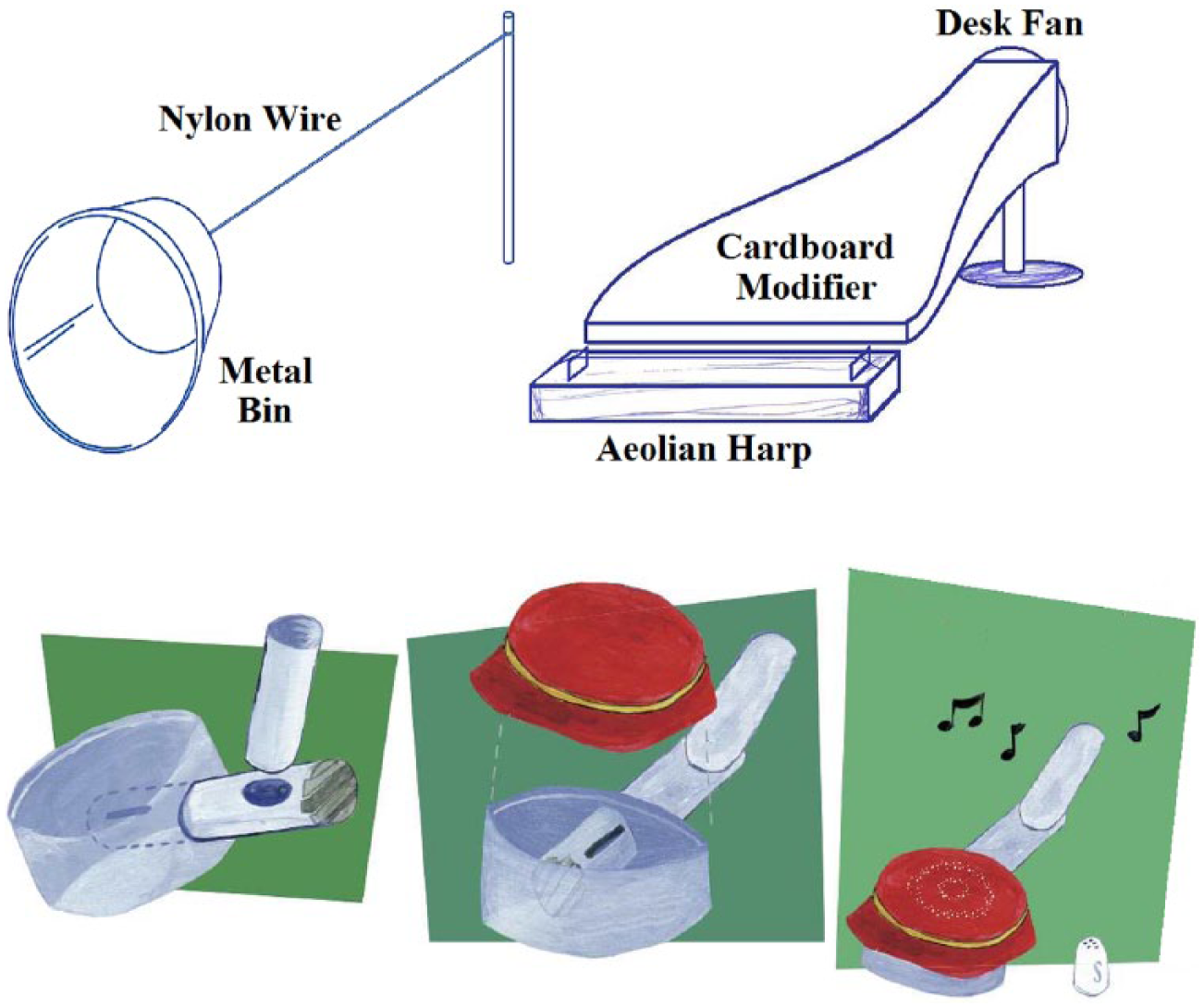
Simple outdoor and indoor Aeolian harp demonstrations and the construction of tonoscopes were key parts of in-school activities.
4. The evaluation
The Aeolus project had a comprehensive evaluation strategy that ranged from tallying numbers of visitors to detailed surveys designed to assess the quality and impact of engagement, especially with respect to raising the awareness of, and interest in acoustics. In addition to evaluating responses from visitors to the artwork, evaluation data was also gathered during outreach activities such as school visits or one-off events.
Throughout Aeolus’ installation periods, teams of volunteers from the National Trust, Eden Project and The Lowry invigilated the artwork. These volunteers were trained by the Aeolus team to provide background information about Aeolus and to direct visitors to the nearby exhibition where they could find more details about Aeolus’ acoustic properties and engage in hands-on experiments. Invigilators were also responsible for sampling visitor opinions via specially programmed handheld tablet personal computers. Opinion data was evaluated with respect to total visits to provide a statistical extrapolation of responses with reasonable confidence.
Three questions regarding visitors’ opinions were asked in addition to basic demographic information:
Q1: Did you enjoy the sculpture?
Q2: Are you curious to know how the sculpture works?
Q3: Does the sculpture make you want to learn more about acoustic science?
Visitors would rate their experience of the artwork and desire to learn more about its acoustic properties with a simple 1–5 star rating system with the following values
No/Negative response
Not much
Indifferent
Yes/Positive response
Yes, very much/very positive response.
By tallying positive responses of visitors to Aeolus, we estimate 91% enjoyed the sculpture, 80% had a raised curiosity and 51% had a raised interest in acoustics science. One can extrapolate with 95% confidence from verified visitor numbers that 48.9K ± 2.5K enjoyed it, 43.0K ± 2.4K were curious as to how it worked and 27.4K ± 4.4K had a raised interest in acoustics. Note, as two of the four Aeolus locations were freely accessible to the public 24 hours a day, we believe unverified total visitor numbers to be around ~100K.
Table 1 shows the mean responses in answers to Q1, Q2 and Q3 with respect to age and gender.
Demographic breakdown of responses showing mean of answers to questions for different groups and correlations between answers.
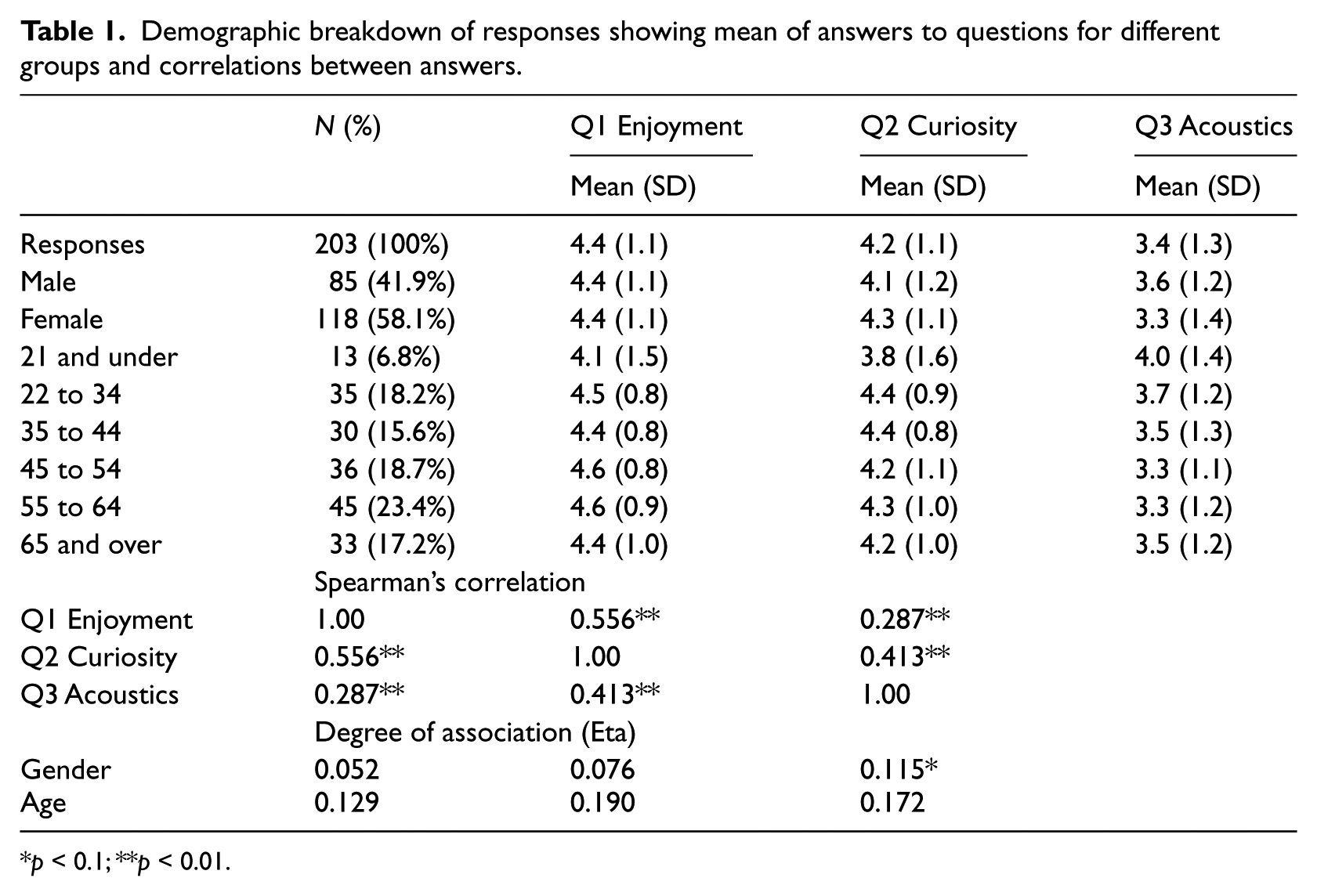
p < 0.1; **p < 0.01.
Although there is some indication that older people enjoyed the sculpture more and that younger people were relatively more amenable to the promotion of acoustic science, the differences in means yielded no statistical significance. The relatively low numbers of young people highlight a problem with this type of project, where such an art/science tour may be off the radar of a younger generation. This was mitigated with wider teacher and schools engagement, with teachers enthusiastically welcoming Aeolus themed workshops to complement their science classes. Although visitor gender and ethnicity were recorded, the demographic breakdown was typical of the UK as a whole and yielded no significant variations between groups. We found strong significant correlations between answers from people reporting enjoyment of the sculpture, curiosity and wanting to learn more about acoustics.
The wider impact of Aeolus was in part due to numerous outreach activities including the delivery of resources for schools and communities. Following directly in-school engagement and CPD events, the recorded responses of teachers were extremely positive with 95% of teachers expressing a commitment to incorporate the content within their lessons, meaning a potential outreach to school children of >10K from the teachers we were in direct contact with. Community workshop activities were also extremely well received by participants from a wide demographic.
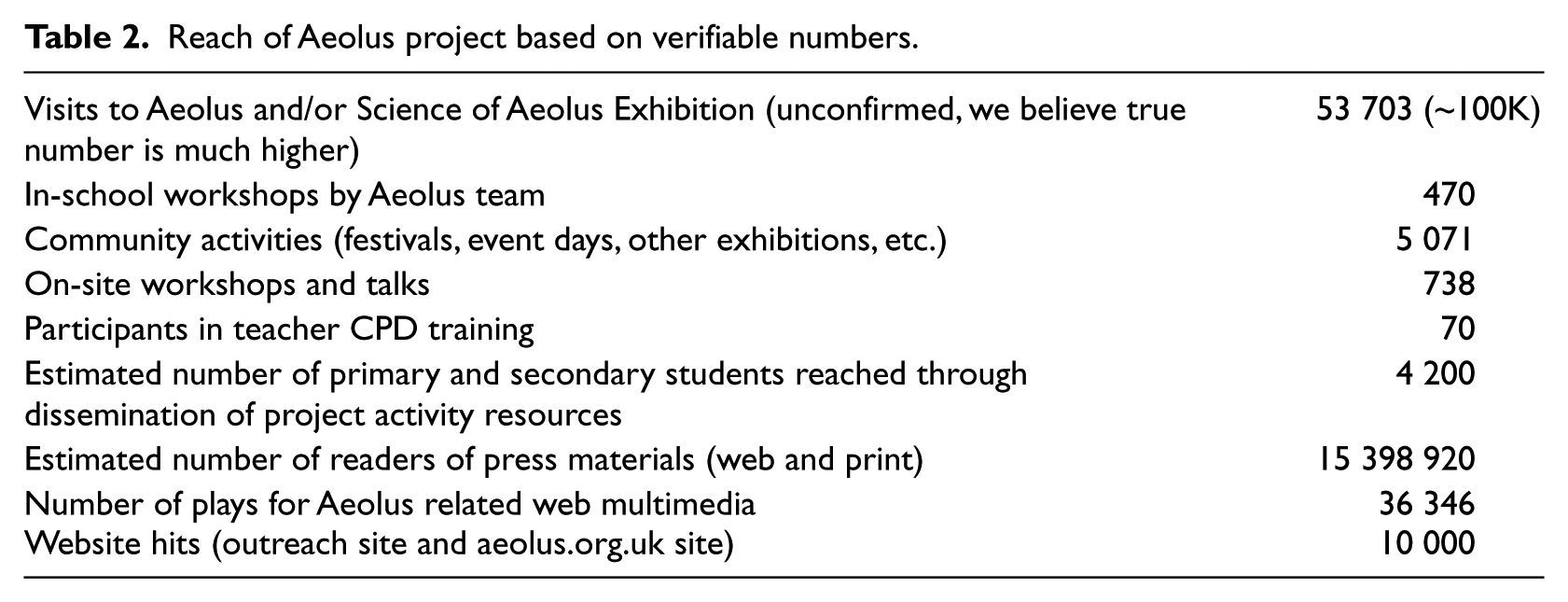
The sculpture also enjoyed wide and diverse media attention including national coverage in The Telegraph, Mail Online, Financial Times, Flybe Flight Magazine, Design Week and The Guardian as well as numerous regional newspapers and online sites. It is difficult to estimate the impact of media coverage; however, reporting did generate discussion via social media, with for example an article in Guardian Travel, whose circulation is ~1198K, generating a recorded 568 social media shares. Table 2 summarises the reach of the project based on verifiable numbers.
Reach of Aeolus project based on verifiable numbers.
A survey of press articles highlights the benefits and problems of our approach to promoting acoustics science through art. All articles talked about the spectacle of a singing sculpture and were universally positive. Of those articles we found 48% explicitly mentioned the science of acoustics and 28% mentioned the academic institutions involved in the project. Despite press releases that gave due attention to the involvement of acoustics academics in the funding, design and outreach, the message of promoting acoustics was not universally portrayed by journalists who wrote about what appeals to them and their expected audiences. However, the greater extent of the coverage and reach to new audiences were welcome benefits.
5. Conclusion
The Aeolus project proved to be a successful collaboration between an artist, acoustic scientists and hosting organisations. Such a project is inherently high risk being dependent on the timely procurement of multiple funding, material, logistical, hosting and contractual elements. The project benefited greatly from the employment and consultation of specialists in tour management and art hosting.
The project reached a very large number of people and significant correlations in data showed that most people who enjoyed the sculpture were also made curious about its workings and many wanted to learn something about acoustics as a result. However, associating art with the promotion of science can be problematic as the ultimate aims of the artist and the scientists involved might be different. On-site and press evaluation data demonstrated only about half the audience will be receptive to the direct promotion of acoustic science topics, indicative perhaps of the dispositions of the wider population.
Also younger audiences formed a smaller proportion of the visitors to the sculpture given the nature of the venues and access to them. However, Aeolus proved an excellent facilitator for schools engagement with schools, teachers and students enthusiastically welcoming Aeolus themed lessons and teacher CPD events. The time invested in developing teacher packs and lesson plans proved immensely valuable. Early engagement with schools and the National Science Learning Centre, North West, UK ensured our content aligned well with teachers’ needs and the requirements of the National Curriculum.
A key lesson learned was the need to be very pro-active in asserting the science promotion message whilst being sensitive to the art agenda. The associated science outreach should include funding for dedicated staff time and material resources. The large window of time before tours allowed for a wide range of school, museum and gallery engagements that widened reach and allowed for refinements in outreach activities and resources prior to the tour. It is also recommended that scientists embarking on such a project invest time in developing press releases and promotion activities because, as our press surveys demonstrated, the focus and emphasis of journalists vary.
During the tour of Aeolus we found the science engagement can be greatly enhanced by invigilator training, timed talks by academics and nearby workshops manned by volunteers. Although the use of on-site signage was understandably restricted, all venues agreed to provide a nearby exhibition space which gave much greater options for enjoyable science engagement.
In summary Aeolus demonstrates that the draw and mystic of a spectacular artwork can widen exposure, access and reach of science public engagement and enable a variety of ways to communicate to the public some of the awe, fascination and curiosity that inspired us to become acoustics scientists.
A full description of the project and its resources can be accessed via the Aeolus Outreach website (http://aeolus-outreach.com/).
Footnotes
Acknowledgements
With special thanks to Carolyn Black, Christian Barnes of Vista Projects, The National Trust, Outokumpu, The Eden Project, Peel Holdings, Arup, and The Sculpture Factory.
Funding
The Aeolus project was funded by the Engineering and Physical Sciences Research Council and the Arts Council England.