







Abstract
This study compares public attitudes toward nanotechnology in the United States and Singapore, using large-scale survey data in both countries. Results indicate that Singaporeans tend to be more knowledgeable about and familiar with nanotechnology than the U.S. public. Singaporeans tend to perceive greater benefits and fewer potential risks of nanotechnology, and to indicate greater support for government funding for nanotechnology than the U.S. public. Between the two countries, perceived familiarity with nanotechnology and the benefits and risks of the emerging technology tend to be interpreted differently through the lens of value predispositions (religiosity and deference to scientific authority) and therefore they indirectly affect public support. Specifically, the U.S. public tends to use religiosity to interpret benefits and Singaporeans are inclined to use religiosity to think about risks. Deference to scientific authority also moderates the impact of perceived familiarity with nanotechnology on funding support for the technology among the U.S. public.
1. Introduction
Nanotechnology has been presented as a socioeconomically significant area in the United States, as well as in many other countries (Renn and Roco, 2006). Globally, more than US$67.5 billion has been pumped into nanotechnology research and development (R&D) by many governments in the past decade (Cientifica, 2011). Policymakers and scientists believe that nanotechnology can overcome many problems that confront the world today in such key areas as healthcare, the environment, and national defense (National Science and Technology Council, 2000). Motivated by the launch of the 2000 U.S. National Nanotechnology Initiative, governments around the world spend US$10 billion per year on nanotechnology R&D, with the investment set to rise to US$12 billion by 2014 (Cientifica, 2011). In turn, nanotechnology has already been applied to more than 1,500 consumer products worldwide (Project on Emerging Nanotechnologies, 2011).
About 5% to 10% of the U.S. National Nanotechnology Initiative Budget is granted for research on societal dimensions to minimize potential social, political, economic, and moral conflicts over this new technology (Matsuda and Hunt, 2009). Research in the social sciences, including the communications discipline, has therefore focused on the issue, especially the public opinion of nanotechnology, over the last decade. Public opinion plays a key role in shaping governmental policies in many countries. With a high level of public support for government funding of nanotechnology, it is likely that a nation can stay competitive in harnessing the potential of the novel technology (Roco and Bainbridge, 2003). Interestingly, the majority of studies regarding nanotechnology have been conducted in the U.S. (e.g., Brossard et al., 2009; Ho, Scheufele and Corley, 2010, 2011) and Europe (e.g., Gaskell et al., 2004, 2005). Given the argument that attitudes toward emerging technologies can vary widely among nations and cultures (Moon and Balasubramanian, 2004) and the critical importance of public opinion toward nanotechnology for keeping national competitiveness (National Research Council, 2010), it would be theoretically and practically worthwhile to conduct a study to compare public perceptions of this emerging technology across cultures, and more importantly, to investigate whether the attitude formation theories for emerging technologies transcend cultural boundaries. However, remarkably few comparative public opinion studies on nanotechnology have been conducted between North America and countries in Asia, despite the fact that many Asian countries have become leaders in both technological innovation and adoption (Gupta, Fischer and Frewer, 2012).
With these considerations in mind, this study aims to fill the research gap by conducting a cross-cultural comparison of public attitudes toward nanotechnology in the U.S. and a developed country in Asia – Singapore. We particularly aim to examine if the use of perceptual filters as interpretive frameworks in attitude formation (Brossard et al., 2009) indeed transcends cultural boundaries and if publics from different cultures use different perceptual filters to help them make sense of complicated scientific information.
The reasons why we chose Singapore to compare with the U.S. are threefold. First, the two countries are both characterized by a highly developed free-market economy, a high Gross Domestic Product (GDP) per capita at Purchasing Power Parity (PPP), rich ethnic multiplicity, a governmental designation of science and technology as a key national priority (Central Intelligence Agency, 2011; Feng, 2011; Foreign Policy, 2010; Roco, Mason and Epstein, 2009; Singapore Department of Statistics, 2011), and strong governmental efforts to develop nanotechnology. Second, the two countries are culturally distinctive with differences in religious composition. The most followed religion among Singapore’s resident population is Buddhism (Singapore Department of Statistics, 2010), which is different from that of the population in the United States, where the majority (73%) are Christians (Pew Research Center, 2012). In addition, Singapore is one of the primary competitors with the U.S. in the international race to develop emerging technologies (Herrera, 2005). The migration pattern of top stem cell scientists from the U.S. to Singapore is a good illustration of Singapore’s competitiveness, which is promoted by liberal policies and growing government financing in the research field in Singapore.
The U.S. government has treated nanotechnology as a key research item at the national level (National Science and Technology Council, 2007), with a federal budget of US$1.8 billion for the National Nanotechnology Initiative in 2013 (National Nanotechnology Initiative, 2012). In Singapore, nanotechnology has been highlighted in the Science, Technology & Enterprise Plan 2015 (Singapore Agency for Science, Technology and Research, 2011) and the Singapore government funding for nanotechnology-related research and manpower development reached about US$300 million between 2003 and 2007 (Vedam et al., 2009). The amount of Singapore government funding is small relative to that of the U.S.; nevertheless, it is an indication of the Asian country’s effort to develop the emerging technology (Ho, 2010).
2. Public attitudes toward nanotechnology in the United States and Singapore
The U.S. public is still largely uninformed about nanotechnology (Project on Emerging Nanotechnologies, 2011). Indeed, around 77% of Americans have heard “just a little” or “nothing at all” about this emerging technology (Smith, Marsden and Hout, 2013). Furthermore, about 45% have no opinion about the trade-offs between the risks and the benefits of nanotechnology, while 37% think the benefits outweigh the risks, and only 9% think that the risks outweigh the benefits (Smith et al., 2013).
To our knowledge, no public opinion studies on nanotechnology have been conducted in Singapore, and research on public opinion of Science and Technology (S&T) in Singapore is scant. However, there are indications that the public knowledge of S&T is rather high and the climate of opinion toward S&T is positive. It has been internationally recognized that Singaporeans are generally knowledgeable in areas like science and mathematics (Tan, 2010). Unlike the negative sentiments toward genetically modified foods in some European countries and complex attitudes in the U.S., the attitudes of Singaporeans are quite accepting of genetic engineering technology owing, most likely, to Singaporeans’ high level of trust in the local government (Lee, 2010; Tan and Tambyah, 2011) and a sense of respect for scientific work (The Straits Times, 2000).
Empirical evidence has demonstrated that scientific knowledge can have significant effects on public acceptance of specific emerging technologies (Brossard et al., 2009). A more informed lay public tends to think the potential benefits of nanotechnology outweigh the risks in the United States (Macoubrie, 2006; Priest, 2006). Previous research has also shown that familiarity with nanotechnology is positively related with the beliefs that the benefits outweigh the risks of nanotechnology (Peter D. Hart Research Associates, 2008). Levels of trust in scientists, regulatory authorities and industry could also positively predict public attitudes toward nanotechnology (Brossard and Shanahan, 2009; Priest, 2001; Wynne, 2001). As discussed earlier, the Singaporean public may be more familiar with and/or more knowledgeable about the technology and have a stronger trust in government and institutions. On the basis of this reasoning, we put forth the following three hypotheses:
H1: On average, Singaporeans perceive greater benefits of nanotechnology than the public in the U.S.
H2: On average, Singaporeans perceive fewer risks of nanotechnology than the public in the U.S.
H3: On average, Singaporeans indicate greater levels of support for governmental funding of nanotechnology than the public in the U.S.
3. The formation of public attitudes toward nanotechnology
People are cognitive misers, who tend to minimize energy and effort when making decisions (Fiske and Taylor, 1991). Instead, people often rely on the least amount of information (or the most easily accessible information) related to the topics, known as heuristic cues, to develop attitudes toward complex technologies (Brossard and Nisbet, 2007; Brossard et al., 2009; Gaskell et al., 2004; Ho, Brossard and Scheufele, 2008a; Ho et al., 2011). Previous research, mainly in the U.S., has shown that factors such as people’s value predispositions, information shortcuts provided by mass media, nanotechnology-specific orientations, and risk and benefit perceptions can influence public support for funding of nanotechnology (Brossard et al., 2009; Cacciatore, Scheufele and Corley, 2011; Ho et al., 2011; Scheufele et al., 2009).
Factors influencing public support for nanotechnology
Value predispositions: Religious beliefs and deference to scientific authority
It has been established that people’s religiosity affects their acceptance of nanotechnology in the U.S. According to Brossard and her colleagues (2009), more-religious U.S. people (mostly Christians) are less likely to indicate support for federal funding of nanotechnology. One primary explanation is that Christians may perceive science and technology to interfere with nature and natural processes, thereby going against many of their religious tenets (Sjöberg, 2004; Sjöberg and Winroth, 1986). In the U.S., there has been an increasing socio-moral conflict between religion and science (Evans, 2013). Religious individuals hold the perception that unnatural and controversial technologies “go too far” or that scientists may be tampering with nature and “playing God,” all of which conflicts with moral and Christian beliefs. It has been well-documented that highly religious U.S. individuals are more opposed to nanotechnology due to moral considerations guided by their religious beliefs (Brossard et al., 2009; Scheufele, 2006).
Deference to scientific authority, a value predisposition developed mainly through formal educational systems, has also been shown to play a major role in explaining support for emerging technologies. Americans with higher deference to scientific authority and more trust in scientists are more likely to support controversial technologies such as genetic engineering in food (Brossard and Nisbet, 2007), embryonic stem cell research (Ho et al., 2008a) and nanotechnology (Ho et al., 2011; Lee and Scheufele, 2006).
Science media use
Mass media are the most important science information sources for Americans (Nelkin, 1995). Research shows that media coverage of nanotechnology is still scant in the U.S., but it has increased in both print and online settings in recent years (Cacciatore et al., 2012; Dudo, Dunwoody and Scheufele, 2011). Meanwhile, there is a positive association between using mass media for science information and support for nanotechnology in the U.S. (Lee and Scheufele, 2006) because of the dominant positive framing of nanotech in the mass media.
Reflective integration
Beyond media effects, people’s news information processing through reflective integration contributes to public support for funding of nanotechnology mainly because people can develop a deeper understanding of science and specific technologies by integrating new information into their pre-existing knowledge structure (Ho et al., 2010). As a dimension of information processing strategies (Kosicki and McLeod, 1990), people’s reflective integration involves thinking about specific issues covered in the mass media (i.e., news elaboration) and talking about them with others by integrating pre-existing knowledge (i.e., interpersonal discussion) (Eveland, 2001, 2002; Eveland and Thomson, 2006).
Nanotechnology-specific orientations: Knowledge and perceived familiarity
Although several scholars have refuted the “knowledge deficit model” (e.g., Scheufele and Lewenstein, 2005), nanotechnology-specific orientations (including nanotech-related knowledge and familiarity with the emerging technology) have been demonstrated to have a small association with public acceptance of nanotechnology (e.g., Brossard et al., 2009; Cacciatore et al., 2011).
Risk and benefit perceptions
Public risk and benefit perceptions about an emerging technology influence how much the public accepts (and supports) this technology. The findings of several studies have noted that people who perceive more benefits of nanotechnology are more likely to support it as compared with people who perceive fewer benefits (e.g., Cacciatore et al., 2011; Siegrist et al., 2007a, 2007b). Perceiving risks is found to be negatively associated with supporting nanotechnology (Brossard et al., 2009; Ho et al., 2011).
Perceptual filters: Predispositional lenses to make sense of encountered information
It is important to look at the context in which people consider the above factors to interpret related information and perceptions. People use perceptual filters as interpretive frameworks to consider the information available to them as they reach judgments about controversial technologies. Specifically, Brossard and Nisbet (2007), Scheufele (2006), and Brossard et al. (2009) have provided evidence that U.S. people make use of their scientific knowledge differently, depending on value predispositions, such as religiosity and deference to scientific authority.
As we have discussed earlier, for highly religious individuals in the U.S., nanotechnology can be perceived as “going too far” and as being in conflict with their moral and religious considerations. More importantly, such religious and moral beliefs can suppress positive effects of knowledge on support for nanotechnology. Researchers have observed a strong and positive link between knowledge about nanotechnology and support for funding for nanotechnology only among less religious people (Brossard et al., 2009).
In contrast, Singapore is a country where the most followed religion is Buddhism, which does not deem such controversies related to some emerging technologies as immoral or evil. For example, most religious groups in Singapore do not oppose research using stem cells obtained from embryos fewer than 14 days old, provided the research is meaningful and beneficial to mankind (The Straits Times, 2002). We assume that even highly religious people in Singapore may not be that cautious about the ethical implications of using nanotechnology, and, as a result, the consequences for human and other species. Following this rationale, we assume that the extent that religiosity serves as a perceptual filter varies between the two countries. However, owing to the dearth of comparative examinations of the interaction between nano knowledge and religiosity, we do not formally hypothesize these differences but simply put forth the following research questions:
RQ1a: Does religiosity have a different impact on the link between knowledge of nanotechnology and supporting nanotechnology in the U.S. and Singapore?
Owing to general low awareness and limited knowledge of nanotechnology, we raise a similar research question with a concern on how the public processes familiarity with nanotechnology through the lens of religiosity:
RQ1b: Does religiosity have a different impact on the link between familiarity with nanotechnology and supporting nanotechnology in the U.S. and Singapore?
Previous research also shows that deference to scientific authority moderates the effect that scientific knowledge has on support for a controversial technology, such as genetic engineering (Brossard and Nisbet, 2007). Given the possible different levels of deference to scientific authority between the two countries (as presented earlier), we raise two additional research questions:
RQ2a: Does deference to scientific authority have a different impact on the link between knowledge of nanotechnology and supporting nanotechnology in the U.S. and Singapore?
RQ2b: Does deference to scientific authority have a different impact on the link between familiarity with nanotechnology and supporting nanotechnology in the U.S. and Singapore?
Beyond nanotechnology-related knowledge and familiarity, benefits, and risks are also likely to be assessed differently through the filter of religiosity. In the current study, we are primarily interested in a cross-cultural comparison of religiosity’s role in moderating the link between benefit/risk perceptions and support for nano funding:
RQ3a: Does religiosity have a different impact on the link between perceiving benefits of nanotechnology and supporting nanotechnology in the U.S. and Singapore?
RQ3b: Does religiosity have a different impact on the link between perceiving risks of nanotechnology and supporting nanotechnology in the U.S. and Singapore?
4. Methods
Participants and study design
Data for the U.S. survey were obtained as part of an online questionnaire using KnowledgePanel, a probability-based web panel designed to be representative of the United States, run by Knowledge Networks. Knowledge Networks initially selects households for their panel using random digit dialing (RDD) sampling and address-based sampling (ABS) methodology. Households that do not already have Internet access are provided a laptop computer and Internet access. The sample for this study was drawn at random from the active panel members. Fieldwork was conducted between July 9, 2010 and July 23, 2010. Those contacted who did not consent to participate were terminated from the survey. The completion rate was 54.2% and a total of 2,338 people completed the survey. This study uses only people who were randomly assigned to receive one of four definitions of nanotechnology (n = 585): “Nanotechnology is usually referred to as nanotechnology, or nanotech for short. There are one billion nanometers in a meter – a sheet of paper is one hundred thousand nanometers thick. Materials can behave in different ways when working with them at the nanoscale. Nanotechnology could improve many aspects of everyday life but some nanomaterials may also have some harmful effects. Because nanotech is fairly new, we need to carefully look at its risks and benefits.”
Data for the Singapore survey were collected through computer-assisted telephone interviewing software using RDD at a large public university in the country. Respondents were 719 randomly selected Singapore citizens and permanent residents who were 18 years or older. The fieldwork was conducted from February 14, 2011 to February 25, 2011, in which respondents were interviewed in English, Mandarin, or Malay to maximize the response rate of the study. Interviewers requested to speak with a male 18 years or older who was then at home, and if there was no eligible male at home, they requested to speak to the oldest female at home. This technique can effectively generate representative samples in Singapore (Ho, Lee and Hameed, 2008b; Ho et al., 2012). The final response rate was 27.1%. All items used in this study were worded exactly the same in both the U.S. and Singapore surveys. With the exception of demographic variables, all items were measured on the same scale. We used appropriate survey weights prior to data merging and analyses in an effort to make the data more representative of both populations.
Dependent variable
Attitudes
Support for funding of nanotechnology was measured by one single item “Overall, I support federal funding for nanotechnology” (1 = “do not agree at all,” 10 = “agree very much”; U.S.: M = 4.46, SD = 2.58; Singapore: M = 6.29, SD = 2.27).
Independent variables
Demographics
Demographic variables included age (Median: U.S.: 45–54 years old; Singapore: 35–44 years old), gender (54.7% of participants in the U.S. were female; 51.5% of participants in Singapore were female), and education (a standardized variable was created; U.S.: M = -.16, SD = 1.05; Singapore: M = .00, SD = 1.00).
Value predispositions
Religiosity was measured by asking participants, “How much guidance does religion provide in your everyday life?” (1 = “no guidance at all,” 10 = “a great deal of guidance”; U.S.: M = 5.81, SD = 3.29; Singapore: M = 5.74, SD = 2.85). The two items measuring deference to scientific authority were combined (1 = “do not agree at all,” 10 = “agree very much”): “Scientists know best what is good for the public” and “Scientists should do what they think is best, even if they have to persuade people that it is right” (U.S.: M = 4.37, SD = 1.95, Pearson’s r = .47; Singapore: M = 5.45, SD = 2.02, Pearson’s r = .30).
Science media use was measured (1 = “little attention,” 10 = “very close attention”) for three types of media – Internet, newspaper, and television – with regard to news and information about science and technology and specific scientific developments, such as nanotechnology. Newspaper and television use was also measured using an item about news and information on the social or ethical implications of emerging technologies. Television use measures also included attention to science fiction dramas, science-themed crime dramas, and science documentaries. In total, science media use was a mean index of 11 items (U.S.: M = 2.53, SD = .75, Cronbach’s α = .87; Singapore: M = 2.52, SD = .85, Cronbach’s α = .87).
Reflective integration
Elaborative processing was a mean index of three items: “I try to make sense of what I encounter in the media by comparing it to my own experiences,” “After getting information from the media, I use it to help organize my thoughts,” and “Often when I’ve learned about something in the news, I’ll recall it later and think about it” on a 10-point scale from 1 = “do not agree at all” to 10 = “agree very much” (U.S.: M = 5.15, SD = 2.20, Cronbach’s α = .87; Singapore: M = 5.47, SD = 1.90, Cronbach’s α = .75). Science discussion was measured by asking respondents how much they talked with family, friends, or co-workers about the following three topics: “science and technology,” “specific scientific developments, such as nanotechnology,” and “social or ethical implications of emerging technologies” on a 5-point scale from 1 = “none” to 5 = “a lot” (U.S.: M = 2.26, SD = .92, Cronbach’s α = .90; Singapore: M = 2.34, SD = .98, Cronbach’s α = .81).
Nanotechnology-specific orientations
Factual knowledge about nanotechnology was an additive index of the correct answers to five questions (see Scheufele and Lewenstein, 2005, for the wording of the questions) (U.S.: KR-20 = .75; Singapore: KR-20 = .57). Perceived familiarity with nanotechnology was measured (1 = “nothing at all,” 10 = “very much”) using one item, “How much have you heard, read or seen about the following technologies?” (U.S.: M = 3.13, SD = 2.31; Singapore: M = 3.54, SD = 2.09).
Risk and benefit perceptions. Risk perceptions was a summative index of three items: “Nanotech may lead to contamination of water supplies,” “Nanotech may lead to more pollution and environmental contamination,” and “Nanotech may lead to new human health problems.” These items were measured on a 10-point scale from 1 = “do not agree at all” to 10 = “agree very much” (U.S.: M = 17.61, SD = 6.27, Cronbach’s α = .89; Singapore: M = 15.58, SD = 5.43, Cronbach’s α = .74). Benefit perceptions was a summative index of three items: “Nanotech may lead to new and better ways to clean up the environment,” “Nanotech may lead to new and better ways to treat and detect human diseases,” and “Nanotech may lead to technologies that will help solve our energy problems.” These items were measured on a 10-point scale from 1 = “do not agree at all” to 10 = “agree very much” (U.S.: M = 17.59, SD = 6.26, Cronbach’s α = .90; Singapore: M = 18.72, SD = 5.86, Cronbach’s α = .81).
Analysis
We tested our hypotheses and research questions using staged regression models (Cohen and Cohen, 1983). We ran a total of three regression models. The first two models examined support for funding of nanotechnology in the U.S. and Singapore, respectively. In the models testing the individual datasets, the blocks were entered according to their assumed causal order as follows: 1
Demographics (age, gender, and education)
Value predispositions (religiosity and deference to scientific authority)
Mass media (science media use)
Reflective integration (elaborative processing and science discussion)
Nano-specific orientations (knowledge and familiarity with nano)
Benefits/risks (benefit perceptions and risk perceptions)
Interactions (six two-way interactions)
The final regression model was run on a merged version of the two datasets. In the merged data, we added a dichotomous Country variable (0 = Singapore, 1 = U.S.). All other aspects of the model used to test the merged data were equivalent to those used to test the individual datasets except the additional interactions. Twelve two-way interactions were included in a separate block after benefit & risk perceptions, followed by six three-way interactions. The interactions were created by multiplying standardized versions of the main effects variables to avoid multicollinearity between interaction terms and their components (Cohen and Cohen, 1983).
5. Results
Based on t-tests results, we found Singaporeans were more supportive and perceived more benefits and fewer potential risks than the U.S. public (p ≤ .001; p ≤ .05; p ≤ .01). H1, H2, and H3 are therefore supported. Singaporeans also tended to be more knowledgeable (p ≤ .01) and familiar with nanotechnology than the U.S. public (p ≤ .01).
The first two regression models explored factors predicting public support for funding of nanotechnology in the U.S. and Singapore, respectively. Overall, our models that predicted support for funding performed well, accounting for a total of 45.3% of the variance in the dependent variable in the U.S. and 29.7% of the variance of the same variable in Singapore. In both countries, the largest variance was accounted for by risk and benefit perceptions, followed by value predispositions in the U.S. (3.8%) and nano-specific orientations in Singapore (2.2%) (Table 1).
Unique variance (%) explained by each block predicting support for governmental funding for nanotechnology.
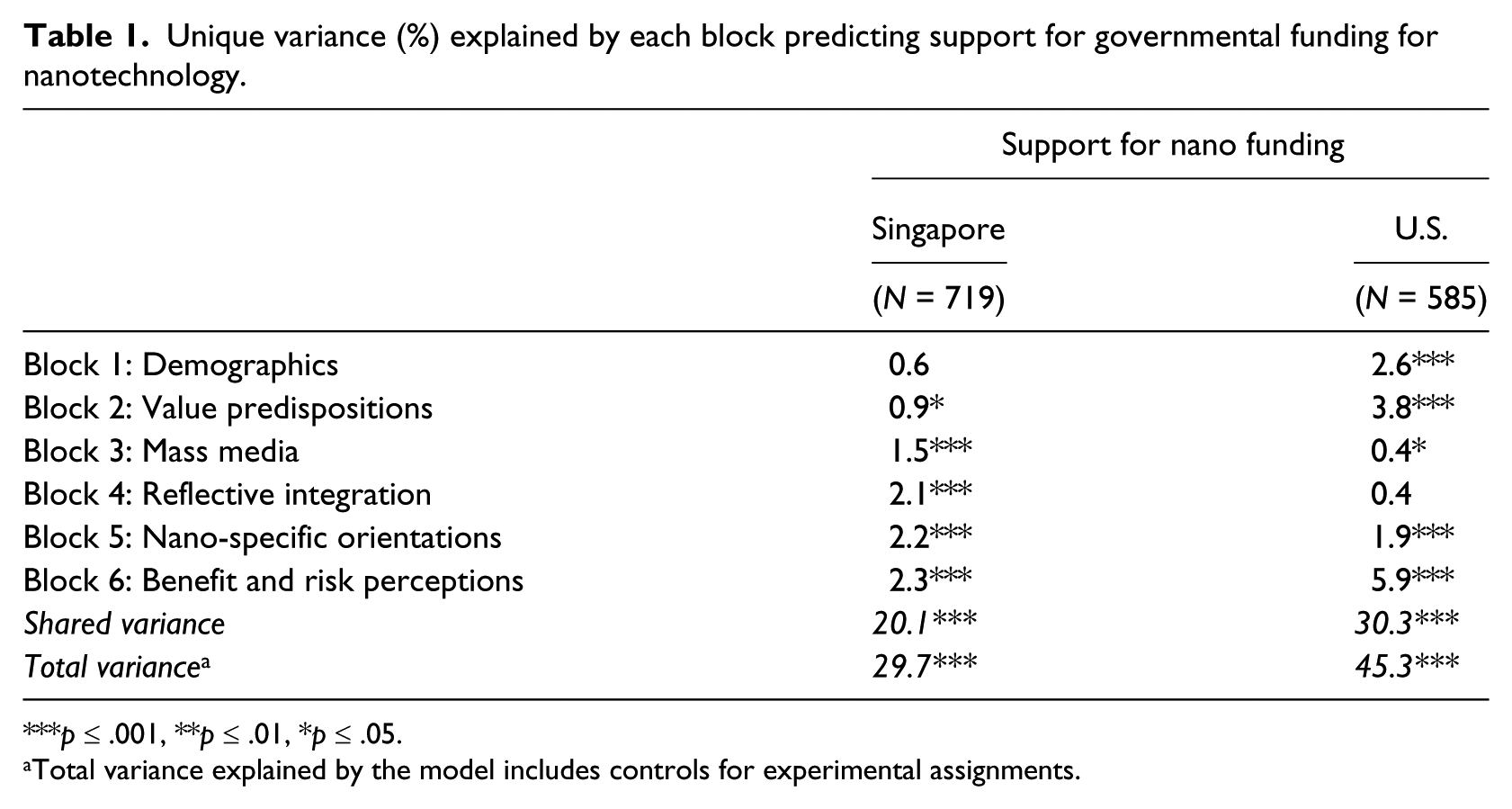
p ≤ .001, **p ≤ .01, *p ≤ .05.
Total variance explained by the model includes controls for experimental assignments.
As shown in Table 2, between value predispositions, religiosity emerged as a significant and negative predictor of support in the U.S. Interestingly, there was no significant zero-order or final correlation between religion and support in Singapore. Deference to scientific authority and science media use were positively and significantly associated with support in both countries. Elaborative news processing was a positive and significant predictor of support funding only in Singapore. In terms of nano-specific orientations, factual knowledge of nanotechnology was found to be positively and significantly related to support in Singapore, while perceived familiarity with the emerging technology had a positive and significant impact in both countries. Finally, benefit and risk perceptions were positive and negative predictors, respectively, of support in both countries.
Ordinary least squares model predicting support for governmental funding of nanotechnology.
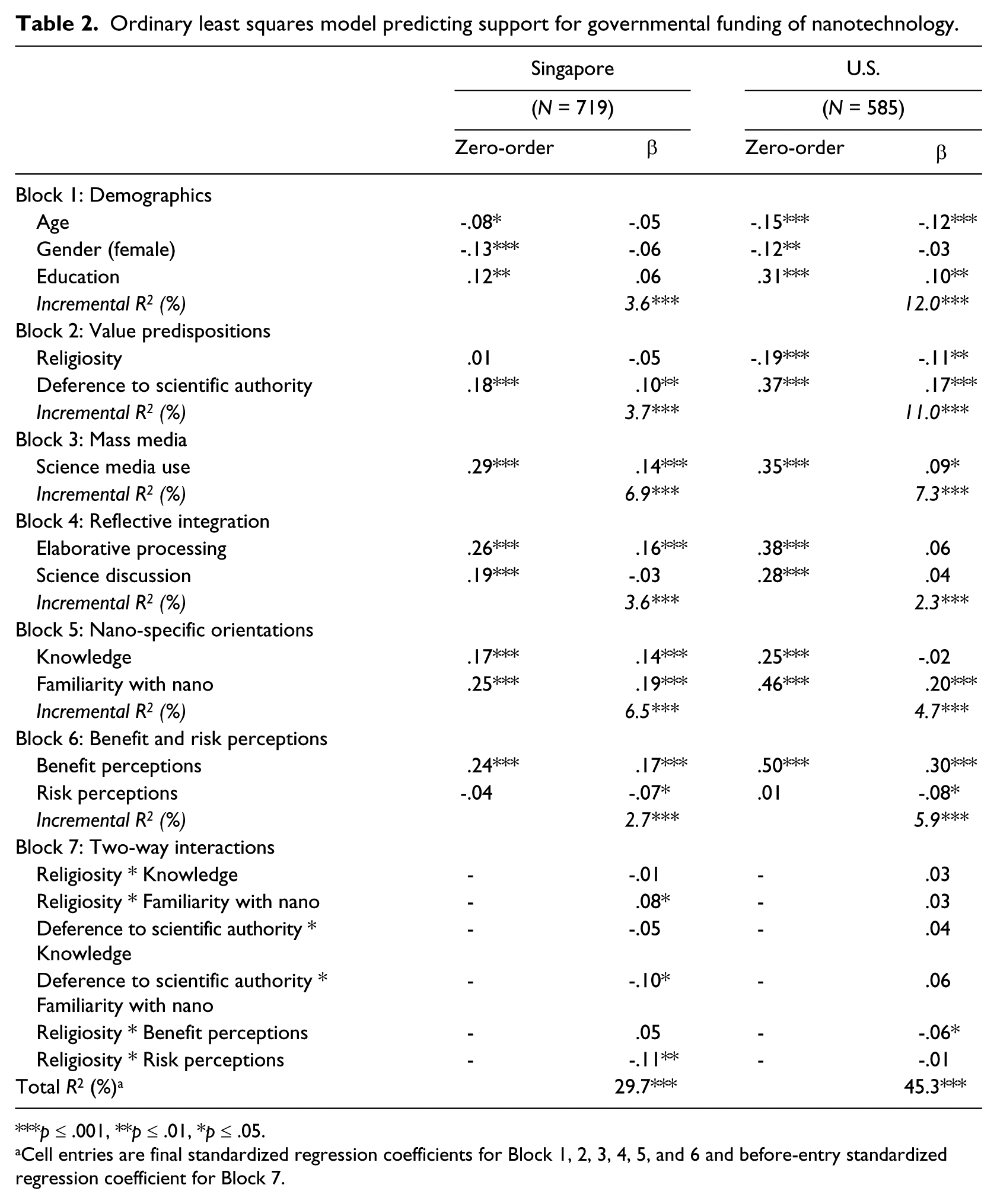
p ≤ .001, **p ≤ .01, *p ≤ .05.
Cell entries are final standardized regression coefficients for Block 1, 2, 3, 4, 5, and 6 and before-entry standardized regression coefficient for Block 7.
Table 3 shows the two-way and three-way interactions of the merged sample (N = 1304). Given the central focus on the differential perceptual filters in forming public support for nanotechnology between countries, the three-way interaction results on the merged dataset are of greatest importance to the present study and some of the two-way interactions are not conceptually meaningful with the primary purpose as controls for the three-way interactions. Our analysis tested a total of six three-way interactions between country, value predispositions (religiosity and deference to scientific authority), nano-specific orientations (knowledge and familiarity), and perceived risks/benefits of nanotechnology. The final block of Table 3 shows that the impact that value predispositions had on the link between U.S. public knowledge and support for nanotechnology funding in the U.S. was not different from that in Singapore. Neither was the interaction significant between country, religiosity, and perceived familiarity with nano on funding support. We found that the other three-way interactions (RQ2b, RQ3a, RQ3b) were significant, and their effects are discussed below.
Two- and three-way interactions in the OLS regression model (N = 1304).
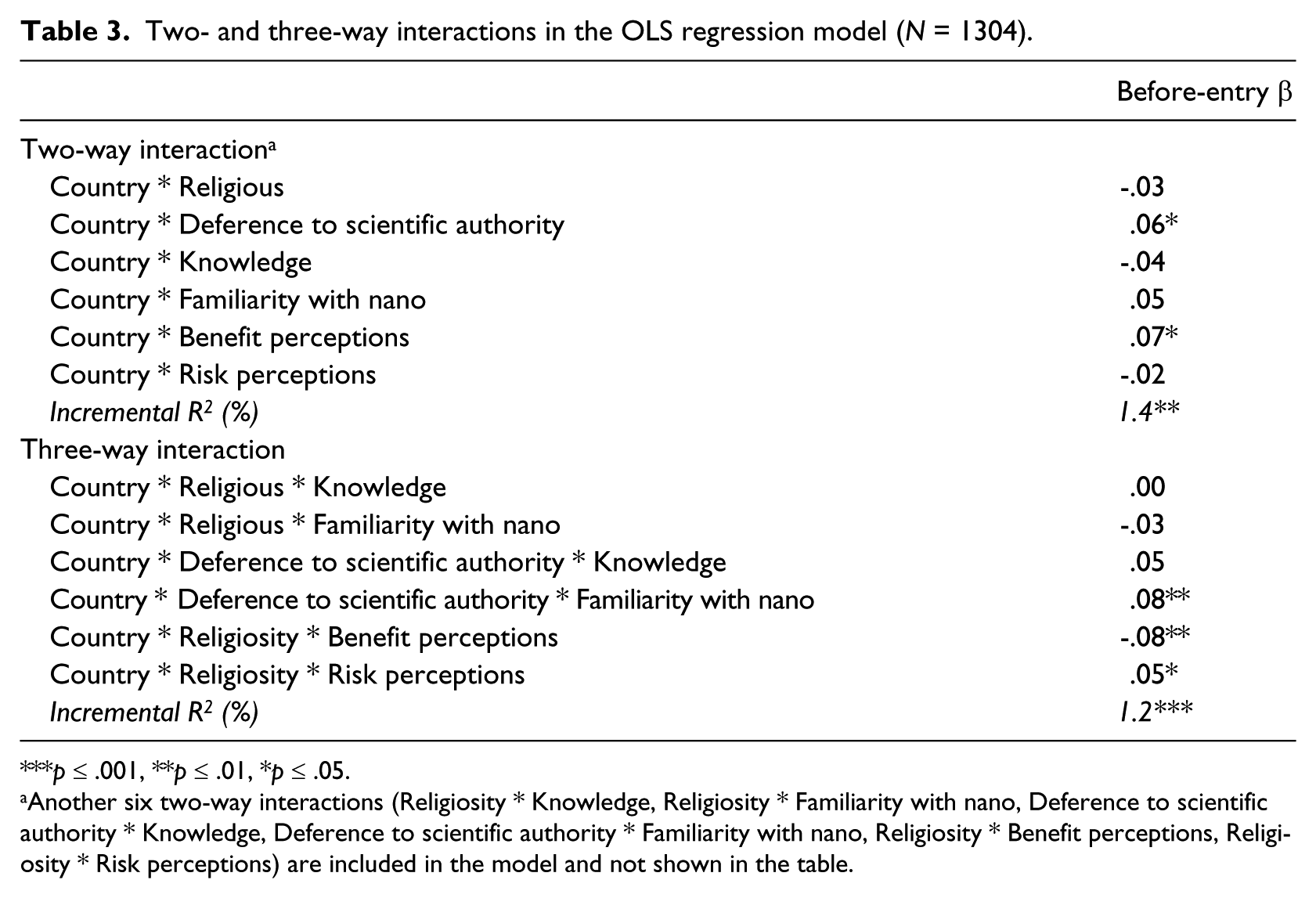
p ≤ .001, **p ≤ .01, *p ≤ .05.
Another six two-way interactions (Religiosity * Knowledge, Religiosity * Familiarity with nano, Deference to scientific authority * Knowledge, Deference to scientific authority * Familiarity with nano, Religiosity * Benefit perceptions, Religiosity * Risk perceptions) are included in the model and not shown in the table.
Figure 1(a) depicts the significant interactions between country, deference to scientific authority, and perceived familiarity with nanotechnology (β = .08, p ≤ .01). For individuals in Singapore, deference moderated the relationship between familiarity and support for nanotechnology funding (β = -.10, p ≤ .05). Among the Singaporeans with low deference to scientific authority, being more familiar with nanotechnology was associated with greater support. For those Singaporeans who maintained high deference to scientific authority, familiarity did little to impact their support. Interestingly, the U.S. individuals who were more familiar with the technology expressed greater support for governmental funding for it, regardless of how much they deferred to scientific authority.
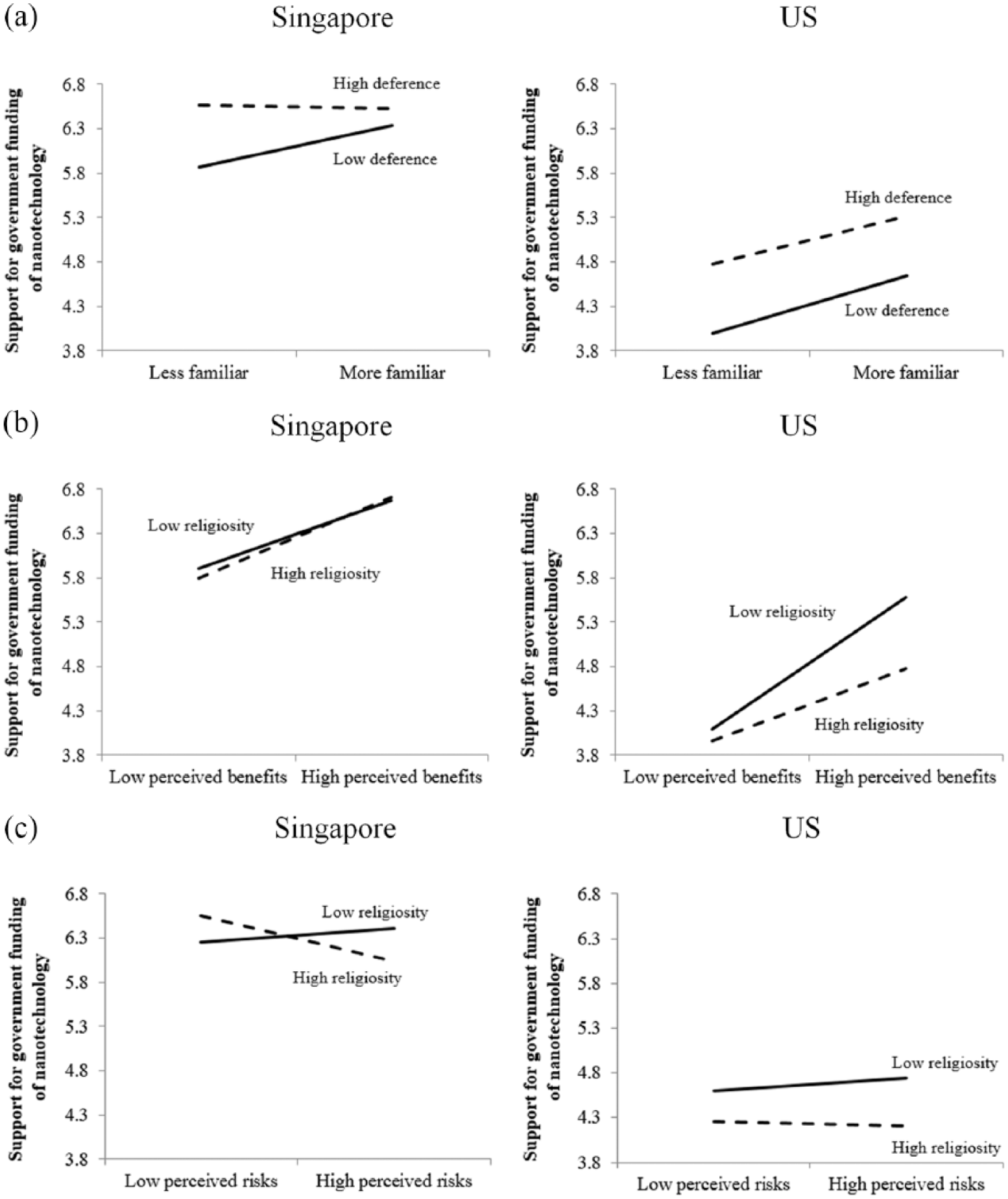
(a) Deference to scientific authority, familiarity with nano, and support for government funding for nano; (b) benefit perception, religiosity, and support for government funding for nano; (c) risk perception, religiosity, and support for government funding for nano.
Research Question 3a asked whether the interaction between religiosity and the perceiving of benefits of nanotechnology differed between the two countries (β = -.08, p ≤ .01). The answer is “yes.” In both countries, higher perceived benefits were associated with greater support (as presented earlier in the results). However, religiosity played a different role in this process. In the U.S., there was a significant interaction effect between the strength of religious beliefs and benefit perceptions of nanotechnology (β = -.06, p ≤ .05). Specifically, for less religious people, perceived benefits had a substantially stronger positive impact on support than for their highly religious counterparts. In Singapore, this interaction between benefit perceptions and support did not vary across different levels of religiosity (see Figure 1(b)).
With respect to RQ3b, we found a significant three-way interaction between country, religiosity, and risk perceptions related to the outcome variable (β = .05, p ≤ .05). As Figure 1(c) illustrates, the interaction between risk perceptions and religiosity was significantly related to the outcome variable in Singapore (β = -.11, p ≤ .01), but not in the U.S. In Singapore, our data showed a strong link between perceiving less risk and greater support for nanotechnology and highly religious Singaporeans showed the highest level of support when they saw less risk. For less religious individuals, seeing risks did not significantly impact their support. In the U.S., religiosity did not interact with risk perceptions.
6. Discussion
This study used data from two surveys to assess public opinion of and attitudes toward an emerging technology in two cultural settings. Overall, people in Singapore perceived greater benefits and fewer potential risks of nanotechnology, and indicated greater support for funding of the emerging technology than the U.S. public. In addition, Singaporeans were more knowledgeable about and familiar with nanotechnology. We also found people in the U.S. and Singapore utilized different perceptual filters in interpreting nanotechnology-related knowledge and perceptions.
It is important to keep in mind several aspects of our data when interpreting the results. First, there were some differences in data collection procedures across the two countries. Despite this, both datasets yielded samples that are generalizable to the populations in the U.S. and Singapore. We believe the comparative insights that emerge from these data outweigh the slight differences in data collection procedures, but future research should aim to use similar, if not identical, survey data collection procedures to ensure that the results are more comparable cross-culturally. Second, we used a single-item measure as our criterion variable to capture public support for nanotechnology, which made our results subject to random measurement error, and likely undermined the strength of the relationships that we observed. In other words, the identified relationships in the present study would be stronger if we had used multiple items to measure support for funding of nanotechnology.
With these considerations in mind, our study offers a new look at the role of perceptual filters in explaining attitudes toward emerging technologies in two cultural settings. The U.S. public tended to use religiosity to interpret their perceived benefits and the Singaporeans were more inclined to use religiosity to think about their risk perceptions. This may be due to the different types of religion practiced in the two countries, especially when risk and benefit perceptions of nanotechnology were specifically measured in terms of the harm and benefits that the emerging technology can bring to the environment in our study. In our Singapore sample, Buddhism and Taoism (30.3%), Islam (11.6%), and Hinduism (8.3%) are the religions practiced by most of our respondents. Specifically, Buddhism places great emphasis on environmental protection. The Buddhist principle of the oneness of self and environment means that life and its environment are inseparable (Ven, 2000). Therefore, damage done upon the Earth is also harm done to humans (Badiner, 1990). Taoism also opposes the destruction of the natural environment, believing that humans and nature are interrelated and bound by ties of reciprocity and retribution. If nature suffers from human beings, it will retaliate against humans (Chen, 2003). In Islam, the environment was made sacred through the tradition from the Quran and the prophets. It is believed that one can gain profound knowledge from nature, and thus, human beings are to preserve and look after it (Muhammad, Shah-Kazemi and Ahmed, 2010). Likewise, Hinduism emphasized that people have to honor the universe as it is the divine creation, and as such, the religion is concerned with maintaining the natural balance and preventing harm to the environment (Dwivedi, 1993). In the teachings of these religions, the emphasis is placed on the protection rather than modification of the environment. This probably explains why religiosity in Singapore moderates the effects of risks rather than benefits that nanotechnology may bring to the environment.
In comparison, science and religion in the U.S. are primarily in conflict about social influence and morality (Evans, 2013). The majority of the U.S. respondents are Christians, who tend to be less concerned about environmental hazards but more concerned about the moral and ethical aspects of the technology per se. In particular, Evangelicals and Catholics may associate nanotech with controversial sciences such as biotechnology (Ho et al., 2010). For example, in the case of embryonic stem cell research, moral and ethical debates often surround the abortion discourse and how scientists are deemed as tampering with nature (Evans, 2010). For more-religious individuals in the U.S., their strong belief system can therefore suppress the positive effects of perceived benefits on support for funding for nanotechnology. Not surprisingly, the link between benefits and support for federal funding was significantly weaker for highly religious respondents than it was for less religious respondents.
We also found that deference to scientific authority moderates the impact of perceived familiarity of nanotechnology on support for funding of it in the Singaporean public, but not in the U.S. public. Among the Singaporeans with low deference to scientific authority, being more familiar with nanotechnology led to greater support. For Singaporeans with really high deference to scientific authorities, they were likely to support technologies in general and specific emerging technologies, such as nanotechnology, regardless of how familiar they were with such technologies. An additional analysis indicates that participants from Singapore expressed significantly higher deference to scientific authorities than their U.S. counterparts (p ≤ .001). This might help us to understand why deference produced substantially different impacts on support for funding between the two countries, depending on respondents’ familiarity with the technology. This finding, coupled with the differential impact of religiosity, suggests that Singaporeans also tend to use interpretative tools when forming attitudes toward emerging technologies, although the processes are somewhat different from those of the Americans. Future research should explore this process further, based on a wider range of value predispositions and multi-item operationalization of the dependent variable.
Our study offers several implications for science communication. As highlighted in the Gathering Storm report (National Research Council, 2010), science and engineering leadership is essential for a nation to maintain economic and military competitiveness; however, the U.S. leadership in science and engineering is jeopardized by adverse national development (such as economic collapse, restricted policy, and reduced funding) and by growing competence abroad. Prominent among the international counterparts is Singapore, a small country with a high public knowledge of S&T, positive climate of opinion toward S&T, high deference to scientific authorities, and growing governmental funding in developing scientific research. Consider stem cell research for example. An increasing number of top scientists moved to and built infrastructure for stem cell research in Singapore after the George W. Bush administration’s policies restricted federal money for stem cell research in the U.S. In order to keep leadership in the global competence of nanotechnology research, the U.S. faces compelling calls to action to promote public support for developing this emerging technology.
It is suggested that policymakers, scientists, and communication practitioners aim at certain aspects when communicating with the public. For example, officials and communication practitioners might try to reassure the public, especially religious groups, that the industry will be properly regulated to minimize any potential risks. Otherwise, religious beliefs may hamper nanotechnology progress in the U.S.; in which case, the U.S. may lose its competitiveness in relation to its international counterparts such as Singapore. A good regulatory framework (e.g., guidelines to manage potential toxicity related to nanofoods) for the nanotechnology industry will be necessary to sustain a positive climate of respect for scientific authorities. In addition, our research suggests that the promotion of public familiarity with nanotechnology would increase public support for governmental funding in the U.S.
Although the primary interest of this paper is the differential effects of perceptual filters between different cultural settings, our findings also indicate that the U.S. public differs from Singaporeans with respect to the factors they use to form attitudinal decisions on nanotechnology: the U.S. public seems to use more heuristic cues such as deference to scientific authority and benefits perceptions than the Singaporean public to make judgments about nanotech. This was reflected in the results of the two-way interactions in the combined regression model (Table 3). In addition to the factors we included in our model, there seem to be additional processes at work in explaining public support for funding of the emerging technology in Singapore. For example, an additional analysis on the Singapore sample reveals that trust in scientists accounted for 5.8% of variance of their funding support in Singapore. It should be worthwhile to investigate other factors that influence Singaporeans’ attitude toward nanotechnology.
Future research is encouraged to explore the perceptual filter framework with longitudinal data and more sophisticated data collection designs in the area of science and political communication. For example, socio-demographic variables, religiosity, ideology, news media use, deference to scientific authority, and attitudinal variables (public support) can be captured in different stages of a panel design, according to their assumed causal order, in order to link explanatory factors and public attitudes, while controlling for potential spurious and intervening factors (such as the immediate political or social setting). It is worthwhile to follow up this study with qualitative research to understand how people link values, knowledge of nanotechnology, and attitudes toward nanotechnology. We also encourage researchers to examine a broader set of factors in predicting public support in different countries and variations in the explanatory power of certain factors across different cultures. For example, in the U.S. context, some other dimensions of religion (e.g., belief in a personal God) are found to be positively related to people’s optimistic stance toward biotechnology (Scheitle, 2005). We call for future research to examine the impact of such distinctive dimensions of religion on people’s attitudes toward emerging technologies across cultures. Moreover, more studies should conduct cross-cultural comparisons of public perceptions of nanotechnology across countries in Asia, Europe, and North America. For example, it would be interesting to compare public opinion across nations that have invested heavily in nanotech research and development, such as China, Japan, and South Korea. Future research should also expand the examination of value predispositions and their interactions with informational variables (knowledge and familiarity with nanotechnology) and risk/benefit perceptions across different scientific issues (such as genetically modified organisms and stem cell research).
In conclusion, our findings are important for several reasons. First, our results suggest that the predispositions-perception filter mechanism is not unique to the Western context, and can be extended to understanding public opinion of science and technology in Asia as well. Second, we provide evidence that the general public tends to use different interpretative tools when forming their attitudes toward emerging technologies, depending on their nationality and cultural background. In particular, individuals’ perceived familiarity with the emerging technology, benefit perceptions, and risk perceptions can be interpreted differently in forming attitudes supportive of nanotechnology, depending on individuals’ predispositions (strength of their religious beliefs and deference to scientific authority) and the particular country in which they reside. As implied in our study, it is the content or type of religion that is driving the differences in perceptual filters people use in forming support for emerging technologies.
Footnotes
Funding
This material is based upon work supported by grants from the National Science Foundation to the UW–Madison Nanoscale Science and Engineering Center in Templated Synthesis and Assembly at the Nanoscale (Grant No. SES-DMR-0832760), and Nanyang Technological University (Grant No. M4080206). Any opinions, findings, and conclusions or recommendations expressed in this material are those of the authors and do not necessarily reflect the views of the National Science Foundation.