







Abstract
Public communication initiatives play a part in placing complicated scientific claims in citizen-consumers’ everyday contexts. Lay reactions to scientific claims framed in public communication, and attempts to engage citizens, have been important subjects of discussion in the literatures of public understanding and public engagement with science. Many of the public communication initiatives, however, address lay people as consumers rather than citizens. This creates specific challenges for understanding public engagement with science and scientific citizenship. The article compares five different understandings of the relations between citizen-consumers and public issue communication involving science, where the first four types are widely represented in the Public Understanding of Science discussions. The fifth understanding is a practice theoretical perspective. The article suggests how the public understanding of and engagement in science literature can benefit from including a practice theoretical approach to research about mundane science use and public engagement.
Keywords
1. Introduction
Citizens are often encouraged by public authorities, interest organisations and even business to take part in solving societal problems to do with, for example, health, the environment and risk by way of changing their everyday habits. These encouragements take the form of different types of public communication initiatives, which is communication that is planned and framed by various social actors with the purpose to persuade and involve groups of people to relate actively to particular messages (Jensen, 2012: 162–163; McQuail, 1998: 48–50; Phillips, 2011b; Rice and Atkin, 1989; Windahl and Signitzer, 2009). In Denmark, some of the latest examples aimed at ordinary citizens are a national competition among primary school classes about exercising and healthy eating initiated by the public Health Agency, a campaign from the Cancer Society to remind people about the necessity to use suntan lotion on skiing holidays and a cookbook from an organic food box scheme, ‘The Seasons’, on how to change the diet towards 80-20 (80% vegetable based, 20% animal based) in order to live in a more climate friendly way.
Many of these public communication initiatives build upon or contain scientific claims, such as how much exercise is necessary for children to stay healthy, what level of sun filter factor offers the best skin protection and which relations there are between climate change and consumption of meat. Thus, public communication plays a part in placing complicated scientific claims and their more concrete ‘translations’ in the everyday contexts of lay people, to get used and handled in people’s daily life (Eden, 2009; Hine, 2014). Hence, such public communication initiatives are part of the societal production of ‘… public issues involving science’ (Wynne, 2014: 64). In the research on science communication, the relations between ‘publics’ and science have been conceptualised either with a focus on public competence or on public participation (Mejlgaard, 2009: 483), parallel to the classic general distinction in communication theorising between transmission and interaction (Dervin, 1989: 72). Thus, the ways in which such public communication is used in everyday life can be seen as a contested element in the discussions about public engagement with science and potential enactment of scientific citizenship (e.g. Árnason, 2013; Bauer, 2014; Burgess, 2014; Felt and Fochler, 2008; Irwin, 2014; Mejlgaard, 2009; Mejlgaard and Stares, 2013).
Many of these public communication initiatives tend to address citizens in their capacity as private consumers rather than citizen members of a public. Thereby, responsibility for public issues involving science could be seen as being privatised and individualised into changing consumption patterns. This is a tendency that would be considered worrying, seen from a deliberative ideal of public participation and scientific citizenship, understood as ‘… undistorted, non-coercive interaction between rational individuals, each contributing their science-based or experience-based expertise, and thus providing a context for informed collective decision making’ (Mejlgaard and Stares, 2013: 661). On the other hand, responsibility for public issues based on scientific claims may be taken up actively in everyday life through changes of practical consumption activities as an available space for action and reflection, creating micro-publics in consumers’ social networks (Halkier, 1999). This is a tendency that would be seen as contributing constructively to horizontal engagement in science and a precondition for enactment of scientific citizenship, understood from a deliberative ideal of public participation.
However, it has been argued that the deliberative perspective on public engagement with science has become a somewhat dominant perspective in the Public Understanding of Science (PUS) discussions as a yardstick for measuring public engagement with science and scientific citizenship (Árnason, 2013; Felt and Fochler, 2008; Mejlgaard and Stares, 2013). This apparent dominance of the deliberative perspective is said to underestimate other dimensions of democratic citizenship such as public accountability, trust in institutions and citizens’ own individual preferences for becoming publicly engaged. I share this critical view, but do so from a perspective of trying to conceptualise the social mundane ways in which science-based public issues are being handled in everyday life. Hereby, I hope to add sophistication to the understanding of citizenship in the public engagement with science discussions.
In this article, I compare five different types of theoretical understandings of the relations between what I refer to as citizen-consumers and public communication initiatives based on scientific claims. In the first section, I discuss four types of such theoretical understandings which have been represented in the PUS discussions on public engagement in science in recent years. The discussion of the strengths and weaknesses of the four types is anchored in a number of existing empirical research projects on how consumers handle public communication initiatives about different food issues, a consumption area surrounded by much debate about science and publics (Blue, 2010: 147–148). In the second section, I present and discuss a fifth type of theoretical understanding of the relations between citizen-consumers and scientifically based public communication initiatives, a practice theoretical perspective. Finally, the article concludes with suggestions for how a practice theoretical perspective can contribute to the research on mundane science use and public engagement.
2. Different understandings of citizen-consumers’ relations with science-based public communication initiatives
In this section, I compare four different theoretical types of understanding of citizen-consumer relations with science-based public communication from the PUS discussions. Hence, the four types are partly my construction of patterns of assumptions – more or less explicit or implicit – in the PUS discussions about science-based communication and citizens. But the types of course reflect existing theoretical approaches used in the PUS contributions. The comparison is based on three parameters: Assumptions about communication processes, assumptions about citizen-consumers as social actors and assumptions about social relations.
Communication processes in the relation between scientific knowledge and publics have been summed up in the PUS literature as a distinction between ‘the deficit model’ and ‘the idea of creative reconstruction’ (Bauer and Gaskell, 1999), parallel to older distinctions between ‘extension’ (diffusion) and ‘communication’ (dialogue) (Freire, 1983), or likewise between ‘strategic action’ and ‘communicative action’ (Habermas, 1987). One of the classic texts on public communication initiatives puts the distinction between ‘information as description’ (transmission) and ‘information as construction’ (interaction) (Dervin, 1989: 72). The comparison regarding assumptions about communication processes draws upon this basic distinction.
Citizen-consumers as social actors have been seen in the literature on political consumption (overlapping with the PUS discussions on citizenship and publics) as covering both collective values, community and public engagement as well as individualism, choice and private matters (e.g. Holzer, 2006; Jacobsen and Dulsrud, 2007; Jubas, 2007; Soper and Trentmann, 2008). The underlying assumptions here are how active or passive citizen-consumers are seen to be, and what drives the conduct of citizen-consumers in relation to public issues.
Social relations and the forms of social relationships are often a more or less implicit sounding board for discussions about publics. The comparison regarding assumptions about social relations draws upon a fourfold typology of social relations, coming from relational models theory (Fiske, 1992: 691; Rai and Fiske, 2011: 60). The typology covers communal sharing, authority ranking, equality matching and market pricing as types for general social relationships.
The first type of understanding of the relations between citizen-consumers and public communication initiatives involving science is commonly named the deficit model. This understanding is based on seeing communication as diffusion of knowledge and messages (transmission) from a sender to more or less passive recipients (Windahl and Signitzer, 2009). The deficit understanding is named so because it is assumed that the recipients, in this case citizen-consumers, are deficient of something, often knowledge, but also particular attitudes and perceptions, or other resources. Thus, citizen-consumers are predominantly seen as passive. The social relations involved in the communication can be seen as authority ranking since a clear hierarchy of positions in relation to knowledge is implied (Irwin, 2014: 73–74).
The deficit understanding can entail quantitatively mapping or qualitatively interpreting the consumer characteristics of single individuals to measure how these characteristics influence one another. The variables of interest are generally knowledge, attitude and behaviour, and the emphasis is on assessing the relationships and gaps between these different dimensions. It is assumed that there are (or at least ought to be) strong correlations between, for example, consumers’ familiarity with scientifically based knowledge and claims, their attitudes towards public issues related to consumption and their everyday decisions and actions (e.g. Aikman et al., 2006; Cacciatore et al., 2014; Crall et al., 2013; Fischer et al., 2013; Fraj and Martinez, 2007; Frewer et al., 2002; Hughner et al., 2009; Knight, 2009; Mielby et al., 2013; Qin and Brown, 2007; Roe and Teisl, 2007; Simon, 2010; Sirieix et al., 2008; Todt et al., 2009; Van de Velde et al., 2011; Vandermoere et al., 2011; Vermeir and Verbeke, 2006; Whitmarsh, 2009).
The prevalence of this understanding may be attributable to its ostensible ability to measure and compare factors in relation to patterns in people’s reports about their interpretations of scientific claims and science-based consumption issues. It is indeed valuable to know how many consumers know the organic food labels or to know that there are systematic differences between men and women regarding attitudes to salmonella risk in food stuff.
However, another explanation of the popularity of the deficit understanding may be that its assumptions are often implicitly applied by both experts and policymakers about ordinary citizen-consumers (Jacobsen and Dulsrud, 2007). Consumption patterns and changes of consumption patterns are understood to be consequences of cognitive motivations and rational choices, which leaves little room for including other dimensions of consumption in everyday life, especially their cultural, social and contextual elements. Therefore, the deficit model is also referenced explicitly by researchers who criticise the implicit uses of it (e.g. Eden, 2009; Irwin, 2001, 2014; Morris, 2003; Wynne, 2006). An example supporting the critiques of the deficit understanding comes from a qualitative empirical study of young Danes and their handling of environmental contestation of food consumption (Halkier, 2010: 63–67). Here, it was found that carrying out environmentally friendly consumption activities (such as buying local food stuff, using organic products and eating less meat) was not systematically related to a higher level of environmental knowledge or reflexivity about environmental issues. Rather, the carrying out of environmentally friendly consumption activities was based on a complex mixture of routinised practical procedures, tacit know-how and environmental knowledge-based reflections as part of a broader reflexivity on consumption and social responsibilities.
The second type of understanding of the relations between public communication initiatives and citizen-consumers is the segmentation understanding. Often, the understanding of communication processes here comes from a diffusion approach as in the deficit understanding (Windahl and Signitzer, 2009). Thus, the social relations involved in the communication can also in this type be seen as authority ranking. But in the segmentation understanding, consumer-citizens as such is seen differently. Citizen-consumers can be seen as less passive, and more importantly, their perceptions and uses of knowledge and messages are seen as influenced by social and cultural contexts.
The segmentation understanding covers types of analyses where factors in consumer lifestyles are mapped and the individual consumer is categorised according to a typology and placed in a particular segment. There is in this approach often a focus on mundane use of science as reproduced patterns of taste and social status that are related to the location of the individual citizen-consumer in larger social structures of class and culture. The theoretical inspiration comes particularly from Bourdieu (1984) and his work on consumption patterns as social distinction markers, related to different types of habitus. But typically empirical segmentation either uses already existing mapped segments of tastes, attitudes and status values from other studies, or map new segments around demographic variables, perceptions and actions on the basis of surveys or focus groups. However, a common assumption in segmentation studies is that uses of scientific claims in consumption are dependent upon the consumers’ location in social and cultural structures (e.g. Blok et al., 2008; Didier and Sirieix, 2008; Dodds et al., 2008; D’Souza et al., 2006; Featherstone et al., 2009; Gamble and Kassardijan, 2008; Hanpää, 2007; Kato-Nitta, 2013; Lawson and Todd, 2002; Rokka and Uusitalo, 2008; Sanjuan et al., 2003; Tylter et al., 2001; Ureña et al., 2007; Verain et al., 2012; Zia and Todd, 2010).
Part of the explanation for the uptake of the segmentation understanding could be that these approaches offer a conceptualisation of collectively shared patterns of consumer lifestyles or local citizen lifestyles. Lifestyle has been an important facet of debates about science-based consumer issues and public engagement because the strength of the lifestyle concept comes from its ability to take into account the socially and culturally structured conditions of everyday life. Furthermore, the segmentation understanding has been used more broadly to capture different kinds of sub-publics in public engagement with science issues (e.g. Blok et al., 2008; Featherstone et al., 2009).
However, the segmentation understanding too often assumes a fairly high degree of stability in the social and cultural conditions for citizen-consumer engagement in science-based issues. This stability assumption can lead to both over-pessimism and optimism about expectations for public consumer engagement. In a qualitative empirical study of parents with young children and their handling of communication on food risks, the stability assumption was questioned (Halkier, 2010: 82–92). Instead, it was found that distinguishable patterns of risk handlings (worried, irritated and pragmatic risk handling) varied in relation to different situations, contexts, food risk issues and social relationships. For example, handling potential salmonella bacteria in eggs could be done in a worried way concerning meals for the children, whereas it could be done in a pragmatic way concerning party food.
The third type of understanding of the relations between public communication initiatives and citizen-consumers is the network understanding. Here, consumer-citizens are seen as resourceful, and interpersonal interaction is seen as significant for the perceptions and uses of knowledge and messages (Rogers, 1995: 281–299; Windahl and Signitzer, 2009). The predominant view of public communication processes is one of diffusion in multiple steps, although minor elements of user-generated knowledge, arguments and action are included (Phillips, 2011b: 66–67). Hence, the implicit view of the social relations involved in the communication here is still primarily on authority ranking, however, potentially blended with some of the other forms, depending upon the contents of the processes of interaction.
In the network understanding, the main assumption is that it is the social network relations that help to driver or hinder change of perceptions of issues and engagement in activities. Citizen-consumer understandings of science-based claims in public communication are formed by the ways in which people discuss such claims with members of the different parts of their social network. The characteristics of network relations considered important are usually how close or distant relations between people are (Granovetter, 1973; Putnam, 2000) and the characteristics of opinion leaders (Rogers, 1995: 293–299). The network understanding can be found both in studies of the importance of existing network influence on mundane science use (Delgado, 2010; Hobson and Niemeyer, 2013; Lehmkuhl, 2008; Liu and Priest, 2009; Rickard, 2011) and in studies of emerging networks around public engagement in scientifically based consumption issues (Boyer et al., 2009).
The network understanding has perhaps remained popular due to its ability to map empirically stages in processes of communication as (mainly) diffusion. Network model-based studies produce very valuable knowledge about concrete processes of uses and interactions about science-based public communication initiatives, such as which kinds of networks and types of interaction make members of sub-publics change their minds (e.g. Lehmkuhl, 2008; Rickard, 2011).
However, the network understanding tends to display an unresolved relation to the transmission or diffusion understandings of communication in so far that the knowledge negotiated in the networks not necessarily but often is expertise ‘external’ to the social networks in case (Phillips, 2011b: 67). A similar weakness comes with the often quite general and firm assumptions about characteristics of opinion leaders and their role in different parts of the social network (Jensen and Halkier, 2011). In a qualitative empirical study of Pakistani Danes and their handling of communication on nutrition and healthier food in their social networks, it was found that the same type of network relations pulled in opposite directions regarding handling of health claims in food consumption. The close-knit family relations of the women who were main responsible food providers in the families pulled in the direction of practising healthier cooking and eating by, for example, texting each other on the mobiles when new health information was discovered. The same family relations pulled in the direction of less healthy food consumption by, for example, helping to maintain social expectations about dishes and drinks with lots of oil, butter and sugar at dinner parties (Halkier, 2010: 155–161).
The fourth type of understanding of the relations between public communication initiatives and citizen-consumers is the dialogical understanding. Here, citizen-consumers are seen as co-producers of knowledge in communication, and communication processes are understood as relational meaning-making activities where the discursive constructions create and constrain knowledge and action in social life (e.g. Phillips, 2011b: 50–55). As a consequence, the implicit view of social relations involved in the communication can be seen as equality matching since the voice and engagement of potentially every citizen-consumer are seen as equally important in the co-production of knowledge.
In the dialogical understanding, a core assumption is that citizen-consumers themselves define – or ought to define – what constitutes problems in need of knowledge and/or other change initiatives (Morris, 2003: 226). Science-based claims only become relevant for citizen-consumers if they become included in the construction and negotiation of what is understood as problems that need change among people in everyday life. The dialogic model will typically focus on direct interaction between citizen-consumers and professionals – communication planners, experts, non-governmental organisations (NGOs) and public representatives – in different forms of participatory involvement set-ups such as consensus conferences (Einseidel et al., 2001) and citizens’ panels (Burri, 2009). It is assumed that there is negotiation and ambivalences in the production of meaning on all types of knowledge among all communication participants. Often the participatory processes and the degree of openness of conditions for sense-making and mutual learning are seen as more important results of public engagement initiatives than specific changes in consumer knowledge, understandings and activities (Anderson et al., 2013; Bucchi, 2008; Burgess, 2014; Dervin, 2003; Dutta, 2007; Eden, 2009; Macnaghten and Guivant, 2011; Phillips, 2011a; Van der Sanden and Meijman, 2008). Thus, the researchers who draw upon the dialogical understanding often criticise the ways in which dialogue is used by public communication practitioners and policymakers as a buzzword, while practitioners and policymakers implicitly draw upon a deficit understanding of citizen-consumers (Davies, 2013; Wynne, 2006).
The dialogical understanding of relations between public communication initiatives and consumers has grown out of an opposition to the diffusion approach to communication, embedded in the first three understandings addressed in this article. The current influence of the dialogical understanding is related to its attempt to take seriously all types of communication actors and thereby address debates about the assets of sceptical publics, democratic inclusion and scientific citizenship (Bauer, 2009: 235–238; Couldry et al., 2010: 12–16; Felt and Fochler, 2008: 491–492; Mejlgaard, 2009: 483–484). The dialogic understanding produces very valuable accounts and analyses of the detailed playing out in practice of interpretations and negotiations of scientific knowledge claims, arguments and actions, and particularly also the potential consequences for governance of societal problems.
However, it is the explicit discursive aspects of citizen-consumer engagement with science-based public communication that are analytically privileged in the dialogic understanding. Apart from the abundant use of the terms discourse and discursive, a perhaps more implicit symptom of this analytical privileging of discursive sense-making is the use of a concept of culture as equal to meaning (Phillips, 2011b: 69). The relations between discursive sense-making of science-based consumer issues and other types of social practices in everyday contexts are not addressed in the dialogic understanding. This way, the importance of explicit discursive meaning-making is overdone at the expense of the tacit, routinised, practical dimensions of how citizen-consumers deal with science-based public communication. The three different Danish qualitative studies referred to earlier on contestation of food consumption in relation to environment, risk and health issues can be compared as three studies about citizen-consumers’ handling of science-based public communication (Halkier, 2010). One of the parallel patterns in people’s dealings in their everyday contexts with public communication on science-based issues, irrespective of its communicative form, is that embodied practical procedures across many different practices shape the specific ways of consuming food and dealing with public communication just as much as intentional sense-making and discursive negotiations.
To summarise, all four understandings of the relations between consumers and science-based public communication initiatives have their analytical strengths and weaknesses, seen from different knowledge interests and theoretical perspectives.
But all four understandings of the relations between consumers and science-based public communication share a common blind spot. This is irrespective of the otherwise important distinction between, on the one hand, the first three understandings seeing the relations as diffusion, and, on the other hand, the dialogic understanding seeing the relations as co-construction. It is also irrespective of the difference in view of citizen-consumers as social actors and implicit assumptions on social relations.
The shared blind spot is that all four understandings fail to capture mundane practices and thereby underestimate the embodied and intersected character of everyday life as context for mundane science use, based on public communication. The deficit understanding tends to underestimate other factors than cognitive ones among citizen-consumers. The segmentation understanding tends to overestimate the stability of cultural conditions for citizen-consumers. The network understanding tends to underestimate the potential variations in social networking processes among citizen-consumers. And the dialogic understanding tends to overestimate the significance of discursive meaning-making in citizen-consumers’ lives.
If the knowledge interest is to analyse how ordinary citizens deal with science-based public consumer issues, it is fruitful to apply a theoretical understanding capable of grasping and including the embodied and intersected character of the daily context for mundane science use. In the next section, one suggestion for such a theoretical understanding is presented.
3. A practice theoretical understanding of citizen-consumers’ relations with public communication initiatives
The fifth theoretical understanding in the comparison – a practice theoretical perspective 1 – has not to my knowledge been used explicitly in the PUS discussions about public engagement with science before. However, by including a practice theoretical understanding, it is attempted to systematically conceptualise the social dynamics of this web of practicalities and common senses that can seem difficult to get an analytical grip on in public understanding of science research (Bauer, 2009: 235). Mundane use of science, science consumption and everyday conversations about science-based consumer issues are embedded in ordinary daily practicalities and taken-for-granted common sense-making. A practice theoretical perspective on the relation between consumer-citizens and (science-based) public communication assumes that people’s connections with public issues (such as climate change, recycling and nutritional health) are part and parcel of the social and practical organisation and accomplishment of the routine practices in everyday life (Couldry et al., 2010; Gram-Hanssen, 2011; Halkier, 2010; Hargreaves, 2011; Shove et al., 2012; Warde, 2005).
Thus, the unit of analysis is social practices and ways of practicing – and not the individual citizen, nor the cultural conditions, nor the networking processes, nor the discursive meaning-making. In this perspective, the patterns in how ordinary activities are carried out and carried through, done, re-done and slightly differently done are the web of everyday life in which peoples’ connections with public issues are enacted. It is the mundane performativity of any kind of ordinary routinised activity that is understood as decisive for how citizen-consumers connect with science-based public issues. The organisation of this mundane performativity consists of a web of equally important and interconnected social dynamics such as ‘forms of bodily activities, forms of mental activities, things and their use, a background knowledge in the form of understanding, know-how, states of emotion and motivational knowledge’ (Reckwitz, 2002: 249).
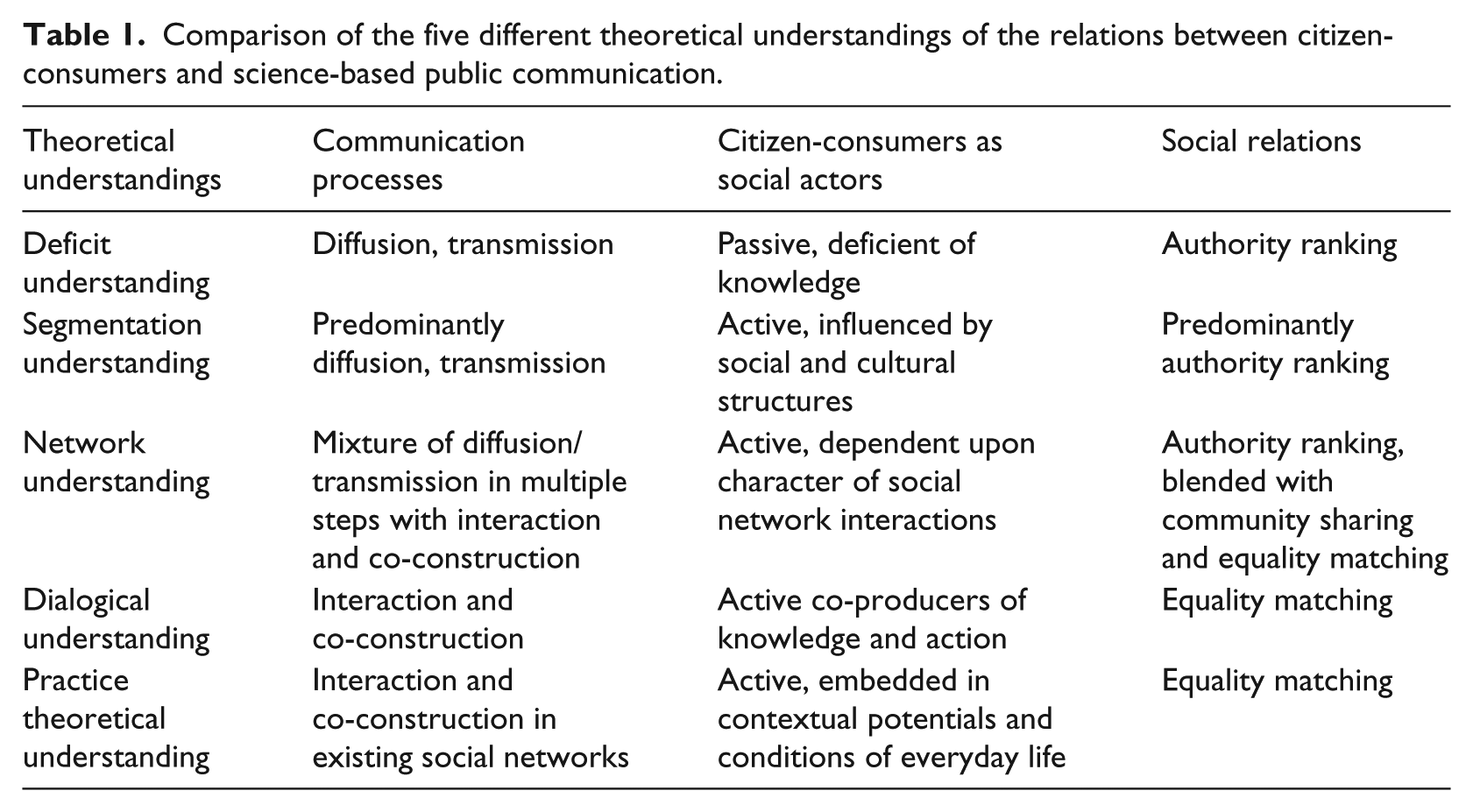
A core assumption about citizen-consumers as social actors is to see people as active and embedded in the contextual potentials and conditions in the mundane performativity of everyday contexts. Thus, how people handle public issues is dependent upon the web of activities they are already carrying out and taking part in and the compound social dynamics organising this web. Hence, compared to the four other understandings of the relations between science-based public communication and ordinary citizen-consumers, neither cognitive, structural, interactive nor discursive elements hold a privileged position in the theoretical assumptions about how engagement with science-based issues is enacted. With a practice theoretical perspective, the view of public communication processes is to see these as interaction potentially integrated in all practices because communication is seen as part of the practicing and construction of all activities – such as eating, cleaning, working and parenting. Thus, public media communication is seen as something that practitioners can connect with in a variety of ways (Couldry et al., 2010: 30) and as a potential resource in practising to be drawn upon in a variety of interactive ways (Keller and Halkier, 2014). Along these lines, it might be suggested that a practice theoretical approach holds an implicit view of social relations in communication as characterised by equality, like the dialogical understanding (Table 1).
Comparison of the five different theoretical understandings of the relations between citizen-consumers and science-based public communication.
There are two analytical implications from such a practice theoretical perspective that are particularly relevant to address in relation to the PUS discussions and more or less implicit theoretical understandings of public engagement with science. The first analytical implication is that it is the development and performance of embodied practices that generate citizen-consumer activities, and neither individual mental motives and choices nor cultural conditions in themselves (Shove et al., 2012: 2; Warde, 2005: 137). People bump into or connect with science-based public issues on pesticide residues in vegetables in the practice of having to feed their children. This implication challenges the basic assumption in the deficit understanding about how motivations drive individual citizen-consumer choice. It also partly challenges the dialogic understanding with its focus on discursive reflexivity and neglect of the embodiment of activities, and it certainly challenges the structuralist understanding of culture in the segmentation studies. For example, in the Danish qualitative study of young people and environmental change communication, a noticeable amount of environmental-friendly consumption was systematically related to neither environmental knowledge, nor high engagement in environmental issues, nor structural lifestyle parameters (see Halkier, 2010: 51–74). Rather, environmental-friendly consumption activities were done when they could become part of existing food practices, such as embodied routines (e.g. shopping in a nearby market with local vegetables), supported by structural conditions (e.g. waste-sorting systems) and accomplished as appropriate eating conduct through negotiations in social networks (e.g. eating organic food).
The second analytical implication from a practice theoretical perspective is that the citizen-consumer is seen as a carrier of social practices and a place for intersection of a plurality of different practices (Warde, 2005: 139–145). Practices are collective entities because the performed activities are socially coordinated and recognisable. People recognise eating practices and handling of environmental issues when somebody makes tea at work with organic teabags. Each individual participates in many different intersecting practices in his or her everyday contexts, for example, job practices, parenting practices, transportation practices and eating practices, and many of them overlap with each other. Thus, people often enact more than one practice at a time or shift between them and negotiate different practices and how to behave on a recurring basis.
The analytical implication about the citizen-consumer as carrier of and crossing-point for many practices challenges the assumption about the significance of individual cognition for action in the deficit understanding. In the qualitative Danish study on food risk communication and parents with young children, the enacting of several practices at the same time (e.g. eating, parenting and using media) with related different practicalities and expectations for acceptable conduct resulted in various ambivalent but do-able ways of dealing with food risk communication, rather than individual reflections on risk knowledge steering the eating (Halkier, 2010: 92–97).
The analytical implication about the citizen-consumer as carrier of and intersecting place for multiple practices also challenges the assumption in the segmentation understanding that individuals can be readily placed in one particular segment. At the same time, it may parallel the assumption in the relational models theory, that probably most social activities involve a mixture of what Fiske terms the four basic modes of coordinating social relationships (Rai and Fiske, 2011: 60). In the qualitative Danish study on Pakistani Danes and change communication on nutrition and food, four different ways of dealing with healthier food were found (Halkier, 2010: 146–155) among members of an otherwise relatively narrow social group, which studies made with a segmentation model would be very likely to place in one segment.
The analytical implication about the citizen-consumer as carrier of and intersecting place for multiple practices also tend to question the implicit assumption about the dominant importance of explicit discursive meaning-making in the dialogic understanding. From a practice theoretical perspective, communication practices, such as explicit discursive meaning-making and reflection, are only one type of practice, embedded in the web of all the other practices, their embodied routines, their practical conditions and their related regulation of acceptable conduct. When citizen-consumers relate to public communication campaigns based on scientific knowledge, they do not just try to understand or make sense of such claims, they also juggle embodied overlapping routines with which the knowledge claims potentially connect, and they negotiate and accomplish what is practically do-able and socially acceptable to do and say.
Summing up, this section argues that a practice theoretical approach is able to grasp more of the embodied and intersected character of how citizen-consumers deal with science-based public communication initiatives which the deficit, segmentation, network and dialogic understandings have difficulties in grasping. A practice theoretical approach addresses in particular two relevant analytical issues: first, the intertwined relations between embodied and mental discursive elements of performing and accomplishing activities in everyday life as a contextual condition for mundane science use and public engagement in scientifically based public consumer issues; second, mundane science use in relation to public consumer issues becomes enacted simultaneously with or shifting between multiple other activities due to the intersected social organisation of practices in everyday life. 2
4. Conclusion
Public communication initiatives are one of the ways in which citizen-consumers connect with science and one of the ways in which mundane science use in everyday life takes place. The article presents a discussion of the strengths and weaknesses of five different understandings of the relations between citizen-consumers and public communication initiatives based on scientific claims. The five different understandings are the deficit understanding, the segmentation understanding, the network understanding, the dialogic understanding and a practice theoretical understanding. In the article, the five understandings are compared regarding their explicit and implicit assumptions about communication processes, citizen-consumers’ characteristics as social actors and apparent social relations.
There are two more general patterns in the comparison. First, the deficit, the segmentation and the network understandings tend to imply a transmission or diffusion view of communication, whereas the dialogical and the practice theoretical understandings imply a view of communication as co-construction. Second, a parallel pattern can be seen regarding the implicit view of social relations in the communication, where the deficit, segmentation and network understandings tend to lean towards assuming authority and hierarchy in the social relations, and the dialogical and the practice theoretical understandings tend to assume equality in the social relations. Both these patterns in comparing the five types of understandings locate the types clearly in the debates about publics, science communication and scientific citizenship: the first three types are parallel to the perspective focusing on public competence in public understanding of science and technology (PUST), whereas the last two types seem to be parallel to the perspective focusing on public participation in public engagement in science and technology (PEST) (Mejlgaard, 2009: 483).
However, despite these differences, it is argued that a practice theoretical approach holds some promise of grasping social dynamics in how citizen-consumers deal with science-based public communication initiatives, which the four other approaches tend to neglect: namely, the embodied and intersected character of everyday practices as a context for mundane science use and potentially public engagement in science-based consumer issues.
There are of course parts of the public understanding of science research where a practice theoretical approach seems much less useful, for example, in relation to carrying out quantitative studies of citizen attitudes, comparative mappings of institutional structures and detailed conversation analysis of dialogic elements of public conferences.
However, the specific constructive contribution of a practice theoretical approach to the public engagement with science literature falls in two related areas.
First, with a practice theoretical approach, researchers can expand and conceptualise the forms of ‘translation’ of science-based claims taking place in everyday contexts (e.g. Dodds et al., 2008; Eden, 2009) to include routinised and embodied forms. One theme of research could be to investigate empirically the influence of embodied routinisation. Which variations can be found of how routinisation and reflexivity become intertwined in ‘translations’ and uses of science-based claims in different micro-contexts? What kind of adaptations, negotiations, improvisations and experiments are taking place when such translations are used in different micro-contexts? (e.g. Hine, 2014). Blue (2010) argues that the definition of publics needs to be contextualised better, using the area of food as example, and concluding that it is necessary also to attend to the mundane character of how public concerns are being handled in everyday life.
Second, with a practice theoretical approach, researchers can balance the apparent favouring of discursive reflections and deliberations (e.g. Phillips, 2011b; Van der Sanden and Meijman, 2008) in relation to public engagement in science in society towards working with societally more realistic assumptions about public participation and the power relations in participation and dialogue (Davies, 2013; Felt and Fochler, 2008). One theme to research could be to investigate empirically everyday agency. What are the variations, ambivalences and overlapping in the flows of practising everyday agency in relation to science-based public issues? Seen from a practice theoretical perspective, such everyday agency in relation to public engagement in science would have as much to do with how ‘do-able’ such agency is across the many intersecting activities to be performed as with reflective and discursive attention to public communication.
Árnason (2013) argues that the discussions about deliberation and citizenship in relation to science issues have focused too much on citizens’ direct participation as an expression of public engagement, using the example of Icelandic bio-ethics, and concluding that other aspects such as public accountability and trust in institutions should be paid more attention. Much in the same vein, Mejlgaard and Stares (2013) compare Eurobarometer data on levels of performed and preferred participation among citizens in 32 European countries, concluding that the discussions about democratic deficit in the public engagement with the science literature would benefit from working with a less idealistic understanding of participation that is, for example, capable of covering both spectator citizens and unengaged citizens. A practice theoretical perspective on mundane science use could be one way of conceptualising an approach to scientific citizenship open to variation of agency.
Footnotes
Funding
The author received no financial support for the research, authorship and/or publication of this article.