







Abstract
Measurement of public trust in sources of information about science primarily examines whether the public turns to the “science communication industry” for information about science. Research posits, however, that scientists are not the singular cultural authority on science. Here, we examine the extent to which people turn to religion and religious individuals for information about science. Drawing on a nationally representative survey of US adults, we examine what factors—when individuals have a question about science—shape respondent’s likelihood of turning to science-based versus religion-based sources. Results show that religiosity is a strong positive predictor of looking to religious sources for scientific information, but it does not deter seeking out scientific sources. The results also show that interest in science has a positive influence on the likelihood of turning to a religious source.
1. Introduction
Contemporary research on public perceptions of science typically treats the “science communication industry”—scientists, science communicators, and science media—as having a monopoly on the public dissemination of knowledge about science. This is not surprising; the division of labor in society is based on functional differentiation of tasks and expertise (Parsons, 1939). For example, we do not trust a barber to diagnose chest pain or a physician to style our hair. In most circumstances, people turn to practitioners for area-specific expertise when questions arise or help is needed. For this reason, scholars who measure public consumption of science or the extent to which the public trusts in sources of information about science primarily examine the extent to which the public turns to scientists, science organizations, and science media for information about science (cf. Bickerstaff et al., 2008; Brewer and Ley, 2013; Brossard et al., 2009; Nisbet et al., 2002; Scheufele and Lewenstein, 2005).
But is the science communication industry the only game in town? Do public constituencies look beyond science for information about science? Two areas of research would suggest they do. Research in the sociology of professions demonstrates that occupational boundaries overlap in rare cases, placing occupations in competition with one another, despite their functional differentiation in the social division of labor (Abbott, 1988). Individuals seeking marital counseling, for example, could turn to psychologists, clergy, and social workers for information, all practitioners situated in distinctively different occupations. Given that science and religion both ask higher order questions related to the origins of humans and the universe, and given the existence of boundary disputes between the spheres of science and of religion (Gieryn, 1983), members of some religious traditions may look to religion for answers about science. Research has also extensively documented that religion shapes how people perceive science (cf. Brossard et al., 2009; Johnson et al., 2015; Nisbet, 2005; Peifer et al., 2016; Scheitle and Ecklund, 2017), yet such research never considers that some public constituencies may turn to religion with a question about science.
This gap is important for at least three reasons. First, in their discussion of the “third wave” of science studies, Collins and Evans (2002) emphasize that the key question scholars must address is “who should and who should not be contributing to decision-making” in terms of their scientific expertise (p. 249). Our results speak directly to this question by documenting the sources of expertise to which everyday citizens (no less important than policy makers) turn when questions about science arise. Second, in highly religious countries such as the United States, where 89% of adults say they believe in God (Pew Research Center, 2015), it is important to document the extent to which the public may turn to religion for questions about science. Finally, this study is practically important because science communicators may need to broaden their understanding of how some public constituencies develop attitudes toward and conclusions about science.
In this article, we address this gap by asking as follows: Under what conditions do individuals turn to religion with a question about science? We analyze nationally representative survey data to examine how attitudes toward science, religious views and characteristics, political ideology, and demographic characteristics influence the likelihood of turning to science and religion-based sources with a question about science. The results show that being a religious person is a strong positive predictor of turning to religious sources for scientific information; but at the same time, being a religious person does not deter seeking out scientific sources. We find that interest in science, which some assume leads to avoiding religious sources of information, actually has a positive influence on the likelihood of turning to a religious source. In the conclusion, we discuss the implications of these findings for the future research and for science communication, in particular.
2. A singular cultural authority of science?
Social theorists have long envisioned limits to public trust in scientific expertise. Early scholars posited that as science expanded, social prestige and confidence would shift, leading to distrust in the power and authority of scientists (Merton, 1938; Parsons, 1962). Contemporary theorists make a related argument that consequences of scientific development, such as industrialization, toxic waste, and scientific controversies could result in diminished credibility for science (Beck, 1992; Yearley, 2000). For example, Collins (2014) suggests that controversies related to science have undermined the cultural authority of science, or the credibility of the scientific community to explain and address problems citizens encounter in their day-to-day lives, such that
[I]t has become possible for celebrities and other campaigners drawn from the citizenry to appear on television, presenting their technological arguments in competition with those of scientists. And also, thus has the ordinary citizen come to feel that stepping out of the door will tell them just as much about the changing climate as a PhD or a professorial position. (p. 14)
Theories that emphasize a “crisis of trust” imply, while Collins (2014) more explicitly asserts, that the public no longer views scientists as the singular cultural authority on science. Or more precisely, competing sources and types of “expertise” have emerged that ordinary citizens encounter when they have a question related to science. Indeed, as Latour (1993) argues, many issues such as nuclear energy, global warming, and the AIDS virus are “hybrids” that oscillate between questions of science and questions of politics. From these perspectives, there has never been a monopoly on knowledge in the public sphere.
Studies of farming (Wynne, 1996), as well as those about the AIDS epidemic (Epstein, 1996) lay the groundwork for the view of a marketplace of scientific “expertise,” revealing that the basis of scientific and technical expertise expands beyond the core of experts who hold the formal qualification of “scientist.” While some argue that the term “lay expertise,” is oxymoronic (Collins and Evans, 2002), the studies demonstrate that through experience some members of the public develop subject matter expertise that is not tied to a credential or certification (Epstein, 1996; Wynne, 1996).
Building on this body of work, Collins (2014) distinguishes between ubiquitous and specialist forms of knowledge. One category of ubiquitous knowledge is “popular understanding,” what could, for example, be learned through popular science magazines such as Scientific American or a television series such as Cosmos. One can also access “primary source knowledge” by reading technical scientific journals or books. While consumers of knowledge in these categories may “get the drift” of source material, they nevertheless lack the technical knowledge required to understand the methods by which scientists arrive at particular claims.
Specialist expertise, by contrast, comprised interactional and contributory forms (Collins, 2014). Scientists represent contributory experts, who have expertise acquired through extensive training that allows them to make contributions to a particular field. Another type of specialist expertise is interactional expertise, which is acquired by “engaging in the spoken discourse of an expert community but without participating in the practical activities or deliberately contributing to those activities” (Collins, 2014: 68). Thus, one can think of an artist as a contributory expert who possesses special creative expertise, and art critics as interactional experts, who have special viewing or experiential expertise with art (Collins and Evans, 2002).
Of the categories proposed by Collins, the sources of information about science most commonly captured by survey research on public understanding of science are “popular understanding” and “specialist expertise.” Specialist expertise, represented by public trust in scientists, has been extensively documented, both as an outcome (cf. Gauchat, 2012; Johnson et al., 2015) and a predictor of attitudes toward issues such as global warming (Bickerstaff et al., 2008; Hmielowski et al., 2014), nanotechnology (Lee et al., 2005), and stem cell research (Critchley, 2008). Equally well-investigated is the role of popular understanding, represented by consumption of science media, as a predictor of outcomes such as reservations about science (Nisbet et al., 2002) and attitudes toward nanotechnology (Brossard et al., 2009; Scheufele and Lewenstein, 2005), stem cell research (Nisbet and Goidel, 2007), agricultural biotechnology (Besley and Shanahan, 2005), and genetically modified food (Marques et al., 2015). One study that directly examines how the public evaluates different sources of scientific information focuses specifically on the environment and distinguishes between scientists, science organizations, and different forms of general versus science-specific media (Brewer and Ley, 2013). Brewer and Ley (2013) find that in the context of environmental science, the public places the highest levels of trust in science television, and to a lesser extent science magazines and websites, while general newspapers and television news evoke the lowest levels of trust. While the study documents the potential credibility gaps within the “science communication industry,” work by Collins (2014) suggests that it is highly likely that members of the public look beyond traditional sources of scientific information when they have a question about science. We advance the discussion by considering a nonscientific source of information thought by many in the media and public to be in conflict with science: religion.
3. Religion as a source of information about science
Our selection of religion—rather than another social institution, such as family—is predicated on the fact that, under certain conditions, science and religion are viewed as competing sources of epistemic authority because both ask higher order questions (Evans and Evans, 2008). One perspective on religion and science as competing realms comes from philosophy, where the notion of Cartesian dualism emphasizes that mental and physical realms exist but neither can be assimilated to the other (Bermúdez, 2005). From a sociological perspective, the cultural authority of science rests in power to define, describe, and explain bounded realms of reality (Gieryn, 1999), while the cultural authority of religion is derived from its ability to speak to spiritual and moral matters. Yet, the boundaries of cultural authority for both institutions are often contested (Abbott, 1988; Gieryn, 1983), typically around epistemological issues related to explanations of the origins of the universe and mankind, but also around moral issues, such as scientists “playing God” through the development of technologies such as cloning (Evans and Evans, 2008). Religious authority thus reflects a type of interactive expertise in Collins’ (2014) framework, in that most religious leaders or laypeople do not participate in or contribute to scientific activities (Ecklund and Scheitle, 2017), but they are nevertheless engaged in conversations about science from time to time.
The importance of religion to public attitudes toward science has been extensively documented (cf. Brewer and Ley, 2013; Brossard et al., 2009; Evans, 2014; Gauchat, 2012; Hmielowski et al., 2014; Johnson et al., 2015; Nisbet, 2005; Peifer et al., 2016; Scheitle and Ecklund, 2017). Most studies reflect the notion that religion acts as a “perceptual filter” (Brossard et al., 2009) or an interpretive framework that helps individuals make sense of complex knowledge when a question about science arises. The implicit, but untested, assumption of this approach is that religious individuals turn to religious texts, leaders within their faith communities, or other religious individuals to inform themselves about science topics, controversial or mundane (Chan and Ecklund, 2016). Also unexamined, but equally plausible, is the possibility that religion actively decreases the likelihood that someone would turn to individuals in science, science media, or a book about science. To take an example from media consumption, some research indicates that television viewers are ideologically selective in choice of media sources (Iyengar and Hahn, 2009). Ideological selectivity in this analysis would imply that religious individuals rely exclusively on religious sources of information to understand science.
The merit of directly examining whether and why some members of the public turn to religious sources with a question about science is extensive. As we have argued, the notion that people turn to religious sources is implied but not directly measured in existing research on public understanding of science. Religion, furthermore, is a pervasive influence around the globe. In the United States, for example, more than half of the public prays daily and attends services at least monthly, while 89% indicate belief in God (Pew Research Center, 2015). Finally, nationally representative surveys suggest that large segments of US society view science and religion as informing one another. In a survey of emerging adults between the ages of 18 and 23 years, Longest and Smith (2011) find that 31% of respondents view science and religion as “compatible,” while 41% indicated that their views on religion have been strengthened by science. Presenting respondents with different ways to characterize the relationship between science and religion, Ecklund and Scheitle (2017) found that 38% of the general US population views the science–faith interface as one of “collaboration, each can be used to help support the other.”
4. Navigating the marketplace of information about science
To understand what factors lead an individual to religious or scientific sources of information, we follow existing research in considering the role of religion, politics, and attitudes toward science. Knowledge of the influence of religion on attitudes toward science is often limited by reliance on one proxy such as attendance (Brewer and Ley, 2013; Brossard et al., 2009; Gauchat, 2012), without capturing the role of religious tradition, which is critical to how religious individuals understand the science–faith interface (Evans, 2011; Nisbet, 2005). An important exception is found in the work of Cacciatore et al. (2016), whose comparison of trust in social institutions shows that Evangelicals are significantly more trusting of religious authorities relative to scientific authorities. This leads us to expect that Evangelical Protestants will be less likely than members of other religious traditions to turn toward science-based sources of information about science, and more likely than those in other traditions to turn toward religious sources of information.
Political ideology—the degree to which an individual identifies as liberal or conservative—is another well-documented factor that shapes public attitudes toward science (cf. Besley and Shanahan, 2005; Gauchat, 2012; Nisbet, 2005). In their analysis of trust in sources of scientific information about the environment, Brewer and Ley (2013) found that conservatives were less likely than liberals to express trust in scientists, but no different than liberals in how they viewed other sources of information, such as science organizations and science media. Research on public confidence in organized religion in the United States shows that while Democrats and Republicans are more likely than Independents to express confidence in organized religion in the United States, political ideology is unrelated to trust in religion (Hoffman, 1998). Together, these streams of research suggest that conservatives will be less likely than liberals to turn to science, yet no different than liberals in the likelihood of turning to religion with a question about science.
Science views represent another set of influences that shape the sources to which one turns with a question about science. Brewer and Ley (2013) show that trust in scientists spills over into other scientific sources of information about science such as science media and science organizations, leading us to expect that trust in scientists will positively predict going to science. Yet, existing research offers little evidence about whether confidence in science will push respondents away from religious sources or have no influence. Baker (2010) reports that nearly 30% of religious and 16% of nonreligious individuals believe that scientists are hostile to religion. This would suggest that religious individuals who believe scientists are hostile to religion will be more likely to avoid science sources and turn to religious sources. Johnson et al. (2015) find that religious and nonreligious individuals are no different in terms of their interest in science, which implies that an interest in science would lead an individual to look to a science source to answer a question about science, independent of religion. Given that representatives of science typically police the cultural boundaries of science in an attempt to keep it free of nonscientific influences such as religion (Gieryn, 1983; Johnson et al., 2016), nonreligious individuals interested in science are unlikely to seek religious sources of information for questions about science. This suggests that interest in science will be negatively associated with turning to religion to answer a question about science.
5. Data
The data for this analysis come from the Religious Understandings of Science (RUS) survey, a nationally representative survey conducted by the firm GFK using its KnowledgePanel. The KnowledgePanel is an online research panel that is representative of the entire US population. The survey was conducted during December 2013 and January 2014. Panel members are recruited using a statistically valid sampling method with a published sampling frame of residential addresses that covers approximately 97% of US households, reflecting the US Census. Non-Internet households that are recruited are provided a computer and free Internet service to allow participation as online panel members. The KnowledgePanel consists of about 50,000 adult members (ages 18 years and older) and includes persons living in cellphone-only households. The RUS survey produced 10,241 total valid respondents from 16,746 invited panelists. 1 We utilize a post-stratification weight that adjusts for this study’s oversample of individuals employed in science-related fields and nonresponse patterns based on population benchmarks from the October 2012 Current Population Survey. 2
6. Measures
Outcomes
Our outcome measures are composed of a series of questions in the RUS survey that asked respondents, “If you had a question about science, how likely would you be to consult the following sources?” Three of the sources offered to respondents were framed as science sources, while three were framed as religious sources. 3 The science sources were (1) A book written by a PhD scientist; (2) A scientific magazine, such as National Geographic, Discover, Smithsonian, Popular Science, or Scientific American; and (3) A person working in a scientific occupation. The religious sources were (1) A religious text, (2) A religious leader, and (3) Other people at your religious congregation.
For each source, the respondent could respond as follows: 1 = not at all likely, 2 = not very likely, 3 = somewhat likely, or 4 = very likely. The general framing of this question is useful because it does not prompt respondents to think about contested knowledge between science and religion. It would not be surprising if some religious individuals turned to a religious authority with a question about evolution. What is more interesting is the possibility that an individual would take any question about science to a religious source of authority.
Predictors
Science attitudes and interest
Science attitudes represent another set of influences that shape the sources to which one turns with a question about science. To assess trust or confidence in science, we include a measure from a question asking respondents, “I am going to name some institutions in this country. As far as the people running these institutions are concerned, how much confidence do you have?” The question include several social institutions, including the category “The scientific community.” Responses offered were 1 = hardly any, 2 = some, and 3 = a great deal.
To capture interest in science, we include a measure from a question that asked, “If you saw a headline on a newspaper or website about a new scientific discovery, how likely are you to read the full story?” Responses offered were 1 = not at all likely, 2 = not very likely, 3 = somewhat likely, and 4 = very likely.
Our final measure for this category of predictors is more negative in its implications than the first three. The measure comes from a question that asked, “How much do you agree or disagree with the following statements? Most scientists are hostile to religion.” Potential responses were 1 = strongly disagree, 2 = disagree, 3 = neither agree nor disagree, 4 = agree, and 5 = strongly agree.
Religion and religious views
The second group of predictors represents respondent’s religious characteristics and views. Analyses of religion’s influence on attitudes toward science is often limited by reliance on a single proxy, such as religious service attendance (Brewer and Ley, 2013; Brossard et al., 2009; Gauchat, 2012). Fortunately, our data contain a variety of measures representing different components of religion and religiosity. The survey included a series of questions to assess the respondent’s religious tradition, which is critical in shaping how religious individuals understand the science–faith interface (Evans, 2011; Nisbet, 2005). These questions began with a broad affiliation question asking, “Religiously, do you consider yourself to be Protestant, Catholic, Jewish, Mormon, Muslim, not religious, or something else?” Respondents selecting Protestant, “Just a Christian,” or “something else” were then asked follow-up questions to narrow their affiliation to a specific denomination, if possible. We used a common classification system to place Protestant respondents into an Evangelical, Mainline, or Black Protestant category (Steensland et al., 2000). We also include indicators for Catholic, Jewish, Mormon, Non-Western, no religion, and other religion.
In addition to the indicators of religious tradition, we also include five measures of individual’s behaviors, beliefs, and strength of identity. These measures consist of questions asking about the respondent’s frequency of religious service attendance, frequency of prayer, frequency of reading a sacred book outside of attending religious services, self-described level of religiosity, and certainty of belief in God. The first three frequency questions offered nine responses ranging from 1 = never to 9 = several times a week. For the self-described religiosity question, respondents could describe themselves as 1 = not religious at all, 2 = slightly religious, 3 = moderately religious, or 4 = very religious. Finally, for the belief in God question, respondents could state 1 = “I don’t believe in God,” 2 = “I don’t know whether there is a God, and I don’t believe there is any way to find out,” 3 = “I don’t believe in a personal God, but do believe in a Higher Power of some kind,” 4 = “I find myself believing in God some of the time, but not at others,” 5 = “while I have doubts, I feel that I do believe in God,” or 6 = “I know God really exists and I have no doubts about it.”
Finally, we include a parallel question as the above confidence in the scientific community measure that asked about the respondent’s confidence in “religious organizations and leaders.”
Demographics and politics
To capture political ideology, we include a measure from a question that asked, “Would you describe your political views as extremely liberal, liberal, slightly liberal, moderate, slightly conservative, conservative or extremely conservative?”
We include several additional social and demographic measures that could shape access to different sources of information about science. Two of these measures represent the respondent’s education and household income. The former is measured as 1 = less than high school, 2 = high school, 3 = some college, or 4 = bachelor’s degree or higher. The latter is measured with 19 responses ranging from 1 = less than US$5000 to 19 = US$175,000 or more. Finally, we include a measure for the respondent’s sex and race. The latter consists of four categories: 1 = White, non-Hispanic, 2 = Black, non-Hispanic, 3 = other, non-Hispanic, and 4 = Hispanic. 4
Descriptive statistics for our outcomes and predictors are shown in Table 1.
Descriptive statistics.
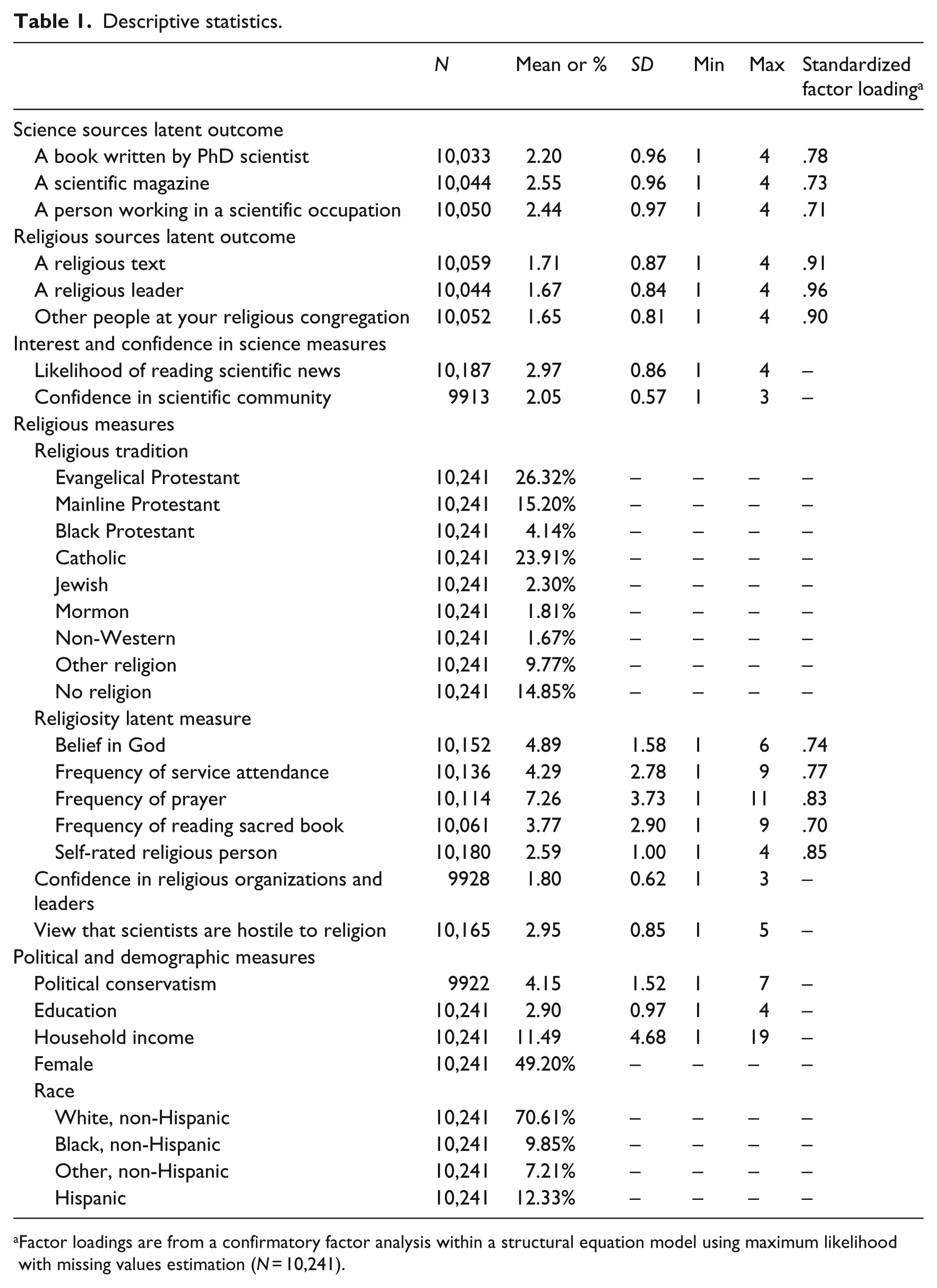
Factor loadings are from a confirmatory factor analysis within a structural equation model using maximum likelihood with missing values estimation (N = 10,241).
7. Method of analysis
Our analysis was conducted in Stata 13.1 utilizing structural equation modeling. This method of analysis offers several advantages for our purposes. First, structural equation modeling allows for the simultaneous estimation of measurement components (i.e. latent factors) and structural components (i.e. path coefficients; Maruyama, 1998). This is useful since some of our measures can be seen as representing underlying latent factors. Specifically, the three items measuring the likelihood of consulting religious sources and the three items measuring the likelihood of consulting science sources can be seen, respectively, as representing a “religious sources” factor and a “science sources” factor. Similarly, our five measures of individual’s religious beliefs, behaviors, and strength of identity could all be conceptualized as a latent measure representing underlying religiosity.
We began by conducting confirmatory factor analyses using structural equation modeling for these three groups of items. As can be seen in the last column in Table 1, the item loadings for the “science sources” latent factor were all above .70, the item loadings for the “religious sources” latent factor were all above .90, and the item loadings for the “religiosity” latent factor were all above .70. Although the religious sources items are more tightly correlated with each other than the other two groups of items, all three factors appear to hold together well and as expected.
Another advantage of structural equation modeling is that it allows for error terms between outcomes in a model to be correlated. For example, two variables may have a relationship with each other and also a third unmeasured variable. This third variable could produce a correlation between the residuals of the two variables (Maruyama, 1998). This is useful for this study, as our preliminary analyses found a moderate positive correlation between the religious sources and science sources latent factors (beta = .34). This might be explained by the respondent’s underlying likelihood of asking any source about a science question. Given this, our analyses allow the error terms between these two latent factors to be correlated.
As can be seen in Table 1, some of our measures have missing values for some cases. One option would be to simply ignore cases with missing values by performing listwise deletion. By doing this, though, we would lose the ability to leverage the non-missing information for those cases. Instead, we estimate our models using the maximum likelihood with missing values estimation method.
8. Results
Table 2 shows the percentage of respondents who said they would “very likely” consult the six individual sources about a science question. The first row of percentages represents all of the respondents. We see that individuals are more likely to say they would very likely consult one of the science sources about a science question than a religious source. However, about 5% of individuals stated that they would very likely consult a religious text, while 4% said they would very likely consult a religious leader.
Percentage of respondents saying that they would be very likely to consult different sources about a science question, overall and by religious tradition.
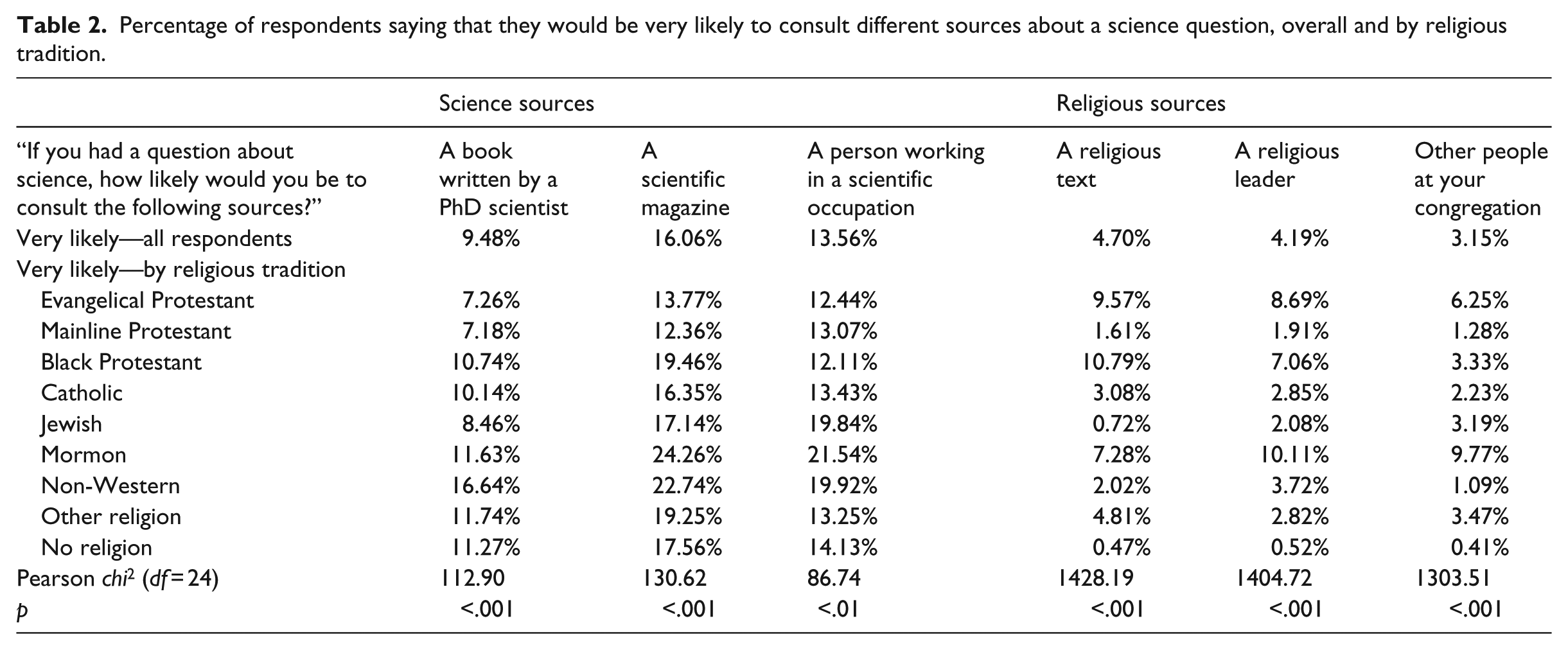
The larger group of percentages in Table 2 breaks these overall percentages down by the individual’s religious tradition. For most of the religious traditions, we find that individuals are much more likely to look to science sources than religious sources. We see, however, that individuals belonging to Evangelical Protestant and Black Protestant denominations are just as likely or even more likely to consult a religious text rather than a book written by a PhD scientist. They are also almost twice as likely as the overall sample to say that they would very likely consult a religious leader about a science question. The Mormon percentages are also worth noting, as Mormons are especially likely to say that they would ask someone at their congregation. This could reflect the higher average educational attainment of Mormons relative to groups with similar levels of religious commitment, which might make congregational peers appear to be a relatively informed group. 5
Although the religious tradition patterns seen in Table 2 are suggestive, they do not tell us whether religious tradition alone shapes the likelihood of consulting different sources. The average individual in these traditions differ in a number of ways (e.g. religiosity, political views). The question, then, is whether we would find religious tradition differences net of other variables? That is, if we took an Evangelical Protestant and a Mainline Protestant with equivalent political views, education, religious service attendance, and so on, would the former still be more likely to say he or she would consult a religious source? To answer this question, we turn to our multivariate analyses.
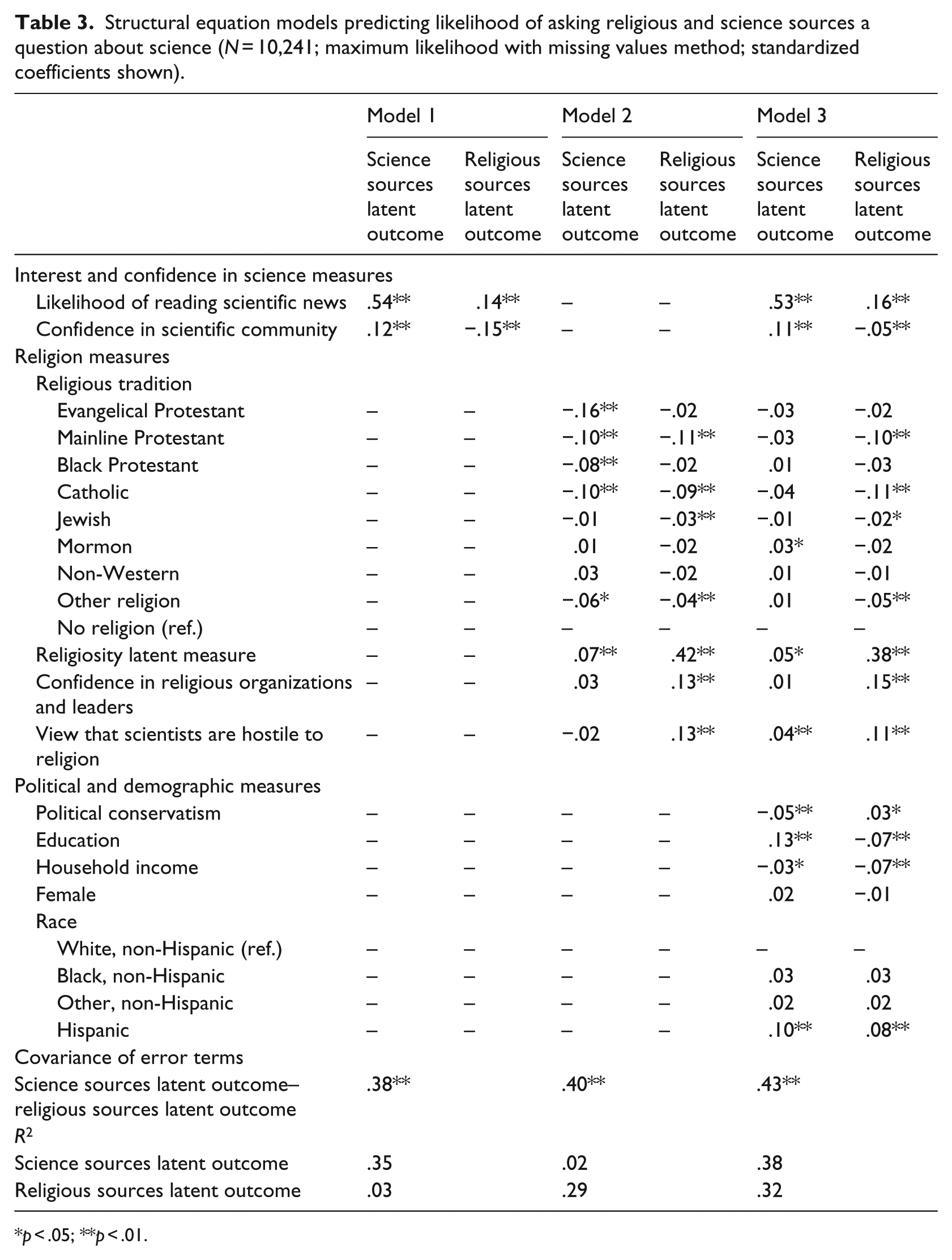
Table 3 shows the results from our structural equation models, which are presented as standardized coefficients. The first model examines the relationship between an individual’s interest and confidence in scientific interest and the two latent source outcomes. We see that an individual’s interest in science, as measured by his or her likelihood of reading a scientific news article, is strongly (beta = .54) and positively related to the likelihood of consulting science sources. This measure is also positively related to the likelihood of consulting religious sources, although to a weaker extent (beta = .14). Although it may seem surprising that interest in science would be positively related to looking toward a religious source for a question about science, religious information could be relevant for some science issues (e.g. ethics and applications of science). An individual’s confidence in the scientific community is positively but only modestly (beta = .12) related to consulting science sources. On the other hand, confidence in the scientific community has a negative association (beta = −.15) with consulting religious sources.
Structural equation models predicting likelihood of asking religious and science sources a question about science (N = 10,241; maximum likelihood with missing values method; standardized coefficients shown).
p < .05; **p < .01.
The covariance between the two latent outcomes’ residuals can be found toward the bottom of Table 3. As noted earlier, there is a positive correlation (beta = .38) between the two outcomes, which suggests that a third unmeasured variable could link the two. This third variable could be the underlying likelihood of asking any source about a science question. Also shown at the bottom of the table is the explained variance for each latent outcome. We see that the measures of interest and confidence in science explain 35% of the variance in consulting science sources but only 3% of the variance in consulting religious sources.
In the second model, we examine the associations between our religion-related measures and the likelihood of consulting the two types of sources. Specifically, we include in this model the indicators of individual’s religious tradition, the latent religiosity factor, the measure of confidence in religious leaders and organizations, and the measure of whether the individual thinks scientists are hostile to religion. Looking first at the religious tradition indicators, we find that compared to the religiously unaffiliated, Protestants, Catholics, and those of an “other” religion are significantly less likely to say they would consult a science source with a question about science. Interestingly, the religiosity latent factor is positively related to the likelihood of asking science sources. An individual’s confidence in religious leaders and organizations is not significantly related to the likelihood of consulting science sources, nor is an individual’s view that scientists are hostile to religion.
The religion measures collectively explain only 2% of the variance in the science sources outcome. In other words, religion does not seem to have a major direct impact on whether or not an individual says he or she would consult scientific sources with a question about science. On the other hand, we see that these religion measures explain 29% of the variance in looking to religious sources. The religiosity latent factor, in particular, is the strongest predictor (beta = .42) of an individual saying he or she would look to a religious source for a science question. However, confidence in religious leaders and organizations is also positively associated with looking to religious sources, as is viewing scientists as hostile to religion.
Model 3 in Table 3 includes all of our predictors simultaneously, including our demographic measures. Looking at the religious sources outcome in Model 3, we find that the results are similar to what was seen in Model 1 and Model 2. There are some more substantial differences for the science sources outcome. We first see that the interest and confidence in science associations seen in Model 1 have not changed greatly. Confidence and interest in science remains positively associated with looking to science sources. However, many of the measures of religion show weakened or vanishing associations with the science sources outcome. For instance, the differences between the religiously unaffiliated and Protestants, Catholics, and those of an “other religion” seen in Model 2 are no longer statistically significant.
Looking at the demographic measures, we see that political conservatism is negatively related to the likelihood of consulting science sources and positively related to the likelihood of consulting religious sources. These associations are fairly weak, however. As might be expected, education is positively associated with asking science sources and negatively related to asking religious sources. Income is negatively, but weakly, associated with looking to science and religious sources. Keep in mind that this is net of education, which is correlated with income. Finally, Model 3 shows that Hispanic individuals are more likely to consult both types of sources with a science question compared to non-Hispanic White individuals.
If we examine the explained variance across the three models, we see that most (35%) of the variance in the science sources outcome is accounted for by an individual’s interest in and confidence in science. The religion-related measures and other demographic measures account for very little (3%) additional explained variance. Similarly, most of the variance (29%) in the likelihood of consulting religious sources for a question about science is accounted for by the religion measures, particularly one’s latent religiosity. Very little explained variance (3%) is added by measures of confidence in science, interest in science, or demographic variables. In sum, religion, whether it is one’s adherence to a particular religious tradition or overall latent religiosity, does not appear to directly lead individuals to avoid science sources when they have a question about science. Religiosity does appear, though, to increase the likelihood that they will supplement their information with religious sources.
9. Discussion
Who does the public turn to when questions about science arise? Such a question is important in an era where some public constituencies have doubts about the credibility of scientists (Collins, 2014). While research on public understanding of science treats science communicators and journalists as having a monopoly on disseminating knowledge about science to the public, this study examined what motivates individuals to turn to religion, a nonscientific source of information about science.
Drawing on a nationally representative survey of US citizens, the analysis above examined how attitudes toward science, religious views and characteristics, political ideology, and demographic characteristics influence the likelihood of turning to science and religion-based sources with a question about science. To summarize our findings, we highlight that religiosity is a much stronger positive predictor of looking to religious sources for scientific information than it is a negative predictor of looking to science sources. In other words, religiosity does not push people away from science information sources when they have a question about science, but it might push them to also look toward religion information sources with the same question.
These results are important because they demonstrate that individuals look to nonscientific sources to resolve questions about science. To be sure, researchers have long acknowledged that nonscientific characteristics of individuals, such as political ideology or the amount of time spent watching general news media, have an influence on the attitudes the public develops about science. But these influences must be distinguished from an active decision on the part of an individual to turn to specific types of authority when issues related to science arise. There is a difference, for example, between attending a church service and asking a minister why some people (often to the chagrin of scientists) refer to the Higgs boson as the “God particle.” The former constitutes a passive influence of religion on how someone makes sense of science. Analytic models that simply model measures such as attendance obscure a different and more direct mechanism: “shopping around” for information about science beyond its walls of epistemic authority.
Our results complement and build on a recent study by Cacciatore et al. (2016) whose examination of trust in religious and science institutions focuses specifically on whether individuals trust religious organizations, university scientists, industry scientists, and science/technology museums to “tell the truth about the risks and benefits of technologies and their applications.” Where their study finds that Evangelicals are more trusting of religious organizations than scientific authorities (see also Johnson and Peifer, 2017), we find that they turn to both religious and scientific sources of information. The studies also nicely complement one another in that they focus specifically on the pursuit of information about scientific technologies while we focus on questions about science in general (which may explain the slight differences in findings). Finally, where Cacciatore et al. (2016) focus exclusively on Evangelical Christians, our analysis provides a more detailed understanding of these patterns across numerous religious traditions. The future research would benefit from analyses that assess trust in information about different science topics (e.g. general questions, basic science, and different technologies) while capturing diverse religious traditions.
Another important avenue for the future research will be to directly measure the consumption of scientific information. We asked our respondents how likely they would be to turn to particular sources of information on science. While this approach is a conventional social scientific survey technique, the future research on the sources to which individuals turn with questions about science would benefit from the use of self-report measures of media use. To be sure, this assumes that respondents can accurately recall and estimate frequency of exposure to various types of scientific content (Taylor and Ghaznavi, 2017). Using guided recall measures in which respondents are asked about actual exposure to specific types of information about science such as public lectures or specific magazines, coupled with direct measures of interactions with scientific and religious authorities, could be an important step forward. We also do not know from our measure what types of questions religious individuals are asking about science. It could be that they turn to religious authorities with questions about the implications of science for religious ethics, rather than epistemological questions. Direct measures of different types of questions would therefore be beneficial in the future research.
The results are also important to how researchers conceptualize boundary contests between science and religion. As Figert (2010) writes, “when the boundaries [of science] are contested, authority is not only rooted in institutional differentiation, but it is also an accomplishment of human actors” (p. 40). Yet, social science has overwhelmingly paid attention to how producers of knowledge such as scientists (Ecklund, 2010; Gieryn, 1983) or regulators in local and state government (Binder, 2009; Johnson et al., 2016) police the boundaries of science and religion. Here, we show that boundaries can be contested and altered when consumers of professional knowledge take their questions about science beyond traditional scientific boundaries of authority. Such consumers permeate rigid institutional boundaries by placing scientific knowledge in dialogue with other sources of authority.
In one sense, turning to religion with a technical question about science might be a problem. It would be consequential for educational achievement if individuals are getting inaccurate information. We are unable to verify this, but one might assume that because religious sources of authority such as ministers or book authors do not contribute to the production of scientific knowledge, they are less equipped to inform individuals about science than scientists and science organizations. In another sense, these results point to an opportunity: they indicate that science communicators should expand their conception of venues and mechanisms for science outreach. For example, the results here suggest that in a highly religious context such as the United States, places that are not typically thought of as a venue for science education—churches—may be an important venue for reaching new audiences. New mechanisms, such as partnering with religious leaders who receive questions from their congregations, may provide a new basis for outreach. The potential for misconceptions on the part of communicators and the public is high. For example, Evangelical Christians are no less interested in science than nonreligious groups (Evans, 2011), but there is a pervasive assumption that Evangelicals are anti-science. Whether one turns to a minister, a friend, or a barber, anytime someone turns to a nonscientific source when a question about science arises, the potential for inaccurate information increases because such sources may lack the authority to speak knowledgeably about science. Thus, the public may develop misconceptions about science. The risks indeed are high, but so too may be the reward for expanding our conception of where people turn to learn about science.
Footnotes
Funding
The author(s) disclosed receipt of the following financial support for the research, authorship, and/or publication of this article: Data collection for this research was funded by the John Templeton Foundation, Religious Understandings of Science Study (Grant #38817), Elaine Howard Ecklund PI.