







Abstract
This study looks at how United States–based academic scientists from five professional scientific societies think about eight different communication objectives. The degree to which scientists say they would prioritize these objectives in the context of face-to-face public engagement is statistically predicted using the scientists’ attitudes, normative beliefs, and efficacy beliefs, as well as demographics and past communication activity, training, and past thinking about the objectives. The data allow for questions about the degree to which such variables consistently predict views about objectives. The research is placed in the context of assessing factors that communication trainers might seek to reshape if they wanted get scientists to consider choosing specific communication objectives.
Keywords
1. Introduction
The science communication training field appears to be growing (Miller et al., 2009; Peters et al., 2008a; Trench and Miller, 2012) and those who conduct such training are eager for guidance on what to include in their courses (Besley et al., 2016). Communication scholars also believe that such training is needed to improve the quality of communicator efforts (Besley and Tanner, 2011). Many trainers may recognize that past research (e.g. Allum et al., 2008) suggests only a limited relationship between knowledge and attitudes, but the literature provides minimal insight on what objectives, beyond knowledge, scientists should seek. Indeed, it appears that much of the advice that continues to be given to scientists focuses on achieving message clarity through careful selection of jargon-free messages and an introduction to journalistic norms (e.g. Baron, 2010; Besley et al., 2016; Hayes and Grossman, 2006). Training may also sometimes focus on specific tactics such as storytelling (Olson, 2009, 2015) and the tactic of “upstream” public engagement focused on fostering dialogue between scientists and non-scientists (Bauer et al., 2007).
The current line of research argues that a problem with focusing on teaching scientists communication tactics such as clear language, storytelling, and engagement is that doing so may mean improving skills in isolation from strategy. It often seems the case that science communicators see the value of many tactics, including engagement-related dialogue, as simply being better ways to achieve the objective of filling knowledge deficits (Besley et al., 2016). We therefore use the theory of planned behavior (TPB) to try to better understand why scientists might choose to prioritize both knowledge and non-knowledge objectives. In doing so, we thus argue that a more strategic form of science communication would foreground the differences between choosing one’s goal for communication, determining interim communication objectives that might allow one achieve that goal in an ethical way, and then selecting tactics that have a realistic chance of meeting those objectives.
Below, we further describe what we mean by a strategic approach to science communication with a focus on the difference between communication tactics, objectives, and overall goals. We then discuss the eight particular objectives that form the core of this research. The literature review concludes with an argument for focusing on attitudes, normative beliefs, and efficacy beliefs—the central constructs of the TPB—to try to understand why academic scientists might prioritize any given communication objective. We test the value of the TPB using survey data from five different scientific societies with the expectation that there may be both commonalities and differences between societies.
The main theoretical contribution we hope to make is to assess whether the main concepts in the TPB can help explain why scientists prioritize different communication objectives for public engagement. The practical utility of the research is in its potential to guide trainers who want to help scientists thoughtfully choose to pursue appropriate, non-knowledge objectives.
2. Literature review
Public engagement and a focus on communication objectives
For numerous reasons (e.g. the expanding media ecosystem, the erosion of science journalism, and the politicization of scientific issues), leaders of the scientific community are asking their scientific colleagues to participate more frequently in public engagement activities (e.g. European Union, 2002; Holt, 2015). Many scientists are attending to these requests. Large-scale surveys show that public communication is becoming a growing priority for scientists in many countries (e.g. Bauer and Jensen, 2011; Besley and Nisbet, 2013; Burchell, 2015; Kreimer et al., 2011; Nisbet and Scheufele, 2009; Rainie et al., 2015). However, with the apparent increased frequency of science–public communication comes many questions. One particularly important line of inquiry centers on evaluating the quality of engagement efforts. Encouragingly, science communication conversations and initiatives are more frequently concerning themselves with the issue of quality (e.g. Bruine De Bruin and Bostrom, 2013; Fischhoff, 2013; Makri, 2017; Nature, 2017). For example, Marcia McNutt (2016), the current president of the US National Academy of Sciences, recently extolled scientists to move past “one-size-fits-all communication” and consider tailoring their engagement efforts to specific audiences. Cutting across such examples is an argument for scientists to become more sophisticated in how they approach communication.
The work reported here seeks to reveal insights that can help enhance the efficacy of science communication efforts. Specifically, our focus on goals and objectives reflects a recognition by strategic communication scholars that it is impossible to talk about effective communication without understanding of what effect is being sought (Broom and Dozier, 1990; Grunig et al., 1992; Hon, 1997). Scholars have also differentiated the concepts of “goals” and “objectives.” Communication “goals” are considered to be long term, “desired outcome[s] of a plan of action” (Kendall, 1992: 248) and overarching frameworks or benchmarks for a campaign (Grunig and Hunt, 1984). Communication “objectives” are viewed as shorter-term antecedents of goals such that seeking to fulfill specific objectives “contribute toward achieving the goal[s]” (Kendall, 1992: 248). In sum, within the strategic communication literature, there is a commonplace recognition of the need to distinguish a hierarchy between the direct effects of communication and ultimate outcomes that communicators actually want to achieve.
It does not seem uncommon for communicators—scientists, in the context of this study—to focus on short-term objectives and think of these objectives without necessarily recognizing that what they see as a goal is not what they really want to achieve. For example, a recent report on communicating chemistry described increasing excitement and interest in chemistry, as well as science literacy, as “goals” for chemistry communicators (The National Academies of Sciences, Engineering, and Medicine, 2016a). Similarly, Burchell’s (2015) review of the scholarship that has examined scientists’ views of public engagement found a continued prevalence among scientists to regard education as the primary objective of science communication. Furthermore, a related recent survey of UK-based scientists found that they regard informing the public as the largest benefit associated with engagement efforts (Wellcome Trust, 2015). We would argue, however, that excitement and knowledge building would be better understood as objectives unless those seeking to increase excitement and knowledge would be satisfied to achieve those objectives with no additional impact on behavior. In other words, a scientist focused on these objectives is using a strategy of attempting to fill deficits in knowledge and/or excitement with the hypothesis that this will lead to behavior change. This strategy (while not consistent with what we know about the limited relationships between knowledge, attitudes, and behavior, cf. The National Academies of Sciences, Engineering, and Medicine, 2016b) might then be implemented through tactics such as telling interesting stories to a selected audience, giving a radio interviews, or engaging in stakeholder dialogue.
The chemistry example also highlights why it might make sense for communication researchers to investigate scientists’ communication objectives. The fact that objectives occupy a midpoint between tactics and goals is useful because we can likely assume that most scientists, with some help, can articulate what they want to accomplish when they communicate. However, scientists willing to communicate also face a range of opportunities for how they might communicate. They could engage in tactics such as face-to-face communication through talks with community groups, they could develop a website or social media strategy, they could pitch journalists, or they could do other things. The value of thinking about objectives is that it can guide science communicators to consider whether an opportunity provides a set of interlocutors (i.e. audiences) and a format that could make the attainment of their ultimate goal(s) more likely. Given the tendency of scientists to focus on the deficit of science literacy as the top-of-mind barrier to public behavior change (Besley and Nisbet, 2013; Davies, 2008), a potential challenge faced by science communication researchers—as well as trainers and those charged with supporting scientists in their communication efforts—is to help scientists think more broadly about what communication can realistically accomplish. It should also be noted that the current research does not seek to assess whether specific tactics might be expected to help achieve a scientists’ communication objective. This question is discussed as an avenue for future research.
What can science communication accomplish?
The types of effects of most interest to this study are those that research suggests are both likely to result from the communication opportunities available to scientists and are likely to affect the goals that scientists want to achieve. In the absence of an established typology suggesting what objectives communication scholars think scientists should prioritize, the objectives studied here are based on insights that have emerged from previous studies of scientists, including the authors’ previous research. These studies include two surveys of members of a single scientific society in the context of online communication that focused on five “goals” (Besley et al., 2015; Dudo and Besley, 2016). These goals, which would be termed as “objectives” in this study, included increasing understanding, increasing perceptions of trust, demonstrating listening, demonstrating caring, and framing. Similarly, a qualitative study by some of the same authors asked trainers about training scientists to build knowledge, foster excitement, build trust, and reframe issues (Besley et al., 2016). We next elaborate on the objectives that are examined this study.
The baseline communication objectives included in this study are “ensuring people are informed about scientific issues” and “getting people interested or excited” about science. We consider the knowledge objective almost as a “control” objective because it is the objective at the heart of the widely discussed deficit model and is the objective that so many discussions of scientists’ views about the public seem to emphasize (e.g. Besley and Nisbet, 2013; Burchell, 2015; The National Academies of Sciences, Engineering, and Medicine, 2016b). The excite/interest objective, while not quite as common, is one that also gets substantial attention, appearing prominently in reports from the US National Academies (National Research Council, 2009; The National Academies of Sciences, Engineering, and Medicine, 2016a), for example.
Beyond these objectives, this study also focuses on six objectives related to a multi-dimensional understanding of trust, fairness, and the importance of identity:
Demonstrating the scientific community’s expertise. The inclusion of this objective reflects research showing that competence is a core dimension of trust (Fiske and Dupree, 2014; Schoorman et al., 2007) and that individuals’ perceptions of competence can influence how they make decisions related to societal risk involving science (Siegrist, 2010) and how willing they are to help others (Fiske and Dupree, 2014). It also seems possible for science communicators to affect competency judgments by highlighting credentials or the process of science, as well as through dress and speech.
Hearing what others think about scientific issues. The inclusion of this objective reflects the central role that perceptions of voice play in how people perceive decision-making (Lind et al., 1990), including science issues (Besley et al., 2017; Besley and McComas, 2015; Einsiedel, 2014). It seems possible to realize this type of objective by doing things such as actively listening as well as using messages that indicate past listening behavior.
Demonstrating that the scientific community cares about society’s well-being. The inclusion of this objective reflects both trust research that suggests that warmth or benevolence perceptions affect how willing we are to support others (Schoorman et al., 2007), including the scientific community (Fiske and Dupree, 2014), as well as similar fairness research that addresses “interpersonal” fairness (McComas and Besley, 2011). Any number of cues might shape whether or not people see scientists as caring, including things such as direct messages about why scientists do their work (i.e. to help their communities) as well as things such tone of communication (e.g. Yuan et al., 2016).
Demonstrating the scientific community’s openness and transparency. The inclusion of this objective further reflects social psychological research related to the concept of perceived “informational fairness” (Greenberg, 1993), including research in the context of science (McComas and Besley, 2011), as well as the idea of integrity (Schoorman et al., 2007). The act of communication itself might send some messages, but additional cues—for example, specific messages that describe efforts to ensure access to data—could also be included in any communication effort.
Demonstrating the scientists share community values. The inclusion of this objective reflects research related to concepts such as cultural cognition and research that suggests that people often use identity cues to make sense of many scientific issues (Kahan et al., 2011). As with the other objectives, many communication decisions could shape whether or not someone sees you as part of their group or another group, including decisions about appearance and choice of words.
Framing research implications so members of the public think about a topic in way that resonates with their values. The inclusion of this objective reflects research showing that framing issues in different ways (Druckman and Lupia, 2016), including science and the environment, can shape outcomes such as peoples’ attitudes and behaviors (Myers et al., 2012). Strategic communicators, of course, can purposefully choose frames aimed at achieving specific responses.
There are also many objectives that this study does not address. Of note are objectives at the core of health and environmental communication research such as trying to change peoples’ beliefs or salience of their own efficacy or the efficacy of specific behaviors. These concepts are at the heart of the TPB and the related Integrative Behavioral Model (Fishbein, 2009). Inducing fear (Yzer et al., 2013) and either general or specific affect (Parkhill et al., 2011) are also potential objectives that communication scholars often study. Future research should look at such objectives, but we also believe that the current set of objectives provides a useful initial representation of the types of outcomes that scientists might be advised to seek through communication.
Why the TPB and a focus on ethicality and beliefs?
Finally, we chose to examine objective prioritization in the context of attitudes, normative beliefs, and efficacy beliefs from the TPB (Ajzen, 1991) because it is one of the most established theories in the area of behavior change research (Montano and Kasprzyk, 2015). In essence, this study represents an early effort to build out what might be called a “strategic science communication as planned behavior” model that is based on the TPB. The TPB, in this regard, argues that the primary driver of intentional behavior is an individual’s choice to undertake the behavior (i.e. behavioral intent). Behavioral intent, in turn, is said to come from attitudes toward the behavior, perceived norms related to the behavior, and efficacy beliefs related to the behavior. These concepts are further described below, but what is key here is the idea that the choice to prioritize a communication objective represents a type of behavior.
The focus on the TPB in the current research is also consistent with past research that looked at what variables predict scientists’ engagement behavior (e.g. Dudo, 2013; Dudo et al., 2014; Poliakoff and Webb, 2007) as well as a previous study on scientists’ views about communication training goals (Besley et al., 2015). Also, as suggested by the title of the Integrative Model (Fishbein, 2009), if you are focused on behavior change, then attitudes, normative beliefs, and efficacy beliefs are all central things that someone like a trainer could consider trying to reshape. For example, one might imagine that a scientist who thinks pursuing an objective is unethical (i.e. conceptualized as attitude in this study) would be less likely to pursue an objective, and that someone who thinks that the scientist should pursue such an objective might benefit from helping the scientist think through how the objective might be pursued in an ethical way. Similarly, a trainer might encounter scientists who believe their colleagues would look down upon them if they were to be seen trying to achieve an objective. In that case, if the trainer finds the objective useful, it might be possible to convince scientists that their sense of their colleagues’ norms is inaccurate.
It is also important to acknowledge that the literature recognizes at least two types of normative beliefs and two types of efficacy beliefs. For normative beliefs, it is also useful to differentiate between beliefs about what scientists perceive as their fellow scientists’ actual behavior (descriptive norms) and what scientists believe their fellow scientists would expect of their peers (subjective or injunctive norms). For efficacy beliefs, it is equally important to differentiate between scientists’ belief that a behavior can make a difference in the world (external or response efficacy) and their belief that they could personally accomplish a behavior (internal efficacy or perceived behavioral control). The research on training in the context of online engagement and a single, general scientific society found that perceived ethicality of objectives (attitude) and external efficacy of objectives were the most consistent predictors of engagement (Besley et al., 2015). Poliakoff and Webb (2007) similarly found that engagement attitudes, perceived engagement ability (i.e. internal efficacy), and the perceived engagement of other scientists were associated with more engagement.
As suggested, the hypotheses of the current research flow from our understanding of strategic science communication as planned behavior, the TPB, and the fact that the survey were conducted with US-based members of five professional societies whose members pursue varied scientific disciplines. The first hypothesis reflects past interest in engagement differences between different types of scientists (Besley et al., 2013; Ecklund et al., 2012) between groups. However, it is should be understood that we propose it primarily to see whether it makes sense to reject the null hypothesis of no difference. In this regard, no attempt is made to propose an argument for why we might expect that scientists from different societies might see engagement objectives in predictable and different ways:
H1. The five societies will differ from each other in terms of their views about communication objectives, including in terms of attitudes, normative beliefs, and efficacy beliefs.
H2. Perceived ethicality of each objective will be positively associated with prioritization of each objective, controlling for other variables.
H3. (a) Subjective and (b) descriptive normative beliefs will be positively associated with prioritization of each objective, controlling for other variables.
H4. (a) External and (b) internal efficacy beliefs will be positively associated with prioritization of each objective, controlling for other variables.
In addition, whereas past research aimed at predicting willingness to engage sometimes included a variable associated with past engagement (Poliakoff and Webb, 2007), this study includes variables focused on whether or not the respondent had previously considered each objective. The logic for including such measures is that it seemed likely that the surveyed scientists would be more likely to say they would prioritize an objective if they had spent time considering it in the past.
H5. Previous consideration of an objective will be associated with prioritization of that objective, controlling for other variables.
In addition to our hypothesized predictors, other variables included in our model include age, gender, past engagement, and past training. While these are not the focus of the current analysis, they should be controlled for because they could potentially shape communication behavior. We choose to examine direct effects associated with the dependent variables, given the novelty of the topic and the absence of extant literature. As such, we provide eight separate tests (i.e. replications) of the TPB variables’ associations with eight communication objectives and do not propose hypotheses about how different TPB variables might differentially predict the various objectives about which we asked. Exploring differential and interactive effects within this context, however, is a next logical step for this line of research.
3. Methods
Sampling
The five online surveys used here took place at slightly different times and included either three or four waves of data collection. Multiple requests were made of each respondent with somewhat different appeals in order to increase the response rate (Dillman et al., 2009). Our analyses focus only on US-based scholars because the sample size would not allow us to make meaningful comparisons between countries, although it should be expected that such comparisons might prove a fruitful area for future work. The survey of the geophysical society membership was sent to respondents four times between 25 January and 8 March 2016. A total of 2419 respondents completed the survey, representing a 10% response rate. Of these, 316 were eligible for this study because they fit the study criteria of (a) being at an American university, (b) holding a PhD, and (c) and asked questions about face-to-face engagement. Those who were excluded because of the first two criteria typically worked in industry or government, and the third criteria reflects the fact that the underlying survey included a branching element that saw respondents being randomly assigned to answer the questions in the context of face-to-face, news media–focused, and online science communication. We focus only on face-to-face respondents for parsimony. The geological respondents were surveyed using three waves between 8 March and 1 April 2016. A total of 1032 completed the survey, also representing a 10% response rate. Of these, 259 were available for this study and its focus on face-to-face engagement. The ecological society respondents were surveyed between 25 March and 16 April using three waves of data collection. A total of 860 respondents completed the survey for a 16% response rate and, of these, 350 met the inclusion criteria for the current analysis. A total of 513 were surveyed from the biological society over four waves conducted between 26 October and 20 November 2015, with 375 meeting the inclusion criteria. Finally, 1263 respondents from a general scientific society were surveyed using five waves between 15 October and 10 November 2015 with 385 meeting inclusion criteria. Both the biological and general societies had response rates of 9%.
In terms of margin of sampling error (MSE), given the underlying populations of the societies, the MSE was about ±3% for all the societies, except the general scientific society where the MSE was about ±5%. However, it is important to note that this study is primarily focused on the relationships between the variables and not the point estimates.
The societies studied were selected based on informal networks and requests to the authors because of an interest by society staff members to better understand their members’ views about engagement. No attempt is therefore made here to suggest that our five different societies represent all scientists in all countries. Rather, the argument is only that commonalities between societies would be consistent with an argument that US-based scientists from different fields think about the issue of communication objectives in similar ways.
Survey structure
The survey itself typically took scientists 15–30 minutes to complete. It began with questions about past public engagement (alongside definitions) and future willingness to engage. Most respondents were then randomly assigned to questions in the context of face-to-face communication with adults, communication with the public through news media, or online communication. However, because the underlying societies were somewhat small, members of the ecological society studied here were only randomly assigned to two of these conditions and members of the biological society studied here all did the face-to-face version. As noted, only respondents in the face-to-face condition are analyzed here. Additional questions then asked about general views about engagement. These questions are the subject of research reported elsewhere.
The next section—which is the focus here—asked respondents to say how much they would be willing to prioritize several different communication objectives that were presented to respondents on a single page in random order using a matrix table that allowed respondents to rate each objective on a 7-point scale from “lowest priority” to “highest priority” with the middle category labeled as “average priority.” Willingness is understood as similar to “intent” to conduct a behavior and intent is at the core of the TPB (for a discussion, see Fishbein and Ajzen, 2010: 42–43). Willingness was chosen for the survey because asking about intent would suggest a need to be more specific about the communication context. The question stem further included admonition to “remember that not everything can be the highest priority.”
Descriptive statistics along with wording for the eight objective questions are provided in Table 1. Following the objectives prioritization page, individual pages, presented in random order, had questions that asked respondents to indicate the degree to which they “strongly disagreed” to “strongly agreed” with six statements related to each objective using 7-point scales. The statements addressed, whether respondents saw the relevant objective as “ethical” (attitude), whether the respondent believed that “scientists who pursue[d] this objective would be well regarded by their peers” (subjective norm), whether the respondent believed that his or her “colleagues would put a high priority on this objective” (descriptive norm), whether the respondent felt he or she had the “skills needed to achieve this objective” (internal efficacy), whether respondent said they felt that “achieving [the] objective [was] possible for a good communicator” (external efficacy), and whether the respondent “had thought a lot about this potential engagement objective” “prior to the survey.” The first five questions reflect our use of a direct measurement approach (rather than an expectancy value approach) to the TPB variables. The final question reflects an interest in understanding whether past exposure to objectives (i.e. familiarity) would make people more or less willing to consider that objective.
Descriptive statistics and between society comparisons (One-way ANOVA).
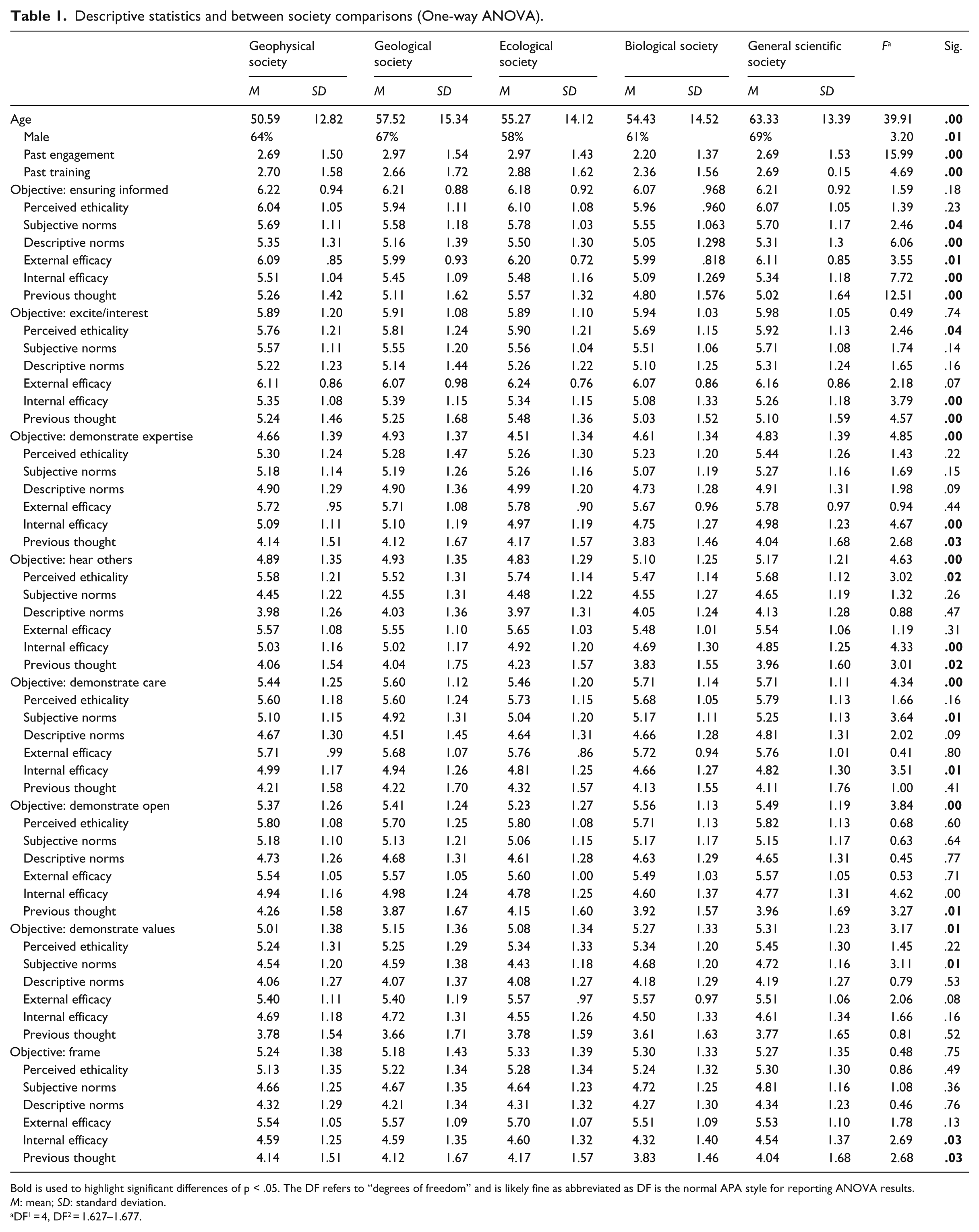
Bold is used to highlight significant differences of p < .05. The DF refers to “degrees of freedom” and is likely fine as abbreviated as DF is the normal APA style for reporting ANOVA results. M: mean; SD: standard deviation.
DF1 = 4, DF2 = 1.627–1.677.
The use of both the direct-measure approach to TPB beliefs and the use of single measures for each construct reflect simple concerns about survey length. Faced with the choice of asking (a) more questions about fewer objectives or (b) asking fewer questions about more objectives, we chose the latter option. The expectation was that the underlying constructs were relatively straightforward for the respondents and thus would have somewhat low measurement error. The fact that it was also possible to, essentially, replicate the study across multiple societies also increased our expectation that any meaningful relationships would emerge in the data analysis.
Analysis
The analysis below initially focuses on mean comparisons and then looks at series of ordinary least squares (OLS) regression models. The mean comparisons are meant to allow an assessment of whether there are substantive differences in the measured items between different societies (H1), whereas the OLS models are used to speak to whether there is a consistent pattern of relationships between demographics, attitudes (H2), normative beliefs (H3), efficacy beliefs (H4), and prior consideration (H5) of each objective. No statistical attempt was made to compare the size of the coefficients between models, although it should be noted that the size of the standard errors for the OLS estimates suggests that it would generally be unwise to make assertions about differences between societies based on whether or not a variable is significant in one case, but not another.
4. Results
First, with regard to the mean comparisons between societies (H1), it can be seen (Table 1) that while there were some differences with regard to age and past engagement behavior, there were few other large differences. In total, about 25 of 56 analysis of variance (ANOVA) tests were significant. However, in most cases, even where there are statistically significant differences, these represent a fraction of a point on the 7-point scale.
Next, and more importantly, we looked at the degree to which the core variables included in our models predicted prioritization of that objective. Predictors included ethicality (attitude) (H2), subjective (H3a) and descriptive (H3b) normative beliefs, external (H4a) and internal (H4b) efficacy beliefs, and previous consideration (H5) of an objective. Table 2 summarizes the results of the core variables from Table 3.
Summary of variable significance across all five societies and all results by objective (number of times significant in ordinary least squares (OLS) regressions).
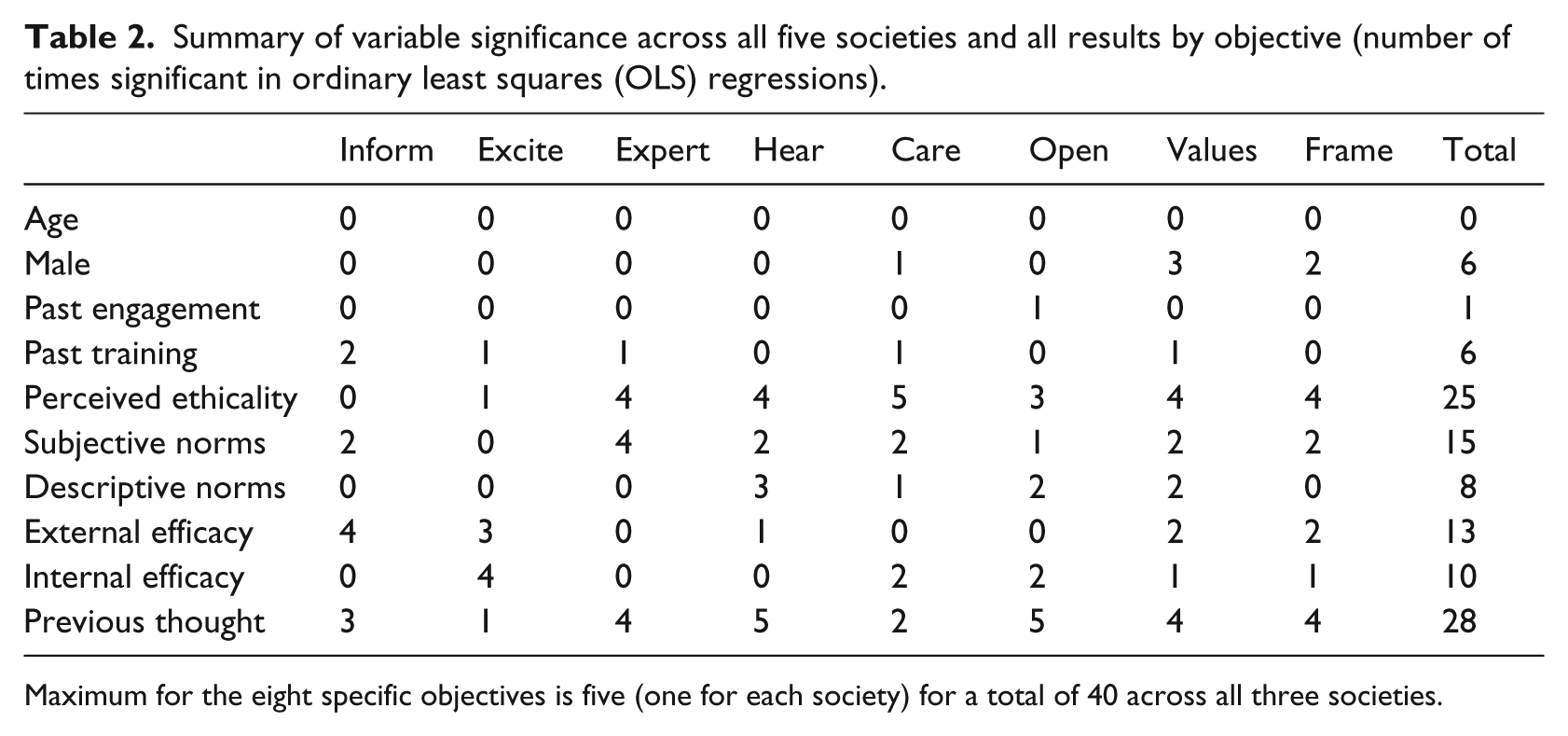
Maximum for the eight specific objectives is five (one for each society) for a total of 40 across all three societies.
Ordinary least squares (OLS) unstandardized regression estimates by society.
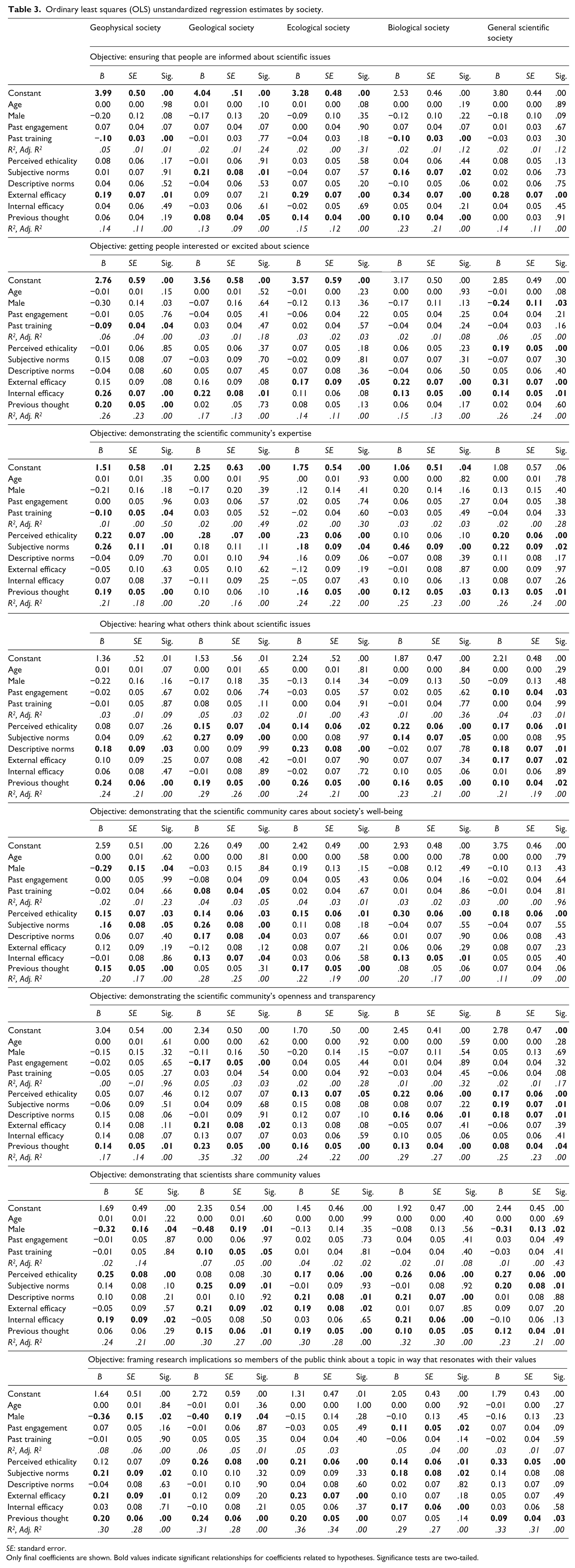
SE: standard error.
Only final coefficients are shown. Bold values indicate significant relationships for coefficients related to hypotheses. Significance tests are two-tailed.
The results show that demographics as well as past engagement and past training rarely predicted prioritization of each objective. Furthermore, these results show that descriptive norms (H4b) and internal efficacy (H4b) (i.e. the responding scientists’ self-perceived ability to achieve that objective) were only significant predictors of objectives in about a quarter of the 40 models (5 societies × 8 objectives) run. Subjective norms (H3a) (i.e. belief that colleagues would approve of someone who sought an objective) and external efficacy (H4a) beliefs were significant predictors in slightly more than a third of the 56 possible models. The most consistent predictors were perceived ethicality (H2) of an objective (i.e. our attitude measure) and previous consideration of an objective (H5) with respondents who indicated that they had considered the objective being more likely to prioritize that objective. These variables were both significant in more than half of the models for perceived ethicality and about three-quarters for prior thought. Overall, per Table 3, the various models predicted from one-tenth to three-quarters of the variance in respondents’ objective prioritization based on their adjusted R2 results.
5. Discussion
Amid calls for scientists to become more frequent public communicators and the growth of science communication training programs and initiatives, this study sought to provide theoretically derived insights that can help increase the effectiveness of science engagement efforts. Stemming from well-established insights from strategic communication scholarship, we explored the communication objectives a sample of US-based scientists from different disciplines (N = 1685) prioritize for their engagement. We were especially interested in the extent to which the main concepts of the TPB can help explain how these scientists prioritize eight different communication objectives, believing that such knowledge can help guide scientists and communication trainers in their continued efforts to enrich the sophistication—and potential outcomes—of engagement efforts.
Our results suggest that the sample of scientists from five societies shared similarities on evaluations of communication objectives. Stakeholders who want scientists to engage in ways beyond filling knowledge gaps may benefit from helping scientists think more about specific science communication objectives. It may also be important for those seeking to get scientists to adopt an objective to make compelling arguments about that objective’s ethicality. One limitation of the fact that previous thought was such an important predictor of engagement is that additional thought by a scientist about an objective might be expected to change the relationship between prioritization and TPB-related variables such as attitudes, normative beliefs, and efficacy beliefs. For example, one might imagine that additional consideration of an objective might lead a scientist to decide that an objective is more (or less) ethical than initially thought, and that such changes could also change the underlying relationship between the attitude and behavioral willingness. They might similarly realize that they have (or do not have) the skills to achieve that objective. These types of interactive and longitudinal relationships represent fertile questions for future consideration. Those interested in training, in this regard, should likely assess the possibility and impact of such changes.
Factors beyond previous thought and ethicality were inconsistent predictors of objective prioritization. Age, gender, and past engagement had almost no meaningful relationship with whether a respondent prioritized any of the objectives studied. Past training and internal efficacy, both of which one might logically expect to predict whether or not a scientist might prioritize at least some objectives, were also relatively unrelated to objective prioritization. As noted in the literature review, one would hope that scientists’ who had received training would have developed a sense that some objectives should be prioritized more and others less. There are, however, no truly inappropriate objectives included in the study so it might simply be that training changed scientists’ views about objectives relative to other objectives.
A post hoc analysis showed that the more training scientists accrued, the smaller the difference between how much they prioritize the “inform” objective and the more strategic objectives (i.e. the correlation between [individual mean of the inform objective] − [individual mean of another objective]). Specifically, while there was no significant difference between training amount and the mean “inform–excite” objective (r = −.03, p = .24) and only a small correlation with the “inform–expert” objective (r = −.05, p = .04) difference scores, most of the other potential difference scores with the inform objective seemed more substantively and negatively correlated with training amount. The smallest correlation was for the “inform–openness” objective difference score (r = −.06, p = .01) and largest was for the “inform–frame” difference score (r = .13, p = 00), with an average correlation of r = .09 (with n = 1666–1682). In other words, it may be that the effect of training is not on the absolute prioritization that scientists are giving to various objectives but, rather, changes in the likelihood that the scientists will prioritize “non-informing” objectives as much as the informing objective. These relationships are all, however, quite small. Future research will need to further consider what this means for how we seek to understand potential effects of training.
For normative beliefs, it appears that scientists’ views about what objectives their colleagues prioritize have little relationship with their own prioritization, but there is limited evidence that scientists may sometimes attend to their beliefs about what their colleagues would consider appropriate. Given persistent reminders of a supposed “Sagan Effect,” future research should continue to consider whether these normative concerns, which were not found to be related to perceptions of training value in online engagement contexts (Besley et al., 2015), actually represent meaningful drivers of scientists’ behaviors. It may be that additional analysis focused on specific types of scientists (e.g. young scientists or scientists in more competitive fields) would find that some sub-groups are more (or less) likely to be swayed by their normative beliefs or that beliefs about specific reference groups (e.g. funders or mentors) may influence specific types of scientists. These types of moderation effects were also not the focus here but might make a useful contribution to our understanding.
The efficacy predictors, while also inconsistent as variables in this study, performed at least somewhat similar to the previous study focused on training in an online context. Internal efficacy was a relatively non-important predictor of whether the scientists surveyed would prioritize any given objective, consistent with Besley et al. (2015), but not Dudo and Besley (2016). In contrast, external efficacy was at least somewhat related to objective prioritization in several cases. One limitation of the question asked, however, was that it focused on whether the responding scientist thought that achieving the objective was possible for a skilled communicator. The question did not ask, however, about whether achieving the objective would help the communicator achieving their actual goals. The specific focus of the question was chosen because, logically, any given objective might be useful toward achieving some goals, but not others. Future research should consider conceptualizing external efficacy differently.
The conceptualization of external efficacy also points to a larger limitation of the study related to measurement. As noted, we made the choice to both ask only single belief questions about each aspect of the TPB. This was done because of a concern about survey length. The fact that we were able to, essentially, replicate the underlying study across several societies means that the study provides a meaningful initial sense of the degree to which the different TPB pieces predict objective prioritization. On the other hand, we also see potential value in more focused research aimed at understanding why scientists might choose any given objective. Such research might also use an expectancy value approach to TPB, rather than the direct measurement approach used here.
Furthermore, we also recognize that we only ask about hypothetical prioritization in a relatively general context and that it would be useful to study how scientists set communication priorities in more specific contexts. It might similarly be helpful to focus on how scientists react to specific tactics that might be expected to achieve an objective. The logic of doing so might be that a scientist might say that he or she is willing to prioritize an objective, but this does not mean that they have thought through what it might take to actually achieve such objectives. For example, some scientists might say they are willing to prioritize trying to make sure that those with whom they communicate believe they care about their communities, but be unwilling to talk about how their research choices are affected by their love for their families and neighbors.
As research in this area continues, it will also be important to consider the possible risks associated with increased strategic science communication. Public Information Officers (PIOs), for example, have played an important role facilitating interactions between scientists and external audiences (Nelkin, 1987, 1995; Rogers, 1986), but some scholars have noted how their influence on these relationships is increasingly institutionalized within scientific organizations (Peters, 2012). This phenomenon, commonly referred to as “medialization” (Weingart, 1998), has resulted in a growing body of research documenting the increasing salience of media criteria within the scientific community and the scientific research process (Ivanova et al., 2013; Peters et al., 2008b; Rödder, 2011). A handful of recent studies have highlighted how the increasingly competitive public relations infrastructure found within scientific institutions may lead to systemic use of problematic communication practices (e.g. Basken, 2014; Sumner et al., 2014; Williams and Gajevic, 2012). In this regard, it is crucial that communication researchers seek to understand the conditions under which science communication that is more “strategic” can be undesirable, ineffective, or outright problematic. And as noted at the outset, nothing we write above should be interpreted to suggest we would endorse any form of dishonest communication. For example, we would only ever suggest that a scientist communicates about listening to stakeholders if they are genuinely listening to stakeholders. We also acknowledge that the societies we studied focus on the natural science disciplines and thus are unrepresentative of all scientists. Future studies can further explore this issue with scientists in social science disciplines. It may also be important to assess whether views about communication objectives vary by country or other cultural factors.
6. Conclusion
Pielke (2007) contended that “if scientists ever had the choice to remain above the fray, they no longer have this luxury” (p. 8). Science communication experts may quibble about the intensity of this particular proclamation, but few would deny the increasing extroversion of the scientific enterprise. The chorus for scientists to improve their communication continues with more voices singing about the need to not just do more science engagement but to do more effective science engagement with effectiveness gauged by the ability of scientists to affect the behavior of those with whom they communicate. Some recent data show promising signs among scientists, suggesting that their perceptions and practices relative to public engagement are becoming more sophisticated (Wellcome Trust, 2015). Other research, however, suggests that scientists continue to associate public engagement narrowly, as primarily being a means to educate (Burchell, 2015; Dudo and Besley, 2016). Additionally, the minimal work that has assessed science communication training organizations has found their approaches and curricula to be focused mostly on helping scientists build specific communication skills devoid of larger strategic contexts and goals (Burchell, 2015; Trench and Miller, 2012). In short, there is an opportunity—if not an outright impetus—for communication researchers to help maximize scientists’ ability to articulate and achieve their engagement goals. This requires clarifying those goals and developing an understanding of how different tactics might allow scientists to achieve objectives that support their goals. Ultimately, this guidance would aim at supporting scientists—and the training professionals who help them—to develop evidence-based strategies for how to use specific tactics to meet specific objectives to, ultimately, have long-term desired effects.
Footnotes
Funding
The author(s) disclosed receipt of the following financial support for the research, authorship, and/or publication of this article: This material is based in part upon work supported by the National Science Foundation under Grant Nos. AISL-1421723 and AISL-1421214. Any opinions, findings, and conclusions or recommendations expressed in this material are those of the author(s) and do not necessarily reflect the views of the National Science Foundation.