







Abstract
Postage stamps are designed to convey messages that reverberate symbolically with broad swaths of the public, and their content has been employed as a window into how members of the public understand the ideas represented therein. In this rhetorical analysis, we analyze Philadelphia’s Science History Institute’s Witco Stamp Collection, which features 430 stamps from countries around the globe dating from 1910 to 1983, to identify how chemistry is portrayed in this ubiquitous medium. We find the vernacular of science reflected and supported by these images functions to (a) define chemistry in terms of its invisibility and abstraction; (b) uphold chemical operations as instrumental and daedal, or exceptional, in nature; and (c) delineate practitioners of chemistry as—on the whole—privileged and preternatural. Our findings reveal some of the overarching communicative tools made available to twentieth-century non-experts for articulating chemistry as an enterprise and reveal how those tools positioned chemistry in terms of values related to opacity and exclusivity.
Keywords
In 1965, Paraguay joined the growing list of countries releasing stamps that showcased vivid representations of chemistry. Paraguay’s version commemorated one of the most well-known scientists of all time, Nobel laureate Albert Einstein. Featuring a design crafted by the popular philatelic artist Imre von Mosdossy, it drew from a range of widely recognizable symbols including rocket ships, retort flasks, atoms, and formulas such as Einstein’s famed
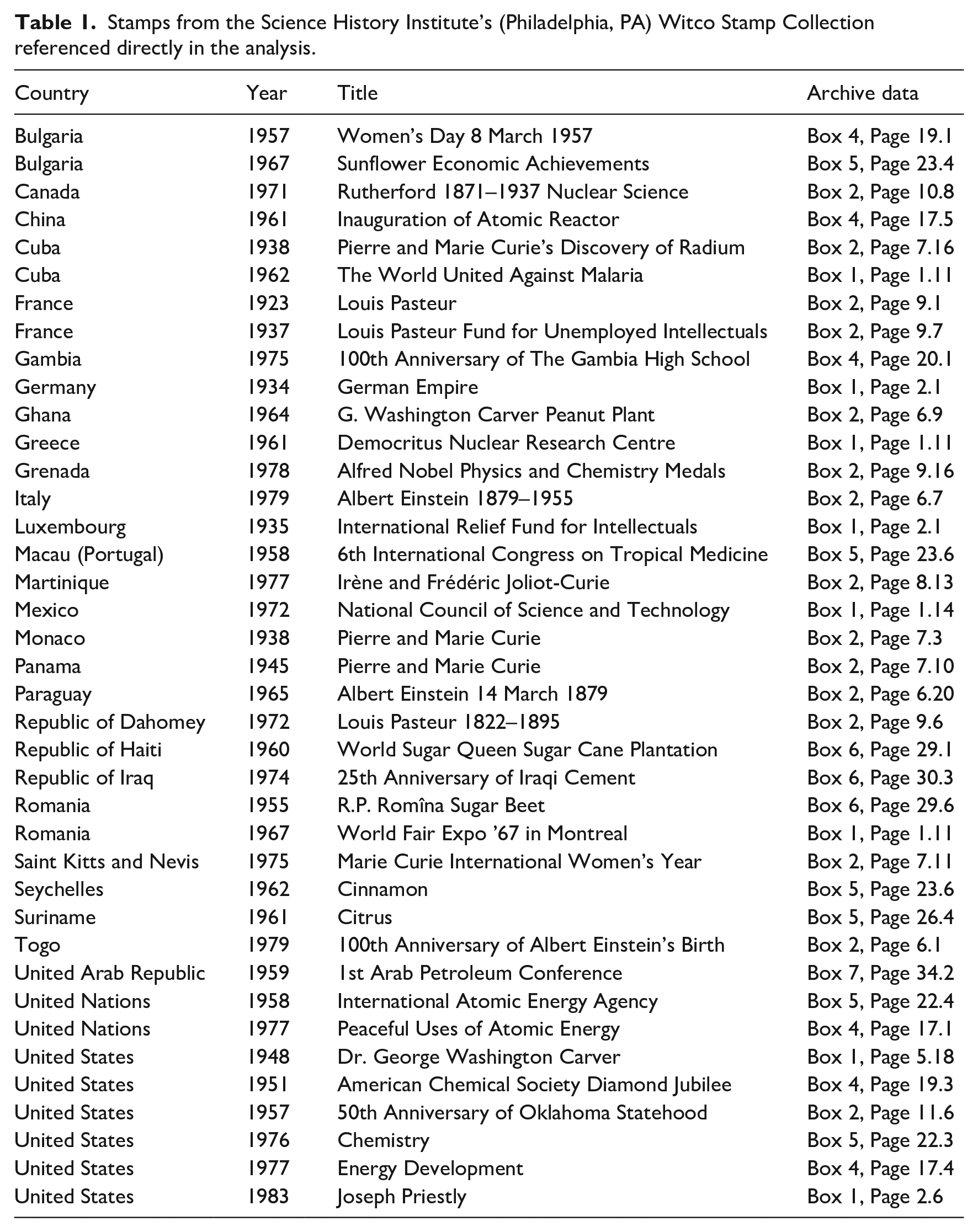
Stamps from the Science History Institute’s (Philadelphia, PA) Witco Stamp Collection referenced directly in the analysis.
In this article, we explore twentieth-century chemistry-focused stamps in answer to calls for research dedicated to identifying the communicative tools that lay people have had access to for understanding and conveying science (Burns et al., 2003; Jasanoff, 2014). In this way, we aim to contribute to explorations into the complex processes defining and facilitating science in relationship to and with non-experts (Burgess, 2014; Guston, 2014; Suldovsky et al., 2019). Research on public science communication by scholars such as Gigante (2018) and Bucchi (2008) suggests that a wide-ranging account of these tools and their patterns of expression are necessary for explicating how certain kinds of public interaction with science emerge, are sustained, and, in some cases, are thwarted. To further this inquiry, we analyze the contents of the Science History Institute’s Witco Stamp Collection, which features the most comprehensive assemblage of chemistry-related stamps (N= 430) from around the globe in the twentieth century. Building from research on vernacular science knowledge (Wagner, 2007), we conceptualize the twentieth-century postage stamp as a “pedagogy of sight” (Jack, 2009: 192), guiding lay people in how to understand, communicate about, and even participate in technical, chemical science, and the broader scientific culture.
In the rhetorical analysis that follows, we demonstrate that the vocabulary of science reflected and created by these stamps characterized chemistry in terms of (a) its invisibility and abstraction, (b) its instrumental and daedal—or exceptional—operation, and (c) the privilege and preternatural state of its practitioners. We find that these three types of representation interrelate in ways that visually communicate an overarching educational vernacular of science that upholds values related to opacity and exclusivity, and we consider the implications of those messages as they played out in the twentieth century and as they echo into the twenty-first. The article proceeds by, first, reviewing scholarship on the communicative tools that have been identified as central to public understandings of science; second, outlining the study’s methodology; third, presenting thematically the study’s analytic findings; and, finally, considering how these specific rhetorical resources created an infrastructure of public science communication that situated lay people as inherently apart from scientific processes, products, and interventions.
Vernacular science knowledge and its communicative tools
Existing research demonstrates that lay people encounter countless sources of information that contribute to a basic, discursively constructed understanding of what science is, how it functions, and who it involves (Falk et al., 2007). These fragmentary, “mundane, symbolic and esoteric facts” underwrite what Wagner (2007) called vernacular science knowledge (p. 8). The vernacular created and perpetuated through public scientific discourse relies on a lay vocabulary altered, often in key ways, from that of the technical sphere of argumentation (Goodnight, 1982). Wagner considered vernacular science knowledge an intermediary stage between scientific ignorance and technical scientific understanding and acumen. In this realm, the public “compensates for a lack of scientific literacy” by relying largely on the fundamental images, metaphors, and symbols available to non-experts (Wagner, 2007; 15). These resources function as communicative tools that guide them in any number of interactions and play a foundational role in shaping their engagement with science.
To date, explorations into these communicative tools focus heavily on the specific media in which they have circulated historically. For instance, research explores the significant role that the periodical press of the nineteenth century played in disseminating science information to non-expert publics (Cantor et al., 2004; Lightman, 2018; Shuttleworth and Cantor, 2004), while other scholarship in this area highlights exhibitions and museums as sites that—during roughly that same period—portrayed science in symbolically resonant and culturally accessible ways (Canadelli and Casonato, 2019; Roca-Rosell, 2015). Moreover, research on the more contemporary media of television and film illustrates how the circulation of scientific ideas in these formats has functioned in some cases to make science more generally palatable to lay audiences and, on the whole, to uphold traditional scientific ideals related to objectivity and gender norms (Boon, 2019; Cole, 2017).
Stamps as a medium for communicating about science has been considered in research by Yardley (2015), who—drawing primarily from a quantitative methodology to explore his personal collection of stamps—focused on assessing the likely intentions of postal authorities and scientists driving featured representations. Yardley’s findings echo several findings from other scholars who have delineated the specific types of science representations across diverse, twentieth-century mainstream media. For instance, like Mitchell (2008) and Haynes (2003), Yardley reported that images of individual male scientists, working alone, were prominent, a phenomenon that Gigante (2018) argued characterizes science as exclusive and scientists as superior. Correspondingly, Yardley (2015) held that—across contexts of time and place—illustrations of instruments such as flasks and microscopes were used to symbolize the expertise and precision science requires, a finding also upheld by Jordanova (2000) who demonstrated that public portrayals of scientific practitioners in the twentieth century across media such as portraits, photographs, and stamps were more likely to include scientific instruments than were those of previous centuries and thereby portray the sciences as complicated and specialized. Yardley’s (2015) research aligns, as well, with that of Toumey (1996), who argued that mainstream stories about science tend to “convert abstract ideas into semi-abstract representations” such as E = mc2 or, as Northcut (2006) noted, the double-helix model of DNA, which functions less to explicate the technical reasoning they represent and more to “humanize the scientific idea by casting it in a familiar representation” (Toumey, 1996: 125).
On the whole, this research demonstrates that, during the twentieth century, the communicative tools circulating throughout mainstream society concerning science functioned both to separate science from society via appeals to exclusivity and to make non-experts feel more comfortable with—though not necessarily more informed about—scientific reasoning and processes. The present research aims to build from those findings to formulate an increasingly comprehensive account of the means by which non-experts developed vernacular science knowledge in the twentieth century. With these goals in mind, we pose the following research questions:
RQ1: What representations of chemistry emerge consistently in the Witco Stamp Collection?
RQ2: What communicative tools do these representations provide non-expert audiences for understanding and engaging chemistry at the level of vernacular science knowledge?
1. Method
To assess how twentieth-century postage stamps represented chemistry and provided non-experts with communicative tools, the authors conducted a rhetorical analysis of the Witco Stamp Collection. Also known as “The World of Chemistry in Stamps,” the collection is located in the Science History Institute’s Othmer Library of Chemical History archives in Philadelphia, Pennsylvania. It includes 430 stamps produced from 1910 to 1983 representing over 90 different countries. Analytical chemist Richard M. Lawrence created the collection over a period of 40 years and made decisions about which stamps to include, though he did not report specific inclusion criteria (Othmer Library of Chemical History, Science History Institute, 2021). The collection has been exhibited repeatedly at meetings of the American Chemical Society (ACS) and at ACS headquarters (Chemical & Engineering News, 1962: 119).
To date, about a quarter of the collection (n = 124) has been digitized and is available for viewing on the Science History Institute website (Science History Institute, 2020). After engaging in an exploratory analysis of the collection’s digitized stamps, one of the authors traveled to the Othmer Library to access and photograph the rest of the collection. For the exploratory analysis, the authors engaged in qualitatively focused, primary-cycle coding to develop a codebook of overarching themes (Tracy, 2013). The study’s authors worked through all 124 digitized stamps to identify each stamp’s year of print, country of origin, symbolism, text, and overarching messages or themes. They employed constant-comparative techniques to ensure consistency and reliability (Charmaz, 2006; Gibbs, 2007).
Next, the authors completed the secondary-cycle coding process of all 430 stamps in the collection to identify and interpret “patterns, rules, or cause-effect progressions” and thereby engage the broader rhetorical configurations operationalized within and throughout emergent themes (Tracy, 2013: 194). In light of Fahnestock’s (1999) approach to analyzing rhetorical figures in science, as well as what Gigante (2018) described as deployments of popular science, this analytical stage focused on deciphering how themes functioned together as shortened forms of argumentation and public science. Finally, the authors convened for data conferencing, which involved reviewing existing findings, discussing additional readings of the data, and revisiting the stamps representative of each category and considering them in terms of the research questions guiding the study (Braithwaite et al., 2017).
2. Analysis
Our analysis revealed three overarching rhetorical configurations related to science, which we articulate below in terms of representative examples (see Table 1 for information about each stamp referenced directly) and interpretive explication.
What chemistry is: The invisible and the abstract
Stamps in this category (n = 132/430) function definitionally in that they provide a sense of what chemistry is through explicit and implicit appeals and narratives. More specifically, they offer “expressive possibilities” that are “ideally but not exclusively constitutive of a text’s many meanings” and thereby shed light on likely patterns of interpretation (Fahnestock, 1999: 22). In this category, two major definitional accounts are upheld that offer associated, interconnected tools for lay communicators.
First, chemistry comes across as dealing with the realm of the invisible and unviewable, particularly for the unspecialized eye. Depictions of microscopic objects are magnified for lay viewing on a number of stamps but presented without description or explanation. For instance, illustrations of the atom—which were prominent in the public realm at mid-century when concern regarding nuclear power was being redirected “away from military applications and toward peaceful uses” (Medhurst, 1997: 576)—include a nucleus at the center of a spherical structure hosting circulating dots, which symbolize (unlabeled) protons, neutrons, and electrons (e.g. Greece 1961; United Nations 1958; United States 1957). These portrayals offer the atom itself, something lay people cannot see on their own, as an enduring representation of scientific focus, and they communicate that chemistry is complex, below the surface of what can be seen naturally, and therefore largely concealed and merely conceptual for most people.
An off-shoot of atomic imagery and appeals to imperceptibility across stamps is imagery and text related to molecules. Several stamps from this same era use the molecule to communicate the invisible components of science that are—they make clear—nonetheless omnipresent in day-to-day life. One 1961 stamp published in the then-Soviet Union centers a black, white, and red molecule to stand-in for the otherwise undetectable workings of science (Romania 1961). The molecule overlays a microscopic rendering of a blue cell structure to represent both basic Russian colors (thereby signaling national exceptionalism in science and commonplace Russian symbolism) and the elegance of the underlying framework that only chemistry makes accessible to the uninitiated, in this case through the lens of an electron microscope which is featured off-center (see Figure 1). Released in 1977, a stamp from Martinique similarly presents a model of an unidentified molecule, which is outlined by rainbow bursts of color that offer a celebratory, eye-catching lens for lay viewers to connect with its content (Martinique 1977). Molecule and cell imagery along these lines produce a narrative that defines science as beyond lay perception and therefore as obscure and even mysterious in its intricacy but, in a larger sense, still related to lay experience in terms of celebratory and nationalistic appeal, as well as omnipresence.
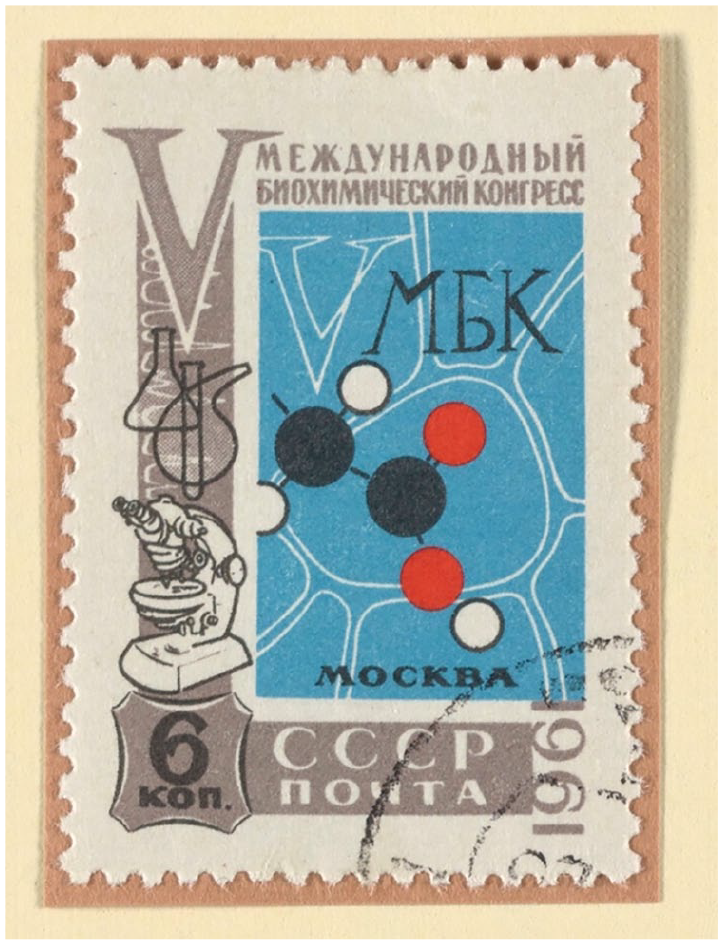
A Soviet Union postage stamp from 1961 commemorates the 5th International Biochemical Congress (Moscow) through depictions of chemical glassware, an electron microscope, a molecule, and a microscopic view of a cell. Courtesy of the Science History Institute (Soviet Union, 1961).
In other cases, key stamps convey even more clearly that chemistry—despite its invisibility—is related to lay people’s day-to-day lives. For example, a variety of stamps feature representations of nature such as the sun (United States 1977), production crops (Romina 1955; Suriname 1961), and medicinal plants (Bulgaria 1967; Macau 1958). These stamps showcase illustrations of nature scenes next to chemical structures and/or molecular formulas, thereby coupling something tangible from lay experience with the invisible chemical subjects of which they are made. For instance, a Cuban stamp from 1962 promoting “The World Against Malaria” campaign depicts an image of a cinchona tree next to the chemical structures for chloroquine and primaquine, which were—at the time—highly available antimalarial drugs (Cuba 1962). The drugs are referenced only via their chemical names and depictions of their chemical structures, which conveys—via the juxtaposition of plants and scientific nomenclature—that chemistry deals with the familiar but at a level that most people cannot fully perceive or interpret technically.
Chemistry’s invisibility in the context of being nonetheless related to lay experience is inscribed further via representations of chemistry as abstract, the second major theme within this category. Repeatedly, Einstein’s theory of relativity is referenced via the equation
How chemistry operates: The instrumental and daedal
Definitional messages about chemistry as imperceptible and abstract are coupled throughout the collection with messages delineating how chemistry operates. Out of the 430 stamps, 61 feature representations that appeal to what Condit (2010) titled relationality, in that they uphold chemical operation as, for one, a type of inter-activity facilitated by technical instruments and, for another, daedal (i.e. inventive and complex in design or function), in that its implementation requires a high degree of intricacy and skill. In terms of instrumentality, these representations link the functionality of chemistry to specific technologies designed to accommodate and compute chemicals and other scientific entities. Stand-alone illustrations of robust containers and other laboratory equipment such as test tubes, beakers, and flasks (i.e. retort, volumetric, Florence) not only center the relational nature of scientific activity but also demonstrate that very specific, special equipment suited to complex chemical needs is what makes chemical relationality possible. Such imagery also offers visual reminders of the danger in handling directly chemical matter.
For instance, a 1976 stamp from the United States depicts imagery of varied but very specific chemical glassware as a stand-in for scientific operations (United States 1976). An inaccurately proportioned Erlenmeyer flask with reddish liquid inside sits in front of a smaller, corked volumetric flask filled to the brim with blue fluid (see Figure 2). A stand with ring clamps holds two additional glass bottles with round stoppers and colorful liquids: one bottle with a bulbous bottom holds bright yellow liquid, while the final bottle, an unusual separatory funnel, contains a non-solid transitioning from the color orange to bright pink. Here, the unique glassware shows its stability by containing strong chemicals and enduring the force and heat of their reactions. It similarly communicates its utility for mixing, measuring, storing, and otherwise relating to dangerous materials needed for experimentation and the preparation of new solutions. The separatory funnel’s distinct layers expose the controlled, complex relational processes of chemistry, and the small inaccuracy in the Erlenmeyer flask reveals that this representation was not designed for the specific expectations of technical audiences.
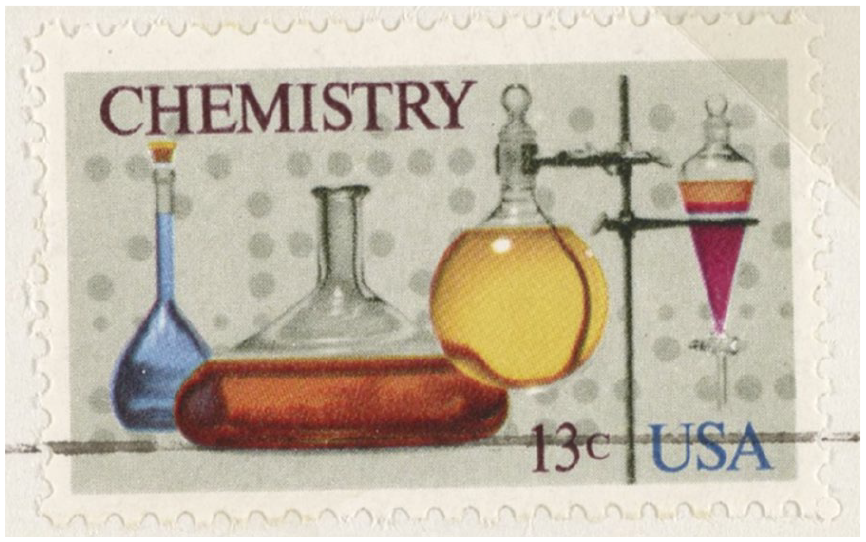
A US postage stamp from 1976 commemorates chemistry by depicting four different styles of chemical glassware filled with a variety of colorful fluids. Courtesy of the Science History Institute (Artmaster, 1976).
Similarly, a 1972 stamp from Mexico includes several small deviations related to equipment use that would not have passed muster among technical scientists of the time (e.g. an antique pulley working in concert with a narrowed, incongruous pipe). For its non-expert audiences, this stamp trades a degree of technical accuracy for an emphasis on the risky relationality of scientific operations, featuring, for instance, a retort flask filled with a substance that is lit from below with tentacle-like fire (Mexico 1972). The imagery of the wild flames, coupled with the novelty of this particular reaction vessel, conveys that it is only through precise instruments that chemistry operates without extraordinary harm. That the instruments are featured without scientists deploying them communicates that the instruments themselves are the relational glue holding chemical operations together. The specificity of instruments in this case and across many other stamps featuring everything from telescopes to hot plates, test tubes, weighing scales, and more imparts that chemical operations vary widely and that they therefore cannot be reduced to one easily ascertained mode of relational activity.
Indeed, chemical operations are upheld throughout the collection as not instrumental in a straightforward respect but in an elaborate, even artful, one. In this way, the stamps represent chemistry-in-action as daedal, endeavors that are “naturally entechnic (produced artistically),” skillfully wrought, and intricate in their manifestations (Ross, 2017: 162; emphasis in original). Images of microscopes featured on a number of stamps support a depiction of chemical operations as daedal. Beginning in the second half of the nineteenth century, the microscope became a widely recognizable symbol of technical science instrumentation, one that—despite its earlier reputation as a “plaything” for members of the upper classes—came to be understood as notoriously sensitive and difficult to manipulate without training (Wilson, 1988: 86). A 1935 stamp from Luxembourg illustrates this type of representation by featuring a nondescript scientist in a laboratory operating a microscope with many sophisticated, complex parts—the microscope is upheld as the mode through which science is done. Its many apparatuses signal the complexity of chemical operations and the high degree of knowledge and technical fluency necessary for its mastery (Luxembourg 1935). The microscope is a heuristic, here, for the assumed presence of something technically relevant that is only viewable through this elaborate machine (thereby linking to messages concerning what chemistry is). Based on portrayals like this one, the numerous gizmos and gadgets constituting the instruments represent machines such as the microscope as so particular that their successful operation can be understood as an act of virtuosity derived from not just a learned skillset but from a special capacity or inherent scientific ability (Bulgaria 1957; Germany 1934).
Messages concerning chemical operations as artistic are further communicated through portrayals of very particular places and structures as necessary conditions for the support of that artistry. A variety of venues are showcased ranging from architecturally elaborate structures such as atomic reactors and ionization indicators (e.g. China 1961; United States 1951) to more common—yet still specialized and expensive—sites such as cement factories and drilling derricks (e.g. Republic of Iraq 1974; United Arab Republic 1959). These diverse representations reveal that, just as a musician or painter requires very specific, tailored conditions to do their art well, so, too, do scientists to orchestrate the special processes and outcomes involved in chemical operations. Chemistry happens in these portrayals not as an impromptu undertaking but as a result of the careful, ongoing orchestration of infrastructure, instruments, sensitive raw materials, inherent capacities, and other specialized resources related to training and regulation.
Who does chemistry: The privileged and preternatural
Although some stamps in the collection represent chemistry as driven by disembodied artistry, made possible via technical instruments, there are also many stamps that represent chemical scientists themselves (n = 208/430) and provide a relatively consistent and clear picture of who, specifically, does chemistry. Of the 118 stamps that feature representations of descript scientists or those with potentially recognizable representations, the majority feature images of male-presenting, light-skinned individuals and at least 75 spotlight Nobel laureates, many of whom are labeled explicitly as such. In this way, they construct the faces of chemistry as—above all else—privileged (along the lines of race or ethnicity, sex or gender, and social class), as well as preternatural, or exceptional, in that they have been granted premier, international recognition for excellence in scientific endeavors and have proven themselves to have extraordinary cognitive capacities. Regarding privilege, a pattern emerges wherein the singular focus of a range of stamps are individual, white men, holding or otherwise linked to symbols that communicate their varied forms of social and cultural capital and their scientific achievement. These particular representations reflect Prelli’s (1997) assertion that scientists “can possess both ‘normal’ and ‘radical’ qualities” when presented to non-experts, since the need for evidentiary structures of scientific eminence (e.g. a discovery or invention) or their associated technologies are considered comparatively redundant attributes in this context (p. 98).
Stamps featuring famous scientists such as Isaac Newton, Alfred Nobel, and Louis Pasteur best demonstrate that the collection tends to uphold a quite particular classification of individual as representative of those who do chemistry. A stamp from the Republic of Dahomey (known today as the Republic of Benin), for example, does this by presenting an exacting portraiture of Pasteur overlaying a royal purple background riddled with various scientific glassware and tubing (Republic of Dahomey 1972). Pasteur’s stoic expression, coupled with his bearded features and extravagant attire, represents a culture of science and erudition that makes no allowance for differences wrought along the lines of race, sex, or class (see also, France 1923; France 1936). Stamps featuring Nobel similarly characterize chemists as light-skinned, male, and occupying high-status positions. A series of stamps from Grenada showcases Nobel’s profile via an elegant, marble statue beside the medals and institutes for research awarded in his name (Grenada 1978). Images like these illustrate “scientist” in ways that many would consider traditional and inherently exclusionary in that they illuminate those who are firmly and obviously situated within positions of social and cultural privilege.
In several notable cases, however, stamp designs in the collection do include caricatures and profiles of individuals who defy this basic rule. For instance, a US stamp from 1948 features Black American George Washington Carver, botanist and Director of Research at the Tuskegee Institute (United States 1948). Although Carver’s face is also featured on supplementary ephemera in the collection, he earns just one other stamp representation on a 1964 Ghanaian stamp wherein his engraved likeness borders a peanut plant and the UNESCO symbol, an arrangement that constitutes him more as a symbol of international, agricultural enterprise than as a scientist writ large (Ghana 1964). Additional stamps in the collection featuring Black, Indigenous, and people of color (BIPOC) also generally fall into the category of chemistry through the lens of agriculture, wherein few details illicit much scientific connection at all. For instance, a 1962 Seychelles stamp offers an illustration of a cinnamon plant overlaying partial imagery of a glass bottle filled with a dark liquid, in this way overlapping with depictions of how chemistry operates (Seychelles, 1962). The dark-skinned, shirtless worker in the backdrop carries a large container atop their head as they walk toward an industrial building fading into an illuminated portrait of Queen Elizabeth II, a depiction that positions racialized people first and foremost as background laborers rather than scientific actors. A set of 1960 Haitian stamps celebrating the “World Sugar Queen” similarly reinforce the association between Black individuals and rural labor by positioning Miss Haiti in front of sugarcane fields and other mainstays of Haiti’s economy (Republic of Haiti 1960). One notable exception to this mode of representation, wherein Black people are depicted for their roles in agricultural labor as opposed to their positions as scientists, is a stamp celebrating the 100th anniversary of Gambia High School in Banjul, Gambia. This stamp pairs a dark-skinned, young woman pipetting a liquid into a flask with a black-and-white portrait of a Black man in glasses (likely Gambian president Sir Dawda Kairaba Jawara), suggesting—perhaps—that Black, female students are the future of chemistry (Gambia 1975). In this case, but no others, those who may one day become scientists are exemplified as neither White nor male, nor even obviously economically advantaged and as overseen by those who are people of color as well.
In terms of sex or gender representations specifically, only two (white) women—Marie Curie and her daughter Irene Joliot-Curie—are featured on their own stamps across the collection. Both women have been broadly recognized as extraordinary deviations from the rule of male scientific achievement. For this reason, many have argued that their representations function as tokens—or anomalies—rather than as legitimate models concerning who can adopt the scientist’s role (Owens, 2011). The idea that Marie Curie exists as an anomalous, rather than as a representative, scientist is evident in a 1975 stamp published in the former British colony Saint Christopher-Nevis-Anguilla. This stamp commemorates Curie through a visual of the twice-over Nobel laureate looking closely at a small vial of radium (Saint Kitts and Nevis 1975). Light illuminates her face and upper body so that she seems to give off a divine glow that merges her gaze with the radiant chemicals under her analysis. In this depiction, Curie’s image is as singular in its scientific intent as it is ethereal. Not only has she accomplished extraordinary feats in chemistry, but she is one of the only included scientists to do so as a woman. In this respect, her preternatural status, especially in the context of her exceptional subject position, limits the stamp’s ability to uphold women as individuals who do chemistry more generally. Numerous stamps commemorating both Marie and her husband, Pierre Curie, as an incomparable scientific duo work in a similar fashion (Cuba 1938; Monaco 1938; Panama 1945).
Even in the many cases where the Nobel Prize winners highlighted are white men, the idea that they, too, are set apart—even from others like them demographically—is made apparent through appeals to their unusual characteristics. For instance, varied depictions of Einstein’s face across the collection are easily recognizable and clearly depict “scientist” as differentiated to the point of being preternatural. For instance, a 1979 stamp from Italy depicts Einstein’s head with his tousled hair on clear display, the wisps of whiteness accentuating an otherwise concentrated expression and mirroring the wild imaginings of his distinct genius (Italy 1979). Other stamps stress his preternatural status by associating him with his famed discoveries (Israel 1956), but it could be argued that the presence of Einstein’s remarkable hair alone offers a clear sign that those who do chemistry are not the kinds of everyday people that one might encounter on the street (see Figure 3). This peculiarity constructs scientists as not only award-winning and universally well-known, but also as functioning well beyond the abilities of those who gaze upon them.
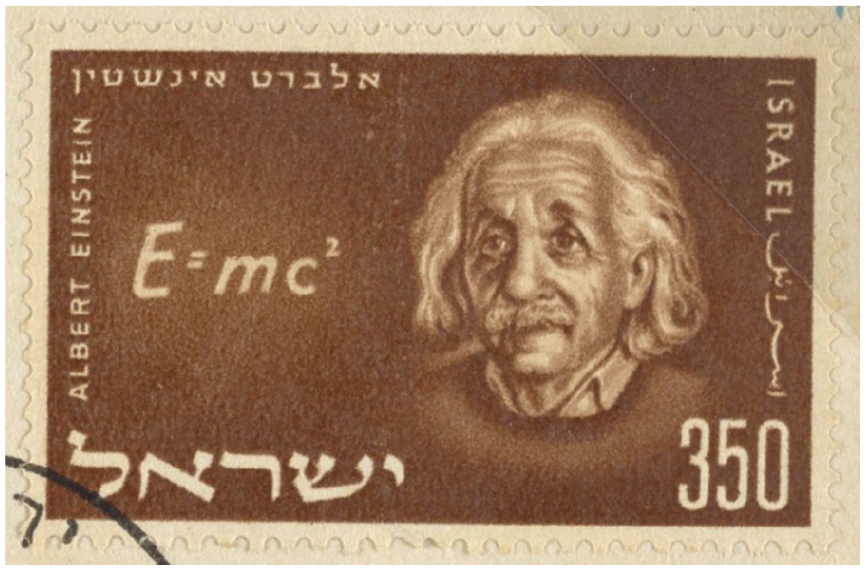
A 1956 Israeli postage stamp depicts Albert Einstein and his famous equation of mass–energy equivalence (
3. Discussion
Twentieth-century stamps’ depictions of chemistry offer visual clues about the means through which lay publics understood and communicated about science, especially in relationship to their own experiences and day-to-day lives. Our findings reveal that chemistry is definitionally upheld therein as invisible and abstract in nature; that chemical operations are constituted as instrumental and daedal; and that chemical scientists themselves are characterized as privileged and preternatural. Ultimately, we aim to employ these findings to consider the communicative tools (e.g. narratives, arguments, and appeals) they provided non-expert audiences as they developed vernacular science knowledge (Wagner, 2007). It is to this query that we now turn.
First, representations of what chemistry is on these twentieth-century stamps narrate the idea that, because chemistry is invisible to lay people and exists for them primarily at the level of abstraction, lay people exist separately from chemistry. A number of stamps seem to attempt to qualify this contention by highlighting chemical products as related to day-to-day life, as well as evidence of scientific concepts in the surrounding world. Yet, because these qualifications highlight either the results of scientific work already completed or omnipresent scientific concepts that are imperceptible to lay people without technical guidance (e.g. atoms, molecules, the transmission of light), the definition of chemistry itself is only ever communicated as out-of-reach from those who are not experts and technicians. Chemistry is conveyed as related to lay people’s experiences and even as worthy of their removed respect and awe, but the underlying argument that emerges is that chemistry, by definition, is not something for them to play a role in at the level of detail or process. In this respect, our findings correspond with that of scholars exploring twentieth-century, definitional representations of science in other, diverse media (e.g. Toumey, 1996), with the caveat that, in the representations at hand, qualifiers seemingly designed to highlight connections and familiarity between chemistry and non-experts may—in the context of overarching messages related to invisibility and abstraction—only solidify the argument that chemistry’s focus is and always will be blurry for those without technical training.
Second and in line with other scholarship in this area (e.g. Yardley, 2015), we found that representations of chemical operations across stamps are overwhelmingly depicted in terms of very particular and often unique instrumentation. Our analysis reveals that the specificity of the instruments featured functions to communicate that chemical operations are, first and foremost, relational in nature, and that the managing of relationships between and among mercurial materials, containers, human bodies, and the like is daedal. It requires something like an artistry that goes beyond mere technical understanding to encompass inherent virtuosity. This warrant—that the operations of chemistry are driven by complex, even inspired orchestration—further supports the contention that chemistry writ large, and chemical operations in particular, is separate from the vast majority of people. The narrative put forth in these cases is that lay attempts to consider or otherwise engage chemical operations will result in confusion at best and physical harm at worst.
Third, our findings about representations that uphold who does chemistry demonstrate that—much like other media from the twentieth century (Gigante, 2018)—stamps from this century portrayed the scientist almost always as an individual, white man, and as one who in this way and others is privileged, as well as preternatural in his recognitions, achievements, and abilities. Examples of BIPOC who might be understood to be in the position of scientist in these stamps could in almost all cases also be read as portrayed primarily for their involvement with agricultural labor, and images of individual (white) women as scientists were restricted almost entirely to the Curies, a mother and daughter who were upheld there and elsewhere as exceptions to the rule as opposed to role models for other women.
On the whole, then, non-experts are taught through these stamps that chemistry is something that they should respond to with veneration because its workings are extensively intricate and its practitioners are extraordinary. This narrative conveys that non-experts are hardly in positions to comprehend, connect with, or partake in chemistry’s happenings or even in the happenings of broader scientific culture, although they can appreciate its outcomes and products in their day-to-day lives. Indeed, the brand of vernacular science knowledge supported by this media is one that speaks about chemistry from a distance as mysterious and unknowable, and that venerates chemistry rather than interacts with it. In this way, it draws from a long tradition of characterizing scientists as saint-like in their devotion to a higher purpose (Bucchi, 2018). While there is research suggesting that respect for scientific culture among non-experts is a value that can support outreach (Kato-Nitta et al., 2018), this value in and of itself is not enough for—and may actually in some cases work against—the creation of societies imbued with genuine scientific curiosity and dedication.
This study is limited in that, although the collection of chemistry-oriented stamps is among the most comprehensive compilations available to date, it is not inclusive of all science-oriented stamps circulating within the twentieth century. To be sure, chemistry is a unique science with characteristics that may not in some cases be representative of other sciences. Chemistry’s distinct focus on color, for instance, or its employment of visible instruments that can be manipulated manually, are examples of content that may be more disciplinary than not. Moreover, a number of the included stamps are undated, particularly among the earliest ones, which limits the ability to contextualize their messages in time, though specific contextualization was not central to the study at hand, as we were looking for general communicative patterns across the century—and across countries—to garner widespread tools broadly available to non-experts for making sense of chemistry. Future research is needed to explore the specific patterns and representations emerging from distinct countries and locations, as well as those emerging during more particular time periods and even across other scientific disciplines. The Witco Stamp Collection includes more stamps from mid-century than from either the beginning or the end, and thus attempts to supplement the analysis at hand by analyzing more science-oriented stamps from the early and late 1900s are merited.
In looking to the future, scholars of science communication interested in supporting public science communication efforts would be wise to find ways to advocate for more inclusive and accessible representations, not only in newspapers, television shows, and on social media, but also in less explored but still relevant and widely circulated media such as stamps. Messages there and elsewhere that show, for instance, diverse peoples engaged in scientific processes, learning about science (as in the Ghanaian stamp from 1976 in the present analysis), and using scientific concepts to solve day-to-day problems would support alternative pedagogies of sight (Jack, 2009), while abstractions and depictions that set science and scientists apart as extraordinary and intricate will reiterate the patterns of exclusion and separation that have for so long been mainstays in scientific culture.
Footnotes
Funding
The authors disclosed receipt of the following financial support for the research, authorship, and/or publication of this article: This project was supported by a Library Travel Grant from the Donald F. and Mildred Topp Othmer Library of Chemical History from the Science History Institute, Philadelphia, PA, USA.
