







Abstract
Science fiction movies could play a pivotal role in making scientific discoveries available to the public. In this study, we explored the dialogue-based strategies these movies employ to appealingly communicate science. To investigate the discursive resources these movies use to represent science, we analyzed the content of 10 award-winning science fiction movies over the last decade (2010–2019). The findings demonstrated that although these movies deploy certain discursive features such as pseudoscientific hints, question markers, probability signals, statistical estimates, science boosters, paradox clues, comparison markers, exemplification, and figurative language that may influence audience thought patterns and a critical-reflective attitude toward science, they predominantly represent a partial distorted version of science characterized by inconsistency, inaccuracy, and skepticism. The study posits implications for science communicators to safeguard the legitimacy of science.
Keywords
1. Introduction
Science fiction movies act as a fertile platform for the representation of science. According to Kirby (2008: 41), science-cinema scholarship attempts to specify how science is represented in cinema. More specifically, “scholars have begun to recognize cinema’s role in the public communication of science and technology, and its importance in the public understanding of science.” The four perspectives of science-media relationship are defined in terms of production (How is scientific knowledge represented in cinema?), content analysis (How much and what kind of science is represented in movie?), cultural meaning (What is the cultural interpretation of science and technology in films?), and media effects (What is the effect of science fiction on science literacy and public attitudes toward science?). In this context, some scientists seek to evaluate or ensure the authenticity of scientific representation in films, and some filmmakers are committed to maintaining verisimilitude (Green, 2019).
Science fiction movies demonstrate the complexity involved in the process of producing and controlling scientific knowledge (Vidal, 2018). According to Kirby (2014), science fiction movies largely impact the public beliefs by representing opinions about science and shaping the perceptions of both scientists and the public. Science and technology in movies contribute to the public conception of and attitudes toward science. That is why films are conducive to making complicated science available and appealing to the public (Angelone, 2019). In this study, we attempted to investigate what discoursal strategies science fiction movies employ that might make science accessible to the public.
In this light, Varghese and Abraham (2004) postulated that “popular depictions of science are consciously adapted away from academic rhetorical conventions toward constructions that have mass appeal” (p. 203). They further listed three differentiating characteristics of popularization, namely authorship, readership, and disciplinary domain accompanied by deeper perspectives of discursive purpose, authorial stance, and generic convention. Popularized science goes through predictable rhetorical conversions (Walsh, 2015). The specific features of popularized science may include question, metaphor, marked lexis, humor, personalization, appeal to readers, and contingency (Giannoni, 2008). In this study, we focused on the representation of popularized science in the dialogue-based discourse of science fiction movies.
Science fiction movies could compellingly educate the public (Vidal, 2018) by communicating fresh findings, updating the audiences’ scientific background, and motivating them to reflect on the relevance of recent discoveries to their daily lives. However, science fiction movies may convey scientific insight by more than mere reliance on science-oriented outcomes. In this study, we aim to address what discursive dialogue-based strategies science fiction movies employ to communicate science.
2. Method
Corpus
In order to specify common popularizing discoursal features in science fiction movies, we selected the science fiction movies ranked as the most acclaimed by the Internet Movie Database (IMDB) from 2010 to 2019. According to IMDB website, this database relies on the registered users’ votes aggregated and reported as IMDB rating index. To further facilitate the viewers’ informed decisions about watching movies, IMDB applies user and professional critic reviews. To this end, 10 science fiction movies, namely “Inception” (2010), “Rise of the Planet of the Apes” (2011), “Prometheus” (2012), “Gravity” (2013), “Interstellar” (2014), “The Martian” (2015), “Arrival” (2016), “Blade Runner 2049” (2017), “Avengers: Infinity War” (2018), and “Alita: Battle Angel” (2019) were selected. The reasons behind this selection include recent release, award-winning status, and IMDB ranking. In “Inception,” a thief intrudes into the dreams of people and by using a dream-sharing technology steals their secrets from their subconscious, when the mind is in a delicate state. He later attempts to plant an idea in an influential person’s mind. In “Rise of the Planet of the Apes,” a scientist experiments by administering a drug to a chimpanzee in the hope that it may cure his father’s Alzheimer’s disease. The proposed drug ends up contributing to the unusual increase of intelligence in the chimpanzee. In “Prometheus,” while two young scientists decode the origin of humankind in a remote planet, they discover a threat that could lead to mankind’s extinction. In “Gravity,” a medical engineer and an experienced astronaut go on a space mission, where they are left stranded as the consequence of a shuttle crash. Short of air and fuel, the only means for their survival is to reach a different space station. In “Interstellar,” a brilliant NASA physicist plans to save humankind by transferring Earth’s population to a new home through a wormhole. Before putting the plan into practice, he sends a former NASA pilot and a research team through the wormhole to determine which of the planets across the galaxy could be the new home. In “The Martian,” the mission of a team of astronauts is aborted due to an unpredictable storm. Watney, left behind on Mars as he is presumed to be dead, has to use his ingenuity to survive. NASA cooperates with a team of international scientists and his own teammates to launch a risky mission to safely bring him home. In “Arrival,” a linguistics professor leading a team of investigators attempt to communicate with aliens appearing across the planet. In “Blade Runner 2049,” while seeking to take down the artificially intelligent human replicants, a “blade runner” agent attempts to find the secrets behind the disappearance of the former blade runner. In “Avengers: Infinity War,” an extraterrestrial warlord is looking for six infinity stones that give him the power to wipe out half of the population of the universe. A team of heroic combatants unite to counteract him. In “Alita: Battle Angel,” a cyber-surgeon revives a cyborg with human brain and artificial body. She has lost her memory and is in a quest to find her identity. In short, these movies are based on three scientific themes, that is, medical advances, space expeditions, and technological breakthroughs, each of which could be potentially intriguing for the public.
Procedure
We watched the 10 science fiction movies three times and concentrated on the scenes including dialogue referring to scientific phenomena. We conducted three phases of coding, namely initial coding, axial coding, and selective coding (Corbin and Strauss, 2008) to specify thematic units that reveal general patterns embedded in the dialogue. In initial coding, we attempted to label and sort out the broad thematic patterns. In axial coding, the codes were repeatedly compared to be integrated and reduced to manageable categories. Nine general categories were identified (see below). Finally, in selective coding, instances of the nine categories in the movie dialogues were identified independently by the two authors.
To ensure reliability of this final step, we asked an experienced third researcher to code the data besides the two authors. We had a briefing session with the additional coder to explain the aim of and procedure for analyzing the relevant movie dialogue. Jointly, we analyzed some randomly selected sample dialogues of the 10 movies to discuss the coding process. Subsequently, the third coder independently analyzed the relevant movie dialogue. After this independent coding, we had several sessions to discuss and examine the thematic units. The disagreements and coding inconsistencies were further discussed until full agreement was achieved.
3. Results and discussion
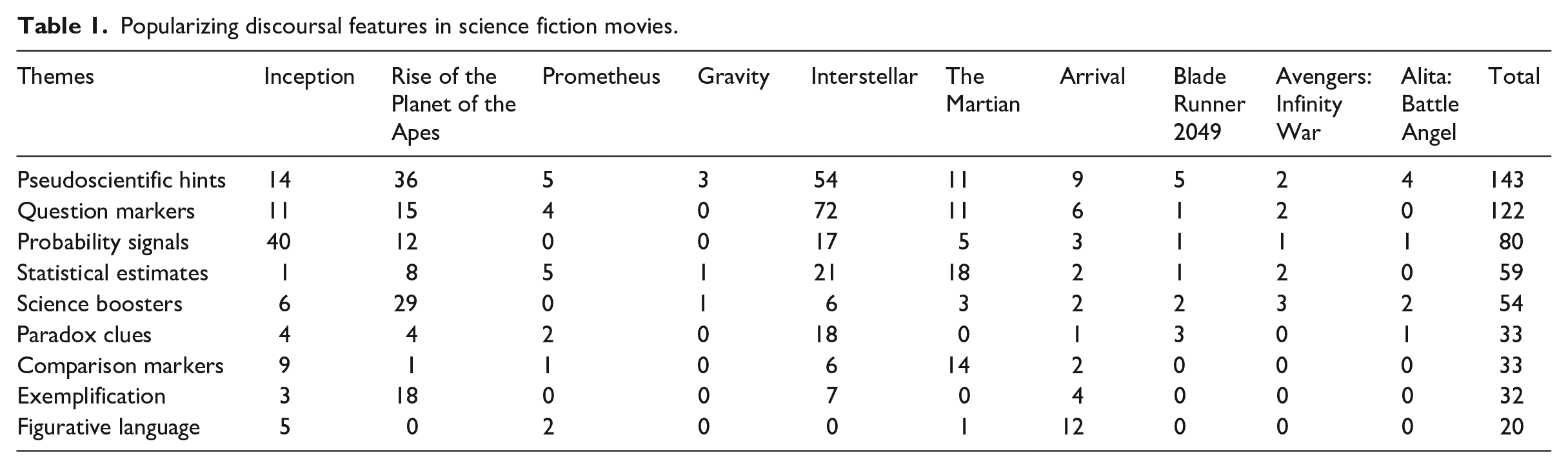
By analyzing the sample of science fiction movies, it was revealed that they employed nine popularizing features that include pseudoscientific hints, question markers, probability signals, statistical estimates, science boosters, paradox clues, comparison markers, exemplification, and figurative language (see Table 1).
Popularizing discoursal features in science fiction movies.
Pseudoscientific hints
To integrate highly sophisticated and remotely available lab-originated or space-based scientific findings into ordinary people’s lives and make technical terminologies comprehensible for the public, science fiction movies rely on familiar concepts, common words, and short sentences. However, the movies frequently miscommunicate scientific notions by highlighting pseudoscientific features and fact–fiction interplay. These may confuse audiences, creating a blurry image of science in their minds and obscuring boundaries between real and fictional science.
The movies in our corpus draw upon well-known existing or self-made scientific concepts to give science-dominant impression to their statements for the purpose of winning the trust of the audiences. At the same time, they find a rich context for embedding distorting concepts, referring to as yet impossible science, or magnifying narrow, simplistic views of science, incompatible with present scientific developments.
Cobb (dream extractor and architect) and Arthur (Cobb’s colleague) explicate the concept of “extraction” to Saito (a Japanese businessman aiming to recruit Cobb to incept his rival Fischer) in the following extract, embellishing the fiction by inducing a scientific impression:
Once an idea’s taken hold in the brain it’s almost impossible to eradicate. An idea that is fully formed, fully understood. That sticks right in there somewhere.
For someone like you to steal?
Yes. In the dream state, your conscious defenses are lowered and makes your thoughts vulnerable to theft. It’s called extraction. (Inception, 2010)
Likewise Will Rodman, a pharmaceutical chemist in Rise of the Planet of the Apes (2011), persuades investors to financially support the mass production of his proposed drug to treat Alzheimer’s, introducing a series of plausible sounding terms: ALZ-112, a gene therapy for creating and repairing cells, also called Neurogenesis.
Cooper (trained NASA pilot), Brand (chief scientist), and Romilly (a scientist) explore the possibilities of selecting one of the two lands (Dr Mann’s ice world or Dr Edmunds’ desert planet) that could be suitable for human landing:
Because of the black hole?
Murphy’s Law. Whatever can happen, will happen. Accidents are the first building block of evolution, but when you’re orbiting a black hole, not enough can happen, it sucks in asteroids, comets, other events which would otherwise reach you. (Interstellar, 2014)
Ian (a physicist) and Louise (a linguist) discuss how to decipher what the aliens are communicating by reliance on a linguistic theory:
If you immerse yourself into a foreign language, then you can actually rewire your brain.
The Sapir-Whorf hypothesis. The theory that, uh . . . It . . . it’s the theory that, uh,
the language you speak determines how you think and . . .
Yeah. It affects how you see everything. (Arrival, 2016)
By using scientific concepts, namely Sapir-Whorf hypothesis (immersing yourself into a foreign language to rewire your brain) and Murphy’s Law (whatever can happen will happen), the last two excerpts present a simplistic public view of science. To transform technical knowledge into easily comprehensible words (Molek-Kozakowska, 2017), science fiction movies use simple lexicogrammatical features and short simple-structured sentences such as the above: “language [. . .] affects how you see everything.” These extracts combine real but simplified, and plausible but invented scientific concepts to give a convincingly scientific impression to the viewers. Although there is a call for science fiction movies to accentuate the relevance of research-based outcomes and address scientist-public interactions (Luzon, 2013) in a compelling manner, these movies do not purely communicate scientific concepts deeply seated in research findings. Instead, these pieces of dialogue make use of scientific concepts and language, and contain similar sounding semi-scientific concepts and terms themselves. Yet these are often jargon filled, overblown in their optimism, and misrepresent science practice (Zaboski and Therriault, 2020).
Question markers
Science is replete with doubts, complexities, and dark corners, and raising questions is one of the popularization features (Giannoni, 2008) that attempts to interactively transmit scientific findings and spark the audiences’ reflection on how to answer the questions. Questioning is also a dimension of science fiction movies that motivates audiences to seek alternative solutions and reflect on plausible responses to current challenges. In the movies we analyzed, there are two kinds of questions: questions about (fictional) science asked for further explanation or elaboration of a concept or idea, and non-scientific questions aiming to stimulate semi-scientific speculation of the audience. Illustrating questions inviting speculation; while training a student in dream architecture, Inception’s Cobb asks rhetorically “You never really remember the beginning of a dream, do you? You always wind up right in the middle of what’s going on” and “How did we end up here?”; similarly, Prometheus’ Peter Wayland, funder of a scientific expedition aiming to empower human race, offers existential questions: I have spent my entire lifetime contemplating these questions. Where do we come from? What is our purpose? What happens when you die? And I have finally found two people who have convinced me they are on the verge of answering them. (Prometheus, 2012)
In the following excerpt, Steven’s question enables Will Rodman to elaborate on his drug:
The applications go beyond the disease. There are indications that show the therapy can improve cognitive functioning, memory quality . . .
What, what are you saying?
My father didn’t just recover. He improved.
You mean, increased intelligence?
It’s not conclusive, but yes. (Rise of the Planet of the Apes, 2011)
Such questions empower the audiences to explore different alternatives to big questions. However, the answers provided to such questions—dreams could be intruded by external forces, trial drugs promote cognitive functioning and human intelligence, or humans were seeded by aliens—represent science in an unrealistic way.
Probability signals
The discourse of science is a hedged discourse. Science fiction movies set in the future rely on both estimated possibilities and imaginary resources to depict potential advances in space missions, medicine, and technology. They also permit the audiences to seek alternative solutions to the current challenges by addressing a single problem from different angles. In the following excerpts, the conditional sentences address the probability of the incidents to highlight the potential cause–effect relationship between them.
In a video journal, The Martian’s Mark explores survival possibilities: I have doubled my battery life by scavenging Rover 1. But if I use the heater . . . I will burn through half my battery every day. If I do not use my heater, I will be . . . slowly killed by the laws of thermodynamics. (The Martian, 2015)
Ian uses conditional propositions in considering the difficulties of communicating with extraterrestrial species to inquire about their purposes:
The shell emits no waste, no gas, no radiation. Assuming that the shells communicate with each other, they do so without detection. The air between the shells is untroubled by Sonic emission or light wave. (Arrival, 2016)
Likewise, Vision and the teammates tentatively explore the possibility of overpowering their opponent:
I think if it were exposed to a sufficiently powerful energy source . . . something very similar to its own signature, perhaps . . .its molecular integrity could fail. (Avengers, 2018)
As the examples of Mark exploring survival possibilities, Ian investigating inter-shell communication possibilities, and Vision looking for rivals’ weaknesses illustrate, by following if-then principles, these movies predict the future and show how potential technological advances may transform lives, combining current science with imagined possibilities. Science fiction movies involve the audiences in thinking about different alternatives because “not only should science communication reach its audience, be understood, assess science critically, provide knowledge, and inspire trust in order to contribute to knowledge society-it also has to address different groups of citizens differently” (Koch et al., 2020: 15). Furthermore, the discourse of probability indicates that science is not always predictable and the implementation of research findings may not lead to definite outcomes. In other words, moving from scientific theories to real-life practices is non-linear and multidimensional. Therefore, these science fiction movies represent an alternative world and imaginatively link the present to future, projecting what is currently impossible.
Statistical estimates
Science fiction movies highlight the prominence of scientific findings by employing statistical estimates and mathematical calculations. Although using numbers draws audiences’ attention to the authenticity of science and accelerates their comprehension, overabundant use of numbers may instigate a narrow view of science as a merely quantitatively oriented phenomenon. The following excerpts focus on mission parameters: time, distance, rations, and breathable air.
Yusuf (a chemist), and Eames (Cobb’s colleague) define the parameters of inception:
Brain function in the dream will be about twenty times normal. When you enter a dream within that dream the effect is compounded. It’s three dreams, that’s 10 hours, that’s twenty . . .
I’m sorry, math is never my strong subject. (Inception, 2010)
Kowalski, veteran astronaut and space mission commander, informs Dr Stone, on her first NASA space exploration, how to get rescued from the rapidly expanding debris strike:
Set your watch for 90 minutes.
Why 90?
Kowalski: Houston clocked that debris at 50000 miles an hour. If you factor in our current orbit, then I figure we got about 90 minutes. (Gravity, 2013)
Mark Watney, stranded astronaut-botanist on Mars, plots survival:
Right! Let’s do the math! Our surface mission here was supposed to last 31 sols. For redundancy, they sent 68 sols worth of food. That’s for 6 people. So for just me, that’s gonna last 300 sols . . . which I figure I can stretch to 400 if I ration. So I got to figure out a way to grow three years’ worth of food here. On a planet where nothing grows. Luckily, I am a botanist. (The Martian, 2015)
Experts consider the conditions conducive to communicating with extraterrestrial species:
Air doesn’t seem to circulate inside the chamber, so after about two hours, we run out of oxygen. It doesn’t take 18 hours to pump fresh air into a room.
Atmosphere . . .
Agent Halpern: Excuse me?
If their atmosphere is different from earth, it would certainly take hours to rebalance their O2 content and pressure for us every time they open their door. (Arrival, 2016)
Science fiction movies use statistics to simplify research intricacies for the public. As Varghese and Abraham (2004) postulated, the popular version of science should be appealing to the public and using statistics is one way. Numbers provide a short cut to indicate science instead of presenting the complexity of science practice. Statistics may also give a science-oriented prestige to the movie. These excerpts’ inclusion of statistics and numbers are a way to sound believable and persuasive (Tal and Wansink, 2016). However, science fiction movies may use statistics (for making predictions, for stating probability, for making calculations) to simplify scientific concepts and reflect science as quantitatively oriented.
Science boosters
Science boosters are the discursive tools used to promote scientific findings for the audiences by grand claims, boosting audiences’ strong confidence in the scale, significance, or benefits of scientific findings. For example, Inception’s Cobb tells Ariadne “They say we only use a fraction of our brain’s true potential. Now, that’s when we’re awake. When we’re asleep, our mind can do almost anything.” And ROTPOTA’s Will states, “In theory, this therapy can be used to treat a wide range of brain disorders. It’s virtually limitless,” while his funder Steven sees limitless “potential profits,” and Interstellar’s Cooper defends the benefits of magnetic resonance imaging (MRI) in medicine: One of those useless machines they used to make was called an MRI. If we had any of those left, the doctors would’ve been able to find . . . the cyst in my wife’s brain before she died instead of afterwards.
Science boosters demonstrate how the infinite nature of science opens the gate to more scientific discoveries and empowers humans to change the world for the better. However, audiences might leave these films unable to distinguish science from fiction. In addition, the movies we analyzed left out the backstage of gradual scientific breakthroughs though science rests on intricate cycles of challenges and obstacles. As the examples demonstrate, our corpus of movies boost science by exaggerating its potentials (e.g. the infinite power of unconscious minds, the limitless possibilities of an emerging therapy for treating neurological disorders, and the multidimensional features of man-made machines). These are examples of science fiction depicting breakthroughs as dramatic and spontaneous, which could be seen as similar to “hype” in that it overstates the pace and benefit of scientific discovery (Roberson, 2020).
Paradox clues
In science fiction movies, paradox is sometimes used to baffle viewers. In the following examples, it is shown how paradoxical cues in science fiction movies may set the context for testing scientific concepts or disrupting the audiences’ previous scientific knowledge.
As Ariadne is astonished to find herself and Arthur in the same spot they were a few seconds ago, Arthur starts to clarify:
Paradox! So a closed loop like that will help you disguise the boundaries of the dream you create.
How big do these levels have to be?
It could be anything from the floor of a building to an entire city. But they have to be complicated enough . . . that we can hide from the projection. (Inception, 2010)
Cooper tries to convince Murph to think scientifically though she believes that the transparent and opaque sides of science may converge:
No such thing as ghosts.
I looked it up, it’s called a poltergeist.
Dad, tell her.
Well, that’s not very scientific Murph.
You said that science was about admitting what we don’t know. (Interstellar, 2014)
Science popularization reformulates and recontextualizes scientific discourse (Calsamiglia and Van Dijk, 2004). The paradoxical dialogues trigger contradictions that invite the audiences to take a side. On the positive side, paradox cues signal the need for hypothesis testing as a scientific approach. Yet contradictions such as those which present as viable incidents, for example, time travel and dream intrusion, may mystify viewers and destabilize their prior knowledge. If the audience were to believe these pieces of dialogue, a closed loop which creates an unpredictable environment (contradictory critique) could facilitate forming different dream levels (supporting the fiction) or the non-existence of ghosts (contradictory critique) may be linked to admitting what science is, that is, what we do not know (supporting the fiction). Critique and conciliation of propositions such as time travel and dream manipulation are synthesized, and these paradoxes challenge the audience.
Comparison markers
The comparison marker is one of the strategies for bridging the gap between scientific theories and real-world incidents, where complicated theories are made accessible to the public by comparative descriptions. Although the imaginative power of fiction simplifies scientific complexities, comparison of this kind may mislead audiences. Comparing real-world examples may simplify complicated scientific concepts. In Inception time passes in a dream slower than in waking life, in Interstellar time passes faster on a visited planet than on Earth, and in Arrival, the alien “. . . writing is semasiographic. It conveys meaning. It doesn’t represent sound,” “unlike all written human languages.”
The movies use comparison-contrast as a helpful strategy for visualizing scientific concepts and linking them to the everyday, by borrowing the shared properties of familiar concepts. However, using comparison markers to simplify scientific facts could cloud meaning instead of enhancing it. In these excerpts, by comparing how time passes as we know it and in the dream world of Inception, the difference between how time passes on Earth and on one of Interstellar’s alien planets, as well as human and alien language of Arrival, the movies attempt to help the audiences more efficiently grasp the scientific notions. Analogy depicts a simple representation of science, the side effect of which may lead the audiences to overlook their reliance on expert perspectives for assessing the credibility of scientific claims (Scharrer et al., 2017).
Exemplification
The corpus of movies use tangible examples to signify the relevance of scientific findings to our daily lives by going beyond science labs to real-world contexts. Using daily life examples could further clarify different dimensions of science even while merging real-life incidents with semi-scientific concepts. In Interstellar Cooper tries to explicate the relativity of time to his daughter using two watches:
When I’m up there in hypersleep, or . . . traveling near the speed of light, or . . . near a black hole . . . time’s gonna change for me. It’s gonna run more slowly. When we get back . . . we’re gonna compare.
Time will run differently for us?
Yeah. By the time I get back, we might even be the same age, you and me. “What?” Imagine that! (Interstellar, 2014)
Ian translates the distinctive nature of the species’ language through the human experience of writing: Imagine you wanted to write a sentence using two hands, starting from either side. You would have to know each word you wanted to use, as well as how much space they would occupy. A heptapod can write a complex sentence in two seconds, effortlessly. It’s taken us a month to make the simplest reply. (Arrival, 2016)
By relying on real-world objects and experiences as examples, such as two watches to compare differences in the passage of time, or the effort of two-handed writing to convey the difficulty of cross-species communication, the movies support the audiences to more properly understand the scientific contents. According to Hong (2015), exemplification helps the audience to better understand complicated scientific ideas, mediate their relationship with the scientific community, and engage emotionally with scientific advances. However, the examples can only convey a partial picture of science to the audience.
Figurative language
By using literary tools such as figurative language, science fiction movies arouse the audiences’ emotions. The following excerpts are examples of imagery that evokes emotion to aid understanding. In Gravity Houston’s warning evokes urgency and threat: “Debris from the missile strike has caused a chain reaction, hitting other satellites and creating new debris. Travelling faster than a high-speed bullet up towards your altitude”; the preciousness of their lifesaving mission and rarity of a singularity is conveyed by Romilly in Interstellar: “If a black hole is an oyster, then the singularity is the pearl inside.”
The danger and precision of Mark’s rescue is conveyed through analogy in the Martian:
How fast a relative velocity can you handle?
I can grab the MAV at 5 meters per second. 10 is like jumping onto a moving train. So any more than that, I might miss. (The Martian, 2015)
While in Arrival Louise rolls her eyes at her science communication efforts:
“Language is the foundation of civilization. It is the glue that holds a people together. It is the first weapon drawn in a conflict . . .” Yeah, well, you wrote it.
It’s the kind of thing you write as a preface. (Arrival, 2016)
The popularization of science leads to the dominance of predictable rhetorical properties (Walsh, 2015), where the use of literary devices arouses the audiences’ emotion. Metaphor is one of these popularization features (Giannoni, 2008) frequently found in popularized discourse. Using literary devices, science fiction movies visualize science. As the excerpts represent, by using figurative language (the debris movement as faster than bullet movement, the black hole as an oyster, velocity management process as jumping onto a moving train, and language as glue holding people together), the movies we analyzed attempt to emotionally engage audiences while facilitating their understanding of the scientific notions. By viewing science from figurative perspectives, audiences’ affective orientations are activated, which elicits sympathy for the characters and also a potential emotional connection to the science represented.
4. Conclusion
In this study, we analyzed the dialogue of 10 science fiction movies to explore how they discursively communicate science to the public. The findings demonstrated that these movies cultivate scientific ways of thinking in audiences, encourage a critical attitude toward daily incidents, and offer reflection on multiple alternatives to a single problem by using questioning, probability signals, and paradox strategies. Furthermore, science boosters and exemplification relate science to everyday life and science is represented metonymically by statistical estimates. The discourse of movie dialogues relies on analogy and figurative language to engage audience attention through emotion. However, the predominant discourse markers in our corpus are those of pseudoscientific hints, which provide an incomplete, distorted version of science characterized by inconsistency, inaccuracy, and skepticism. These movies merge scientific facts and intuitive stories in a non-hierarchical manner which could be counterproductive to science communication as audiences might be unable to distinguish science from non-science. The science fiction movies we analyzed include real science but shift focus away from this into thriller narratives. This indicates that such movies may persuasively entertain the public, but while doing so could miscommunicate science, as the blockbuster movie makers have motivations beyond mediating between scientists and the public. Instead, they have different incentives, the most significant of which is satisfying the audiences’ interests and emotions. If science fiction movies represent fictional science too persuasively, audiences might conflate the real and the fantastical. Movie makers distort real science, and risk audience conflation of fact and fiction. Accordingly, science fiction movies may exaggeratedly represent pseudoscience as a panacea capable of resolving any problem. To address this alarming concern, there is a call to either involve scientists in science fiction movie-making practice or train the future generation of scientists as filmmakers (Angelone, 2019). By the same token, “due to the prevalence of pseudoscience, scientific illiteracy, and fake news, scientists are increasingly concerned about pseudoscientific beliefs among individuals without advanced scientific training” (Zaboski and Therriault, 2020: 820). Thus, we need to raise audiences’ awareness and enable them to distinguish fact from fiction when it comes to science in cinema. This study could assist discourse analysts and science popularization stakeholders to consider how science is represented in fiction and explore alternatives for effectively communicating science, making it comprehensible and engaging for the public. Science communicators need to raise the public awareness of the blurred boundaries between science and non-science. Moreover, science educators could underline the scientific highlights for the public and discourage them from unquestionably accepting all that is presented as “science.”
Future studies may compare audience responses to popularization in science fiction series, for example, based on age or gender. Researchers could also address how emerging science popularization trends in virtual spaces, science podcast series, and digital science stories may transform the digital natives’ public understanding of science. Furthermore, researchers could investigate scientific knowledge construction and popularization by means of exploring micro-content and micro-media embedded in video games. Future research could scrutinize the strategies science popularization apps employ to facilitate science communication. In addition, researchers may compare how technology and medicine are represented in science fiction movies.
Footnotes
Funding
The author(s) received no financial support for the research, authorship, and/or publication of this article.
