







Abstract
Science education inclusive of learners’ cultures requires understanding how students position scientific knowledge with regard to identity-laden beliefs, such as religions. To address this need, we developed a research tool administered across linguistic and societal contexts. In this article, we present the conceptual frameworks the instrument articulates and draws upon. We then test the construct validity and internal consistency of its dimensions based on data collected from a main sample of 238 English-speaking American, Dutch and Norwegian students, all in their final year of compulsory school education, as well as from a secondary sample of 372 French-speaking Belgian students that we use to further discuss the results from the main sample. The results obtained through exploratory and confirmatory factor analyses and by Cronbach’s alpha analysis are consistent with our theoretical model. We discuss implications for the use of this instrument by researchers, as well as formal or informal science educators.
Keywords
In this article, we approach scientific literacy as a process that involves scientific enculturation. From such a perspective, science can be understood as a culture with specific styles of reasoning that vary across disciplines and that science teaching initiates to (Kind and Osborne, 2017). In a theoretical paper about sociocultural perspectives on science education, Lemke (2001: 312) concludes that when we invite students to learn and change their minds by joining scientific sub-cultures, ‘We must also stop and consider whether we are, perhaps unnecessarily, making the price of admission to science the rejection of other essential components of students’ identities and values, the bonds that link them to other communities and cultures’. We add to these cautionary words that perceiving science as disruptive of bonds that link students to other cultures may also result in the rejection of science. For example, many studies have shown a total or partial rejection of the theory of evolution by learners in different countries in reason of how they relate them to their beliefs (e.g. Hokayem and Boujaoude, 2008; Hrairi and Coquidé, 2002). Science education that is inclusive of students’ identity needs to allow cultural border crossing between scientific sub-cultures and those of their everyday life (Aikenhead and Jegede, 1999), such as religious beliefs. Such border crossing requires that learners are able to identify borders of different sub-cultures and acknowledge the incommensurability of their epistemic foundations. This is an important component of both formal and informal science education that allows for learners of all ages to reflect on the practices, concepts and ideas that are part of the scientific culture. More broadly, beliefs about science is an essential component to the informed understanding and actions of the general public, which needs to interpret the world through scientific worldviews to adopt informed positions and make decisions while navigating life’s everyday challenges.
Evaluating representations of science and religious beliefs allows researchers to understand why, as well as to anticipate how, people engage with ideas that may be perceived as being in competition with their beliefs. Specifically, to understand whether they distinguish the scientific domain from religious beliefs and therefore have a secularized perception of science. Drawing upon a sociological perspective, we consider secularization as characterized by a functional differentiation of institutions and activities, rather than the preeminence of secular ones. This implies that religion develops in its own field and does not have a position of control over all the institutions and activities of society (Beckfort, 2003; Wallis and Bruce, 1992; Weber, 1919), including science. We approach the specificities of scientific domains from an epistemological rather than axiological perspective.
Our aim is to construct, test and validate an instrument conceived to explore students’ positions between science and religious belief, then to determine their perceptions of secularization or non-secularization of science. When developing the scale, we primarily had the use of the instrument for the analysis of high school students’ beliefs in mind. However, the instrument and the reasoning behind its construction are also adapted for the analysis of beliefs among broader groups of adults. For example, surveys that make use of our instrument can inform the design of science communication to a given audience (e.g. museum activities participants), to identify existing conceptions in programmes aiming to promote public awareness of science, or to evaluate how to support people who struggle with articulating their identity-laden beliefs with sciences.
Previous research findings (Wolfs et al., 2014) demonstrated the psychometric quality of the original French-language version of the instrument. In this article, we examine a second variant of the instrument and we primarily focus on the quality of the English version, although we also administered a French one that we will also briefly mention as we present the results obtained from our primary English-speaking sample. To achieve that, we draw from data collected as part of an ongoing larger international study of high school students’ perceptions about secularization or non-secularization of science (Wolfs, 2013, 2018), to determine the factors – societal, personal, related to education – that influence them.
The first part of this article provides a review of literature on several existing typologies and research tools. The second part discusses the aims of the methodology of constructing the instrument and testing the validity of its results. The third part submits the results of both exploratory and confirmatory factor analyses. The article ends with a discussion on the appropriateness and the limits of the instrument, followed by suggestion regarding its potential applications for science educators or communicators, as well as for any professional supporting processes of cultural border crossing between scientific sub-cultures and those of everyday life.
1. Conceptual framework
In the field of education, an analysis of recent literature highlighted at least a dozen existing typologies aimed at listing the different positions possible between science and religious beliefs. Such typologies (Alexander, 2007; Barbour, 1965; Billingsley et al., 2012; Hanley et al., 2014; Haught, 1995; Lambert, 1999; O’Brien and Noy, 2015; Rasi, 2003; Stenmark, 2004; Yasri et al., 2013; Yasri and Mancy, 2014) are similar in some cases and different in others, as we will explain in the following paragraphs.
Generally speaking, four major types of positions stand out. The first, evoked by all the authors, except Lambert (1999), although in different terms, is about a possibly conflictual dimension between science and religious beliefs: ‘conflict’ for Barbour (1965), Haught (1995) and Alexander (2007) and ‘contradictory’ for Billingsley et al. (2012). In that case, a form of reasoning can be considered superior to the other. Some typologies have different names for perceptions which prefer scientific reasoning and excludes the religious – ‘rationalism’ for Rasi (2003), ‘science trumps religion’ for Yasri and Mancy (2014), and ‘modern’ for O’Brien and Noy (2015). For those perceptions which privilege religious reasoning and reject the scientific debate, the term ‘fideist’ is used by Rasi (2003), ‘religion trumps science’ by Yasri and Mancy (2014), and ‘traditional’ by O’Brien and Noy (2015).
A second position of independence between science and religious beliefs can be found among nearly all the previous authors and constitutes an alternative position to the position of conflict. In this case, science and religion are considered as fundamentally different fields (given the subjects discussed, the questions asked, the methods chosen, etc.) that there is no reason to oppose one to the other. Terms used in this case are ‘Independence’ for Barbour (1965) and Stenmark (2004), ‘discordism’ for Lambert (1999), ‘dualism’ for Rasi, ‘contrast’ for Haught (1995) and Yasri and Mancy (2014), and ‘Non overlapping magisteria’ (NOMA) for Alexander (2007), who took this expression from Gould (2000).
A third position expresses the idea of a possible if not desirable complementarity between science and religious belief, with terms like: ‘complementarity’ for Yasri and Mancy (2014) and Alexander (2007), ‘dialogue’ for Barbour (1965), ‘articulation’ for Lambert (1999), and ‘post-secular conceptions’ for O’Brien and Noy (2015).
A fourth position, which is sometimes difficult to differentiate from the third one, is that of parallels leading to confusion between science and religious beliefs, with terms like ‘integration’ (Barbour, 1965), ‘contact’ (Haugth, 1995, and Stenmark, 2004), ‘concordism’ (Lambert, 1999), ‘fusion’ (Alexander, 2007) and ‘coalescence’ (Yasri and Mancy, 2014). It should be noted that third and fourth positions are those showing the most important conceptual difficulties, with delimitations far from being clear.
Finally, some authors mention positions such as ‘unexplored’, ‘unknowable’ (Billingsley et al., 2012) or ‘confused’ (Hanley et al., 2014). These positions refer to people who do not have a clear opinion on the issue because they have never explored it or cannot decide on the matter. Hanley et al. (2014) also refer to the position of ‘explorers’ corresponding to the ‘post-modern’ of O’Brien and Noy (2015). Such people do not have a definitive opinion on the relationships between science and religion and constantly re-assess the contribution of both on their understanding of the world.
To sum up, four or five positions are proposed by the authors, positions 3 and 4 being the most difficult to differentiate and operationalize.
Based on different typologies, some researchers created research tools and studied issues related to the relationship between science and religion (Billingsley et al., 2012, 2013; Francis et al., 2018; Francis and Greer, 2001; Hokayem and Boujaoude, 2008; Yasri et al., 2013). Each study considered different aspects of this issue (Table 1).
Issues and research questionnaires related to the relation between science and religion in the field of education.
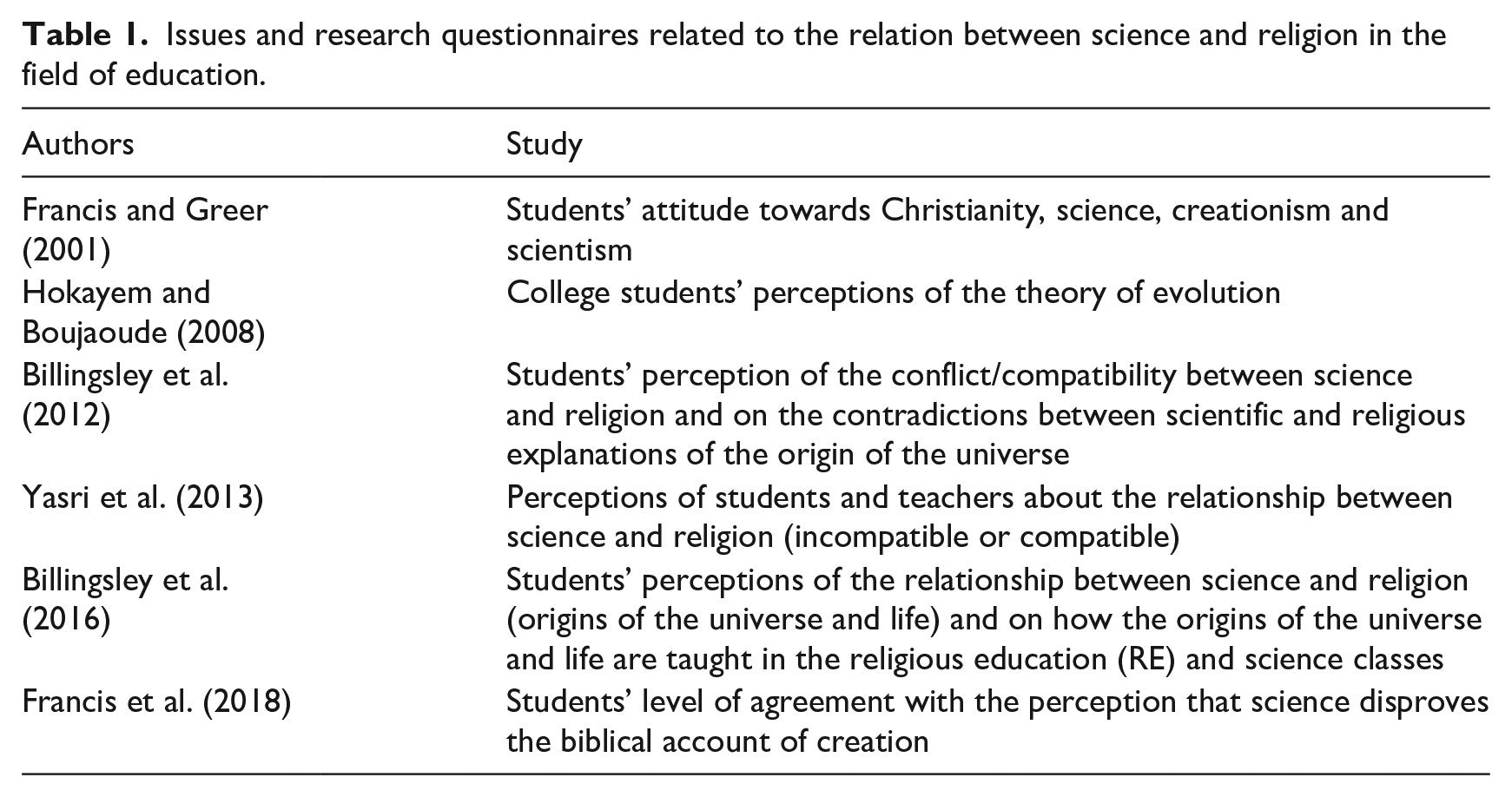
Francis and Greer (2001) studied students’ attitude towards Christianity, science, creationism and scientism and their relationships. Their research tool is a questionnaire bearing on those attitudes. Also, Hokayem and Boujaoude (2008) developed two research tools (questionnaire and interview) to study the relationship between science and religion and particularly college students’ perceptions of the theory of evolution. Similarly, Yasri et al. (2013) developed a seven-positions model as well as a questionnaire to determine the perceptions of students and teachers about the compatibility/incompatibility between science and religion.
Billingsley and collaborators conducted several studies on the relationship between science and religion. They developed different research tools like questionnaire and interview. Billingsley et al. (2012) studied the positions of young people about the conflict or the compatibility between science and religion. Also, they aimed to discover students’ thinking about contradictions between scientific and religious explanations of the origin of the universe. Similarly, Billingsley et al. (2016) studied students’ perceptions about science and religion and about the relationship between science and religion (origins of the universe and life), as well as students’ perceptions of how the origins of the universe and life are taught in religious education (RE) and science classes.
Francis and Greer (2001) and Francis et al. (2018) developed a questionnaire to study adolescents’ perceptions of the relationship between science and religion. The purpose of this empirical inquiry is to discover the level of agreement with the perception that science disproves the biblical account of creation, and to explore several variables to predict individual differences in responses to that opinion.
To summarize, there are several studies about the relationship between science and religion in the literature. These studies proposed typologies and research tools. However, these do not specifically consider the question of secularization of science. Thus, we developed a new research tool, based on a new model, defining indicators related to secularization or non-secularization of science.
On the basis of the reading grids and also more broadly surveys of an historical and sociological nature (e.g. Minois, 1990, 1991, 1998; Popper, 1991; Urvoy, 2006; Le Ru, 2010), a new model has been developed (Wolfs, 2013, 2018). It consists of seven contrasted positions, defined in the form of typical ideals:
Total or partial rejection of scientific content in the name of ‘fideist’ perceptions (the primacy of faith over reason), based, for instance, on a literal interpretation of the Holy Scriptures.
‘Classic concordism’ consisting of the desire to read the ‘Book of Nature’ depending on the conceptual categories of the ‘Book of the Word’ (the Bible or the Koran), with the specific aim of confirming through science the revelations of the Holy Scriptures or, more broadly, establishing a form of alliance between science and the Holy Scriptures (or theology) under the authority of the latter.
‘Reversed concordism’ aims at establishing concordances between science and religious beliefs (or more broadly metaphysical), not on the basis of the Scriptures or a revealed tradition, as is the case with conventional concordism, but rather on a ‘scientific’ approach (e.g. intelligent design).
The search for complementarity between science and religion, in a different form than concordism (classical or reversed) based on the acknowledgement of the difference of the fundamental nature between these two domains and a net respect for the autonomy of science. The latter has already been expressed by Galileo – ‘The intention of the Holy Spirit is to teach us how to go to heaven and not how heaven was’ – and quoted notably by S. Gould (2000) under the acronym ‘Noma’ (Non overlapping magisteria).
The principle of the autonomy of a scientific approach towards religious beliefs, without research for complementarity between science and religion. Positions 4 and 5 are based on a common principle which is that of the autonomy of science with regard for religious beliefs. It is based on the following methodological rule: in the scientific approach, nature is explained by nature (and not by the Book of the Word). This is a departure from science once supernatural factors are involved (revelation, miracles, etc.). Science tends to construct representations of the world, ensuring the respect of certain specific methodological rules which are stipulated or reformulated over time: the ‘parsimony principle’ in the explanatory approach (expressed by Occam in the fourteenth century); the limit of scientific ambitions in the search for ‘efficient causes’ and not that of ‘ultimate causes’ put forward by Descartes in the seventeenth century; the distinction between ‘knowledge’, ‘belief’ and ‘opinion’ put forward by Kant in the 18th century or again the ‘refutability’ principle of Popper in the twentieth century, despite the difficulties of interpretation. Such features make it possible to mark out more precisely the questions which do or do not reveal science. If such criteria are accepted, the questions which relate to the existence or non-existence of God do not come under the scope of science, given the methodological choice and not conviction.
‘Non-scientist rationalist critiques of religious beliefs’: certain specific religious beliefs or forms of intolerance towards religious authorities can be perceived as hindrances or obstacles to the development of science, or even the emancipation of humanity and denounced on that account. This perception must be clearly distinguished from the following.
‘Scientist rationalist critiques of religious beliefs’ where science is perceived as a thought domain totaling and excluding others, in particular religious ones.
This model has the advantage of taking into account the four main categories which result from the models discussed above, and at the same time adds extra explanations, notably with regard to the limit between ‘classic’ and ‘reversed’ concordism and ‘complementarity’, within the above meaning or even showing how a few limiting criteria between science and religious belief are defined and stipulated over time (‘autonomy’ section). Table 2 summarizes these seven positions as well as the underlying distinctive criteria: (1) the perception of some form of primacy of a given domain over the other or the absence of such a perception; (2) the search for alliance between these two domain or the absence of such a search; (3) the acknowledgement of some form of incommensurability between science and religion; and (4) the types of secularized, non-secularized or secularist perceptions that the different positions reveal from a sociological perspective.
Positions between science and religious beliefs.
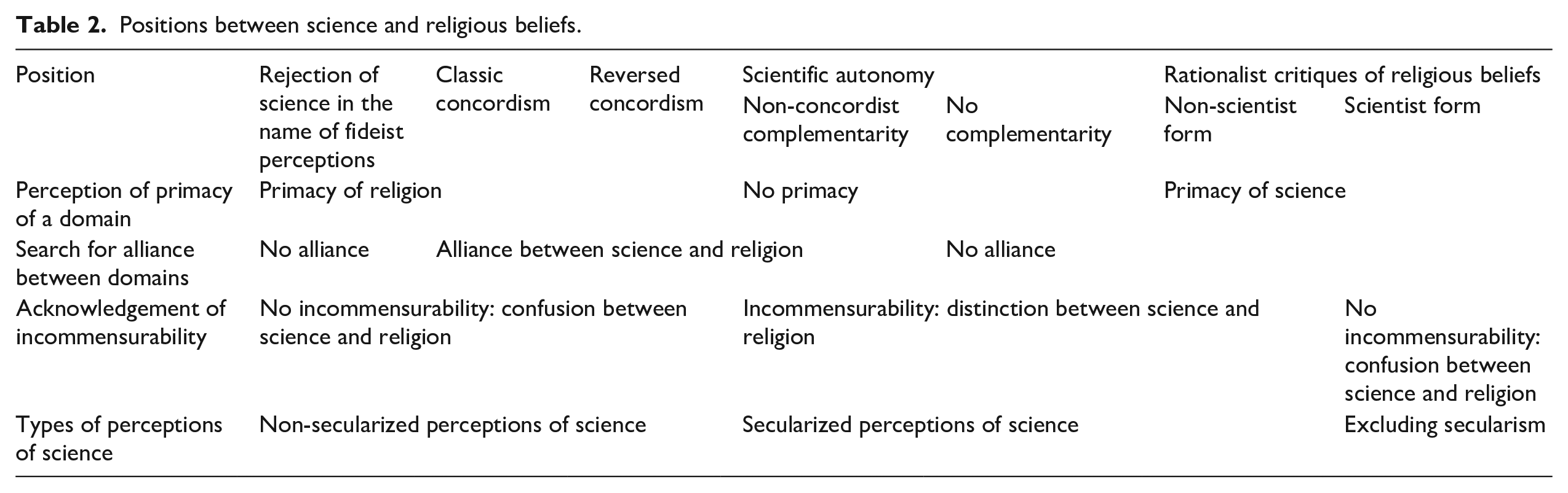
In a non-secularized perception, science is controlled by religion; in a secularized perception, science is independent from religion; in a excluding secularism (scientism), the will is to eradicate religion in the name of science. The aim of our model is to study the positions of students regarding the science–religion relationship to create students’ profiles with secularized or non-secularized perception of science.
2. Purpose of the research
This background shows several typologies and research tools to study different aspects of the relationship between science and religion. The aim of our model is to define secularized/non-secularized positions of science and to create students’ profiles regarding these positions. Our first research tool was created in French. To further our research internationally, we decided to develop the same model in English, to test and validate it in order to obtain comparable results from a larger sample, especially from English speakers. The aim of this study is to develop, test and validate a questionnaire in English to measure the final year of high school students’ perceptions about the secularization or non-secularization of science.
3. Method
Samples
The main sample is composed by 238 English-speaking students in their final year of high school who responded to the questionnaire and were aged between 16 and 19 (121 identified as boys and 116 as girls). Among them, 146 were native speakers from Indiana in the United States, 57 were Dutch, and 35 were Norwegian students with an advanced level in English who could therefore take the questionnaire in English. These countries were selected because we wanted a broader representation of the types of science–religious dynamics respondents may perceive and thus used samples from countries that have varying histories with regard to science–religion antithesis. The sample is a convenience sample for the purpose of field-testing the questionnaire and thus will not be considered as representative of English-speaking students of these countries. Students did not have the same convictions, especially on religious matters: 60% declared themselves Protestant, 25% Agnostic-Atheist, 7% Catholic, 4% believe in a higher power without any religious affiliation, 2% were Muslim and 2% of other beliefs.
In order to nuance our discussion of the results obtained from this main sample, we compare it to a secondary sample of 372 French-speaking Belgian students in the last year of high school (180 identified as boys, 191 as girls, 9 as ‘other’), between 16 and 21 years old, to whom we administered a French-speaking version. This secondary French-speaking sample is entirely new and separate from the French-speaking sample collected in a previously published study that tested the quality of a prior version of the questionnaire (Wolfs et al., 2014). The students of our secondary sample did not have the same convictions as those in our main English-speaking sample: 36% declared themselves Catholic, 32% Agnostics or Atheists, 21% Muslims, 6% believe in a higher power without any religious affiliation, 2% were Protestants and 3% of other beliefs. This second sample was also a convenience sample.
The data were collected in parallel for both of these samples.
Instrument
First, we developed a model with six positions and a questionnaire based on the six-positions model (Wolfs, 2013). On the basis of the first version of our model (which included six positions), we developed a close-ended questionnaire in French. Then, with data collected from 638 students, we tested its construct validity and the internal consistency of its dimensions through exploratory and confirmatory analyses (Wolfs et al., 2014).
Then, we developed a model with seven positions and tested it with a questionnaire. On the basis of the version of a second model (see Table 2), new items were developed, particularly for the ‘scientism’ dimension which was non-existent in the previous model. The purpose of our research, from an international perspective, was to develop a questionnaire in English, that also exists in French, that could show the new model’s positions towards science and religion.
The construct validity of the questionnaire results was tested in three steps with both samples, since the aim was to have scales with the same items in both languages. The steps are described below:
We selected items explaining at least 50% of the total variance of their category with a saturation threshold superior or equal to .50 for each selected item. After this first step, some items were rejected, and others were kept. For example, for the ‘autonomy’ position, we kept 6 out of the 10 items. In the end, we kept 43 of the 51 original items.
After a factor analysis undertaken with SPSS software, 27 items were kept.
We tested the questionnaire (27 items) through a confirmatory factor analysis within each group (French speaking and English speaking).
The questionnaire was designed to be best suited for believers in some religion, agnostics or atheists. For believers in some religion, the questionnaire allows to determine if they have a non-secularized conception of science or, on the contrary, a secularized conception of science (distinction between science and religious beliefs). For agnostics or atheists, the aim of the questionnaire was to examine if they have a secularized conception of science or, on the contrary, a scientist conception of science (excluding secularism). For believers, the items assume the existence of a higher power, as well as the existence of sacred scriptures, which is not the case for all religious traditions. Therefore, the questionnaire seems particularly appropriate for participants with a monotheistic belief system. It would be interesting to adapt the questionnaire to the other traditions of forms of spirituality for further research.
The questionnaire includes two main parts. The first part of the questionnaire aims to collect some socio-demographic data (e.g. age, sex, nationality, education) and includes an important question relating to the students’ personal beliefs about religion. The second part of the questionnaire is about the perspectives on science and religion. Table 3 provides a general overview of the questionnaire.
General overview of the questionnaire.
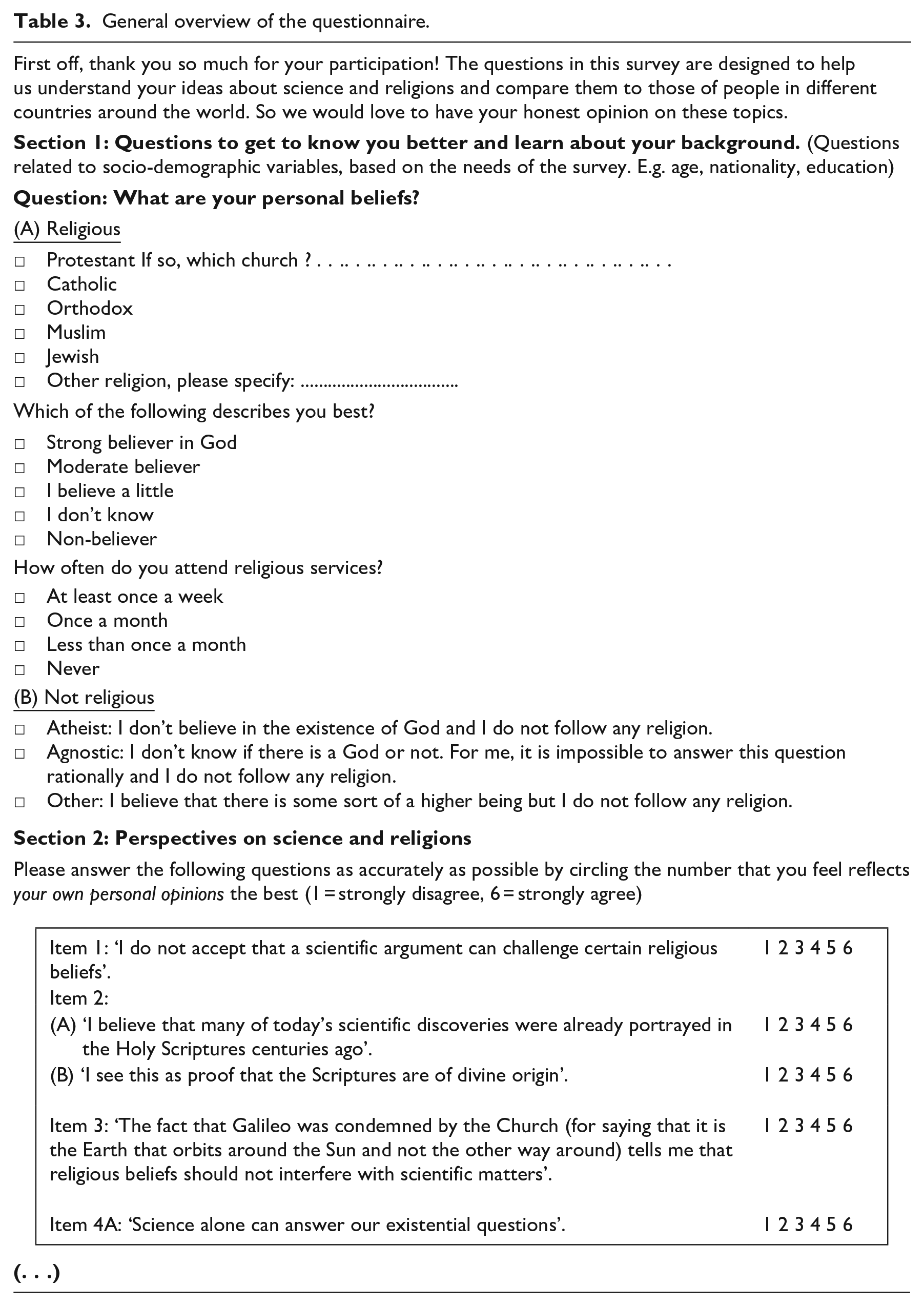
To avoid a possible halo effect, the items from different positions were mixed. For example, here is a sample of the order: item 1 (‘fideism’), items 2A and 2B (‘classic concordism’), item 3 (‘autonomy of science’), item 4A (‘scientism’).
4. Results
Exploratory factor analysis
After a ‘factorisation in principal axes’, as well as an ‘Oblimin rotation with a Kaiser normalization’ with a number of factors put down to six, we obtained six identical scales for the six dimensions of our theoretical model. For the English version of the questionnaire, the percentage of variance extracted was 61.4%. The results of the Kaiser–Meyer–Olkin (KMO) were examined because they provide a global overview of the quality of inter-item correlation. The KMO varies between 0 and 1 and gives additional information about the investigation of the correlation matrix. A KMO index that surpasses .8 is considered as excellent. In this case, we obtained a KMO index of .866. Bartlett’s test was significant: χ2(253 df) = 2857.5, p < .001, showing that the correlation matrix was significantly different from the identity matrix. For information, in the French version of the questionnaire, the KMO is .881, which is also excellent.
Notes:
In Table 4, the means and the standard deviation corresponding to each item are expressed on a scale of –10 to +10, in order to make the disagreements (negative values) and the agreements (positive values) more visible. For this purpose, the Likert-type scale values from 1 to 6 were recoded as follows: 1 = –10, 2 = –6, 3 = –2, 4 = 2, 6 = 6, 6 = 10.
Matrix of items/factors (English version).
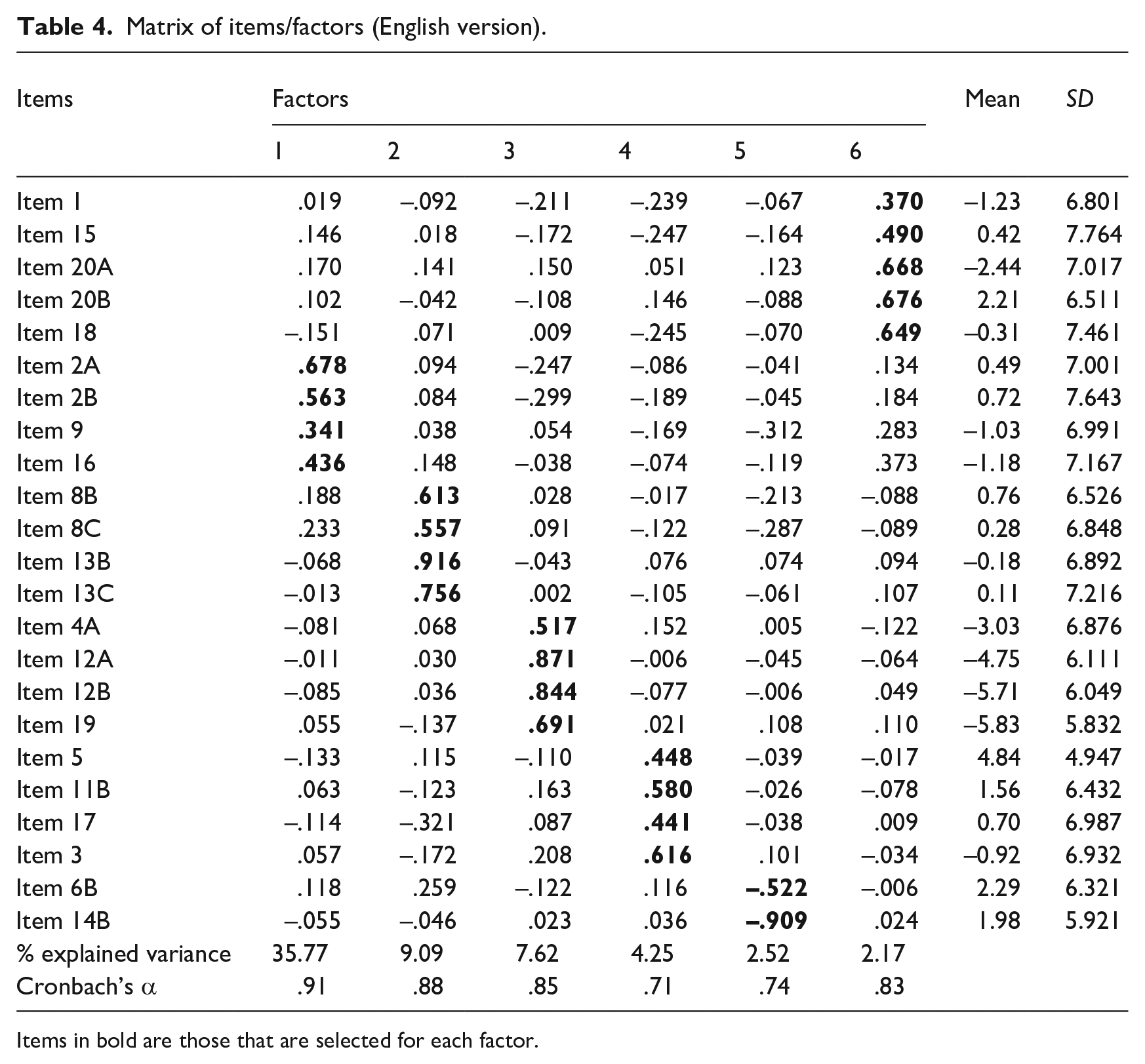
Items in bold are those that are selected for each factor.
The factors obtained relate to the dimensions of our model: factor 1: ‘classic concordism’, factor 2: ‘reversed concordism’, factor 3: ‘scientism’, factor 4: ‘autonomy of science’, factor 5: ‘complementarity’ and factor 6: ‘fideism’ (the items can be found in the Supplemental materials). Byrne (2012) recommends a minimum of four items which is a criterion we fulfil, except for the fifth factor. Cronbach’s alpha is less than .80 for two of the dimensions (factors 4 and 5), but is satisfactory for the four others. For information, in the French version, the alpha is between .82 and .92 for three factors, but it is a little lower for ‘complementarity’ (.76), for ‘scientism’ (.71) and more particularly for ‘autonomy of science’ (.61).
It was more difficult to create a specific scale for the sixth dimension (rationalist critiques of religious beliefs: non-scientist form) clearly different from the others. We identified four items (items 7, 10, 21, 22B). However, the exploratory analysis did not put them in a new factor but associated them with already existing factors. Three of those items were associated with ‘autonomy’ and the fourth with ‘scientist rationalist critiques’. Rational critics towards science can indeed be considered as an argument to justify the autonomy of science from religious beliefs. This position can also seem close to scientism and even opposed to fideism. Nevertheless, it seems preferable to consider the four items as a specific scale instead of associating them with other factors. As we will further explain, the confirmatory analysis revealed that a model with seven factors was appropriate. Furthermore, the new ‘rational critics’ scale’s Cronbach’s alpha indicates satisfactory reliability (.86 in the English version and .85 in the French version).
Confirmatory factor analysis
A seven-factor model was tested. By assessing seven correlations between ‘disturbances’ (errors in items from the same dimension), we modified the index (relating to χ2). By default, these disturbances are considered independent and as such, the theoretical model will not estimate them. However, this premise is often unsustainable because close items often have correlated disturbances (especially when items concern the same factor) but in a manner that it is difficult to predict. Thanks to the modification analysis index, we can determine which correlations should be considered (Kline, 2015). In our case, items 20A and 20B (fideism), 2A and 2B (classic concordism), 8B and 8C, 8B and 13C, 8C and 13B, 8C and 13C, 13B and 13C (reversed concordism) (Table 5).
Expected values for the different indicators and observed values.
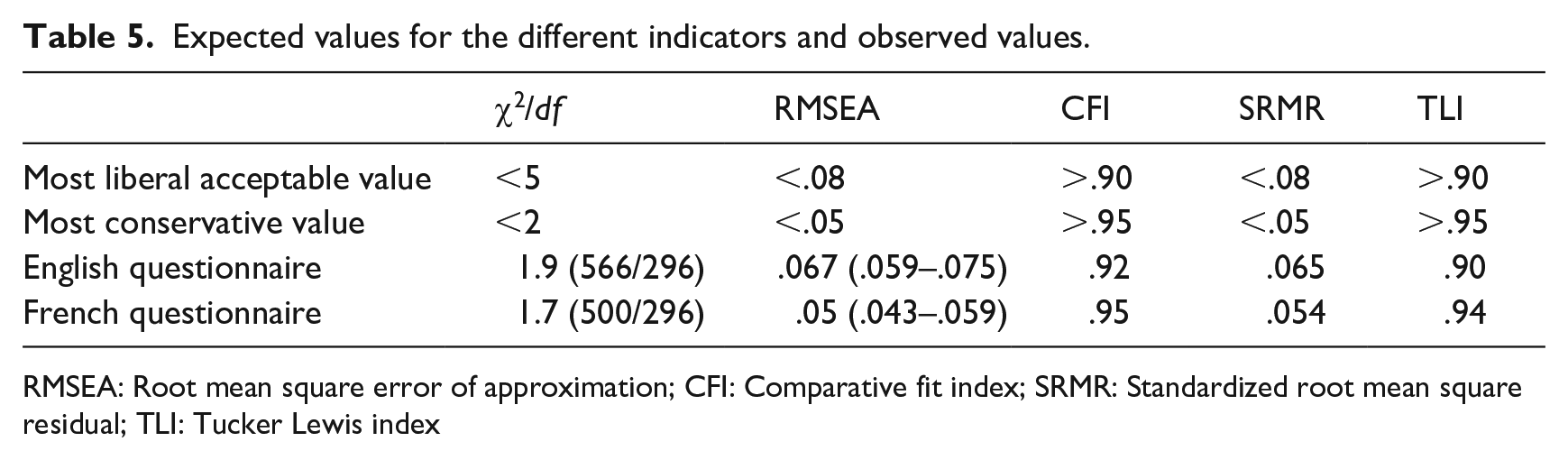
RMSEA: Root mean square error of approximation; CFI: Comparative fit index; SRMR: Standardized root mean square residual; TLI: Tucker Lewis index
It appears that all indicators are satisfactory, meaning that the data fit the theoretical seven-factor model. These results confirm the validity of the questionnaire for both groups (English and French speakers).
Since our research instrument seems valid, our wish is to create student profiles according to whether or not students have a secularized perception of science:
Profile 1, ‘non-secularized perceptions of science (strict form)’: adherence to the fideist and/or concordist perceptions and non-adherence to the scientific autonomy. At least one of the three means for ‘fideism’, ‘classic concordism’ and ‘reversed concordism’ is ⩾2.5 (on a scale of –10 to +10) and the mean for ‘autonomy’ is less than 2.5 (on a scale of –10 to +10).
Profile 2, ‘non-secularized perceptions of science (hybrid form)’: adherence to the fideist and/or concordist perceptions, but also to the scientific autonomy. At least one of the three means for ‘fideism’, ‘classic concordism’ and ‘reversed concordism’ is ⩾2.5 and the mean for ‘autonomy’ is ⩾2.5.
Profile 3, ‘neither secularized nor non-secularized perceptions’: non-adherence to these positions. The means for ‘fideism’, ‘classic concordism’ and ‘reversed concordism’ are all three less than 2.5 and the mean for ‘autonomy’ is also less than 2.5.
Profile 4, ‘secularized perceptions of science’: non-adherence to the fideist and concordist perceptions and adherence to the scientific autonomy from religious beliefs (with or without searching complementarity between science and religion). The means for ‘fideism’, ‘classic concordism’ and ‘reversed concordism’ are all three less than 2.5 and the mean for ‘autonomy’ is ⩾ 2.5.
Profile 5, ‘non-secularized perceptions of science (excluding secularism)’: non-adherence to the fideist and concordist perceptions and adherence to rationalist critiques of religious beliefs that promote scientism. The means for ‘fideism’, ‘classic concordism’ and ‘reversed concordism’ are all three less than 2.5 and the mean for ‘scientist rationalist critiques’ is ⩾2.5.
If a participant meets the conditions of profiles 3 or 4, but also the conditions of profile 5, the profile 5 will prevail. In other words, if a participant has the means <2.5 for ‘fideism’, ‘classic concordism’ and ‘reversed concordism’ and ⩾2.5 for ‘scientist rationalist critiques’, he will be considered as profile 5, regardless of his mean for ‘autonomy’. It could also happen, even though it is less frequent, that a participant has at least a mean ⩾2.5 for ‘fideism’, ‘classic concordism’, ‘reversed concordism’ and a mean ⩾2.5 for ‘scientist rationalist critiques’. This profile will be considered as atypical, distinct from the five main profiles, and therefore it will be studied on a case-by-case basis. At this stage, these profiles were determined a priori but future research (statistical analyses, among others) could allow to refine the criteria that demarcate them.
5. Discussion and conclusion
Understanding students’ positions towards science and religious beliefs is a topic for which researchers have not yet developed many instruments, in particular ones that are appropriate across societal and linguistic contexts. To our knowledge, no instruments allow to specifically identify and distinguish secularized and non-secularized views of science. Based on an initial model, a questionnaire has been developed, tested and validated (Author et al., 2014). After rethinking the model (see Table 2), we developed a new version of the questionnaire in French and in English. Then, we tested the questionnaire’s construct validity through exploratory and confirmatory factor analyses within English- and French-language samples. In this article, we presented the results in detail for the English version of the questionnaire and more briefly for the French version of the questionnaire. Our research has shown that the factor structure respects the theoretical model we tested within the two samples. The questionnaire can therefore be considered a relevant and valid instrument to capture student’s position towards science and religious beliefs regarding the theoretical model. Furthermore, it could determine whether students adopt a secularized or non-secularized perception of science, which is the main goal of this instrument, by distinguishing five profiles. For further analyses, it could be interesting to use data collected from different international samples to conduct a comprehensive study on these profiles. So, this questionnaire is a promising tool for research in comparative education. It can be used to compare students’ perception of the secularization of science by country, region, population or educational institution. It is also possible to cross the socio-demographic variables of the first part of the questionnaire with the results of the second part of the questionnaire (the students’ positions towards science and religious beliefs) for more detailed analyses, in particular relating to the students’ personal beliefs about religion. Thus, combined with an analysis of the societal context (historical, political, sociological, cultural, religious explanatory factors), results would provide a better understanding of the factors that influence perceptions about the secularization of science.
The questionnaire and its validity construct are not flawless: the instrument was tested with small samples and not many items were left per dimension as we had to reduce them drastically during the validity process (we only kept 27 from 43 initial items). The corollary of the high number of positions to the nuances between them could explain this drastic selection. Indeed, there were some items (positively or negatively) saturated in more than one factor we had to remove to obtain scale unidimensionality. Therefore, complex positions such as classic concordism, reversed concordism or scientific autonomy are each represented by only four items. Those items probably focus on important elements of the perceptions without, however, covering all possible nuances.
This latter point is not particularly problematic because the main purpose of the questionnaire, based on how students respond not to one but to several categories, is to determine whether or not they adopt a secular vision of science. For further research (e.g. if we wish to focus on an intellectual position or on factors that could influence it), we could complete these results with open questions and interviews. That would allow us to understand ‘one’s perspective, one’s comprehension of a particular experience, one’s worldview’ (Baribeau and Royer, 2012: 26).
It is possible to use this questionnaire in public opinion surveys or in surveys about societal issues to determine the positions of participants of a given population, as long as the sample is sufficiently representative of the religious affiliations within the population. That could be the case, for example, in demographic surveys such as those administrated by the Pew Research Center, in the United States and elsewhere, to identify views or values related to religion or science. It could also be the case in European Commission or European Union Parliament polls, such as the Eurobarometer, to determine the opinions of European Union citizens.
The measure is also suitable to identify prior and posterior positions of learners who engage in informal science education activities that aim to change their perceptions of how to position science and religion.
This instrument, used anonymously to guarantee the sincerity of students’ answers, could be a promising tool in the classroom. It could be used to determine whether or not students adopt a secular view of science, especially during scientific courses, for example, the one on the theory of evolution. Students could respond to the questionnaire before and after the course. Some classes could also conduct activities to help students distinguish scientific and religious domains. The instrument could then assess the impact of the activity on their vision of science (whether secularized or not), as Aroua et al. (2012) did in Tunisia, for example. Lessons that support students in perceiving the borders between cultures can include activities that address topics related to the epistemic foundations of different sub-cultures that are at play when students make sense of the world, particularly when it comes to topics where different narratives may be perceived as competing. Lessons can also be designed in a way that allows for dialogic teaching (Alexander, 2020) that offers students the opportunity to express, listen to and evaluate ideas. In particular, teachers can engage students in scientific argumentation (Osborne, 2010), which offers them opportunities to express ideas while supporting claims with evidence and reasoning that is appropriate within a given discipline, to co-construct ideas and to critique them.
Finally, the characteristics of the scientific enterprise should be understood by educated citizens, who must be able to reflect on scientific practices, concepts and ideas. From this perspective, we consider this questionnaire as a potential measure of what constitutes science knowledge that can be used both in formal and informal science education with upper high school students and adults.
The conceptual complexity of the instrument offers an original contribution to research about representations of science and religion. Its heuristic value across linguistic contexts and societies makes it an instrument that allows researchers to conduct comparative analyses. The simplicity of use and processing make it a tool that has potential in supporting science educators, as well as professionals in the field of RE.
Supplemental Material
sj-docx-1-pus-10.1177_09636625221075787 – Supplemental material for Positions on science and religious beliefs across societies: Development of a research instrument and testing of its validity among high school students
Supplemental material, sj-docx-1-pus-10.1177_09636625221075787 for Positions on science and religious beliefs across societies: Development of a research instrument and testing of its validity among high school students by Jose-Luis Wolfs, Coralie Delhaye, Christophe Leys, Cansu Altepe, Kevin Dini, Laurence Gauthier and Lucie Bertrand in Public Understanding of Science
Footnotes
Acknowledgements
The authors thank Professor Dany Laveault (University of Ottawa) for his attentive reviewing and his constructive suggestions.
Declaration of conflicting interests
The authors declared no potential conflicts of interest with respect to the research, authorship and/or publication of this article.
Funding
The author(s) received no financial support for the research, authorship and/or publication of this article.
ORCID iDs

Supplemental material
Supplemental material for this article is available online.
Author biographies
References
Supplementary Material
Please find the following supplemental material available below.
For Open Access articles published under a Creative Commons License, all supplemental material carries the same license as the article it is associated with.
For non-Open Access articles published, all supplemental material carries a non-exclusive license, and permission requests for re-use of supplemental material or any part of supplemental material shall be sent directly to the copyright owner as specified in the copyright notice associated with the article.
