







Abstract
The COVID-19 pandemic was accompanied by an infodemic in which trust in news played an essential role. This article analyzes how this trust can be divided into two components, institutional and non-institutional, which are differentially related to beliefs about COVID-19 and perceptions of receiving misinformation and disinformation. Based on a survey conducted in three European countries (Germany, Spain, and the United Kingdom), the study confirms that higher levels of institutional news trust (the trust dimension correlated more with trust in the news media, government, politicians, national and global health organizations, and scientists) are a good predictor of both better knowledge of COVID-19 myths and misstatements, and lower perceptions of being surrounded by false and misleading information about the virus. The research also highlights the special role of media and political sources in strengthening the institutional dimension of news trust.
Keywords
More than 2 years after the outbreak of the COVID-19 pandemic, many scholars maintain that the health pandemic has been accompanied by a true infodemic, characterized not only by an abundance of information but also by its impurity; a chaotic mixture of true information with fake news, disinformation and misinformation (Butcher, 2021; Ceron, 2015; Orso et al., 2020; World Health Organization, 2021; Zarocostas, 2020). There are multiple consequences of this situation that have yet to be studied, but there are some phenomena that can already be analysed. One of these is how citizens have managed, from the news perspective, in such a complex environment in which the perception of risk, fear for their own health and uncertainty are conditioning how they evaluate the information and news they receive. 1
One of the key elements to navigating an environment of crisis and uncertainty is trust, the transfer of certain power to exercise control over our lives to others (institutions, experts, friends, etc.), and assuming the risk of depending on their actions to make up for our own shortcomings and limitations (Luhmann, 1979). The media system has traditionally been one of the social subsystems that has generated confidence in knowing what was happening. This system is now increasingly complex and has been disfigured as new technologies have made it easier for all people and institutions, whatever their type, to play a certain role in information mediation with respect to reality (Lüders, 2008). This is especially noticeable in times of crisis and upheaval, such as the COVID-19 pandemic, when people need to resolve their lack of knowledge and uncertainty about complex issues by placing their trust in third parties (Jackob, 2010; Retzbach and Maier, 2015; Vermeer et al., 2022).
This article analyses how, in the context of the pandemic, the trust that citizens place in different sources of information and news is related to their knowledge of the truth or falsity of certain controversial information and to their perception of the quality of the news they receive about the virus in question. The study focuses on contrasting these relationships regarding trust in institutional and non-institutional sources of information, a novel division that is proposed in the work. Furthermore, the study examines whether these relationships follow a common pattern in different countries from the point of view of their media systems, albeit in countries that share a similar geopolitical and health environment (namely Germany, Spain and the United Kingdom).
In the first part of the article, I discuss the proposal to differentiate between institutional and non-institutional news sources for the current analysis and establish the main hypothesis based on the findings of research on COVID-19 misinformation and disinformation. Second, I present the data and the operationalization of key variables. Third, I show the results and, finally, give the conclusions and limitations of the findings.
Institutional and non-institutional trust in news sources
The distinction between institutional and interpersonal trust as components of trust has been studied in detail in fields such as politics (Delhey, 2011; Sønderskov and Dinesen, 2016), economics (Bjørnskov, 2012; Delhey et al., 2011) and sociology (Knight, 2001; Spadaro et al., 2020). In all fields investigated, it is accepted that trust, defined either as institutional confidence towards the government and public institutions or as interpersonal/social trust towards other people, forms the foundation of a well-functioning society. In different fields, the duality of trust has been examined and explained in multiple ways by different researchers (Barber, 1983; Fukuyama, 1995; Grovier, 1997; Luhmann, 1979). Moreover, in medicine and health issues, trust is often operationalized on two interrelated levels: interpersonal (i.e. horizontal) trust and institutional (i.e. vertical) trust (Mohseni and Lindström, 2007; Ward, 2006).
The division of trust into generic components has not deserved special academic attention in its application in the field of media and news beyond some generic references to the ‘institutional media trust’ linked to mainstream media (Gil de Zúñiga et al., 2019; Jackob, 2012; Taneja and Yaeger, 2019; Williams, 2012) or, to cite more specific cases, the analysis of individual and contextual trust (Tsfati and Ariely, 2014) and ‘interpersonal informational trust’ in political activism (Himelboim et al., 2012). However, as Quandt (2012) pointed out in his analysis of the differences between personal, institutionalized and network trust, this type of analysis is essential today – even more so in the face of phenomena such as the pandemic – since a ‘widespread loss of trust in media and institutions might pose a danger to democratic societies – and that various forms of (participatory) network communication might not be an adequate solution to this problem’ (p. 7).
This article argues that the multiple sources of news and information used by citizens during the COVID-19 pandemic can also be classified in two areas of trust, working differently when people evaluate the complex and diverse ‘communicative ecology’ that they face (Houston et al., 2021). On one hand, governments, political parties, health authorities and scientists constitute qualified sources that stand out for their institutional character and for representing clearly recognizable social subsystems. Likewise, the news media have been part of this institutional network, especially in times of crisis (Althaus, 2002; Hu and Zhang, 2014). All of these constitute what I label as ‘institutional’ sources of trust. On the other hand, interpersonal sources (family, friends, contacts in social networks, etc.) transmit abundant information in situations of great uncertainty, mostly using interpersonal modes of communication and channels. However, as commented by Quandt (2012), interpersonal trust is not the same as network trust. In fact, as pointed out by this author, ‘there still seems to be trust in web communities being a reflection of “the real” people, as network trust is largely regarded as a form of additive “personal” trust’ (p. 16). Because the trust derived from interpersonal interactions (interpersonal trust) and trust mediated by technology (network trust) is diverse and cannot be equated with the traditional concept of social trust, for this article I will include it under the ‘non-institutional’ label in contrast to the clearer concept of ‘institutional’ trust.
Therefore, in line with the literature on trust already mentioned, I expect that:
H1: The overall trust in COVID-19 news coming from different sources can be differentiated into two components of a different nature, institutional and non-institutional, which synthesize the types of trust in a great diversity of sources in a statistically significant manner.
COVID-19, misinformation and disinformation, and news trust
One of the central issues of concern during the COVID-19 pandemic has been the ease with which people have believed hoaxes, misinformation and conspiracy theories about the virus, its causes, and its consequences (Hansson et al., 2021; Roozenbeek et al., 2020a, 2020b; Salaverría et al., 2020; Zou and Tang, 2021).
Hameleers et al. (2022) indicated that in the initial phase of the COVID-19 pandemic, people perceived that information on the coronavirus was to a relatively large extent surrounded by misinformation and, to a lesser extent, disinformation. Of course, in between the hoaxes and false beliefs of the public and the feeling of infoxication are the news sources themselves (journalists, experts, government sources, international organizations, influencers, colleagues, friends, etc.), who perform various tasks such as filtering, interpreting and disseminating information. It is easy to see that the consideration these sources deserve from citizens, especially in terms of trust and credibility, becomes a key aspect in the management of a health issues and crisis like the current one (Jennings and Russell, 2019; Nielsen et al., 2020).
In the specific case of COVID-19, recent research has analysed different aspects of the relationship of citizens with these sources of information and their effects on citizens’ belief in COVID-19 hoaxes and their evaluation of the quality of the information received or on their own behaviour during the pandemic. Thus, for example, a study by Uscinski et al. (2020) found that beliefs in conspiracies about the virus are associated with a propensity to reject information from expert authorities, raising concerns about the potential for popular conspiracy theories to reduce people’s willingness to comply with public health guidance. Others have explored the role of receiving information from social media and the World Health Organization (WHO) in shaping people’s beliefs about the virus (Allington et al., 2020). A series of research studies in the United Kingdom by the Reuters Institute for the Study of Journalism has ascertained that news use declined during the crisis after the initial surge, that trust in news fell, that trust in the government as a source of information about COVID-19 dropped dramatically and that a large minority of the public (‘infodemically vulnerable’) did not feel that the news media and/or the government had explained what they could do in response to the pandemic. Finally, other investigations have found that trust in government, science and medical professionals is associated with increased coronavirus risk perception (Dryhurst et al., 2020; Wu and Shen, 2021); that a clear link, replicated internationally, exists between people’s susceptibility to misinformation and the key role that scientists play as disseminators of factual and reliable information (Roozenbeek et al., 2020a); and that exposure to social media is associated with misperceptions regarding basic facts about COVID-19 (Dhanani and Franz, 2020; Mitchell et al., 2020), while the inverse is true for news media (Bridgman et al., 2020).
Beyond a general acceptance of the importance of trust in information and news sources to reduce the impact of misinformation and disinformation (Kim and Kim, 2020), it is clear that the differentials in trust generated by diverse news sources have different effects on the evaluations of information and therefore on the practical consequences thereof. In this sense, several studies focused on COVID-19 have already noted the wide variety of trust levels in news coming from traditional versus non-traditional media (Ferreira and Borges, 2020; Liu et al., 2020; Nielsen et al., 2020), from some types of channels compared with others (news media, social media, government, interpersonal) (Hwang and Jeong, 2020; Van Aelst et al., 2021), or from different specific media (Zhao et al., 2020).
But none of the cited works have addressed the impact of joint trust in news sources from an integrative perspective, one that is able to analyse whether there are ‘types of trust’ that have significantly different effects on both beliefs in misinformation and disinformation and perceptions of being more or less exposed to them. In fact, this is not a problem specific to the pandemic but rather to the role of trust in the news in any context of strong uncertainty.
Based on this reasoning, and following the partial results commented on in previous paragraphs about the relationships between trust in different information sources and COVID-19 beliefs, several hypotheses are stated for this work:
H2: Higher levels of trust in institutional news sources are associated with better knowledge about the truth or falsity of certain controversial information about the COVID-19 pandemic;
H3: Higher levels of trust in non-institutional news sources are associated with worse knowledge about the truth or falsity of certain controversial information about the COVID-19 pandemic;
H4: Higher levels of trust in institutional news sources are associated with a lower perception of receiving misinformation and disinformation during the pandemic;
H5: higher levels of trust in non-institutional news sources are associated with a higher perception of receiving misinformation and disinformation during the pandemic.
Finally, this article will analyse the extent to which the hypothesized relationships are present in the countries analysed in this study (Germany, Spain and the United Kingdom). The three countries have been selected to represent, on one hand, a homogeneous geopolitical area (Europe) where the evolution of the pandemic and the narratives about COVID-19 were in the same phase when the field study was carried out, a vital attribute in a health crisis characterized as being highly asymmetric worldwide (Ng et al., 2021). On the other hand, the three countries are quite diverse, especially from the point of view of their media systems. Each effectively represents one of the three different media systems described by Hallin and Mancini (2004): liberal model (UK), polarized pluralist model (Spain) and democratic corporatist model (Germany).
1. Method
Sample and data
For this article, I used a survey commissioned by the Reuters Institute for the Study of Journalism and the Misinformation, Science, and Media Project run with the Oxford Internet Institute and supported by the Oxford Martin School (for further details, see Nielsen et al., 2020). The purpose of the survey was to understand how people accessed and rated news and information about COVID-19 from different sources. Research was conducted by YouGov using an online questionnaire fielded from 31 March to 7 April 2020 across Germany, Spain and the United Kingdom. Samples in each country were assembled using nationally representative quotas for age, gender and region. The data were also weighted to targets based on census/industry-accepted data for the same variables (Nielsen et al., 2020). The final samples of the countries under examination were the following: Germany (n = 2003), Spain (n = 1018) and the United Kingdom (n = 2216).
Two methodological caveats should be kept in mind when reading this analysis. The first is that the coronavirus pandemic was ongoing during the fielding at different stages in each country, and the governments in these countries had each implemented different countermeasures at this point. As of 31 March 2020, when the survey went into the field, Germany had seen 6.96 deaths per million, Spain 156.99 and the United Kingdom 20.74. As of April 2020, when the last survey closed, the death rates had jumped to 19.18 in Germany, 279.22 in Spain and 79.15 in the United Kingdom (Nielsen et al., 2020). By then, however, the pandemic was an issue of general and great concern across the three countries. The second caveat is that online samples will tend to underrepresent the consumption habits of people who are not online (typically older, less affluent, and with limited formal education). However, for the countries under research, Internet penetration is higher than 90%, so the samples represented the individual populations fairly accurately.
Measures
Dependent variables
COVID-19 beliefs. To measure participants’ knowledge and beliefs about COVID-19, the Reuter’s survey presented them with five statements about the virus, three of them false (‘eating garlic prevents infection’, ‘antibiotics are an effective treatment’, and ‘coronavirus was made in a laboratory’) and two true (‘it can be transmitted in areas with hot weather’, and ‘older people are more susceptible to becoming seriously ill’). The participants had three possible answers (‘True’, ‘False’, and ‘Don’t Know’ (DKO)), and I built an overall index (0–10) for each respondent by scoring correct answers = 2, incorrect answers = 0 and DKO answers = 1 (M = 7.42; SD = 1.71). I adopted this system of ‘formula scoring’ used in science education (Ravesloot et al., 2015) to recognize the importance of uncertainty in knowing in science-learning contexts (Thuneberg and Salmi, 2018) and in other public-issue environments (Sturgis et al., 2008), especially when they are as new and complex as COVID-19. (Supplemental Material (S1) shows the exact wording of the questions and all the answers for the dependent, independent and control variables.)
COVID-19 misinformation and disinformation. This dependent variable was a measure of the perception of exposure to false or misleading COVID-related information. Respondents in each country were queried on a 5-point scale (1 = ‘None at all’ to 5 = ‘A great deal’), for each of the 12 sources presented (news media, government, politicians, national and global health organizations, scientists, known and unknown ordinary people, social media, search engines, video sites and messaging applications). I averaged scores on the 12 source items into an overall index to measure the intensity of the perception of the amount of false or misleading COVID information seen by each respondent (M = 2.17; SD = 1.10). Internal consistency values for the items presented very good Cronbach’s α levels ranging from .88 to .90, with a total scale value of α = .90.
Independent variables
News trust (institutional and non-institutional trust). Twelve items were used to assess trust in different information sources within society and to build the model of institutional and non-institutional trust. The list of sources was the same used in the case of the ‘False or Misleading COVID Information’ variable. For the question ‘How trustworthy would you say news and information about the coronavirus (COVID-19) from each of the following (sources) is?’, answers ranged from 0 (‘not at all trustworthy’) to 10 (‘completely trustworthy’). The full scale exhibited a high level of internal consistency as evidenced by Cronbach’s α of .84 (M = 6.34, SD = 1.54). Reliability in the country scales was also satisfactory: Germany (α = .87 (M = 6.31, SD = 1.33)), Spain (α = .86 (M = 6.20, SD = 1.39)) and the United Kingdom (α = .84 (M = 6.45, SD = 1.92)). The generic way of asking for news trust by source is consistent with the previous theoretical suggestions, and with similar studies on this issue (Ardèvol-Abreu and Gil de Zúniga, 2017; Elvestad et al., 2018; Vermeer et al., 2022). There may be some potential confusion within the list of sources, as respondents may mix in the same response perceptions of messages received from different sources, such as health experts mediated by news organizations. However, we can be confident that such confounds do not significantly distort the data because it is minimized when the data are aggregated in indices and factors.
Control variables
Sociodemographic variables
Respondents were asked to indicate their age, which was categorized into five intervals (18–24, 25–34, 35–44, 45–54, 55+), gender (0 = male, 1 = female), education level (1–10, 1 being ‘I have not completed any formal education’ and 10 being ‘Doctoral or similar level’) and political ideology (1–7, 1 being ‘very left wing’ and 7 being ‘very right wing’). Age, gender and education are significant factors tested regularly in research on fake news and beliefs in conspiracy theories (Baptista and Gradim, 2020; Guess et al., 2019) and also in specific works about COVID-19 misinformation (Garry et al., 2022; Nguyen and Catalan-Matamoros, 2020; Stanley et al., 2020). As for the fourth control variable in this block, political orientation, different studies have also connected factors and processes such as political partisanship and bias with fake news exposure and perceptions (De Coninck et al., 2021; Pennycook and Rand, 2019; Spohr, 2017; Van der Linden et al., 2020).
News usage variables
News consumption measures also used as control variables in this study were based on previous research about common predictors in fake news and misinformation studies in general and on research about COVID-19 misinformation in particular (Bridgman et al., 2020; De Coninck et al., 2021; Dhanani and Franz, 2020). I used two indicators of news consumption: news frequency (‘Typically, how often do you access news? By news, I mean national, international, regional/local news, and other topical events accessed via any platform (radio, TV, newspaper, or online))’, measured on a scale of 1–10 (with 1 being ‘more than once a day’ and 10 being ‘never’), and diversity of sources used to access news on COVID-19. This variable was constructed by adding the number of news sources that respondents claimed to use in the past week for information about coronavirus (‘Which, if any, of the following have you used in the last week as a source of news or information about coronavirus (COVID-19)? Please select all that apply’: News organizations; the national government; individual politicians; global health organizations; national health organizations, scientists, doctors or other health experts; ordinary people whom I know personally; and ordinary people whom I do not know personally). (Detailed data for the dependent and independent variables for each of the three countries under analysis can be consulted in S2, Table 1.)
Principal components (PC) of trust in COVID-19 news sources.
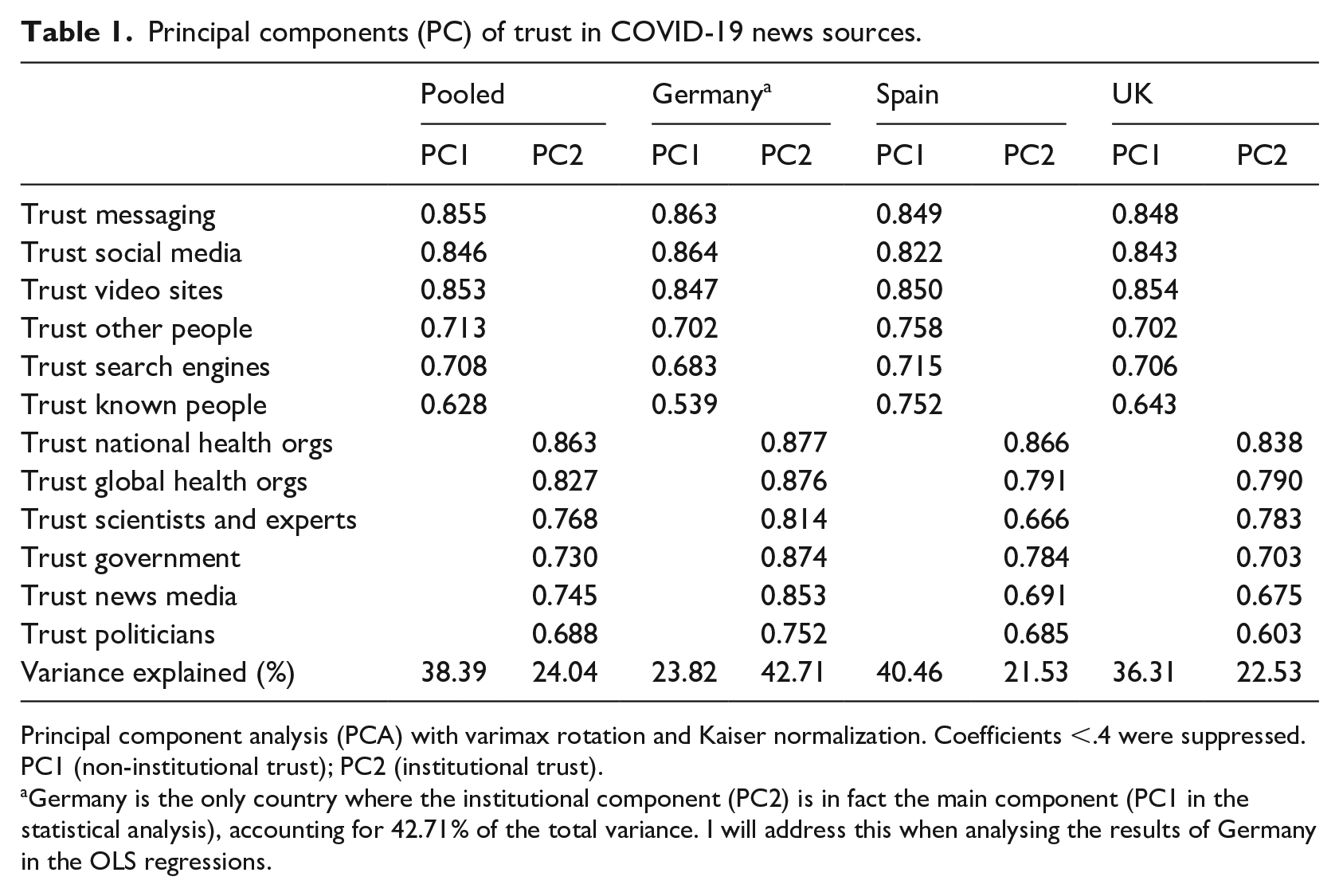
Principal component analysis (PCA) with varimax rotation and Kaiser normalization. Coefficients <.4 were suppressed. PC1 (non-institutional trust); PC2 (institutional trust).
Germany is the only country where the institutional component (PC2) is in fact the main component (PC1 in the statistical analysis), accounting for 42.71% of the total variance. I will address this when analysing the results of Germany in the OLS regressions.
2. Analytical strategy
First, to comprehensively analyse the hypothesized two-dimensional measurement of source trust (institutional and non-institutional) (H1), based on the 12 items used to assess trust in different information sources, I conducted a principal component analysis (PCA) and a confirmatory factor analysis (CFA), both for the pooled sample and for each country in question, to test the validity of the two factors model. A multigroup CFA analysis (MGCFA) was also undertaken to establish measurement invariance, to determine if items and factors used in the analysis mean the same things to citizens of different countries.
Second, as for testing H2–H5, I used multiple regressions to analyse the direction and strength of the significant relationships. First, to investigate predictors of the knowledge and beliefs about COVID-19, a hierarchical ordinary least squares (OLS) regression was used to examine the association between this variable and the two regressed components of source trust (specifically institutional and non-institutional), controlled by sociodemographic and media use variables to test H2 and H3. In the hierarchical OLS, I entered gender, age, education and political orientation in the first block of the regression (Step 1), media use variables in the second block (Step 2), and the principal components (PCs) of institutional and non-institutional trust in the third (Step 3). Second, to examine H4 and H5, I carried out the same analyses but with a perception of exposure to false or misleading COVID-19 information as the dependent variable. I checked for multicollinearity in all models, and the variance inflation factor was, in practically all cases, around 1 and never higher than 1.2 (tolerance levels were never less than .8), thus indicating the existence of no multicollinearity.
3. Results
Institutional and non-institutional news trust
A PCA with varimax rotation was conducted to analyse the dimensions of news trust. PCA for the pooled sample resulted in two factors with an eigenvalue > 1, which accounted for 0.38 (PC1) and 0.24 (PC2) of the total variance. The Kaiser–Meyer–Olkin criterion (.857) and the Bartlett’s test (p < .001) proved to be acceptable. As illustrated in Table 1, sources were clearly divided according to the level of trust in two dimensions that can be identified primarily with the hypothesized division between ‘institutional’ (news media, government, politicians, national and global health organizations, scientists) and ‘non-institutional’ (known and unknown ordinary people, social media, search engines, video sites and messaging applications) news trust. These two PCs were reproduced with the same pattern in the case of the three countries analysed. (Supplemental Material S3 (1–4) shows the detailed PCA results for the pooled sample and for each of the three countries under analysis.)
To test the validity of the dual structure of the PCA, I performed a CFA. First, I carried out the baseline model as initially hypothesized, which revealed acceptable but not sufficient structural validity (χ2 = 4813.69, df = 53, p < .001, TLI = 0.78, CFI = 0.85, RMSEA = 0.131, 90% CI = [0.128, 0.134], SRMR = 0.08). Based on fit diagnostic information and theoretical justification, I revised the model in order to improve its goodness of fit and interpretability. On one hand, I added the covariance between the highly correlated error residuals of three items associated with the institutional factor (news media, politicians and government), based on the trust nexus of politics and the media (Hanitzsch et al., 2018). On the other hand, the content similarity of the variables may help to explain the correlation between the error residuals of two pairs of items in the non-institutional dimension (known and unknown people, and social media and messaging services). The fit of the data in the respecified model (see Figure 1) far exceeds the hypothesized model, and surpasses the usual cut-off point of good fit measures ((χ2 = 1461.94, df = 48, p < .001, TLI = 0.93, CFI = 0.95, RMSEA = 0.075, 90% CI = [0.0.72, 0.078], SRMR = 0.074) (Hair et al., 2010)). Factor loadings were all significant at p < .001, ranging from 0.49 to 0.87.
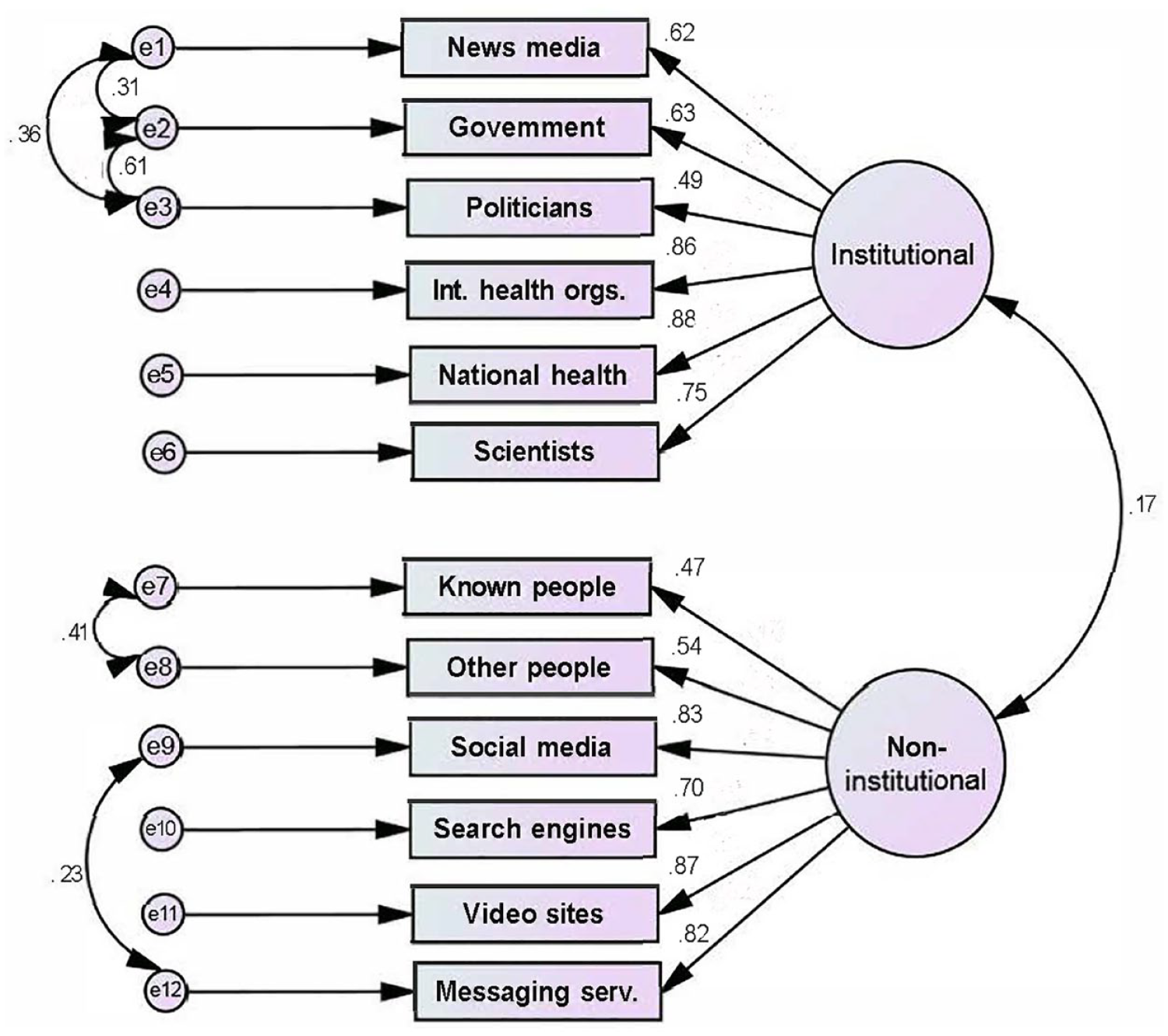
Path diagram for the CFA of news source trust.
Prior to examining measurement invariance among groups, separate CFAs were conducted for each country data with the respecified model, and the results demonstrated acceptable model fits (Germany: χ2 = 568.08, df = 48, p < .001, TLI = 0.94, CFI = 0.96, RMSEA = 0.074, 90% CI = [0.068, 0.079]; Spain: χ2 = 416.49, df = 48, p < .001, TLI = 0.91, CFI = 0.94, RMSEA = 0.087, 90% CI = [0.079, 0.095]; United Kingdom: χ2 = 588.63, df = 48, p < .001, TLI = 0.93, CFI = 0.96, RMSEA = 0.071, 90% CI = [0.066, 0.077]. (For more detailed information on country models and factor loadings, see Supplemental Material, S4.)
Subsequently, a multigroup analysis was conducted to assess the measurement invariance model across the matched data from the three countries, by comparing a baseline model that fixed an equal number of factors and factor patterns for each group (i.e. configural model) to a model that included invariant factor patterns (i.e. metric model). To assess the MGCFA in the testing of the measurement invariance, the CFI and RMSEA difference tests were used (i.e. ΔCFI ⩽ 0.010 and ΔRMSEA ⩽ 0.015), as suggested by Cheung and Rensvold (2002). First, a configural invariance model was assessed via CFA where the factor loadings were unconstrained to be equally fixed between the three countries. The unconstrained model fit the data well (χ2 = 1998.27, df = 168, p < .001, CFI = 0.94, RMSEA = 0.079). Second, a metric invariance model was then assessed using CFA by constraining all factor loadings to be equal across groups. To test the metric invariance, the fit of this model was compared with the fit of the configural model (ΔCFI = 0.006, and ΔRMSEA = 0.004). Finally, the scalar model (assuming equal factor loadings and intercepts across groups) was within the limit of acceptable difference tests with respect to the metric model (ΔCFI = 0.017, and ΔRMSEA = 0.018). In conclusion, the analysis of the measurement invariance demonstrates that the model was robust across countries.
COVID-19 beliefs
After validating the two components of news source trust (institutional and non-institutional), I performed the hypothesis testing with both factors as independent variables, and with socio-demographics and media use variables as controls. Table 2 shows the basic results for the final model of the hierarchical OLS regression with COVID-19 beliefs as the dependent variable, both pooled and by country. As expected, a number of control factors stood out as significant predictors of a better performance when identifying true and false statements about COVID-19. In the pooled sample, gender (female) and political orientation (right) had a very slight negative association with scores on COVID-19 knowledge, whereas education (higher levels), news frequency (higher frequency: 1 was the highest and 10 the lowest), and diversity of news sources (a wider variety of sources) demonstrated a clear positive relationship. The direction of the relationships was maintained across the three countries under research almost without changes. As for the predictive capacity of these variables, there was some variety among countries, but it is interesting to note that the media use factors (news frequency and diversity of sources) were significantly and consistently associated with beliefs about COVID-19 in the pooled sample and in the three countries analysed (Germany, Spain and the United Kingdom). These findings are in line with other research that has also found a positive association between sources variety and health literacy and news discernment (Calvillo et al., 2021; Inoue et al., 2022).
Results of the hierarchical OLS regression with predictors of Covid beliefs, pooled and by country.
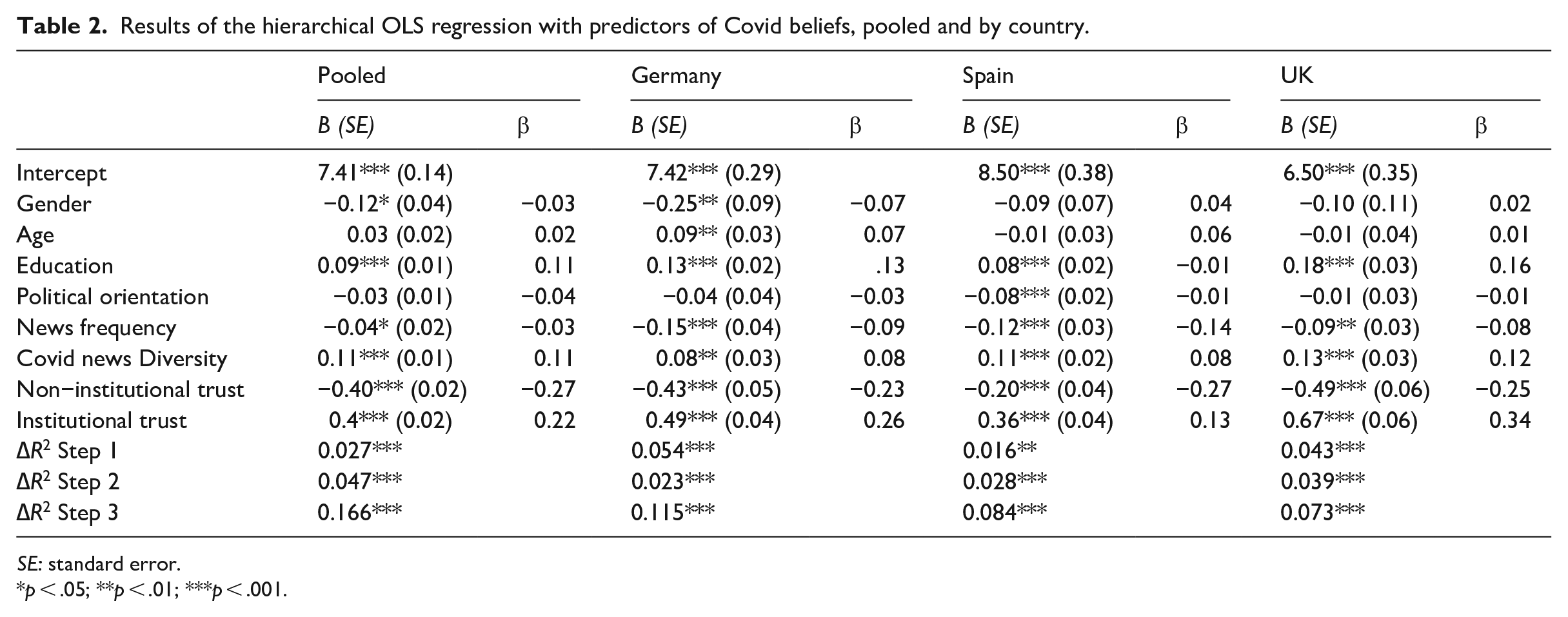
SE: standard error.
p < .05; **p < .01; ***p < .001.
After controlling for these factors, and as hypothesized in this work (H2, H3), the PC1 (non-institutional) and PC2 (institutional trust) components emerged as the key predictors of COVID-19 beliefs in a strong and consistent manner. Without exception, both in the pooled and in the three national samples, higher non-institutional trust was significantly associated with lower scores in COVID-19 beliefs (β = −.27, p < .001 for the pooled sample). Meanwhile, with the same consistency, higher institutional trust was significantly associated with higher scores on the COVID-19 knowledge index (β = .22, p < .001 for the pooled sample). Based on the standardized beta values, these trust factors had the greatest influence on COVID-19 beliefs in all countries, and they accounted for a great part of the variance explained by the final OLS regression models (for the pooled sample, ∆R2 Step 3 = 0.166, p < .001 compared with ∆R2 Step 2 = 0.047, p < .001 and ∆R2 Step 1 = 0.027, p < .001) (see the other country results in Table 2). Consequently, these results clearly confirmed H2 and H3. (Detailed information about the complete models for the pooled sample and the three countries under research can be found in S5 (1–4).)
False or misleading Covid information
The relation between the two trust dimensions and the level of false or misleading information about COVID-19 seen by the respondents also showed clear results (Table 3). With different levels of significance in the pooled and countries samples, the study confirmed that females and older people perceived a lower intensity of false or misleading Covid information. However, that pattern was not replicated in other control factors such as political orientation, education and news frequency, which were not statistically relevant (with the exception of news frequency for the pooled sample). Finally, in the sample as a whole and in the three countries, a more diverse use of sources showed a strong association with a greater perception of COVID-19 misinformation and disinformation.
Results of the hierarchical OLS regression with predictors of Covid mis- and disinformation, pooled and by country.
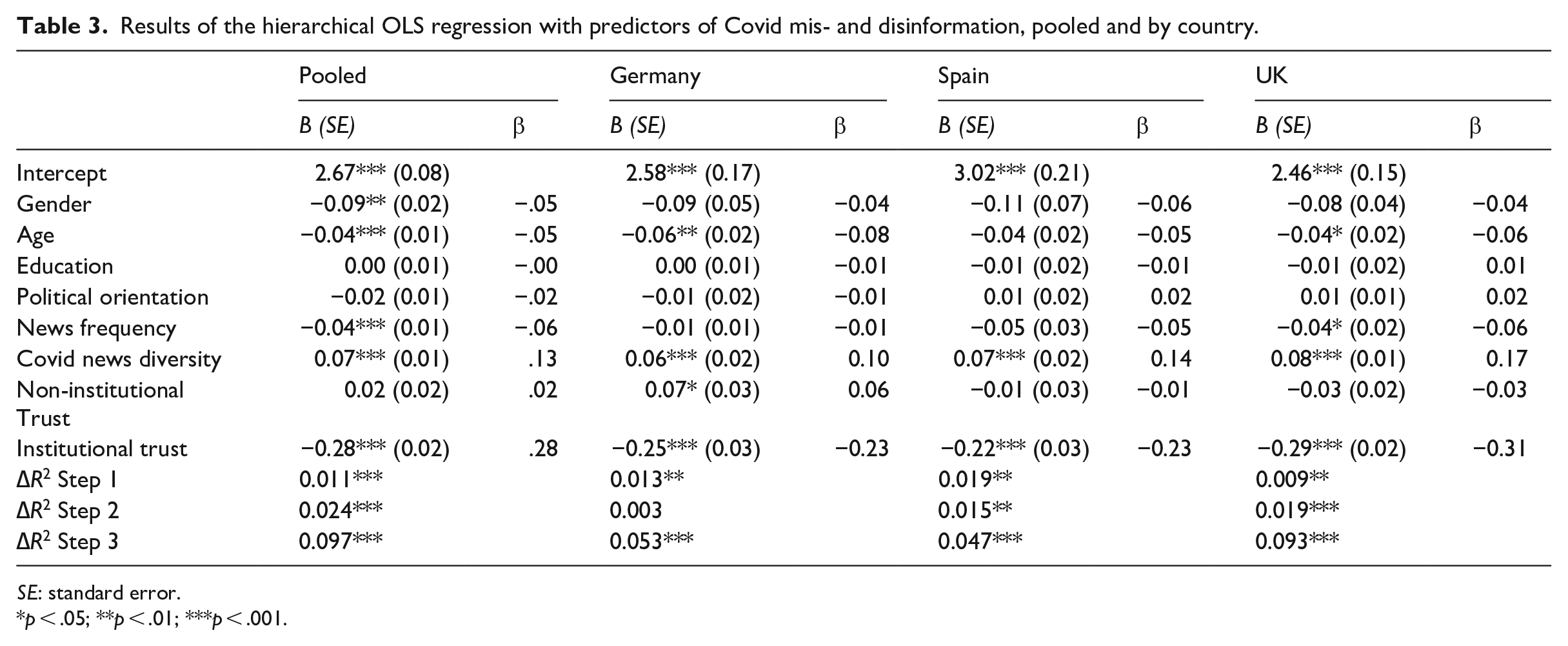
SE: standard error.
p < .05; **p < .01; ***p < .001.
After accounting for control factors, scoring higher in the institutional trust dimension clearly predicted a lower perception of being surrounded by disinformation about COVID-19 in the total sample and country by country (β = −.25, p < .001 for the pooled sample), thus confirming H4. With the exception of Germany, where a slight significant negative association existed between the dependent variable and non-institutional trust, this relationship occurred in neither the pooled sample nor in Spain or the United Kingdom (β = .02, p = .29 for the pooled sample). These results reject H5. (Detailed information about the complete models for the pooled sample and the three countries under research can be found in S6 (1–4).)
4. Conclusion and discussion
This article has analysed how in the context of the pandemic the trust that citizens place in different sources of information is related to their knowledge of the truth or falsity of certain controversial information and to their perception of the quality of the news they receive about the virus. I have confirmed, first, that the overall trust in COVID-19 news sources can be differentiated into two components of a different nature, institutional and non-institutional, which synthesize the levels of trust in a great diversity of sources in a statistically significant manner. Second, the study has confirmed that higher levels of institutional news trust (the trust dimension correlated more with trust in the news media, government, politicians, national and global health organizations and scientists) is a good predictor of both better knowledge about COVID-19 myths and false statements, and also of a lower perception of being surrounded by false and misleading information about the virus. On the contrary, higher levels of non-institutional news trust (the trust dimension correlated more with trust in known and unknown ordinary people, social media, search engines, video sites and messaging applications) is a good predictor of the belief in COVID myths and false information, but not of the perception of being exposed to misinformation and disinformation. Third, this study also draws attention to the special role of the news media and political news sources as two important types of news sources. When they are not clearly correlated with the rest of the institutional sources – as one would expect by their nature and by their role in society – the predictive role of trust can be eroded, as already demonstrated in recent studies in places like Hong Kong, the United States and the Philippines (De Coninck et al., 2021).
The results of this study, in line with others carried out during the early phases of the COVID-19 pandemic (Hameleers et al., 2022; Nielsen et al., 2020), highlight the importance of building trust in certain institutional sources of information when uncertainty and risk perceptions are very high among the population. This work in turn confirms and integrates in two dimensions – institutional and non-institutional – the partial results of other research that have so far analysed the different consequences that trust in different sources of information and news can have on maintaining a well-informed citizenry (Bridgman et al., 2020; Dhanani and Franz, 2020; Dryhurst et al., 2020; Roozenbeek et al., 2020a, 2020b; Uscinski et al., 2020; Wu and Shen, 2021).
From a theoretical perspective, distinguishing between the different effects that institutional and non-institutional dimensions of trust in news and information sources can generate is a very fruitful approach for analysing different informational and disinformational processes around complex public controversies of different kinds. From a pragmatic perspective, these findings can contribute to the design of communication strategies and plans to deal with public concerns and anxieties in the early stages of a crisis, when neither the authorities’ policies nor people’s understanding of the crisis has stabilized. For example, in such uncertain circumstances, both the news media and political news sources have a special responsibility to strengthen the institutional dimension of news trust, which can lead to better informed and more responsible citizenship.
Finally, the study raised several questions that need to be addressed in future studies. One of these questions is related to the evolution of trust dimensions in different phases of the pandemic, in order to verify whether the patterns explained in this article are maintained or not. Such an analysis would require a longitudinal or panel design to examine changes in the relationships between trust in news sources, beliefs about the controversial issues surrounding crises, and perceptions of disinformation. This type of analysis would also allow causality to be addressed, which is beyond the focus of this cross-sectional study. Another important approach could be, for example, to analyse the associations studied in this article in a larger sample of countries using a multilevel analysis strategy, with the idea of seeing whether institutional and non-institutional trust in news is influenced by specific country-level variables.
Supplemental Material
sj-docx-1-pus-10.1177_09636625231217081 – Supplemental material for Institutional and non-institutional news trust as predictors of COVID-19 beliefs: Evidence from three European countries
Supplemental material, sj-docx-1-pus-10.1177_09636625231217081 for Institutional and non-institutional news trust as predictors of COVID-19 beliefs: Evidence from three European countries by Ángel Arrese in Public Understanding of Science
Footnotes
Funding
The author disclosed receipt of the following financial support for the research, authorship and/or publication of this article: This project has received funding from the European Commission under the call CEF-TC-2020-2 (European Digital Media Observatory). Reference: 2020-EU-IA-0252. Co-financed by the Connecting Europe Facility of the European Union.

Supplemental material
Supplemental material for this article is available online.
Notes
Author biography
References
Supplementary Material
Please find the following supplemental material available below.
For Open Access articles published under a Creative Commons License, all supplemental material carries the same license as the article it is associated with.
For non-Open Access articles published, all supplemental material carries a non-exclusive license, and permission requests for re-use of supplemental material or any part of supplemental material shall be sent directly to the copyright owner as specified in the copyright notice associated with the article.
