







Abstract

1. The history of science journalism
Studies on the history of science journalism allow a critical analysis of this essential profession’s tradition for contemporary societies. After all, as observed by Nelkin (1995), the first efforts to communicate science through the media shaped the role and style of science journalists and their relations with the scientific community, and these long-standing patterns continue to this day.
Lewenstein (1992) and Nelkin (1995) emphasize that in the 20th century, the professionalization of science journalism, symbolized by the creation of the U.S. National Association of Science Writers (NASW) in 1934, involved close collaboration with scientists. Seeking to obtain the prestige of science and support from the scientific community, science journalists aligned with scientists’ values concerning the importance of science and the need for public recognition of its benefits, often choosing “to interpret science” or “to educate the public” rather than to report news independently. Many Anglo-Saxon science journalists admired science, seeing themselves as “descendants of Prometheus,” responsible for fomenting public interest in science. This led to a celebratory and often acritical view.
As shown by Nelkin (1995), this strategy is reflected in the way science has been portrayed, as an esoteric, superior, and neutral activity capable of resolving controversies the best way possible, as the basis for economic development and guide for correct thinking and behavior. This image benefits both scientists in pursuit of status and journalists who present newsworthy incidents, but it also helps perpetuate the distance between science and the public.
The same happened with Latin American professionals who particularly emphasized the importance of science for their countries’ cultural and economic development (Rosen and Crúz-Mena, 2015). Such origins continue to influence the style and objectives of contemporary Latin American science journalism, with journalists viewing their role as “translating complex themes and informing the public,” like the figure of the “science and technology enthusiast” (Massarani et al., 2012: 76). The First Ibero-American Congress of Science Journalism, organized by the Asociación Iberoamericana de Periodismo Científico (AIPC) in 1974 in Venezuela, clearly expresses the concepts and objectives of science journalism within this pioneering Latin American generation and marks an important moment in the field’s professionalization. We take advantage of the event’s 50th anniversary to revisit it.
2. The AIPC and its documents
The history of science journalism can be enriched by examining the role of professional associations, which have been crucial for the field’s development and consolidation. Such associations provide training, foster networking, and promote a sense of community among often isolated professionals. They help elevate the profession’s status and support its growth in regions with less tradition in science coverage. Their records, such as minutes of meetings and correspondence, reveal how these organizations shape the practice of science journalism.
Founded in 1969 after a Round Table on Science Journalism held by the Organization of American States (OAS) and the Inter-American Press Association (IAPA) in Medellín, Colombia, the AIPC was one of the first international professional associations for science journalism and science communication in general. Its goals included the advancement of science journalism in Ibero-American media, awareness-raising on the role of scientific information for development, fostering regional exchange among journalists, the promotion of training through courses and seminars, and the strengthening of cooperation between scientists and journalists (Calvo Hernando, 1974: 346–347).
Led by Spanish journalist Manuel Calvo Hernando (1923–2012) and Venezuelan journalist Arístides Bastidas (1924–1992) (Photo 1), pioneers in the field, the association became a key instrument in the organization and training of science journalists in the Latin America and spearheaded the creation of various national science journalism professional associations in the region in the 1970s (Massarani and Magalhães, 2023). Throughout its three decades, the association organized courses, seminars, and seven Ibero-American congresses, in Venezuela (1974), Spain (1977), Mexico (1979), Brazil (1982), Spain (1990), Chile (1996), and Argentina (2000).
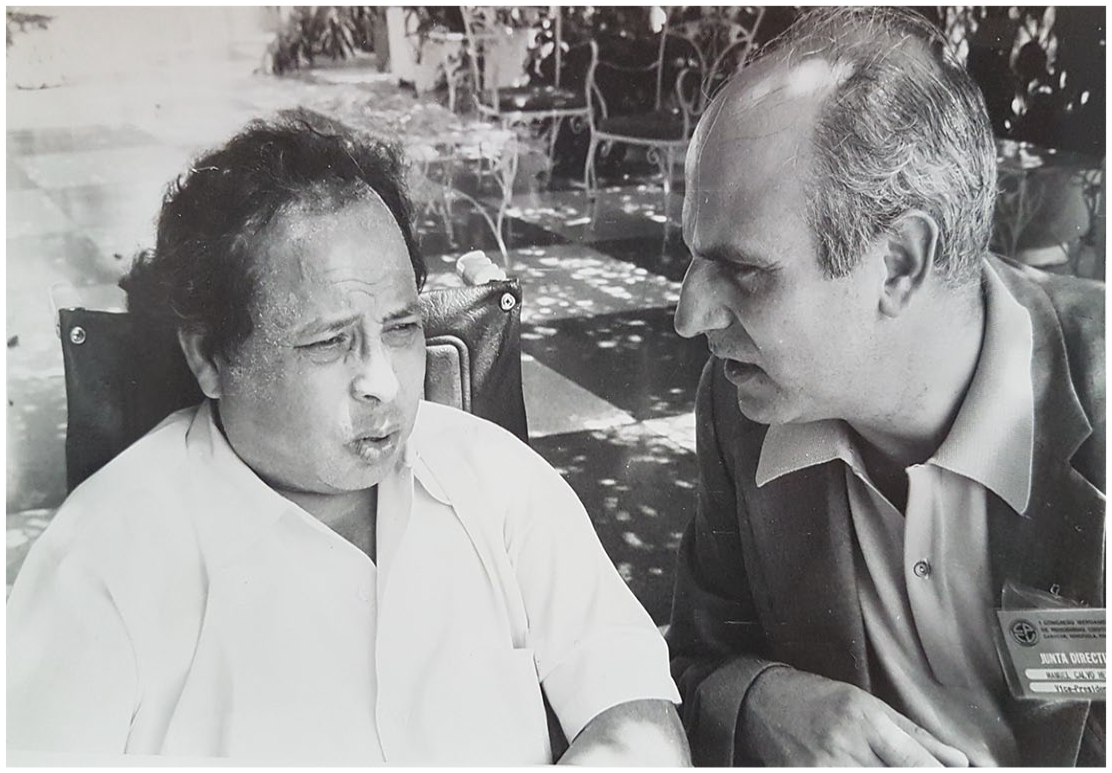
Arístides Bastidas and Manuel Calvo Hernando during the congress.
Documents related to the AIPC are preserved in the personal archives of Manuel Calvo Hernando, a key figure in Ibero-American science journalism. After studying Law, he transitioned to science journalism in the 1950s and served as AIPC’s secretary-general. His archives, reviewed in Spain in January and February 2023, include letters, travel diaries, photographs, and documents from science communication and science journalism congresses in Latin America. They were accessed at his residence in Madrid, and in the Agencia Española de Cooperación Internacional para el Desarrollo (AECID) and the Museo Nacional de Ciencia y Tecnología, in A Coruña. The congress proceedings, provided by Brazilian science journalist Julio Abramczyk in April 2023, offer a detailed account of participants’ speeches. We present the congress and the way participants defended the objectives of science journalism and their demands for greater professionalization.
3. The context of the First Ibero-American Congress of Science Journalism
The First Ibero-American Congress of Science Journalism was held on 10–16 February 1974, at the Hotel Ávila in Caracas, Venezuela. The event featured seminars, roundtables, courses, screening of science films, and exhibits by Venezuelan scientific and technological organizations. It was apparently the first international congress of science journalists. 1
The congress was sponsored by the Venezuelan government and the OAS, under the Inter-American Council for Education, Science, and Culture. The OAS, which had already financed science journalism meetings in the region since the 1960s as part of its cooperation for development projects, covered the international guests’ airfares, lodging, and meals. The congress’s role as part of a broader effort to promote science journalism in Latin America and as a continuation of the OAS project was highlighted by participants like Ecuadorian scientist and journalist Misael Acosta Solís, who recalled 12 years of accumulated debates (CPCV, 1974: 121–158).
The congress was held at a moment of unprecedented political stability and economic prosperity in Venezuela driven by the oil boom, which generated a significant flow of financial resources invested in infrastructure, education, social programs, and science and technology. Organized by the Círculo de Periodismo Científico de Venezuela (CPCV), recently founded in 1971 and led by Arístides Bastidas, the congress benefited from the fact that Venezuelan science journalists were among the most highly organized in Latin America. A self-taught journalist since the 1940s, Bastidas began covering science in 1953 and later established an informal training school for science journalists.
For his part, Manuel Calvo Hernando was considered a mentor of the congress and had a significant influence in its organization. He suggested many of the participating journalists, whom he had met during his travels around Latin America in previous years.
The book of congress proceedings lists 117 journalists from 17 Latin American countries and Spain: 78 Venezuelans, 37 from other Latin American nations, and 2 Spaniards. This ample regional representation reflects the organizers’ success in spreading the discussions across the region. There were also 58 honorary guests, including 50 Venezuelan scientists, 2 representatives from the OAS, the director of the Centro Internacional de Estudios Superiores de Comunicación para América Latina (CIESPAL) Gonzalo Córdova Galarza, the Secretary-General of the European Union of Science Journalists’ Associations (EUSJA) Andrés Sidet, and North American journalists Hiller Krieghbaum and Robert N. Schwartz. The sitting Venezuelan president and the president-elect, who would take office the following month, also attended and spoke at the event (Photo 2).
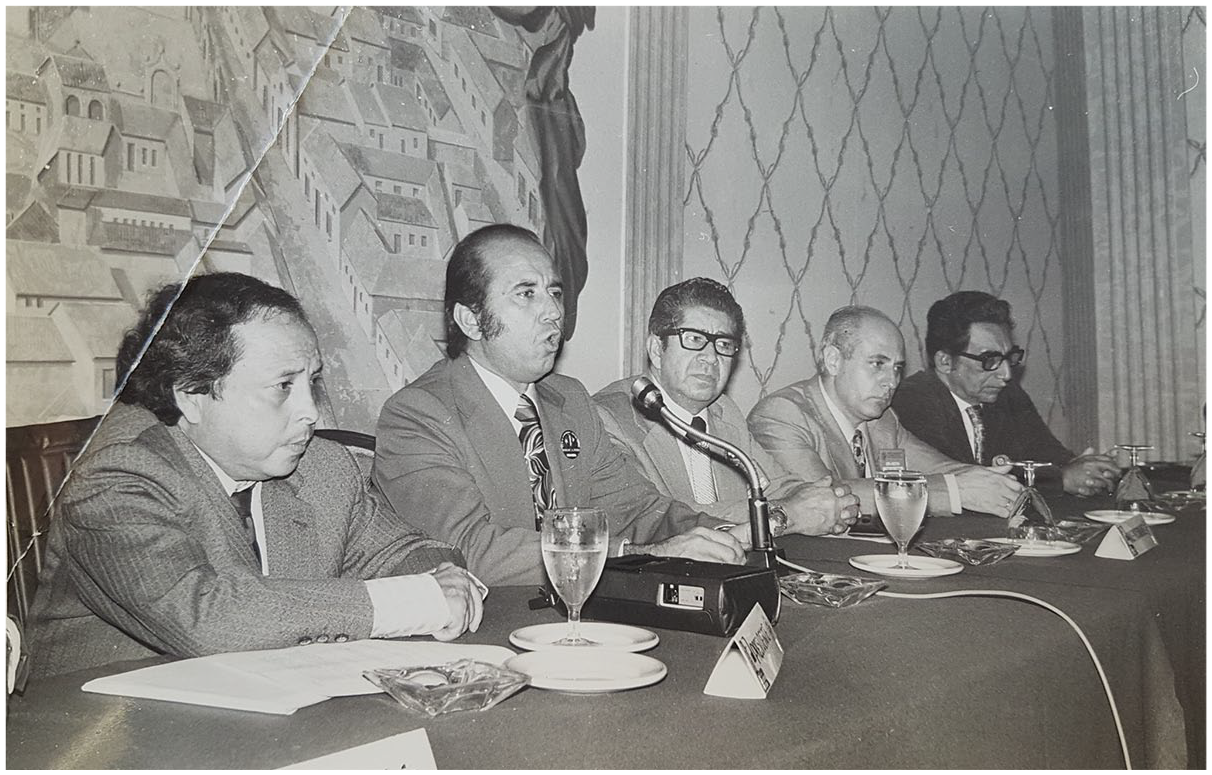
Roundtable during the congress, showing, left to right, Arístides Bastidas (Venezuela), Venezuelan President-Elect Carlos Andrés Pérez, Josué Muñoz Quevedo (Colombia), Manuel Calvo Hernando (Spain), and Manuel Isidro Molina (Venezuela).
The congress was predominantly male. Only 23 of the 117 journalists (19.7%) and 25 of the 175 participants (14.2%) were women. Most of the Latin American science journalists had scientific training.
4. Science journalism as a novelty and the congress participants’ optimism
Congress participants described science journalism as a novel concept in the Latin American media landscape, which they reported as having negligible coverage of science and technology. Several speakers highlighted the challenge of convincing publishers and editors of its importance, beyond commercial interests. Representatives from the Centro Interamericano de Periodismo Educativo y Científico (CIMPEC), an OAS program with headquarters in Bogotá which had prepared press stories on science and technology since 1969, besides publishing science journalism handbooks and organizing seminars, presented a study from 1970 conducted in collaboration with CIESPAL. They reported that an analysis of the presence of science and technology topics in 78 Latin American newspapers had produced “discouraging” findings (CPCV, 1974: 327).
According to many participants, holding the congress signaled the strengthening of a movement to promote science journalism, a different approach when compared to the traditional science communication frequently found in the region’s newspapers. Venezuelan journalist Pedro Serra commented, “Throughout our history, we find constant examples of science communication, but science journalism as a daily, systematic, professional activity has not emerged until our time” (CPCV, 1974: 67). In his opening speech to the congress, Calvo Hernando referred to science journalism as an “adolescent” and stated that “it is coming of age today in Venezuela” (CPCV, 1974: 15). Representatives from CIMPEC echoed the same sentiment: “Science journalists from the continent are now speaking out, and this congress, organized by an association of science journalists, can be considered beautiful proof that this specialty is coming of age” (CPCV, 1974: 331). There was significant optimism, reflected in the vision of science journalism expressed by Venezuelan Arístides Bastidas as a crucial and privileged mediator between the scientific world, its laboratories and coded language, and the public at large. He stated, “Science journalism is the journalism of the future” (CPCV, 1974: 217).
5. The objectives of Latin American science journalism: Informative, educational, and in defense of national development
A central theme of the congress was the definition of science journalism’s objectives. The debates did not focus on abstract objectives, but on a specific science journalism for the Latin American context, which was described as underdeveloped, backward, and dependent. The science journalist was also constantly referred to as the “Latin American science journalist,” highlighting his immersion in the social context.
Science journalism was described as the privileged mediator between the science lab and the reading public. According to Venezuelan journalist Eloy Enrique Porras, “Science journalism seeks to serve as the link between the scientific researcher and the masses, for whom he should simplify what is complicated and express, in everyday language, what the scientist does among his indecipherable expressions” (CPCV, 1974: 57). Honduran journalist Juan Sierra Fonseca expressed a similar view: “The journalist should open the way for the people, especially the man on the street, to understand scientific truths more simply” (CPCV, 1974: 242–243).
The predominant idea was the classical notion that science journalism involves the translation of science into popular language. As stated by Costa Rican journalist Ignacio de la Cruz, “The translation of science to the people’s language is science journalism’s essential issue” (CPCV, 1974: 173). It was thus expected that the science journalist should have a command of both scientific and popular language, serving as a translator between the two.
The congress greatly emphasized science journalism’s educational role. Venezuelan Isidro Molina defended “a transcendent mission: of propelling [. . .] the comprehensive development of the Latin American man” (CPCV, 1974: 21). Venezuelan Pedro Serra stated that “science journalists should be educators of their people [. . .]. They should foster concerns among readers, raise collective awareness concerning the problems that affect them, and point to the root causes and correct solutions” (CPCV, 1974: 76). Guatemalan Edgar Nicolle de León proposed that science journalism should focus on rural and indigenous populations, using specific language and participating in literacy campaigns to expand its reach in a region marked by illiteracy (CPCV, 1974: 47).
Although it is not possible to determine whether it was a predominant view, the congress revealed the perception that one of science journalism’s objectives was to elevate the common man out of ignorance and tradition and lead him to progress. This is evident, for example, in the declaration by Venezuelan journalist Eloy Porras when he stated, “We are going to liberate [man in the underdeveloped countries] from himself, from harmful habits, ignorance, ingrained attitudes, traditional mechanisms, all of which prevent and hinder his voluntary participation in collective tasks for progress” (CPCV, 1974: 51). It is thus evident that the ideal was that of a civilizing mission, aligning the Latin American masses with progress, understood as urbanization and the use of technologies. As summarized by Porras, “Science journalism in developing countries should pursue a transformation of the public’s cultural essence” (CPCV, 1974: 53).
The awakening of new callings for science was also among the main objectives defended. As argued by Bastidas, “Science journalism [. . .] encourages callings for the future. It will spark young people’s interest in the fields on which our nations’ transformation will essentially depend” (CPCV, 1974: 7–8). Another key point was the importance of science journalism in health promotion, such as engaging in efforts to fight infant mortality and malnutrition and raise awareness on vaccination, adequate diet, and hygienic principles.
Journalists at the congress emphasized that one of science journalism’s main objectives was to foment a favorable public opinion toward science as an instrument for national development. Bolivian Carlos Romero stated, “The objective of science and technology journalism in Latin America [. . .] is to foster public awareness on the importance of progress in science and technology for nations’ development” (CPCV, 1974: 85). Likewise, Honduran journalist Juan Sierra Fonseca emphasized the field’s responsibility for orienting public opinion and governments to use resources wisely to solve national problems (CPCV, 1974: 240). Closely tied to development was the need to promote research to reduce reliance on imported knowledge and overcome technological dependence, a recurring theme in several speeches. The speeches reflect that the 1970s generation of Latin American science journalists was aligned with the so-called Latin American School of Thought in Science, Technology, and Development, a current of thought that emerged from the 1950s to the 1970s in a context of regional industrialization, focused on technological autonomy and its role in economic and social development (Marí, 2018).
The declaration by Moreno Gómez summarizes how science journalism was understood by this pioneering generation in Latin America, convened in the congress: “Science journalism cannot be contented with [. . .] information for general communication; rather, it should be fully aware of its role in educating and promoting development” (CPCV, 1974: 282).
6. Closer ties between scientists and journalists
A noteworthy aspect is the profound respect and admiration that these journalists had for science and scientists, as illustrated in their abundant praise for scientists during the congress. Venezuelan journalist Jenara Álvarez Cáceres illustrated this feeling: “I feel profoundly awed by science” (CPCV, 1974: 421). Paraphrasing Nelkin’s (1995) analysis, this admiration suggested a celebratory and largely acritical view of science in the speeches at the congress.
The congress attempted to attenuate cultural, value-based, and procedural differences between journalists and scientists to reach a common objective: science communication with informative, educational, and development goals. Various journalists underscored that science journalism should result from a partnership between the scientific community and journalists, with a shared interest in promoting science through journalism. The relationship between the two groups, particularly potential conflicts, was a recurring theme, highlighted in the roundtable “Conflicts Between Journalists and Scientists,” drawing scientists and journalists together (Photo 3).
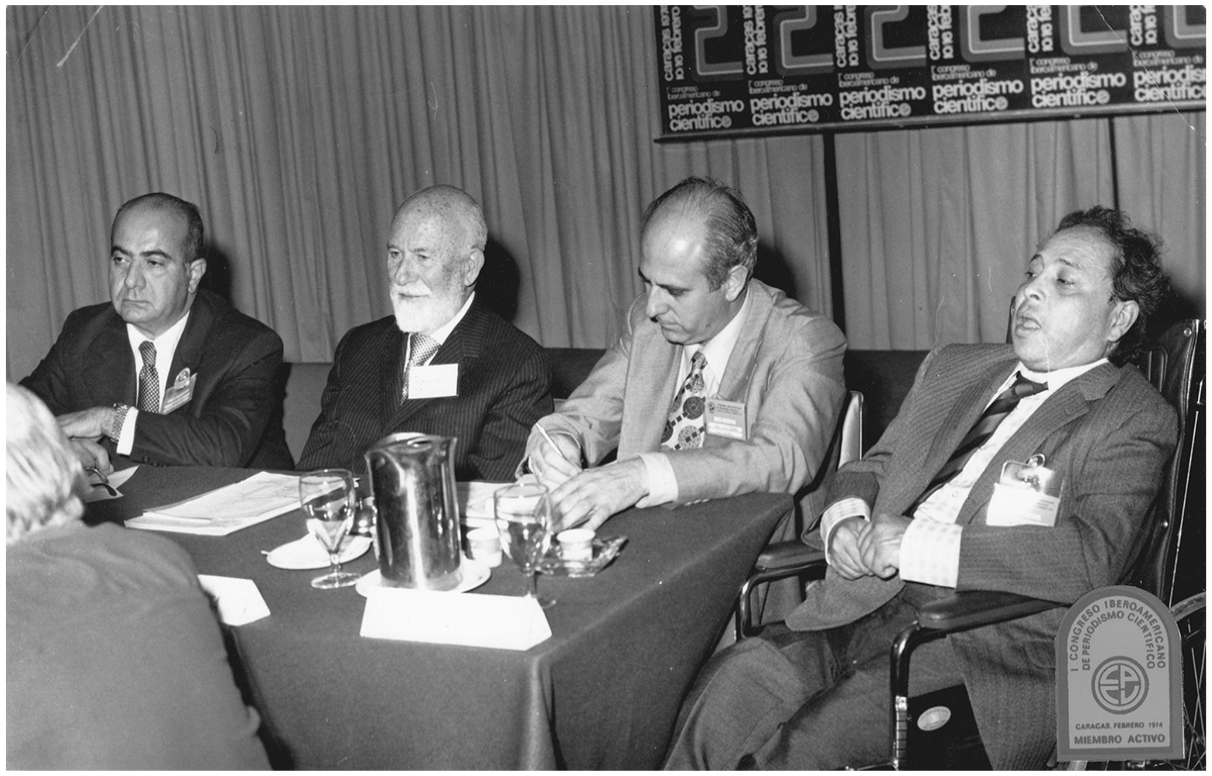
Roundtable “Conflicts between journalists and scientists” during the congress.
Venezuelan journalist Luis Moreno Gómez stated that there was a “divorce between the science community and the journalism community” due to diverging moral and ethical codes. He defended a “joint effort” to overcome this division, noting signs of recent progress (CPCV, 1974: 288). Argentinian Jacobo Brailovsky also used the marriage metaphor and argued for a “marriage of convenience” that should be characterized by cordiality and tolerance (CPCV, 1974: 354). Meanwhile, Honduran journalist Juan Sierra Fonseca suggested that resolution of the conflicts would require better training for journalists (CPCV, 1974: 244). This position was seconded by Moreno Gómez, who also emphasized that science journalists should be reliable allies of the scientific community: “The journalism community should supply the science community with properly trained journalists, prepared to deal with the responsibility of communicating sciences and techniques” (CPCV, 1974: 288).
Many participants in the congress had prior training in science before entering journalism, and some were still working as scientists. This prior experience and familiarity with scientific practice led this generation of journalists to vigorously defend science’s objectives in its relationship with the public at large.
7. Promoting the professionalization of Latin American science journalism
A central theme in the congress was the training of new science journalists. Nicolle de León was one that suggested the creation of science journalism chairs in Latin American journalism schools (CPCV, 1974: 50). Moreno Gómez proposed the supply of postgraduate courses (CPCV, 1974: 289). Acosta Solís suggested various training formats, including short courses and seminars (CPCV, 1974: 128). At the time, there was still no space for science journalism in Latin American universities.
Another important point was the need for greater support for science journalism from governments and institutions. The congress also emphasized the importance of establishing national professional associations devoted to science journalism. Correspondence after the congress reveals the creation of new national associations in Ecuador, El Salvador, and Guatemala, adding to those that already existed in Argentina and Venezuela, as direct consequences of the congress.
The congress was thus a crucial step in consolidating the AIPC, transforming it from a vague concept since 1969, still without practical action, into an active organization. The congress was essential for strengthening regional ties and promoting the association’s activities.
8. Final remarks
The First Ibero-American Congress of Science Journalism in 1974 was important for the professionalization and legitimation of science journalism in Latin America, where media coverage of science and technology had still been very limited. The event advocated an informative and educational journalism focused on the defense of science in national development. It emphasized the importance of expanding journalists’ training, strengthening institutional and media support, improving the relationship between scientists and journalists, and promoting greater organization through professional associations. The Latin American science journalists defended a science journalism at the service of science’s goals, thus celebratory and largely acritical. Fifty years later, science journalism can still play a vital role in Latin America’s development, and there is still a relevant need to improve science journalists’ training and organization, as well as to foster a more critical perspective within the profession.
Footnotes
Funding
The author(s) disclosed receipt of the following financial support for the research, authorship, and/or publication of this article: This study is hold in the scope of the Brazilian Institute of Public Communication of Science and Technology, with the support of the National Council for Scientific and Technological Development (CNPq) and of the Rio de Janeiro Research Foundation Carlos Chagas Filho (Faperj). Massarani thanks to CNPq for the Productivity Researcher Scholarship and to Faperj for the Scientist of Our State Scholarship. Magalhães thanks to Faperj for the Doctoral Grant.
Notes
Author biographies
 . She is the recipient of the Productivity Researcher Scholarship of the National Council for Scientific and Technological Development and of the Scientist of Our State Scholarship of the Rio de Janeiro Research Foundation Carlos Chagas Filho.