







Abstract
Implementing artificial intelligence also requires examinations of public attitudes and perceptions. One approach is by examining media framing of artificial intelligence, including news coverage, which is a reflection of societal perceptions and a key influence over people’s understanding. As such, this study examines the framing of communicative artificial intelligence in Singapore, looking at how the news media frame communicative artificial intelligence and characterize it as a social actor. Through a manual content analysis of 336 news articles from three major news websites in Singapore, this study found that the news media in Singapore tend to focus on the benefits and advances of communicative artificial intelligence and portray communicative artificial intelligence as a tool rather than social actor. However, when comparing news coverage of communicative artificial intelligence after the advent of ChatGPT, the news framed communicative artificial intelligence more in terms of risks, regulations, responsibilities, and conflict.
Keywords
1. Introduction
Limited by its small population size, the city-state of Singapore has implemented artificial intelligence (AI) across various sectors and industries to reduce reliance on manpower. For example, Singapore has implemented AI in combatting scams (Lim, 2022) and customer service (Low, 2021), among numerous others. It has also invested heavily in AI research and launched the Artificial Intelligence Singapore (AI.SG) initiative that funds research into AI technology and governance, and supports organizations in implementing AI technologies (Tegos, 2017).
Beyond technological and economic considerations, implementing a technology also requires understanding attitudes, perceptions, and discourses that shape and reflect public acceptance of the technology (Stoutenborough et al., 2013). The rollout of AI across various industries has triggered concerns over job displacement, privacy intrusions, and data safety, among others (Brondi et al., 2021). These concerns are particularly salient in the subset of communicative AI. For example, the use of AI to automatically generate news articles has sparked concerns about the job security of human journalists, while the rise of generative AI chatbot ChatGPT has sparked concerns related to plagiarism and copyright.
An important factor in understanding people’s knowledge, attitudes, and perceptions regarding emerging technologies is the news media. On the one hand, the ways that the news media represent phenomena are shaped by social factors—news is essentially a social construction influenced by societal norms and values (Shoemaker and Reese, 2014; Tewksbury and Scheufele, 2009), reflecting societal attitudes. On the other hand, the news media can also influence the ways individuals perceive issues and phenomena. As the public usually does not have immediate personal knowledge or direct experience with emerging technologies, such as AI, they rely on external sources of information to help them form their initial opinions and attitudes that may affect their subsequent decisions and behaviors (Höijer, 2011). Both perspectives make it important to evaluate how the news media represent emerging technologies. Guided by the assumptions of news framing theory (Tewksbury and Scheufele, 2009), this current study examines news coverage of communicative AI in Singapore through a content analysis of articles published in three mainstream news websites in Singapore.
2. Literature review
Communicative AI
The Infocomm Media Development Authority (IMDA, n.d.) of Singapore defines artificial intelligence (AI) as “intelligent machines to mimic human action and thought.” AI consists of computers that process information and complete tasks in a manner and order programmed by a human, without deviation, also known as narrow AI, as well as computers that develop, learn, improve, and execute processes without direct input from a human, also known as machine learning (IBM, n.d., Russell and Norvig, 2010).
One subset of AI is communicative AI, which includes various applications such as “conversational agents, social robots, and automated-writing software” (Guzman and Lewis, 2019: 72). In practice, communicative AI is a computer, machine, or software that generates communication, or communicates with humans, autonomously without a human directly dictating the contents of its communication. The impact of AI is particularly pronounced in communication, where messages and meaning have been traditionally assumed as originating from human communicators. However, generative AI is now able to generate messages with minimal human prompt with its output being almost indistinguishable from a human communicator.
Communicative AI has been widely researched in the context of journalism, as news organizations adapt technologies to automate stages of news production previously performed by human journalists, from conducting preliminary research, proofreading, to automatically writing an article (Carlson, 2015; Wu et al., 2019). While this allows newsrooms to push out more stories in less time and with less human effort, this practice also raises concern, from fears of human journalists losing jobs to computers to questions of integrity and accountability, especially when AI-written news articles come with fake bylines (Gold, 2024).
In Singapore, various types of communicative AI have also been implemented. Still, despite extensive focus given to researching and developing AI and its applications in Singapore, little is known about how the general public perceives and understands communicative AI, which may influence the level of public acceptance and use. Examining news articles on communicative AI is a good starting point in analyzing public perceptions—news articles can be seen as both shaped by societal attitudes, as well as an important factor that can subsequently shape public perceptions and attitudes (Tewksbury and Scheufele, 2009). Thus, this current study examines how news articles in Singapore frame communicative AI.
News frames
Chong and Druckman (2007: 104) argue that “an issue can be viewed from a variety of perspectives and be construed as having implications for multiple values or considerations.” But the way information is presented—namely, words, angles, and formats—can influence how the audience understands the topic or situation being presented, creating a framing effect (Druckman, 2001). As such, framing can prompt audiences to “develop a particular conceptualization of an issue or reorient their thinking about an issue” (Chong and Druckman, 2007: 104).
Framing is inevitable. Communicators engage in framing, intentionally or unintentionally, by presenting an issue in a way where certain aspects are emphasized at the expense of others; this may influence how those exposed to the message think about the issue (De Vreese, 2005; Tewksbury and Scheufele, 2009). A frame makes certain aspects of an issue or topic more salient than others, which can impact how audiences understand, interpret, and evaluate the issue (De Vreese, 2005; Entman, 1993). This is because a frame makes certain information more salient than others, making them “more noticeable, meaningful, or memorable” (Entman, 1993: 53). At the same time, by focusing on certain perspectives of an issue, the frame will activate audiences’ pre-existing information and beliefs when processing the message, redirecting people’s information processing toward certain considerations and away from others (Nelson et al., 1997; Price et al., 1997).
When evaluating an issue, people also rely on numerous values, beliefs, and opinions. Thus, other than redirecting audiences’ considerations, frames can also alter which values, beliefs, and opinions people focus on when processing and evaluating an issue (Nelson et al., 1997). By emphasizing perspectives and information, frames increase salience of certain beliefs, making it more likely for audiences to process the information based on those beliefs (Lecheler and De Vreese, 2019). Alternatively, the frame can also present new beliefs and considerations for audience to process the message with. Hence, frames can influence people’s attitudes toward and understanding of issues.
Framing is arguably most salient in examining news. In reporting about events and issues to the public, news articles inevitably engage in framing, highlighting one aspect over others. Tewksbury and Scheufele (2009) classify news framing studies into those examining “frame building” and “frame setting.” Frame building refers to the process that shapes how journalists frame their stories, influences by various factors, such as by their professional routines, news values, and their imaginations or encounters with audiences (e.g. Boesman et al., 2017). Frame setting refers to the extent to which frames in communication influence how audiences understand the issue—essentially, media effects (e.g. Aday, 2006). However, a third group of studies focus on identifying frames in the news (De Vreese, 2005) or what others refer to as media or news frames, “a written, spoken, graphical, or visual message modality that a communicator uses to contextualize a topic, such as a person, event, episode, or issue, within a text transmitted to receivers by means of mediation” (D’Angelo, 2017: 1).
Scholars distinguish between two general types of news frames: equivalency framing and emphasis framing. Equivalency framing refers to presenting the same information in different but logically identical ways, with each presentation resulting in different outcomes among the audience (Chong and Druckman, 2007; Druckman, 2001). Emphasis framing occurs when a message emphasizes certain considerations or perspectives over others, steering the audience to understand the issue through these considerations or perspectives (Druckman, 2001, 2004). Emphasis framing has been studied extensively across numerous issues and topics such as news framing of blogs (Jones and Himelboim, 2010), obesity (Kim and Anne Willis, 2007), among others.
Identifying news frames usually takes either an inductive or deductive approach (De Vreese, 2005). In an inductive approach, frames emerge during the analysis of texts, with each study yielding a new set of frames (Tewksbury and Scheufele, 2009). In a deductive approach, studies examine texts through the lens of frames previously defined and operationalized in earlier studies (De Vreese, 2005). Such an approach allows comparison across studies, contexts, and time. This current study uses the deductive approach and examines the emphasis framing in news reports in Singapore about communicative AI.
AI in the news
The news media have covered AI and its applications extensively. Like any issue or event, AI too has been subject to news framing, and scholars have attempted to understand how the media in various countries have framed AI. These previous studies have generally identified the following news frames in the reporting of AI: technological progress or advancement (Chuan et al., 2019; Sun et al., 2020); potential benefits, especially for business innovation (Brokensha, 2020; Chuan et al., 2019; Cools et al., 2024; Nguyen and Hekman, 2022, 2024); challenges, dangers, and risks (Brokensha, 2020; Chuan et al., 2019; Ouchchy et al., 2020); regulation, accountability, and responsibility (Chuan et al., 2019; Nguyen and Hekman, 2022, 2024; Ouchchy et al., 2020; Sun et al., 2020); public perception and acceptance (Chuan et al., 2019); conflict and competition (Cools et al., 2024; Nguyen and Hekman, 2024); and human interest (Chuan et al., 2019).
In terms of benefits, the media have emphasized creation of new jobs (Brokensha, 2020), practical uses of AI in improving people’s daily lives (Chuan et al., 2019; Cools et al., 2024; Nguyen and Hekman, 2024; Sun et al., 2020), and AI as a potential solution to societal issues and problems (Cools et al., 2024; Sun et al., 2020). With regard to technological progress or advancement, some articles emphasize the technology behind AI, such as the computing power, or the capabilities of the technology (Sun et al., 2020). Some articles also describe AI as being able to surpass humans in certain tasks, allowing society to make use of these AI technologies to improve processes (Bunz and Braghieri, 2022; Cools et al., 2024). In terms of the costs, the media have framed AI in terms of the risks, challenges, and negative ethical implications of the technology. These include causing job or economic losses for some (Brokensha, 2020; Chuan et al., 2019; Ouchchy et al., 2020). Other articles focus on the ethical or moral issues that AI technology would entail, including questions of data privacy (Brokensha, 2020; Chuan et al., 2019; Nguyen and Hekman, 2024; Ouchchy et al., 2020), AI bias and discrimination (Nguyen, 2023; Ouchchy et al., 2020), errors committed by AI technology (Nguyen and Hekman, 2024), and other information-related issues, such as information disorder and hacking (Nguyen, 2023; Vergeer, 2020). Related to these errors, challenges, and issues brought by AI, some articles also frame AI with regard to the need for guidelines or regulations, and responsibility. These regulations are to ensure AI indeed brings economic progress (Nguyen and Hekman, 2022) or to mitigate potential detriments of AI technology (Chuan et al., 2019; Cools et al., 2024; Nguyen and Hekman, 2022; Ouchchy et al., 2020; Sun et al., 2020). Some articles delved deeper, focusing on which parties should be held accountable or responsible for these issues and harms (Ouchchy et al., 2020). Some articles also emphasize and frame AI as creating conflicts between various groups, such as market competition between companies, or an AI arms race between geopolitical rivals (Cools et al., 2024; Nguyen and Hekman, 2024). When reporting about and framing AI technologies, some news articles focus on the human interest of the issue, crafting a news story surrounding individuals’ experiences (Chuan et al., 2019). Some also frame the technology using the opinions of individuals (Chuan et al., 2019), focusing on public perceptions of AI technology.
News framing studies also examine article valence, for example, whether the article frames AI as positive or negative. Across news media globally, coverage of AI tends to be positive or neutral, but with news articles becoming more negative over time as coverage increases (Chuan et al., 2019; Cools et al., 2024; Nguyen and Hekman, 2024; Ouchchy et al., 2020; Vergeer, 2020).
Understanding how the news media frame issues and events is important, for while the news media are influenced by social factors and contexts, news frames can also influence public understanding of such issues and events (Entman, 1993). For instance, greater perceived risk created via news about AI is associated with lower support for implementing AI technology (Choi, 2024). While studies have documented the different news frames in the media reports of AI, most of these studies have done so in Western media contexts. This study seeks to contribute to this growing area of research by examining news frames in the media reports of communication AI technology in Singapore. Thus, guided by news framing theory and previous studies that examined how AI is framed in the news, this study asks:
RQ1: How do the news media in Singapore frame communicative AI technology?
Anthropomorphizing AI
Implicit in the general frames identified in previous studies that examined news coverage of AI is the comparison of AI with humans. For example, highlighting technological advancements of AI (i.e. capabilities of AI to perform certain tasks) usually takes the form of presenting AI as equal to or better than humans in certain tasks. Scholars have also examined the relationships emerging between humans and AI. For example, Tschopp et al. (2023) examined through the lens of relational models theory (RMT) how users of conversational AI (e.g. Alexa) perceived their relationship with the technology. The study found that users perceived the relationship more as a master-assistant one than a companion-like relationship. Such perceptions have implications on how individuals use AI technology; for example, another study found that those who perceived a peer bonding relationship with voice shopping AI tools were more likely to report higher shopping intentions (Tschopp and Sassenberg, 2024). Other studies have focused on the extent to which AI tools are presented as possessing human-like traits, outperforming humans in previously human-only tasks. For example, in an inductive analysis of news articles in China and the United States about Google’s AlphaGo, Curran et al. (2020) examined whether articles presented AlphaGo as human or nonhuman. While most studies that analyzed news frames in the context of AI focused on general frames, a few articles considered the presentation of AI as human (vs nonhuman) as a news frame as well (Brokensha, 2020; Curran et al., 2020).
When a computer, software, or machine is described as a human, it is being anthropomorphized. Anthropomorphism refers to “attributing humanlike properties, characteristics, or mental states to real or imagined nonhuman agents and objects,” including emotions, behaviors, and appearance (Epley et al., 2007: 865). For example, news reports about the use of AI in medicine have referred to AI as a doctor (Bunz and Braghieri, 2022). Studies have found that the higher the level of anthropomorphism people perceive in a computer or machine, the more attractive, believable, and likable they evaluate the computer or machine (Lee, 2010; Lee-Won et al., 2020; Spatola and Wudarczyk, 2021).
The level of anthropomorphism can be influenced by visual, verbal, behavioral, and emotional characteristics of the computer or machine. The more human-like a software agent looks, the more similar, competent, and trustworthy people rate the software agent, and the more they are influenced by the software agent in decision-making (Gong, 2008). The verbal capabilities of a computer can also influence anthropomorphism. When a chatbot displays more human-like speech patterns, such as response time, people perceive greater anthropomorphism and report greater satisfaction and time spent interacting with the chatbot (Rhim et al., 2022). Similarly, when a chatbot talks more like a human, people tend to attribute greater anthropomorphism to the chatbot, which can increase an emotional connection with the organization employing the chatbot (Araujo, 2018).
Other studies examined behavioral characteristics ascribed to AI. For example, when a software agent engages in more reciprocity and self-disclosure, which are relationship-building behaviors, people find the software agent more trustworthy and the interaction more enjoyable (Lee and Choi, 2017). With regard to emotions, a virtual agent that displays emotions will be perceived to be more anthropomorphic and authentic, which will lead people to have more favorable attitudes toward it (Ham et al., 2024). Thus, giving the chatbot more human identity and personality can also increase engagement with the chatbot, which can make the user experience more enjoyable (Chaves and Gerosa, 2021).
These findings are consistent with the assumptions of the Computers-Are-Social-Actors (CASA) paradigm, which states that “people, despite their awareness that computers are not humans, do apply social rules, norms, and expectations to their interactions with computers, and treat computers as if they were ‘social actors’” (Lee and Nass, 2010: 2). When confronted with a computer exhibiting even minimal social cues, people would perceive a personality, treat the computer as a social actor, applying human stereotypes and expectations on the computer based on the personality and social category they perceive the computer to have (Lee and Nass, 2010). These include norms of reciprocity (Fogg and Nass, 1997), applying gender stereotypes (Nass et al., 1997), among others. The CASA framework is especially useful in examining communicative AI applications, such as chatbots, which are social in nature, with their main functions being interacting and conversing with human users.
How individuals perceive communicative AI, such as the extent to which they anthropomorphize these technologies, can also be influenced by how communicative AI tools are described in the media, and whether the media portrayals themselves anthropomorphize such technologies. In turn, journalists’ observations and perceptions of the extent to which the public ascribes human traits to AI can shape their reporting. However, only a few studies have examined news reporting of AI as social actors. Brokensha (2020) found that some news articles in South Africa described AI news in terms of appearance, behavior, and function, much like how a human is usually described. In analyzing US and UK news about AI in healthcare, Bunz and Braghieri (2022) found that AI is often mentioned as a social actor, being personified and labeled as a “doctor” or as a “boss.”
Therefore, in this study, we complement our analysis of general news frames used in news coverage of communicative AI with a deeper analysis into the extent to which communicative AI is anthropomorphized in the news media in Singapore. This can be examined based on three components: social cues, sociability, and personification. First, news reports can describe the affordances of communicative AI technologies by referring to the social cues they generate, which can be verbal, visual, and auditory cues. Verbal cues are word-based written or spoken words; visual cues are nonverbal visual cues such as movement, gestures, and appearance; while auditory cues are nonverbal sounds such as pitch, volume, and tone (Feine et al., 2019). Second, news reports can also ascribe sociability characteristics to communicative AI tools, which refers to “the extent to which the communication environment mediated by technology is perceived to facilitate social interaction and to enhance social connectivity” (Shin, 2013: 940). While sociability refers to facilitation of social interaction between people, a computer can facilitate social interactions with itself, with the computer taking on a social role such as friend or family (Purington et al., 2017). For example, news headlines have referred to AI chatbots as friends or companions (Wall Street Journal, 2023). Third, news reports can also describe communicative AI tools as having person-like qualities, such as having emotions, reacting, adapting, and being autonomous (Schaumburg, 2001). A simple writing device that adds to personification is the use of pronouns, referring to AI tools as he or she. Focusing on these three areas, we therefore ask:
RQ2: To what extent do news media in Singapore present communicative AI technology as humanlike, in terms of social cues, sociability, and personification?
ChatGPT
Examining how the news frames and anthropomorphizes communicative AI must also account for temporal contexts. For example, in their analysis of news articles about AI in healthcare, Bunz and Braghieri (2022) found temporal differences in how AI has been framed. Such timeline accounts for major events and developments that may have influenced news coverage. In the realm of communicative AI, one major development is the rise of ChatGPT.
Launched in November 2022, ChatGPT soon dominated headlines after it amassed 100 million users by January 2023 (Chow, 2024). It has since become the most popular generative AI chatbot. Therefore, it is also important to account for this phenomenon when analyzing news coverage of communicative AI. Thus, we also ask:
RQ3: How does media framing of communicative AI, in terms of emphasis framing and anthropomorphism, compare before and after the rise of generative AI?
3. Method
To answer the research questions, a manual content analysis of news articles published in the three largest local mainstream news websites in Singapore—www.straitstimes.com, www.channelnewsasia.com, and www.todayonline.com—was conducted. Closely regulated by the state through an elaborate system of legal frameworks, the news industry in Singapore is marked by a duopoly (Tandoc and Chew, 2023). The government-owned Mediacorp operates most of the radio and television stations, including the regional news network Channel NewsAsia (CNA), while the government-supported SPH Media Trust operates most of the newspapers, including the paper-of-record The Straits Times (ST). Both CNA and ST have their websites, while Mediacorp’s Today started as a newspaper before transitioning into an online-only news outlet.
A search was conducted on Factiva for news articles that contained at least one of the following keywords: “artificial intelligence communication, chatbot, conversational agent, social robot, automated writing, and virtual assistant.” The search was conducted on September 7, 2023, and yielded 346 articles (271 from ST, 33 from CNA, and 42 from Today), with the earliest article dated 29 June 2001, and the most recent dated 2 September 2023. Three researchers were trained to manually code the articles based on a content analysis manual developed based on past studies on news framing, CASA, anthropomorphism, and social cues. Several rounds of coder training were conducted prior to actual coding to ensure data quality. We initially conducted two training sessions. During each round, 10 news articles discussing communicative AI technologies were coded and formal intercoder reliability testing was conducted after these two sessions, yielding acceptable reliability scores for news frame, valence, social cues, and personification. Two additional training sessions were conducted, focusing on sociability, to ensure greater clarity among coders; a formal intercoder test focusing only on sociability items yielded acceptable reliability scores (see supplemental materials for final coding manual used). The 40 articles used in the training sessions were from various local and international news organizations, such as Yahoo News, WION, and ZDNet; 10 of these articles were from Today, which were excluded from the final analysis. Next, the coders proceeded with the actual coding. The 336 articles were evenly divided among the coders, with each coder coding articles from all three news organizations.
News frame
The coders indicated the news frame of each article based on a list of frames adapted from past studies (i.e. Brokensha, 2020; Chuan et al., 2019; Cools et al., 2024; Nguyen and Hekman, 2022, 2024; Sun et al., 2020). The most prominent frame was derived from coding which of the following frames appeared first in the headline and first paragraph of the article, with each article only having one most prominent frame: (a) technological advancement frame—technological aspects of communicative AI, such as its capabilities, features, or advancements in the field; (b) potential benefits frame—potential positive impacts of communicative AI; (c) risks, challenges, and negative ethical implications (dangers) frame—risks, challenges, dangers, or negative ethical or moral implications associated with communicative AI; (d) public perception and acceptance frame—examines public opinion, attitudes, or acceptance of communicative AI; (e) regulation and responsibility frame—the need for AI to be controlled or regulated either by the state or by individual human users; (f) human interest frame—reports the issues through the perspective or experience of a specific individual or group that humanizes the story or makes it more relatable for readers by reading through someone’s experience; and (g) conflict frame—competition between countries, or between companies, or between human and machines, and depicts potential winners and losers. The coders achieved intercoder reliability after two rounds of training, Krippendorf’s α = 0.75.
Valence
Framing studies argue that news frames also involve valence. Thus, each article was also coded for its valence—the overall sentiment or emotional tone conveyed in the article. Each article was coded as (a) negative, (b) neutral, or (c) positive. The coders achieved intercoder reliability after two rounds of training, Krippendorf’s α = 0.85.
Social cues
Articles were also coded for which social cues AI is reported to display. This was adapted from the framework of social cues of conversational agents developed by Feine et al. (2019). The presence of each of the following were coded for (a) verbal cues (Krippendorf’s α = 0.77), (b) visual cues (Krippendorf’s α = 1.00), and (c) auditory cues (Krippendorf’s α = 0.74). Invisible cues were excluded as the coders did not achieve intercoder reliability after the initial two rounds of training.
Sociability
Articles were also coded for whether the AI is portrayed as actually or potentially facilitating social interactions, taking on a human role or function. This is based on the findings and conceptualization by Purington et al. (2017). Intercoder reliability testing showed inconsistent results after the initial two sessions of training. Thus, two additional training sessions were conducted, focusing only on the sociability items. Intercoder reliability testing following these two additional rounds of training yielded acceptable results. The following human roles and functions were coded, in increasing degree of sociability and intimacy: (a) information (AI as a source of information such as fact-checking, or for research; Krippendorf’s α = 0.69), (b) entertainment (AI to provide entertainment such as playing music, audio books, games, or telling jokes; Krippendorf’s α = 0.73), (c) assistant (AI to assist the user in personal activities such as time management or creating schedules; Krippendorf’s α = 0.61), (d) companion (AI as a companion, conversation partner, or other entity that listens and speaks; Krippendorf’s α = 0.86), and (e) friend (AI as akin to the user’s friend, family member, roommate, or spouse; Krippendorf’s α = 0.82).
Personification
Finally, articles were coded for the extent that the AI or its agent is being personified. This is based on previous studies on framing of AI (Brokensha, 2020; Bunz and Braghieri, 2022), CASA (Lee and Nass, 2010), and anthropomorphism (Bradshaw, 1997; Chaves and Gerosa, 2021; Epley et al., 2007; Ham et al., 2024; Schaumburg, 2001). The following expressions of personification were coded for, after coders achieved intercoder reliability following two rounds of training: (a) use of pronouns—object pronoun, male pronoun, female pronoun, or collective pronoun (Krippendorf’s α = 0.71); (b) emotions—the AI is presented as able to express emotions, like love or empathy, such as feeling bad or sorry for the user, acknowledges the user’s feelings, or showing understanding for how the user is feeling (Krippendorf’s α = 0.77); (c) reactivity—the article mentions that AI has the ability to selectively sense and act as well as reacts to changes in its environment or to messages from other agent (Krippendorf’s α = 0.72); (d) autonomy—the article mentions that AI can make decisions or perform tasks without any direct inputs or instructions from a human user (Krippendorf’s α = 0.77); and (e) adaptivity—the article mentions that AI is able to learn and improve with experience (Krippendorf’s α = 0.84).
4. Results
RQ1 asks how the news media in Singapore frame communicative AI technology. The most frequently used news frame was the potential benefits of AI (31.5%). This was followed by technological advancements (28%); risk, challenges, and negative ethical implications (12.2%); and public perception and acceptance (11.3%). The other frames are human interest (6%), conflict (5.7%), and regulation and responsibility (5.4%). Table 1 summarizes the results.
Content analysis results.
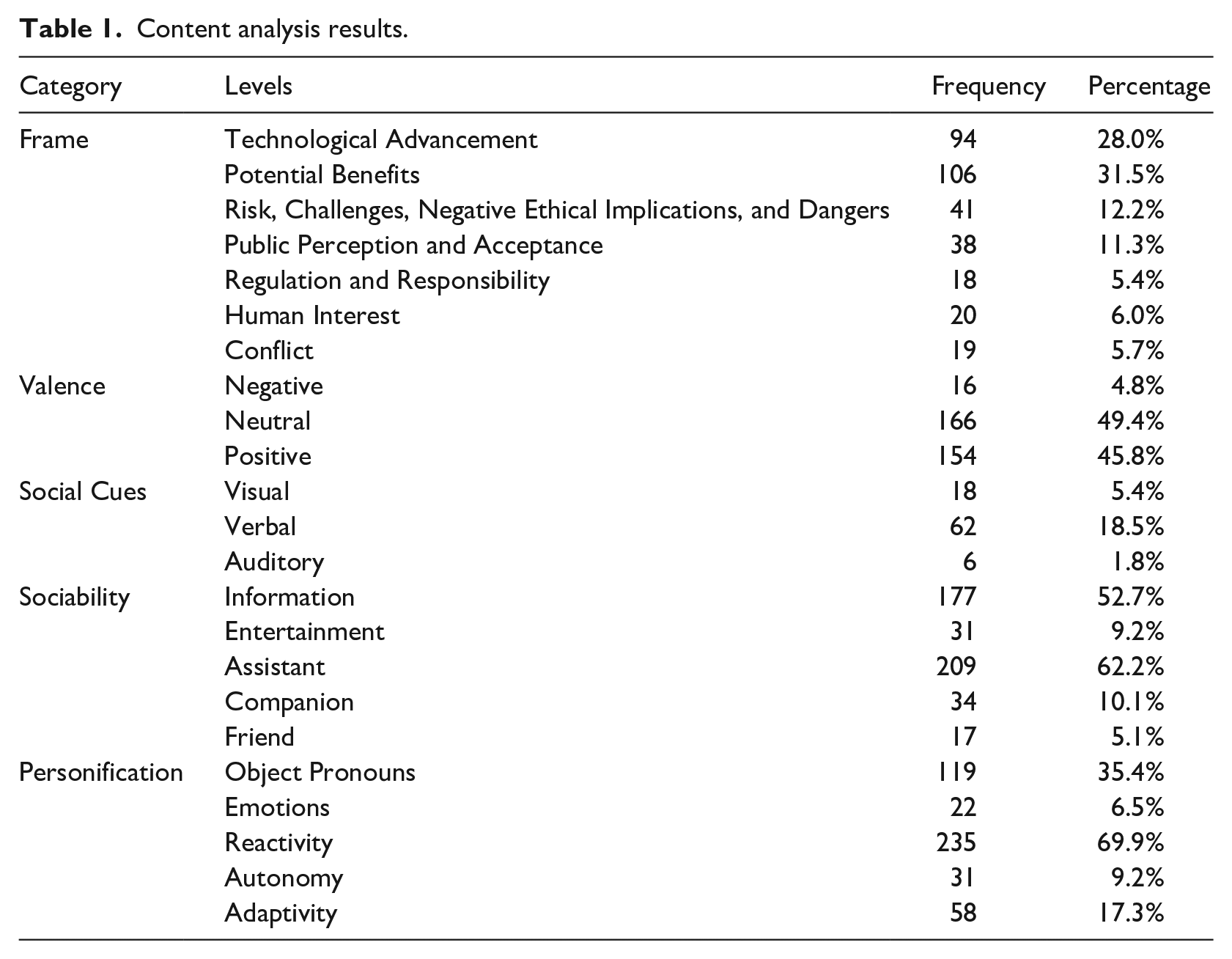
In terms of valence, most articles were positive or neutral, consistent with those found by previous studies in other media contexts. Only 4.8% had a negative overall sentiment or emotional tone; in contrast, 49.4% were neutral and 45.8% were positive. Thus, media framing of communicative AI in Singapore locates it within the larger discourse of benefits to society. To investigate this further, we examined the association between the general emphasis frames and valence. We conducted a one-way analysis of variance (ANOVA) to compare the valence of articles across the different emphasis frames.
The analysis showed significant differences in the valence across the different frames, F (6, 336) = 24.85, p < .001. News articles using the potential benefits (M = 2.66, SD = .50) and the technological advancement (M = 2.65, SD = .48) frames were more likely to be positively valanced than all the other frames. Articles using public perception (M = 2.32, SD = .62); human interest (M = 2.20, SD = .41); conflict (M = 2.00, SD = .47); and regulation and responsibility (M = 1.94, SD = .24) tend to be less positive; they are not statistically different from one another, but statistically different from the previous two frames. Finally, articles using the risk and challenges frame tend to be the least positive (M = 1.80, SD = .46), although not statistically different from the regulation, human interest, and conflict frames.
RQ2 asks to what extent news media in Singapore anthropomorphize communicative AI technologies. We examined this based on three components. First, we examined the extent to which news articles attribute social cues to communicative AI technologies: 75% of the articles do not mention any social cues related to communicative AI; 18.5% mentioned communicative AI displaying verbal cues; 5.4% describe them as having visual cues; and only 1.8% describe them as having auditory cues.
Second, we examined how news articles describe the sociability of communicative AI technologies. Most of the articles presented communicative AI as an assistant (62.2%); the majority also presented communicative AI as an information source (52.7%). In contrast, only 9.2% presented communicative AI as a source of entertainment, 10.1% as a companion, and only 5.1% as a friend.
Finally, we examined the extent of personification. In terms of pronoun use, 53% of the articles did not use any pronouns, while 35.4% used object pronouns (i.e. “it”). Only 7.2% used male or female pronouns and 4.5% used collective pronouns.
In terms of emotions, only 6.5% of articles mentioned the AI having or displaying emotions. In terms of reactivity, most articles described communicative AI as capable of reacting (69.9%). In contrast, only 17.3% of the articles described communicative AI technologies as adaptable and only 9.2% described them as autonomous (see Table 1). Therefore, in terms of presenting communicative AI as being humanlike, we see a relatively low level of anthropomorphizing, mostly portraying it as a functional tool for information to assist human users, dependent on user inputs.
RQ3 asked about how news framing of communicative AI compares before and after the rise of generative AI. To answer this, we divided the articles into two temporal groups: those published from 2001 to 2022 (n = 231) and those published in 2023 (n = 105). This was in consideration of ChatGPT’s launch in late November 2022 and how it started attracting global media attention when it crossed 100 million users in January 2023. Next, we conducted chi-square tests of independence to examine the association between time and each of our content analysis categories.
First, in terms of news framing, we see a significant association, χ2(6, 336) = 47.08, p < .001. While the most used news frames from 2001 to 2022 were potential benefits (38.1%) and technological advancement (31.2%), the most used frames in 2023 were technological advancement (21%) and risks, challenges, and negative implications (19%). We also found an increase in the use of regulation and responsibility (from 2.2% to 12.4%) and conflict (from 2.6% to 12.4%) frames (see Table 2).
News frames across time.
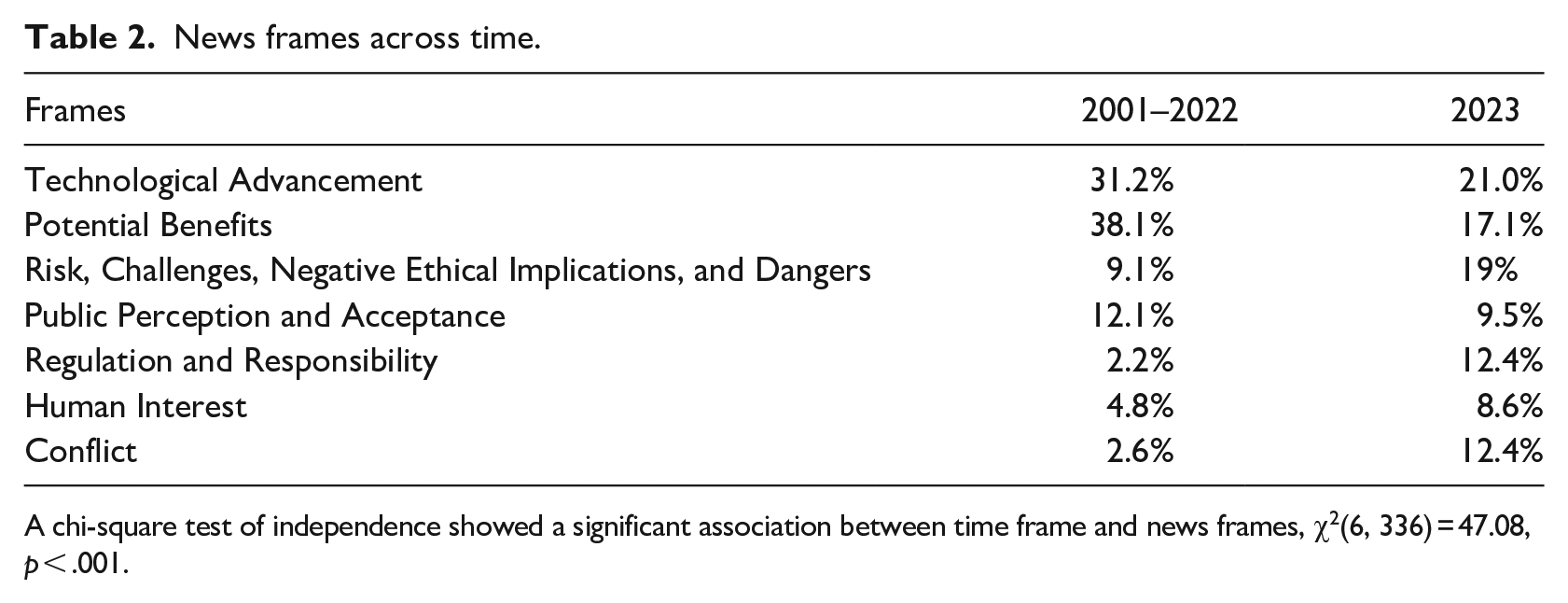
A chi-square test of independence showed a significant association between time frame and news frames, χ2(6, 336) = 47.08, p < .001.
Second, the chi-square test of independence also showed signification association, χ2(2, 336) = 28.52, p < .001, between time and valence. While articles about communicative AI were mostly positive in the first timeframe (from 2001 to 2022; 55.4%), the articles published in 2023 were largely neutral (70.5%). In both timeframes, only a few (4.8%) of the articles were negatively valanced. Examined another way, through independent samples t-test, we found that articles published before 2023 were more positive (M = 2.51, SD = .59) than those published in 2023 (M = 2.20, SD = .51), t(334) = 4.61, p < .001.
No significant association was found between time and the description of social values. In terms of sociability descriptions, we found a decreasing trend in describing communicative AI as an assistant, χ2(1, 336) = 7.54, p = .006, from 67.1% to 51.4%; and AI as a companion, χ2(1, 336) = 4.82, p = .028, from 12.6% to 4.8%. No such changes were found for describing AI as a source of information, a source of entertainment, or as a friend.
Finally, in terms of personification, a significant association was found only between time and ascribing autonomy to communicative AI, χ2(1, 336) = 7.40, p = .007, decreasing from 12.1% to 2.9% of the articles. No such changes were found for the use of pronouns and for ascribing emotions, reactivity, and adaptiveness.
5. Discussion and conclusion
Guided by framing theory, the CASA paradigm, and work on anthropomorphism of AI, this study examined media framing and anthropomorphizing of communicative AI in Singapore. Through a manual content analysis of 336 news articles about communicative AI published by three major news websites in Singapore, the study found that the most common frames used were the benefit to society and technological advancement frames. Most articles were either positive or neutral, with a very small number of articles framing AI negatively. This aligns with the findings from other countries where the utility and benefits of AI tends to be reported more often (Nguyen and Hekman, 2022; Sun et al., 2020).
The results showed that the news media in Singapore generally do not anthropomorphize communicative AI. Most articles did not refer to AI with human pronouns, while only a few mentioned social cues of the AI or described the AI as having a personality or serving an emotional or intimate role. By emphasizing how AI is nonhuman, through using object pronouns or no pronouns, along with few descriptions of how AI resembles or is akin to humans, the news media in Singapore paints the picture of AI more as a tool or machine rather than a social actor. This aligns with previous findings that users of conversational AI (e.g. Alexa) perceived their relationship with the technology more as a master-assistant one than a companion-like relationship (Tschopp et al., 2023). Such framing of communicative AI technologies may shape public expectations and attitudes toward these technologies. This may also be a reflection of how the Singapore society still regards AI as a tool rather than a social actor, placing AI as an entity under the control of, and subordinate to, its human users. However, this assertion necessitates future studies to examine communicative AI directly from the perspective of the public, such as through interviews and focus group discussions. Nonetheless, by situating AI as a tool subordinate to its human users and human input, the news media frame AI as requiring human supervision and having human control, which may also impact how responsibility and accountability is attributed or doled out.
With the popularity of generative AI, such as ChatGPT, news framing of communicative AI in Singapore showed some changes, with a higher proportion of articles published in 2023 (after ChatGPT dominated headlines) framing communicative AI in terms of risks and challenges; still, technological advancement was the most used frame and many articles still framed communicative AI in terms of potential benefits. However, we also saw an increase in the use of regulation and responsibility frame, most likely stemming from debates related to plagiarism and copyright with the rise of generative AI. Thus, we also see most of the articles in 2023 were neutral in terms of valence. This seems to represent a wait-and-see attitude from both policy makers and the public, which recognizes the benefits of generative AI, on the one hand, but is also mindful of the issues it brings and will bring.
The relatively low levels of anthropomorphism in the news framing of communicative AI technologies persisted even with the rise of generative AI chatbots. Most articles treat these technologies more as tools and machines, implicitly preserving human agency over AI.
It is also important to note that the rise of ChatGPT also directly impacts the work of human journalists; while the use of AI in news has long been discussed after some news organizations started investing in automation (Carlson, 2015; Wu et al., 2019), ChatGPT and similar tools no longer require organizational investment and adoption, as individual journalists can choose to use GenAI in their writing. This, too, have been met with some resistance, as some point out the limitations of GenAI and the important role that human journalists play in society (Breazu and Katsos, 2024). Indeed, such discourses may have shaped the way journalists in Singapore framed communicative AI, especially after the rise of ChatGPT, since journalists are also important stakeholders in this technological shift.
These findings must also be understood along with the study’s limitations. First, this study only sampled from three mainstream English news outlets in Singapore. Other news outlets in Singapore, such as alternative news outlets and non-English news outlets, may have also reported heavily on AI and framed AI differently. Some of these news outlets have niche audiences, targeting specific demographics, such as younger audiences, which may influence the way they frame communicative AI. Thus, future studies can examine media framing of communicative AI from other news outlets with different target audiences. Second, this study quantitatively coded the presence of news frames that were previously identified by earlier content analysis studies of AI news coverage in other countries; with the rise of generative AI, new ways of framing AI technologies may also emerge. Thus, continuing this examination with more inductive and qualitative approaches to documenting social framing of AI technologies is important. Third, we coded the extent to which the news media represent communicative AI technologies as humanlike based on various frameworks, such as the CASA paradigm, and while numerous ways of attributing humanness to AI technologies were coded, it is plausible that our content categories are not exhaustive, other important ways that media framing anthropomorphize AI technologies were missed. Finally, we were guided by media framing theory in this investigation of how the Singapore news media report on communicative AI. Focusing on emphasis framing through a deductive approach, this study analyzed which aspect of communicative AI the media focuses on based on frames identified in previous studies, as well as how the media frames communicative AI as humanlike. However, there are other ways of framing communicative AI, and future studies can build on our findings in examining other forms of framing strategies. Our analysis also presents limitations: using the deductive approach, we coded for the dominant frames used in the articles, but media representations of AI go beyond just the dominant frames. Future studies can build on our study design to code for other message elements and implement more complex analysis, such as cluster analysis, that can identify patterns of media representation that account for various messaging strategies and elements.
Notwithstanding these limitations, we hope that our findings contribute to a more nuanced understanding of how the news media represent communicative AI technologies by providing evidence from a unique media context in a small but technologically advanced nation.
Supplemental Material
sj-docx-1-pus-10.1177_09636625251317970 – Supplemental material for Exploring AI identity: The media framing of communicative artificial intelligence in Singapore’s news sites
Supplemental material, sj-docx-1-pus-10.1177_09636625251317970 for Exploring AI identity: The media framing of communicative artificial intelligence in Singapore’s news sites by Edson C. Tandoc, Seth Seet, Vanessa Xinyi Chan and Penny Ju Onn Wong in Public Understanding of Science
Footnotes
Funding
The author(s) disclosed receipt of the following financial support for the research, authorship, and/or publication of this article: This research is supported by the National Research Foundation, Singapore under its AI Singapore Programme (AISG Award No: AISG3-GV-2021-003).

Supplemental material
Supplemental material for this article is available online.
Author biographies
References
Supplementary Material
Please find the following supplemental material available below.
For Open Access articles published under a Creative Commons License, all supplemental material carries the same license as the article it is associated with.
For non-Open Access articles published, all supplemental material carries a non-exclusive license, and permission requests for re-use of supplemental material or any part of supplemental material shall be sent directly to the copyright owner as specified in the copyright notice associated with the article.
