







Abstract
Trust in scientists has declined among US conservatives, while belief in science itself remains high among nearly everyone. This indicates a political differentiation of scientific authority where political ideologues are increasingly getting their scientific information from different scientific sources. But beyond pure information consumption, those who have eschewed mainstream scientific authority are also more likely to find support for their scientific identity in a more differentiated medium like the Internet. To examine this possibility, we use the General Social Survey NSF Knowledge scale and a question measuring self-perception of scientific competency to operationalize a concept we call “scientific humility/arrogance.” We then compare liberals and conservatives on this measure across self-reported mediums of scientific consumption. We find that accessing scientific information through the Internet has the general effect of humbling extreme liberals with no such effect found among conservatives. We discuss implications for researchers and stakeholders in scientific communication and understandings.
Keywords
1.Introduction
In recent decades, the US public has been increasingly exposed to information that challenges mainstream scientific consensus. Scholars attribute this trend largely to the rise of right-wing social movements and organizations – particularly think tanks – that contest mainstream scientific authority (e.g. Farrell, 2016a, 2016b; Gross et al., 2011; McCright and Dunlap, 2010; Medvetz, 2012). The success of these movements and associated anticonsensus sources has been apparent as they have demonstrably moved public opinion on issues like climate change and the COVID-19 pandemic (Evans and Hargittai, 2020; Kozlowski, 2022; McCright and Dunlap, 2011a, 2011b). While our focus is on the United States – a case where political conflict over science has been especially visible – we view it as illustrative of mechanisms that are likely generalizable to other polities. Here, we examine a neglected function of such US-based sources: providing individuals with the rhetorical tools and scientific arguments that boost scientific confidence. We argue that by paying attention to the mediums through which self-identifying liberals and conservatives access scientific information – and particularly the difference between the Internet where sources challenging scientific consensus are abundant and “old media” where traditional gatekeepers have rendered such content less prevalent – it is possible to determine whether accessing this information through the Internet contributes to enhanced (or muted) confidence in scientific self-perceptions across political groups.
To test our argument, we use cross-sectional General Social Survey (GSS) data from 2006 to 2018, when the shift from old media sources to the Internet was salient for many, to explore the relationship between political identity, sources of scientific information, and respondents’ views of their own scientific knowledge (hereafter, scientific self-perceptions). We examine these relationships in two stages: first, we measure differences between liberals and conservatives in terms of where they get their scientific information and how this affects scientific self-perceptions. Second, drawing on insights from work on status characteristics and expectations states theory (SC-EST), we combine a measure of scientific self-confidence with the National Science Foundation (NSF) scientific knowledge scale to construct a novel measure of scientific self-perception. We interpret differences between these variables as indicating overestimations (i.e. arrogance), accurate estimations (i.e. aligned), or underestimations (i.e. humility) of scientific competence. By examining how this outcome is patterned by liberal or conservative political identity and mediums of scientific information, we find that accessing scientific information through the Internet is associated with muting liberal arrogance, while no such effect is found for conservatives.
2.Political polarization and science in the United States
The sociological study of science and politics has been motivated by the observation that science itself, and the boundaries around it that constrain its meaning, are constantly being argued and redefined based on the changing contours of social life (e.g. Gieryn, 1999). Science enjoys an epistemologically privileged position in US society (Brown, 2009; Epstein, 1998), and trends like worsening political polarization and sorting will often manifest in battles over ownership of this particular way of knowing. Over time, political parties have become more ideologically homogeneous (Fiorina, 2015), self-identifying partisans view their cross-partisans more negatively (Iyengar et al., 2019), and there is even evidence that people are deciding to reside in more politically homogeneous communities (Martin and Webster, 2020; Nall, 2015). These bellwethers of polarization have been joined by mounting evidence that information ecosystems are becoming increasingly politically fractured (Benkler et al., 2018; Faris et al., 2017), raising concerns that political partisans are now living in two separate realities (Barberá et al., 2015; Pariser, 2011).
However, empirical evidence of the existence of “echo-chambers” (Sunstein, 2001) or “filter bubbles” (Pariser, 2011) is mixed, and political media diets continue to show themselves to be more ideologically heterogenous than suggested in some coverage in the popular press (Eady et al., 2019; Guess et al. 2018b). Yet, the advent of the Internet has radically altered the consumption of political as well as scientific information in a variety of respects. Among these has been increased dissemination of and access to political disinformation (Grinberg et al., 2019; Guess et al. 2018a), the surging popularity of highly partisan content (Benkler et al., 2018; Faris et al., 2017), and the declining influence of scientific and journalistic gatekeepers (Shoemaker et al., 2009).
3.“Old media” versus the Internet
When discussing potential effects and implications of how scientific information is accessed, it is important to distinguish between mediums and specific media organizations and sources. Here, we distinguish the Internet from “old media” (i.e. any non-Internet medium) as the Internet represents unprecedented ease of access to a variety of scientific sources – including those that challenge mainstream scientific authority (Brossard, 2013). Of course, the Internet is not exclusively populated by information or sources challenging mainstream scientific authority – and what we refer to as “old media” does not always promote the consensus views of the scientific community. 1 Therefore, our argument is one of degree, not kind – compared to “old media,” on the Internet, it is easier to access sources of information with no scientific editorial process, and this has implications for liberals and conservatives. 2
This ease that we believe the Internet, as a medium, instantiates has been captured in previous research in a variety of ways – two of which are important for our purposes here. First, studies have shown that just by searching for a certain kind of information on the Internet, one becomes likely to be exposed to misinformation on that issue that could shape beliefs (Muhammed and Sadiq Mathew, 2022; Tokita et al., 2024; Tustin et al., 2018) – a kind of incidental exposure that is much less likely through other mediums. Second, just being exposed to conflicting information itself through online searching can undermine confidence in pre-held beliefs without necessarily changing them (Kobayashi, 2018; Nagler et al., 2021) – a more subtle but, for our purposes, extremely relevant effect.
With these implications in mind, we still recognize that some may be skeptical that there is a substantial enough population of a truly non-Internet browsing scientific public to make such comparisons (i.e. some may report they access scientific information through newspapers, but they are nevertheless reading them on the Internet). To this, we note that from 2006 to 2018 (the years we analyze below), those reporting to the GSS that they access scientific information through the Internet have risen significantly from about 55% to about 72% of respondents (see Supplemental material Figure S9). While we do not deny that some may misreport their actual medium of information, this rise alone suggests, especially around 2006, a real and substantial non-Internet browsing public.
In terms of the content and context of explorations for scientific information in the general public, it is important to note that (1) people seek out scientific information when such issues are salient in the news and political debates or even interpersonal exchanges (Segev and Baram-Tsabari, 2012), (2) that such searches are likely aimed toward opinion content when the issue is contentious (Xenos et al., 2011), and (3) that people are increasingly likely to conduct such searches online (Besley and Hill, 2020). Yet, while some scientific issues do not reflect dramatic qualitative differences in journalistic coverage between offline and online sources (Gerhards and Schäfer, 2010), this is less the case for issues where policy or environmental implications were being discussed or debated. Cacciatore et al. (2012) found that those seeking information on nanotechnology were much more likely to be exposed to a range of perspectives – including those challenging scientific consensus – in online than in print news. Thus, those with high trust in mainstream scientific authority – a group that is disproportionally liberal (Gauchat, 2012; Lee, 2021) – accessing scientific information through “old media” are less likely than on the Internet to encounter views challenging their scientific orientation. Meanwhile, those with scientific orientations of distrust in the mainstream scientific community – a group that is disproportionately conservative (Carl and Cofnas, 2016; Gauchat, 2012; Mann and Schleifer, 2020) – are more likely to encounter robust challenges through “old media” and readily available support on the Internet (Eady et al., 2019; Guess et al. 2018b). These features, we argue, echo McLuhan’s (1964) famous words, “the medium is the message.” Regardless of whether similar sources can be found on the Internet and old media, people interact with the Internet in a way that is fundamentally more exposed to fringe messaging, which means views challenging mainstream scientific authority.
4.SC-EST and scientific self-perceptions
We synthesize the above research on scientific understandings, self-perceptions, and political polarization to examine how the political differentiation of scientific authority has affected liberal and conservative scientific self-perceptions and, by extension, willingness to participate in scientific arguments. We accomplish this by drawing on insights from SC-EST in social psychology (Conner and Hamit Fisek, 1974). The SC-EST is a theoretical framework that explains macrolevel stratification through the individual-level internalization of cultural beliefs about identities and abilities and has been mainly applied in contexts of stratified labor outcomes between genders (Correll and Ridgeway, 2003; Foschi, 2000). Because we are interested in scientific self-perceptions, we are particularly inspired by Correll’s (2001) study that examines the role of biased self-assessments in perpetuating gender gaps in the pursuit of STEM careers. She finds that high school-aged men report more positive self-assessments of their mathematical ability compared to similarly performing young women (based on objective measures like GPA and standardized tests) and that these positive self-assessments were integral in filtering young people into STEM fields in college and beyond. This indicates that cultural beliefs about gender, and not actual competence or performance, play a large role in creating and maintaining the gender gap in STEM. This study and many others (e.g. de Gilder and Wilke, 1994; Kalkhoff and Thye, 2006; Ridgeway, 2006) have added strong support to SC-EST generally and provide a solid foundation to extend these insights to evaluations of the role of biased self-assessment in political-scientific engagement.
While Correll compares self-assessments to objective measures of competence to examine how cultural beliefs drive engagement in a specific field, we aim to accomplish something similar but distinct. Correll’s study and SC-EST in general are concerned with ubiquitous cultural messaging of competence and capability in relation to variables like gender, sexuality, and race. It reasonably follows then that this work generally measures relationships between self-assessments and outcomes of interest like career choice. Here, we are concerned with messaging from distinct political-scientific authorities and how this affects self-assessments. Therefore, we focus on the earlier stage of these processes: how access or exposure to cultural messaging biases self-assessments. This has the potential to contribute to SC-EST by examining this earlier, often assumed, stage of these processes and measuring effects on self-assessments.
5.Methods
Data
To examine how political identity and medium of scientific information interact to affect scientific self-perceptions, we use data from the cross-sectional GSS from the years 2006 to 2018. We argue this period is optimal for our purposes, not just in terms of available data (discussed below) but in covering a time of higher variability of reported mediums of scientific information and relevance for contemporary political and scientific orientations. The GSS itself is a national face-to-face survey of the non-institutionalized adult population of the United States. Starting in 2006, the GSS began collecting additional questions about science as part of its rotating ballot design for non-core questions. 3 Not all of our variables, however, were collected in the same rotating ballot during each survey year. For example, in 2010 our measure of science self-perceptions (i.e. confidence in science knowledge) (SCISTUDY) was collected on ballot A and C, and our measure of the primary source of science information (SEEKSCI) was collected on ballot C, and the measures used to create our NSF scale of science knowledge were collected on ballot A and C during that year. We focus our analyses on those who provided information on all of our measures of interest. 4 After adjusting for missing information, our final sample includes 7177 respondents across 12-survey years.
Dependent variables
The GSS collected information about how well respondents felt they understood the term “scientific study” when they encountered it in various forms of media. They asked, When you read news stories, you see certain sets of words and terms. We are interested in how many people recognize certain kinds of terms. First, some articles refer to the results of a “scientific study.” When you read or hear the term “scientific study,” do you have “a clear understanding of what it means” (coded 3), “a general sense of what it means” (coded 2), or “little understanding of what it means” (coded 1)?
We use this information in two distinct ways. First, we transform this variable into an indicator for those who report a clear understanding of a “scientific study” (coded 1) compared to everyone else (coded 0) (e.g. Scheitle, 2018; Shi et al., 2023). This binary measure forms an outcome for our first set of analyses (see the logistic regressions from Table 2, Models 1 and 2). Second, we retain information on all three categories of understanding as a measure of a respondent’s “perceived” scientific knowledge and use this full information variable in the construction of our scientific humility/arrogance categories (described below).
While the above measure gives a sense of the respondents’ self-reported confidence in their scientific understanding (i.e. “I know science when I see it”), we cannot use this as a measure of the accuracy of their actual knowledge. We define scientific knowledge as knowledge of scientific facts as defined by the mainstream scientific community through the establishment of near-universal scientific consensus. To measure this, we make use of the National Science Foundation’s (NSF) science knowledge scale (hereafter NSF scale) that was administered as an instrument for measuring civic scientific literacy (Bauer et al., 2007; Evans, 2011; Gauchat, 2011; Miller, 2004; Roos, 2014, 2016; Sturgis and Allum, 2004). This scale is composed of a set of 14 statements, and the respondents are asked whether each statement is true or false. For example, each respondent is presented: Now, I would like to ask you a few short questions like those you might see on a television game show. For each statement that I read, please tell me if it is true or false. If you don’t know or aren’t sure, just tell me so, and we will skip to the next question. Remember true, false, or don’t know
followed by 10 statements such as “The center of the Earth is very hot” and “Father’s genes decide sex of baby.” There are additional questions about odds and experimental design that have different prompts/response categories, but also have right and wrong answers (according to current consensus). (For a full description, see Supplemental material Table S1.)
For each question on this NSF scale, we code correct answers as 1 and incorrect or I do not know answers as 0. We then create a measure of the proportion of correct answers for each individual by dividing the number of correct answers by the total number of questions addressed by each respondent. We create a mean value of correct answers for each respondent that runs from 0 (all incorrect answers) to 1 (all correct answers). By taking the mean proportion of correct responses, we can include individuals who skipped single questions or sets of questions (i.e. individuals who were assigned missing values on these questions). Overall, 99.76% of our sample answered at least 10 of these 14 questions. We retain only those cases where the missing information on this scale is for three or fewer questions. 5 We also retain questions in the NSF scale that some have identified as being “culturally contested” (e.g. Roos, 2014), as these are of primary interest in relation to our research question. 6 The average respondent score on this scale is 0.659.
Again, we use this information in two distinct ways. For our preliminary set of analyses, the NSF scale is treated as a continuous outcome measure for a series of linear regression models (see Models 3 and 4 from Table 2). The second way we treat this variable is to recode it into three categories and then use it as a measure of a respondent’s “demonstrated” scientific knowledge. To achieve this, we split the NSF scale into the bottom third (scores range from 0 to 0.54, coded 1), middle third (scores range from 0.55 to 0.75, coded 2), and the top third of scores (scores range from 0.76 to 1, coded 3). By recoding this information into three categories, we can differentiate respondents’ “perceived” scientific knowledge and their “demonstrated” scientific knowledge to create the scientific humility/arrogance scale.
With the three-category scientific self-perception variable (i.e. one’s confidence) and the three-category coding of the NSF scale acting as a measure of objective knowledge, we create a variable that captures the difference between perceived and demonstrated scientific competence. To accomplish this, we take an individual’s score on the categorical NSF measure and subtract that from their score on the full information “perceived” science knowledge variable. The full range of this new difference measure runs from 2 which captures those individuals who believe they have a clear understanding of science but score in the bottom third of the NSF general scale (High perceived knowledge [3] – Low demonstrated knowledge [1] = 2) to −2 for those who scored in the top of the NSF scale, but self-report lows levels of understanding (Low perceived knowledge [1] – High demonstrated knowledge [3] = −2). The 0 category here captures those whose self-perceptions and knowledge are aligned (i.e. confidence equals competence). We compress these five categories of information into three-category measures for those who are aligned in their confidence and competence (coded 0), for those who are arrogant (confidence is greater than competence, coded 1), and for those who are humble (confidence is lower than competence, coded 2) in terms of their scientific knowledge. These will be treated as additional categorical outcomes for a series of multinomial logistic regression models (see Supplemental material Table S2 and the associated probabilities from Supplemental material Table S2 Model 2 in Table S3). 7 This variable, more than just “controlling” for knowledge, allows us to examine how sources of scientific information are correlated with distances between objective knowledge and self-perceptions. This allows for a direct examination of how concepts like humility and arrogance – measured in this way – are being affected by mediums of scientific communication.
Key independent variables: Source of scientific information and political ideology
The GSS also collects information about where respondents receive most of their scientific information. The respondents are presented with the following question: “If you wanted to learn about scientific issues such as global warming or biotechnology, where would you get information?” Response Categories here include: “Newspapers” (coded 1), “Magazines” (coded 2), “The Internet” (coded 3), “Books or other printed materials” (coded 4), “TV” (coded 5), “Radio” (coded 6), “Government agencies” (coded 7), “Family” (8), “Friends or colleagues” (coded 9), and “Other” (coded 10). As our primary interest is in how the Internet is different from other sources, we transform this variable into an indicator of those whose primary source of information about science and technology is the Internet (coded 1) compared to those who get their information from another source (coded 0, hereafter “old media”). We recognize that our choice to focus on a binary predictor does not make use of all the information provided. This choice was driven by our theoretical concerns. But to determine whether this affected our results, we explore those who get their information from Print media (newspapers, magazines, or books), Television, and Other (non-Internet) primary sources and find a similar effect for those getting their information from the Internet (see Supplemental material Figure S3 and Figure S4 for results of these alternative specifications). Overall, around 64.5% of individuals in our sample report that the Internet is their primary source of scientific information, and this proportion has increased from 55.7% in 2006 to 72.3% in 2018.
The GSS collects information about respondents’ political ideology as part of its core set of questions, and research has shown that this information is related to various attitudes toward science (e.g. Gauchat, 2012; Mann and Schleifer, 2020). The GSS asks the following: We hear a lot of talk these days about liberals and conservatives. I’m going to show you a seven-point scale on which the political views that people might hold are arranged from extremely liberal – point 1 – to extremely conservative – point 7. Where would you place yourself on this scale?
with the following response categories “Extremely Liberal” (coded 1), “Liberal” (coded 2), “Slightly Liberal” (coded 3), “Moderate” (coded 4), “Slightly Conservative” (coded 5), “Conservative” (coded 6), and “Extremely Conservative” (coded 7). To preserve as much of this information as possible, we treat this as a categorical measure, retaining all categories with “Moderates” serving as the comparison group. 8
Control variables: Education
We control for three sets of variables that have been shown, along with politics, to affect attitudes about and knowledge of science: education (Noy and O’Brien, 2019; Weisberg et al., 2021), religion (Evans, 2018; O’Brien and Noy, 2015), and demographic differences. We control for education with a series of indicators of the highest degree respondents have completed. We include dummy variables for those with a “High School,” “Junior College,” “Bachelor’s Degree,” and “Advanced Degree,” compared to those with “less than a High School Degree.” We also include controls for having ever taken a high school biology, chemistry, physics, or any college-level science class. In our preliminary models, we also control for the respondent’s score on the NSF scale and those who report a clear understanding of a scientific study when these measures are not the outcome.
Control variables: Religion
To control for religious affiliation, we implement a modified version of the Steensland et al. (2000) religious traditions categories. Our modification includes disaggregating historically black traditions into mainline and conservative protestant groups to avoid collinearity issues with our controls for race (Wilcox and Wolfinger, 2007) and placing Jewish individuals into our other religious traditions category due to the low number of these individuals in our sample (Schleifer and Chaves, 2017). After these transformations, we include indicators for “Mainline Protestants,” “Catholics,” “Other Religious Traditions,” and the “Religiously Non-affiliated,” compared to “Conservative Protestants.” We also control for those who attend religious service at least once a week (coded 1) compared to those who attend less often (coded 0), believe “The Bible is the actual word of God and is to be taken literally, word for word” (coded 1) compared to everyone else (coded 0), and include three indicators for those who report being “Very Religious,” “Moderately Religious,” and “Slightly Religious” compared to those who report being “Not Religious.”
Control variables: Demographics
To account for demographics, we control for gender by including a binary indicator for women. The GSS collects information on race and Hispanic ethnicity, and we combine this information into three measures for “Black, non-Hispanic,” “Hispanic,” and “Other Race (non-Hispanic)” individuals compared to “White, non-Hispanics.” We include a control for those who are currently married and those who are parents. For income differences, we include a continuous measure of the natural log of equivalized income. The equivalization is achieved by dividing personal income – adjusted to 2018 dollars – by the square root of household size. For age, we include a continuous measure that runs from 18 to 89 or older and an age-squared term to capture curvilinear effects. Finally, we control for geography with a series of regional dummy variables for those living in the “Northeast,” “Midwest,” and “West” compared to those living in the South and an indicator for those who live in a city. Table 1 provides summary statistics for all variables in the analysis.
Summary statistics.
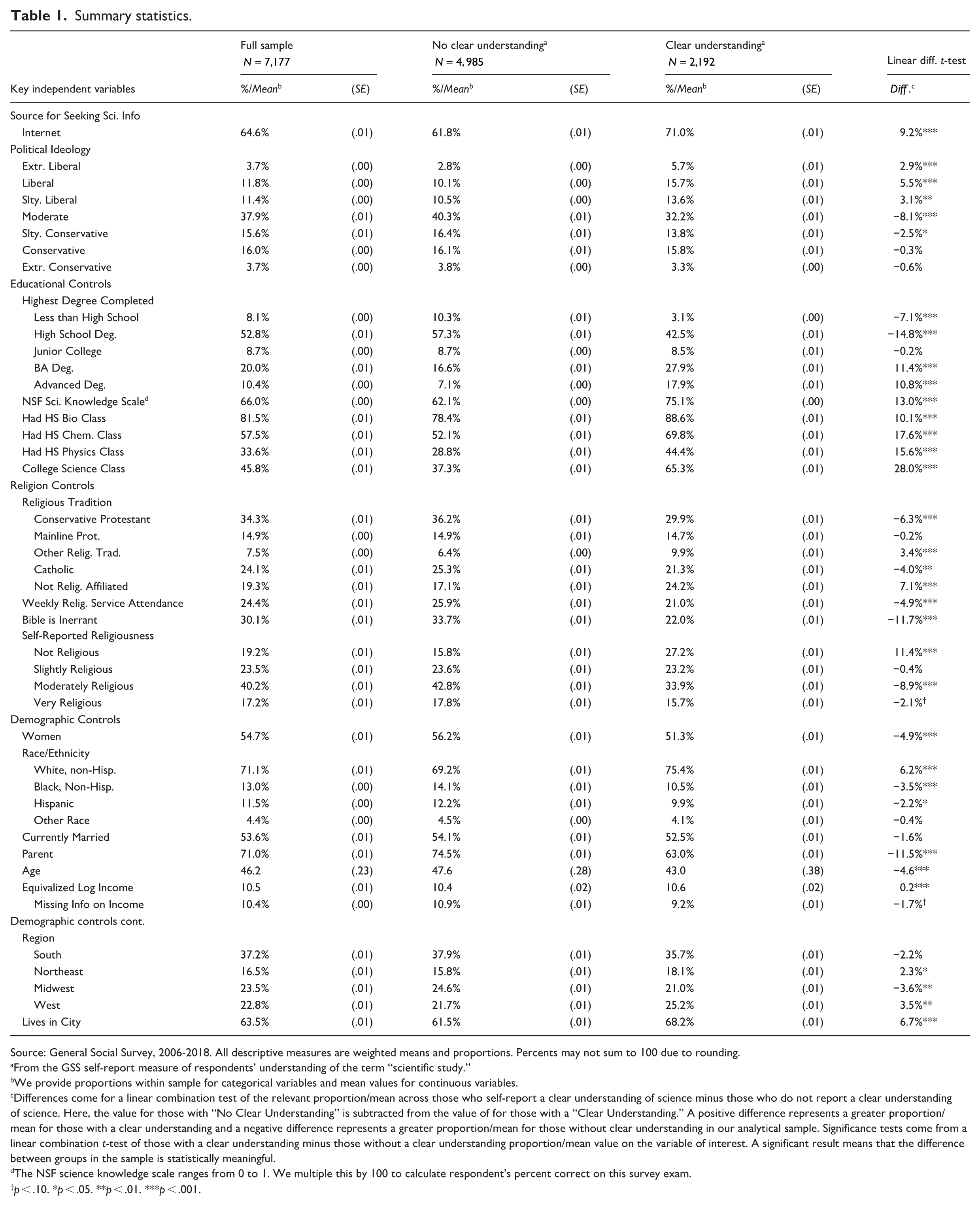
Source: General Social Survey, 2006-2018. All descriptive measures are weighted means and proportions. Percents may not sum to 100 due to rounding.
From the GSS self-report measure of respondents’ understanding of the term “scientific study.”
We provide proportions within sample for categorical variables and mean values for continuous variables.
Differences come for a linear combination test of the relevant proportion/mean across those who self-report a clear understanding of science minus those who do not report a clear understanding of science. Here, the value for those with “No Clear Understanding” is subtracted from the value of for those with a “Clear Understanding.” A positive difference represents a greater proportion/mean for those with a clear understanding and a negative difference represents a greater proportion/mean for those without clear understanding in our analytical sample. Significance tests come from a linear combination t-test of those with a clear understanding minus those without a clear understanding proportion/mean value on the variable of interest. A significant result means that the difference between groups in the sample is statistically meaningful.
The NSF science knowledge scale ranges from 0 to 1. We multiple this by 100 to calculate respondent’s percent correct on this survey exam.
p < .10. *p < .05. **p < .01. ***p < .001.
Analytical strategy
We pursue three main approaches to our analyses in this article. First, to model those who report having a clear understanding of science, we run a series of logistic regression models that take the following form:

where

where
The second set of models pursued here focuses on our three-category measure of scientific arrogance, alignment, and humility. To model this, we run a series of multinomial logistic regression models that take the following form:

where m = 1, 2, 3.
Here, the right-hand side of the equation remains the same as our logistic regression. On the left-hand side, we are now modeling the log odds that Y is equal to a particular category of our outcome compared to all other categories. We report the coefficients predicting those in the arrogant and humble groups side by side for comparison, and those who are aligned in their scientific knowledge are omitted as the model comparison group.
We are pursuing an interactive strategy, and Allison (1999) and others (e.g. Long and Mustillo, 2021; Mize, 2019) have pointed out that relying on interactions to establish group differences when using categorical models is problematic. We follow Long and Mustillo’s (2021) recommendation to compare these group differences using predicted probabilities. We plot our predicted probabilities and differences in predicted probabilities and, where necessary, run additional tests to determine whether these differences in predicted values are statistically significant. All predicted probabilities presented in the article are average adjusted predictions where control characteristics vary freely for each respondent, and we use delta method standard error estimations to compute confidence intervals and for additional comparisons.
After focusing on individuals who received our central science understanding questions (i.e. primary source of science information, self-perception of science knowledge, and the NSF knowledge question), the remaining data has relatively little missing information. The exception to this is the 9.2% missing on our income measure. The calculation and comparison using the delta method standard errors for our predicted probabilities make normal approaches to multiple imputation difficult. To overcome this issue, we multiply imputed income across 10 datasets (
6. Results
Table 2 presents the results from our models on those who report having a “clear understanding of a ‘scientific study’” as well as our models on the NSF scale. Model 1 (visualized in Supplemental material Figure S1A) shows that those getting their scientific information from old media are identical to those getting their information from the Internet, in that 30.3% of both groups are predicted to report having a clear understanding.
Regression on perceived science knowledge and the National Science Foundation general science knowledge scale by source for seeking science information and political ideology.
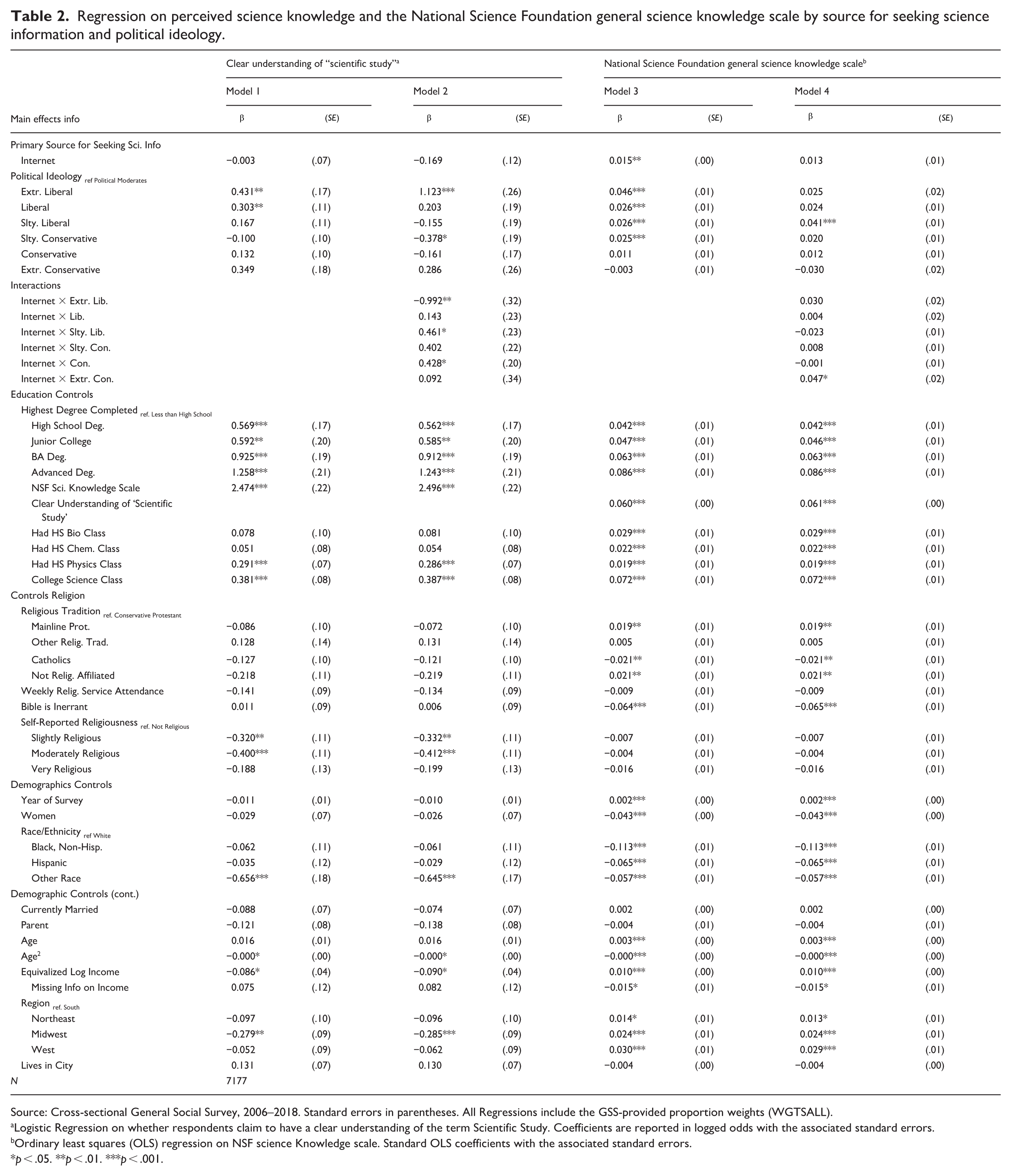
Source: Cross-sectional General Social Survey, 2006–2018. Standard errors in parentheses. All Regressions include the GSS-provided proportion weights (WGTSALL).
Logistic Regression on whether respondents claim to have a clear understanding of the term Scientific Study. Coefficients are reported in logged odds with the associated standard errors.
Ordinary least squares (OLS) regression on NSF science Knowledge scale. Standard OLS coefficients with the associated standard errors.
p < .05. **p < .01. ***p < .001.
Model 1 also shows meaningful differences in confidence in scientific understanding across political ideology. We can see that 36.6% of those who are extremely liberal and 35.0% of those who are extremely conservative report having a clear understanding of science. As a comparison, those who report being ideologically moderate have a 28.6% predicted probability. (See Supplemental material Figure S1B for a plot of these results).
Model 3 runs a similar regression, but our outcome is the NSF scale. We find that those who use the Internet have a predicted average score of around 66.5, while those who use old media score around 65.1%. This amounts to a 1.4 point difference in predicted scores, which is small but significant (
In Model 2 and Model 4, we complicate this story by interacting our seeking science knowledge from the Internet variable with our political ideology indicators. Figure 1 plots the probabilities from this interaction, and the top row shows the results from a logistic regression on the indicator for a clear understanding of the scientific study. Here, we find that extreme liberals who get their scientific information from “old media” appear far more likely to report having a clear understanding of science. When we focus on those who use the Internet, we also find little difference across our political ideology categories. When we compare the predictions from Figure 1a to the predictions from Figure 1b, only those who are extremely liberal show a meaningful difference in probabilities across sources of science information:

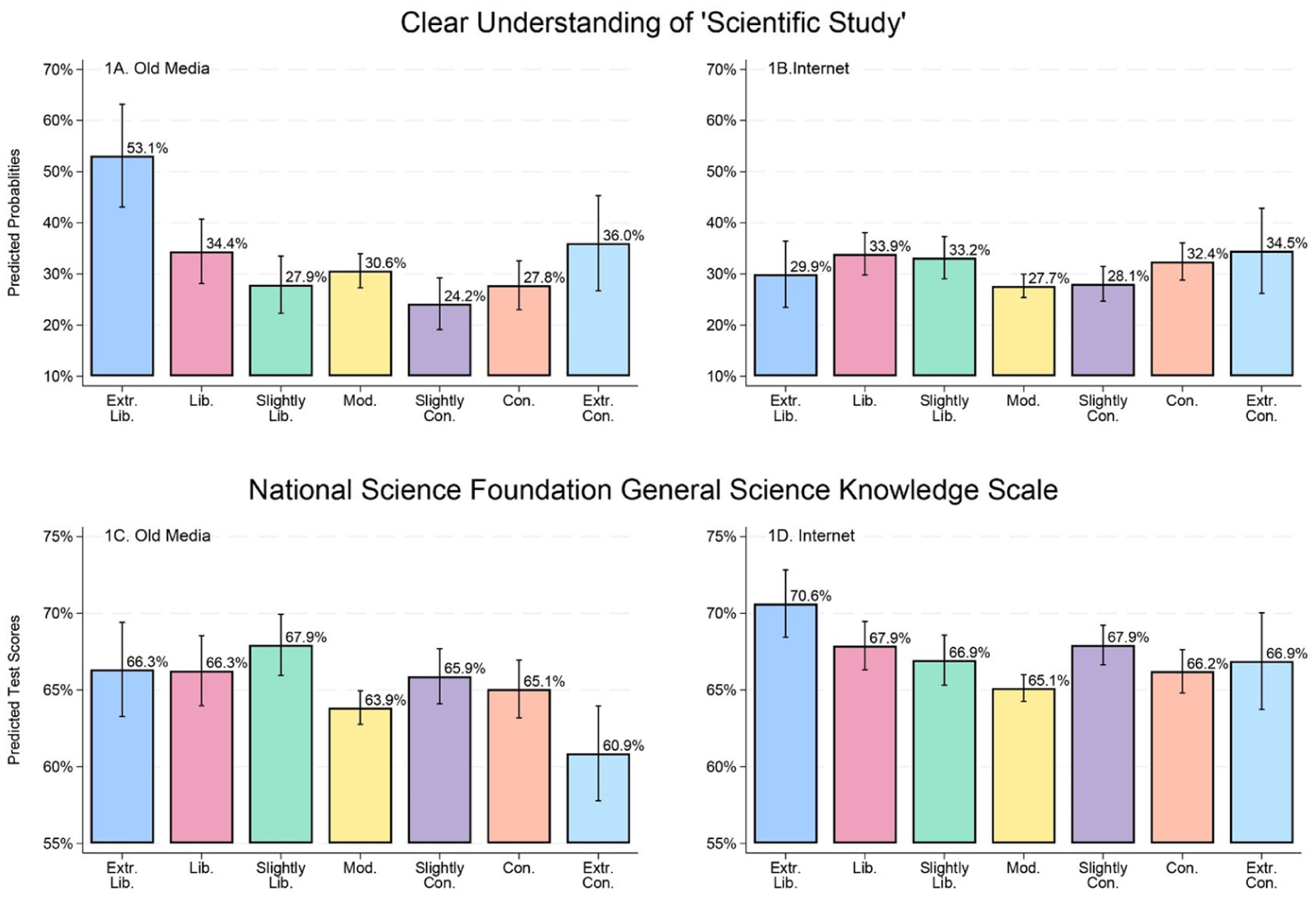
Predicted probabilities of self-reporting a clear understanding of “scientific study” and predicted test scores on the NSF general science knowledge scale by political ideology across primary sources for seeking scientific information.
The second row of Figure 1 also shows the predicted scores on the NSF scale by media and political ideology. Among those using old media, slight liberals have the highest scores and extreme conservatives have the lowest scores. While there is meaningful variability here, the overall range of scores is 6 points across all categories. Those using the Internet all appear to have higher test scores. However, only those who are extremely liberal (
While we find interesting patterns in science self-perceptions and the NSF scale, what these models do not establish is when confidence is justified. To account for this, we run a series of multinomial logistic regression models on our scientific humility/arrogance categories. We first run a full model with no interactions and then a second model that interacts the source of scientific information with political ideology (see Supplemental material Table S2 for full results).
Figure 2 shows the predicted probabilities for each of our three outcomes by media use (row 1) and political ideology (row 2). Independent of where respondents get their scientific information, nearly 50% have an accurate scientific self-perception. For those who get scientific information from old media, around 46.8 are predicted to be accurate about their scientific understanding, while those who use the Internet show a similar probability of around 45.6%. These patterns become more interesting when including political ideology. In Figure 2c, we plot probabilities for the arrogant and humble groups 9 and the difference between the arrogant and humble within ideology categories in Figure 2d. Focusing on Figure 2d, those who report being political liberals, moderates, and conservatives are significantly more arrogant in their scientific knowledge.
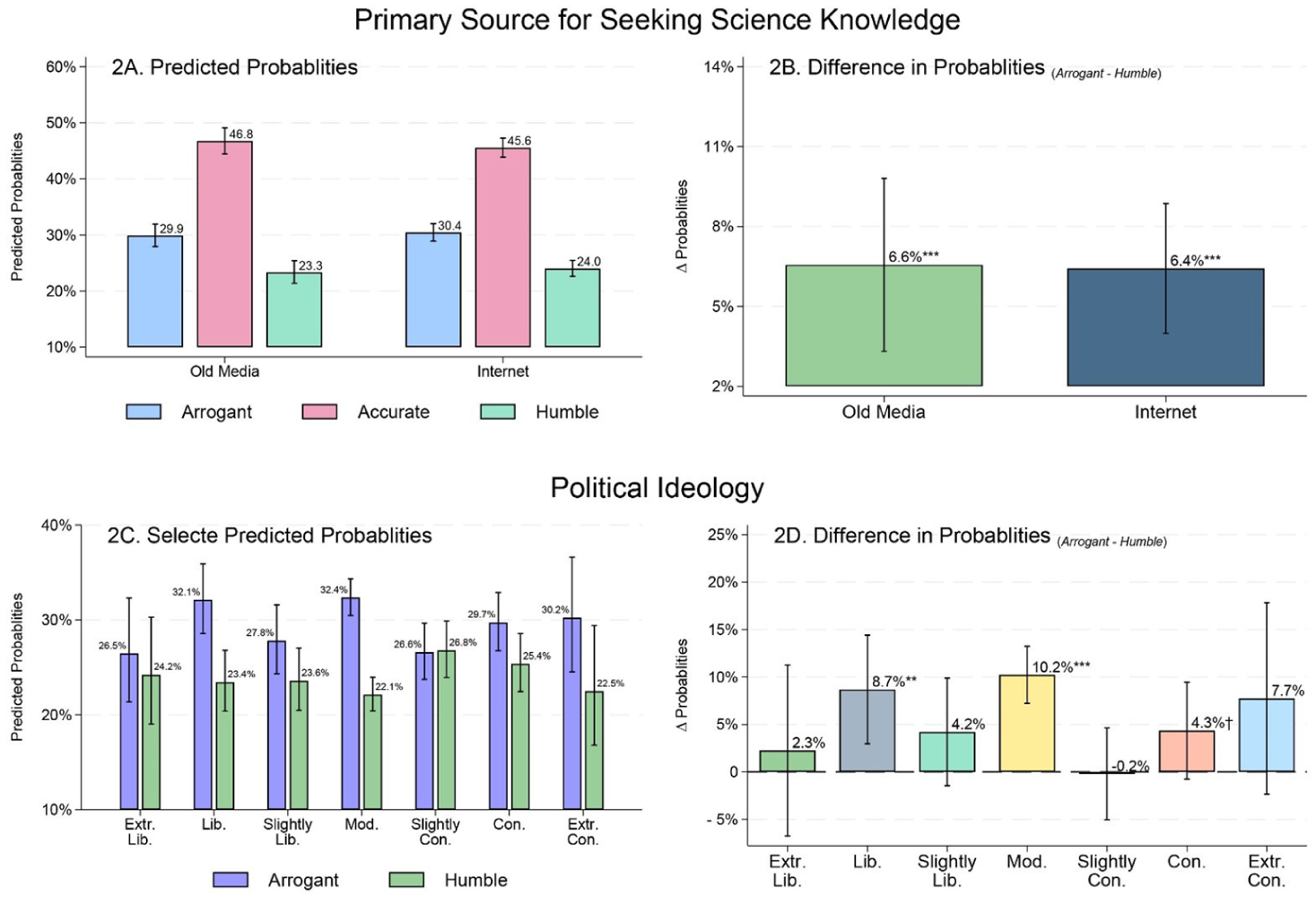
Predicted probabilities of the difference between self-reported understanding of “scientific study” and the NSF science knowledge index by primary source for seeking scientific information and political ideology.
For our final analysis, we rerun this multinomial logistic regression while including an interaction between source of science knowledge and political ideology (see Supplemental material Table S2, Model 2). We then calculate the predicted probabilities of reporting being arrogant, aligned, or humble relative to one’s perceived scientific knowledge across media usage and political ideology. This approach allows us to calculate the difference in probabilities between those who are humble and arrogant, which is a type of first-order difference. First-order differences subtract predicted probabilities for groups of interest to determine the magnitude of these differences as well as whether they significantly differ from one another. For example, in Figure 3b, the old media bar captures a first-order difference in probability between those who are scientifically arrogant and those who are scientifically humble among those who rely on old media for their scientific information. Figure 2a shows that among old media users, the model predicts that 29.9% are predicted to be scientifically arrogant, and 23.3% are predicted to be humble. If we differ these probabilities, calculating a first-order difference, we get 6.6% point difference, which is a significant difference (
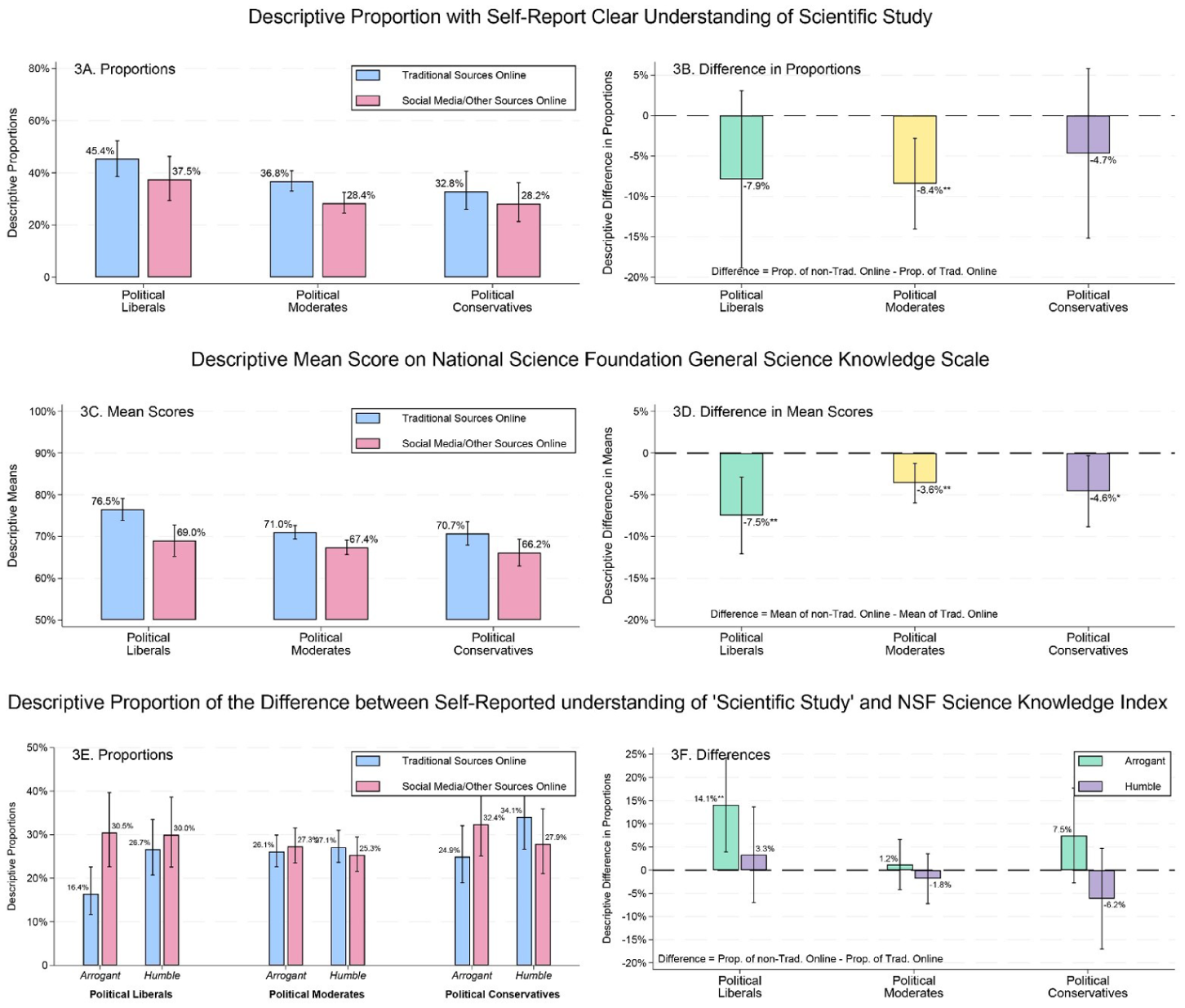
Descriptive difference across traditional and non-traditional online sources of online information on science and technology among liberals and conservatives across outcomes of interest.
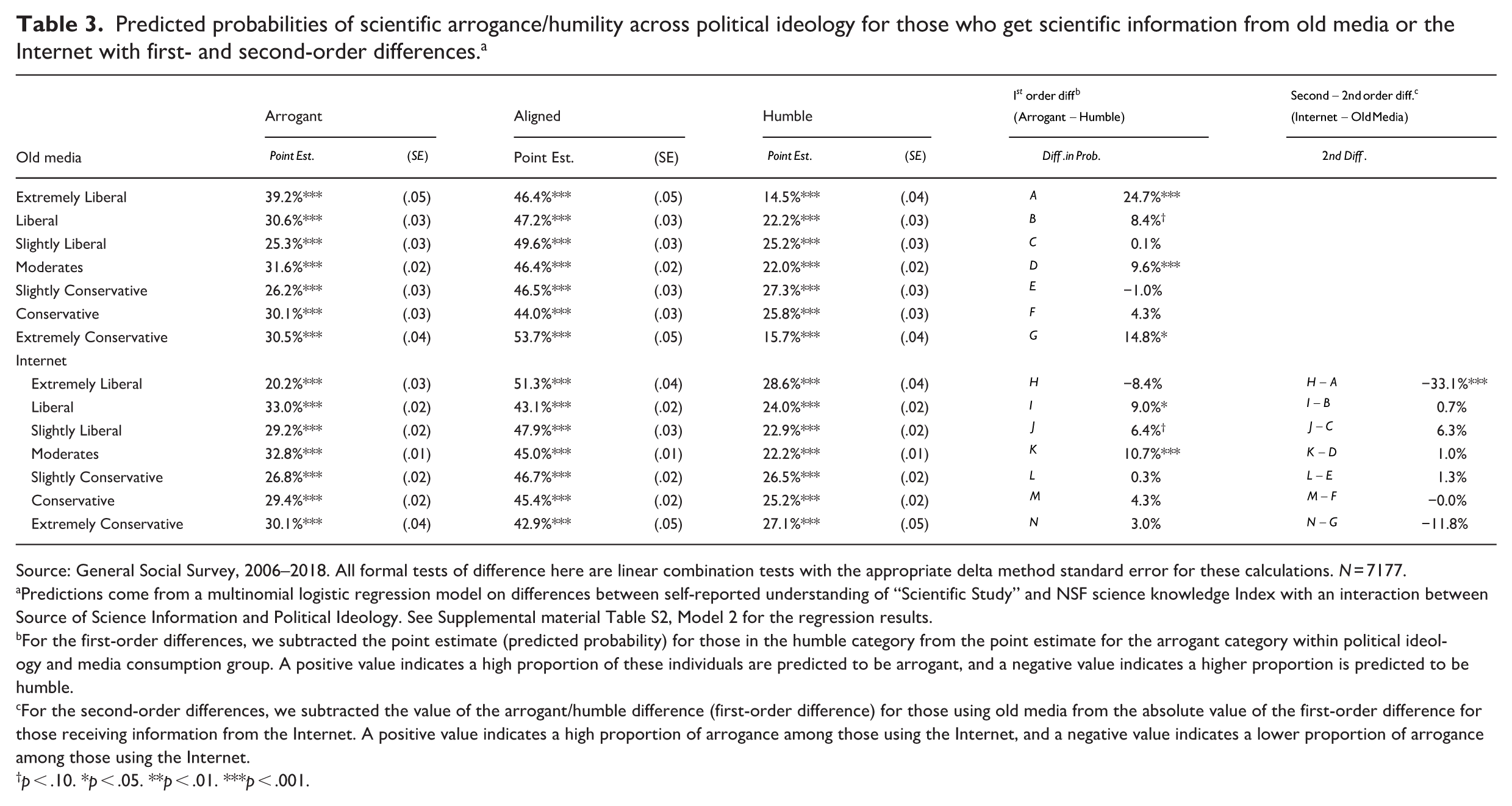
We present these predicted probabilities, first-order differences between those who are scientifically arrogant and humble, and second-order differences across new and old media in Table 3. Focusing on the first-order differences, among those using old media, we see that those who are extremely liberal show the largest gap in predicted probabilities between being scientifically arrogant and the scientifically humble (
Predicted probabilities of scientific arrogance/humility across political ideology for those who get scientific information from old media or the Internet with first- and second-order differences. a
Source: General Social Survey, 2006–2018. All formal tests of difference here are linear combination tests with the appropriate delta method standard error for these calculations. N = 7177.
Predictions come from a multinomial logistic regression model on differences between self-reported understanding of “Scientific Study” and NSF science knowledge Index with an interaction between Source of Science Information and Political Ideology. See Supplemental material Table S2, Model 2 for the regression results.
For the first-order differences, we subtracted the point estimate (predicted probability) for those in the humble category from the point estimate for the arrogant category within political ideology and media consumption group. A positive value indicates a high proportion of these individuals are predicted to be arrogant, and a negative value indicates a higher proportion is predicted to be humble.
For the second-order differences, we subtracted the value of the arrogant/humble difference (first-order difference) for those using old media from the absolute value of the first-order difference for those receiving information from the Internet. A positive value indicates a high proportion of arrogance among those using the Internet, and a negative value indicates a lower proportion of arrogance among those using the Internet.
p < .10. *p < .05. **p < .01. ***p < .001.
Among those who seek scientific information from the Internet, there is a very different pattern. Here, the extreme liberals are more humble than arrogant, though this difference is not statistically significant. The largest difference between arrogant and humble in this group is among the political moderates, who are 10.7% more likely to be arrogant than humble (
We conduct an additional analysis that suggests possible mechanisms for this humbling effect. Starting in 2010 and refined from 2012 to 2018, the GSS asked a series of follow-up questions to the sources of scientific information question. For respondents who answered that they got their information about science and technology from a newspaper, they were asked the follow-up: “You said you get most of your information about science and technology from newspapers. Would that be printed newspapers or online newspapers?” with the response options “Print newspapers,” “Online Newspapers,” and other. For those who answered “Magazine,” the GSS followed up with “You said you get most of your information about science and technology from magazines. Would that be printed magazines or online magazines?” with the same response categories. Finally, for those who said they got their science news online, they follow with, “You said you get most of your information about science and technology from the Internet. What is the place you are most likely to go on the Internet for science and technology information – online newspapers, online magazines, or some other place on the Internet?” During 2010, the response categories were “Online Newspapers,” “Online Magazines,” and “Science Sites.” From 2012 to 2018, these categories were expanded to include “Electronic Books and Reports,” “Wikipedia,” “Government sites,” “Social Media,” “Other,” and “Search engines.”
We use this information to focus on those who report the Internet as their primary source of information on science and technology. With the above follow-up questions, we are able to disaggregate these individuals into those who get their science and technology information online but from digital versions of traditional sources (here defined as individuals who get science and technology information from online newspapers, online magazines, science site(s), news site(s), electronic books and reports, or government site(s)) compared to those whose information comes from less traditional sources (here defined as social media, Wikipedia, search engines, or other online sources). Across the years captured here for this reduced sample (
Figure 3 shows the descriptive differences between those who seek information from traditional sources online and those who look to social media/other sources online, disaggregated by political orientation. Because of the reduced sample size, we focus on conservatives (extremely conservative and conservative), moderates (slightly conservative, moderate, and slightly liberal), and liberals (extremely liberal and liberal). The left-side images show the descriptive mean/proportions of the relevant measures for the groups of interest, and the right-side images show the first-order difference in means/proportions where Traditional online news sources are subtracted from social media/other online news sources. A positive difference means that those who get their information from social media have a higher mean/proportion of confidence or knowledge, and a negative difference means that those who are using traditional online news sources have a higher mean/proportion of confidence or knowledge. Here, the bottom panel is especially relevant as it indicates that it is among the “traditional” online media accessing liberals where the humbling effect is most prevalent. (
7. Discussion and conclusion
This last finding suggests a few potential mechanisms, which, with the current data, we can only speculate on. One is that traditional online sources allow for an ease of exposure to scientific information that challenges scientific self-perceptions, while not being subject to the algorithmically fueled landscape of “non-traditional” sources (e.g. on social media) that can serve to reinforce self-perceptions and counter challenging messaging through echo-chambers and backfire effects (Bail et al., 2018). This kind of understanding of liberal scientific self-perceptions, for which we have offered substantial empirical evidence, is portrayed conceptually in Figure 4, where the U-shaped curve represents the humbling effect of exposure to counter-attitudinal scientific messaging without the well-established social media effects that reinforce self-perceptions of all kinds. Although this same general relationship is also observed among conservatives in our findings, it is far less striking. Importantly, we only find evidence for this mechanism for strong ideologues, which is a much smaller population than moderate ideologues and partisans but consistent with previous studies on science and partisan media effects (Gauchat, 2012; Mann, 2024; Mann and Schleifer, 2020).
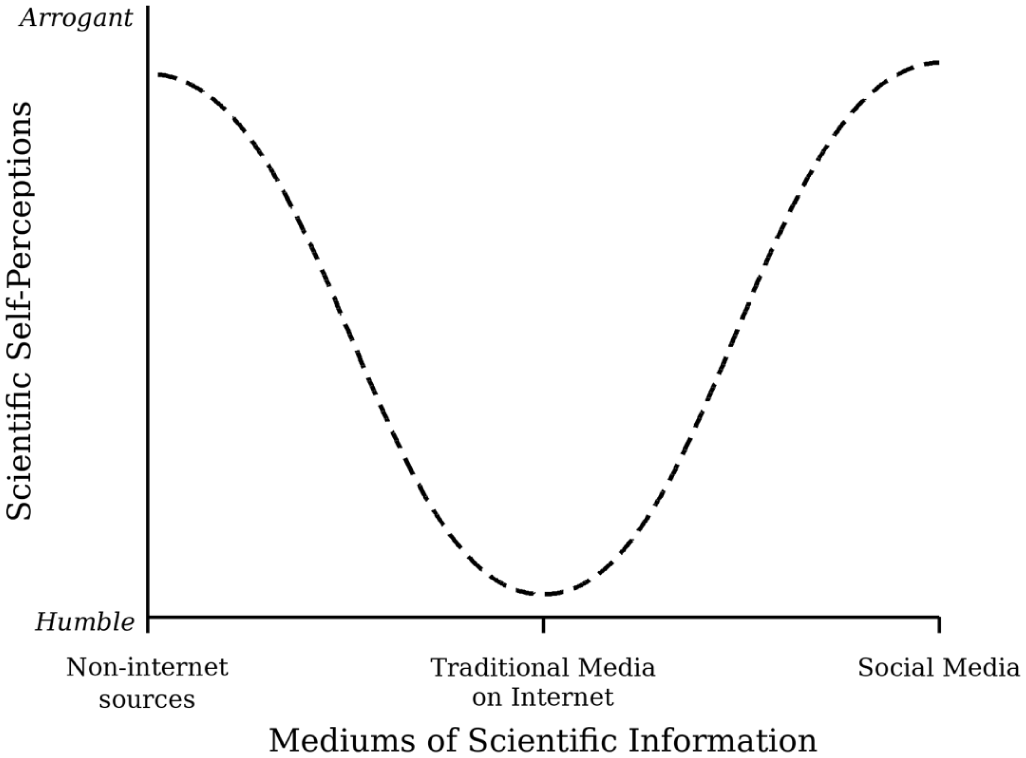
Conceptual relationship between engagement with scientific mediums and scientific confidence.
Reporting having a clear understanding of a scientific study has a U-shaped distribution across our categories of political ideology, suggesting that ideologues on both sides are likely to express more confidence (Figure S1B). However, when looking at this pattern by those who get their scientific information from old media and those who get their scientific information from the Internet, we find that among those in the latter category, this U-shape goes away mainly as a function of extreme liberals being less likely to report confidence when they get their scientific information from the Internet (Figure 1(b)). When we combine this measure with the NSF knowledge scale to look at arrogance and humility, these patterns are durable. Most striking is how much more humble extreme liberals who get their information from the Internet are than extreme liberals who get their information from old media (Table 3).
These patterns suggest that different media provide unequal access to politically congruent scientific information and that exposure to science supporting one’s political views can bolster scientific self-perceptions independent of actual scientific knowledge. Interestingly, these patterns also suggest a mechanism other than politically congruent knowledge sources – namely, access to politically incongruent knowledge sources. While extreme liberals who got their information from old media were the most arrogant group by far, extreme liberals who got their information on the Internet were also the humblest in this category. This prompts a consideration of how certain kinds of scientific information undermine scientific self-perceptions and lead to withdrawal from public discussion of science, much in the same way Correll (2001) found that negative self-assessments of competence in math and science among young women biased them away from STEM majors.
Previous research on scientific understandings among conservatives has established dramatic declines in trust in the scientific community (Gauchat, 2012) but stable and positive views of science itself as a societal good (Mann and Schleifer, 2020). These observations suggest that worsening political polarization has not registered among partisans in the form of proscience or antiscience parties. This kind of reading obscures how the political differentiation of scientific authority has maintained the cultural and epistemological dominance of scientific approaches. Instead, in recent decades, certain organizations and institutions provide a “conservative scientific repertoire” (Mann and Schleifer, 2020) for conservatives (and other communities that have eschewed mainstream scientific authority) to enable their participation in scientific debates. Our results here add to this insight by identifying mediums like the Internet and old media as locations where scientific self-perceptions, that may make participation more likely, variably support or challenge scientific self-perceptions for different political groups.
This study also contributes to research on political knowledge more generally. For years, this area of research has been largely characterized by studies examining the existence (Barberá et al., 2015; Sunstein, 2001) or lack thereof (Guess et al. 2018b) of things like political echo-chambers and the effects of counter-attitudinal information (see, for example, Bail et al., 2018; Guess and Coppock, 2020). While these studies tend to measure this kind of exposure in terms of political news sources with outcomes like political beliefs and attitudes, we contribute to this area by demonstrating the implications of exposure to different mediums that shape access to politically (in)congruent knowledge in science. Our findings suggest that social scientists should consider how similar exposure in the explicitly political realm might affect political self-perceptions of competence and therefore participation in political debates and discussion. Who is opting in and opting out of such discussions, and why, is of increasing importance as levels of affective polarization and political extremism worsen (Iyengar et al., 2019; Iyengar and Westwood, 2015; Youngblood, 2020).
This analysis has several limitations that are worth noting. First, although we were inspired by SC-EST to examine the initial step in these processes, which is often overlooked or assumed (usually fairly) – exposure to cultural messaging – we were unable to examine the final step: engagement in political-scientific discussions. This kind of research is underway, and there are several studies examining how students incorporate scientific knowledge in moral or socio-scientific debates (e.g. Nielsen, 2012a, 2012b). Insights from this research – including how levels of scientific knowledge itself predict its invocation in debates on social issues – could be readily extended to political partisanship.
This study also examines these dynamics through one vector of social difference – political identity in the United States. But there are many intriguing areas of further study in this regard, including religious identity and practice, as well as the myriad of social dynamics that may be salient in other countries. In terms of the United States, researchers of religion and science have identified dominant modes of religio-scientific understandings (Ecklund et al., 2017; Evans and Evans, 2008; O’Brien and Noy, 2015) and outlined how perceptions of the epistemological boundaries of science and religion influence public discourse about science’s role in social life (e.g. Evans, 2018). The findings presented here engage with this work by asking how and in what contexts religion might boost or mute scientific self-perceptions and what the implications are for the religio-scientific understandings. Similar studies outside the United States might examine how scientific self-perceptions operate in multi-party systems where orientation toward mainstream science might be more nuanced and variable than in the United States, where the two-party system has led to Democrats and Republicans being relatively pro- and antimainstream science, respectively.
Climate change, COVID-19, and vaccination are only a few of the pressing issues of our time and are fundamentally scientific matters. However, despite enjoying broad scientific consensus on the reality of these threats and how to address them, public consensus has been hamstrung by political/cultural disagreements emanating from quasi-scientific institutions (Farrell, 2016b; McCright and Dunlap, 2003, 2011b; Mirowski, 2011). In this article, we have argued that in addition to providing the arguments and ideas that contradict scientific consensus, these institutions have leveraged the Internet to support their audiences’ scientific self-perceptions in the face of that contradiction. For scholars and stakeholders interested in improving scientific understandings, we hope this draws more attention to the factors – in addition to politics and media – that foster or challenge these self-perceptions and thus enable participation in public scientific discourse generally.
Supplemental Material
sj-docx-1-pus-10.1177_09636625261449987 – Supplemental material for Does medium matter? Political orientation and variability in scientific self-perceptions
Supplemental material, sj-docx-1-pus-10.1177_09636625261449987 for Does medium matter? Political orientation and variability in scientific self-perceptions by Marcus Mann and Cyrus Schleifer in Public Understanding of Science
Footnotes
Acknowledgements
The authors would like to thank Trent Mize, David Peterson, and Samuel Perry for their helpful feedback. Previous versions of this project were presented at the 2022 Annual Conference for the American Sociological Association.

Funding
The authors received no financial support for the research, authorship, and/or publication of this article.
Declaration of conflicting interests
The authors declared no potential conflicts of interest with respect to the research, authorship, and/or publication of this article.
Data availability statement
This paper uses General Social Survey (GSS) data, which can be publicly accessed at GSS Data Explorer or directly from the NORC website at NORC GSS.
Supplemental material
Supplemental material for this article is available online.
Notes
Author biographies
References
Supplementary Material
Please find the following supplemental material available below.
For Open Access articles published under a Creative Commons License, all supplemental material carries the same license as the article it is associated with.
For non-Open Access articles published, all supplemental material carries a non-exclusive license, and permission requests for re-use of supplemental material or any part of supplemental material shall be sent directly to the copyright owner as specified in the copyright notice associated with the article.
