






Abstract
Ligament injuries can lead to lasting instability and early joint degeneration despite rehabilitation or surgery. Stem cell therapies may aid regeneration, but studies are highly variable. Bibliometric analysis can summarize trends, hotspots, and research gaps. We searched the Web of Science Core Collection for English-language original articles on stem cell therapy for ligament injuries from 2001 to 2025 on April 2, 2025, excluding non-original publications. Publication and citation trends were summarized, and co-authorship, co-citation, and keyword networks were mapped using Excel, VOSviewer, CiteSpace, and Bibliometric.com. A total of 599 articles were included, with steadily increasing annual publications. The United States and China were leading contributors, with strong collaboration networks involving major institutions such as the University of Pittsburgh and Zhejiang University. Keyword analyses identified seven main themes spanning mechanisms, clinical translation, tissue engineering, surgery/grafting, injury models, biomechanics, and biomaterials. Recent hotspots included “inflammation” and “artificial ligament”. Stem cell research for ligament injuries is increasingly focused on mechanisms and biomaterials, but evidence is still mainly preclinical and inconsistent. Better comparative clinical studies and standardized, well-defined biomaterial–cell approaches are needed.

Introduction
Ligament injuries impose a substantial burden on musculoskeletal health and often lead to persistent instability, delayed return to activity, and accelerated degenerative joint changes. Anterior cruciate ligament (ACL) injuries alone have an annual incidence of approximately 68.6 per 100,000 person-years and account for a large proportion of clinically significant ligament injuries.1,2 Current management includes structured rehabilitation and surgical repair or reconstruction, but long-term outcomes remain variable.3–5 Even with advances in arthroscopic techniques and ligament-preservation approaches, many patients experience incomplete functional recovery, reinjury or residual laxity, and early osteoarthritic change, reflecting the limited intrinsic healing capacity of ligament tissue and the reliance of conventional approaches on endogenous repair.6–8 These limitations have motivated interest in regenerative strategies that aim to restore ligament structure and function rather than achieve mechanical stabilization alone.
Stem cell–based therapy has therefore emerged as a potential adjunct or alternative for ligament repair. 9 Mesenchymal stem/stromal cells and other stem/progenitor populations may promote healing through multilineage differentiation and, importantly, through paracrine mechanisms that regulate inflammation, angiogenesis, and extracellular matrix remodeling within the injury microenvironment. 10 Preclinical studies, including both in vivo animal injury and graft-integration models as well as in vitro mechanobiology experiments, have reported improvements in histological organization, collagen composition, and biomechanical properties following stem cell delivery, particularly when combined with biomaterial scaffolds or growth-factor–releasing constructs. 11 These studies have provided mechanistic hypotheses involving immunomodulation, matrix regulation, and mechanotransduction. Early clinical investigations have also reported encouraging signals for symptom improvement and functional recovery. 12 However, the strength of clinical evidence remains limited, and it is not yet clear whether stem cell–based interventions provide additive or superior benefit compared with established rehabilitation protocols or surgical repair/reconstruction, especially with respect to long-term durability, safety, and objective stability outcomes. Moreover, the literature spans multiple ligament contexts (with ACL predominating but not exclusively), and substantial heterogeneity exists in ligament type, cell source and dose, delivery route, adjunctive biomaterials, outcome measures, and follow-up duration, complicating comparison across studies and slowing translation.
Given this rapid growth and heterogeneity, a systematic mapping of the field is needed. Bibliometric analysis provides quantitative methods to evaluate scientific output and knowledge structure by analyzing publication trends, collaboration networks, influential contributors, and thematic evolution through keyword co-occurrence and burst detection. 13 Unlike systematic reviews and meta-analyses that synthesize pooled estimates of effectiveness, bibliometric analysis provides a complementary, field-level perspective by quantifying research output, collaboration structure, and thematic evolution. It can characterize the distribution of evidence across ligament types and study models (eg, human vs animal; in vivo vs in vitro), map contributions and partnerships among countries/regions, institutions, and journals, and identify major research themes and rapidly developing topics through keyword co-occurrence and burst detection. Collectively, these analyses help contextualize persistent translational challenges in stem cell–based ligament repair and inform priorities for future comparative, long-term, and mechanistic investigations. 14
Accordingly, this study performed a comprehensive bibliometric analysis of publications on stem cell therapy for ligament injuries from 2001 to 2025. The study objectives were to quantify publication and citation trends, identify leading countries/regions, institutions, authors, and journals and visualize collaboration networks, and delineate major thematic clusters and emerging topics using keyword co-occurrence and burst analyses. By providing a structured overview of publication trends, collaboration networks, and keyword evolution, the present study offers a field-level map of research activity in stem cell–based ligament repair. This bibliometric perspective helps clarify how the field has evolved from early stem cell and graft-related studies toward emerging themes, thereby providing a basis for identifying future research priorities.
Methods
Data source and search strategy
The Web of Science Core Collection (WoSCC; Clarivate Analytics) was selected as the data source because it provides standardized bibliographic and citation metadata commonly used for bibliometric analyses.15,16 All records were retrieved on a single day (April 2, 2025) to minimize variation caused by routine database updates.
The search was performed using the WoSCC Advanced Search function with the following query: TS = (Ligament injur* OR Ligament tear OR Ligament rupture) AND TS = (stem cell* heal* OR stem cell* therap* OR stem cell* promot* OR stem cell* treat*). Records were restricted to English-language publications and the timespan 2001–2025.
Inclusion criteria were: (1) original research articles focused on stem cell–related interventions in ligament injury/repair/regeneration; (2) indexed in WoSCC; (3) published in English between 2001 and 2025. Exclusion criteria were: (1) publications not directly related to stem cell therapy for ligament injury/repair/regeneration; and (2) non-original document types (eg, reviews, conference proceedings, editorial materials, letters, book chapters, case reports, and patents).
Records were screened by document type and topic relevance. After screening, bibliographic data were exported from WoSCC as “Full Record and Cited References”. Export files were downloaded in plain text format for VOSviewer/CiteSpace and in tab-delimited (Win, UTF-8) format where required for Bibliometric.com, consistent with the platform’s recommended input settings (full record and cited references). Exported fields included publication year, title, authors, affiliations, countries/regions, journal, keywords, and citation counts. To support transparency and reproducibility, the full bibliographic dataset used for analysis has been prepared and will be provided as an Excel supplement (Supplementary Dataset 1), exactly as exported from WoSCC.
Because the search strategy used broad ligament-related terms, the retrieved records encompassed studies involving multiple ligaments (eg, ACL, medial collateral ligament, and others). Therefore, this study reflects the overall ligament-injury literature related to stem cell therapy; ligament-specific emphasis (eg, ACL predominance) emerges from keyword and topic distributions rather than being imposed by the study design.
Statistical analysis
Bibliometric Analysis and Visualization.
Bibliographic data were imported into Microsoft Excel 2021 for data cleaning and descriptive analyses, including annual publication counts and citation summaries. Bibliometric mapping and visualization were conducted using VOSviewer (v1.6.20), CiteSpace (v6.3. R1), and the online bibliometric platform Bibliometric.com (v4.4.2; https://bibliometric.com/). Bibliometric.com was used to generate country-level publication trends and country/institution collaboration maps based on uploaded WoSCC export files.
VOSviewer was used to construct collaboration and knowledge-structure networks, including country/institution/author co-authorship networks and citation/co-citation networks. 17 The following thresholds were applied: at least 3 documents for country co-authorship analysis, at least 4 documents for institution co-authorship analysis, and at least 3 documents for author co-authorship analysis; at least 10 citations for authors, references, and journals in co-citation analyses; and keywords occurring more than 2 times in titles/abstracts for keyword co-occurrence analyses.
CiteSpace was used primarily for keyword burst detection to identify rapidly emerging topics. Parameters were set as follows: time slicing 2001–2025 (1 year per slice), node type “keywords”, selection criterion top 5 per slice, and pruning using “pathfinder” and “pruning merged network” options.
No restrictions were applied at retrieval regarding study model. To describe the composition of the included evidence base, two authors independently reviewed the title and abstract, and the full text when necessary, and assigned non-mutually exclusive study-feature tags to each article. These tags included human/clinical features, animal-related experimental features, explicitly reported in vivo experimental components, explicitly reported in vitro experimental components, and mixed/unclear features. Because one article could contain multiple study components, these tags were allowed to overlap and were not intended to represent mutually exclusive study-type categories. In addition, intervention-related features, including scaffold-assisted delivery, growth factor/PRP co-therapy, and the presence of an explicit comparator, were recorded as non-mutually exclusive auxiliary tags. Disagreements were resolved by discussion. These tags were used only to describe the evidence structure and were not used as inclusion/exclusion criteria.
Bibliometric indicators and academic impact assessment
Annual publication counts, citation counts, and journal metrics (including Journal Impact Factor (IF) and JCR quartile, when applicable) were summarized descriptively in Excel 2021. For evaluating the individual influence of researchers, 18 the H-index, G-index, and M-index were utilized. The H-index indicates that a researcher has H papers, each of which has received at least H citations. 19 The G-index is defined as the largest integer g, such that the top g articles have accumulated at least g2 citations. 20 The M-index, calculated by dividing the H-index by the number of years since the first publication, measures the development rate of a researcher’s academic influence. 21 The H-index of authors and relevant journal indicators were directly retrieved from the WoSCC database. When used, additional indices (eg, G-index and M-index) were reported only to characterize bibliometric influence and were not interpreted as evidence of study quality or clinical effectiveness.
Results
Overview of stem cell therapy for ligament injuries
A total of 849 articles were initially retrieved from the Web of Science Core Collection. After screening, 250 unique articles were excluded, resulting in a final cohort of 599 articles for analysis. The included articles involved 3,498 authors from 2,007 institutions and were published in 242 journals, citing 22,764 references. The reasons for exclusion included document type (reviews, n=249; proceeding papers, n=7; editorial materials, n=11; letters, n=1; early access, n=7; book chapters, n=9) and language (non-English, n=18). It should be noted that a single article could be excluded for multiple reasons (Figure 1). Because the retrieval strategy did not restrict study model, we additionally tagged the included literature using non-mutually exclusive study-feature descriptors based on title/abstract (and full text when required), performed independently by two authors with disagreements resolved by discussion. Using non-mutually exclusive study-feature tagging, 277 records were tagged as involving human/clinical features, 572 as involving animal-related models or materials, 120 as explicitly reporting in vivo experimental components, and 164 as explicitly reporting in vitro experimental components. Because a single article could contain more than one component, these tags were descriptive and overlapping, and therefore should not be summed to the total number of included articles. Although ACL-related research constituted a major proportion of the included publications, the dataset was not restricted to ACL and also included studies on other ligament injuries and repair contexts, as reflected in keyword and topic analyses. Flowchart of the literature screening process.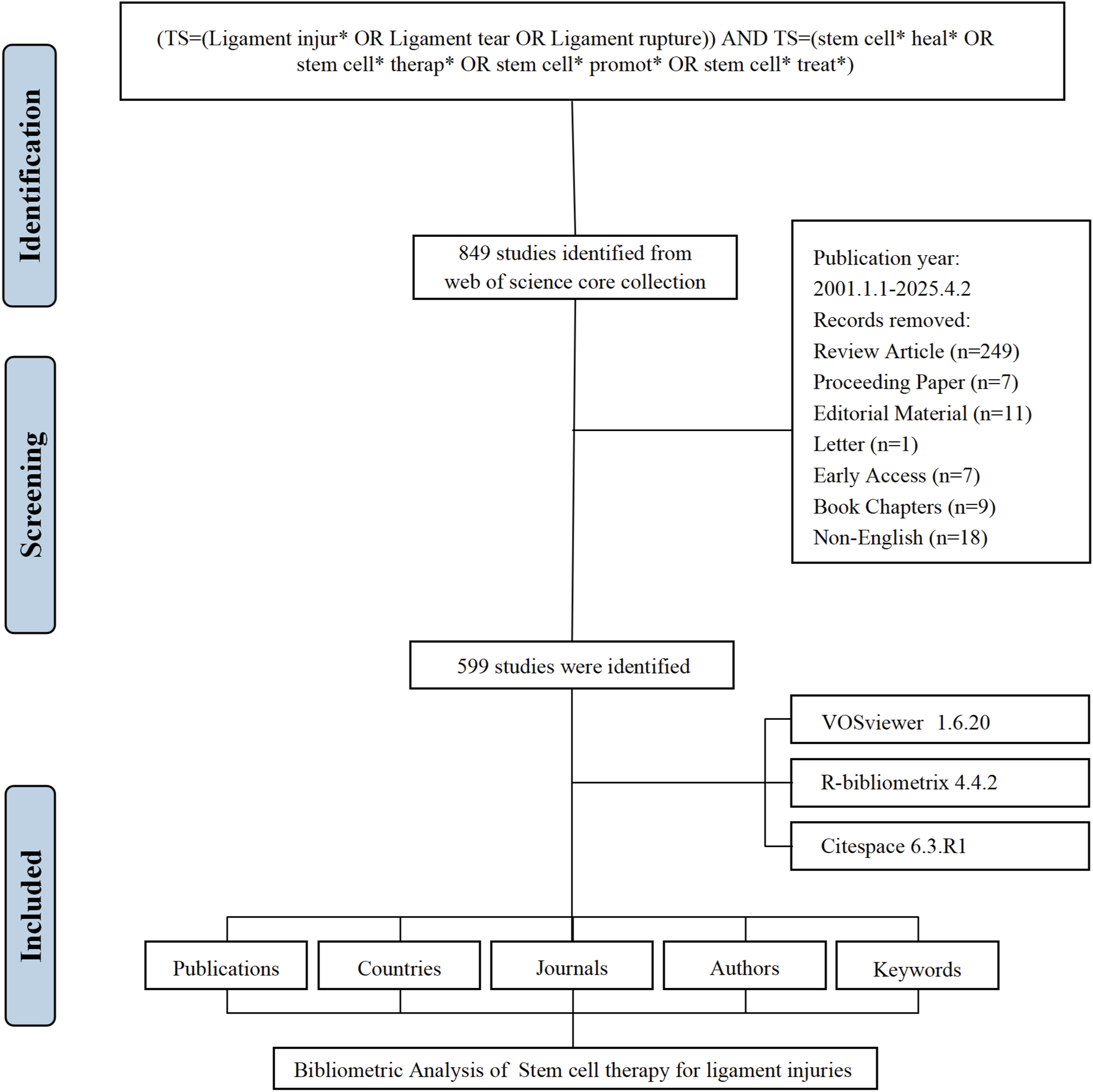
We analyzed annual and cumulative publications from 2001 to 2025 (Figure 2). The annual publication count exhibited a consistent upward trajectory, beginning with just 2 articles in 2001 and escalating to a peak of 51 articles in 2022, with 10 articles recorded in 2025 by the search date. A linear regression analysis with an R2 value of 0.9927 confirmed a strong positive correlation between the years and the cumulative number of publications, underscoring the sustained and increasing interest in this research field.
22
Among the most influential works, a 2010 study in The Journal of Clinical Investigation (“CTGF directs fibroblast differentiation from human mesenchymal stem/stromal cells and defines connective tissue healing in a rodent injury model”) has garnered 267 citations.
23
A Biomaterials article from the same year (“A bFGF-releasing silk/PLGA-based biohybrid scaffold for ligament/tendon tissue engineering using mesenchymal progenitor cells”) has accumulated 253 citations.
24
Additionally, a 2006 study in the Journal of Cellular Biochemistry (“In vitro chondrogenesis of human synovium-derived mesenchymal stem cells: optimal condition and comparison with bone marrow-derived cells”) has been cited 232 times, highlighting key contributions to the field.
25
Annual number of publications.
Evaluation of national/regional and institutional contributions
From 2001 to 2025, a total of 28 countries/regions published articles on stem cell therapy for ligament injuries. Supplementary Table 1 details the top 20 countries based on publication output. Based on corresponding-author publication counts, China contributed the largest number of articles (n = 179), followed closely by the United States (n = 174) and Japan (n = 62). In terms of citation impact, the United States ranked first, with 8,583 total citations, followed by China with 4,308 citations and Japan with 3,381 citations. Italy, the United Kingdom, and Germany contributed 24, 24, and 22 corresponding-author articles, respectively (Figure 3(a)). Analysis of countries and institutions. (A). Distribution of corresponding author’s publications by country. (B). Visualization map depicting the collaboration among different countries. Nodes represent countries, with size indicating publication count. Links represent co-authorships, with thickness showing collaboration strength. Colors indicate different research clusters. Total link strength in collaboration networks measures the frequency of co-authorship between countries, indicating the level of collaborative research. (C). Top ten institutions by article count and rank. (D). Visualization map depicting the collaboration among different institutions. Nodes represent institutions, with size indicating publication count. Links represent co-authorships, with thickness showing collaboration strength. Colors indicate different research clusters. Total link strength in collaboration networks measures the frequency of co-authorship between institutions, indicating the level of collaborative research.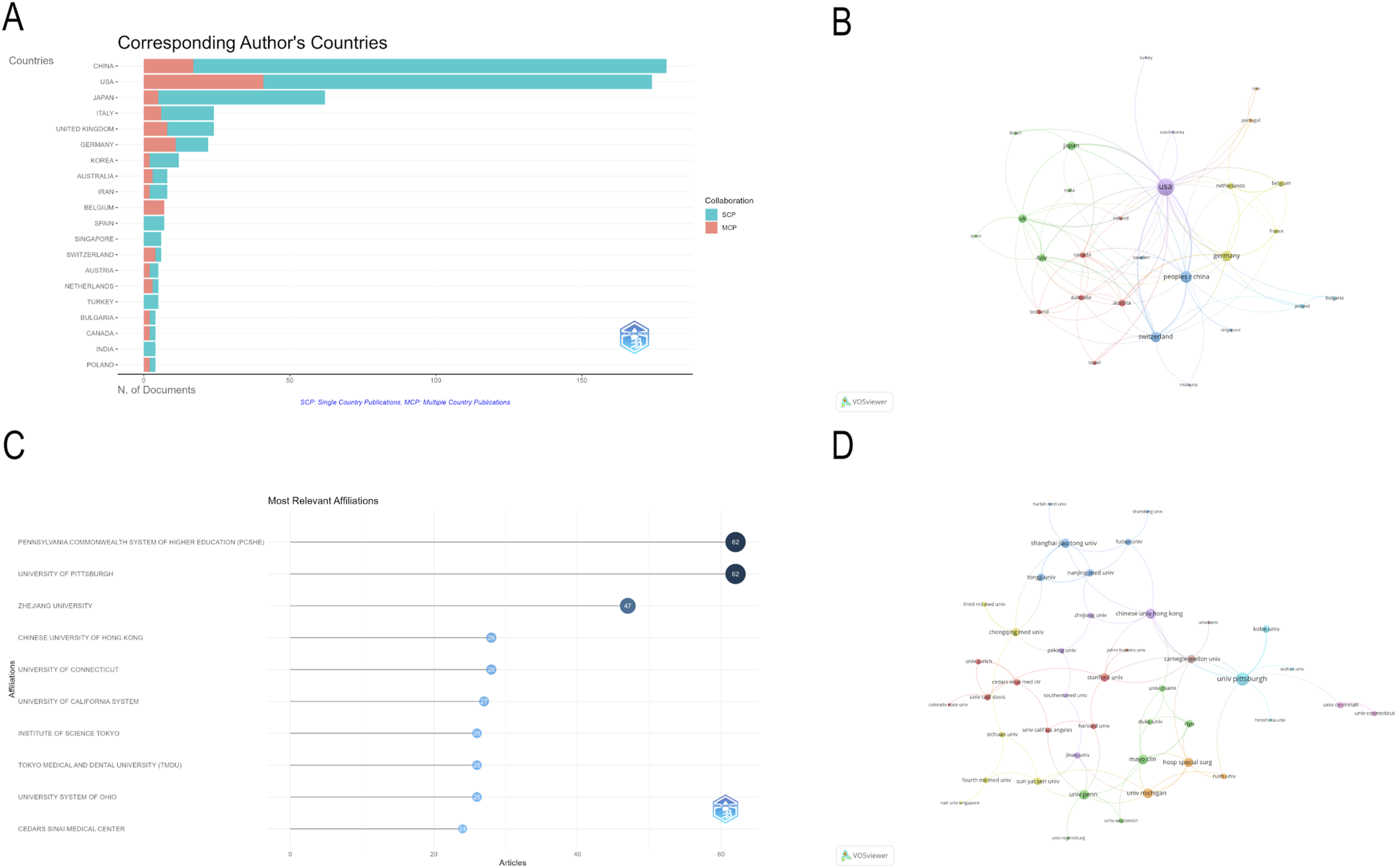
In the collaborative network, among the 28 countries with at least 3 articles involved in international collaborations, USA emerged as the most collaborative country, with the highest total link strength (TLS = 93). China followed with a TLS of 41, and Germany ranked third with a TLS of 35. These figures underscore the global nature of research in this field and the pivotal role played by these countries in fostering international scientific cooperation (Figure 3(b)).
Between 2001 and 2025, a total of 2,007 different institutions contributed to the research on stem cell therapy for ligament injuries. The institutions with the top 10 number of publications are shown in Figure 3(c). The Pennsylvania Commonwealth System of Higher Education (PCSHE) and the University of Pittsburgh tie for the lead, each with 62 published articles. Zhejiang University follows with 47 articles, and the Chinese University of Hong Kong has 28 articles. Other institutions such as University of Connecticut, University of California System, Institute of Science Tokyo, Tokyo Medical and Dental University (TMDU), University System of Ohio, and Cedars Sinai Medical Center have also made substantial contributions to the field.
Among institutions involved in international collaborations with a minimum of 4 articles, 56 institutions were included in the institutional collaboration network. The University of Pittsburgh was a key player in this network, with the highest total link strength (TLS = 15), followed by the Chinese University of Hong Kong (TLS = 9) and Mayo Clinic (TLS = 8) (Figure 3(d) and Supplementary Table 2).
Authorship analysis
In the research on stem cell therapy for ligament injuries, a total of 3,498 authors were involved. The analysis of high-impact authors with publication and citation is shown in Supplementary Table 3. The top four authors with the most published articles are Kuroda Ryosuke (14 articles, H-index 13), Matsumoto Tomoyuki (14 articles, H-index 13), Kurosaka Masahiro (11 articles, H-index 11), and Fu Freddie H (10 articles, H-index 9). Figure 4 provides a visualization of the collaboration network among different authors. Among these 111 authors engaged in international collaborations with a minimum of 3 articles, Matsumoto Tomoyuki has the most extensive collaborations with other authors (TLS = 84), followed by Kuroda Ryosuke (TLS = 80), and Chen Xiao (TLS = 69). Visualization map depicting the collaboration among different authors. Nodes represent authors, with size indicating publication count. Links represent co-authorships, with thickness showing collaboration strength. Colors indicate different research clusters. Total link strength in collaboration networks measures the frequency of co-authorship between authors, indicating the level of collaborative research.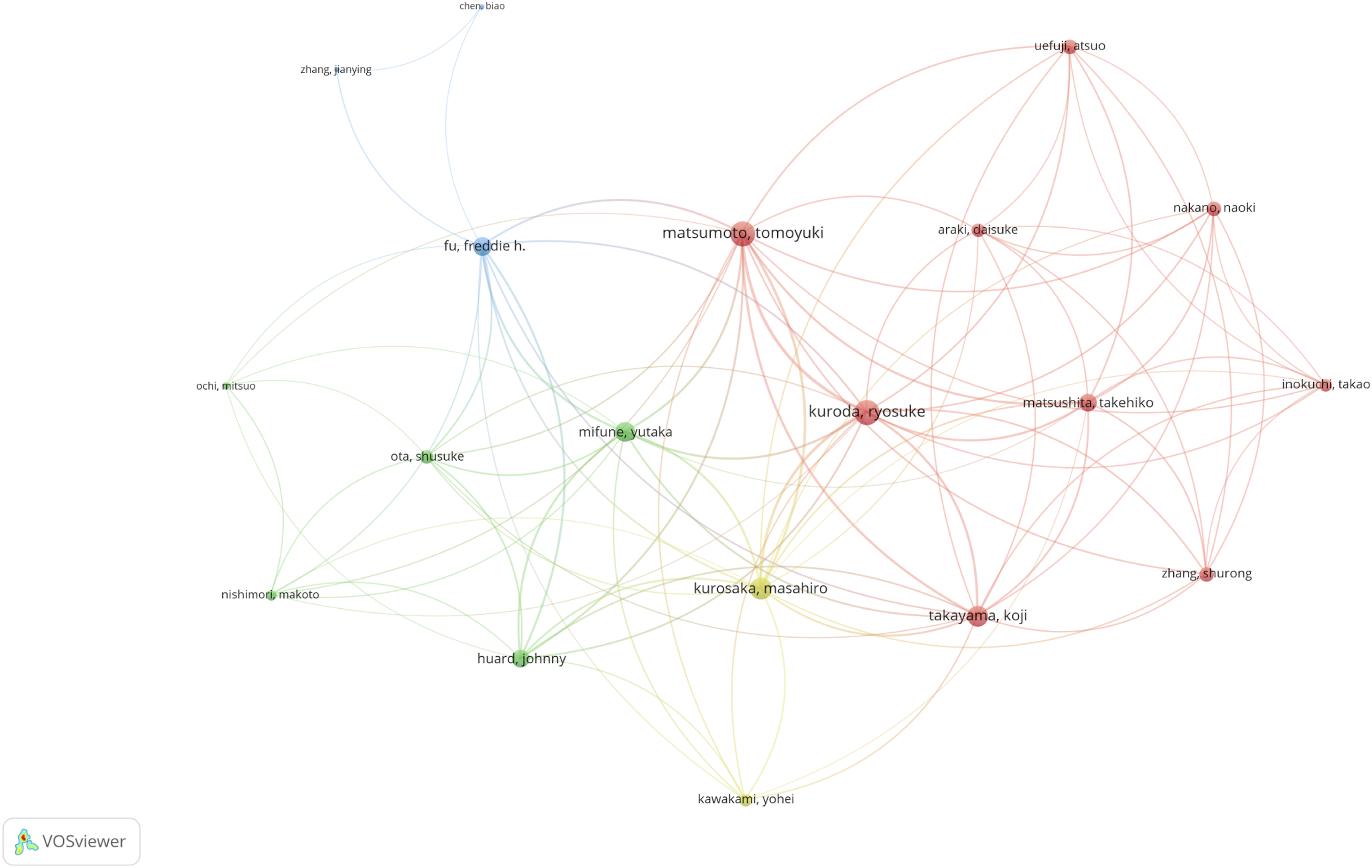
Journal analysis
Research articles on stem cell therapy for ligament injuries have been published in 242 journals. To evaluate their influence and relevance, these journals were ranked by their H-index (Supplementary Table 4). The analysis reveals that American Journal of Sports Medicine leads with an H-index of 21, followed by Tissue Engineering Part A with an H-index of 15, and Journal of Orthopaedic Research with an H-index of 11. Acta Biomaterialia closely follows with an H-index of 10.
Figure 5(a) presents a co-occurrence network of 115 journals with at least two occurrences. The three journals with the highest total link strength in Co-occurrence Networks were American Journal of Sports Medicine (TLS = 120), Journal of Orthopaedic Research (TLS = 72), and Tissue Engineering Part A (TLS = 56). This indicates a significant level of interconnectivity and influence among these publications. Analysis of journals. (A). Co-occurrence Network of Journals. Journal Link Strength in co-occurrence networks measures the frequency with which two journals are cited together within the same articles or references. This metric reflects how often the publications from two different journals are associated in the bibliographies of scholarly articles. High link strength implies that the journals are often cited in tandem, indicating a thematic or topical connection between the research they publish. (B). Coupling Network of Journals. Journal Link Strength in coupling networks assesses the extent to which journals are linked based on the common references cited in their articles. This metric captures the degree to which the research published in two different journals relies on the same body of prior work. A strong link strength in this context signifies that the journals share a substantial number of references, highlighting a shared intellectual foundation or research focus.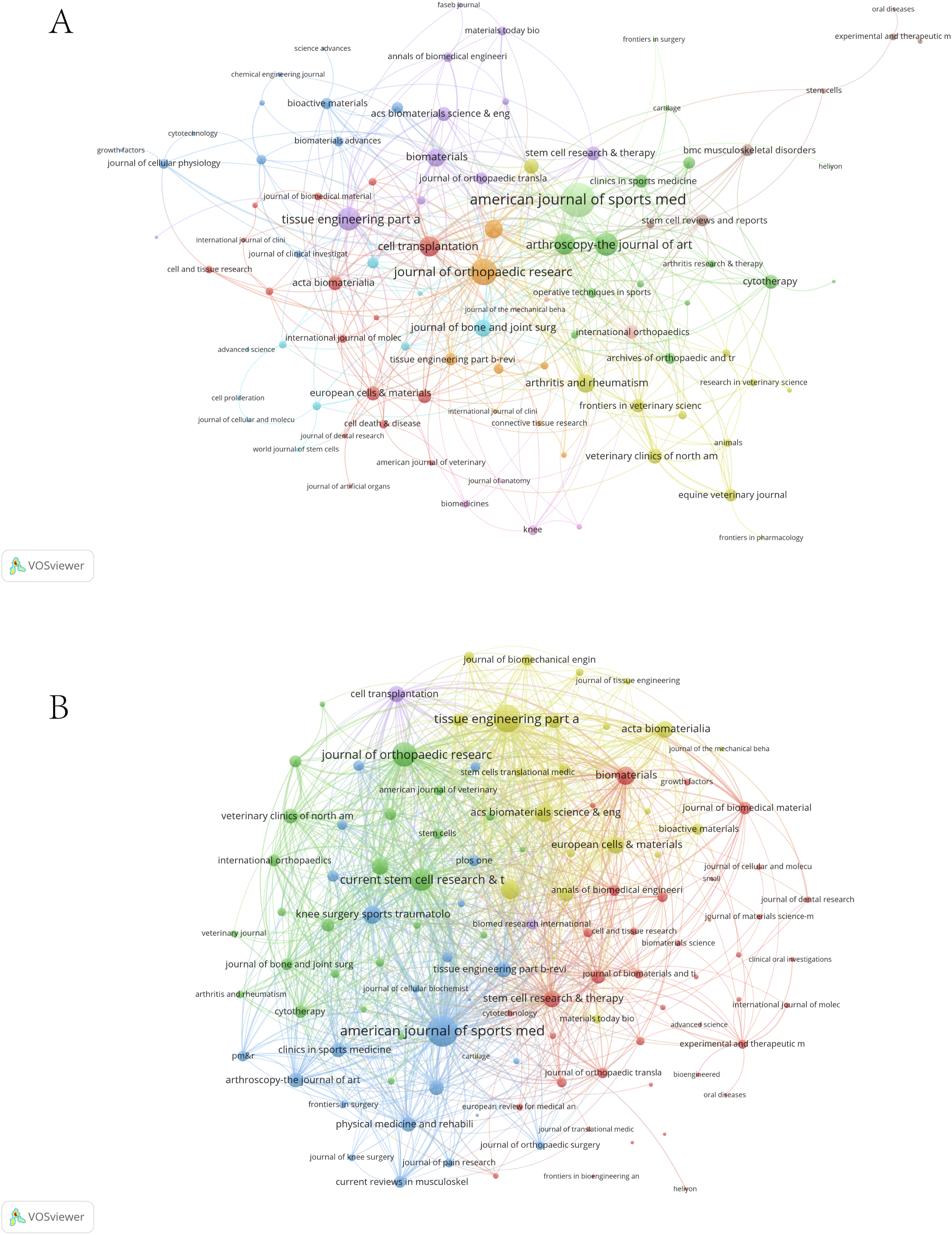
Figure 5(b) shows the coupling network of 115 journals with at least two coupled occurrences. The three key journals with the highest total link strength in coupling networks were American Journal of Sports Medicine (TLS = 3,502), Tissue Engineering Part A (TLS = 2,696), and Journal of Orthopaedic Research (TLS = 2,180). These figures underscore the substantial interconnectedness and collaborative influence of these journals within the field.
Keyword co-occurrence network and burst analysis
The keyword co-occurrence analysis (Figure 6(a)) reveals the multidimensional structure of research in stem cell therapy for ligament injuries, with seven major clusters, each represented by a distinct color and research theme. At the center of the network, the blue cluster (Cluster 1): mechanisms and cellular responses, featuring keywords such as “differentiation,” “inflammation,” “extracellular-matrix,” and “mesenchymal stromal cells.” This theme highlights the biological processes and signaling pathways central to ligament healing and regeneration. The green cluster (Cluster 2): clinical translation and therapeutic approaches, with prominent terms like “articular-cartilage,” “gene-therapy,” “platelet-rich plasma,” “intraarticular injection,” and “knee osteoarthritis.” These keywords reflect efforts to bridge laboratory findings with clinical applications and adjuvant strategies in musculoskeletal repair. Analysis of keywords. (A). Keyword Co-occurrence Network and Thematic Clustering in Stem Cell Therapy for Ligament Injuries. Network visualization of keyword co-occurrence, illustrating major thematic clusters within the selected literature. Each node represents a keyword, and node size indicates its frequency. Nodes with similar colors are grouped into clusters, reflecting distinct research themes such as mechanisms, clinical translation, tissue engineering, surgical techniques, injury models, biomechanics, and biomaterials. Links between nodes represent co-occurrence relationships. (B). Mapping time distribution of keywords. This network visualization displays the co-occurrence of keywords in selected literature. Each node represents a keyword, with size indicating its frequency of occurrence. Links between nodes represent co-occurrence in the same documents, with thicker lines showing stronger associations. Colors reflect the average publication year of the articles, as indicated by the color gradient at the bottom right. (C). Top 20 Keywords with the Strongest Citation Bursts (CiteSpace).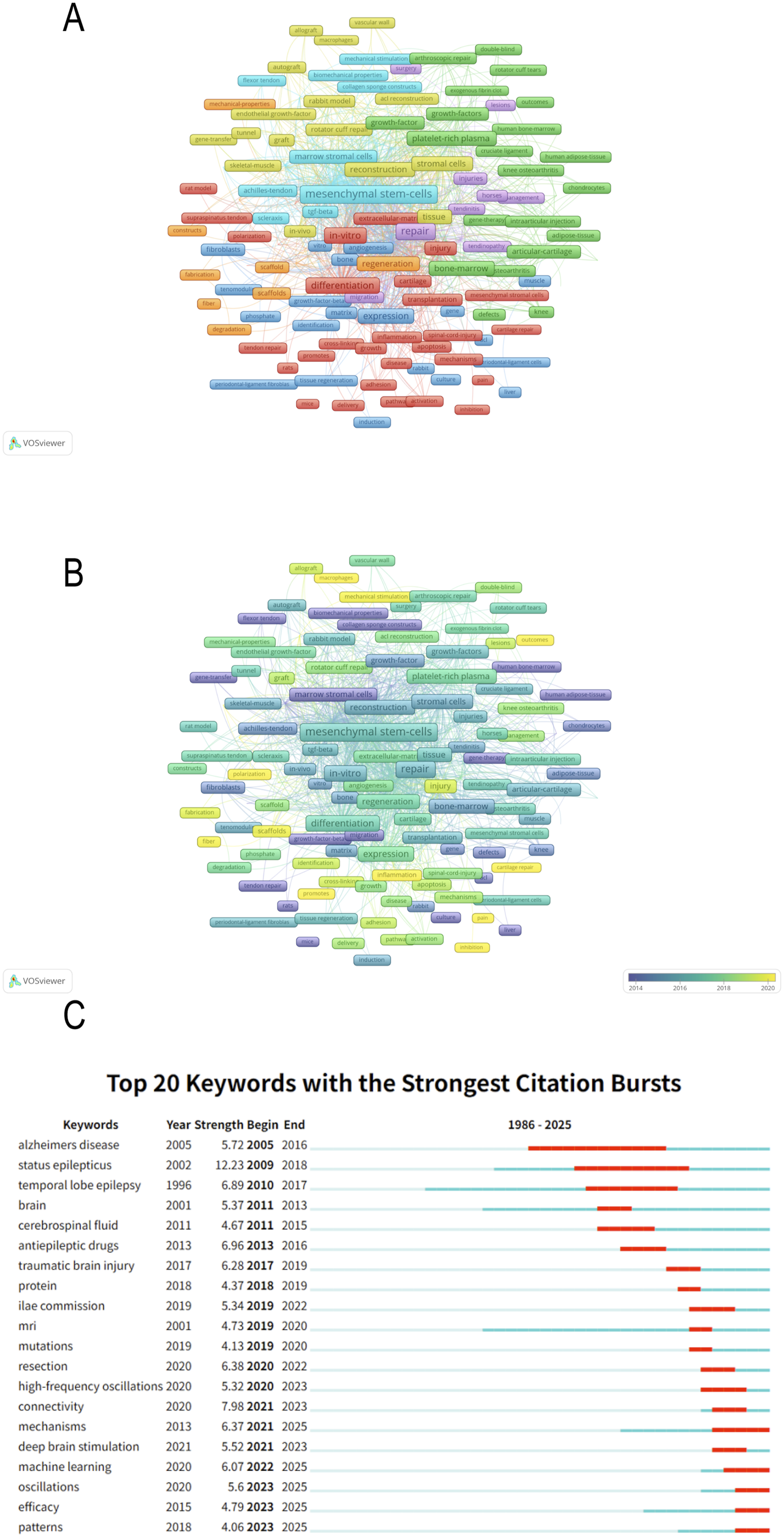
Moving to the red cluster (Cluster 3): tissue engineering and regeneration. Here, keywords such as “fibroblasts,” “matrix,” “osteogenesis,” and “tissue regeneration” illustrate the development of regenerative techniques and scaffold-based solutions to enhance ligament repair. The yellow cluster (Cluster 4): surgical techniques and grafting, with terms like “ACL reconstruction,” “allograft,” “autograft,” “tendon graft,” and “rotator cuff repair.” This cluster emphasizes the integration of stem cell-based methods with established surgical reconstruction practices. In the purple cluster (Cluster 5): injury models and disease entities. Keywords including “injuries,” “lesions,” “tendonitis,” and “rupture” point to the broad spectrum of pathological conditions being addressed by stem cell therapies. The turquoise cluster (Cluster 6): biomechanics and experimental models. With keywords such as “biomechanics,” “mechanical stimulation,” “rat model,” and “tenogenic differentiation,” this cluster underscores the importance of preclinical studies and biomechanical factors in optimizing therapeutic outcomes. Finally, the orange cluster (Cluster 7): biomaterials and scaffold innovation, featuring keywords like “artificial ligament,” “biomaterials,” “scaffold,” “degradation,” and “fabrication,” which signal the field’s growing interest in advanced materials and engineering strategies for ligament regeneration.
Temporal mapping of these keywords (Figure 6(b)) reveals evolving research hotspots over time. In the early stage (circa 2014, purple), the field was primarily concerned with topics such as “marrow stromal cells,” “graft,” and “autograft.” By the mid-phase (2016–2018, transitioning blue to green), attention shifted towards “repair,” “mesenchymal stem-cells,” “regeneration,” and “platelet-rich plasma,” reflecting advances in regenerative approaches and adjuvant therapies. In the latest phase (post-2020, yellow), the emergence of “inflammation,” “apoptosis,” “extracellular matrix,” “mechanisms,” and “artificial ligament” highlights a turn toward molecular mechanisms, immune modulation, and innovative biomaterial solutions.
Supplementary Table 5 provides quantitative data on the occurrence and total link strength of specific keywords, further emphasizing their importance in the field. For instance, “mesenchymal stem-cells” appeared 189 times with a total link strength of 976, making it a highly connected and frequently mentioned keyword. Similarly, “repair” appeared 114 times with a total link strength of 636, and “anterior cruciate ligament” appeared 111 times with a total link strength of 620, indicating their significant roles in the research.
Subsequently, a burst analysis of keywords spanning from 2001 to 2025 was conducted, which helped reveal the evolutionary trends of these keywords. As shown in Figure 6(c), from 2007 to 2015, the research focus was on core elements related to stem cell therapy for ligament injuries, including “marrow stromal cells”, “patellar tendon”, and “transplantation”. From 2016 to 2022, there was a notable shift in emphasis towards biomolecular mechanisms. Keywords such as “gene expression” and “apoptosis” took center-stage, reflecting a deeper dive into the molecular underpinnings of the therapy. Since 2022, keywords such as “inflammation”, “cruciate ligament reconstruction”, “artificial ligament”, “rotator cuff repair”, “extracellular matrix”, and “anterior cruciate ligament reconstruction” have become more prominent. These bursts indicate periods of intense research activity and highlight the evolving focus areas within the field of stem cell therapy for ligament injuries.
Discussion
This bibliometric study provides a comprehensive overview of global research activity on stem cell therapy for ligament injuries from 2001 to 2025. Consistent with the purpose of bibliometric research, the findings are interpreted as patterns in scientific production, collaboration, and thematic evolution, rather than as evidence of clinical efficacy. Overall, the field has shown sustained growth in publications and citations, increased international collaboration, and an increasingly interdisciplinary knowledge base linking orthopaedics, cell biology, and materials science. Taken together, publication trends, collaboration networks, and keyword evolution indicate a progressive shift from early feasibility-oriented and graft-related studies toward more mechanism-oriented and engineering-oriented themes, with inflammation, extracellular matrix regulation, tissue engineering, and biomaterial-assisted repair becoming increasingly prominent directions in the field.
China and the USA emerged as the main contributors, reflecting strong research capacity and sustained investment in regenerative medicine. Leading institutions such as the University of Pittsburgh occupied central positions in the collaboration network, while Zhejiang University showed substantial publication output, indicating their role in shaping topic direction and accelerating dissemination through multi-institutional output.9,26 Importantly, bibliometric dominance should be interpreted as concentration of publications and connectivity rather than superiority of evidence quality. The observed collaboration pattern suggests potential complementary strengths across research communities; however, country- or institution-specific thematic emphases should be interpreted cautiously because bibliometric network measures do not directly assess study quality, translational readiness, or the research focus of individual groups.9,26
Journal analyses indicate that field-defining output is concentrated within orthopaedic and tissue engineering outlets such as the American Journal of Sports Medicine, Tissue Engineering Part A, and Journal of Orthopaedic Research. These journals not only publish a high proportion of relevant work but also appear as central nodes in co-citation and coupling structures, supporting their role in consolidating interdisciplinary knowledge and amplifying emerging themes. 27 For researchers, these patterns can inform dissemination strategy (journal selection and audience alignment) but should not be conflated with methodological rigor of individual studies, which requires study-level appraisal.
At the author level, the collaboration networks highlight highly connected contributors such as Kuroda Ryosuke and Matsumoto Tomoyuki, whose work is frequently embedded in cross-team output and topic-defining clusters.26,28 Within bibliometric framing, “impact” reflects citation connectivity and field-level visibility, which may be influenced by publication volume, collaboration centrality, and topic salience. Several highly cited studies align with mechanistic and translational pivots observed in the keyword structure. For example, Lee et al. identified CTGF as an important regulator of fibroblast differentiation from human mesenchymal stem/stromal cells, providing a mechanistic anchor for connective tissue repair research. 23 Sahoo et al. developed a bFGF-releasing silk/PLGA biohybrid scaffold seeded with mesenchymal progenitor cells, supporting the expansion of scaffold-based strategies in ligament/tendon engineering. 24 Shirasawa et al. compared synovium-derived and bone marrow-derived mesenchymal stem cells under optimized chondrogenic conditions, contributing to diversification of cell sources and protocols used in musculoskeletal regeneration. 25 Together, these publications illustrate how foundational mechanism papers and scaffold-enabled constructs can function as “knowledge hubs” that shape subsequent research trajectories.
The keyword analysis from 2001 to 2025 in stem cell therapy for ligament injuries shows a clear evolution in research focus.
Mechanisms and cellular responses (blue cluster)
The blue cluster, defined by keywords such as “differentiation,” “inflammation,” “extracellular matrix,” and “mesenchymal stromal cells,” captures the mechanistic foundation of the field. Recent work emphasizes that stem cells and their extracellular vesicles can influence macrophage polarization and the inflammatory milieu, with downstream effects on cytokine signaling, matrix metalloproteinase activity, collagen deposition, and ligament–bone integration. 29 Related studies on immune-regulatory approaches, including TGF-β2 preconditioning and reduced immune activation (eg, reduced MHC-II expression), further reinforce immunomodulation as a central mechanistic route being pursued for safer and more durable regenerative effects.30,31 From a bibliometric standpoint, the appearance of “inflammation” as an emerging hotspot is consistent with this mechanistic consolidation and increasing integration of immune biology into orthopaedic regeneration.
Clinical translation and therapeutic approaches (green cluster)
Keywords such as “articular cartilage,” “gene therapy,” “platelet-rich plasma,” and “intraarticular injection” reflect efforts to move beyond proof-of-concept toward clinically implementable interventions. Combination strategies, particularly MSCs with PRP, appear repeatedly across the literature and connect mechanistic hypotheses with translational practicality. Reported effects include enhanced MSC proliferation and tenogenic differentiation, with proposed pathways such as AKT/mTOR activation, increased collagen synthesis, and reduced inflammatory cytokine release.32,33 These studies align with continued interest in adjuvant or multi-component therapy as a route to improve structural and functional outcomes. 34 However, bibliometric prominence does not resolve whether these strategies outperform established surgery or optimized rehabilitation, reinforcing the need for well-designed comparative human studies.
Tissue engineering and regeneration (red cluster)
The red cluster highlights scaffold-enabled regeneration and matrix-focused engineering, with keywords including “fibroblasts,” “matrix,” “osteogenesis,” and “tissue regeneration”. The growth of this cluster is consistent with increasing reliance on biomaterials to address ligament’s limited intrinsic healing. Collagen-platelet composite scaffolds and bioactive scaffold-assisted ACL repair approaches are repeatedly studied as approaches to provide structural guidance and microenvironmental cues that support integration and remodeling in animal models. 35 This thematic concentration suggests that scaffold design and cell–matrix interactions remain core translational bottlenecks and opportunities.
Surgical techniques and grafting (yellow cluster)
The yellow cluster emphasizes integration of stem cell strategies with existing surgical pathways, including “ACL reconstruction,” “allograft,” “autograft,” and “tendon graft.” The literature frequently tests stem cell augmentation to improve graft incorporation and biomechanical performance in both autograft and allograft contexts. 36 The recent burst of terms such as “cruciate ligament reconstruction” and “rotator cuff repair” supports the view that regenerative augmentation is increasingly being evaluated within established operative frameworks. 37 Bibliometrically, this reflects a pragmatic translational direction: embedding biologics into surgical workflows rather than replacing them outright.
Injury models and disease entities (purple cluster)
The purple cluster demonstrates the breadth of experimental models and clinical entities captured by the search strategy, including keywords such as “injuries,” “lesions,” “tendonitis,” and “rupture.” Animal models (eg, patellar tendon and rotator cuff injury) have served as platforms to test delivery strategies and clarify repair mechanisms, consistent with early bursts in “marrow stromal cells,” “patellar tendon,” and “transplantation”. While this diversity broadens the evidence base, it also contributes to heterogeneity that limits direct comparison across studies and underscores the value of standardized reporting and endpoints.
Biomechanics and experimental models (turquoise cluster)
This cluster, with terms including “biomechanics,” “mechanical stimulation,” “rat model,” and “tenogenic differentiation,” highlights the role of mechanical context in ligament regeneration. Studies increasingly integrate mechanical stimulation, biomechanical testing, and controlled in vivo models to optimize differentiation and functional outcomes. 38 From a translational perspective, this cluster supports the view that successful regeneration must account for loading environment and structure–function relationships, not solely cellular or molecular endpoints.
Biomaterials and scaffold innovation (orange cluster)
The orange cluster points to accelerating innovation in materials and constructs, with “artificial ligament,” “biomaterials,” “scaffold,” “degradation,” and “fabrication” representing a move toward engineered substitutes and mechanically functional implants. Emerging approaches include biohybrid implants and stem cell–laden hydrogels designed to improve cell delivery, retention, and mechanical compatibility.38,39 The appearance of “artificial ligament” as a recent hotspot suggests that the field is moving toward solutions that explicitly target mechanical function alongside biological repair.
Temporal and burst analysis
Burst analysis indicates a stepwise evolution: early work (2007–2015) concentrated on establishing feasibility within injury and surgical models (“marrow stromal cells,” “patellar tendon,” “transplantation”); the intermediate phase (2016–2022) emphasized mechanisms and adjuvant approaches (“gene expression,” “apoptosis,” “platelet-rich plasma”); and the most recent period (2022–2025) highlights translation-oriented expansion and engineering innovation (“inflammation,” “artificial ligament,” “extracellular matrix,” “rotator cuff repair”). These bursts suggest increasing convergence of immunology, biomaterials, and mechanobiology as the field’s main drivers, while also indicating where heterogeneity is likely to persist without shared outcome definitions and reporting standards.
Hotspots and frontiers: Current directions shaping the field
The combination of adjuvant strategies with stem cell therapy remains a prominent direction intended to improve regenerative performance. A representative example is the reported synergy of MSCs with PRP, where PRP-derived growth factors (eg, PDGF and TGF-β) have been associated with increased MSC proliferation and tenogenic differentiation. 32 Mechanistic work has linked these effects to pathways such as AKT/mTOR activation, accompanied by increased collagen synthesis and reduced inflammatory mediators such as IL-6 33. In multiple models, such combination approaches have been associated with improved tensile strength and structural outcomes, supporting continued translational interest.34,40 In bibliometric terms, the prominence of PRP-related keywords indicates that combinatorial, clinically accessible adjuncts remain a key translational bridge, although comparative effectiveness versus standard care still requires stronger human evidence.
Clinical translation of innovative biomaterials has also advanced, particularly through scaffold-assisted repair approaches. In porcine ACL repair models, collagen-platelet composite scaffolds improved suture repair outcomes, including yield load and linear stiffness at 3 months, along with increased cell density and structural properties approaching conventional reconstruction. 35 In skeletally mature goats, ECM sheet wrapping combined with ECM hydrogel injection increased healing tissue cross-sectional area and stiffness versus suture-only repair at 12 weeks. These examples illustrate why scaffold keywords occupy a large and growing portion of the thematic map: biomaterials can deliver cells, guide matrix organization, and provide mechanical support during the vulnerable early healing phase, thereby increasing the plausibility of clinically meaningful regeneration. Nevertheless, bibliometric growth in this area also highlights the need for standardized characterization of materials (composition, degradation, mechanics), manufacturing reproducibility, and clinically relevant endpoints to support translation.
Strengths and limitations
This study has several advantages. Firstly, bibliometric analysis offers a comprehensive overview of research trends and patterns, aiding in the identification of key areas of interest and growth within the field. It enables the quantification of research output, facilitating comparisons across institutions, countries, and time periods. Additionally, bibliometric tools can highlight influential authors, institutions, and journals, which is valuable for understanding leadership and collaboration networks in academic research. Furthermore, such analysis can reveal emerging topics and trends by examining citation patterns and co-citation networks, which is beneficial for strategic planning of future research directions.
Several limitations of this bibliometric analysis should be acknowledged. First, bibliometric indicators (eg, publication and citation counts) reflect research activity and dissemination but do not directly measure clinical effectiveness, methodological quality, or risk of bias of individual studies. Second, because the dataset was derived from WoSCC and limited to English-language publications, relevant studies indexed elsewhere, published in other languages, or available as preprints may have been missed, introducing selection bias. Third, results from visualization tools (VOSviewer, CiteSpace, and Bibliometric.com) depend on database metadata quality (eg, author name disambiguation and affiliation standardization) and on user-defined thresholds, which may influence network structure and keyword clustering. Fourth, although we added non-mutually exclusive human/clinical, animal-related, in vivo, and in vitro study-feature tags, this tagging was based primarily on titles/abstracts and therefore may be subject to misclassification for studies with incomplete reporting. Future work integrating multiple databases and applying full-text validation would further improve completeness and interpretability.
Conclusions
This bibliometric analysis maps the global research landscape of stem cell therapy for ligament injuries and demonstrates a clear evolution from early feasibility work toward mechanistic refinement and biomaterial-enabled translation. The thematic structure indicates that immunomodulation of the healing microenvironment, extracellular matrix–guided regeneration, scaffold-based delivery, and mechanobiology-informed design are increasingly central to the field, while “inflammation” and “artificial ligament” represent recent hotspots. At the same time, the knowledge map highlights several areas that may require further attention in future translational research, including standardization of cell-product reporting, delivery strategies, biomaterial characterization, and ligament-specific outcome measures. Future studies may benefit from more consistent reporting, longer follow-up, and clinically meaningful endpoints that allow clearer comparison across different regenerative and conventional treatment strategies. Together, these bibliometric findings provide a field-level basis for understanding thematic evolution and for informing future research priorities in stem cell–based ligament repair.
Supplemental material
Supplemental material - Hotspots and trends in stem cell therapy for ligament injuries: A bibliometric analysis (2001–2025)
Supplemental material for Hotspots and trends in stem cell therapy for ligament injuries: A bibliometric analysis (2001–2025) by Xuchao Wang, Junjie Liu and Wenlong Gao in Cell Transplantation.
Footnotes
Acknowledgement
The graphical abstract was created using resources from the Generic Diagramming Platform (GDP). 41

Author contributions
Xuchao Wang carried out the studies, participated in collecting data, and drafted the manuscript. Junjie Liu and Wenlong Gao performed the statistical analysis and participated in its design. Junjie Liu and Wenlong Gao helped to draft the manuscript. All authors read and approved the final manuscript.
Funding
The authors received no financial support for the research, authorship, and/or publication of this article.
Declaration of conflicting interests
The authors declared no potential conflicts of interest with respect to the research, authorship, and/or publication of this article.
Data Availability Statement
All data generated or analysed during this study are included in this published article.
Graphical abstract
Graphical overview of the bibliometric landscape and emerging thematic directions in stem cell therapy for ligament injuries. This graphical summary presents the 25-year publication landscape from 2001 to 2025, including publication growth, leading contributing countries, and representative academic hubs.
Supplemental material
Supplemental material for this article is available online.
Appendix
References
Supplementary Material
Please find the following supplemental material available below.
For Open Access articles published under a Creative Commons License, all supplemental material carries the same license as the article it is associated with.
For non-Open Access articles published, all supplemental material carries a non-exclusive license, and permission requests for re-use of supplemental material or any part of supplemental material shall be sent directly to the copyright owner as specified in the copyright notice associated with the article.
