







Abstract
The time-tested notion that increased contact improves intergroup attitudes, particularly under optimal conditions, is well established. Yet early theorists doubted whether contact could benefit intolerant, prejudice-prone persons. Without tackling the question directly, the contemporary contact field embraces an assumption opposed to that of its predecessors: that contact benefits intolerant individuals, given its general effectiveness. However, other prejudice interventions have failed or backfired among such people. Thus, established contact benefits among people generally may mask the failure of such interventions among intolerant people. I review contemporary evidence and conclude that the contact hypothesis retains its prominence among prejudice-reduction strategies: Intergroup contact and friendships work well (and often best) among intolerant and cognitively rigid persons—by reducing threat and anxiety and increasing empathy, trust, and outgroup closeness. Historically untested assumptions about contact have therefore tested favorably. Future imperatives involve directly addressing contemporary criticisms of contact research.
Bolstered by an extensive meta-analysis of over 500 studies (Pettigrew & Tropp, 2006) clearly supporting the effectiveness of intergroup contact in improving attitudes toward other groups, the field of social psychology is understandably enthusiastic and optimistic about contact. Contact is routinely touted as a critical method for improving attitudes and intergroup relations (e.g., Tausch & Hewstone, 2010). Pioneers in this field, however, were initially pessimistic, particularly with regard to the benefits of contact among ideologically oriented, intolerant, highly prejudiced persons (e.g., Allport, 1954; Amir, 1969). Among these concerns were apprehensions that strong “negative” personalities would overshadow positive benefits, that the highly prejudiced would inflame prejudices in face-to-face contact settings, or that such persons would avoid contact and thus not derive benefits (see Hodson, 2008, in press; Hodson, Costello, & MacInnis, in press). Historical accounts of “the prejudiced person” characterized these individuals as intolerant toward multiple outgroups due to psychological insecurity, threat sensitivity, and ego weakness (Allport, 1954). Concerns about their contact experiences were therefore understandable. Until recently, however, such assumptions had not been tested directly. The outcome is a paradoxical sense that successful contact among highly prejudiced persons is unlikely, given their avoidant and intolerant natures, yet presumably effective, given its well-documented successes among the general population. Problematically, this question has been largely unaddressed empirically (see Hodson et al., in press), leading us to ask the ultimate question: Does contact work among those most in need of intervention?
Individual Differences in Effectiveness of Contact
Pettigrew (1998) reformulated Allport’s (1954) contact hypothesis, the proposition that increased contact reduces prejudice. Pettigrew emphasized the importance of individual differences because “prior attitudes and experiences influence whether people seek or avoid intergroup contact, and what the effects of contact will be” (p.77, emphases added). Although it is well established that highly prejudiced individuals avoid outgroup interaction, contact researchers typically ignore or statistically remove effects of individual differences (see Hodson et al., in press), thus failing to address whether contact works for these persons. After decades of omission, researchers are increasingly incorporating individual differences into their theorizing. For instance, Tausch and Hewstone (2010) suggest that individual differences moderate contact effects on attitudes. However, the authors leave open the question of whether intolerant people benefit from or interfere with the efficacy of contact interventions. As argued elsewhere (Dhont & Van Hiel, 2009; Hodson, 2008, in press; Hodson, Harry, & Mitchell, 2009; Hodson et al., in press), there is strong reason to anticipate positive contact effects among highly prejudiced persons because contact reduces anxiety and increases empathy, while increasing inclusion-of-other-in-the-self (“psychological closeness”). Promisingly, these beneficial outcomes directly correspond to factors underpinning biases among intolerant persons, suggesting that contact can reduce their anti-outgroup sentiments.
Prejudice interventions, however, are not surefire bets. For example, multicultural training can inadvertently increase reliance on categorization (i.e., perceiving differences between groups) and stereotyping (Wolsko, Park, Wittenbrink, & Judd, 2000). Among those who are highly prejudiced, interventions—even presumably established prejudice-reduction procedures such as value confrontation (Altemeyer, 1996), teaching tolerance for diversity (Avery, Bird, Johnstone, Sullivan, & Thalhammer, 1992), or priming multiculturalism (Vorauer & Sasaki, 2010)—often backfire and sour intergroup relations. It is by no means obvious that contact will work among these individuals. In contrast to interventions directly confronting and challenging deeply entrenched worldviews, however, contact effectively reduces psychological threats and thus is likely to improve attitudes among ideologically intolerant people. Given that such people typically avoid contact, this review considers contact benefits in both free-choice and limited-choice (e.g., prison) settings.
Evidence Review
Early on, Mussen (1950) found that nonauthoritarian boys benefited from contact but that authoritarian boys became increasingly negative. However, Mussen employed indirect and questionable measures of authoritarianism and contact, problems common to early studies (Hodson et al., in press). The present review therefore only considers contemporary studies utilizing psychometrically sound measures of contact and individual differences relevant to outgroup intolerance. A total of seven publications (nine studies) meet these criteria, as summarized in Table 1 . Several strong individual-difference predictors of prejudice are reviewed, including hawkishness (intolerant aggression without conciliatory goals) and strong ingroup identification. Tapping into social/cultural domains, political conservatism also predicts outgroup resistance (Duckitt, 2001), and thus is also considered in this review. Particularly interesting are social-dominance orientation (SDO) and authoritarianism, two strong prejudice predictors (Duckitt, 2001). Those higher in SDO endorse hierarchies between groups and are motivated to attain/maintain group-based dominance. Authoritarians typically desire strong leadership, submit to recognized leaders, and value tradition and conventions.
Summary of Studies Showing Positive Contact Effects on Favorable Attitudes at Low or High Levels of Individual Difference Variables, and the Mediating Processes Involved
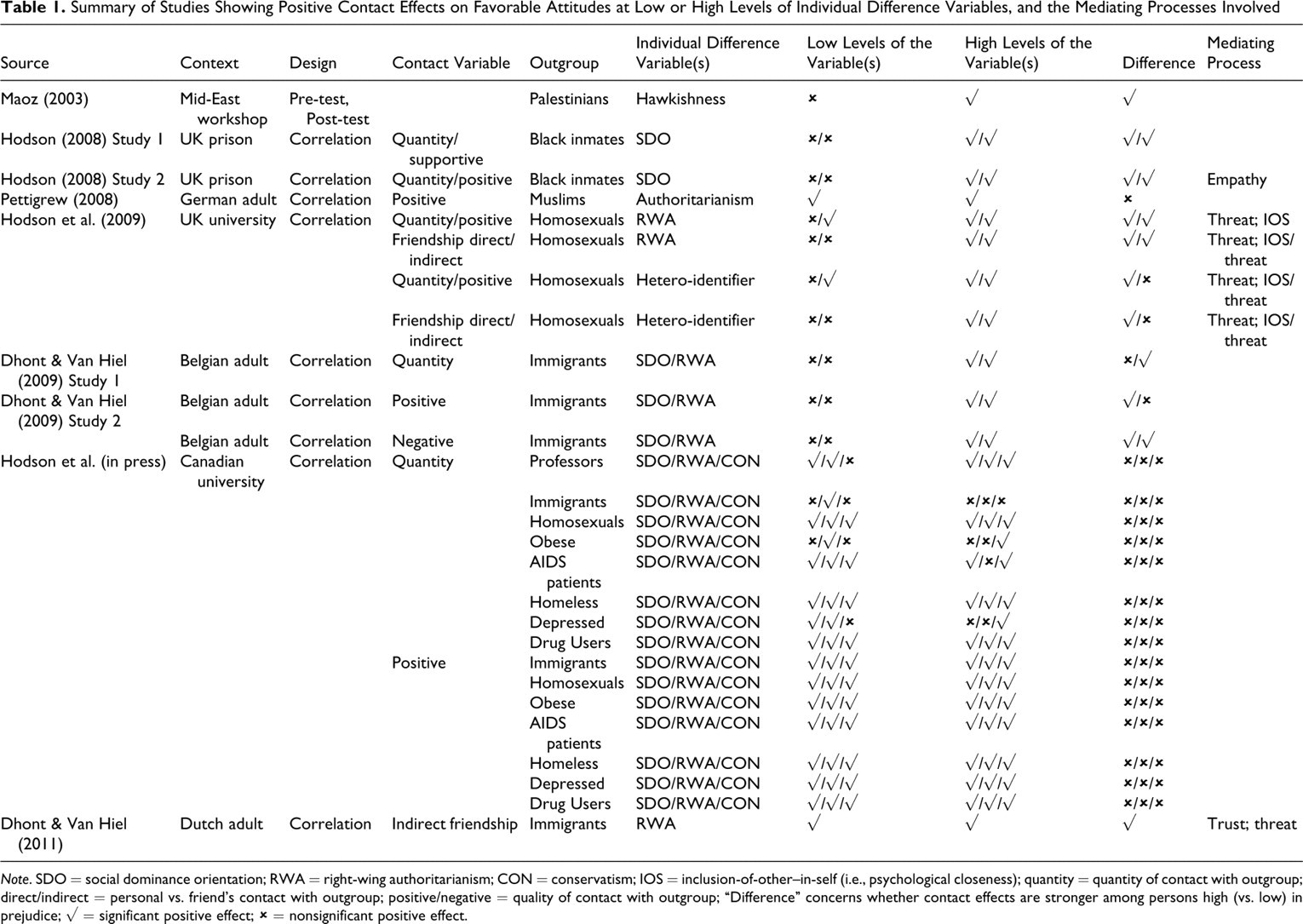
Note. SDO = social dominance orientation; RWA = right-wing authoritarianism; CON = conservatism; IOS = inclusion-of-other–in-self (i.e., psychological closeness); quantity = quantity of contact with outgroup; direct/indirect = personal vs. friend’s contact with outgroup; positive/negative = quality of contact with outgroup; “Difference” concerns whether contact effects are stronger among persons high (vs. low) in prejudice; = significant positive effect; = nonsignificant positive effect.
A consistent pattern emerges from Table 1: Those high on the prejudice-relevant individual difference variables clearly benefited from increased contact quantity and from positive contact experiences across eight of nine studies, with mixed success in one. Individuals equivalently high in intolerant ideologies but who experience less contact or fewer friendships expressed significantly more negative outgroup attitudes. Low scorers on the prejudice-relevant individual difference variables sometimes benefited from contact and sometimes did not. Contact benefits were often statistically stronger among prejudice-prone persons (see instances marked given a checkmark in the “Difference” column). Illustrations of such patterns are reflected in Figure 1 , where (a) White prison inmates higher (vs. lower) in SDO benefited from increased contact with Black inmates and (b) heterosexual authoritarians particularly benefited from having heterosexual friends who themselves had homosexual friends (i.e., indirect outgroup friendships). Overall, those higher in prejudice-relevant ideologies benefited from intergroup contact and friendship experiences in virtually all cases (see checkmarks under the “High levels” column)—often significantly more than did relatively tolerant persons.
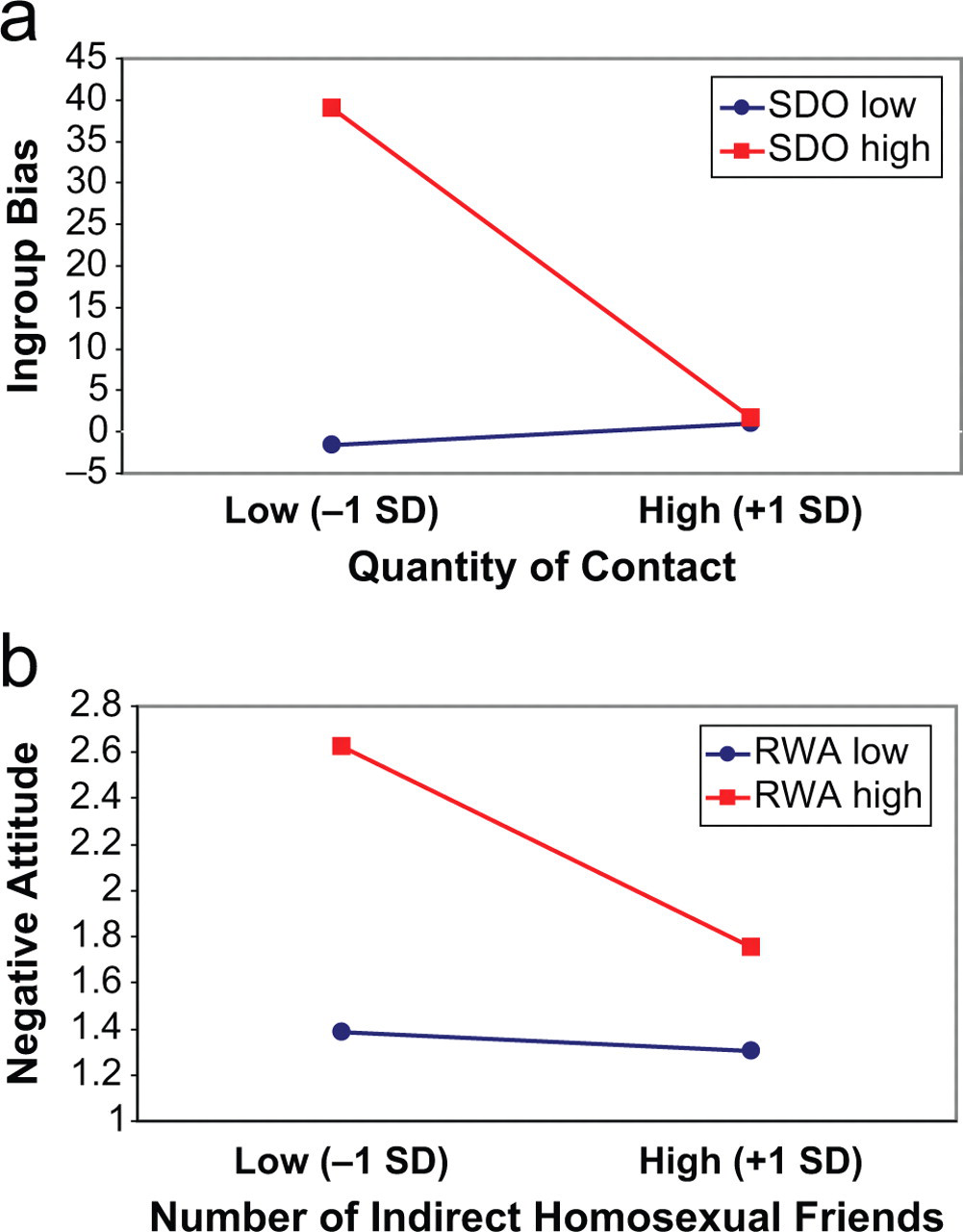
Social dominance orientation (SDO) × contact quantity patterns in prison (a; adapted from Hodson, 2008, Study 1), and right-wing authoritarianism (RWA) × indirect friendship patterns in a university sample (b; adapted from Hodson, Harry, & Mitchell, 2009). Only the slopes for high SDO or RWA are statistically significant.
The far-right column of Table 1 (“Mediating process”) provides insights into why highly prejudiced individuals benefit from intergroup contact. As anticipated, contact increases outgroup empathy and psychological closeness with the outgroup. Among those higher in prejudice, contact also attenuates factors that exacerbate prejudice, notably perceived outgroup threat. These factors explain why contact reduces prejudice among those prone to it whereas interventions that challenge and confront intolerant individuals often fail or backfire.
General Discussion
The contact hypothesis enjoys a long history and remarkable support as a prejudice-reduction strategy among people generally. Only recently have researchers directly addressed whether contact works among those most in need of intervention. This is no minor point. The endorsement of equality and fair treatment has become normative in Western countries, and many studies utilize student samples that lean toward liberalism and tolerance. For this reason, historically recognized benefits of contact may have actually reflected favorable attitudes among those relatively low or moderate on intolerant-ideological variables. The presumed effectiveness of contact in improving attitudes among ideologically intolerant persons risked being revealed as greatly exaggerated or even unsubstantiated. The summary in Table 1 presents a clear case for the opposite conclusion: Contact works well, if not best, among those higher on prejudice-prone individual-difference variables. Failure to find contact benefits among such individuals is the exception, not the norm. Early pessimism about contact (e.g., Allport, 1954; Amir, 1969) appears unsupported by recent evidence. Encouragingly, similar results extend to related individual difference constructs. Across correlational and experimental designs, individuals motivated by cognitive closure (i.e., quick and certain answers) benefit from contact through reduced intergroup anxiety (Dhont, Roets, & Van Hiel, 2011).
These encouraging findings are not attributable to easily identifiable confounds. Benefits of contact among prejudice-prone persons are documented across research designs, countries, populations (community, university, prison samples), types of contact variables (contact quantity, contact quality, direct outgroup friendships, indirect friendships), and several prejudice-relevant individual differences. Contact with other racial groups, homosexuals, or stigmatized and marginalized social groups proved beneficial. Of note, contact operated on highly prejudiced individuals through well-established psychological processes linked to elevated empathy, trust, and closeness, and to reduced threat and anxiety.
Whereas highly prejudiced individuals consistently benefit from contact, their low-prejudice counterparts react inconsistently. Although the latter individuals' results presumably reflect ceiling effects—failing to improve attitudes because their attitudes are initially favorable—this explanation is incomplete. After all, contact improved their attitudes in approximately 45% of studies reviewed (see Table 1). Moreover, preliminary data (Hodson et al., in press) suggest that individuals lower in prejudice benefit from contact even more than do highly prejudiced individuals when contact outgroups are strongly stigmatized (e.g., the homeless). Closer examination of low-prejudice individuals is encouraged. Statistical adjustments may be useful for comparisons with high-prejudice individuals given the potential for restricted variance among more tolerant individuals.
However, unduly focusing on those low on prejudice-relevant, ideological variables risks missing the point of the present exercise: addressing the long-unaddressed question of whether contact works among those most needing prejudice interventions—persons predisposed to disliking other groups for largely ideological reasons (e.g., group dominance motivation, desire for social order) or from cognitive-closure motivations. Attempts to undermine the benefits of contact among the highly prejudiced by pointing to potential ceiling effects among those low in prejudice is akin to criticizing a literacy intervention for not improving reading among strong readers and only demonstrating effectiveness among poor readers, or decrying sleep interventions that only work among insomniacs because those without sleep problems show little room for improvement. Such criticisms would miss the point of identifying treatment strategies. Although highly prejudiced people clearly have room for improvement with regard to their intergroup attitudes, the literature demonstrates that having room for improvement is no guarantee of success, as interventions often worsen or entrench negative intergroup positions. In contrast, documenting benefits of contact on attitudes through psychological processes theoretically associated with contact (e.g., reducing threat or anxiety) is a meaningful and practical finding. In fact, if contact did not operate through these processes among the highly prejudiced, the contact hypothesis would require serious reformulation. Clearly this is not the case. In overlooking the effectiveness of contact as a function of prejudice-relevant person factors, relatively strong effects among highly prejudiced persons have been overshadowed by lumping their results with weaker effects for those who are less intolerant (Hodson et al., 2009). Consequently, the case for contact interventions is stronger and more pragmatic than ever.
Future Challenges
Establishing that contact works for those who are highly prejudiced addresses the question of contact effects, not that of whether contact is likely to happen (see Pettigrew, 1998). Although contact is effective among intolerant people, their avoidant natures render contact unlikely if it is left to their own devices. Authoritarians, for instance, avoid contact at three levels: living in separate neighborhoods, avoiding contact in overlapping neighborhoods, and not forming friendships (Pettigrew, 2008). The problem can be stated simply: By habitually avoiding contact, prejudiced individuals could miss out on its benefits. Contrary to early concerns, however, contact not only improves their attitudes in confined contact settings that ensure at least minimal contact (e.g., prisons; see Hodson, 2008) but also in high-choice university (Hodson et al., 2009) and community (Dhont & Van Hiel, 2009, 2011) contexts. Although highly prejudiced individuals naturally experience little contact, some clearly experience enough contact that it could potentially attenuate their outgroup biases. Nonetheless, increasing their likelihood of experiencing contact remains a key challenge for future researchers and intervention strategists. This concern ought to be handled in the same manner as when alcoholics avoid Alcoholics Anonymous meetings, or when bullies avoid anti-bullying interventions. Avoidance tendencies in themselves do not diminish the importance of isolating effective treatments (e.g., contact), but merely introduce challenges in effectively coaxing individuals toward such treatments. Promising strategies to increase contact likelihood among prejudiced individuals include inducing perspective taking and low-threat mental simulations prior to contact (Hodson et al., in press). Furthermore, because such individuals are more favorable toward outgroups when fellow ingroup members experience positive outgroup contact and friendship (Dhont & Van Hiel, 2011 Hodson et al., 2009), norms supporting outgroup friendship can be introduced in schools and workplaces to encourage initiation of personal contact.
Although the body of recent evidence is compelling, future research can extend our understanding. More experimental support for contact benefits among prejudice-prone persons, as well as longitudinal research on long-term effects, is encouraged (see Dhont et al., 2011). The intergroup contact field also needs to address critics of contemporary contact research. Dixon, Durrheim, and Tredoux (2005) suggest that contact theorizing is too “idealized,” focusing on (rare) positive contact. This caution is recognized in the present review by expressly focusing on nonidealized contact among intolerant people. Impressively, contact benefits were established, even among such persons, even in antagonistic and deeply entrenched conflict contexts such as prisons (Hodson, 2008) or the Israeli–Palestinian conflict (Maoz, 2003). But unwavering optimism is unwarranted. Although increased contact and more positive contact is associated with decreased outgroup negativity among the highly prejudiced, these individuals are detrimentally impacted by low levels of contact and by poor-quality contact. These individuals, therefore, are particularly sensitive to intergroup contact conditions (Dhont & Van Hiel, 2009). With such individuals being avoidant of contact (Pettigrew, 2008) and overly sensitive to negative contact, Allport’s (1954) optimal contact conditions (equal status, cooperation, common goals, institutional support) appear especially important (see Hodson, 2008).
Dixon and colleagues (2005) also criticize contact researchers for inadequately considering participants' meanings of contact and instead imposing researchers' standards. This point has particular relevance to our discussion: Do persons high and low in intolerance differ in conceptualizing “a lot of contact” or “positive contact”? Standard research (see Table 1 for summary) employs between-person comparisons, addressing whether people experiencing more contact with Group X endorse more favorable attitudes toward Group X. Hodson and colleagues (in press), in contrast, examined both contact and attitudes toward a range of outgroups. In addition to standard between-person associations (as reported in Table 1), within-participant contact–attitude associations were examined. This strategy addresses whether, for any specific person, more contact with Group X (relative to Groups Y and Z) leads to more positive attitudes toward X (vs. Y or Z). This approach controls for idiosyncrasies in participant construals of variables. Beyond confirming contact–attitude associations uncovered using standard between-person comparisons, within-person contact–attitude associations were equivalent for those high and low in intolerance. Put simply, the effects in Table 1 are not attributable to simple differences in how persons low or high in intolerance construe “a lot of contact” or “positive contact.”
At this juncture, we cannot turn our attention from critics of contact theory any more than we could advocate the benefits of contact without clear evidence that contact works among highly prejudiced persons. An intervention should define and support itself based on its ability to generate positive outcomes among those principally needing remedy. Contact fits the bill. But an honest assessment recognizes that we have celebrated contact’s successes without directly addressing the prejudiced person. The field now needs to tackle present challenges and move beyond simple outcomes (e.g., attitudes) to examine structural and political change.
Recommended Reading
Adesokan, A.A., Ullrich, J., van Dick, R., & Tropp, L.R. (in press). Diversity beliefs as moderators of the contact–prejudice relationship. Social Psychology. Demonstration that those failing to appreciate diversity benefit most from intergroup contact
Brown, R., & Hewstone, M. (2005). An integrative theory of intergroup contact. Advances in Experimental Social Psychology, 37, 255–343. A comprehensive review of the contact hypothesis and reformulation
Dovidio, J.F., Gaertner, S.L., & Kawakami, K. (2003). Intergroup contact: The past, the present, and the future. Group Processes and Intergroup Relations, 6, 5–21. A discussion of contemporary concerns relevant to contact theory and research
Pettigrew, T.F., & Tropp, L.R. (2006). (See References). The most comprehensive quantitative summary and analysis of contact research
Wright, S.C., Aron, A., McLaughlin-Volpe, T., & Ropp, S.A. (1997). The extended contact effect: Knowledge of cross-group friendships and prejudice. Journal of Personality and Social Psychology, 73, 73–90. Evidence that having outgroup friends or having ingroup friends with outgroup friends increases intimacy and reduces prejudice
Footnotes
Declaration of Conflicting Interests
The author declared no potential conflicts of interest with respect to the research, authorship, and/or publication of this article.