







Abstract
People assume that they perceive the world as it really is. In this article, we review research that questions this assumption and instead suggests that people see what they want to see. We discuss classic and current research demonstrating wishful seeing across two perceptual tasks, showing that people categorize ambiguous visual information and represent their environments in ways that align with their desires. Further, we outline when and how wishful seeing occurs. We suggest directions for future research in light of historical trends and contemporary revisions of the study of wishful seeing.
Much of what people see when they gaze on the outside world is the product of the features of the landscape and objects in it. But is that all that affects vision?
This fundamental question has been asked throughout the history of psychology, in multiple ways. For instance, does belief in God change how people make sense of visual ambiguity (Lo Sciuto & Hartley, 1963)? Does American culture teach little boys to see violence and little girls to repress the recognition of it (Moore, 1966)? Are impulsive prison inmates more likely to see uncouth and crude images that others would inhibit (Berg & Toch, 1964)? Although the domains change, the question remains: Do people perceive the external environment according to the way it truly is or the way they wish it to be?
“New Look” theorists originally posed this question after World War II. They answered it by suggesting that people’s internal states shape perceptions to create the experience of wishful seeing. For example, early studies revealed that young children from less affluent families, compared with children from wealthier families, overestimated the size of coins, presumably because money held more value for them (Bruner & Goodman, 1947). People also took less time to report detecting positive words than taboo ones (McGinnies, 1949).
However, the conclusions of these early studies were refuted, given their severe methodological problems and theoretical controversies (e.g., Eriksen, 1962). For example, researchers often asked participants to report their perceptual experiences aloud. Unfortunately, these self-report measures of perceptual experience were potentially confounded by response bias. Participants who took less time to report seeing positive words than taboo words may not necessarily have seen them more quickly. Rather, they may have been surprised or embarrassed by the taboo words, and that might have slowed their reports of detection (Erdelyi, 1974). Additionally, some of those classic paradigms conflated desires with familiarity (Howes & Solomon, 1950). Poorer children might have misjudged the size of coins not because they valued them more but because they had less experience with them (McCurdy, 1956). Thus, the influence of motivational factors on visual perception was never firmly established, and the study of it simply expired during the latter half of the 20th century.
Contemporary researchers, armed with improved methodological tools and theories, have recently reopened the study of wishful seeing. This emerging literature suggests that people’s preferences do indeed shape perceptual experience. The wishful seeing revealed by modern research can be informally classified into two types: that which occurs in the categorization of objects and that which emerges in representations of the environment.
Categorization
First, wishful seeing is revealed when people categorize ambiguous visual information. For instance, consider the image depicted in Figure 1a, which can appear to perceivers as either a “B” or “13.” Observers were shown this image for 400 milliseconds. They tended to identify it as a “B” when letters were associated with a desired outcome, such as drinking freshly squeezed orange juice, and numbers were associated with an undesirable outcome, such as drinking a noxious health-food smoothie (Balcetis & Dunning, 2006). If the associations of letters and numbers with those outcomes were reversed, observers tended to see a “13” instead of the “B.”
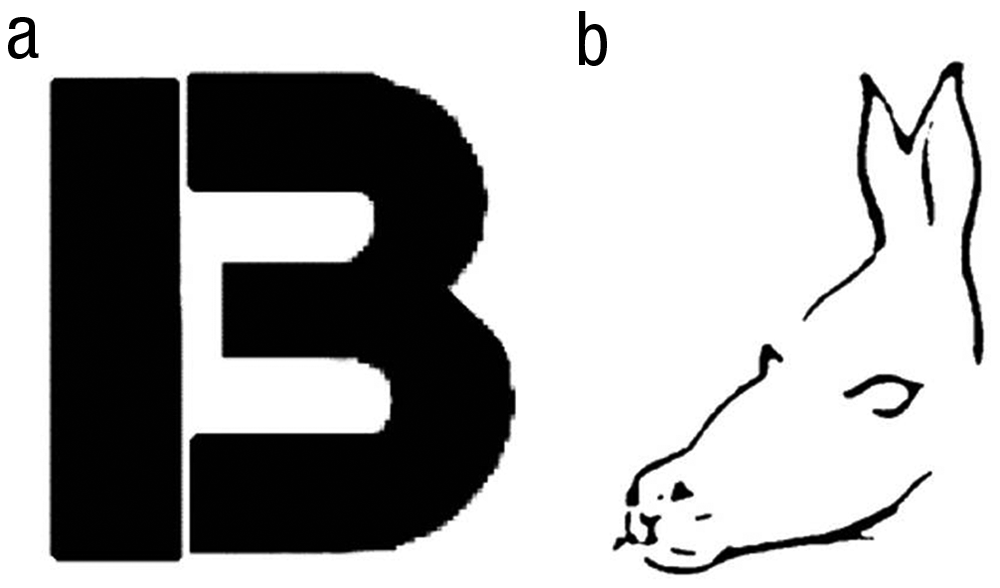
Ambiguous figures used in studies of wishful seeing when categorizing ambiguous objects. Panel (a) shows an image that can be interpreted as either a “B” or a “13”; panel (b) shows an image that can be interpreted as either a horse or a seal. Panel (a) reprinted from “See what you want to see: Motivational influences on visual perception,” by E. Balcetis and D. Dunning, 2006, Journal of Personality and Social Psychology, 91, p. 615. Copyright 2006 by the American Psychological Association. Reprinted with permission. Panel (b) reprinted from “Ambiguity of form: Old and new,” by G. H. Fisher, 1968, Perception and Psychophysics, 4, p. 191. Copyright 1968 by the Psychonomic Society. Reprinted with permission.
It is important to note that observers do not consciously misrepresent or lie about what they see. We confirmed this by using unobtrusive measures that observers had little control over, such as eye movements (Balcetis & Dunning, 2006; Study 3) and reaction times during lexical decision tasks (Study 4).
In addition, we specifically tested for reporting biases, such as lying (Study 5). Again, we presented participants with an ambiguous image (see Fig. 1b) that could be interpreted as either a horse or a seal. We first associated farm animals, for example, with drinking orange juice and sea creatures with drinking a repulsive, gelatinous veggie smoothie. Next, we showed participants the ambiguous image for 1 second. However, before perceivers reported what they saw, we feigned an error and said that the associations needed to be switched. For instance, if farm animals had originally been paired with orange juice, we now said that sea creatures and orange juice were paired. After making this switch, we asked participants what they saw. Participants tended to report the interpretation of the image that had been desirable at the time they viewed it (e.g., the horse) but was now undesirable. In short, perceivers appeared to provide honest reports of what they saw when presented with the ambiguous stimulus, even if those reports now led to an undesirable outcome.
Wishful seeing can also occur during early stages of categorization. We tested this by exposing perceivers to binocular rivalry. Binocular rivalry occurs when each eye is shown one of two mutually incompatible images. For instance, we presented a letter to the observer’s left eye and a number to his or her right eye (see Fig. 2). In such binocular rivalry tasks, instead of creating a composite image, perceivers consciously experience seeing only one image, but they are unable to consciously control which image initially appears in conscious awareness.
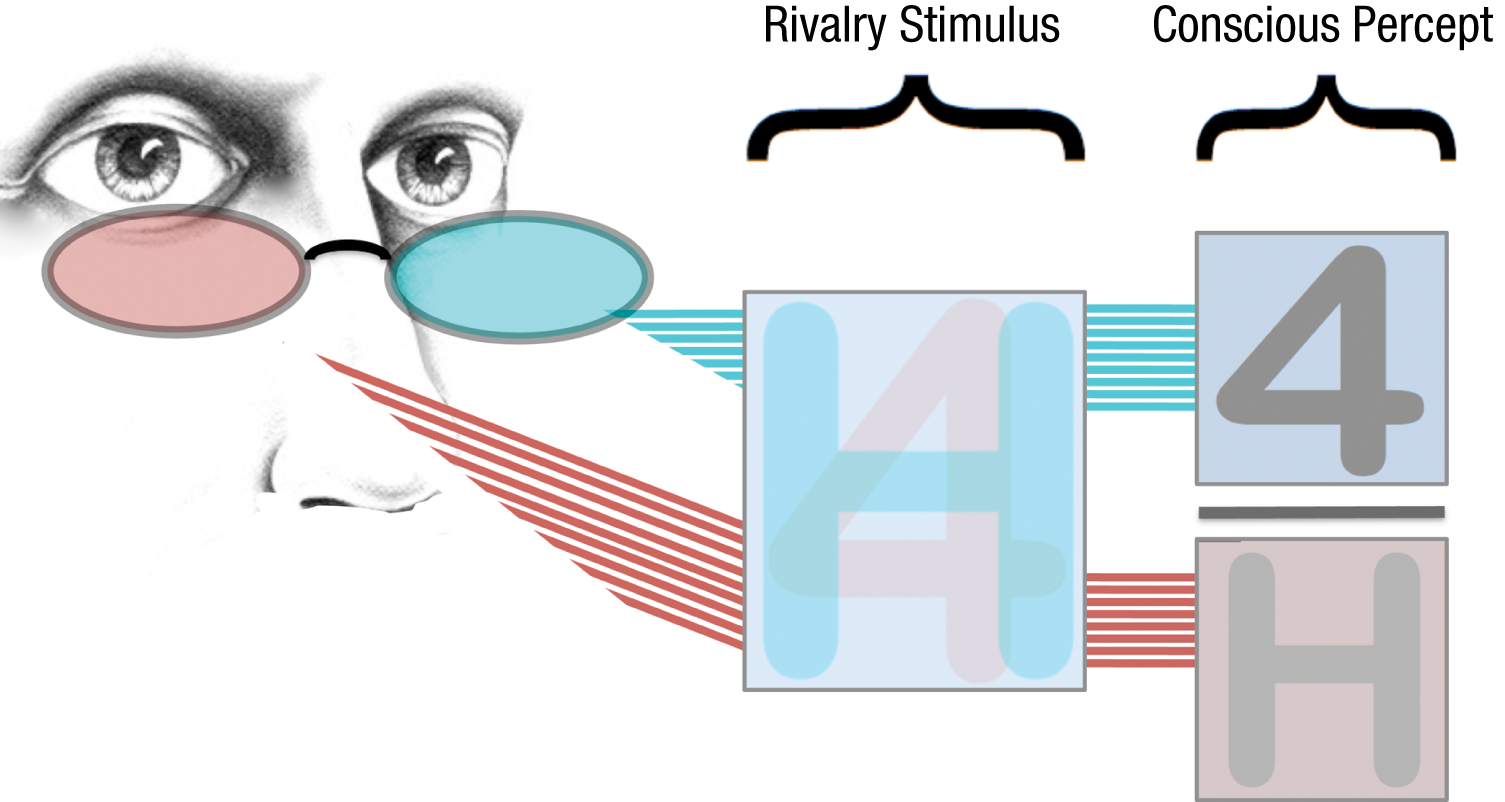
Depiction of observers’ experience during a binocular rivalry task. Reprinted from “Subjective value determines initial dominance in binocular rivalry,” by E. Balcetis, D. Dunning, and Y. Granot, 2012, Journal of Experimental Social Psychology, 48, p. 214. Copyright 2012 by Elsevier. Reprinted with permission.
We discovered that perceivers’ desires predicted which image they initially saw. In one experiment, we linked letters to possible financial gain and numbers to possible loss (Balcetis, Dunning, & Granot, 2012). We had participants wear colored goggles and presented the rivalry images for 300 milliseconds (see Fig. 2). The goggles filtered out different elements of the stimulus for each eye, such that one eye experienced a letter and the other a number. As we expected, participants were more likely to consciously see the image associated with financial gain than the image associated with loss, a pattern suggesting that desires influenced their preconscious categorization of ambiguous visual information to present to conscious awareness.
Representation
As with categorization, wishful seeing emerges when people form representations of the dimensions of the natural environment. Recent evidence has suggested that desires influence estimates of size, length, and slope in the environment. For instance, the desirability of an object in an environment can influence perceptual estimates involving it. A delicious chocolate muffin appeared larger to dieters than to non-dieters after both groups perused pictures of tempting desserts (van Koningsbruggen, Stroebe, & Aarts, 2011).
Desirable objects also appear physically closer than undesired objects do. In one experiment (Balcetis & Dunning, 2010), participants estimated a $100 bill they could win as more than 13% closer than a $100 belonging to the experimenter. And people not only reported that desired objects appeared closer, they acted as though these objects were closer. After being told that they could win a gift card if they hit it by tossing a beanbag, participants tended to underthrow the beanbag by 9 inches when the gift card was worth $25, but they tended to hit it when it was worth nothing. This action-based measure reflected changes in participants’ actual perceptual experiences rather than any response tendencies (as would be reflected by verbal reports). If participants were simply responding in ways that maximized payoff, they should have (and could have) hit the $25 gift card with the beanbag. Instead, results from this study and other evidence suggest that the desirability of the object influenced participants’ actual perceptual experience outside of their awareness or control.
More complex psychological motives, such as the desire to resolve cognitive dissonance, also influence perceptual estimates (Balcetis & Dunning, 2007). In one study, participants performed the embarrassing physical task of pushing themselves up a hill on a skateboard using only their arms. Those who had freely agreed to participate in the task, and who thus experienced dissonance about that choice, perceived the hill as 22% less steep than did participants who had been more forcefully assigned to the task, and thus were not experiencing dissonance. It is plausible that participants resolved those uncomfortable feelings by experiencing the hill as shallower, easier, and perhaps quicker to traverse.
To be sure, evidence regarding representations of the environment is new, and investigations of why such misperceptions arise are underway. Nonetheless, we can conjecture that some of these distortions may be adaptive for perceivers. For example, consider that when desirable objects actually are large or close, approach behaviors aimed at acquiring those objects increase (Dollard & Miller, 1950). Perhaps misrepresentations of proximity and size similarly facilitate approach actions toward these objects, thus motivating optimal behavioral responses geared toward obtaining desirable objects.
Mechanisms
Because this line of work is still developing, researchers are still exploring what mechanisms contribute to wishful seeing. Emerging research has hinted at a few possibilities.
Perceptual sets
One possible psychological mechanism underlying wishful seeing involves perceptual sets. Perceptual sets are mental states or associations that are activated before an object comes into view. These activated associates subtly guide the visual system during processing once the item is detected. For instance, in our studies, we paired the category of farm animals with reward and with cost. This procedure may cause participants to activate associations related to farm animals when “farm animals” is a desirable category. Indeed, participants who associated farm animals with reward more quickly indicated that cowboy, saddle, stallion, and pasture were words than did participants who associated farm animals with cost (Balcetis & Dunning, 2006, Study 4). Activating this category may have made it easier for participants to interpret an ambiguous figure (see Fig. 1b) as a horse once it appeared. Likewise, being thirsty activates thoughts about water and mental images of liquid, which subsequently influence how people represent objects. Thirsty participants perceived more transparency (a common property of water) in unrelated, ambiguously transparent visual images than did participants whose thirst was satisfied (Changizi & Hall, 2001).
Attention
A second possible psychological mechanism underlying wishful seeing involves attention. For instance, positive feelings associated with approach cause the narrowing of cognitive and visual attention (Gable & Harmon-Jones, 2010). When pictures of desirable foods (e.g., delicious desserts) appear in the center of a computer screen, observers’ attention narrows, leading them to better recognize words presented in the center of the screen than words presented at the periphery.
It is possible that attention affects perceptual representations of the environment. Narrowly attending to a target distorts perception of space (Wardak, Denève, & Ben Hamed, 2011), since narrowed attention limits access to depth cues, which are necessary for accurately coding distance (Wu, Ooi, & He, 2004). Future research might specifically test whether desires affect perceptual estimates through focused attention.
Outstanding Questions
As investigations of wishful seeing proliferate, we suggest that attention be paid to the following issues in future research.
Enhancement versus inhibition
Do people see what they wish to see or do they fail to see what they do not want to? That is, does wishful seeing occur via facilitation of desired input or via inhibition of undesired input? Our data suggest the former. In our studies of binocular rivalry, we found that people were more likely to see images associated with reward than images that were neutral (Balcetis et al., 2012, Study 3). However, people did not see images associated with loss less often than they saw neutral ones.
The story may be more nuanced. Voss, Rothermund, and Brandtstädter (2008) showed participants speckled images comprised of two different colors and asked them to identify the dominant color. One color was associated with either financial gain or loss, whereas the other color was not associated with any consequence. Reaction times suggested both a perceptual advantage for the processing of colors associated with gain and a disadvantage for the processing of those associated with loss. These data suggest that, in some contexts, wishful seeing may occur via both facilitation of rewarding information and inhibition of aversive information.
Cognitive penetrability
Some theorists have argued that psychological influences, such as preferences, exert an influence not on visual perception itself but only on later stages of visual processing that reflect cognitive judgment (e.g., the conclusion that an ambiguous image depicts a horse). In other words, some aspects of early visual perception are impenetrable to higher-order influences, such as the construction of accurate representations of objects in the environment (Pylyshyn, 1999).
Recent work, however, has suggested that preference can penetrate early visual processing. For instance, a person’s recognition of stimuli can be enhanced if he or she is motivated to see them. Objects satisfying a perceiver’s goals are perceived faster, within only a dozen milliseconds. Hungry participants, but not participants who were well fed, more accurately recognize words that were related to food, such as bread and cake, than words that were not, such as boat or glove (Radel & Clement-Guillotin, 2012), at short (33-millisecond) durations. However, more work is necessary to examine just how far and how much perceptual processes are influenced by preference.
Tuning perception toward the unwanted
Although people categorize objects and represent their environments in ways that align with their desires, wishful seeing may attenuate or reverse under certain circumstances. Researchers are beginning to tackle this issue and have offered two possibilities so far. First, wishful seeing may reverse when threat increases. People’s perceptions of threats tend to be exaggerated. For instance, participants perceived another individual as closer to them when that person seemed threatening (e.g., he talked about his love of guns) rather than disgusting (e.g., he claimed to have urinated into customers’ drinks) or ordinary (Cole, Balcetis, & Dunning, 2012). Participants also estimated that an image of a pointed gun was larger than a disgusting image of a dirty toilet or a mundane image of a mug, even though all the images were actually equally sized (van Ulzen, Semin, Oudejans, & Beek, 2008).
Second, some people may be less inclined toward wishful seeing than others. For instance, people experiencing strong generalized negative affect or anxiety showed increased preferential processing of angry faces at short exposures compared with people not experiencing this general tendency to experience a range of negative affect (Oehlberg, Revelle, & Mineka, 2012). Likewise, pessimistic young adults looked more at threatening images of skin cancer than did their less pessimistic peers (see Isaacowitz, 2006). Chronic individual differences may thus dampen wishful seeing.
Conclusions
In 1951, Princeton battled Dartmouth in a combative game of football. Princeton’s All-American quarterback left in the second quarter with a broken nose and a mild concussion. Dartmouth’s quarterback left in the third quarter with a broken leg he suffered when tackled in the backfield. Hastorf and Cantril (1954) played students footage of this game 1 week later and simply asked which team had started the rough play. In this classic study, participants provided perhaps the first evidence for wishful seeing. These football fans clearly harbored partisan desires that tainted their perceptions of the game. Whereas 86% of Princeton students saw Dartmouth as having started the rough play, only 36% of Dartmouth students did.
For the past 60 years at least, a growing body of literature has suggested that people see what they wish to see. People categorize objects and represent aspects of their environment in ways that align with their preferences, a phenomenon that has been demonstrated using different measures of perceptual experience and corroborated using both nonconscious and behavioral measures. Although people assume that their visual experiences reflect the outside world as it is, emerging data converge to suggest that, at least in part, they see it the way they want it to be.
Recommended Reading
Balcetis, E., & Lassiter, D. (2010). The social psychology of visual perception. New York, NY: Psychology Press. An edited volume summarizing research on social psychological factors that influence various aspects of visual processing.
Barrett, L. F., Mesquita, B., & Gendron, M. (2011). Context in emotion perception. Current Directions in Psychological Science, 20, 286–290. A review of psychological and situational factors that influence the perception of emotion.
Bruner, J. (1957). On perceptual readiness. Psychological Review, 4, 123–152. A historical classic; one of the first papers to review the first wave of research exploring the influence of values, preferences, and goals on visual perception.
Sakaki, M., Niki, K., & Mather, M. (2012). Beyond arousal and valence: The importance of the biological versus social relevance of emotional stimuli. Cognitive and Affective Behavioral Neuroscience, 12, 115–139. A review of the effects of biological and social emotional stimuli on attention.
Zadra, J. R., & Clore, G. L. (2011). Emotion and perception: The role of affective information. Wiley Interdisciplinary Reviews: Cognitive Science, 2, 676–685. A recent review of literature demonstrating the links between emotion and visual perception.
Footnotes
Declaration of Conflicting Interests
The authors declared that they had no conflicts of interest with respect to their authorship or the publication of this article.