







Abstract
Recent research has provided new insights into the integrative process, which allows for unified self-functioning. In this article, we review recent work that has used a variety of behavioral, physiological, dual-process, and survey techniques to examine personality integration. On the basis of theoretical considerations and the growing body of findings, we highlight three subprocesses—namely, awareness, ownership/autonomy, and nondefensiveness—and summarize evidence linking these facets of integration to energy, wellness, and relational benefits. Finally, we review contextual factors, such as autonomy support and unconditional regard, that have been shown to be conducive to integration, and we suggest tools that may be used in future research on integration.
In everyday life, people are asked to make decisions, express attitudes, and endorse beliefs, all of which can be either internally consistent or at odds with one another. People are also challenged when presented with new experiences, facts, or events that do not fit with their existing self-concepts or worldviews. In short, individuals are ever faced with the problem of how to coordinate and increase the congruence between their behaviors and cognitions, and of how to integrate new experiences within their existing web of self-knowledge. In this article, we review recent research concerning the integrative processes involved in unified self-functioning. We suggest that integrative processing of experience is conducive to wellness and effective functioning, and we contrast integrative processing with defensive and compartmentalized processing, which has many costs. More specifically, we review recent research highlighting the critical and synergistic roles of awareness, ownership, and nondefensiveness in the process of integration.
What Is Integration?
Theorists within multiple traditions have pointed to integrative processes within the psyche. Freud (1927/1961), for example, stressed the importance of the synthetic function of the ego to wellness, focusing on the degree to which unconscious elements are integrated into the self (das Ich) through awareness, a conception that has continued to inform modern psychodynamic thinking (e.g., Shedler, 2010). Rogers (1963) understood self-actualization as an integrative function, which was characterized by a natural tendency toward awareness and congruence but could become derailed by conditions of threat, such as conditional regard (G. Roth & Assor, 2010). More recently, the theoretical framework offered by self-determination theory (SDT) has suggested that internalization and integration are fundamental processes for health and wellness, reflected in autonomous behavior congruent with one’s values (Ryan & Deci, 2000).
Across psychodynamic, humanistic, existential, and other traditions (see Ryan, 1995), integration is understood as a matter of degree, given that the relative coherence and unity of experience underlying motivated action varies both between and within individuals. When functioning in an integrated manner, a person has enhanced access to the motives, emotions, and meanings underpinning his or her actions, which better enables him or her to selectively identify behaviors that fit with personal values and life goals and to be authentic and wholeheartedly engaged. For these reasons, integration enhances vitality and wellness (Ryan & Deci, 2008).
Awareness, Ownership/Autonomy, and Nondefensiveness as Process Elements of Integrative Functioning
In the following sections, we highlight three key features of integrative processes that have been identified as underlying personality integration and behavioral regulation across theoretical traditions, and that have been the focus of our and others’ recent research. First, integration requires awareness, or access to self-knowledge. Second, it requires ownership/autonomy, or taking responsibility for one’s attitudes and actions and identifying with and endorsing one’s actions. Finally, integration is associated with nondefensive processing of events, as manifested in approach-related coping and low use of psychological defenses that block self-knowledge from consciousness, including projection and compartmentalization of experience. We discuss each of these aspects in turn.
Awareness
Awareness is evident when people have open access to their own emotions, motives, and values. Theoretical and empirical literatures have supported the view that awareness of one’s emotions, such as sadness and anger, is conducive to health and wellness (e.g., Brown & Ryan, 2003; Pennebaker & Chung, 2011). In our view, it is not necessary that one always be conscious of emotions, motives, and values, but rather that such self-knowledge be accessible and available if called upon. Integration fails to occur in the absence of accessibility of self-knowledge because awareness is necessary for individuals to process events and contextualize experiences (see also Pennebaker, Kiecolt-Glaser, & Glaser, 1988) and to size up new actions or decisions in terms of pre-existing beliefs, values, and needs. We focus on mindful awareness in particular because, in contrast to constructs concerning self-consciousness (e.g., Buss, 1980), mindfulness represents an open and receptive, rather than evaluative, form of self-reflection (Brown & Ryan, 2003).
Recent research using dual-process methods has attempted to deepen this perspective on awareness by examining the convergence between implicit and explicit assessments of experience. Presumably, when individuals are low in awareness, they are out of touch with their deeply held identities, values, and emotions, but these may be accessed through other means, such as indirect assessments that target automatic and subconscious responding. As an example, we and our colleagues (Weinstein, Ryan, DeHaan, Legate, Przybylski, & Ryan, 2012) showed that congruence between implicit and explicit assessments of sexual identity was associated with indicators of personality integration, such as low defensiveness and less homophobic reactions. Legault and colleagues have shown that greater congruence is related to more integrated and autonomous behavioral regulation (Legault & Inzlicht, in press). Similarly, Legault, Green-Demers, Grant, and Chung (2007) provided evidence that people who expressed more autonomous motives for behaving in nonprejudiced ways exhibited less racial prejudice not only on explicit measures but also on implicit, reaction-time-based assessments. G. Roth and Assor (2010, 2012) tested awareness of anger and sadness in both children and adults and found that greater awareness predicted both greater well-being and more accurate self-expression.
The study of mindfulness has also provided insights into the positive role awareness can play in integrated behavioral regulation; in this work, awareness has consistently been linked with self-congruence. Defined as a receptive awareness of what is occurring in the current moment, mindfulness has been linked to indicators of integration; specifically, Brown and Ryan (2003) showed that when individuals are more mindful, they are more likely to act with autonomy, a tendency evident at both between- and within-persons levels of analysis (Brown & Ryan, 2003). Moreover, Brown and Ryan demonstrated that greater mindfulness was related to greater emotional congruence, as represented by higher correlations between explicit and implicit assessments of affect. Similarly, Niemiec et al. (2010) showed that mindful awareness facilitated nondefensive responding after a mortality-salience intervention.
Ownership/autonomy
A second key feature of integration is personal ownership, or taking responsibility for one’s emotions, decisions, and thoughts. Sometimes referred to as autonomy, or a sense of valuing and endorsing one’s actions (Weinstein, Przybylski, & Ryan, 2012), ownership/autonomy has been studied in a range of ways. For example, Weinstein and Hodgins (2009) exposed participants to emotionally challenging material (images of Hiroshima-Nagasaki bombings). Ownership was operationalized as the use of first-person pronouns (e.g., I, me, us), relative to second- and third-person pronouns (e.g., one, you), in descriptions of personal reactions to the images. Individuals who either were high in trait autonomy or had been primed with autonomy were given the opportunity to express their feelings. Those who exhibited more ownership (i.e., used more first-person pronouns) after a second exposure to the material had greater state well-being and more energy, a trend that was amplified by primed or trait autonomy.
In a similar vein, a series of studies reported by Weinstein, Deci, and Ryan (2011) challenged participants to reflect on shameful or regrettable past experiences or life events. More frequent use of personal pronouns in event descriptions predicted greater likelihood that individuals would report being responsible for the painful past events and that they would report having grown and learned from them. This research also revealed that both trait autonomy and autonomy priming facilitated ownership and acceptance of negative or shameful events. Complementing this work, findings from Legault and Upal (2012) showed that autonomy priming increased ownership of negative or shameful group identities among participants who reflected on a valued in-group. Finally, recent related research using similar measures has also shown that reflecting on one’s death in a meaningful way increases one’s ownership of regrettable past events (Cozzolino, Blackie, & Sedikides, 2012).
Nondefensiveness
Defensive processing of events and experiences can occur as a suboptimal attempt to cope with or resist threats. In assessments of integrated processing, nondefensiveness in dealing with emotions is contrasted with suppression, or the motivated or defensive avoidance of the emotional material (e.g., G. Roth & Assor, 2010). Indeed, within the literature on coping, responding has been broadly classified into avoidant and approach types (S. Roth & Cohen, 1986). Avoidant coping generally reflects a defensive form of regulation that involves ignoring, distorting, or escaping threatening stimuli (e.g., Stowell, Kiecolt-Glaser, & Glaser, 2001). In contrast, approach coping involves turning toward and resolving challenging situations (e.g., Fortune, Richards, Main, & Griffiths, 2002) and is believed to facilitate the assimilation and transcendence of stress in a way that ultimately enhances wellness (Shontz, 1975).
Weinstein, Brown, and Ryan (2009) related nondefensiveness to both mindfulness and enhanced integrative processing in a series of studies. In these studies, individuals higher in mindfulness evidenced better integration of stressful material—specifically, they evidenced less defensive or avoidant coping and more approach and responsive processing of the material; as a result, they were better able to process stress and anxiety. Additionally, individuals who act in a more integrated and nondefensive fashion benefit more from relationships that are responsive, empathic, and caring (Weinstein, Hodgins, & Ryan, 2010). They are also better able to perform both collaboratively (e.g., while playing charades; Weinstein et al., 2010) and on their own (e.g., when giving speeches; Hodgins et al., 2010).
At the group level, individuals who successfully integrate the negative characteristics of their racial in-group exhibit less prejudice, as measured with the Symbolic Racism 2000 Scale, whereas individuals faced with negative group characteristics they cannot integrate show increased prejudice (Legault & Upal, 2012). In addition, studies on humor have shown that less integrated and more defensive individuals are more likely to enjoy aggressive humor that derogates others, particularly when they are feeling angry. Presumably, poor integration makes the process of regulating emotion difficult, thus increasing the appeal of hostile humor (Weinstein, Hodgins, & Ostvik-White, 2011).
The intersection of awareness, ownership/autonomy, and nondefensiveness
It is evident that these three elements of integration are interrelated, each serving to facilitate the others and all functioning together to foster coherence and well-being. Thus, awareness conduces to ownership and autonomous functioning. In addition, awareness is both associated with and a manifestation of reduced defensive responding. All three facets have bidirectional patterns of effects. Increased awareness provides the necessary preconditions for ownership/autonomy of to-be-integrated material to flourish and, in doing so, reduces defensive responding, whereas defensiveness undermines self-awareness. Thus, we conceptualize the integrative process as self-reinforcing: Support for each element of integration catalyzes and develops the process. Similarly, the absence of one or more of these aspects can lead to stagnation and nonintegration.
Research has indicated that the process of integration, as a whole, benefits self-regulation and long-term well-being, leading to greater consistency between one’s behavior and personal values; greater capacity for emotional down-regulation, resulting in fewer negative emotions in the long-term and better adaptation to stress (Weinstein & Ryan, 2011); and greater satisfaction of basic psychological needs for autonomy, relatedness, and competence (Ryan, 1995).
Evidence has also shown that in the long term, higher integration is clearly linked to greater energy and vitality (Ryan & Deci, 2008), an important indicator of well-being that links to important indicators of physical and psychological health (Ryan & Frederick, 1997). There are two possible explanations for this link. First, the need to continue to defend and protect the self against unintegrated material keeps energy engaged and thus unavailable. This is particularly true when unintegrated material is associated with reminders or cues that are pervasive in one’s environment. Second, by integrating new information or experiences, individuals perceive themselves to be more authentic or feel more in touch with themselves, an experience that vitalizes and increases well-being (Weinstein, Deci, & Ryan, 2011).
Yet the process of integration may also be energy depleting for short periods if the material that must be integrated is particularly challenging or painful. In studies requiring individuals to integrate painful emotional material relating to the Hiroshima-Nagasaki bombings, participants reported having less vitality and exhibited lower energy in a handgrip task directly after processing; however, over time, these participants, compared with participants who had not integrated the material, showed higher energy on both behavioral and self-report measures, and they maintained higher energy levels when they were faced with the painful material a second time (see Fig. 1; Weinstein, Hodgins, & Ostvik-White, 2011). By integrating the material, they had developed greater resilience to the negative emotional events.
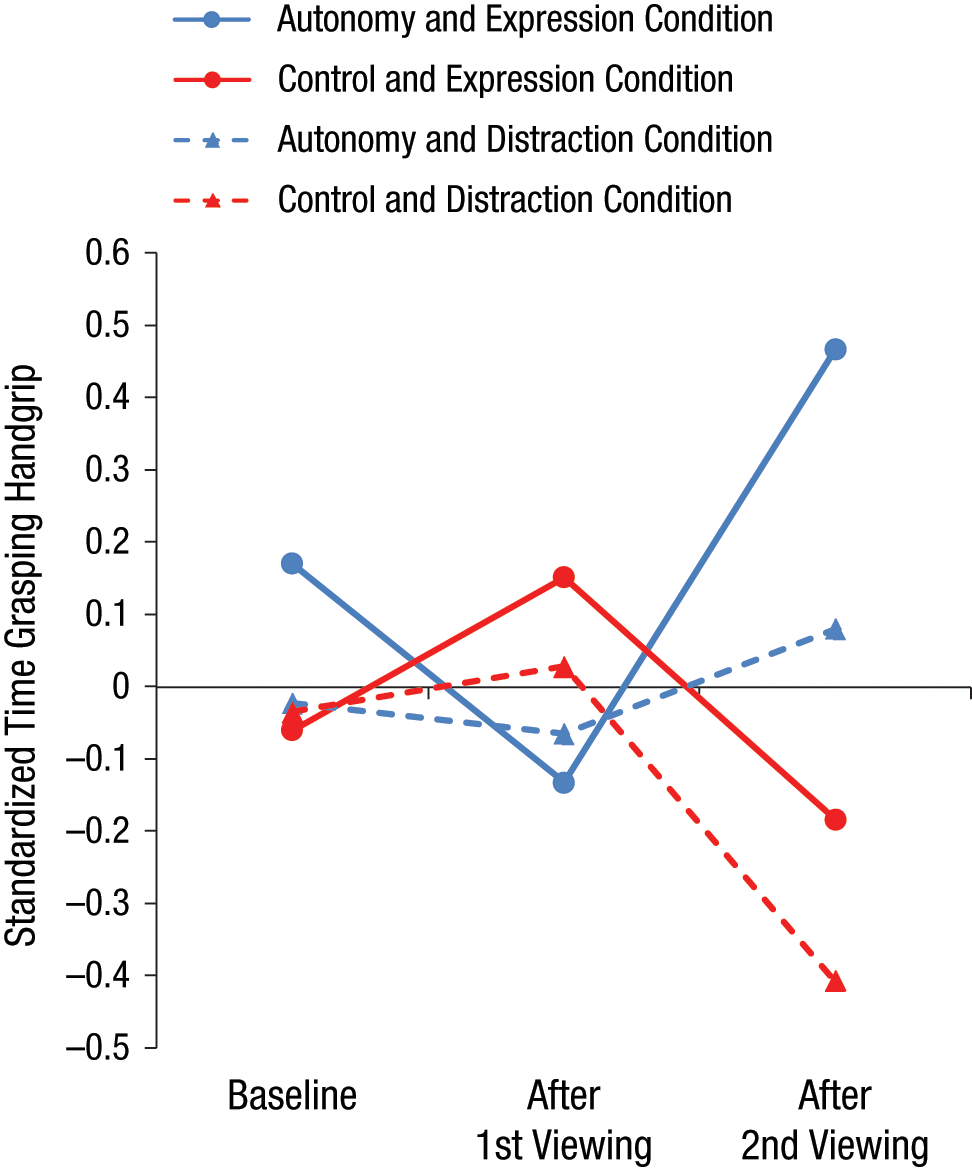
Time spent grasping a handgrip (a reflection of energy level) before viewing an emotionally challenging film, after viewing the film, and after viewing it for a second time 24 hours later. Findings are presented separately for autonomously functioning individuals who either expressed (and thereby integrated) their emotions or were distracted from (and thus did not integrate) their emotions, and control (nonautonomous) functioning individuals who either expressed or were distracted from their emotions (presumably, the control-functioning group did not integrate their emotions in either of the two conditions). Adapted from “Humor as Aggression: Effects of Motivation and Hostility on Humor Appreciation,” by N. Weinstein, H. S. Hodgins, and E. Ostvik-White, 2011, Journal of Personality and Social Psychology, 100, p. 357. Copyright 2011 by the American Psychological Association.
What promotes integration?
Given the benefits of integrative functioning, research has also explored contextual influences that promote unified self-functioning. Findings have suggested that autonomy-supportive contexts may be beneficial for integration, particularly when the material to be integrated is threatening (Ryan, Lynch, Vansteenkiste, & Deci, 2011). One form of autonomy support is unconditional regard. Research assessing kindergarteners has shown that they have greater integration, expressed as awareness and ownership of negative emotions, when their parents are more unconditionally regarding of them (G. Roth & Assor, 2010). Autonomy-supportive social environments also decrease self-concealment among people with potentially stigmatized identities (e.g., Legate, Ryan, & Weinstein, 2011). Indeed, in related studies, Weinstein, Ryan, et al. (2012) found that the adult children of parents perceived to be more autonomy supportive showed less discrepancy between implicit and explicit measures of sexual identity, a pattern indicative of greater integration. In yet other research, young adult children of more autonomy-supportive parents showed less discrepancy between implicit and explicit measures of religious identity (DeHaan & Deci, 2012). Presumably, autonomy support promotes integrative processing by fostering openness, ownership, and self-acceptance in the face of both positive and negative experiences.
In addition, mindful awareness, which supports autonomy and nondefensiveness, can be cultivated through individual practices. For example, recent work has shown that meditation promotes well-being through its effects on mindful attention (Josefsson, Larsman, Broberg, & Lars-Gunnar, 2011). More generally, specific interventions targeting these underlying processes can help support integrative tendencies.
Measuring integration
Integrative processing is often difficult to measure, but as our review highlights, there are new tools emerging that can be used to either directly or indirectly assess integration with respect to identities, emotions, beliefs, and behaviors. In particular, research has pointed to the utility of reaction-time-based measures, such as implicit association tasks (Greenwald & Farnham, 2000; Legault et al., 2007; Weinstein, Ryan, et al., 2012), and other indirect and projective assessments (e.g., Baumann, Kaschel, & Kuhl, 2005). Reaction times can be used to evaluate the accessibility of contents to awareness, and discrepancies between implicit and explicit assessments can be calculated. More integrated behaviors and identities should also demonstrate more consistency across time and situations and be less prone to shift in reaction to environments, except in cases where the situation may demand adaptive variability (e.g., Legate et al., 2011).
Hodgins and colleagues have shown that defensive processes indicative of low levels of integration can be observed in both verbal and nonverbal modes of communication and responding. For example, people who are more defensive show different verbal (more frequent use of defensive language), paralingual (longer response latencies and short response lengths), and nonverbal (more fake smiling, as indicated by measures of symmetry in mouth-muscle movements) behaviors than do their less defensive counterparts, as well as different vocal-acoustic (higher pitch) and physiological (threat patterns, as opposed to challenge patterns, in cardiovascular activity) responses (Hodgins et al., 2010).
Finally, integrative processes may be apparent in neurophysiologic activity. Research utilizing functional MRI has, for example, linked autonomous activity to the insular cortex (Lee, Reeve, Xue, & Xiong, 2012), an area of the brain that has also been linked to self-awareness (Craig, 2009). Integration is also reflected in enhanced neural detection of executive control failures, as indicated by event-related potentials, which in turn is facilitated by autonomy support (see Legault & Inzlicht, in press). By finding neurological links among these constructs, the present studies have demonstrated the validity of the construct of integration. Using neuropsychological methods such as these, future research can explore the biological roots and correlates of integration. Selective recruitment of self-knowledge, constituting the operation of integrative processes, may also be identified through enhanced prefrontal-cortex activity (e.g., Nakao et al., 2009; Ryan, Kuhl, & Deci, 1997).
Summary
Although integration has been a perennial topic of interest for personality, clinical, and social psychologists, and although integration has often been overrepresented in theory relative to empirical research, new ground is being broken that promises to add to our body of knowledge in increasingly specific ways. In this review, we have highlighted the interconnected roles of awareness, ownership, and nondefensiveness in integrative processes, as well as the important role of autonomy supportive and noncontrolling environments in facilitating thee processes and, thus, human wellness. We have reviewed evidence indicating that integration fosters well-being, sustains energy, and encourages prosocial and responsive behavior, as well as low levels of prejudice and high levels of empathy and closeness in relationships. Yet this research is nascent, and future work could elaborate on the links between the presence or absence of integration and interpersonal outcomes, such as aggression, rejection sensitivity, and conformity, and intrapersonal consequences, such as self-compassion, psychological growth, and resilience.
Recommended Reading
Hodgins, H. S., Weisbust, K. S., Weinstein, N., Shiffman, S., Miller, A., Coombs, G., & Adair, K. C. (2010). (See References). An empirical work examining the processes of self-integration and its outcomes.
Ryan, R. M. (1995). (See References). An in-depth review of the theory and seminal work on integration, with a focus on environmental characteristics that foster integration.
Ryan, R. M., & Deci, E. L. (2008). (See References). A theoretical piece examining the dynamics of integration in relation to energy.
Footnotes
Declaration of Conflicting Interests
The authors declared that they had no conflicts of interest with respect to their authorship or the publication of this article.