







Abstract
The physician’s general survey is an invaluable method for quickly assessing a patient’s overall health and demeanor. Recent studies in psychology have found that qualities of one’s face—including skin coloration and facial adiposity—are associated with one’s underlying health. Subtle variations in these features can indicate serious health problems but can be detected with the untrained eye. Here, we describe how these facial traits link to health and discuss how such cues could be incorporated into the physician’s general survey. In light of research on the barriers preventing physicians from implementing new approaches in their practice, we also consider how scans of facial cues to health could be rapidly and effortlessly integrated into a physician’s current general survey. Integrating assessments of facial cues to health into the general survey would be a simple, low-risk, and low-cost way to detect, monitor, and track possible health concerns, particularly in the burgeoning field of telemedicine.
Physicians typically begin a patient’s appointment by briefly assessing the individual’s appearance and behavior. This evaluation, known as the “general survey” or “general assessment” of the overall comprehensive exam (though infrequently named), is a simple scan of cues to the patient’s overall health that allows gross concerns to be addressed in a more focused manner. This includes examining a number of basic anatomical and physiological conditions before proceeding to discuss the patient’s specific reasons for the visit (Bickley & Szilagyi, 2012).
Recently, experimental psychologists have reported several facial features that predict a person’s state of health. These characteristics are not based on the static, structural anatomy of the face; rather, they fluctuate with an individual’s current health. Furthermore, these cues are plainly visible from a brief visual scan and do not require technology or medical training to detect. Because they are all readily apparent, these features may allow physicians to quickly infer several elements of health in their general survey without invasive or time-intensive examination.
Here, we review the main findings from studies documenting aspects of health that produce changes in facial appearance detectable by the average person. These span three domains: skin redness, skin yellowness, and facial adiposity. Untrained and naive participants, rather than medical professionals, provided the judgments in all of these studies, demonstrating their broad legibility.
Skin Redness
Skin “redness,” or red coloration of the skin of the face, reflects blood oxygenation levels, which in turn represent one’s cardiovascular fitness and lung capacity (Armstrong & Welsman, 2001). Increasing an individual’s aerobic capacity enhances vascularization of blood vessels in the skin, resulting in higher levels of blood coloration that perceivers see as redness (Re, Whitehead, Xiao, & Perrett, 2011). In contrast, high levels of deoxygenated blood could indicate poor cardiovascular health or respiratory illness, producing a bluish tint to the skin (Kienle et al., 1996).
New research has discovered that subtle changes in cardiovascular health correspond to perceptible changes in skin redness in the face and are noticeable regardless of ethnicity (Stephen, Coetzee, Law Smith, & Perrett, 2009); see Figure 1. 1 Even common minor illnesses, such as colds and mild influenza, visibly reduce skin redness (Perrett et al., 2011). Research into the effects of exercise on blood coloration has shown that just one additional hour of aerobic exercise per week (on average) produces a noticeable increase in the redness of the skin (Perrett et al., 2011). The subtle changes in skin redness associated with aerobic fitness are consequently enough to significantly alter a person’s appearance (including how healthy and attractive he or she looks) and can be reliably detected by the untrained eye, though they remain well below the intensity of the redness associated with sunburn (e.g., Re et al., 2011). Indeed, one study found that 98% of faces tested appeared healthier after modest increases in skin redness (Stephen, Coetzee, et al., 2009). Importantly, redness fluctuations are perceptible in human faces regardless of the ethnicity of the face and perceiver (Stephen, Coetzee, et al., 2009). Red signals in primates (both human and nonhuman) are of such importance that they may have driven the evolution of the primate red-green color system (Changizi, Zhang, & Shimojo, 2006). Thus, a brief visual scan should reveal noticeable variations in facial redness and could alert physicians to changes in cardiovascular health.
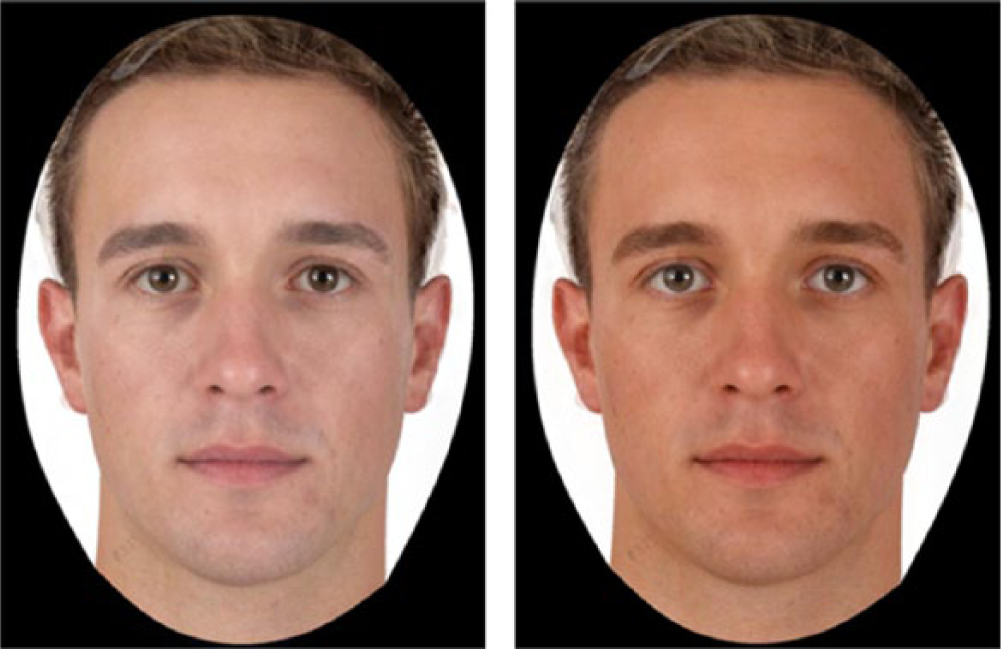
Images illustrating low (left) and high (right) facial redness. Facial redness is based on blood oxygenation levels and correlates with cardiovascular health.
Skin Yellowness
Facial skin color can also communicate immune function. Consumption of carotenoids, organic phytochemicals abundant in fruits and vegetables, delivers pigments that provide a yellow-orange coloration to the skin (Sies, 1993). Carotenoid levels are reflected in the skin through diffusion via the vascular system to the dermis and epidermis (Darvin et al., 2008). Yet carotenoids are reciprocally expended by immunological functions as well; hence, skin yellowness may fluctuate both as a function of carotenoid intake and as a function of carotenoid depletion (Krinsky, 1998). Indeed, carotenoids act as antioxidants, defending cellular proteins, lipids, and DNA from oxidative damage, and people who consume diets rich in carotenoids show superior immune function and lower levels of mortality and chronic illness (Diplock et al., 1998).
Accordingly, increases in skin yellowness make faces appear healthier and more attractive. In one study that involved digital manipulations of skin coloration, participants increased yellowness in 100% of faces presented when asked to make them appear as healthy as possible (Stephen, Law Smith, Stirrat, & Perrett, 2009). Another study showed that increasing fruit and vegetable consumption by approximately three servings per day is enough to increase skin yellowness and improve one’s attractiveness and apparent health after just 6 weeks (Whitehead, Re, Xiao, Ozakinci, & Perrett, 2012); the authors noted that this is a conservative estimate, such that a smaller dietary change may produce similar results. Moreover, observers perceive added skin yellowness as more attractive than the increased melanin coloration gained from tanning (Lefevre & Perrett, 2015), though at levels well below those associated with jaundice. As with skin redness, untrained individuals can detect even small changes in people’s skin yellowness regardless of their ethnicity (Whitehead, Coetzee, Ozakinci, & Perrett, 2012); see Figure 2. It would therefore be easy for physicians to evaluate patients’ skin yellowness to quickly infer their current immune status.
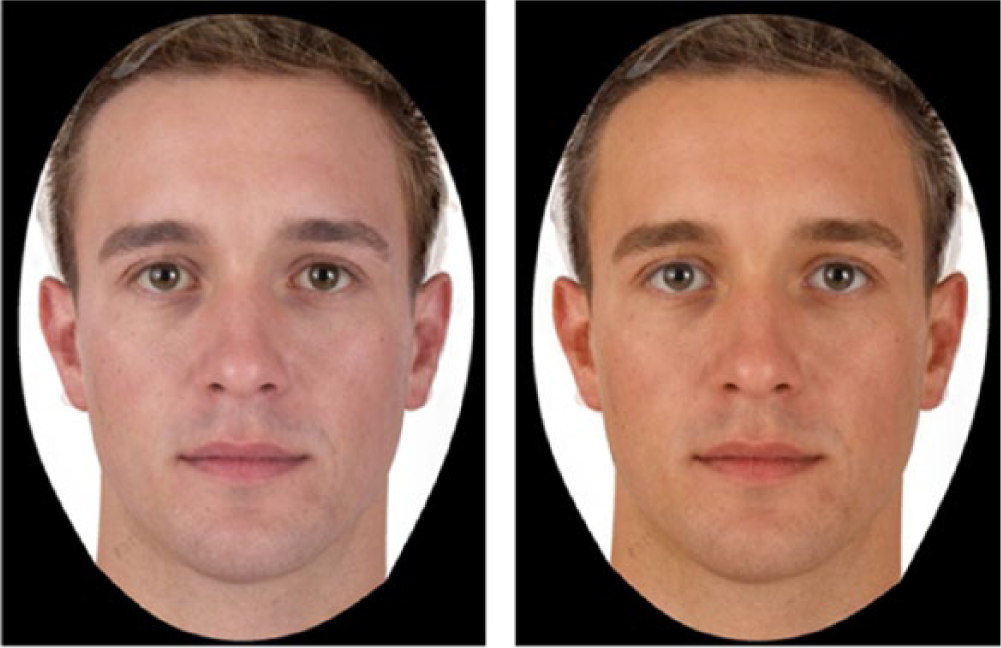
Images illustrating low (left) and high (right) facial yellowness. Facial yellowness is based on carotenoid levels in the skin and can signal immunological strength.
Facial Adiposity
Changes in body weight can reflect several types of health problems, and even moderate weight changes may indicate serious afflictions (Bickley & Szilagyi, 2012). Physicians are therefore advised to attend to fluctuations in patients’ body mass index (BMI), a measure of weight scaled for height, but BMI is limited as a measure of adiposity—particularly among people with unconventional body shapes and sizes (e.g., individuals with high amounts of muscle; Ode, Pivarnik, Reeves, & Knous, 2007). Moreover, fat deposits often form subcutaneously or between muscles, making weight change less noticeable and difficult to measure (Bickley & Szilagyi, 2012).
Given the importance of tracking weight change, it would be helpful if physicians could utilize a superficial cue to monitor subtle changes in patients’ BMI in their general survey. Here, the face may again present a solution. Recent studies report that untrained observers can detect BMI fluctuations from faces and can accurately guess BMI from facial cues (Coetzee, Chen, Perrett, & Stephen, 2010). Moreover, facial correlates of body weight (facial adiposity) strongly influence how healthy and attractive a person looks (Coetzee, Re, Perrett, Tiddeman, & Xiao, 2011; Re & Perrett, 2013).
Facial adiposity is also a telltale sign of a person’s actual health, predicting illnesses such as respiratory infections, sinus congestion, diarrhea, nausea, headaches, and breathing problems (Coetzee, Perrett, & Stephen, 2009; Reither, Hauser, & Swallen, 2009; Tinlin et al., 2012). Moreover, facial adiposity inversely relates to one’s immunological strength (as measured by levels of hepatitis B antibody produced in response to a hepatitis B vaccination; Rantala et al., 2013) and mental health (people higher in facial adiposity tend to show a greater risk for stress- and anxiety-related disorders and depression; Tinlin et al., 2012).
Changes in facial adiposity would be easy for physicians to note in their general survey (see Fig. 3). Recent studies have found that undergraduates can detect changes in BMI as low as 1.33 kg/m2 (corresponding to weight differences of less than 8 lbs and 10 lbs for women and men of average height, respectively; Re & Rule, 2016). The deviation around this value was narrow, with all perception thresholds for all faces in the study being between 1.21 and 1.45 kg/m2, suggesting that weight loss within this range will reliably make a person look thinner. Untrained observers are therefore impressively sensitive to changes in facial adiposity—both gains and losses—and this information can provide a wealth of information about a person’s overall health through its correlation with various physical and psychological maladies.
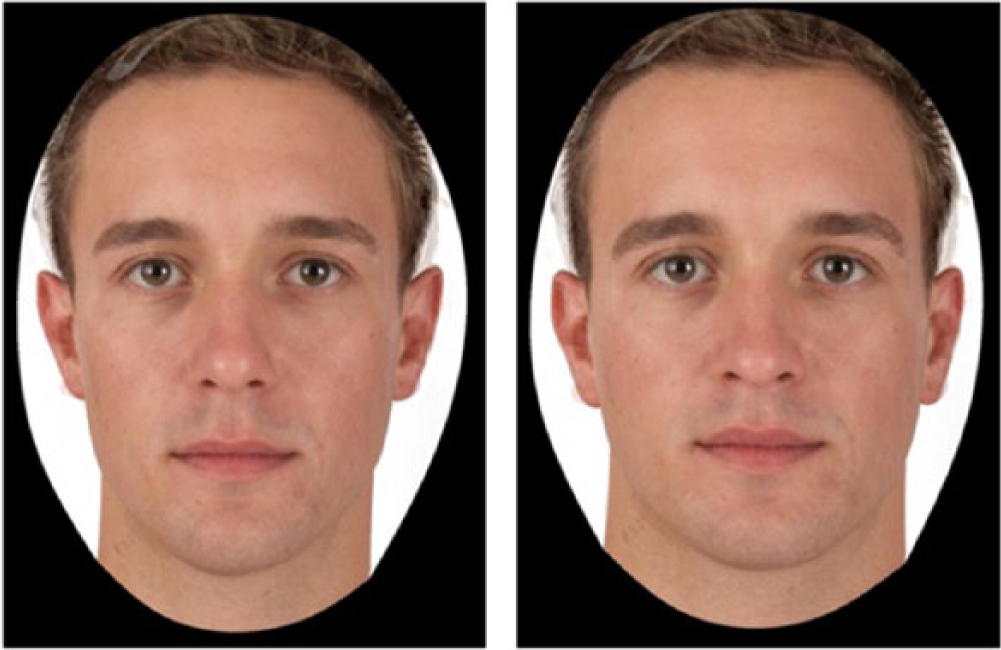
Images illustrating low (left) and high (right) facial adiposity. Facial adiposity predicts measures of physical and psychological health affected by weight, and differences as small as 1.33 kg/m2 (roughly 8 lbs and 10 lbs for women and men of average height, respectively) can be detected by the untrained eye.
Discussion: Conclusions and Practice Implications
The studies described in this review converge on an overarching theme: Certain elements of health can be discerned from the face. Indeed, research has demonstrated not only that fluctuations in health manifest as changes in skin color and adiposity but that such fluctuations are easily detected by untrained observers. Variations in skin redness provide information about one’s cardiovascular condition and can be a sign of changes in aerobic capacity. Reductions in skin yellowness suggest depletion of carotenoid concentration in the dermis, signaling reduced immunological capacity. Finally, facial adiposity accurately and reliably reflects fluctuations in BMI, predicting various physical and mental health problems.
These three facial traits reveal both longitudinal and proximal connections between appearance and health. Alterations in skin redness, skin yellowness, and facial adiposity not only make a person appear more or less healthy but may also avail themselves as cues to patients’ actual health for use by clinicians. For this reason, the current review summarizes research from psychological science that could have implications for the practice of medicine. It is important to consider, however, whether physicians are likely to utilize such research.
Several barriers commonly prevent physicians from adopting new practices, such as the difficulty in adopting new guidelines and general confusion about recommended changes (Cabana et al., 1999). Other obstacles include the perceived cost and discomfort to patients, lack of time, and the incompatibility of new practices with physicians’ preexisting facilities (Cabana et al., 1999). Including a quick scan of facial cues to health is robust to all of these barriers. Physicians could therefore seamlessly integrate quick visual checks on skin color and facial adiposity into their general surveys with pronounced efficiency.
Naturally, appearance-based assessments of health are no substitute for physicians’ deep knowledge of their patients’ lives and should merely supplement practitioners’ standard discussions about patients’ general health habits. Observing facial cues to health could, however, serve as a beneficial diagnostic tool for general practitioners and may save time spent on directly inquiring about some of their patients’ lifestyle choices, thereby facilitating the efficiency of routine appointments. Physicians could track these cues over multiple visits within their customary facility and could include a brief description in their general notes that complements other areas of the general survey. Given that physicians examine the overall health of their patients as they enter their office, this could be a good time to quickly observe facial cues to health. Raising physicians’ awareness of these cues and their scientific support may thus help to arm them with new tools to improve patient care.
In fact, given that naive study participants seem to perceive these cues nonconsciously, it is possible that some physicians may also already notice facial cues to health during their general survey without realizing what they convey. The research reviewed here could therefore provide these professionals with the knowledge and awareness of how their holistic perceptions of faces could relate to their patients’ health. Furthermore, examining facial cues to health is a low-risk procedure, given that even if a particular patient’s face did not accurately convey health (perhaps as a result of temporary emotional flushing or poor lighting conditions), further testing would bear out any false positives triggered by misleading facial cues without great financial or medical impact. Although briefly checking facial color and adiposity should not replace direct medical testing, knowledge of face coloration, adiposity, and their underlying links to health may allow physicians to explicate evidence for potential health problems without expending additional time. As such, future research should include controlled studies with real physicians to assess the utility of recording facial cues in terms of clinical efficiency and patient health.
Moreover, it is intriguing to imagine how modern medical technology could exploit skin coloration or facial adiposity. For example, “telemedicine” (the use of telecommunication technology to provide health care to patients unable to easily visit a physician’s office in person; Perednia & Allen, 1995) is becoming increasingly popular as computerized video chat applications such as Skype and FaceTime increasingly allow doctors to diagnose patients from afar (Goodnough, 2015). These media limit clinicians’ access to diagnostic information, however. Detecting health cues from simple visual scans of skin coloration and facial adiposity may thus be especially valuable in telemedicine, particularly as the studies reviewed here have themselves been conducted via computer screens. Facial redness, yellowness, and adiposity should therefore be fairly perceptible in typical video chat interactions with normal illumination. Increasing physicians’ knowledge of facial cues to health could therefore greatly benefit the efficacy of telemedicine.
Advancements in medical technology could also capitalize on facial cues to health. Similar to the comprehensive computer-based systems developed for airport security and border screening (e.g., Twyman, Lowry, Burgoon, & Nunamaker, 2014), face-recognition technology could be coupled with calibrated color-processing techniques to track and record the exact changes in skin redness and yellowness that a patient may exhibit between visits and could be programmed to alert physicians to serious fluctuations that require attention. Facial adiposity levels could also be instantly measured with face-processing software similar to that used in current psychological studies to reveal even the subtlest changes in BMI (Re & Rule, 2016). Automating these assessments with the assistance of relatively simple visually based computer technology could improve the efficiency of delivering medical services, providing relief to a growingly overburdened labor unit with high stakes for individual well-being (e.g., Hawkins, 2014).
Concluding Comments
The relative ease of implementing checks on facial cues to health in the physicians’ general survey makes it likely that many practitioners will be able to benefit from this research once becoming aware of it. Attending to minor fluctuations in facial skin redness, yellowness, and adiposity would provide physicians with instant information on changes in patients’ underlying health, with the potential to increase the efficiency and efficacy of patient treatment and to contribute to the rapidly growing field of telemedicine.
Footnotes
Declaration of Conflicting Interests
The authors declared that they had no conflicts of interest with respect to their authorship or the publication of this article.