







Abstract
Infants have asymmetrical exposure to different types of faces (e.g., more human than nonhuman, more female than male, and more own-race than other-race). What are the developmental consequences of such experiential asymmetry? Here, we review recent advances in research on the development of cross-race face processing. The evidence suggests that greater exposure to own- than other-race faces in infancy leads to developmentally early differences in visual preferences for, recognition of, formation of categories for, and scanning of own- and other-race faces. Further, such perceptual differences in infancy may be associated with the emergence of implicit racial bias, consistent with a perceptual-social linkage hypothesis. Current and future work derived from this hypothesis may lay an important empirical foundation for the development of intervention programs to combat the early occurrence of implicit racial bias.
Keywords
In many parts of the world, the experiences infants have with faces are asymmetrical. For example, infants see more own- than other-species faces, more female than male faces, and more own- than other-race faces (Rennels & Davis, 2008; Sugden, Mohamed-Ali, & Moulson, 2014). Researchers have discovered that such asymmetries have not only significant perceptual consequences but also social ones (Lee, Quinn, & Heyman, 2017). Here, we focus on research that has illustrated such consequences in the context of the development of face race processing.
Visual Preference
When presented with an own-race face paired with an other-race face, newborns look equally at the two faces. However, after 3 months of predominant exposure to own-race faces, Caucasian infants look longer at Caucasian faces than at other-race ones (e.g., African or Asian faces) regardless of their gender (Kelly et al., 2005). This visual preference does not reflect the face stimuli used: When the same Caucasian and Asian faces are shown to Asian 3-month-olds with predominant exposure to own-race faces, they look more at the Asian faces (Kelly, Liu, et al., 2007). The role of visual experience is further confirmed by the finding that African infants with extensive exposure to both African and Caucasian adults show no visual preference for either African or Caucasian faces (Bar-Haim, Ziv, Lamy, & Hodes, 2006).
The visual preference for own-race faces should not necessarily be construed as an early form of racial bias (Baron, 2013). Rather, it reflects the familiarity that infants have with faces encountered daily. A recent finding supports this idea: Whereas 3-month-olds look significantly longer at own- over other-race faces, 6-month-olds look at both equally, and 9-month-olds look significantly longer at other- over own-race faces (Liu et al., 2015). One possible reason for this developmental change is that as infants become increasingly sophisticated at processing own-race faces, they rapidly process information from own-race faces and spend more time exploring less familiar other-race faces.
Recognition
How does asymmetrical visual experience with own- and other-race faces affect infants’ recognition of faces from different races? A perceptual-learning account (e.g., Chien, Wang, & Huang, 2016) would suggest that infants at birth are unable to process identity from either own- or other-race faces, but with extensive exposure to own-race faces and little or no exposure to other-race faces, they become better at recognizing own- relative to other-race faces (Fig. 1a). An alternative, perceptual-narrowing account would suggest that infants initially recognize both own- and other-race faces, but with increased exposure to own-race faces and lack of experience with other-race faces, their ability to recognize own-race faces is maintained, and their ability to recognize other-race faces declines (Fig. 1b).
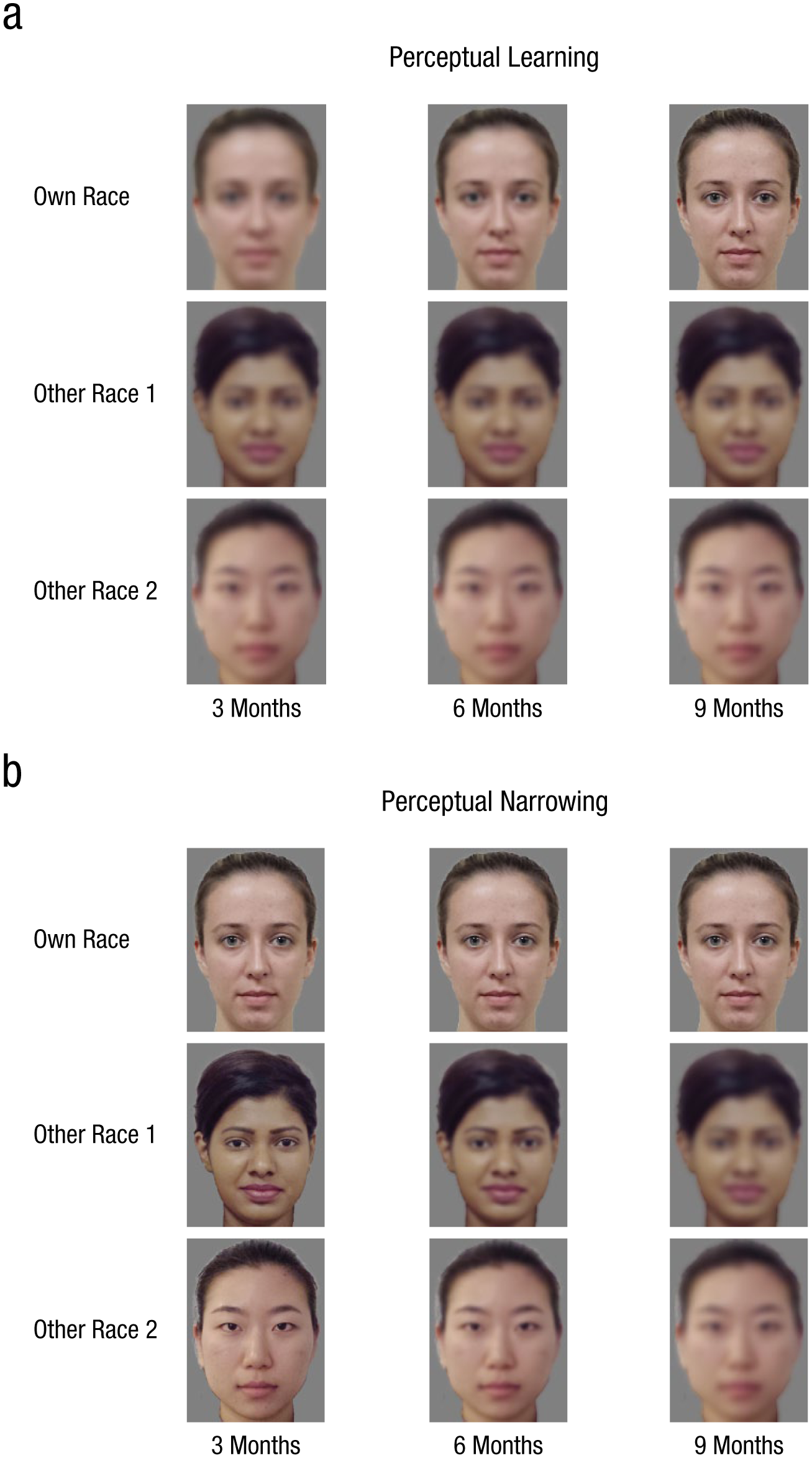
Two possible models of own- and other-race face recognition (for a Caucasian infant being exposed to predominantly Caucasian faces): a perceptual-learning model (a) and a perceptual-narrowing model (b). Existing evidence supports the perceptual-narrowing model for recognition of own- and other-race faces (e.g., Kelly et al., 2009; Kelly, Quinn, et al., 2007). (Blurring is used in the figure to depict decline in recognition of specific identity rather than a general loss in visual sensitivity.)
The evidence suggests that recognition of own- and other-race faces by infants undergoes perceptual narrowing (Kelly et al., 2009; Kelly, Quinn, et al., 2007). After being familiarized with either an own- or an other-race (e.g., Asian, African) face for 10 seconds, Caucasian 3-month-olds recognized the familiarized own- and other-race faces at test. By contrast, 9-month-olds recognized only the familiarized own-race faces, not the other-race faces, demonstrating perceptual narrowing (Fig. 1b). When the same face stimuli were shown to Asian infants, perceptual narrowing was again observed: Asian 9-month-olds recognized own-race faces but not other-race faces. Some of the evidence suggests that 6 months may be a time of transition into narrowing. For example, Kelly, Quinn, et al. (2007) found that Caucasian infants at 6 months could still recognize Asian faces but not African faces.
Research has also examined whether visual experience plays a causal role in engendering perceptual narrowing. For example, in one study, Caucasian 6-month-olds were pretested to ensure that they could recognize Asian faces (Heron-Delaney et al., 2011). Then, parents of the infants took home photo albums of either other-race Asian (experimental group) or own-race Caucasian (control group) faces. Parents taught their infants these faces with individual names (e.g., “This is Linda”) over a period of 3 months. Although both groups at 6 months recognized other-race Asian faces, the experimental group maintained this ability at 9 months, whereas the control group did not. The results from the different age groups suggest that early exposure to other-race faces can forestall perceptual narrowing. Moreover, after perceptual narrowing, 10-month-olds have been shown to recover recognition of other-race faces following daily exposure to videos in which other-race individuals each introduced themselves with a different name, but not following exposure to similar videos of own-race individuals (Anzures et al., 2012).
The findings suggest that visual experience individuating other-race faces leads infants to recognize other-race faces at a level comparable to own-race faces. Without changes in visual experience, the early difference in own- versus other-race face recognition continues into the preschool years and beyond (e.g., Anzures et al., 2014).
Category Formation
Although infants categorize visual stimuli from birth (Quinn, 2011), few studies have examined whether they form categories based on race. Anzures, Quinn, Pascalis, Slater, and Lee (2010) first reported that Caucasian 9-month-olds grouped Caucasian faces into one category and Asian faces into another. Category formation for face race also undergoes perceptual narrowing. Quinn, Lee, Pascalis, and Tanaka (2016) found that Caucasian 6-month-olds partitioned Caucasian, African, and Asian faces into three separate categories. However, although Caucasian 9-month-olds continued to sort own-race Caucasian faces into one category, they grouped African and Asian faces into a single “other-race” category, even though the Asian and African faces were physically dissimilar. Thus, it appears that extensive exposure to own-race faces and lack of exposure to other-race faces leads infants not only to recognize own-race faces better than other-race faces but to treat other-race faces from multiple races as if they are of the same kind—that is, as “other.” A computational simulation of classification of face race by infants with inputs of Caucasian, African, and Asian faces in an 8:1:1 ratio further supported this experiential account (Balas & Quinn, 2015).
The ability to categorize faces by race continues to develop during childhood (see Pauker, Williams, & Steele, 2016, for a review) and is influenced by children’s social and linguistic experience with different races (Waxman, 2012). By age 4, when presented with color face images, most children can readily categorize faces by race (e.g., Dunham, Stepanova, Dotsch, & Todorov, 2015).
Scanning
Recent eye-tracking experiments have revealed that infants develop different scanning patterns for own- and other-race faces (see Lee, Quinn, Pascalis, & Slater, 2013, for a review). For example, Xiao, Quinn, Pascalis, and Lee (2014) found that when scanning Caucasian and Asian faces, Caucasian infants increased the time they spent looking at the eyes of individuals of both races from 6 to 9 months. Also, in the same time frame, Caucasian infants maintained the time they spent looking at the noses of own-race individuals but decreased attention to the noses of Asian individuals. In contrast, Liu et al. (2011) found that Asian 4- to 9-month-olds fixated stably on the noses of own-race individuals, but fixation time for the noses of other-race individuals decreased with age. Further, the Asian infants did not increase their scanning of the eyes of own-race individuals with increased age.
These early differences between Asian and Caucasian infants may represent the initial manifestation of differences between Asian and Caucasian children and adults in culturally specific scanning strategies: Whereas Caucasian children and adults use eye-centric scanning for both own- and other-race faces, Asian children and adults use nose-centric scanning for own-race faces and eye-centric scanning for other-race faces (Hu, Wang, Fu, Quinn, & Lee, 2014; Kelly et al., 2011). Moreover, how frequently monoracial infants scan between the eye and mouth regions of own-race faces during familiarization has been shown to predict their recognition of such faces (Gaither, Pauker, & Johnson, 2012). This relation between scanning and recognition was, however, not observed for other-race faces.
Social Consequences
The evidence reviewed reveals the perceptual consequences of early asymmetrical exposure to own- versus other-race faces. A key question concerns whether the perceptual biases of infants for own- versus other-race faces have social consequences inclusive of racial bias. Quinn et al. (2016) suggested that representation of faces from multiple other-race classes as belonging to a single broad “other” category at 9 months of age may be a precursor of racial bias. That is, it represents an initial race-based in-group/out-group partitioning of faces, in which the in-group is the face race to which infants have been predominantly exposed and the out-group consists of faces that do not match those in the in-group. Further, Lee et al. (2017) proposed a perceptual-social linkage hypothesis suggesting that greater perceptual exposure to own-race faces accompanied by mostly positive experiences with these faces (e.g., experiences in which such faces assume positive expressions; Malatesta & Haviland, 1982) leads to implicit racial bias favoring one’s own race and against other races.
Although definitive infant evidence is lacking to support the perceptual-social linkage hypothesis, recent studies have provided suggestive evidence that this hypothesis has merit. For example, Xiao, Quinn, et al. (2017) used an infant-friendly Implicit Association Test to examine the emergence of implicit racial bias in infancy. Asian 3- to 10-month-olds were presented with a series of novel faces paired sequentially with a series of novel musical excerpts. In congruent conditions, infants were presented with own-race Asian faces alternating with happy music or other-race African faces alternating with sad music. In incongruent conditions, infants were presented with own-race Asian faces alternating with sad music or other-race African faces alternating with happy music. According to the perceptual-social linkage hypothesis, the infants should have paired negative valence with the unfamiliar other-race face category and positive valence with the familiar own-race face category. Given that cross-domain congruency promotes exploration of visual and auditory stimuli by infants, thereby making habituation less likely and leading to longer maintenance of looking time (e.g., Walker et al., 2010), visual attention was measured to determine whether infants would look longer at the novel faces paired with congruent versus incongruent musical excerpts.
It was found that the looking time of the infants did not differ between the conditions at 3 months. However, with age, infants increasingly looked longer when own-race faces were paired with happy music and when other-race faces were paired with sad music. The transition from unbiased to biased attention began between 6 and 9 months. No relation between looking time and age was found in the incongruent conditions. Thus, infants increasingly associated own-race faces with positive emotion and other-race faces with negative emotion.
To seek corroborative evidence, Xiao, Wu, et al. (2017) tested the idea that if infants have positive associations with own-race individuals and negative associations with other-race individuals, then it may be more difficult for infants to learn from, and effectively “trust,” other- relative to own-race individuals. Indeed, after an own- and an other-race adult provided uncertain information about the subsequent appearance of a dynamic animal image (i.e., their gazes correctly predicted the event only 50% of the time), 8-month-olds followed the gaze of the own-race adult more than the other-race one to anticipate the occurrence of the upcoming event. In fact, the infants treated the 50%-accurate own-race adult as if she were 100% accurate and the 50%-accurate other-race adult as if she were only 25% accurate (i.e., at chance). Overall, the findings from the two infant studies are consistent with the perceptual-social linkage hypothesis. They suggest that implicit racial bias may emerge during the first year of life.
Stronger evidence to support the perceptual-social linkage hypothesis has come from studies with children. Research has revealed that children’s sorting of faces by race labels (e.g., “Is this face White or Black?”) predicts their implicit racial bias (Dunham, Chen, & Banaji, 2013; Setoh et al., in press). This finding suggests that reducing children’s tendency to categorize faces by race may reduce intergroup bias. Consistent with this suggestion, Xiao et al. (2015) measured the implicit racial bias of Asian preschoolers against Africans. The children were then trained to perceptually individuate other-race African faces or own-race Asian faces until they could recognize each individual face by its identity. Training significantly reduced implicit racial bias against Africans only for those children who were trained to recognize African faces. In a later study, Qian et al. (2017) found that training Asian children to individuate African faces, but not merely exposing them to those African faces, reduced implicit bias against Africans. These findings suggest that young children’s perceptual recognition of other-race faces is causally linked to their implicit racial bias against them, supporting the perceptual-social linkage hypothesis.
Conclusions and Future Research
The evidence has revealed that asymmetrical exposure to own- versus other-race faces leads to marked differences in the development of preferences toward, recognition of, formation of categories for, and scanning of own- versus other-race faces. Recent studies have also suggested that the perceptual processing differences have social consequences such as implicit racial bias. Training preschool children to recognize other-race faces reduces their implicit racial bias. Future studies need to examine whether such training will have greater and longer-lasting bias-reduction effects if begun earlier in development.
Similar findings regarding experience-related development in the perceptual processing of other face attributes (species, gender, age) have been observed (e.g., mother-reared 3-month-old infants prefer female to male faces: Quinn, Yahr, Kuhn, Slater, & Pascalis, 2002). The face race–related perceptual effects described in this review may thus reflect a general developmental phenomenon (Lee et al., 2013). This suggestion should be confirmed by future studies that directly compare the development of face race processing with that of the processing of face species, age, and gender. Further, given that infants also have differential experiences with these other face attributes, future research needs to explore the potential social consequences of such asymmetries (e.g., gender bias: Cvencek, Greenwald, & Meltzoff, 2011).
Forthcoming studies also need to explore whether the perceptual processing differences in infancy may lead to the early development of explicit racial biases (e.g., Qian et al., 2016), which is strong and resistant to change as early as the preschool years (Aboud, 2013; Bigler, 2013). No infant evidence exists to answer this question. However, investigations with preschoolers have consistently shown that labeling individuals by their race leads young children to make racially biased inferences about them (Waxman, 2012). Also, other social factors (e.g., socialization) must be considered to understand fully the development of implicit and explicit racial biases (e.g., Devine, 1989).
Finally, if the validity of the perceptual-social linkage hypothesis can be confirmed with further evidence, we should be in a position to develop a novel racial-bias-reduction program in younger children or older infants. To date, existing childhood racial-bias-reduction programs (e.g., Killen, Rutland, & Ruck, 2011) often require direct contact with other-race individuals, operate via social means (e.g., socialization), or are linguistically demanding (e.g., involving explicit instruction). These requirements make them difficult to use with younger participants. In contrast, intervention based on perceptual individuation of other-race faces can be implemented as early as infancy. Through such early intervention, racial bias might be prevented before it emerges or reduced before it becomes entrenched. An added benefit of such training is that it may allow infants to develop the ability to recognize other-race faces that would have otherwise been lost through perceptual narrowing.
Footnotes
Declaration of Conflicting Interests
The authors declared that they had no conflicts of interest with respect to their authorship or the publication of this article.
Funding
This article is based on research supported by the National Institutes of Health (Grants R01HD046526 and R01HD060595), the National Natural Science Foundation of China (Grant 31028010), and the National Sciences and Engineering Research Council of Canada.