







Abstract
Our tendency to engage in episodic counterfactual thinking—namely, imagining alternative ways in which past personal events could have occurred but did not—is ubiquitous. Although widely studied by cognitive and social psychologists, this autobiographically based variety of counterfactual thought has been connected only recently to research on the cognitive and neuroscientific basis of episodic memory and mental simulation. In the current article, we offer an empirical characterization of episodic counterfactual thinking by contrasting it with related varieties of mental simulation along three dimensions: temporal context, degree of episodic detail, and modal profile (i.e., perceived possibility or impossibility). In so doing, we offer a practical strategy to navigate the nascent literature on episodic counterfactual thinking within the context of other mental simulations, and we argue that the evidence surveyed strongly indicates that although connected along the aforementioned dimensions, episodic counterfactual thinking is a psychological process different from episodic memory, episodic future thinking, and semantic counterfactual thinking.
Keywords
Have you ever wondered what would have happened had you not made a critical decision or missed a crucial encounter in your past? There are few experiences as frequent and familiar as our tendency to recall and alter past personal memories. Although studied by cognitive and social psychologists for over three decades (Roese & Epstude, 2017), our capacity to imagine alternatives to past personal events has been connected only recently to research on the cognitive and neuroscientific basis of episodic autobiographical memory and mental simulation. Investigated under the term episodic counterfactual thinking, convergent results on the psychological and neural nature of this variety of mental simulation are now emerging, suggesting that episodic counterfactual thinking is a useful psychological construct. In this article, we offer a characterization of episodic counterfactual thinking by contrasting it with related mental simulations varying along three dimensions: temporal context (i.e., mentally simulated events can be imagined as occurring at some point in the past or the future), degree of episodic detail (i.e., mentally simulated events can differentially draw from episodic or semantic memory), and modal profile (i.e., the perceived possibility or impossibility of the imagined event). Our aim is to offer a practical strategy to navigate the nascent literature on episodic counterfactual thinking within the context of other mental simulations rather than provide an exhaustive taxonomy of hypothetical thinking. Nevertheless, we argue that the evidence surveyed strongly indicates that although connected along the aforementioned dimensions, episodic counterfactual thinking is a psychological process different from episodic memory, episodic future thinking, and semantic counterfactual thinking.
Temporal Dimension
Like episodic memory, episodic counterfactual thinking is retrospective: The imagined alternative events are mentally placed in the past. However, episodic counterfactual thinking represents hypothetical, not actual, events. In that sense, episodic counterfactual thinking is similar to episodic future thinking, which involves the mental simulation of possible events that may occur in the future (Szpunar, 2010). However, unlike episodic future thinking, episodic counterfactual thinking is about possible events that could have been in our past, not that may be in our future. Thus, episodic counterfactual thinking shares with episodic memory the fact that both depict events in a subjective past, whereas it shares with episodic future thinking the fact that it involves the mental simulation of merely possible (i.e., nonactual) events.
Research shows that episodic future thinking and episodic memory depend on similar cognitive and neural mechanisms (Schacter et al., 2012), leading some theorists to suggest that both are processes of a single cognitive system for mental time travel (Suddendorf & Corballis, 2007; Tulving, 1983). This view, however, renders mental time travel surprisingly asymmetric (Van Boven, Kane, & McGraw, 2009). Whereas episodic memory is about what actually happened in the past, episodic future thinking is not constrained by what will actually occur, because we can imagine a wide range of future possibilities. Recent research on episodic counterfactual thinking, however, offers a more symmetric view of mental time travel. Initial evidence suggesting overlap in brain activity during episodic memory, episodic future thinking, and episodic counterfactual thinking came from a functional MRI (fMRI) study in which participants saw three components from autobiographical memories (Addis, Pan, Vu, Laiser, & Schacter, 2009). When the components belonged to the same memory, participants were asked to remember the event as it happened, but if the components were recombined, they were asked to imagine an episode including those elements either in a possible future or a possible past. Their results showed that all three kinds of mental simulations recruited core regions of the brain’s default network, particularly medial prefrontal cortex, anterior cingulate cortex, lateral and medial temporal lobes (including hippocampus), inferior parietal lobule, and caudate.
Neuropsychological evidence also suggests that episodic counterfactual thinking, episodic memory, and episodic counterfactual thinking share common neural substrates. For instance, individuals with schizophrenia, who have impairments in episodic memory and episodic future thinking, also have difficulties with episodic counterfactual thinking (Hooker, Roese, & Park, 2000). Similarly, patients with hippocampal amnesia, who show severe impairments in episodic memory and episodic future thinking, also exhibit difficulties in generating and maintaining certain episodic counterfactual thoughts (Mullally & Maguire, 2014). Finally, patients with damage in ventromedial prefrontal cortex—critical for episodic memory and episodic future thinking—exhibit poor performance in tasks requiring episodic counterfactual thinking (Levens et al., 2014).
Behavioral and phenomenological commonalities among episodic counterfactual thinking, episodic memory, and episodic future thinking have also been documented. Employing a variation of the autobiographical interview, De Brigard and Giovanello (2012) reported that young adults use proportionally more episodic than semantic information when describing all three kinds of mental simulations. Likewise, Özbek, Bohn, and Berntsen (2017) found similar reliance on cultural life scripts (i.e., shared schemas of major transitional life events) for episodic memory, episodic future thinking, and episodic counterfactual thinking, further suggesting similarities in the cognitive mechanisms engaged during the generation of all three kinds of mental simulations. Additionally, Özbek, Bohn, and Berntsen (2018) found that when participants are asked to reflect on why they engage in episodic memory, episodic counterfactual thinking, or episodic future thinking, they consistently favor answers that convey both reflective and social purposes across all three kinds of mental simulations. Finally, developmental evidence also suggests similar age-related trajectories across all three mental simulations both in young children (Weisberg & Gopnik, 2013) and older adults, who tend to employ more semantic and less episodic information in these three mental simulations than do younger adults (De Brigard et al., 2016), as well as a similar positivity bias (Özbek et al., 2018).
Similarities notwithstanding, there are also important differences between episodic counterfactual thinking and both episodic memory and episodic future thinking. For instance, like episodic future thoughts, episodic counterfactual thoughts are experienced with fewer sensory details and worse spatial composition than episodic memory (De Brigard & Giovanello, 2012). Additionally, repeatedly simulating episodic counterfactual thinking tends to decrease its perceived plausibility, whereas repeated simulation of episodic future thinking increases it (De Brigard, Szpunar, & Schacter, 2013). Similarly, participants who generated episodic counterfactual thoughts about improving their past performance on a lab task tended to mentally modify uncontrollable task features, whereas those who generated episodic future thoughts about improving a future trial modified controllable ones (Ferrante, Girotto, Stragà, & Walsh, 2013). Additionally, episodic counterfactual thoughts are experienced with less emotional intensity than episodic memory and episodic future thoughts (De Brigard & Giovanello, 2012), except those that are perceived as ruminative, which tend to be experienced more intensely (Özbek et al., 2017). Finally, neural differences have been reported, too, with episodic counterfactual thinking increasing activity in lateral prefrontal and posterior medial-frontal cortices, inferior parietal lobule, right temporal pole, and middle temporal gyrus relative to both episodic memory and episodic future thinking (Van Hoeck et al., 2013). Thus, despite some similarities, episodic counterfactual thinking temporally differs from episodic memory and episodic future thinking, and these differences suggest that it may be worth considering it as a related yet separate construct.
Episodic Dimension
Typically, when we retrieve autobiographical episodic memories, their content invokes concrete spatiotemporal episodes from our past. By contrast, semantic memories do not involve the generation and maintenance of concrete spatiotemporal episodes. Counterfactual thoughts vary along this dimension, too (Fig. 1). On one extreme, we can entertain an almost episodic-memory-like counterfactual thought. The simulation would be barely distinguishable from an actual episodic memory if not for a change in its content—of which we are aware—that prevents it from accurately portraying an actual autobiographical event (e.g., imagining taking an earlier exit on the highway to avoid traffic rather than getting stuck in it). On the other extreme, we can think of almost semantic-like counterfactual thoughts, as when we entertain contrary-to-fact thoughts that do not involve the generation and maintenance of concrete, autobiographically based simulations but rather abstract thoughts involving general knowledge (e.g., what if water boiled at 90° C?). Thus, episodic counterfactual thinking—which tends to be similar to and based on episodic memory—stands in contrast to semantic counterfactual thinking, which tends to be similar to and based on semantic memory (Roese & Epstude, 2017).
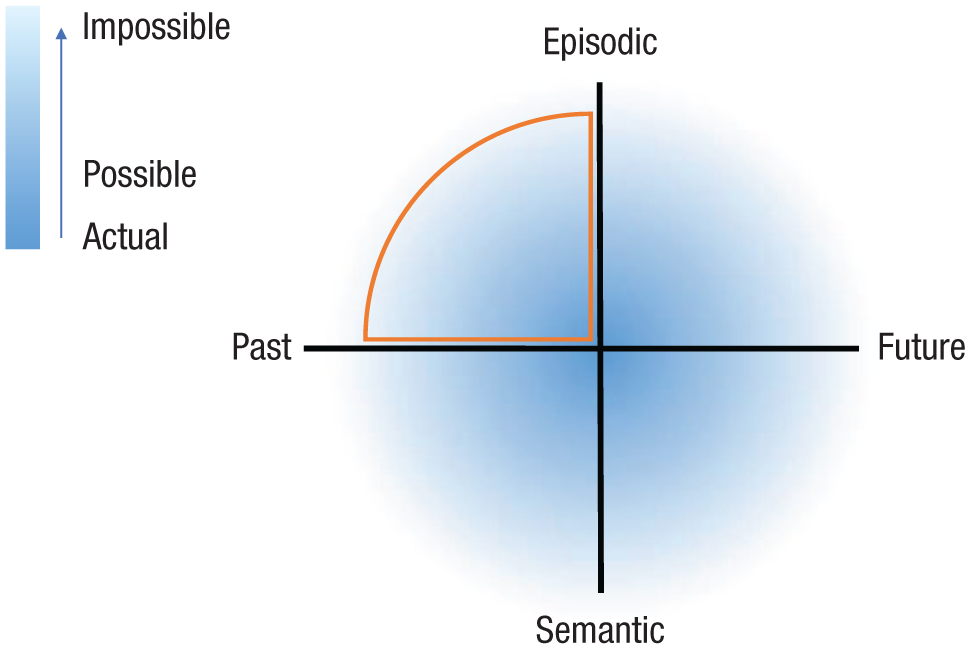
Graphical representation of three dimensions along which mental simulations may vary. In the temporal dimension (horizontal axis), episodic counterfactual thinking (which occurs in the area outlined in orange) contrasts with episodic future thinking because it is a retrospective rather than prospective hypothetical simulation. In the episodic–semantic dimension (vertical axis), episodic counterfactual thinking contrasts with both semantic memory and semantic counterfactual thinking in that it involves simulations of concrete spatiotemporal episodes that could have occurred. Finally, as indicated by the graded tones, episodic counterfactual thinking also contrasts with autobiographical episodic memory in that it depicts nonactual events with varying degrees of possibility. However, whether the modal dimension applies uniformly to both past and future episodic and semantic simulations remains an open question.
Earlier research on counterfactual thinking employed either vignette- or task-based materials to measure participants’ reactions when they consider alternative ways in which events could have occurred (Byrne, 2005; Kahneman, 1995). Yet most of these studies involved either semantic counterfactual thinking or impersonal, nonautobiographically relevant laboratory-based events (e.g., anagram completion) that are ill-suited to reveal the nature of episodic counterfactual thinking. Moreover, recent studies show critical differences between the mental simulations entertained during episodic counterfactual thinking and the mental simulations evoked by impersonal vignettes in lab-based tasks. In a landmark study, Girotto, Ferrante, Pighin, and Gonzalez (2007) showed that participants focus on different mutable elements of a decision (i.e., features of the agent vs. the context) depending on whether they personally make or read about someone else making a decision (for a replication, see Pighin, Byrne, Ferrante, Gonzalez, & Girotto, 2011).
What could be the reason behind this asymmetry? A possible explanation pertains to the degree to which the counterfactual simulation engages episodic relative to semantic memory processes. To explore this hypothesis, De Brigard, Spreng, Mitchell, and Schacter (2015) asked participants to engage in counterfactual thinking about themselves, other people, or objects while undergoing fMRI. They found that whereas object-based counterfactual thoughts tended to recruit brain regions associated with semantic memory, person-based counterfactual thoughts tended to recruit core regions of the default network. Interestingly, the recruitment of the default network was modulated by how familiar participants were with the main characters of their simulations. More precisely, when episodic counterfactual thinking featured either the participants themselves or someone they were very familiar with, the associated brain activity was remarkably similar to that engaged during retrieval of episodic memories. By contrast, when the main character was someone participants had little personal knowledge of, fewer core regions of the default network were engaged, and more lateral regions associated with semantic processing came on-line.
Convergent evidence comes from Kulakova, Aichhorn, Schurz, Kronbichler, and Perner (2013), who showed brain activity in areas associated with semantic processing—but not the default network—coming on-line while participants engaged in a semantic-based task requiring counterfactual thinking. More recently, Parikh, Ruzic, Stewart, Spreng, and De Brigard (2018) directly compared episodic counterfactual thinking with semantic counterfactual thinking in an fMRI study and corroborated preferential engagement of the default network during episodic counterfactual thinking as opposed to semantic counterfactual thinking, which in turn recruited lateral temporal and occipital regions (Fig. 2). Finally, developmental evidence suggests differential trajectories in the emergence of episodic counterfactual thinking relative to semantic counterfactual thinking. Research by Beck, Robinson, Carroll, and Apperly (2006) suggests that although our ability to reason about “real-world” counterfactual situations does not develop until the age of 7, our capacity to reason about general-knowledge, pretend, or fictional counterfactual events appears earlier. Given that their notion of real-world counterfactual thoughts is similar to episodic counterfactual thinking and that their notion of general-knowledge counterfactual thoughts is close to semantic counterfactual thinking, it is likely that this developmental evidence could point to age-related differences in the emergence of these two kinds of mental simulation.
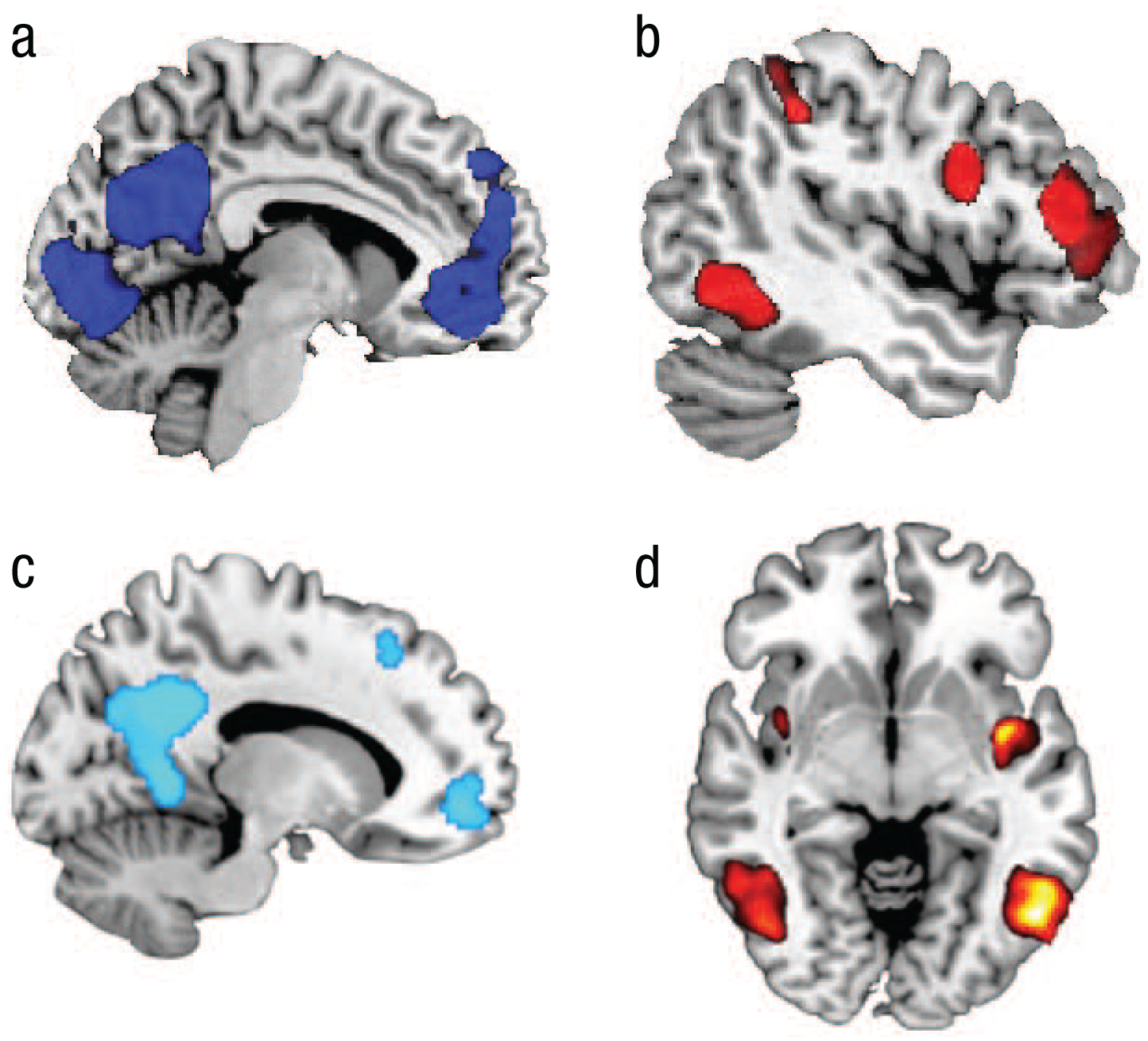
Brain images showing where episodic counterfactual thinking preferentially engages core regions of the brain’s default network. Areas in dark blue (a; posterior cingulate cortex, medial prefrontal cortex) indicate neural activation associated with episodic counterfactual thinking involving known people. Areas in red (b; lateral occipital cortex, inferior temporal gyrus, dorsolateral prefrontal cortex) indicate neural activity associated with semantic counterfactual thinking involving objects. Areas in light blue (c; posterior cingulate cortex, frontal pole) indicate neural activity associated with episodic counterfactual thinking with varying degrees of perceived possibility. Areas in red and yellow (d; inferior temporal gyrus, insula) indicate neural activity associated with semantic counterfactual thinking with varying degrees of perceived possibility. (Images taken from De Brigard, Spreng, Mitchell, & Schacter, 2015; Parikh, Ruzic, Stewart, Spreng, & De Brigard, 2018.)
It is worth emphasizing that episodic counterfactual thinking and semantic counterfactual thinking do not constitute two entirely different and dichotomous psychological categories but rather two extremes of a continuum, so that different simulations can engage relatively more or less cognitive processes of certain sorts (Weisberg & Gopnik, 2016). Our suggestion is that episodic and semantic memory processes are differentially engaged depending on whether a mental simulation is closer to episodic counterfactual thinking, in which case, episodic details are required to generate it, or closer to semantic counterfactual thinking, in which case, semantic information helps to scaffold the counterfactual thought (Irish & Piguet, 2013).
Modal Dimension
When we engage in episodic counterfactual thinking, unlike when we engage in episodic memory, we are not constrained by what actually happened. Even if we admit some degree of inaccuracy in our memories, remembering implies an attempt to generate mental simulations that approximate an actual past event. When we engage in episodic counterfactual thinking, though, we know that what we imagine did not happen and that our mental simulation depicts an event that is contrary to fact. In philosophy, the term modality refers to ways in which things could be. For instance, some things are possible, some are necessary, and some are impossible. The term counterfactual was introduced in reference to conditional statements with false antecedents (Goodman, 1947), for example, “If the earth were farther from the sun, days would be longer.” By definition, then, antecedents in counterfactual conditionals refer to ways in which reality could have been but is not. Counterfactual statements and modality are thus profoundly connected, and by extension, so are counterfactual thoughts.
The third dimension of episodic counterfactual thinking, therefore, is modal: Episodic counterfactual thoughts vary from the almost actual to the almost impossible (Fig. 1). Often, when we imagine variations in actual past personal events, we tend to minimally deviate from what actually occurred, which in turn often (but not always!) leads us to think that these close alternatives were not only possible but also plausible. However, sometimes we let our minds wander far beyond the plausible “what ifs” and find ourselves dreaming up almost impossible scenarios that bear little resemblance to what actually happened in our life. For instance, after narrowly failing a basketball shot, I may imagine what would have happened had I thrown the ball a little harder, just enough to make it bounce off the rim into the basket. But I may also let myself daydream about a bird miraculously hitting the ball just so to tip it over. Both of these mental simulations are, of course, counterfactual, but whereas some involve minimal deviations from what actually happened in the past—for example, a little extra push when tossing the ball—others require drastic departures—for example, the unlikely presence of a bird flying right into the ball. But to complicate things, the amount of change required to alter an event need not correlate with how plausible it would have been for the imagined counterfactual event to have occurred instead. I may have prior knowledge of the physical limits of my arm strength, leading me to think that the kamikaze-bird scenario is more possible than the unlikely yet minimally deviant one of exerting my muscles beyond their physical capabilities.
Of the three dimensions, the modal one is the least well understood and in the case of episodic counterfactual thinking, the least studied. Work employing vignette-based semantic counterfactual thinking suggests, for instance, that participants are more likely to reason counterfactually about events that deviate from norms, that involve actions rather than inactions, or that are causally close rather than distant from a desired outcome (Byrne, 2005). Interestingly, it has been shown that even the initial selection of the alternatives we entertain when reasoning counterfactually are constrained by moral considerations, such that we are less likely to consider as possible a counterfactual event we deem immoral rather than a moral one (Phillips & Cushman, 2017). Other research contrasting episodic counterfactual thinking and episodic future thinking has shown that contrary to increasing episodic future thoughts, increasing the availability of episodic counterfactual thoughts via repeated simulation reduces rather than increases their perceived plausibility (De Brigard, Szpunar, & Schacter, 2013). Neuroimaging evidence also shows differences in brain activity as a function of perceived plausibility because there is increased recruitment of core regions of the default network for episodic counterfactual thoughts perceived as plausible versus implausible (De Brigard, Addis, Ford, Schacter, & Giovanello, 2013; De Brigard, Parikh, Stewart, Szpunar, & Schacter, 2017). These and related results suggest, therefore, that how plausible we think a counterfactual event is may depend on the extent to which we see it as immoral, abnormal, salient, or easy to imagine or whether it has been repeatedly simulated.
However, it is likely that at least some factors that influence our judgments of possibility in episodic counterfactual thinking are common to other forms of counterfactual simulation. It has been suggested, for instance, that counterfactual thinking involves the generation of a mental model and its juxtaposition to a mental template, which in the case of episodic counterfactual thinking may be an autobiographical episodic memory. In turn, the degree of similarity between the counterfactual model and the template may modulate the extent to which we think of it as more or less plausible. Evidence in favor of this idea comes from a recent study suggesting that repeatedly simulating an episodic counterfactual thought may bring out more dissimilarities between the original autobiographical memory and the episodic counterfactual thought, which in turn reduces the perceived possibility of the latter (Stanley, Stewart, & De Brigard, 2017). Importantly, studies employing semantic counterfactual thinking also show strong correlation between the perceived similarity of the actual and counterfactual events and their perceived possibility (De Brigard, Henne, & Stanley, 2018).
Finally, there seem to be important commonalities between episodic counterfactual thoughts and semantic counterfactual thoughts perceived as possible at the neural level, as suggested by a recent study reporting increased hippocampal activity for both kinds of simulation as a function of perceived possibility (Parikh et al., 2018). This result also contrasts with a similar study showing reduction of hippocampal activity as a function of perceived possibility in episodic future thinking (Weiler, Suchan, & Daum, 2010). Needless to say, further research is needed to fully understand the extent to which perceived possibility and impossibility differs between episodic counterfactual thinking and semantic counterfactual thinking. Nevertheless, extant evidence does suggest that the modal profile of episodic counterfactual thinking is to a certain extent independent of that of semantic counterfactual thinking as well as other hypothetical mental simulations, such as episodic future thinking.
Conclusion and Future Research
We have argued that autobiographically based counterfactual thoughts that are episodic-like, retrospective, and perceived somewhere in a continuum from possible to impossible form a coherent psychological construct conveniently denoted by the notion of episodic counterfactual thinking. Moreover, we have also argued that despite similarities among temporal, episodic, and modal dimensions, episodic counterfactual thinking is distinctly different from episodic memory, episodic future thinking, and semantic counterfactual thinking. In addition to further unveiling the nature of counterfactual thinking, future research may also study the relationship between episodic counterfactual thinking and related mental phenomena. One particularly fruitful avenue is to study episodic counterfactual thinking as an emotion-regulation strategy during autobiographical memory retrieval. When reactivation occurs, episodic autobiographical memories can become labile and prone to modification. Imagining alternative ways in which past personal events could have occurred seems to affect the reactivated content, and although doing so may induce false recollection (Gerlach, Dornblaser, & Schacter, 2014), it may also help to mollify the emotion of negative memories as well as protect the valence of positive ones (De Brigard, Hanna, St Jacques, & Schacter, 2018).
Moreover, these results can be particularly useful to counter the negative effects of counterfactual creation. Counterfactual thoughts are often created in response to negative memories, and repetitive counterfactual creation is one of the major forms of pathological rumination (Tanner, Voon, Hasking, & Martin, 2013), resulting in extreme feelings of regret and disappointment. To counteract this effect, counterfactual thoughts can be used to elicit feelings of relief and contentment in response to a memory. A recent meta-analysis found that a form of counterfactual thinking, called imagery rescripting, is successful at altering acute, aversive memories (Arntz, 2012). This method involves taking an intrusive memory, rescripting the story to have a more positive outcome, and actively visualizing or imagining this change. By creating this episodic counterfactual thinking, the positive emotions of the imagined event bleed into the patients’ emotional response to the actual memory, and the patient is better able to handle the original memory and thus more receptive to future treatment. Clinical applications of counterfactual memory modification appear promising and need to be further explored and studied in controlled environments.
Recommended Reading
Byrne, R. M. J. (2005). (See References). A monograph surveying the social and cognitive psychology of counterfactual thinking in the context of the mental-models theory.
Roese, N. J., & Epstude, K. (2017). (See References). A recent update to the influential functional theory of counterfactual thinking.
Smallman, R., & Summerville, A. (2018). Counterfactual thought in reasoning and performance. Social and Personality Psychology Compass, 12(4), Article e12376. doi:10.1111/spc3.12376. An up-to-date review of the social psychology of counterfactual thinking and its effects on thought and action.
Footnotes
Action Editor
Randall W. Engle served as action editor for this article.
Declaration of Conflicting Interests
The author(s) declared that there were no conflicts of interest with respect to the authorship or the publication of this article.
Funding
This research was funded by a grant from the Duke Institute of Brain Sciences to F. De Brigard and by a National Defense Science and Engineering Graduate (NDSEG) fellowship to N. Parikh.