







Abstract
Over the past 15 years, research on the assessment of psychological situations has flourished. As a result, many basic questions about psychological situations have been answered. We discuss the theoretical and empirical studies that answered these questions, including what situations are; how they can be characterized, taxonomized, and measured; how they relate to person variables; and how persons navigate situations. We first summarize the “knowns” of psychological situation research and then proceed to chart the “unknowns” that have yet to be examined. We conclude with an agenda for future situation research.
Every thought, feeling, desire, and behavior is embedded in a situation. Although situations have been a core concept of psychological theories for decades, little empirical research on them had been conducted prior to 2005. Over the past 15 years, research on the assessment of situations has flourished, making it possible to understand and study situations better than before (Funder, 2016; Rauthmann, Sherman, & Funder, 2015b). Consequently, many basic questions about situations have now been effectively answered (Rauthmann, Sherman, & Funder, 2020). However, few researchers outside of this research area seem to be aware of these recent advances. In this article, we describe conceptual and empirical studies that have brought (largely) conclusive evidence to the following basic questions about situations: What constitutes a situation? In what ways can situational information be taxonomized? What are the major psychological characteristics of situations? In what ways can situations be measured? How do situation variables relate to person variables? And how do persons transition from one situation to another? After reviewing the “knowns,” we bring attention to “unknowns” by highlighting what questions remain unresolved, thereby carving out a future agenda for psychological situation research.
The Knowns
What is a situation?
Defining what, exactly, a situation is has been a thorny issue in social psychology and beyond (Reis, 2008). Complicating the matter further, different terminology (e.g., occurrence, situation, episode, life event, environment, context) is used haphazardly and interchangeably, creating jingle and jangle fallacies surrounding terms that obfuscate the literature. To provide some clarity, we compile different key concepts in Table 1 (based on Rauthmann, Sherman, & Funder, 2015a). This article is more narrowly concerned with situations, but of course they need to be viewed in concert with other associated concepts.
Overview of Different Concepts in Situation Research
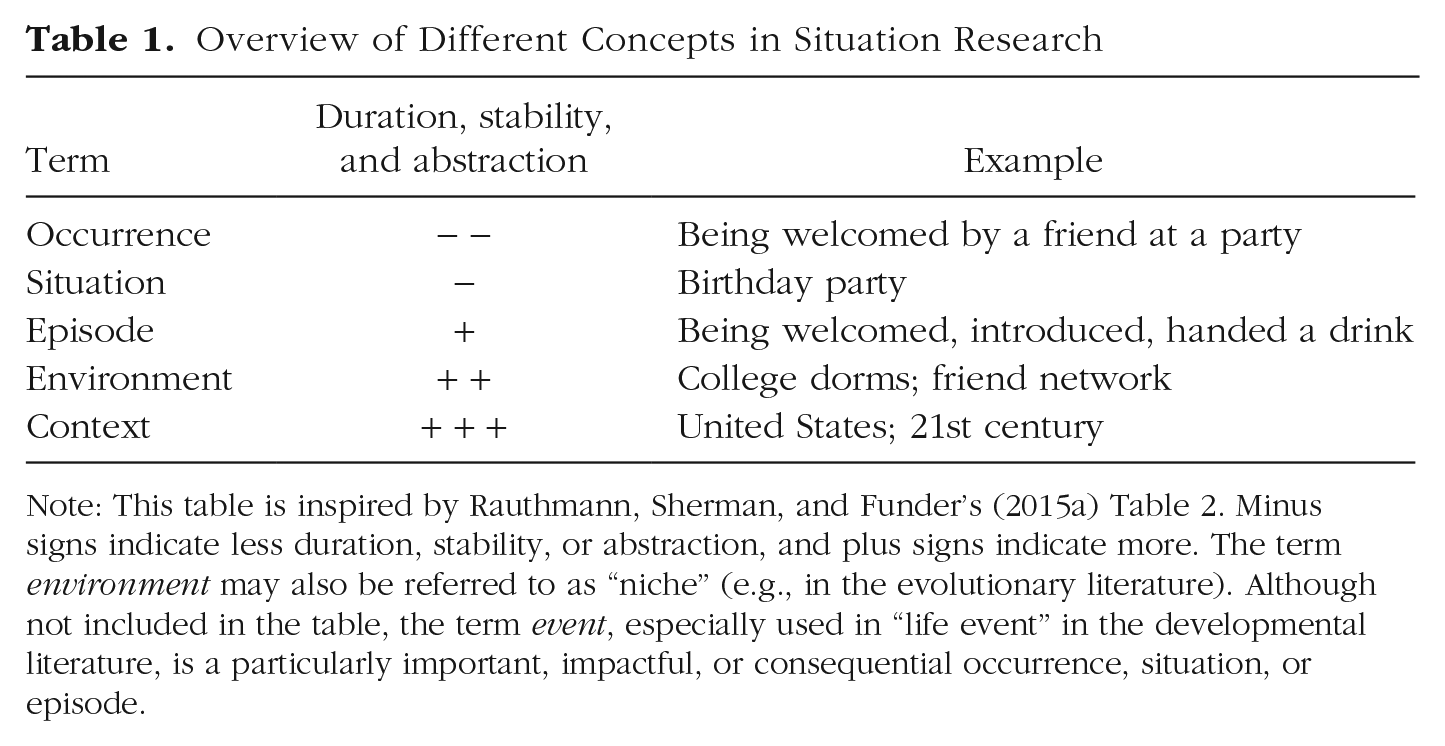
Note: This table is inspired by Rauthmann, Sherman, and Funder’s (2015a) Table 2. Minus signs indicate less duration, stability, or abstraction, and plus signs indicate more. The term environment may also be referred to as “niche” (e.g., in the evolutionary literature). Although not included in the table, the term event, especially used in “life event” in the developmental literature, is a particularly important, impactful, or consequential occurrence, situation, or episode.
One coherent way to conceptualize situations is in terms of the different kinds of information they offer (Rauthmann, 2015; Rauthmann et al., 2015b). In this perspective, a situation is a set of fleeting, dynamic, and momentary circumstances that do not lie within a person (i.e., they are neither one’s own mental processes nor one’s own behavior) but rather in their surroundings. The situation consists of objectively quantifiable stimuli called cues (e.g., illumination, temperature, noise, persons in a room, trees, animals, books) that may be perceived and interpreted by a person, yielding psychological situation characteristics (e.g., whether work needs to be done, how intellectually stimulating a situation is). Different situations may be grouped together into classes (e.g., medical situations, travel situations, happy situations) on the basis of the similarities among their cues and characteristics. Thus, different kinds of situational information—cues, characteristics, and classes—provide a lens to define situations.
In which ways can situational information be taxonomized?
The literature has repeatedly called for a taxonomy of situations, but as the previous section suggests, there can, in fact, be different taxonomies depending on which situational information is being taxonomized. Indeed, there is already taxonomic research on cues, characteristics, and classes (for an overview, see Rauthmann, Horstmann, & Sherman, 2020, Table 1). Although the taxonomization of characteristics has seen a surge of publications in the last decade (see below), research on cues and classes has not yet established any replicable or agreed-on structures or lists. However, two approaches seem particularly promising and most inclusive.
First, Noftle and Gust (2015) summarized cue-related “w questions” (who? what? where? when?; Saucier, Bel-Bahar, & Fernandez, 2007) in the acronym PEARLS, which is formed from the initial letters of “persons” (other persons), “events” (anything happening), “activities” (what others are doing), “roles” (social and formal roles of people), “location” (space and time), and “states” (mental states of the self and others), although the latter should not be considered proper situation cues (Rauthmann et al., 2015b). Second, van Heck (1984) identified 10 classes of situations: interpersonal conflict, joint working and information exchange, intimacy and interpersonal relations, recreation, traveling, rituals, sport, excesses, serving, and trading. However, little has been done to follow up on these valuable ideas and insights.
What are the major psychological characteristics of situations?
When researchers are interested in psychological situations (Funder, 2016), they are less likely to focus on cues or classes than on characteristics that, containing psychologically important interpretations and meanings, are the perceived qualities or attributes of situations. Characteristics allow for a differential psychology of situations in which each situation can be described and compared on continuous dimensions. Naturally, researchers want to know which dimensions these would be. An early assessment method, the Riverside Situational Q-Sort (Sauerberger & Funder, 2020), features between 81 and 90 items (in its different versions) to assess situation characteristics. However, it was unclear to what extent these items were comprehensive or exhaustive and which higher-order factors they may contain. We next review the later work in which researchers sought to partly address these issues.
As summarized in Figure 1, seven taxonomies of situation characteristics emerged in the last decade (Brown, Neel, & Sherman, 2015; Gerpott, Balliet, Columbus, Molho, & de Vries, 2018; Griffo & Colvin, 2019; Oreg, Edwards, & Rauthmann, 2020; Parrigon, Woo, Tay, & Wang, 2017; Rauthmann et al., 2014; Ziegler, Horstmann, & Ziegler, 2019). All were developed independently from each other with different approaches, levels of theory involvement, item pools, samples, and data-analytical strategies (though most approaches subscribed to factor-analytical techniques). What they have in common, though, is that they produced psychometrically validated assessment tools to measure the proposed dimensions. Although the number and labels of dimensions in them differ, it is striking that a six-factor solution—tentatively referred to here as the “Replicable Six”—seems to materialize from empirical and conceptual overlaps among the different dimensions (see Rauthmann, Horstmann, & Sherman, 2020). These factors are (a) threat (does the situation pose a threat, problem, obstacle, risk, or danger to me or others?), (b) stress (does the situation yield distress or frustration?), (c) tasks (does the situation involve tasks, work, or jobs that need to be done?), (d) processing (does the situation call for intellectual engagement?), (e) fun (does the situation allow for a good time?), and (f) mundaneness (does the situation involve routine, automaticity, or repetition)?
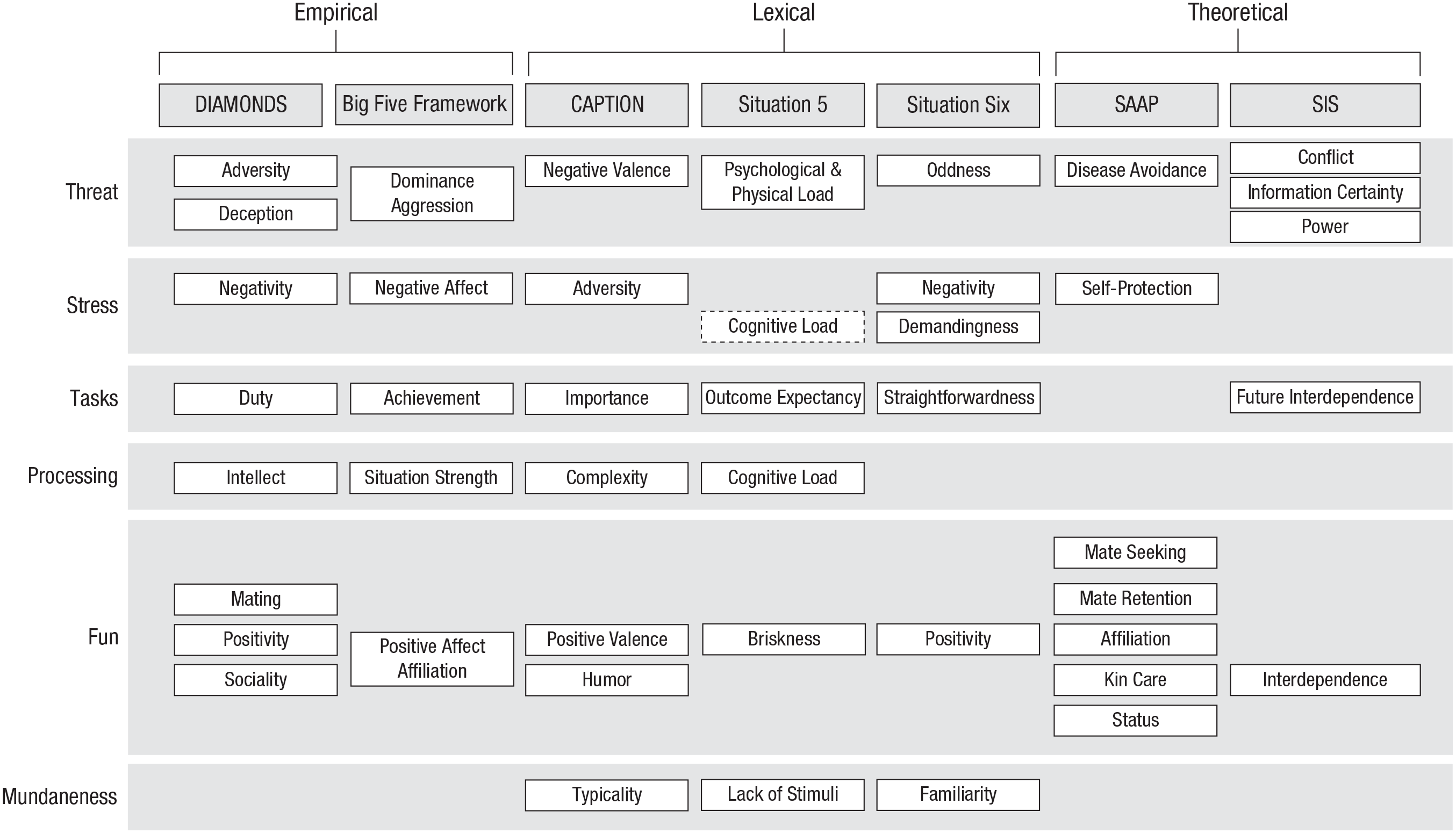
Overview of major dimensions in taxonomies of situation characteristics and possible common structure. “Empirical” means that a taxonomy was created bottom-up (data-driven, e.g., via factor analyses). “Lexical” means that a taxonomy was created with adjectives as descriptors of situations’ characteristics. “Theoretical” means that a taxonomy was created on the basis of a theory. Examples of empirical taxonomies include DIAMONDS (Rauthmann et al., 2014) and the Big Five framework (Griffo & Colvin, 2019). Examples of lexical taxonomies include CAPTION (with English adjectives; Parrigon, Woo, Tay, & Wang, 2017), Situation 5 (with German adjectives; Ziegler, Horstmann, & Ziegler, 2019), and Situation Six (with Hebrew adjectives; Oreg, Edwards, & Rauthmann, 2020). Examples of theoretical taxonomies include Situational Affordances for Adaptive Problems (SAAP; use of evolutionary theory; Brown, Neel, & Sherman, 2015) and the Situational Interdependence Scale (SIS; use of interdependence theory; Gerpott, Balliet, Columbus, Molho, & de Vries, 2018). Some dimensions have been aligned on the basis of their empirical correlations with each other, as each taxonomy has been associated with the DIAMONDS taxonomy. Others have been inferred on the basis of conceptual overlaps, as well as implied empirical correlations (e.g., if A is correlated with B, and B is correlated with C, then A and C should also be correlated to some extent). However, many overlaps and the overall six-factor structure are still speculative and await empirical investigation. Future research will have to examine the exact position of each dimension (and taxonomy) within the proposed superstructure. The domains on the left denote the tentative “Replicable Six.” The labels used here are preliminary. Figure adapted from Rauthmann and Horstmann (2019).
Notably, the first five dimensions (a–e) correspond in content quite well to the Big Five personality traits (i.e., disagreeableness, neuroticism, conscientiousness, intellect, extraversion). There may be different reasons for this content convergence between person and situation-perception dimensions, such as that (a) people form perceptions of situations as if they were coherent entities, leading to similar judgment patterns (Rauthmann & Sherman, 2019); (b) human-perception modules for judging persons and situations have evolved similarly, and the same cognitive and effective mechanisms apply for both person and situation perception (Nystedt, 1981); or (c) people understand situations in terms of the persons present, their personalities, and their social effects (Asendorpf, 2020). That six somewhat similar domains seem to repeatedly emerge could mean that we are progressing toward a consensual and reasonably comprehensive taxonomy of situation-characteristics dimensions. Nonetheless, the exact structure of situation characteristics remains to be explored, and the relations in Figure 1 still need to be seen as heuristically positioning dimensions into a common structure (see “The Unknowns and the Future of Situation Research”).
In what ways can situations be measured?
Cues can be measured objectively (e.g., via cameras, microphones, life-logging systems, sensors; e.g., Brown, Blake, & Sherman, 2017) or subjectively (e.g., inquiring about perceived or remembered cues from participants). Characteristics, as the perceived attributes of situations, can be measured only by asking participants how they would describe the situations (Rauthmann et al., 2015b). Such participants could be directly involved in the situation and affected by it (in situ raters), merely observing the situation unfold without being directly implicated (juxta situm raters), or observing recordings or coding verbal descriptions of others’ situations (ex situ raters). Classes can be measured directly, by asking participants what kind or type of situation they were in, or indirectly, by classifying cues or characteristics data (e.g., with cluster analyses).
Regardless of which situational information is studied, participants are often asked to judge the situation. Rauthmann et al. (2015b) have raised concerns about a common practice here: having participants rate their own situation and using only that rating as a situation variable. In such a scenario, the situation rating is merely a person variable, namely a perception. Thus, if one wanted to study how states (e.g., momentary mental processes and behavior) related to situation characteristics, then this practice would entail studying state–state relations (because situation perceptions are essentially just perceptual states of a person) instead of state–characteristic relations. This is a common problem in situation research (e.g., Sherman, Rauthmann, Brown, Serfass, & Jones, 2015) that has been addressed in only a handful of recent studies (e.g., Rauthmann & Sherman, 2019; Rauthmann, Sherman, Nave, & Funder, 2015). It has been argued that a “true” situational variable would be best approximated from multiple sources by aggregating ratings of different raters (in situ, juxta situm, ex situ). Thus, one best-practice recommendation is to employ multiple raters for the same situation. This allows not only the creation of aggregated composite scores but also the disentangling of different concepts, such as the raw in situ rating reflecting situation experience, aggregated ex situ ratings reflecting situation contact, and raw in situ ratings controlled for ex situ ratings reflecting unique situation construals (Rauthmann, Sherman, et al., 2015). If researchers gather experimental data in which each participant observes or reacts to the same set of multiple situations (e.g., in vignettes, different rooms, or virtual reality), then variations in participants’ ratings of the characteristics of those situations (e.g., how intellectually stimulating they are) can be decomposed into variance stemming from different perceivers, situations, and perceiver-by-situation interactions (plus error; for details, see Rauthmann & Sherman, 2019). In such a full-block design, the situation effects could be deemed “pure” measures of the situations’ characteristics because any other variance sources are removed from them.
How do situation variables relate to person variables?
It has become a truism that an outcome variable (e.g., behavior) is a function of both person and situation variables (encapsulated in Kurt Lewin’s now iconic formula). However, person and situation variables can show quite different relations, and it is important to make the function or functions relating them to each other and to other variables (outcomes) explicit. In Figure 2, we attempt to bring clarity to distinct concepts that have unfortunately all been lumped together under the term “person–situation interactions.” As can be seen, three basic person–situation relation phenomena can be distinguished: correlations (person and situation variables are concurrently associated with each other), interactions (a situation variable moderates the strength of relation between a person variable and an outcome variable, and vice versa), and transactions (across time, person variables predict situation variables and situation variables predict person variables). A fourth concept not specifically depicted in Figure 2 is the fit between person and situation variables, which can be seen as a special case of either correlation or interaction (see Rauthmann, in press). How single or entire profiles of variables of persons and situations match together (functionally or contentwise) may have consequences for intrapersonal (e.g., mental health, well-being, life satisfaction, self-esteem) and interpersonal (e.g., status, popularity) adjustment, and thus person–situation fit can be seen as a linchpin concept in psychology (Kristof-Brown & Guay, 2011; Rauthmann, in press). The four person–situation relations concepts may be related, but they need to be kept conceptually separate. Certainly, they each require different methodologies to be studied properly.
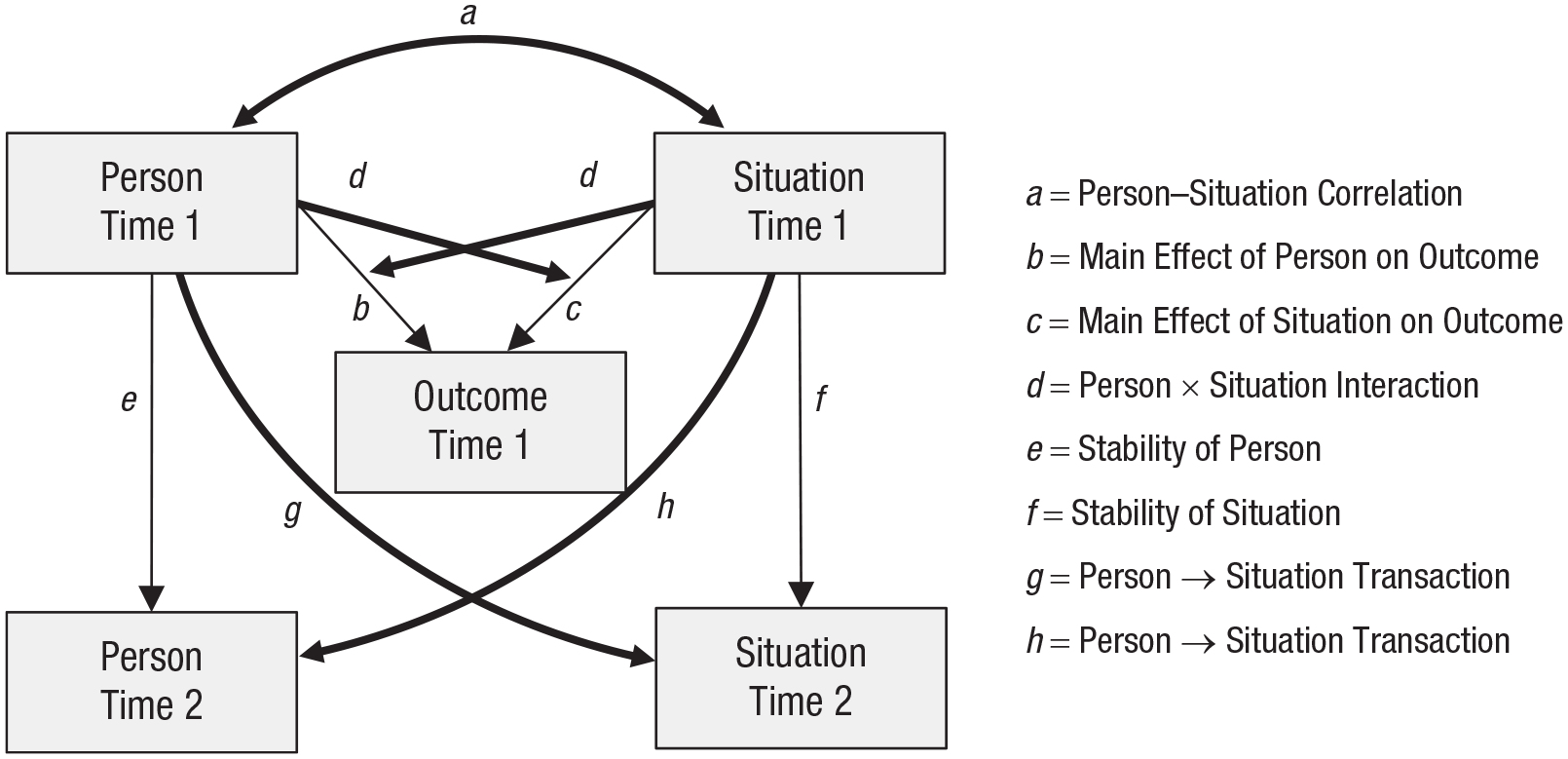
Overview of person–environment relations: correlations, interactions, and transactions. Person refers to any person variable (e.g., an enduring or stable trait or a momentary or variable state), situation refers to any situation variable (e.g., an enduring or a momentary cue or characteristic), and outcome refers to any person or situation variable. Thick arrows represent the concepts of correlation (a path), interaction (d paths), and transaction (g path). For d paths, keep in mind the main effects of Person (b path) and situation (c path) on the outcome. Note that the person may moderate the situation effect on an outcome and vice versa; hence, there are two d paths. For the g path (person to situation) and h path (situation to person), keep in mind the stabilities of persons (e path) and situations (f path).
How do people transition from one situation to another over time?
The demarcation of situations (when does one end and the other start?) has been a tricky issue. Some researchers have argued that situations change when the physical cues change, and others have argued that situations change when people change their perceptions of the situation (Magnusson, 1981). Again, it helps to think of situations in terms of cues, characteristics, and classes, as any of these information sources may change (Rauthmann & Sherman, 2016). Additionally, situation change may be studied within individuals (e.g., idiographically examining dynamic networks of situation characteristics across time within single persons) or between individuals (e.g., nomothetically examining situation change across several persons, in which interindividual differences in change are possible). Lastly, situation change may be examined at the level of single variables or profiles of variables. Despite these complexities, people show remarkable consensus in demarcating situations when given a video stream of a person’s life (Rauthmann & Sherman, 2016). This means they agree on when one situation ends and the other begins, suggesting that even the subjective perception of change may be somewhat normative.
A particularly interesting question is why situations change in the first place. Although situations can, of course, change on their own and outside of the agency of persons, persons can also navigate, influence, and shape situations to certain degrees (Rauthmann & Sherman, 2016). Table 2 summarizes such person → situation navigation mechanisms, which can be enacted willingly or unwillingly, more passively or actively, and with intended or unintended effects: maintaining versus terminating and changing situations (via construal, evocation, selection, modification, creation). Although these mechanisms have already been detailed in various literatures (e.g., Buss, 1987; Scarr & McCartney, 1983), they have rarely been studied empirically on their own so far (cf. Brown et al., 2017).
Overview of Person → Situation Navigation Mechanisms
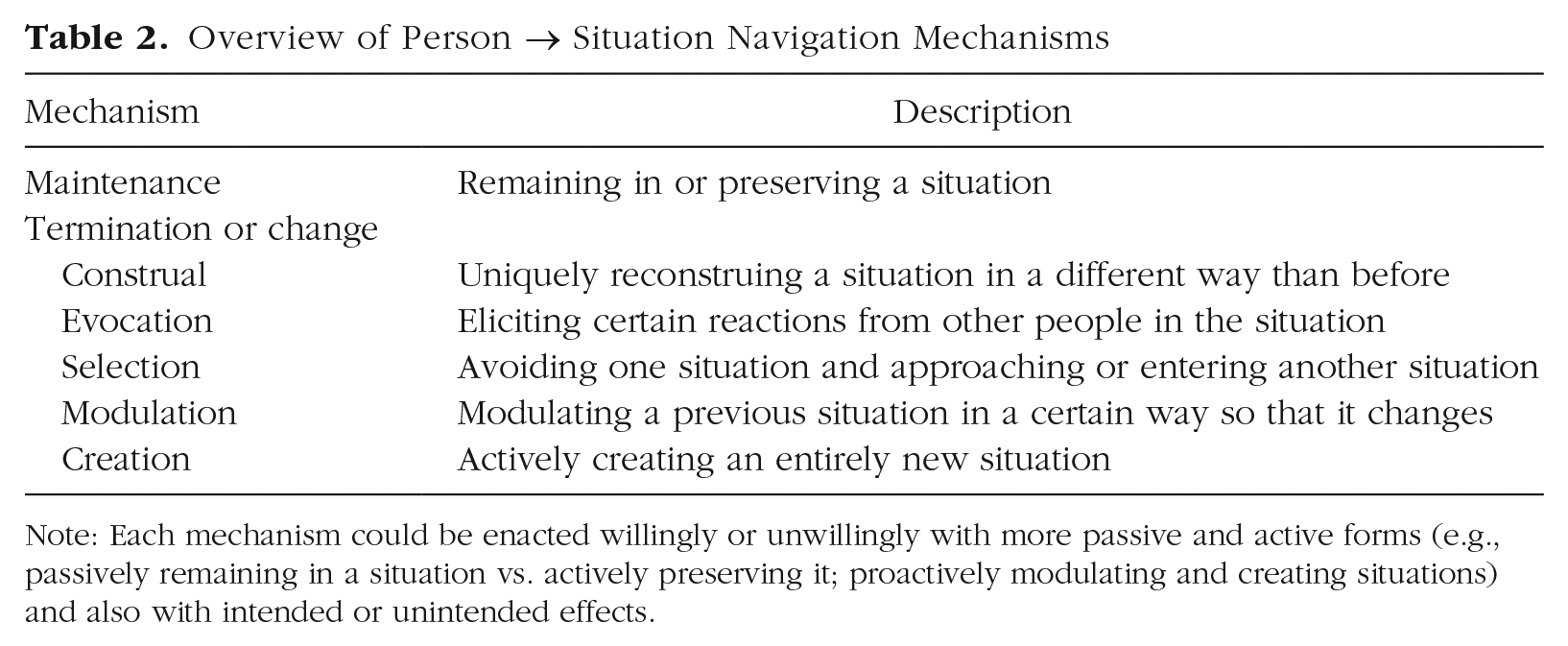
Note: Each mechanism could be enacted willingly or unwillingly with more passive and active forms (e.g., passively remaining in a situation vs. actively preserving it; proactively modulating and creating situations) and also with intended or unintended effects.
The Unknowns and the Future of Situation Research
Having outlined the knowns of situation research (i.e., pieces of theory or evidence that are either largely agreed on or replicable enough), we now turn to issues that are not yet resolved, have been neglected, or still await independent replication. Thereby, we also chart an agenda of issues for future researchers to tackle.
First, there has been burgeoning work on cross-cultural aspects of situation experience and how to properly measure them (Gardiner, Baranski, & Buehler, 2020; Guillaume et al., 2016). These lines of work, though impressive in their scope, have mainly been focused on college students, which limits their generalizability. Additionally, so far there has been little effort to construct trans- or pan-cultural taxonomies of situation characteristics, with a few exceptions (e.g., see Yang, Read, & Miller, 2006, for Chinese idioms in Chinese and American samples). Most taxonomies in Figure 1 were derived from within only one country and did not assess cross-country replicability. Indeed, the entire heuristic superstructure of Figure 1, with the Replicable Six, needs to be comprehensively studied, as no empirical data currently exist on the relations of all of the taxonomies jointly assessed.
Second, all taxonomies of situation characteristics have so far identified relatively broad domains. However, as with personality traits, situation perceptions could be multifaceted and organized in a hierarchy, though this hypothesis has yet to be empirically tested (against other ways of understanding situational structures, such as networks, lists, and lattice-based or composable components). Still, hierarchical analyses of higher- and lower-order factors may cast a more comprehensive picture and could also yield multifaceted measures that would be quite valuable if researchers wanted to zoom into participants’ situation perceptions.
Third, research already exists on how situation perceptions, traits, and states are linked (e.g., Morse, Sauerberger, Todd, & Funder, 2015; Sherman et al., 2015), but replications with other samples and countries are still needed. A major shortcoming of almost all of these studies is that they model all relations statically instead of also considering ongoing dynamics (cf. Rauthmann & Sherman, 2016). Future research should thus be focused more on situations as unfolding processes rather than as static entities. Such process-focused research may also tie together currently distant literatures that could enrich each other. For example, research on event and experience models deals with how unified impressions of what is going on (events) are formed and how these relate to memory, action control, and problem solving (e.g., Radvansky & Zacks, 2014). Unfortunately, though, this event-focused research has so far not been integrated with the situation-focused literature reviewed here. Integrating different literatures, perspectives, and theories would make situation research more synthetic, appealing, and useful across disciplinary boarders.
Fourth, in line with a more process-focused conceptualization of situations, the person → situation navigation mechanisms in Table 2 deserve further theoretical and empirical investigation. Although such mechanisms should be important for how people navigate and conduct their lives, surprisingly little research exists on the antecedents, correlates, and consequences of the different mechanisms. Additionally, there may be individual differences in how often, when, and how strongly each mechanism is used in daily life. This area seems ripe for future research.
Fifth, developmental aspects of situations have barely been tackled. So far, there is only one study examining mean levels of situation characteristics across the life span in population-representative samples of the United States and Germany (Brown & Rauthmann, 2016). However, there is no longitudinal research tracking cues, characteristics, or classes of participants’ situations across their life span. It is thus unknown how different situational information remains stable or changes within persons across years and how such changes are associated with (or even drive) personality development, well-being, and health.
Lastly, besides requiring more replication and generalization efforts, current situation research seems to be operating mostly without theories (for exceptions, see Brown et al., 2015; Gerpott et al., 2018; see also Radvansky & Zacks, 2014, for distant but topically related research areas such as event cognition with theories) or not building toward theories. This may be forgiven for a nascent field that needs to build on a strong empirical foundation. However, at some point, cumulative empirical evidence will have to be integrated into theories that will generate new hypotheses and help the field be productive in the long term. Moreover, such theory building would hopefully not impede, but actually encourage, researchers to make connections between different topics and areas of research (e.g., situations and culture, health, work; see Rauthmann, Sherman, & Funder, 2020) and clarify how insights on situations can be applied practically (e.g., to understand team climates, toxic work atmospheres).
Conclusion
Research on psychological situations has been gaining traction and thriving, especially in the last decade. It has comprehensively addressed the conceptualization, measurement, taxonomization, and usefulness of different kinds of situational information, most notably situation characteristics. This article provides an entry point to the many advances that have been made, but it also highlights that there are still many more exciting questions to be explored and answered.
Recommended Reading
Rauthmann, J. F., Sherman, R. A., & Funder, D. C. (2015b). (See References). Provides several principles for how psychological situations may be conceptualized and measured.
Rauthmann, J. F., Sherman, R. A., & Funder, D. C. (Eds.) (2020). (See References). The first handbook on psychological situations, culling together cutting-edge theory and research in the field.
Reis, H. T. (2008). (See References). Analysis of the concept of situations, mainly from a social-psychological view, and how it can be feasibly approached.
Yang, Y., Read, S. J., & Miller, L. (2009). The concept of situations. Social and Personality Psychology Compass, 3, 1018–1037. Accessible overview on the concept of situations and how different situational information has been taxonomized.
