







Abstract
Learning to produce the written forms of individual words is an important part of writing. In this article, I review research on how children acquire this skill. I begin by discussing young children’s knowledge about the visual appearance of writing and then consider how learners of alphabetic writing systems begin to use letters to symbolize the sounds they hear in words. The English writing system, the focus of this review, is complex. In the final section of the article, I discuss how older children learn about its subtler patterns. Implications of the research for how children learn and for how spelling should be taught are considered.
Keywords
Learning to write is important for success in today’s world, and spelling is an important part of writing. Parents and teachers have many questions about how children acquire this skill. For example, the toddler who produced the scribble shown in Figure 1 identified the part with small squiggles near the bottom left as writing. Could a child so young have learned that writing is usually small and dense? As another example, a 5-year-old might draw some shapes and label them as shown in Figure 2. Why would a child produce spelling errors such as these? Does the reversal of the ‹d› in the spelling of “diamond” mean that the child may have serious difficulties in learning to read and spell—dyslexia? My goal in this article is to review the research on how children learn to write words and consider its implications.
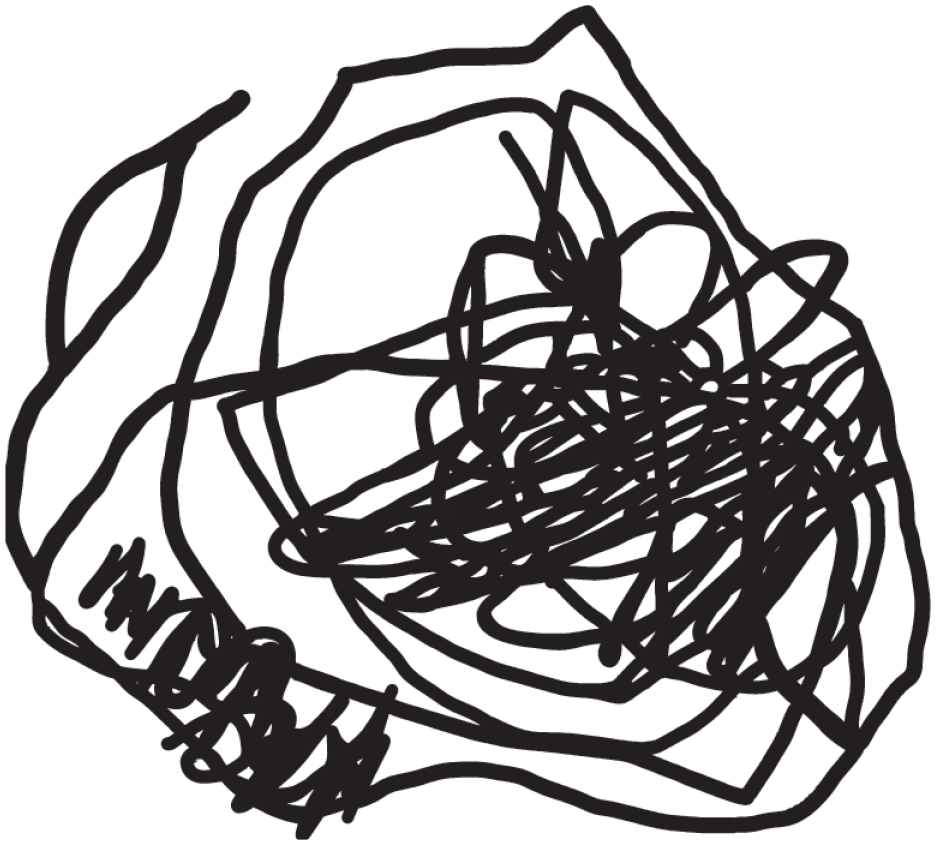
Production made by a 2.5-year-old U.S. child.
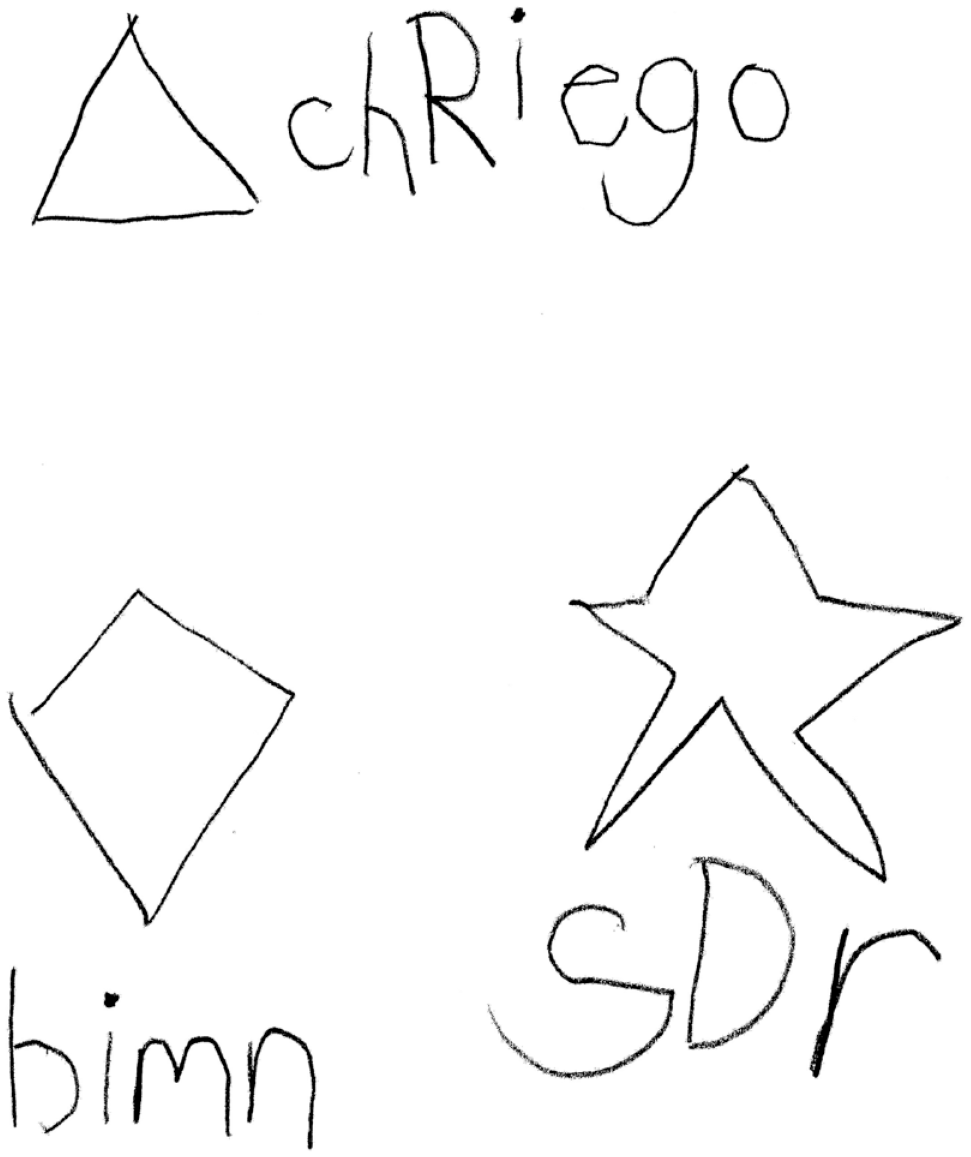
Typical spelling errors of beginning writers when asked to label the names of shapes they have drawn.
Children’s Early Knowledge About Writing and Spelling
Modern children see many examples of writing, and they start to learn about its appearance from an early age. In one study, Otake, Treiman, and Yin (2017) asked U.S. children between the ages of 2 years 0 months and 5 years 5 months to write four words and draw pictures of the corresponding objects. The top row of Figure 3 shows several U.S. children’s drawings of the sun, and the middle row of Figure 3 shows some writings of the word “sun.” Although one might label all of these productions as scribbles, there were some differences between the writing scribbles and the drawing scribbles. For example, the writings were, on average, smaller than the drawings. In addition, the children were more likely to choose a pen or a pencil, as opposed to a colored crayon, for writing. Before children’s writing includes identifiable letters, these results suggest, it may have some characteristics that are typical of writing.
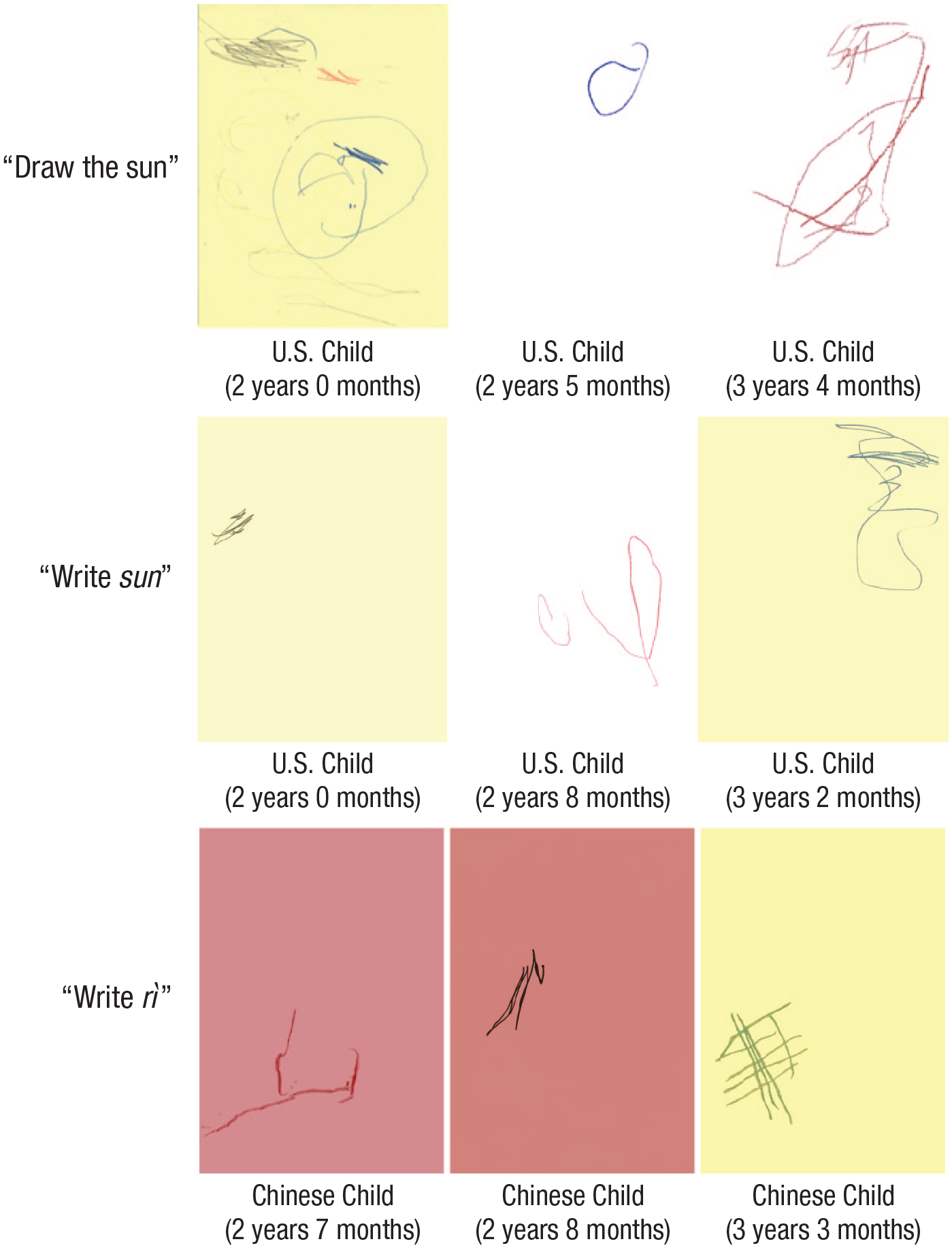
Sample figures produced by preschool children when asked to draw the sun, write the word “sun” (English), and write the word [rì] (Chinese).
In another study, Chinese 2- to 5-year-olds were asked to write the same words as in the above-described study with U.S. children, and adults who knew both English and Chinese were asked to judge whether each production was made by a U.S. or a Chinese child (Otake, Treiman, & Yin, 2018). The bottom row of Figure 3 shows some of the Chinese children’s writings. The adults performed above the level of random guessing in determining the language of the writer, even with the productions of the 2- and 3-year-olds. This result suggests that the productions contained some cues to the writing system to which the child had been exposed. A Chinese child’s production might not be identifiable as a specific character, for example, but it might have the squarish shape that is typical of Chinese characters. Interestingly, the adults found it easier to identify the writer’s language when children wrote their own name than when they wrote another word. This difference suggests that youngsters write their names in a more advanced way than other words (Levin, Both-de Vries, Aram, & Bus, 2005).
Young children learn not only about the general characteristics of their writing system’s symbols but also about their typical spatial arrangement. This differs across languages. Symbols are arranged horizontally in some systems and vertically in others. Evidence for children’s learning about spatial arrangement comes from a study in which 3- to 5-year-old U.S. nonreaders were shown pairs of displays with different spatial arrangements (Treiman, Mulqueeny, & Kessler, 2015). Some pairs contrasted horizontally arranged letters, as in Figure 4a, with randomly scattered letters, as in Figure 4d. Other pairs had other contrasts, such as vertical (Fig. 4b) and diagonal (Fig. 4c). When horizontally arranged letters were paired with other types of arrangements, the children picked the horizontal arrangement significantly more often than expected by chance. Thus, the children seemed to have some knowledge about a language-specific characteristic of their writing system.
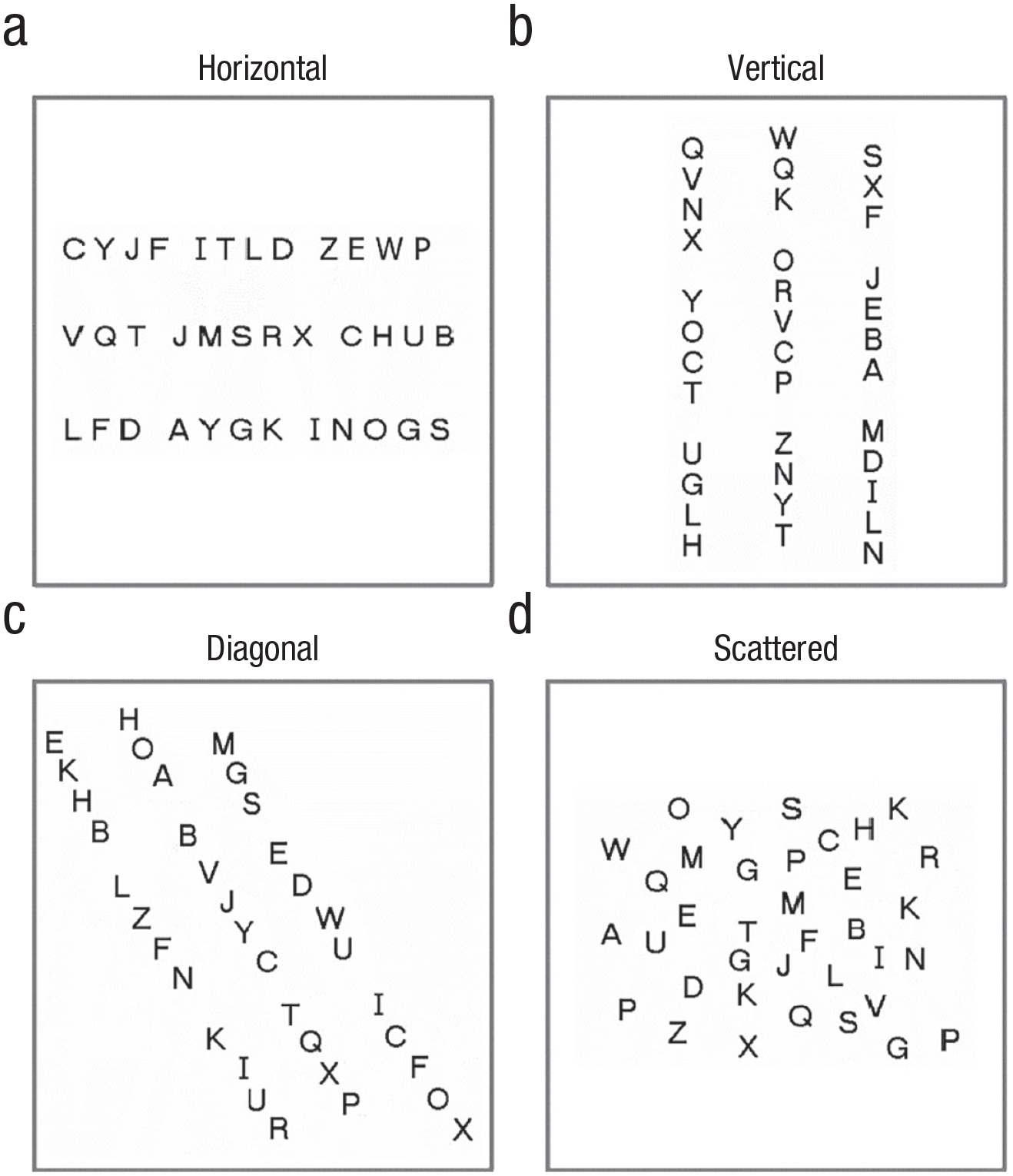
Displays with letters presented (a) horizontally, (b) vertically, (c) diagonally, and (d) scattered, as shown to U.S. 3- to 5-year-olds in a study by Treiman, Mulqueeny, and Kessler (2015).
Representing the Sounds in Words
A U.S. child of 4 or 5 years may produce a roughly horizontal string of recognizable letters when asked to write a word. However, the letters may not make sense given the phonemes (sounds) in the word: the phonology. For example, a child may write ‹OAB› for “dirt.” Such a child may perform better when asked to write “deal,” producing a spelling such as ‹DIT› that at least begins with a phonologically plausible letter. Children’s better performance on “deal” reflects the fact that its first two sounds form the name of the letter “d.” Children who are familiar with letter names, as many U.S. preschoolers are, sometimes use a letter to symbolize all the sounds in its name (Treiman & Wolter, 2020). Knowledge of letter names, therefore, can help children produce spellings that are at least partly phonologically plausible.
Children who know the spelling of their own name, as many preschoolers do, can use this knowledge to move toward plausible spellings of other words. For example, Ben is likely to be good at using ‹b›, the first letter of his name, in a phonologically appropriate manner. This allows him to produce better quality spellings of words such as “button” and “bear” than of words that do not contain the name of the letter “b” (Zhang & Treiman, 2020).
Results such as those just described indicate that children do not move neatly from a stage or phase of literacy development during which they use random letters to spell words (see Ehri, 2015; Gentry, 1982) to a period during which they represent some sounds in words with phonologically appropriate letters. A child may produce spellings that vary in phonological plausibility at a given time, depending on the properties of the words.
Spellings such as ‹DIT› for “deal” and ‹b› for “button” represent the first phoneme of the word with a plausible letter, but a parent or teacher who saw the spellings out of context would not know what word was meant. The spellings in Figure 2 communicate better in that they represent more of the sounds in the words. The child’s use of ‹chR› at the beginning of “triangle” may seem odd, but the first sound of “triangle” is similar to the sound that is conventionally spelled with ‹ch›, as in “chin.” The child’s spelling shows a recognition of this similarity (Read, 1975) as well as some confusion about the proper use of uppercase and lowercase letters. Another letter choice in Figure 2 that may seem odd to adults is the ‹d› in the child’s spelling of “star.” But this word’s second sound is similar to [d], and the use of ‹d› reflects this (Hannam, Fraser, & Byrne, 2007). Other beginning spellers omit the second consonants when spelling words such as “triangle” and “star,” producing spellings like ‹chiego› and ‹SR›. These spellings reflect children’s difficulty in breaking spoken words into phonemes and thinking about and manipulating the phonemes: phonemic awareness. Consonant clusters such as those at the beginning of “triangle” and “star” are especially likely to be treated as units (Treiman, 1991). The omission of the vowel in spellings such as ‹SDR› and ‹SR› for “star” reflects the use of ‹R› to represent both the vowel sound and the [r] in the letter’s name. These spellings are another example of how children use knowledge of letter names, if they possess it, to construct spellings.
Instruction that systematically promotes phonemic awareness and knowledge of correspondences between sounds and letters, phonics, helps children learn to spell and read (Ehri, Nunes, Stahl, & Willows, 2001). Such instruction is most effective when teachers understand the reasons behind children’s errors and respond accordingly. For example, a teacher can tell a 6-year-old who wrote “trick” as ‹chrik› that he did a good job of listening to the word and writing the sounds he heard. The teacher can explain, though, that the first sound of “trick” also sounds similar to [t], as in “tick,” and that we use ‹t› to write it. A teacher might not tell a child of this age that [k] is normally spelled as ‹ck› when it occurs after a single vowel letter in a one-syllable word, although this might be covered in a lesson for older students. Unfortunately, many U.S. teachers do not have sufficient opportunities during their training to learn about the structure of language and how to use it to inform spelling instruction (Carreker, Joshi, & Boulware-Gooden, 2010).
Parents and teachers sometimes worry that children who reverse letters, as with the use of ‹b› for ‹d› in the spelling of “diamond” shown in Figure 2, may be dyslexic. But letter reversals are not uncommon among typically developing young children. Indeed, the left-right reversal of ‹d› in Figure 2 suggests that the child has learned that letters of the Latin alphabet are more likely to have a vertical stem and an appendage that faces right, going in the direction of writing, than a vertical stem and a left-facing appendage. A child who writes ‹d› as ‹b› is making the shape conform to the pattern shown by letter shapes such as ‹h› and ‹E› (Treiman, Gordon, Boada, Peterson, & Pennington, 2014).
Beyond Simple Sound–Letter Mappings
Learners of some writing systems, such as Spanish, will spell most words correctly if they can analyze spoken words into phonemes and if they know the letter that is most often used to spell each phoneme. The English writing system, however, is complex. Many sounds have more than one possible spelling. Some sound-to-letter correspondences are less common than others, but even a less common correspondence may be systematically used in certain contexts. For example, [k] is almost always spelled as ‹ck› when it follows a single vowel letter at the end of a one-syllable word (e.g., “trick,” “back”). This same sound is almost always spelled as ‹k› when it occurs at the beginning of a word before ‹e› or ‹i› (e.g., “key,” “kitten”). In such cases, the context that is relevant to the spelling of a phoneme is its position in the word’s spelling and the spelling of an adjacent letter. In other cases, the identity of the surrounding sounds is more decisive. For example, [ɑ] is spelled as ‹a› in “wad” and “squash” rather than with the ‹o› that appears in “pod,” “gosh,” and many other words. The presence of a preceding [w] influences the spelling of [ɑ].
Children who receive phonics instruction are taught common sound–letter correspondences, such as the correspondence between ‹f› and [f]. They may be taught that some sounds have more than one possible spelling, and they may be taught that some options (e.g., ‹f› for [f]) are more common than others (e.g., ‹ph› for [f]). Often, however, children are not taught how context can help in selecting the correct spelling. Children pick up some context-dependent patterns through exposure to words in their reading materials, but this process can take many years (Hayes, Treiman, & Kessler, 2006; Treiman & Kessler, 2006).
The discussion of context effects so far has emphasized surrounding letters and sounds as influences on the spelling of a sound. In other cases, what is important for spelling is whether a sound or sound sequence is a morpheme: a unit of meaning. For example, the final [t] in “rapped” is a separate morpheme from “rap.” English generally spells the past-tense morpheme as ‹ed› regardless of its pronunciation. Thus, “rapped” is not spelled with the final ‹t› that is used for “rapt.” This is one of many examples of how English spelling is influenced by morphology (the structure of words and word parts) or etymology (the history of words). Becoming a good speller requires learning about these influences. Younger students will need to write some words that contain more than one morpheme, such as “jumped,” and words with multiple morphemes are increasingly important for older students. Many of the morphologically complex words that older students encounter come from Latin or classical Greek. These words have some different spelling patterns than words in the basic Germanic vocabulary of English. For example, [f] is more likely to be spelled as ‹ph› in words that derive from Greek (e.g., “phase”) than in basic words (e.g., “foot”). University students are sensitive to some of the spelling differences between words that derive from Latin and Greek and words that do not, even though these matters are not usually covered systematically in schools (Treiman, Decker, & Kessler, 2019). However, even adults have not fully internalized the morphological patterns in the English writing system (Treiman, Wolter, & Kessler, 2020).
Is it worthwhile to teach older students about context-dependent spelling patterns and about how spelling is influenced by morphology and etymology? Students learn some of these things on their own through reading. This process is slow, however, and adults do not take full advantage of all of the regularities that could help their spelling. Explicit spelling instruction can help, and research shows that it leads to larger spelling gains than informal or indirect approaches (Graham & Santangelo, 2014). Formal spelling instruction is typically limited to the primary grades in U.S. schools, but it is effective with older students as well.
Improving students’ knowledge of spelling is beneficial in several ways. For one, it allows those who read their writing to avoid the confusion that might occur when “prophet,” for example, has been misspelled as “profit.” (Most spell-checkers would not catch this error.) But learning the conventional spellings of words is not just a courtesy for the reader. Learning to spell fosters students’ phonemic awareness and improves their reading, underlining the importance of spelling for literacy in general (Graham & Santangelo, 2014; Ouellette, Martin-Chang, & Rossi, 2017).
Conclusions
Learning to write words is a long process. Even adult users of English have difficulty spelling some words that they know how to read. The research on spelling reviewed in this article sheds light on learning, showing how children use what they know—including the names of letters, the spelling of their name, and the similarities among sounds—to learn new things. The research findings also show that, although implicit learning plays a role in spelling development, explicit teaching is also important.
Recommended Reading
Kemp, N. (2016). Children’s first language acquisition of the English writing system. In V. Cook & D. Ryan (Eds.), Routledge handbook of the English writing system (pp. 193–206). Abingdon, England: Routledge. An accessible chapter about spelling development in English.
Read, C., & Treiman, R. (2013). Children’s invented spelling: What we have learned in forty years. In M. Piattelli- Palmarini & R. C. Berwick (Eds.), Rich languages from poor inputs (pp. 197–211). Oxford, England: Oxford University Press. An overview of research on children’s early spelling.
Tolchinsky, L. (2003). The cradle of culture and what children know about writing and numbers before being taught. Mahwah, NJ: Erlbaum. An interesting discussion of young children’s knowledge about writing and other symbolic systems.
Treiman, R., & Kessler, B. (2014). How children learn to write words. Oxford, England: Oxford University Press. A comprehensive work on writing systems and how children learn to use them.
