







Abstract
Response durations for simple key presses are an easily available but heavily underused measure. Whereas response times dominate the toolbox of experimental psychologists and cognitive modelers alike, any study with standard key-press responses also allows for the measurement of such durations as the time from response onset to response offset. Moreover, response times and durations are decidedly independent, so response durations hold great promise as a means to uncover unique perspectives on cognitive processing. We showcase recent observations and corresponding theoretical frameworks to highlight that this inconspicuous measure deserves much more attention than it has attracted so far. Given that it comes at no extra cost for common experimental setups, any researcher is well advised to consider adding the measure of response duration to their empirical toolbox.
Response times are a staple of experimental psychology. They offer an elegant approach to studying the inner workings of the mind but are remarkably simple to assess; all it takes is measuring the time between the occurrence of a stimulus and the beginning of an overt response.
The current prominence of response times emerged from classical experimentation linking this measure to general principles of psychological processing, including hypothesized relations to intelligence, personality, and atypical mental functioning (Jensen, 2006; Luce, 1986). Crucially, this tradition postulated that response time involves separate processing stages, such as perceiving and classifying stimulus information, selecting an appropriate action, and initiating a motor response (Donders, 1869/1969). However, a major downside of response times was their high moment-to-moment variability. Response time was therefore firmly established as a go-to measure with the advent of computer technology, which enabled researchers to gather many observations per participant quickly and easily. This database then allowed researchers to average across many repetitions of the same condition and fit sophisticated computational models of evidence accumulation to the observed data (Ratcliff & Smith, 2004).
Typical modeling efforts in psychology and neuroscience capitalize on response times by focusing on the time required to reach a decision threshold (Evans & Wagenmakers, 2020). The same is true for information-processing frameworks, such as sensorimotor-stage models of human cognition, which cover the processes up to movement initiation but not any processing afterward (Pashler, 1994). These theoretical traditions thus tacitly consider motor execution a mere appendage to cognitive processing and assume that later aspects of action execution are not particularly relevant for psychological theorizing. Actual motor control has therefore been dubbed “the Cinderella of psychology” to reflect this neglected status (Rosenbaum, 2005).
The neglect of motor execution in many cognitive approaches stands in stark contrast to a range of fields that do not rely heavily on response time measurements. In fact, some experimental setups obviously invite the study of how movements are enacted, as in the case of reaching, grasping, or pointing actions (Fitts, 1954); movements of the mouse cursor and swiping on a touch screen (Wirth et al., 2020); and data on mobility in everyday life (Hinds et al., 2022). The same is true for measures of syllable duration in psycholinguistic studies (e.g., Kawamoto et al., 1998) and for dwell times in eye-tracking research (e.g., Sauter et al., 2021).
Most of these measures promise obvious information gain because they are able to capture, for instance, the difficulty of fine-tuning and coordinating movement, as in the case of movement times (Fitts, 1954), or the time needed to extract information from visual input, as in the case of ocular dwell times (Holmqvist et al., 2011). Crucially for the present argument, even simple and seemingly ballistic, preprogrammed actions such as key presses or taps provide more information than the single measure of response time.
A close cousin of the execution-related measures presented above is the measure of response durations, that is, the time between response onset (key press) and response offset (key release). Among all possible ways to assess action execution, however, this measure has received particularly little interest in the community so far. (This is also true for us, who have routinely assessed similar variables for more extended movements, e.g., Wirth et al., 2020, while turning a blind eye to response durations for common key-press responses.)This state of affairs is all the more surprising because response durations are part and parcel of any key-press response as employed in countless studies in psychological science and beyond.
Even though response durations have been hiding in plain sight for decades, there are good reasons to assume that this measure has strong potential (a) if it provides unique information that cannot be distilled from response time measurements and (b) if this information can contribute to advancing theories of human cognition and behavior. We discuss both points in the following section.
Much Promise, Little Peril
Are response durations a unique source of information, especially compared with other aspects of a simple key-press response? This is certainly the case, as demonstrated by the following examples.
A first way of assessing whether response durations offer information on top of response time data is to compute the correlation of both measures across trials of individual participants (Kello et al., 2007). Figure 1 shows example correlations computed from the publicly available data of a recent study (Foerster, Moeller, et al., 2022). 1 In this study, participants responded to letter stimuli by pressing either a left or a right key on the computer keyboard according to a stimulus-response mapping rule. The study included visual noise distractors and a short response deadline aimed at eliciting errors to study error commission. Setting aside the original aim of this study for the moment, we will first focus on correct responses only, as is commonly done in studies on response times (we will come back to the effect of error commission on response duration later in this section). Computing individual correlations between response time and response duration on a given trial and then averaging these correlations does not reveal any systematic relation (r = –.007 in this data set). A similar pattern arises when mean response time and mean response duration are correlated across participants (r = .104). Both measures therefore appear to be remarkably independent, with no more than 1% overlap.
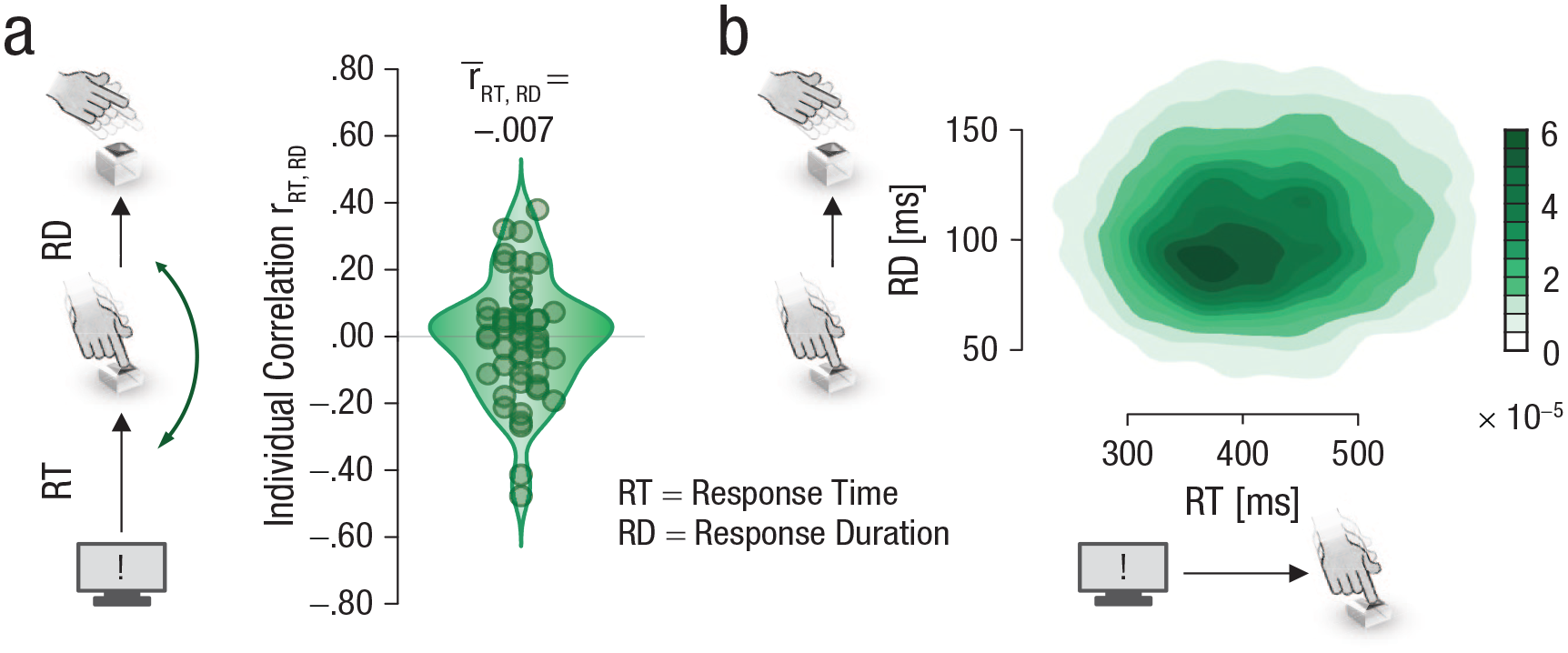
Relation of response duration (RD) to response time (RT) in an example data set (Foerster, Moeller, et al., 2022; publicly available at https://osf.io/3at7x/). Participants in this study classified a target letter with left or right key presses, and the figure shows data from correct classification responses. The violin plot (a) shows across-trial correlations of RT and RD for each participant (dots). The distribution centers on a correlation of 0, indicating that there is no systematic linear relation between both measures. The graphical assessment (b) gauges potential nonlinear relations between RT and RD. The plot shows the pooled data of all participants, with darker shading indicating higher relative frequency (iso-density contours). The pattern again portrays both measures as independent from one another.
A related observation concerns hidden statistical properties of response times and response durations when time-series analyses are used to assess how these measures evolve across multiple responses. Here, research on human response times has suggested that this measure follows general laws of complex, self-organizing systems (Gilden et al., 1995). This becomes evident when the overall variability of response times is partitioned into relatively slow fluctuations of the performance level on the one hand (i.e., extended periods of overall better or worse performance) and fast moment-to-moment fluctuations on the other hand. Complex, self-organizing systems typically show a strong contribution of slow relative to fast fluctuations, and this pattern reliably emerges for response times as well. Intriguingly, the same type of fluctuation is also present in response durations, but the fluctuations of both variables are independent from one another. That is, experimental manipulations—for example, predictable versus unpredictable stimuli, including versus excluding preview of upcoming stimuli—have independent effects on the fluctuation of response times and response durations, indicating that both measures carry distinct information (Kello et al., 2007).
Observing response durations to be independent of response times suggests that this measure might indeed be a worthwhile addition to the empirical toolkit of psychological scientists. Yet it is useful only if it provides relevant insight into cognitive processing. By now, there is converging evidence in support of this claim (e.g., Foerster, Steinhauser, et al., 2022; Grosjean & Mordkoff, 2001; Kello et al., 2007; Neszmélyi & Horváth, 2018; Pfister et al., 2022).
Research on action slips is a recent example for the added value of analyzing response durations. This field of research has commonly used neurophysiological techniques to assess when and how errors are detected and how these events are processed (Gehring et al., 2012). Several theoretical models have emerged from such findings, positing that it takes about one tenth of a second after committing an error to detect the action slip. However, recent findings suggest that durations for erroneous responses are often shorter than this timescale, whereas correct actions come with substantially longer response durations (Foerster, Steinhauser, et al., 2022; Hochman et al., 2017). Moreover, this pattern cannot be explained by other corollaries of error commission, such as response times of force output of erroneous responses (Foerster, Steinhauser, et al., 2022). These findings show that starting and finishing a response can be related to distinct cognitive processes. In this case, response durations capture early behavioral adaptation to error commission, suggesting that erroneous actions are canceled on a surprisingly short timescale that had previously been related to detecting rather than canceling erroneous actions. Findings from response durations thus challenge current models of error processing and therefore have the potential to contribute to refining theoretical approaches to cognition and behavior.
A particular selling point of response durations is that this measure does not involve any added cost, given that response durations are a necessary corollary of any response. That is, whereas previous suggestions for additional behavioral measures have pointed toward the promises of expanded setups (Abrams & Balota, 1991; Kramer et al., 2021), response durations can easily be measured in almost any setup that is used to gather response time data, and they do not require additional experimental apparatus. This is at least true when researchers are willing to accept a somewhat limited measurement precision compared with common response time measurements (e.g., when using standard computer keyboards, which tend to sample key presses at higher rates than key releases). Although this limitation can be overcome by using specialized equipment, analyses of response durations can already yield promising results with the precision offered by the usual technology (Foerster, Moeller, et al., 2022) and even when running Web-based studies.
The ease of implementation also sets response durations apart from other properties of key-press responses, such as their force profile (Giray & Ulrich, 1993). Response force had already been highlighted as an elegant measure in the early days of experimental psychology because force can be regarded as a basic output quantity of the human body (Bates, 1947). Response force has therefore been used as a unique source of information about cognitive processing (e.g., Ulrich et al., 1998), with particular promise as an implicit measure of decision confidence (Abrams & Balota, 1991). Although measuring response force requires dedicated recording equipment and sophisticated analysis procedures, response durations can be readily assessed and thus mined for relevant information. 2
Fully taking advantage of a measure requires not only the technical means to assess it, however, but also a solid theoretical understanding of what this measure actually captures. We will cover this point in the next section.
Interpreting Response Times and Durations
Many psychological scientists find it intuitive to interpret data from response time experiments. This measure is commonly taken to reflect a series of component processes, such as perceiving and classifying perceptual events, selecting an appropriate course of action, and initiating a body movement (Fig. 2). The seemingly intuitive nature of this measure, however, builds on scholars’ long-lasting efforts to understand its underlying psychological processes. Approximately 200 years ago, for example, many scientists were still convinced that basic psychological functions, such as perceiving a visual object, would not require a noticeable amount of time (see Woodworth, 1938, for a historical sketch). Only continued, systematic experimenting was able to change this misconception by establishing that response times relate to a series of psychological processes in preparation of an overt response (Donders, 1869/1969; see also Jensen, 2006; Luce, 1986).
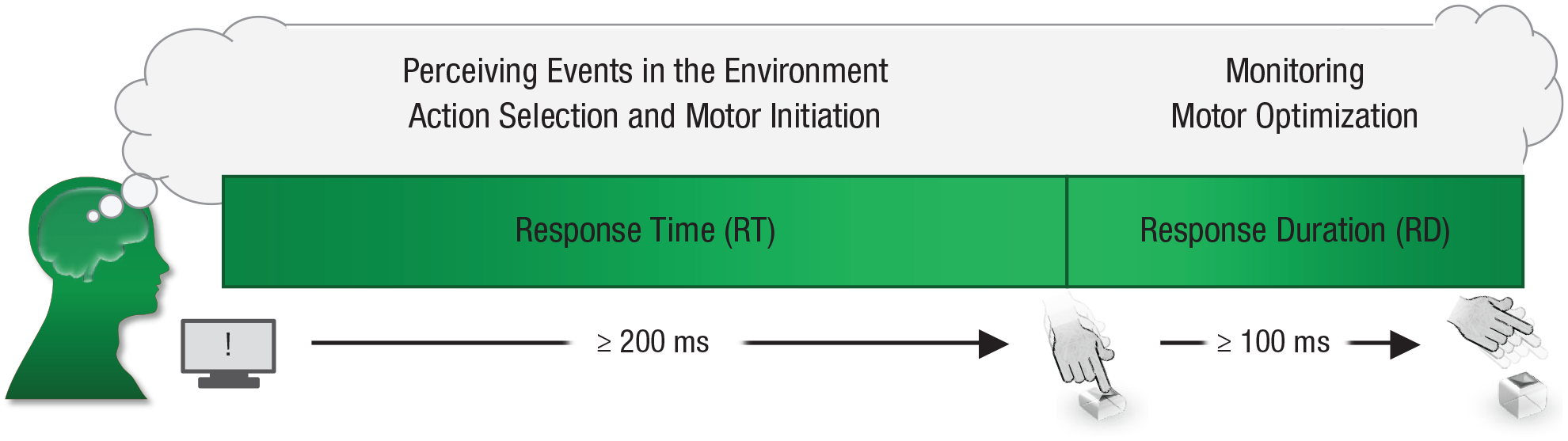
Psychological processes affecting response times and response durations. The processes of perception, action selection, monitoring, and motor optimization may each include different components corresponding to the experimental setup. Crucially, both measures can be used to study any variable that affects at least one of the listed components. If, for example, certainty (vs. uncertainty) can be assumed to affect monitoring demands, such an impact will be readily observable when response durations are assessed. The same holds true for previous events that cause response times or response durations to adapt for later responses. Finally, response durations can be expected to be sensitive to upcoming demands, such as subsequent actions in an action sequence.
A similar database has yet to be established for response durations. Although response time data were scrutinized by many experimental psychologists in the early 20th century, common textbooks of that era either did not discuss the execution of key-press or key-release responses at all or considered it an “after-period” that did not warrant extended discussion (e.g., Woodworth, 1938, p. 310). A rare exception is early work that discussed response durations as “recovery time” or “restart time” (Hirsch, 1936; Ponzo, 1936). 3 The present proposal indeed echoes these seminal observations because these researchers had already proposed using response durations to capture continued processing of the response while also observing that this duration was uncorrelated with response times. These articles further suggested using such durations as a diagnostic tool in personnel selection to measure a candidate’s psychomotor efficiency. Interest in response durations had shortly spiked for technical reasons as well, when human-factors engineers noticed that key-press durations were critical when operating mechanical typewriters (e.g., Lahy, 1927). Here, pressing a key while still holding down the previously pressed one would result in equipment malfunction, such as the type hammers entangling and thus interrupting performance. After mechanical typewriters had given way to refined computer technology, key-press durations were no longer studied systematically in applied psychology and human factors. In any case, this field highlighted that response durations were an integral part of any key-press response, likely reflecting the duration of cognitive mechanisms that monitor ongoing behavior.
Theorizing on human motor control offers several elegant concepts to refine the notion of monitoring. This is particularly true for models that provide an economic perspective on cognitive effort and metabolic costs involved in controlling body movements (e.g., Shadmehr et al., 2016). Monitoring has to accommodate two opposing goals in this view. For one, an action has to be performed for a sufficient amount of time with sufficient force to register whether an intended movement unfolds as planned. For another, force and duration of an action should be kept to a minimum to avoid undue metabolic investment. Several recent observations are consistent with this view. One corresponding example is that key-press or finger-pinch actions that trigger reliable auditory feedback come with low force and short duration compared with superficially similar actions without auditory feedback (Neszmélyi & Horváth, 2018). Reducing the reliability of feedback signals, in turn, increases response force and duration. Such observations are consistent with the idea that participants use additional body-unrelated feedback for motor optimization, that is, for shifting the balance toward lesser motor effort (Karlovich & Graham, 1968; Varga et al., 2022).
Taken together, these studies show that response durations reflect monitoring efforts to establish whether a movement unfolds as intended while minimizing metabolic energy investment. This view portrays response duration as especially tailored to studying online adjustments of performance. Several intriguing additional applications present themselves, however, as sketched below.
Applications
Having a solid understanding of the processes underlying response times and response durations allows for informed inferences, as summarized in Figure 2. The emerging view discussed so far is only the tip of the iceberg of potential applications of response duration as a means to study human cognition and behavior. Because response durations can be assessed in any study measuring response times, future researchers would be well advised to look for systematic effects across diverse fields of psychological inquiry. For instance, response durations have been observed to be affected by upcoming task demands, with shorter response durations the sooner the agent expects to perform a new movement (Vaughan et al., 1998). The same work also revealed hysteresis effects in the sense that response durations are affected by immediately preceding actions. Instructing participants to produce responses of specific durations has also been used to study motor programming (Klapp & Rodriguez, 1982) or stimulus-response compatibility effects (Kunde & Stöcker, 2002). Yet a particularly elegant property of response durations is that participants usually spend little thought on this aspect of their behavior if not specifically instructed to do so. Promising future directions therefore include the use of response durations as an implicit measure for relevant concepts such as choice confidence and certainty (vs. uncertainty) given that these variables likely affect monitoring demands (Gawronski & Hahn, 2019).
Conclusions
Response durations are available at the fingertips of any researcher running studies with simple key-press responses. Routinely measuring and analyzing this property of how a response is enacted provides a powerful addition to any study on human cognition. The high promise of recording and analyzing durations for simple key-press responses should of course be seen as supplementing rather than replacing other measures of action execution (Rosenbaum, 2005), given that a maximally diverse set of measures is key to making exciting discoveries about cognition and behavior. Whenever a researcher opts to conduct a study involving any type of key-press reaction, however, recording the innocuous measure of response duration may yield precisely such a discovery.
Recommended Reading
Foerster, A., Steinhauser, M., Schwarz, K. A., Kunde, W., & Pfister, R. (2022). (See References). The reported findings on error cancellation showcase how traditional theorizing can be challenged by analyzing response duration in common experimental setups.
Kello, C. T., Beltz, B. C., Holden, J. G., & van Orden, G. C. (2007). (See References). Convincing analyses to show that the durations of simple key-press responses contain valuable information that is distinct from the information conveyed by response times.
Rosenbaum, D. A. (2005). (See References). An engaging view of how the peculiarities of actually performing a body movement have become “the Cinderella of psychology,” including a vibrant plea to overcome this state of affairs.
