







Abstract
Humans are avid explainers: We ask “why?” and derive satisfaction from a good answer. But humans are also selective explainers: Only some observations prompt us to ask “why?” and only some answers are satisfying. This article reviews recent work on selectivity in explanation-seeking curiosity and explanatory satisfaction, with a focus on how this selectivity makes us effective learners in a complex world. Research finds that curiosity about the answer to a “why” question is stronger when it is expected to yield useful learning and that explanations are judged more satisfying when they are perceived to support useful learning. Although such perceptions are imperfect, there is nonetheless evidence that seeking and evaluating explanations—in the selective way humans do—can play an important role in learning.
Imagine an agent in a complex, information-rich environment. The agent could be a scientist or a child; it could be you or me. This agent has limited time and memory, so it needs to be selective about the information it seeks and the representations it encodes. What information should our agent seek and encode in order to effectively predict and control its environment—to solve the problems it will face and, ultimately, to survive? How might it go about doing so?
We know something about how human agents solve this problem: Humans seek and represent explanations. Of course, we seek and represent other things, too (labels, procedures, and so on), but explanations seem to play a characteristic role in guiding exploration and shaping what we learn (Danovitch & Mills, 2018; Lombrozo, 2006, 2012, 2016). For example, encountering unexpected traffic might prompt us to ask “why?” (Is there construction? A major concert that just ended?) Acquiring an explanation in turn allows us to generalize from this event to the future (whether there is likely to be traffic tomorrow).
This article introduces recent work on the human drive to explain, focusing specifically on selectivity in the explanations we seek and find satisfying. In the next sections we review new work suggesting that the selectivity of explanation goes hand in hand with explanation’s role in guiding learning.
Picky With a Purpose (PwP): A Hypothesis About the Selectivity of Explanation
Consider the following two observations, each of which is supported by a robust body of research. The first is that seeking, generating, and evaluating explanations supports learning and generalization, at least in many situations (Chiu & Chi, 2014; Lombrozo, 2016). For instance, a child might learn about dinosaurs by asking why they had various features, or a scientist might discover a new explanation for results by reasoning through the evidence or conducting experiments, in turn generating novel predictions. The second observation is that we are highly selective in both the explanations we seek and in the claims we accept as explanatory (Liquin et al., 2020; Liquin & Lombrozo, 2020a, 2022; Lombrozo, 2016; Zemla et al., 2017). For example, someone might wonder why the piecrust is soggy but not why the clock reads 1:37 p.m. when noticing the soggy crust. Someone might be satisfied by an explanation for the soggy crust that appeals to baking method but reject the “explanation” that the crust is soggy because of the big bang.
Together, these two observations prompt a compelling hypothesis (see Fig. 1): that explanation search and evaluation are effective mechanisms for learning by virtue of their selectivity. In other words, our proclivity to explain could support learning precisely because it effectively directs us to investigate certain aspects of the world over others and to evaluate the fruits of our investigation by particular criteria. We refer to this as the PwP hypothesis, for “picky with a purpose.” PwP can be understood as an extension and unification of prior accounts suggesting a role for curiosity in driving learning and for explanation in supporting generalization (see, e.g., “Explanation for Export,” Lombrozo & Carey, 2006; “Aligned Motivation,” Liquin & Lombrozo, 2020a; for older precedents, see Berlyne, 1978; Craik, 1952; Heider, 1958).
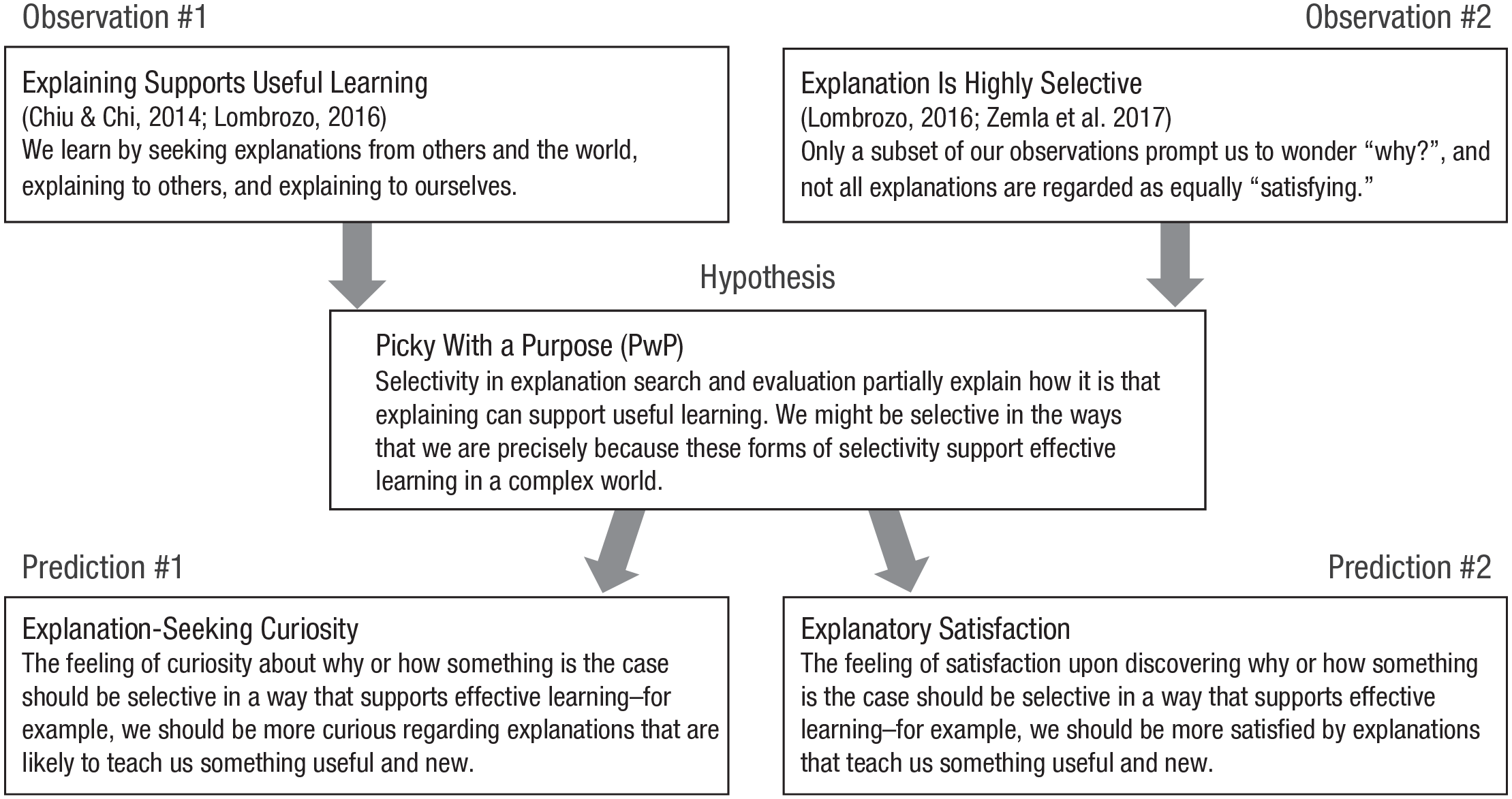
A summary of two key observations that motivate the picky with a purpose hypothesis and two key predictions that the hypothesis generates.
PwP is a hypothesis about the function of our explanatory fastidiousness: It claims that our pickiness has positive consequences for learning (and perhaps more strongly, that we are picky for this reason). But PwP also generates testable predictions about the phenomenology of explanation (Gopnik, 1998)—that is, about which things we should feel most curious to explain and which explanations we should find most satisfying. If selectivity in explanation search serves the function of maximizing useful learning, then we should expect higher levels of “explanation-seeking curiosity”—curiosity about how or why something is the case—when explanation search is likely to result in such learning (Prediction 1, Fig. 1). Correspondingly, if selectivity in explanation evaluation serves the function of maximizing useful learning, then we should expect higher levels of “explanatory satisfaction” when an explanation supports such learning (Prediction 2, Fig. 1).
It is worth being precise about the kind of learning that explanatory selectivity might support. After all, an explanation for why the piecrust is soggy could teach its recipient all sorts of things: not only about the causal factors that typically contribute to various pastry-related outcomes but also whether the baker is indignant or resigned to the soggy crust, how loudly the baker speaks, and so on. Only some of this information is explanatory in the sense that it addresses why or how the “explanandum” (i.e., what is being explained, such as the soggy crust) occurred. Moreover, only some of the explanatory information we could possibly learn is useful, in the sense that it supports generalizations or helps us achieve our goals. PwP is intended as a claim about learning useful information relevant to addressing the explanation-seeking question under consideration (e.g., why the piecrust is soggy), not a claim about any kind of learning at all.
PwP runs into a different problem if the intended kind of learning is defined too narrowly—for instance, as “learning the kind of information that makes us preferentially seek and favor some explanations over others.” Defined so, PwP risks circularity. For these reasons, it is important for PwP to be restricted to learning why or how the explanandum obtains but without specifying additional constraints that build in the explanatory selectivity that PwP seeks to explain.
Explanatory Phenomenology and Perceptions of Learning
Recent research has tested PwP’s core predictions about explanatory phenomenology and found support. In one series of studies involving samples recruited online within the United States (Liquin & Lombrozo, 2020a), participants were presented with “why” questions from Internet forums (e.g., “Why does food turn black when it burns?”). They indicated how curious they were about the answer to each question alongside a variety of additional ratings, including how much they expected to learn and whether they expected the explanation to be useful. These ratings were the strongest and most consistent predictors of curiosity (see Fig. 2a): When participants expected to learn more useful information, they reported stronger curiosity about the answer to a question. Related effects have been found for curiosity more broadly, even when directed toward nonexplanatory facts (Dubey & Griffiths, 2020; Liquin & Lombrozo, 2020a).
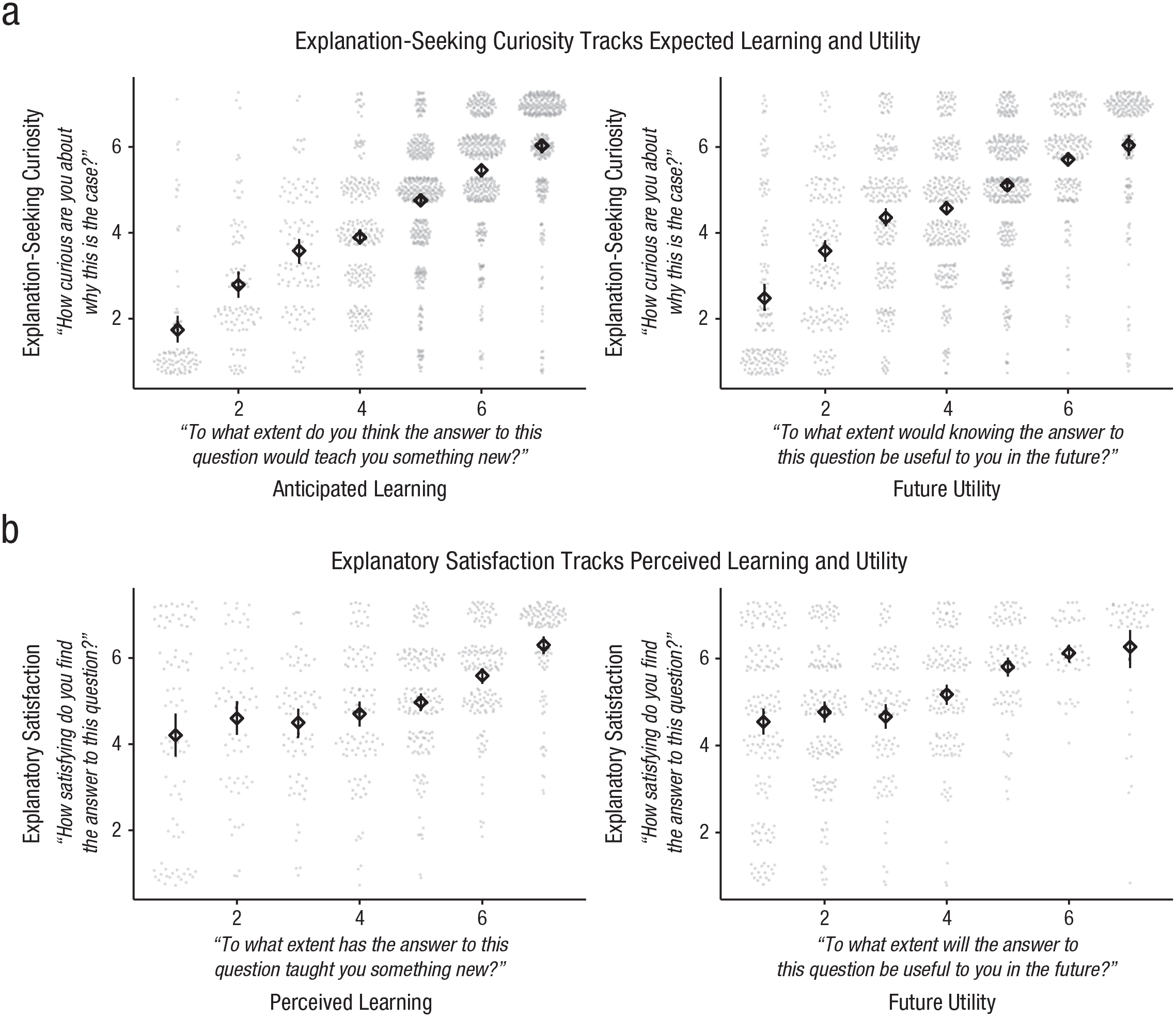
Relationship between explanation-seeking curiosity, explanatory satisfaction, and measures of learning and utility in Liquin and Lombrozo (2020a) and Liquin and Lombrozo (2022). (a) In Liquin and Lombrozo (2020a), participants read “why” questions from internet forums (e.g., “Why is random number generation so important for IT security?”) and rated explanation-seeking curiosity, anticipated learning, and future utility, among other measures. Gray points show individual ratings for each question from each participant; diamonds indicate mean curiosity at each level of anticipated learning (left) and future utility (right); error bars indicate bootstrap 95% confidence intervals. Anticipated learning and future utility were among the strongest and most consistent predictors of explanation-seeking curiosity. (b) In Liquin and Lombrozo (2022), participants read explanations from a variety of sources (e.g., “Why would dinosaurs be striped? A zebra’s stripes break up its outline, making it hard for a predator to pick one animal out from the herd. Dinosaurs that lived in herds may have had stripes for the same reason.”). They rated explanatory satisfaction, perceived learning, and future utility, among other measures. Gray points show individual ratings for each explanation from each participant; diamonds indicate mean curiosity at each level of perceived learning (left) and future utility (right); error bars indicate bootstrap 95% confidence intervals. Perceived learning and future utility were among the strongest and most consistent predictors of explanatory satisfaction.
Turning from explanation-seeking curiosity to explanatory satisfaction, evidence similarly points to an important role for perceptions of useful learning. In one set of studies (Liquin & Lombrozo, 2022), online U.S. participants received explanations from a variety of sources (e.g., “Why did pyramids have temples? . . . Temples were the gods’ homes on earth. The priests performed special ceremonies before and after the pharaoh was put in the tomb, so temples were built in the pyramids”). Participants indicated how satisfying they found each explanation alongside a variety of additional ratings, including how much they learned from the explanation and how useful they judged the explanation to be. These ratings were the strongest and most consistent predictors of explanatory satisfaction (see Fig. 2b): When participants thought an explanation supported more useful learning, they reported greater explanatory satisfaction. A follow-up study confirmed that it was participants’ evaluation of learning relevant to the explanandum, as opposed to learning “in general,” that best predicted explanatory satisfaction.
Perceptions of Useful Learning Boost Explanatory Satisfaction
One limitation of the results just reported is that they identify a correlation, not a causal relationship. To test whether perceptions of useful learning cause explanations to be more satisfying, one study had participants complete a fake assessment that purportedly diagnosed “which explanations a given individual will learn from best” (Liquin & Lombrozo, 2022). Participants were later shown explanations that the assessment supposedly flagged as “high” or “low” in terms of their expected learning. Although explanations were randomly assigned high or low, participants were fooled: They judged that they learned more from the high explanations than the low explanations. And the result was a shift in satisfaction: High explanations were also judged significantly more satisfying than low explanations (see Fig. 3).
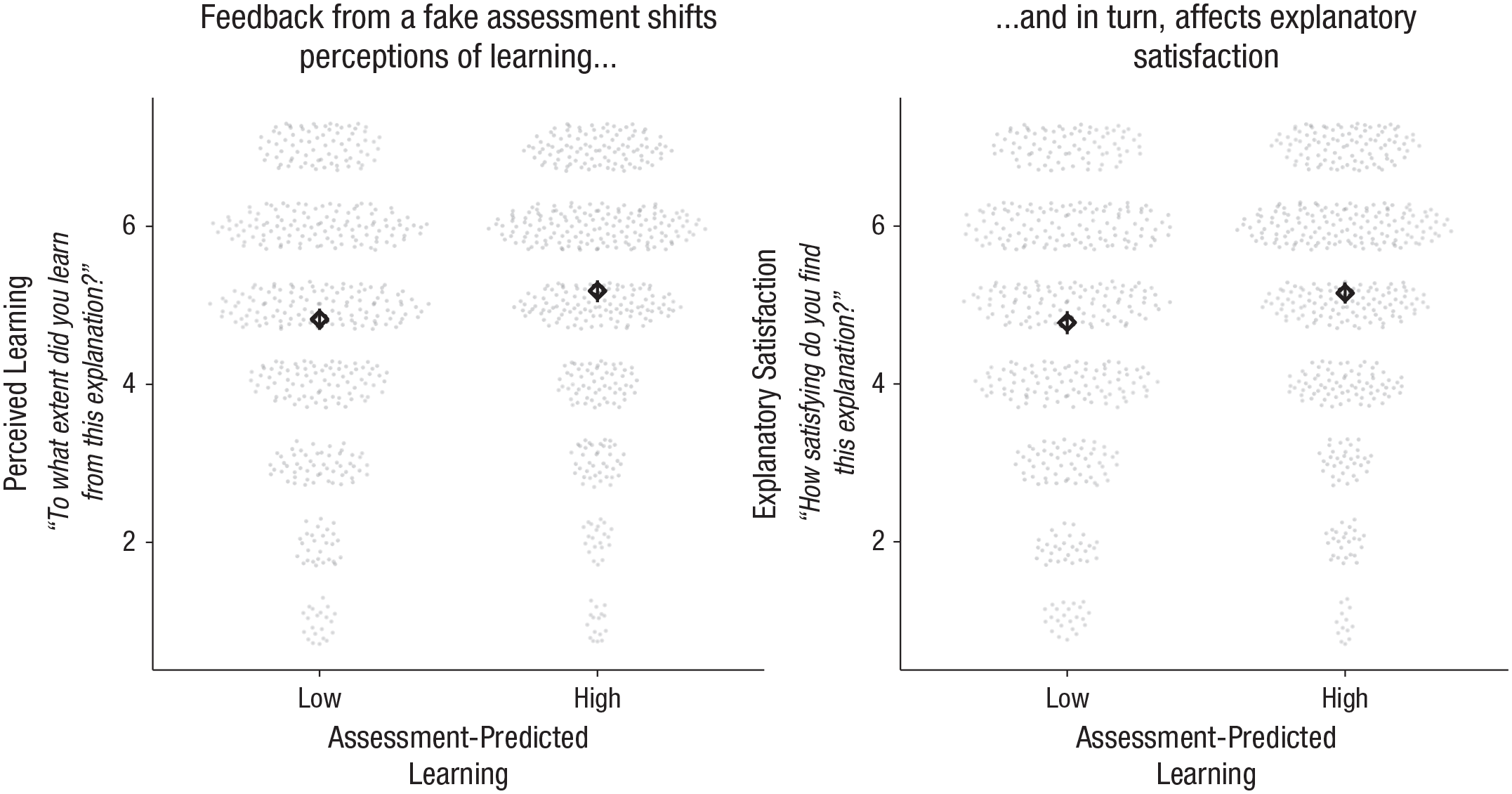
Effects of learning assessment predictions on perceived learning and explanatory satisfaction in Liquin and Lombrozo (2022). In this study, participants completed a fake assessment, which predicted “low” or “high” learning from particular explanations. Gray points show individual ratings for each explanation from each participant; diamonds indicate mean ratings; error bars indicate bootstrap 95% confidence intervals. The randomly assigned “low”/“high” labels affected perceived learning (left), as well as satisfaction (right), but not an unrelated control measure (not pictured).
These results demonstrate that a change in perceived learning causes a change in explanatory satisfaction. However, they do not rule out a causal relationship in the other direction as well. If explanations that support useful learning tend to be more satisfying, then finding an explanation satisfying should offer some evidence that it supports useful learning. (As an analogy, if adding salt to popcorn makes it delicious, then finding popcorn delicious should offer some evidence that it has salt. This inference is fallible—popcorn could be delicious for other reasons—but it is not a bad guess.) Indeed, results from an additional experimental condition revealed a bidirectional causal relationship between perceived learning and satisfaction: If you think you learned a lot from an explanation, you are more likely to find it satisfying, and if you judge an explanation satisfying, you are more likely to think you learned a lot from it.
Finally, there is evidence that anticipated utility has a causal impact on explanatory satisfaction as well. Across three studies (Vasilyeva et al., 2017), participants recruited online within the United States learned multiple explanations of variable utility. A real-world example might look like this: You can explain why rotary phones spin by appeal to their parts (a gear) or their function (dialing). Depending on the inferences you anticipate having to make in the future (e.g., predicting which other devices spin on the basis of their parts vs. their functions), these explanations will be differentially useful. Participants were randomly assigned to a future inference task, which they learned about before evaluating explanations. The key result was that explanations were judged to be better when they aligned (vs. did not align) with the future task that participants anticipated completing.
Beyond providing support for PwP, these findings offer one possible explanation for differences in curiosity and satisfaction across individuals. Individuals are likely to differ both in their perceptions of (expected) learning (e.g., due to differing prior beliefs or metacognitive abilities) and in their future goals. As a result, they might vary in the extent to which they are curious about particular explanations and find them satisfying. Exploring such variation across individuals is an important direction for future research.
Perceptions Don’t Always Match Reality
So far, we have good evidence for PwP: People are selective in the explanations they seek and find satisfying, and this selectivity is aligned with expectations and perceptions of useful learning. Moreover, experimentally manipulating perceived learning or anticipated utility has a causal impact on explanatory satisfaction. But there is a catch! Expectations and perceptions are imperfect. We may not find useful information where we expect it; we may misperceive how much we have learned. (Indeed, the “learning assessment” study from Liquin & Lombrozo, 2022, suggests that perceptions of learning are easy to distort.) Is there reason to think these expectations and perceptions are accurate, such that explanatory selectivity in fact supports useful learning?
For explanation-seeking curiosity, we can ask whether people are more curious about an explanation when it is more likely to support actual useful learning, not merely perceived useful learning. To address this question, one set of studies with online samples within the United States (Liquin et al., 2020) assessed curiosity in the context of a task that could be formalized with a Bayesian learning model, enabling a direct comparison between explanation-seeking curiosity and the model’s predictions of actual learning. As PwP would predict, participants were more curious about the answer to a “why” question when the model predicted higher “expected information gain” (i.e., that the possible answers to the question were more likely to support actual learning). Formal models of curiosity about nonexplanatory facts (e.g., trivia) similarly suggest that information search is related to actual expected learning as well as how relevant or useful that learning is likely to be (Dubey & Griffiths, 2020; Dubey et al., 2021, 2022; Rothe et al., 2019).
We can ask a parallel question for explanatory satisfaction: Are people more satisfied by explanations that support actual useful learning, not merely perceived useful learning? Here, the findings are less clear. In several of the aforementioned studies of explanatory satisfaction (Liquin & Lombrozo, 2022), participants reported not only explanatory satisfaction and perceived learning; they also completed assessments of actual learning, such as multiple-choice tests or an explanation recall task. The studies found inconsistent and modest associations between explanatory satisfaction and performance on these learning assessments. So whereas explanatory satisfaction corresponded closely to perceptions of learning, it was less closely tied to tested measures of actual learning.
From one perspective, this finding is unsurprising: Research generally finds that people are poor at assessing what they have learned (Bjork et al., 2013; see also Rozenblit & Keil, 2002). (Indeed, perceived and actual learning were weakly and inconsistently correlated in Liquin & Lombrozo, 2022.) One reason for this is that judgments of learning are not based on some direct, internal measurement of how mental representations have improved. Instead, useful learning from an explanation must be inferred based on indirect cues, such as complexity (e.g., Liquin & Lombrozo, 2022) or ease of comprehension (e.g., Scharrer et al., 2012). The weak link between explanatory satisfaction and learning plausibly reflects the limitations of these cues.
Indirect Benefits of Explanatory Selectivity
If explanatory satisfaction is a poor guide to actual learning, this raises a prima facie challenge to PwP: How can selectivity in explanatory satisfaction support useful learning if satisfaction is not strongly correlated with how much useful information we have learned? One possibility is that perceived learning—although imperfect—is still “reliable enough.” Another possibility is that effects of explanatory selectivity on learning are indirect: It is not that explanatory satisfaction accurately signals and reinforces successful learning from a given explanation but, rather, that the search for satisfying explanations directs inquiry in fruitful ways in the long run (Wilkenfeld & Lombrozo, 2015).
In fact, there is some evidence for such indirect benefits of explanatory selectivity on learning. Consider the finding that seeking and generating explanations can be an effective mechanism for learning (e.g., Chiu & Chi, 2014; Lombrozo, 2016; for informative exceptions, see Rittle-Johnson & Loehr, 2017; Williams et al., 2013). Some of these learning benefits emerge from the selectivity of explanation: By virtue of engaging in explanation, learners look for particular kinds of structure and entertain particular kinds of hypotheses—namely, those that would offer satisfying explanations—and this often leads to the discovery of real explanatory patterns in the world (Lombrozo, 2016; see also Brockbank & Walker, 2022). In children, as well, generating explanations can prompt the discovery of simpler and broader patterns (Walker, Bonawitz, & Lombrozo, 2017; Walker, Lombrozo, et al., 2017). However, these effects of explanatory selectivity are not necessarily “direct” in the sense that the discovery of a satisfying explanation accurately signals that relevant learning has occurred. Instead, explanatory dissatisfaction could play a key role in determining what is ultimately learned: Failure to discover a sufficiently satisfying explanation could indicate that further inquiry is warranted; failure to discover any explanation at all could indicate that a learner would benefit from considering alternative hypotheses or approaching the problem in a different way.
These indirect roles for explanatory phenomenology have been nicely documented in young children’s explanation search (Liquin & Lombrozo, 2020b). For instance, prompting children to explain observations in a novel domain leads them to ask more informative questions and thus solve a causal learning task in that domain with greater efficiency (Ruggeri et al., 2019). In receiving explanations, young children favor informants who provide noncircular explanations (Corriveau & Kurkul, 2014) and are more likely to seek more information following an unsatisfying or incomplete explanation (Danovitch et al., 2021; Mills et al., 2017), suggesting that explanatory phenomenology directs how and when inquiry is pursued.
The upshot of such cases is that favoring explanations that are satisfying could be a good strategy for learning in the long run, even when the features that drive satisfaction in response to a given explanation are imperfect guides to actual learning from that explanation itself. An important direction for future research is to evaluate this proposal empirically—that explanatory selectivity, through its effect on inquiry, has downstream benefits for actual learning.
Some Puzzle Cases
Thus far, we have focused on the potential benefits of explanation-seeking curiosity and explanatory satisfaction. These benefits derive in part from the link between explanatory phenomenology and learning, with perceptions of learning playing a key role. However, it is not hard to come up with cases in which explanatory phenomenology and judgments of useful learning seem to come apart. People routinely pursue evidently useless lines of inquiry, and they can remain unsatisfied despite acquiring what they recognize to be useful learning. These examples suggest that judgments of useful learning are neither necessary nor sufficient for an agent to experience explanation-seeking curiosity or explanatory satisfaction. How can such cases be reconciled with PwP?
These puzzle cases derive from (at least) two sources. First, note that explicit judgments of useful learning can be based on information that goes beyond phenomenology (i.e., the feeling of learning and the indirect cues on which it is based). For example, riddles might have just the right cues to induce feelings of learning—and hence curiosity and satisfaction. However, these cues might result in experiences of curiosity and satisfaction even when additional information, such as the hypothetical or fantastical content of the riddle, allows one to override the explicit judgment that the riddle will lead to useful learning. (As an analogy, someone can enjoy sugar-free candy and experience its sweetness despite recognizing that it does not in fact contain sugar.) Cases like this highlight one of the most pressing directions for PwP: characterizing the precise mechanisms that give rise to explanation-seeking curiosity and explanatory satisfaction, including how they relate to perceptions of learning.
Second, explanation-seeking curiosity and explanatory satisfaction can diverge from judgments of useful learning when the relevant learning does not involve explanations. For instance, someone might be curious about how to ride a bike and derive satisfaction from learning but without experiencing either explanation-seeking curiosity or explanatory satisfaction. Recall that PwP concerns learning how or why an explanandum obtains, so learning a skill will typically fall beyond the scope of the proposal. Other kinds of learning, as well, may not be properly explanatory. For instance, access to a deep neural network might supply accurate predictions that induce genuine learning and explicit judgments of learning but without generating explanatory satisfaction. These examples make it clear that PwP rests on a distinction between explanatory and nonexplanatory learning, which itself rests on an account of explanation (Lombrozo, 2012). Although providing such an account goes beyond the scope of this review, characterizing the explanatory and nonexplanatory flavors of curiosity and satisfaction are important directions for future work on motivation and learning.
Conclusion
We began with two observations: that explaining often supports useful learning and that the human drive to explain is highly selective (see Fig. 1). The key idea behind PwP is that these two observations are connected, such that explanatory selectivity partially explains the (often beneficial) effects of explanation on learning. In particular, selectivity in explanation-seeking curiosity directs individuals to learn about some aspects of the world over others (often in beneficial ways), and selectivity in explanatory satisfaction guides inquiry through both direct and indirect means (often in beneficial ways). Recent research supports this proposal. We have seen that curiosity about an explanation-seeking question is greater when individuals anticipate learning useful information from the answer and when the question is in fact associated with higher expected information gain. We have also seen that explanatory satisfaction is higher for explanations perceived to support useful learning, with evidence for a causal link between such perceptions and satisfaction. And although explanatory satisfaction is less than perfect as a signal of actual learning, the search for satisfying explanations can nonetheless guide inquiry in fruitful ways. In sum, when it comes to explanation, humans are picky with a purpose.
Recommended Reading
Brockbank, E., & Walker, C. M. (2022). (See References). A recent empirical paper disentangling the effects of explanation search on hypothesis generation versus evaluation.
Liquin, E. G., & Lombrozo, T. (2020a). (See References). A recent empirical paper exploring the features of a question that make us curious about its answer and, in particular, the role of expected learning.
Liquin, E. G., & Lombrozo, T. (2020b). (See References). A brief review summarizing research on explanation-seeking curiosity in children.
Liquin, E. G., & Lombrozo, T. (2022). (See References). A recent empirical paper exploring the features of an explanation that make it more satisfying and, in particular, the role of perceived learning.
Lombrozo, T. (2016). (See References). A brief review of research on explanatory preferences and how they influence reasoning and learning.
