







Abstract
This article provides an overview of a model of psychological well-being put forth over 30 years ago. The intent was to advance new dimensions of positive functioning based on integration of clinical, developmental, existential, and humanistic thinking along with Aristotle’s writings about eudaimonia. The operationalization and validation of the model are briefly described, followed by an overview of scientific findings organized around (a) demographic and experiential predictors of well-being, (b) well-being as predictors of health and biomedical outcomes, (c) pathway studies that examine intervening processes (moderators, mediators), and (d) underlying mechanistic processes (neuroscience, genomics). Much prior work underscores the benefits of well-being, including for longevity. Widening socioeconomic inequality is, however, increasingly compromising the well-being of disadvantaged segments of the population. These problems have been exacerbated by recent historical stressors (Great Recession, COVID-19 pandemic). Cumulative hardships from these events and their implications for health are critical targets for future science and practice.
Keywords
An article published decades ago in this journal (Ryff, 1995) described a new approach to psychological well-being based on the integration of ideas from clinical, developmental, existential, and humanistic psychology as well as Aristotle’s distant writings about eudaimonia. Much scientific engagement followed: The measures were widely translated (40 languages), and many new findings (1,550-plus publications) were generated (see Ryff, 2018, 2024; Ryff et al., 2021). This review highlights scientific advances that have grown up around the model and brings attention to troubling new realities. The central problem is that well-being is increasingly sequestered among privileged segments of modern society. Historical events, such as the Great Recession and the COVID-19 pandemic, have exacerbated these ever-widening inequalities. Of dire concern going forward is the health of socioeconomically disadvantaged individuals dealing with cumulative stress exposures and chronically low well-being.
Key Advances in the Science of Eudaimonic Well-Being
Extensive research going back to the middle of the last century examined subjective well-being, defined with hedonic indicators, such as happiness and life satisfaction (Diener et al., 1999; Ryff, 2024). Eudaimonic well-being emerged decades later and focused on existential challenges, such as finding purpose in life, having autonomy, experiencing personal growth, acquiring mastery, enjoying positive relationships, and having self-acceptance (Ryan & Deci, 2001; Ryff, 1989). Empirical tools constructed to assess these dimensions received extensive psychometric scrutiny and were differentiated from hedonic assessments (Keyes et al., 2002). Analyses of factorial structure, including with samples from diverse countries, generally supported the six-factor model when scales of sufficient length were used (see Ryff, 2018).
Building on such measurement work, multiple domains of scientific investigation unfolded, as depicted in Figure 1. Many studies examined how demographic variables (e.g., age, education) or experiences in work and family life predicted varying levels well-being. Other endeavors investigated well-being as an antecedent or predictor of biological risk factors, morbidity, and mortality. Studies using longitudinal data, such as the Midlife in the U.S. (MIDUS) national study (www.midus.wisc.edu), probed intervening pathways focused on well-being and other factors as moderating or mediating influences. Further lines of inquiry linked well-being to underlying mechanisms, such as neuroscience and genomics. Illustrative findings in these areas are described next, followed by consideration of causality issues and translational relevance.
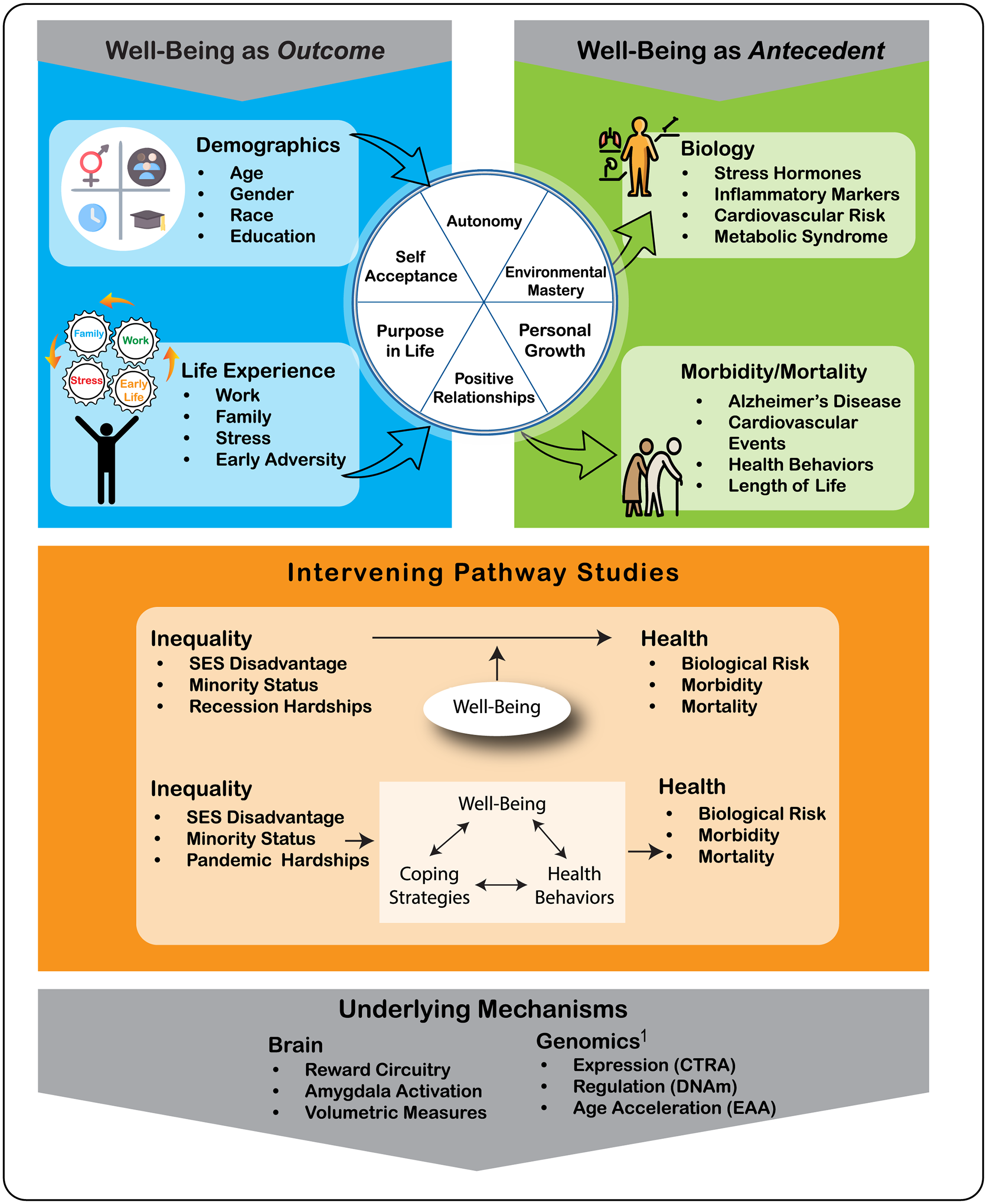
Varieties of well-being research. CTRA = conserved transcriptional response to adversity; DNAm = DNA methylation; EAA = epigenetic age acceleration; SES = socioeconomic status.
Well-being as outcome: what happens to eudaimonia as we age and engage
As shown in Figure 1, eudaimonic well-being has been linked with numerous demographic status variables. Much initial research focused on how well-being varies by age, with initial cross-sectional findings showing decline from midlife to old age in personal growth and purpose in life along with upward age trajectories for environmental mastery and positive relations with others and mixed patterns for autonomy and self-acceptance (Ryff, 1989). Longitudinal research subsequently confirmed many of these patterns and brought in other experiential topics (Ryff, 2018, 2024). For example, greater involvement in multiple life roles was linked with higher levels of diverse aspects of well-being, and helping others enhanced purpose in life and self-acceptance. Married individuals showed advantaged well-being compared with divorced, widowed, or never-married individuals, though single women had higher profiles on autonomy and purpose in life compared with married women. Parenting was linked with higher well-being, particularly if children were doing well, whereas the loss of a child predicted impaired well-being decades later. Similarly, loss of a parent in childhood predicted lower levels of multiple aspects of well-being in adulthood. Alternatively, experiencing parental warmth in childhood predicted multiple aspects of well-being in midlife and was inversely associated with drug use and smoking.
With regard to work life, findings from MIDUS linked occupational experience to diverse mental and physical health outcomes (Soren & Ryff, 2023). Although job strain and perceived unfairness at work were associated longitudinally with mental distress and insomnia, positive findings showed that employees’ sense of purpose was predicted by skill variety and coworker support. Illustrating bidirectional influences, those with higher personal growth also showed greater likelihood of subsequent employment. Considerable interest has been shown in linking entrepreneurship to eudaimonic well-being (Ryff, 2019), where most prior entrepreneurial research focused on hedonic well-being. New perspectives (Stephan et al., 2020) emphasized that self-employment compared with wage employment is more self-determined and volitional, which in turn enhances experiences of meaningfulness and autonomy at work.
Not illustrated in Figure 1, but important to consider, is the role of cultural context as a predictor of well-being. To assess such questions, the MIDUS national longitudinal study was augmented in 2008 with a parallel study known as MIDJA (Midlife in Japan) based on a probability sample (recruited from the general population) from Tokyo, Japan. Multiple findings have shown cultural differences in experiences of well-being, emotion, and health (Miyamoto & Ryff, 2022). Japanese adults experience both positive and negative affect in more balanced ways, whereas U.S. adults are more likely report high positive and low negative affect. Culture is also relevant for understanding links between socioeconomic status (SES) and well-being. For example, subjective SES (one’s perceived status vis-à-vis others) was more strongly associated with well-being in the United States, whereas objective SES (educational status) was more strongly associated with well-being in Japan. In addition, Japanese findings revealed that higher SES was linked to a greater self-orientation as well as maintenance of relationships and fulfillment of social responsibilities. Thus, high social status in Japan confers privileges as well as responsibilities for others, likely tied to the rise in Japan’s suicide rate since the 1990s, which was most noticeable among those in managerial positions. These issues take on heightened significance as inequality has grown over time.
Well-being as antecedent: how eudaimonia matters for biomarkers, morbidity, and mortality
Arguably the most novel advances have come from extensive efforts to link eudaimonic well-being to biology and health (see Fig. 1; Ryff, 2018, 2024; Ryff et al., 2021). A wide array of initial findings showed that higher well-being (particularly, personal growth, positive relations with others, and purpose in life) was associated with better neuroendocrine regulation, lower inflammatory profiles, lower cardiovascular risk factors, and better sleep duration and efficiency (measured objectively). More recent findings from multiple national samples, which control for numerous covariates, continue to show that diverse aspects of eudaimonia are associated with better glycemic (blood sugar) regulation, better inflammatory profiles, better lipid profiles, lower risk of metabolic syndrome, and lower allostatic load (summary index of physiological dysregulation).
Findings from multiple longitudinal studies have also shown that purpose in life predicts extended longevity and reduced risk of disease. The Rush Memory and Aging Project was first to show those with higher purpose in life had reduced mortality 7 years later as well as reduced incidence of Alzheimer’s disease and mild cognitive impairment. MIDUS findings replicated and extended the mortality findings, showing greater survival over 14 years among those with higher purpose in life at baseline after adjusting for numerous covariates. Findings from the Health and Retirement Study showed lowest risk of all-cause mortality among those with high purpose in life as well as reduced risk of mortality from heart, circulatory, and blood conditions. A meta-analysis of 10 prospective studies found significant associations between purpose in life and reduced all-cause mortality as well as reduced cardiovascular events. Overall, the evidence that eudaimonic well-being, especially purpose in life, predicts better health and longer lives is widespread and strong.
Intervening pathway studies
A strength of population-based inquiries such as MIDUS is the opportunity to investigate intervening pathways, framed as moderating and mediating influences (see Fig. 1). As summarized in prior reviews (Ryff, 2018, 2024), initial work found that those with lower levels of educational status showed higher levels of interleukin-6 (IL-6), an inflammatory marker involved etiologically in multiple disease outcomes. These outcomes replicated prior work but were extended with moderation analyses showing that multiple aspects of eudaimonic well-being buffered against higher IL-6 among those with a high school education or less. Similarly, in studies of early-life adversity, purpose in life was found to moderate (buffer against) the link between emotional abuse in childhood and depressive symptoms in adulthood.
More recent mediational analyses have also been conducted. Boylan et al. (2023) investigated links between religiousness or spirituality with mortality, finding that service attendance and spirituality were each associated with lower mortality. Explicating underlying pathways, they found that purpose in life and social support mediated these effects. Other mediational studies come from research on entrepreneurs, where one inquiry linked childhood adversity with later career success, with the effects mediated by eudaimonic well-being. Another investigation asked why self-employed people report higher levels of eudaimonic well-being than wage workers (Nikolaev et al., 2023). The answer provided was that entrepreneurs more likely use problem-focused coping (proactive thoughts and actions) and less likely use emotion-focused coping (venting, denial); these types of coping were then tested as mediators of links between self-employment and eudaimonic well-being.
Underlying mechanisms: neuroscience and genomics
The bottom panel of Figure 1 draws attention to varieties of topics in neuroscience and genomics that have been linked to eudaimonic well-being. As summarized in Ryff (2018, 2024), studies of the brain using functional magnetic resonance imaging (fMRI) techniques show different activation patterns among those with higher eudaimonic well-being, such as less amygdala activation in response to negative stimuli as well as sustained activation of reward circuitry (striatal activity) in response to positive stimuli. The latter pattern was further linked with lower cortisol output over the course of the day. Higher purpose in life has been linked with less reactivity (eye-blink startle response) to negative stimuli, and higher eudaimonia overall was associated with greater insular cortex volume involved in higher-order functions. Recent findings linked less persistent amygdala activation to aversive emotional experience, which in turn predicted greater psychological well-being (Puccetti et al., 2021). Another study found that greater purpose in life was associated with brain microstructural features (fMRI diffusion metrics in white matter and the right hippocampus) that are consistent with better brain health (Nair et al., 2024).
Genomic links to eudaimonia have also been examined, including gene expression activated by chronic social adversity. Known as the conserved transcriptional response to adversity (CTRA), this pattern is marked by increased expression of pro-inflammatory genes and decreased expression of antiviral- and antibody-related genes. Findings from the Health and Retirement Study (Cole et al., 2015) showed CTRA expression to be upregulated in association with loneliness but downregulated in association with eudaimonic well-being. Joint analyses, controlling for demographic and behavioral risk factors, further showed that CTRA associations with loneliness were largely abrogated when controlling for individual differences in eudaimonic well-being. In contrast, eudaimonia continued to show highly significant association with CTRA gene expression in analyses that controlled for loneliness. Other genomic indicators included in Figure 1 (DNA methylation, epigenetic age acceleration) underscore the richness of MIDUS data, which are publicly available to the scientific community. Numerous opportunities exist to advance understanding of genomic processes underlying eudaimonic well-being.
Reflection on causality and translational applications
Do longitudinal studies show evidence of causal relationships or only associational ties? What about bidirectional influences? Several observations are provided on these issues. First, some predictor and outcome variables do not lend themselves to questions about reverse causality. For example, many sociodemographic factors (age, gender, race) used to predict levels of eudaimonic well-being are assigned status variables. It does not make sense to ask whether well-being causes such statuses because they are part of the existential thrown-ness of life (i.e., we do not pick our parents or when or where we are born; Aho et al., in press). Similarly, in studies of mortality, extensive evidence shows that higher purpose in life predicts longer lives (after adjusting for numerous confounds). Again, it is not meaningful to ask whether death causes prior levels of well-being.
Nonetheless, in many areas of longitudinal inquiry, it is useful to consider directions of causal influence. There are often good reasons to consider bidirectional influences: Well-being may influence health, but health may also influence well-being. Both patterns likely exist among subgroups of the population—those confronted with unexpected health events in midlife may subsequently show changes in well-being, whereas among others, well-being may credibly predict unfolding profiles of biological risk. MIDUS data have been used to document bidirectional influences. As described earlier, work experience (skill variety, coworker support) predicted subsequent levels of purpose in life, but personal growth also predicted greater likelihood of subsequent employment.
More importantly, issues of causal directionality need not be resolved before action can be taken to effect positive outcomes. The central question therein is, What can be changed or improved? Multiple studies, including meta-analyses, show that such interventions exist to improve eudaimonic well-being (see Ruini & Ryff, 2016). The import of such interventions is heightened amid evidence linking eudaimonia to greater use of preventive health care (checkups) and better health behaviors (diet, exercise; see Ryff, 2024). Purpose in life also predicts lower likelihood of prescription medication misuse (Kim et al., 2020). These findings take on greater significance in the face of recent historical stressors, described next, which are undermining the well-being of those who are socioeconomically disadvantaged.
Contemporary Challenges: Widening Inequality and Two Historical Stressors
Well-being, discrepant life opportunities, and the Great Recession
Numerous findings show that inequality is widening over time, especially in the United States (see Ryff, 2023). Top income earners have privileged access to better educations, jobs, income, and wealth as well as greater likelihood of stable marriages to successful partners, thriving neighborhoods, and healthier lifestyles. Such discrepant life opportunities and income have been linked to compromised levels of optimism, life satisfaction, and happiness among the disadvantaged. The Great Recession beginning in 2008 compounded these problems, fueling increases in poverty and health costs due to job loss, unemployment, and financial strain.
A unique feature of MIDUS was recruitment of two national samples situated on either side of the Great Recession: The baseline sample was recruited in 1995, followed by recruitment of the refresher sample in 2012. Educational attainment in the United States improved over this period. Despite such gains, the postrecession refresher sample had less household income (after adjusting for inflation), lower financial stability, worse general health, more chronic conditions, higher body mass, more functional limitations, and more physical health symptoms than the baseline sample (Kirsch et al., 2019). The postrecession refresher sample also had lower eudaimonic well-being (autonomy, personal growth, self-acceptance) and lower positive affect and life satisfaction than the prerecession baseline sample. Other MIDUS findings compared the two samples on negative emotions, positive emotions, fulfillment, and life satisfaction, finding worse mental health in the refresher sample, which was concentrated among those with lower SES (Goldman et al., 2018). The results were interpreted in the context of the opioid epidemic, growing alcoholism, and increased death rates, including suicide, collectively described as “deaths of despair” (Case & Deaton, 2020).
Psychologists bring attention to what lies behind these widening inequalities and their consequences. Upper- compared with lower-class individuals have been shown to have a greater sense of entitlement, have higher narcissism, and be more likely to behave unethically (Côté et al., 2021). Others are focusing on greed—what it is as a disposition and how it affects diverse life outcomes (Hoyer et al., 2022). In addition, sociologists are documenting the extent to which many in the United States profit from those in poverty at the bottom social hierarchy (Desmond, 2023). Other sociologists are examining public policies, particularly at the state level, that are contributing to reduced life expectancy among marginalized groups (Montez et al., 2020).
Of further interest is the surrounding normative climate, characterized by growing acceptance of widening inequalities. Illuminating this issue was a large panel study of over 65,000 U.S. students (Mendelberg et al., 2017) that probed agreement or disagreement with the statement “Wealthy people should pay a larger share of taxes than they do now.” Findings showed that students from affluent colleges (defined by family SES background) were more likely than those from public or less affluent schools to disagree with the statement. Such views were prominent among those active in fraternities and sororities. Into this normative climate unfolded another major historical stressor.
Enter the pandemic: eudaimonic well-being in the face of intersecting catastrophes
The COVID-19 pandemic exacerbated problems of widening inequality, already heightened by the Great Recession (Ryff, 2023). Over 6.9 million deaths occurred around the world, including more than 1.2 million deaths in the United States (https://covid19.who.int/region/amro/country/us). Also important were pandemic hardships among those who did not die: rampant unemployment, lost health insurance, evictions and homelessness, and hunger and food lines. Such suffering was not equally distributed across the social order: The wealthiest experienced little change in employment compared with those in the bottom quartile of income, who also did not have enough to eat compared with those with higher incomes. Those with higher incomes were more likely to stay home compared with those with lower incomes, and those in the top quartile of income reported notably greater progress in children’s online math coursework compared with those in the bottom quartile. Additional evidence showed higher rates of housing insecurity, food insecurity, financial insecurity, and risk of being fired or unemployed among those with a high school education or less compared with those with a college degree as well as among Blacks compared with Whites (Perry et al., 2021).
These discrepant realities in the human condition cannot be ignored. The plague of inequality combined with two widespread historical stressors are making experiences of eudaimonic well-being a sequestered privilege among well-educated, economically comfortable segments of society, whereas anger and shame are concentrated among the disadvantaged (Ryff, 2023). High-quality science using representative national longitudinal samples needs to document the extent to which these unfolding societal stressors are disproportionately borne by those who were already vulnerable. The questions are urgent, given their import for compromising the future health and longevity of those who are disadvantaged in an increasingly unequal world.
Conclusion
In the 30 years following publication of “Psychological Well-Being in Adult Life” (Ryff, 1995), much scientific research has been generated about eudaimonic well-being. Findings show how it changes with aging, how it is linked with experiences in work and family life, and importantly, how it matters for health (biomarkers, chronic conditions, disease outcomes, mortality). Underlying mechanisms (neuroscience, genomics) are also under study. The overall message has been that qualities such as purpose in life, personal growth, autonomy, mastery, positive relations with others, and self-acceptance are generally beneficial for health and longevity.
Despite such encouraging findings, combined with evidence that eudaimonic well-being can be promoted via intervention studies, major causes of concern are evident in recently unfolding events. Widening socioeconomic inequality, now exacerbated by two major historical events (Great Recession, COVID-19 pandemic), appears to be undermining experiences of well-being of less privileged segments of society. What seems to be unfolding, though future research is needed, is that those lacking educational and economic opportunities are increasingly suffering from cumulative hardships and chronically low eudaimonic well-being. These pernicious patterns do not bode well for future profiles of morbidity and mortality among what was once a thriving middle class the United States.
Recommended Reading
Desmond, M. (2023). (See References). A compassionate look about an urgent moral problem: how affluent Americans, knowingly and unknowingly, keep poor people poor.
Goldman, N., Glei, D. A., & Weinstein, M. (2018). (See References). Uses data from Midlife in the U.S. (MIDUS) to show declining mental health (increased distress, decreased well-being) among socioeconomically disadvantaged Americans.
Kirsch, J. A., Love, G. D., Radler, B. T., & Ryff, C. D. (2019). (See References). Frames growing inequality in America as a scientific imperative and summarizes extensive research from MIDUS that fills in the psychosocial, behavioral, and biological pathways.
Ryff, C. D. (2023). (See References). Examines the intersecting impacts of the pandemic and widening inequality on health and well-being and calls for greater engagement with the arts and humanities in dealing with turbulent times.
Ryff, C. D., Boylan, J. M., & Kirsch, J. A. (2021). (See References). Provides a review of how hedonic and eudaimonic well-being are linked with major sociodemographic factors (age, socioeconomic status, gender, race) as well as with multiple indicators of health (morbidity, mortality, physiological regulation).
