







Abstract
Hearing a single word can initiate a sequence of activation that spreads from the representation of the word (e.g., “candy”) to words that share auditory and visual form (e.g., “candle”) and the concepts those words reference (e.g., the idea of a “candle”). In bilinguals, this coactivation spreads both within and across languages to words that share form or meaning in either or both languages. This parallel activation across two languages has cascading effects on higher order cognitive functions such as attention (e.g., what people focus on in a visual scene), memory (e.g., what people remember seeing), and semantic organization (e.g., how concepts are represented and grouped on the basis of their meanings). Here, we consider how the consequences of language coactivation extend beyond the linguistic domain to impact the broader cognitive system and conclude that the interactivity of languages in the bilingual mind fundamentally transforms mental operations.
Language shapes the mind from the earliest stages of cognitive development. Newborns show a preference for languages heard in the womb, infants tune their perceptual system to specialize in the sounds of their native tongue, and children’s understanding of concepts and categories is grounded in their linguistic knowledge. Throughout life, learning and using multiple languages has consequences that cascade from basic attentional and perceptual processes to higher order cognitive functions that support complex thought and behavior (Marian, 2023). Here, we provide a concise overview of research investigating the consequences of bilingual experience on cognitive processes. In particular, we focus on how language coactivation influences visual attention, which in turn shapes memory, ultimately impacting the organization of semantic knowledge.
Language Coactivation
When individuals look for a target in response to a spoken word (e.g., “candy”), they make brief eye movements (i.e., visual fixations) toward objects with similar-sounding labels (e.g., a “candle”; Allopenna et al., 1998). In these types of visual search tasks, participants typically view a display of multiple objects while listening to spoken words or instructions (e.g., “Click on the candy”). By using a specialized eye tracker that records participants’ gaze in real time, researchers can infer which objects or words a listener is considering at each moment. For instance, a quick look at a candle when hearing “candy” indicates that “candle” (a similar-sounding word) was momentarily activated in the listener’s mind. Critically, the activation of competitors with similar forms extends to words both within and across languages (Spivey & Marian, 1999), a finding that has since been replicated not only in multiple languages (e.g., German-English: Blumenfeld & Marian, 2007; Russian-English: Marian & Spivey, 2003a, 2003b; Spanish-English: Ju & Luce, 2004) but also across modalities (e.g., English-American Sign Language, or ASL; Giezen et al., 2015; Shook & Marian, 2012).
When Russian-English bilinguals search for a target labeled in English (e.g., “marker”), they look not only at objects whose labels overlap with the target in English (e.g., a “marble”) but also at those that overlap in Russian (e.g., a “stamp,” or marka in Russian; Marian & Spivey, 2003a). Likewise, during visual word processing of written text, Dutch-English bilinguals recognize English words faster when the written words resemble their Dutch translations in both form and meaning (i.e., cognates, such as banana-banaan) than when they do not (Duyck et al., 2007). When bimodal bilinguals of English and ASL search for a chair in response to its English label, they may also look at a picture of a train. This is because in ASL, the hand signs for “chair” and “train” share three of the four manual sign components (handshape, location, and palm orientation) and differ only in movement—in other words, hearing “chair” sets off a chain of activation that spreads from the English word to the ASL translation of “chair,” which in turn activates the sign for “train” and its associated meaning (Giezen et al., 2015). These findings challenge early theories that bilinguals activate only one language at a time. Instead, evidence that words in one language can facilitate or interfere with responses in the other language strongly supports parallel activation of both languages. Notably, parallel activation has been observed across auditory (Marian & Spivey, 2003a, 2003b) and visual (Duyck et al., 2007) stimuli, during both language comprehension (Blumenfeld & Marian, 2007) and production (Schwartz & Kroll, 2006), and using behavioral (Ju & Luce, 2004) and neural (Hoshino & Thierry, 2011) measures.
The strength of coactivation of the two languages can vary as a function of linguistic (Ju & Luce, 2004), individual (Blumenfeld & Marian, 2007), and contextual (Duyck et al., 2007; Schwartz & Kroll, 2006) variables. For example, English-Spanish bilinguals are more likely to look at English competitors when the Spanish target label sounds more like an English word (e.g., when the “voice-onset time”—the slight delay between when a speaker begins to produce a consonant sound and when their vocal cords start to vibrate—is similar across languages; Ju & Luce, 2004). This suggests that the extent of parallel activation is sensitive to fine-grained phonetic differences. Consequently, some studies suggest that within-language phonological competition (e.g., looks to a candle when looking for candy) may be greater than competition across languages (e.g., looks to a candado, or “padlock” in English, when looking for candy; Marian & Spivey, 2003a, 2003b). Although bilingual lexical access is nonselective—meaning words in both languages are activated even when only one is in use—phonological and orthographic neighbors within the same language may receive stronger activation because of greater form overlap within than across languages. The thresholds of coactivation of each language depend on factors such as recency of use, proficiency, and language similarity (Shook & Marian, 2013). In addition, cross-linguistic interference is more likely when using a less dominant language (Blumenfeld & Marian, 2007), suggesting that the unintentional activation of a nontarget language is dependent on one’s degree and balance of linguistic experience. The extent of language coactivation is also reduced for individuals with better inhibitory function (Giezen et al., 2015), lending support to the proposal that language control relies on cognitive control mechanisms (Kubota et al., 2020; Prior & Gollan, 2011).
In addition to language coactivation resulting from “overt” input overlap between the target word and the cross-linguistic competitor (e.g., English “candy” and Spanish “candado”), bilinguals can experience competition from words that overlap with the target’s unspoken translation. For instance, when an English-Spanish bilingual is instructed to click on an image of a duck, they make eye movements to a picture of a shovel because of the phonological overlap between the mentally activated Spanish translations (pato and pala, respectively; Shook & Marian, 2019). This influence of covert language coactivation on eye movements is consistent with connectionist models of bilingual language processing (e.g., the Bilingual Language Interaction Network for Comprehension of Speech, or BLINCS; Shook & Marian 2013) that propose that activation can spread not only across languages within a given level of representation (e.g., phonology) but also across phonological (i.e., sounds), lexical (i.e., words), and semantic (i.e., concepts) levels of processing.
Research on language coactivation has offered significant insight into the architecture of the bilingual mind, revealing the extent of interactivity across languages and the cognitive mechanisms underlying the elicitation and resolution of cross-linguistic competition during language processing. Notably, however, recent investigations have revealed that the parallel activation of multiple languages has both on-line and off-line effects that cascade beyond the linguistic domain to shape cognitive function more broadly.
Visual Attention
As discussed, hearing words in one language (e.g., “candy”) can draw bilinguals’ attention to visual objects that overlap with the target within and across languages (e.g., to a candle and a candado, respectively). Because we tend to automatically activate objects’ labels when viewing visual scenes, the languages we know can guide visual attention even in the complete absence of linguistic input. When searching for a previously seen object (e.g., a picture of a clock) without any overt language being used, both English monolinguals and English-Spanish bilinguals make eye movements not only toward a clock but also toward other items with similar-sounding English labels, such as “cloud” (see Fig. 1). But only English-Spanish bilinguals also make eye movements to objects with similar-sounding Spanish labels, such as a “gift,” because the Spanish word for “gift” is regalo, and the Spanish word for “clock” is reloj (Chabal & Marian, 2015).
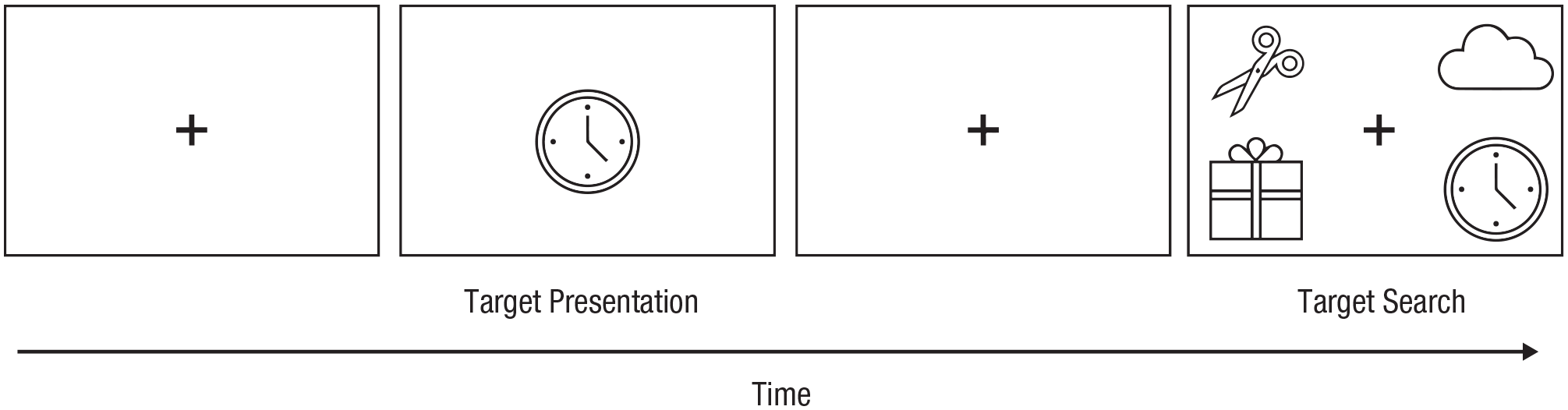
Example of a nonlinguistic visual search trial with English and Spanish phonological overlap. After being presented with the target of the visual search (an image of a clock), the target is identified from a four-item visual display that includes phonological competitors. Both English monolinguals and Spanish-English bilinguals look at English competitors (e.g., a cloud when looking for a clock) more than controls, whereas bilinguals additionally look at Spanish competitors more than controls (e.g., a gift, or regalo, when looking for a clock, or reloj).
The activation and subsequent influence of language during visual search has been observed in children as young as 8 years old (Chabal et al., 2021). In adults, fixations toward competitors persist even when rehearsal of the target label is unnecessary or prevented (Chabal et al., 2022). For instance, people look at phonological competitors not only when the target image needs to be kept in mind prior to initiating the search (e.g., for 750 or 250 ms) but also when the target is presented simultaneously with the search display (thereby removing the need to remember the target label). Likewise, phonological competition emerges not only when people can devote all of their attention to the search task but also when they are required to complete a concurrent nonlinguistic task of remembering a spatial array or a linguistic task of rehearsing a list of numbers, thereby preventing vocal or subvocal rehearsal of the target label. These results suggest that the spread of activation between visual and linguistic representations may be an automatic process that is not contingent on task demands or working memory resources. In other words, after a lifetime of associating an object’s visual form with its linguistic label, seeing that object may implicitly and automatically increase activation of its associated label even without explicit rehearsal or even conscious awareness. Such an effect would be consistent with Shiffrin and Schneider’s (1977) two-process theory of detection, search, and attention, which stipulates that through extensive experience, information processing can shift from effortful, capacity-limited controlled processing to automatic processing, wherein stimuli rapidly and effortlessly trigger associated responses without requiring conscious attention or deliberate rehearsal.
Together, these findings highlight the interactivity of the visual, attentional, and linguistic systems—visual input automatically activates labels in all known languages, which then spread activation to similar-sounding words within and across languages. The subsequent activation of meaning and form guides eye movements, thereby affecting what listeners attend to in their environment. These findings represent a key discovery in our understanding of bilingual cognition, demonstrating that knowledge and activation of multiple languages can change how individuals visually process their surroundings even in nonlinguistic contexts.
Memory
Visual attention plays a significant role in cognitive processes ranging from perception to memory. Thus, it follows that effects of bilingual language coactivation on attention may subsequently impact a host of other functions, and indeed, recent evidence supports this hypothesis. Individuals exhibit above-chance memory for objects that were previously seen during visual search (Lavelle et al., 2021), and memory for incidentally viewed objects varies as a function of similarity to the target of the search (Williams, 2010). Studies incorporating eye tracking indicate that the moderating impact of target similarity likely stems from increased visual attention during the encoding phase. Objects are more likely to be looked at when they phonologically overlap with a target (Allopenna et al., 1998), and increased looks to objects lead to more robust encoding into memory (Lavelle et al., 2021; Williams, 2010).
Both monolinguals and bilinguals exhibit superior memory for items that overlap phonologically with a target (Fernandez-Duque et al., 2023; Marian et al., 2021). When English monolinguals and English-Spanish bilinguals were tasked with looking for a target object in response to a spoken English label (e.g., “candy”) in a display that included a within-language English competitor (e.g., “candle”), a between-language Spanish competitor (e.g., “candado”), or a control item (e.g., “boot”), both English monolinguals and Spanish-English bilinguals were later more likely to remember English competitors whose labels overlapped within language than control items with no overlap. Critically, only Spanish-English bilinguals, particularly those with higher Spanish proficiency, also exhibited superior memory for Spanish competitors that overlapped across languages. Eye-tracking data revealed that memory for competitors was predicted by how long participants looked at the items during the visual search.
These results demonstrate that effects of language experience on eye movements and visual attention can extend to episodic memory, suggesting potential influences on how information is encoded and retrieved. Although further research is needed to explore direct applications, these findings may have implications for understanding memory processes in bilingual individuals, including contexts in which accurate recall is critical, such as learning and everyday decision-making.
Semantic Organization
The coactivation of multiple languages can guide visual attention, which can subsequently impact how and what information is encoded into episodic memory. Over years of accumulated multilingual experience, effects of language coactivation may even extend to how memories and concepts are organized within the bilingual’s semantic network. Connectionist models of monolingual (e.g., TRACE; McClelland & Elman, 1986) and bilingual (e.g., BLINCS; Shook & Marian, 2013) language processing suggest that activation spreads within and across levels of representation. For instance, hearing the word “candy” results in spreading activation to similar-sounding words at the phonological and lexical levels of processing in the two languages (e.g., to “candle” as well as “candado” for English-Spanish bilinguals), as well as to their corresponding concepts at the semantic level of processing (e.g., the concepts of a “candle” and “padlock”/“candado”). Over time, the repeated coactivation of concepts that share phonological features (e.g., of “candy,” “candles,” and “padlocks”/“candado”) may strengthen connections between the concepts themselves. Such an effect would be consistent with principles of Hebbian learning stipulating that neuronal connections are strengthened when neurons repeatedly fire together.
Indeed, converging behavioral (e.g., Van Orden, 1987) and neural (e.g., Wang et al., 2021) evidence suggest that phonological similarity within a single language can influence semantic processing. When making speeded judgments about whether a written word (e.g., “rose”) belongs to a semantic category (e.g., “flowers”), participants are slower and more error-prone when the word is phonologically similar but semantically unrelated to a category member (e.g., “rows”; Van Orden, 1987). Similarly, when “flowers” is paired with a written word like “rows” (which sounds like the semantically related “rose”), it elicits a reduced N400 response (Wang et al., 2021), indicating easier semantic integration. The N400, an EEG component, reflects the effort required to integrate meaning, with smaller N400 amplitudes for semantically related words compared to unrelated ones. A reduced N400 for flowers-rows suggests that words that sound like semantically related words are also processed as more meaningfully connected. It is of note, however, that although hearing a word (e.g., “bin”) typically speeds the recognition of subsequent words that start with the same speech sound (e.g., bin-bat; i.e., “phonological priming”), it can interfere with recognition when the speech sounds are distinct but perceptually similar (e.g., bin-pat, where /b/ is easily confused with /p/ because they have similar acoustic features and are produced in similar ways; Goldinger et al., 1992). This suggests that the impact of phonological similarity on semantic processing depends on the degree of overlap. In many cases, phonological connections enhance semantic associations, providing a potential mechanism through which cross-linguistic phonological coactivation may influence conceptual organization over time.
To the extent that associations at the semantic level can be impacted by similarities at the phonological level, there is reason to expect that the coactivation of multiple languages influences the organization of semantic networks. For example, Hebrew-English bilinguals rate English word pairs to be more semantically related when they share a translation in the unused language (e.g., “dish” and “tool,” which both translate to /kli/ in Hebrew; Degani et al., 2011), consistent with this proposal. Similar effects emerge even when there is only partial overlap, such as when Hebrew translations of English word pairs overlap in sound but not spelling—for example, “skin” (רוֹע) and “light” (רוֹא), which both sound like /or/—or overlap in spelling but not sound—for example, “book (séfer) and “barber” (sapár), which are both written as “רפס” (Norman et al., 2024). Likewise, bilinguals of English and ASL perceive English word pairs to be more semantically related when their translations share similarities in ASL (Morford et al., 2011). In addition to the activation of translations’ phonological forms, bilinguals’ judgments can be influenced by the inadvertent activation of phonologically mediated semantic information. In one study, Arabic-Hebrew bilinguals judged the semantic relatedness of Hebrew word pairs (Degani et al., 2018), some of which included a false cognate—a word that overlaps in form but not meaning across languages (e.g., /sus/, meaning “horse” in Hebrew but “chicken” in Arabic). Critically, whereas the Hebrew word meanings were semantically unrelated (e.g., /sus/-/beytsah/, meaning horse-egg), there was a semantic relationship between the Arabic meanings of false cognates and their corresponding words (e.g., /sus/-/beytsah/, meaning chicken-egg). Despite the fact that the task was conducted entirely in Hebrew and the two languages do not share a script, Arabic-Hebrew bilinguals made more errors and took longer to determine that two Hebrew words were unrelated when there was a semantic relationship to one of the Arabic translations.
In addition to acquiring language-specific semantic associations (e.g., between concepts that phonologically overlap within English such as candy-candle, as well as those that overlap within Spanish such as candado-cangrejo), cross-linguistic coactivation may lead to perceived semantic relations between concepts that phonologically overlap across languages (e.g., between “candy” and “candado”). This raises the intriguing possibility that bilinguals may develop a more densely interconnected lexicosemantic network that may increase the perceived semantic association between concepts more generally. When Spanish-English bilinguals and English monolinguals made relatedness judgments of semantically related (e.g., student-teacher) and unrelated (e.g., cloud-present) picture pairs, bilinguals rated semantically unrelated pictures as more related than monolinguals (Ning et al., 2020). A follow-up study with Korean-English bilinguals and English monolinguals further revealed that bilingual experience modulated the N400 ERP component during semantic judgments. The N400, which is known to index semantic integration, is typically larger for semantically unrelated compared with related stimuli. Compared with monolinguals who showed the typical N400 increase for unrelated (vs. related) pairs, bilinguals exhibited a smaller N400 effect, suggesting that they processed unrelated pairs more similarly to related pairs. Such findings indicate that, in addition to guiding the on-line processing of visual inputs and modifying the contents of episodic memory, the accumulated experience of activating multiple languages may also alter associations between semantic concepts. The reorganization of the semantic network has implications for higher order cognitive abilities such as those underlying creativity because the ability to perceive relationships among seemingly disparate concepts is a hallmark of creative cognition.
Conclusion
We have illustrated that there is substantial interactivity both across languages (e.g., English and Spanish) and across domains of cognitive function (e.g., language, attention, memory, semantic organization). The parallel activation of words across multiple languages influences what bilinguals attend to in their environment. Attention strengthens encoding and subsequently changes what bilinguals remember. Over time, repeatedly coactivating labels and retrieving their corresponding concepts may strengthen connections between the concepts themselves, thereby reorganizing the semantic network (see Fig. 2).
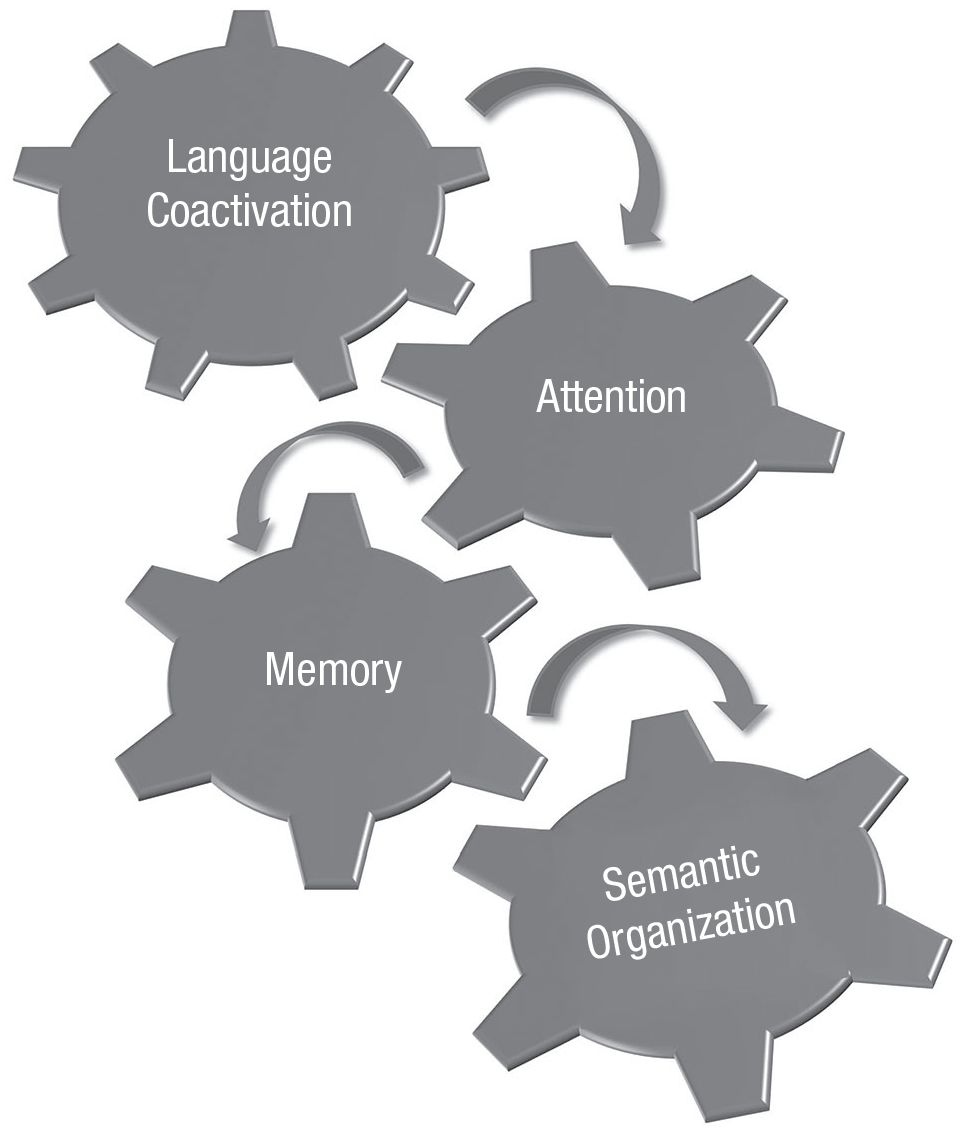
Schematic of cascading effects of language coactivation on nonlinguistic cognitive functions. The coactivation of multiple languages influences the allocation of visual attention, which subsequently strengthens the encoding of attended information into memory. Over time, the repeated coactivation of cross-linguistic words and associated concepts can reorganize the semantic network.
Ongoing research from our lab is testing whether the effects of bilingual experience extend further to other higher order cognitive processes, including creativity (Chung-Fat-Yim et al., 2024) and decision-making (Hayakawa et al., 2021). Beyond these domains, future research could examine how language coactivation influences cognitive processes such as problem-solving and reasoning. The functions discussed here—attention, memory, and semantic organization—are foundational to higher order cognition. Judgment and decision-making are shaped by the salience and accessibility of exemplars (driven by attention and memory), whereas problem-solving and creativity depend on the ability to form connections between seemingly unrelated concepts (facilitated by semantic organization). Thus, effects of language coactivation in one domain (e.g., memory) are likely to spread to others (e.g., decision-making). In this way, the acquisition and subsequent activation of multiple languages have consequences that begin with a word and send ripples that cascade throughout the cognitive system. Tracing the processes and outcomes of language coactivation extends our understanding of cognition beyond the traditional monolingual model into how diverse language experiences shape the capabilities and limits of the human mind.
Recommended Reading
Fernandez-Duque, M., Hayakawa, S., & Marian, V. (2023). (See References). Shows that language coactivation shapes memory.
Hayakawa, S., & Marian, V. (2019). Consequences of multilingualism for neural architecture. Behavioral and Brain Functions, 15, Article 6. Reviews neurophysiological consequences of multilingual experience for cognitive control, speech processing, and language learning.
Marian, V. (2023). (See References). Provides a comprehensive look at how knowing multiple languages shapes cognition.
