







Abstract
Social anhedonia, the inability to experience social pleasure, is a transdiagnostic symptom. Current research on social anhedonia adopts a monolithic approach to evaluate and treat this complex symptom. In this article, we reconceptualize social anhedonia using a triune framework encompassing functional, ecological, and ethological validity. This framework can better guide the future development of assessment tools and interventions. Moreover, it addresses the online-versus-offline, contextualized-versus-decontextualized aspects of social anhedonia in the digital era. We argue that future assessment tools should adopt virtual reality and multimodal data-collection platforms. Personalized, dimension-specific interventions are likely to be more effective. Our timely revisit paves ways for more sophisticated, context-sensitive evaluations and interventions for social anhedonia.
Anhedonia, the diminished ability to experience pleasure, is implicated in a wide range of mental disorders, in particular schizophrenia (SCZ) and major depressive disorder (MDD; Husain & Roiser, 2018). Two different types of anhedonia are observed: social anhedonia (concerning social contact) and nonsocial anhedonia (concerning physical, sensory, or monetary aspects; Gooding & Pflum, 2022). The Revised Chapman Physical Anhedonia Scale (RCPAS) and the Revised Chapman Social Anhedonia Scale (RCSAS) are classic inventories designed to capture social and nonsocial anhedonia, respectively (Chapman & Chapman, 1978; Eckblad et al., 1982). The RCPAS was originally designed to capture a relatively “biological” (which may be more “fundamental”) aspect of anhedonia, whereas the RCSAS was believed to tap into a domain of anhedonia more related to social contact (Chapman et al., 1976). However, subsequent longitudinal evidence suggested that social anhedonia showed promise in predicting the future onset of SCZ (Gooding et al., 2005; Kwapil, 1998). Such differentiation between social and physical anhedonia, which originated in SCZ research, has since been extended to clinical populations with MDD. Growing evidence indicates that people with MDD experience similar levels of social and physical anhedonia, contrary to people with SCZ, who endorse more severe social anhedonia relative to physical anhedonia (Gandhi et al., 2022).
Despite the growing evidence for altered social-reward processing as the neurobiological basis for social anhedonia in SCZ and MDD (He et al., 2019), two important shortcomings in the extant literature are noteworthy: the monolithic approach that fails to capture the complex and multifaceted nature of social anhedonia and the limited number of valid measurements for social anhedonia. In the current article, we advocate for a timely reconceptualization of social anhedonia and review the limitations of the current assessment instruments for this phenomenon. We further propose a three-dimensional, triune framework for social anhedonia that emphasizes functional, ecological, and ethological validity. We believe that our reconceptualization and proposed framework are useful for unveiling the important construct of social anhedonia beyond the traditional self-report checklist or task-based approach. Furthermore, we recommend several lines of future efforts to further elucidate the nature of social anhedonia. Last, we describe several promising assessments and interventions for social anhedonia based on the current evidence available.
Reconceptualization of Social Anhedonia
Social anhedonia traditionally refers to the lack of interpersonal pleasure derived from social interactions (Chapman et al., 1976). However, such a traditional definition may be overinclusive and ambiguous. Most recently, social anhedonia has been defined as a more complex construct characterized by deficits of pleasure derived from social contact, reduced experience of reward from social stimuli, and reduced motivation and disinterest to social engagement (Gooding & Pflum, 2022). Despite having this refined definition, we believe that the digital era might have fundamentally reshaped the landscape of social interaction in humankind (Alsaleh, 2024), which primarily encompasses two forms of online engagement—online human-to-human communication and online human-to-artificial intelligence (AI) interaction (Hall, 2020). The rise of online social engagement may have expanded the boundaries of social interactions to cover virtual social interactions (i.e., human-AI interactions). Interestingly, people can have a pronounced lack of interest in face-to-face social interactions but are enthusiastically engaged in online social platforms. Likewise, people can be disinterested in real-life social gatherings but are willingly engaged in interacting with AI agents. This changing landscape leads to several open questions regarding social anhedonia, as detailed in Figure 1. In the digital era and across different cultures, social anhedonia can manifest in many different forms. In addition to these newly emerging online social interactions, the cultural context is an important factor for understanding the manifestation of social anhedonia (Chentsova-Dutton et al., 2015). For instance, Eastern and Western cultures have different ideals regarding how social encounters would be considered pleasurable or conducive, and the values of social encounters (e.g., social conformity or personal pleasure) are evaluated differently in different cultural contexts (Scherer et al., 1988). Together, these issues highlight the need for a more sophisticated framework to better conceptualize social anhedonia beyond the current monolithic approach.
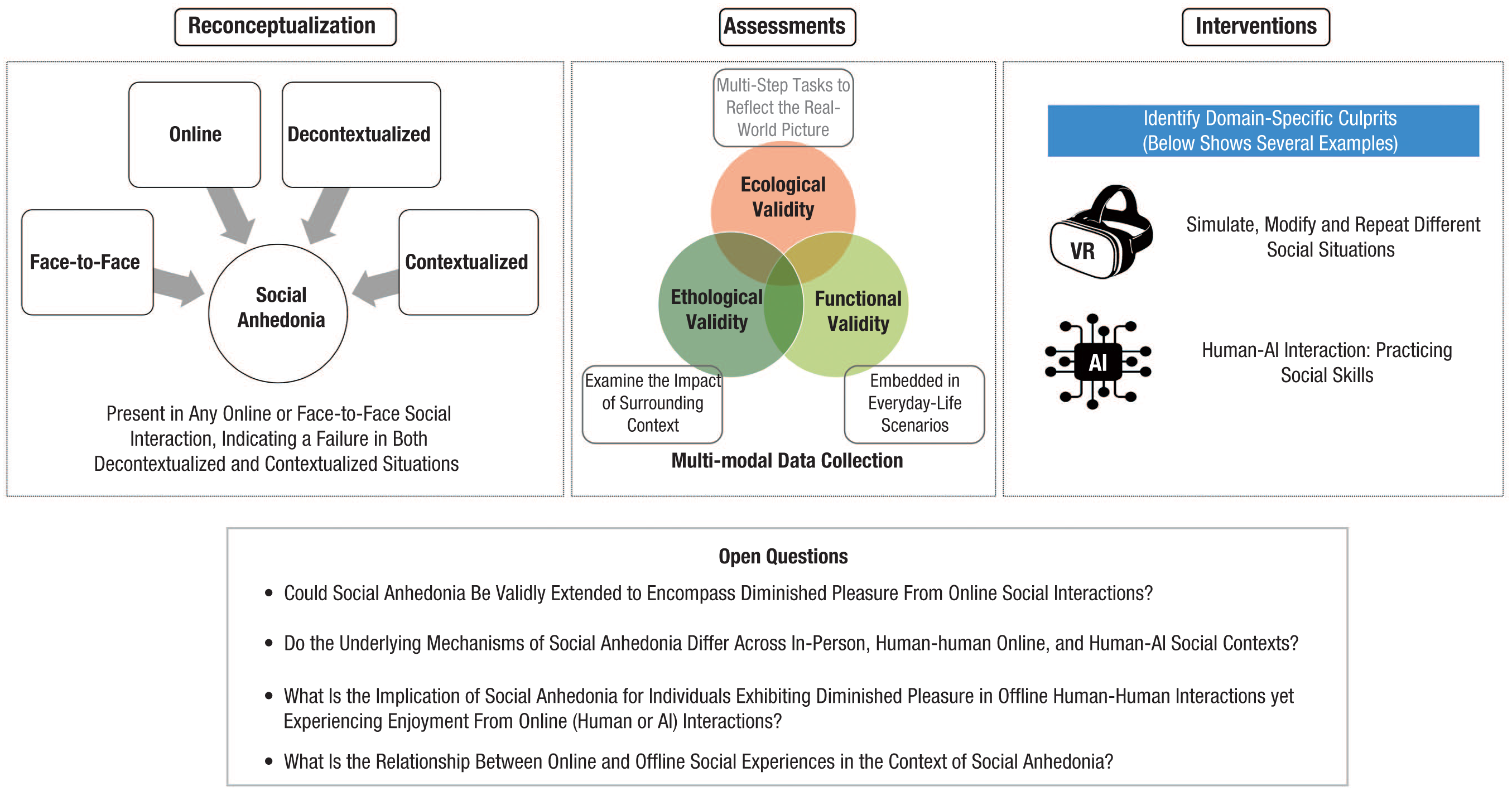
Our proposed framework and open questions to social anhedonia in the digital era. The refined construct (left) includes online (new domain to Meehl’s traditional construct) versus face-to-face interactions and contextualized (new domain to Meehl’s traditional construct) and decontextualized situations. The three dimensions of validity (middle) are evaluated using multimodal data. Virtual reality and artificial intelligence are examples of interventions (right) that can be used to identify domain-specific culprits.
To address these concerns, we propose a triune framework for social anhedonia. In this framework, social anhedonia refers to the avoidance of engagement in online or face-to-face social interaction, affecting both decontextualized (such as reacting to smiles) and contextualized (such as real-life social scenarios) situations (Fig. 1). Our revised construct emphasizes online and offline multimodality and incorporates the contextualized and decontextualized facets of social anhedonia (Tamir & Hughes, 2018). We explain this framework in the following sections.
Sophisticating Future Assessment Tools
One of the key limitations of current assessment instruments lies in the disproportionate focus on offline social scenarios, with minimal coverage of socially pleasurable online experiences. For instance, instruments such as the RCSAS and the Anticipatory and Consummatory Interpersonal Pleasure Scale (R. C. K. Chan et al., 2016; Gooding & Pflum, 2014) predominantly comprise items tapping into in-person (face-to-face) social interactions, whereas items that tap into social pleasure derived from online interpersonal connections (such as social media engagement) remain very scarce. Most of the scarce online-related items included in these instruments are limited to traditional forms of online communication (e.g., phone calls and text messages) and do not fully encompass more contemporary modes of online interaction (e.g., Zoom, video calls). Moreover, many current instruments for measuring social anhedonia mainly adopt the “decontextualizing” approach, which parses complex social interactions into arbitrary, simple “building blocks” (e.g., smiles). Indeed, many assessment tools for social anhedonia (e.g., the social-incentive-delay task) target only the subjects’ responses toward smiles (He et al., 2019). However, social reward is highly contextualized in real-world settings. It is important to consider the nuanced and differential components of social rewards, such as acceptance, cooperation, and admiration (Foulkes et al., 2014).
To address these shortcomings, our triune model has three levels of validity for evaluating or developing future assessments for social anhedonia and its neuropsychological origins (R. Chan et al., 2008). First, functional validity fully acknowledges social-reward process ability in everyday-life scenarios; second, ecological validity emphasizes the need to design complex multistep tasks to reflect the real world beyond the levels of disability; and third, ethological validity implies that an experiment should directly examine how the surrounding context can exert impacts on social-reward processing (R. Chan et al., 2008). This framework should be able to address the important issues of online-versus-offline differentiation and contextuality in social-reward processing, as well as embrace the drastic changes in social encounters in the contemporary digital era.
A few recently developed paradigms appear to have higher functional, ecological, or ethological validity. For instance, the mock job-interview task is a sophisticated effort-based decision-making task that utilizes social scenarios to tap into social anhedonia and apathy symptoms in individuals with SCZ (Shao et al., 2024), covering ecological validity. The social-vigor task is another sophisticated paradigm that has high ethological validity and measures the effort exertion in the context of live social encouragement (Fulford et al., 2018). Both tasks can better delineate the natural functional modules of social-reward processing. Another sophisticated paradigm, the distancing task, utilizes the naturalistic approach to measure quantifiable forms of automatic motor behavior that play a central role in social context, such as personal space (Park et al., 2009). This task represents a notable example of paradigms with high functional validity.
In the future, more naturalistic task-based paradigms should be devised using highly simulated real-world social interactions. For instance, the social-navigation task, a narrative-based game in which participants interact with a variety of virtual characters with the goal of finding a job and a place to live, can be used to measure how one can dynamically update information related to relationship dynamics and the ability to act in accordance with such information (Banker et al., 2025).
Moreover, the next-generation assessment tools should be culturally adaptive. Apart from harmonizing measurements across different countries (Pinkham et al., 2025), research on social anhedonia should also capture the different cultural contexts. For example, although prosocial bodily gestures are universal in humankind, they vary in form and frequency among different cultures. The differences in depressive symptoms between Asians and Westerners (Yoo & Skovholt, 2001) can also result in different manifestations of social anhedonia. Future instruments for social anhedonia should have better ethological validity to the target populations.
That said, these emerging paradigms (e.g., social-vigor task, social-navigation task) still need further validation across diverse cultural contexts and in large samples of clinical as well as nonclinical subjects. It is also necessary to conduct research to parse the lower level components of these paradigms.
Another crucial direction is multimodal data-collection platforms. It is necessary to combine self-report measures with computer-based tasks, VR simulations, and human-AI interaction for comprehensive and accurate assessments of social anhedonia. For instance, questionnaires should be used to assess an individual’s frequency and quality of emotional experiences during virtual and real-time social activities. Moreover, future assessments can clarify how people respond to social cues originating from humans versus AI-generated stimuli by providing the same social feedback using the two different agents (AI vs. human). This can help clarify whether the underlying mechanisms for social response would differ between real human encounters and computer-generated encounters.
Implications and Interventions
To unravel the possible mechanisms involved in different social-interaction contexts, ecologically momentary assessments (EMAs) should be developed. EMAs can measure individuals’ responses during different forms of social interactions, including offline human-human communication, online human-human communication, and human-AI communication. In addition, after addressing the ethical and privacy concerns, passive digital phenotyping should be used to capture data such as geographical location, social media usage patterns, and time spent on interacting with AI.
Moreover, we should design real-time, moment-to-moment experimental paradigms to address social anhedonia. These experimental paradigms can introduce human-AI communication, thus hopefully differentiating contextualized and decontextualized situations. Nijman et al. (2022) reported that VR technology can simulate, modify, and replicate diverse social situations, transcending the limitations of traditional therapeutic and assessment settings. By creating controlled virtual social environments, VR bridges the gap between traditional assessment methods and real-world social interactions, facilitating the identification of altered processes in people with social anhedonia (Freeman, 2008). Moreover, VR also holds promise for addressing social anhedonia. By enabling participants to engage in social interactions with avatars, we can create social rewards, enhance motivation, and foster the experience of positive affect.
Nevertheless, the validity of VR-measured responses remains questionable. It remains unclear whether the responses elicited in VR settings can truly reflect an individual’s behavioral responses in authentic social contexts. The utility of VR in assessing and treating social anhedonia requires rigorous verification in future longitudinal studies. Future research should also directly compare VR-assessed responses with real-world social behavior.
Given that social anhedonia can manifest in one but not another dimension (e.g., online vs. offline, human vs. AI), future interventions should be customized/individualized on the basis of a dimension-specific principle. For instance, people with social anhedonia only affecting offline but not online conditions should receive interventions that attempt to identify the culprits exclusively undermining offline socializing behavior. Using gradual exposures to online social scenarios, people can learn to reframe their beliefs and subsequently find comfort in offline settings. AI-augmented reality can also be used to promote pleasure derived from real-human social interaction.
We envisage several potential problems in applying VR and AI technology to future interventions for social anhedonia. First, real human-to-human interactions bear a higher degree of uncertainty than VR situations. Population-based normative data regarding real human-to-human interactions and perhaps human-AI communication are needed to address such uncertainty. In the long run, more follow-up normative studies should be conducted. Second, low computer literacy in older generations may limit VR technology. Moreover, cost concerns in mental-health care can limit the development and application of such sophisticated intervention strategies. People also have individual differences in interacting with VR and AI technology. For instance, some people are vulnerable to VR-induced motion sickness or sensory overload, rendering immersive therapy intolerable. Moreover, people who are digitally proficient (“tech-savvy”) may be readily engaged in AI-driven simulations, whereas those who are anxious or mistrustful about digital technology may refuse to interact with AI. Whether this aversion of VR/AI reflects a positive sign of preference toward human-human social interaction requires further exploration. The between-individual differences as such call for more personalized assessments and interventions that can be dynamically adjusted to an individual’s unique profile. Last, AI is built on repetitive training and simulation using large and plentiful data sets to detect homogeneous patterns and thus may suffer from the problem of misinterpreting diverse behavioral cues from different cultures.
The transdiagnostic nature of social anhedonia warrants attention. It can be found in SCZ, MDD, and many other psychiatric conditions (e.g., bipolar disorder, autism, and Parkinson’s disease). Different conditions can have different problems in social-reward processing (Husain & Roiser, 2018). For instance, the co-occurring physical anhedonia in people with MDD can complicate the problems of social anhedonia and warrant additional intervention strategies, such as neurostimulation and neurofeedback training.
Conclusion
This article provides a timely revisit of social anhedonia. We have better conceptualized this construct to address the current limitations in this area and further proposed a triune framework to refine and evaluate future sophisticated assessment tools. We strongly advocate applying VR technology and AI augmented reality for devising more personalized assessments and interventions to tackle this complicated, multidimensional deficit across different psychiatric conditions.
Recommended Reading
Catalano, L. T., & Green, M. F. (2023). Social motivation in schizophrenia: What’s effort got to do with it? Schizophrenia Bulletin, 49(5), 1127–1137. https://doi.org/10.1093/schbul/sbad090. Describe how social motivation in schizophrenia can be conceptualized through the lens of effort-based decision-making.
Fulford, D., Campellone, T., & Gard, D. E. (2018). (See References). Describe the importance of experimental paradigms and real-time measurement to capture the interaction between social approach and avoidance in characterizing social motivation in schizophrenia.
Pizzagalli, D. A. (Ed.). (2022). Anhedonia: Preclinical, translational, and clinical integration. Springer. Provide a comprehensive evaluation, synthesis and integration of theories and empirical findings focusing on anhedonia.
Ritsner, M. S. (Ed.). (2014). Anhedonia: A comprehensive handbook: Volume I: Conceptual issues and neurobiological advances. Springer. Provide an overview of conceptual issues and neurobiological correlates of anhedonia.
Ritsner, M. S. (Ed.). (2014). Anhedonia: A comprehensive handbook: Volume II: Neuropsychiatric and physical disorders. Springer. Provide an overview of the anhedonia construct in neuropsychiatric and physical disorders.
