






Abstract
The 11 articles in this special issue of Current Directions in Psychological Science examine the converging and diverging paths of human and artificial intelligence (AI) to illuminate the foundations of intelligent behavior. By comparing the mechanisms and limitations of human and machine cognition, these articles reveal how each field can inform the other. Discussed applications of AI to psychology include building computational models of mental processes, automating analyses of rich behavior, automating the generation of materials and procedures for studies in psychology, and providing personal assistants and coaching. Applications of psychology to AI include generating ideas for future AI algorithms by considering how humans reason and applying analysis techniques from psychology to understand AI. Together, the articles advance a broad conception of intelligence that spans humans, machines, and their increasingly intertwined collaborations.
As recently as 10 years ago, humans held an unequivocal advantage over all other intelligent systems in their capacities for pattern recognition and high-level general reasoning. Astonishing recent advances in artificial intelligence (AI) have significantly reduced or eliminated this superiority in both cognitive capacities. In pattern recognition, AI innovations have led to highly efficient and accurate systems for image classification, speech recognition, disease diagnosis, and anomaly detection. In reasoning, systems now exist to play grandmaster-level games of chess, Go, and video strategy games like League of Legends. They can solve problems in mathematics that are challenging even for people with PhDs in mathematics (Sun et al., 2025) and visual analogical reasoning problems that were explicitly designed to require flexible generalization of visual input-output relations from only a few examples (Chollet, 2019; Lee et al., 2025). Despite these undeniable successes, AI also shows failures that are bewildering to people who assume that world-class performance in university-level mathematics olympiads, chess, or medical-image diagnosis will necessarily entail competency in tasks that are far simpler for humans, such as children’s mathematics olympiads (Cherian et al., 2024), connecting overheard stories to personal experiences, or folding laundry.
Developments in AI have increasingly drawn the attention of psychological scientists, who are now actively studying AI systems not only as tools but also as objects of empirical investigation. Over the past several years, research at the intersection of psychology and AI has expanded rapidly, spanning domains such as perception, reasoning, language, decision-making, creativity, and human-AI interaction. In addition to the practical applications of AI advances, AI challenges psychological scientists to refine our understanding of what understanding itself means. If a linguist were interested in what all languages have in common, then they would be well advised to study languages with dissimilar historical and geographical origins (e.g., Swahili, Mandarin, and Finnish) rather than languages with a common root (e.g., Italian, French, and Spanish). By the same token, if psychologists are interested in the fundamental nature of intelligence, it makes good sense to study intelligence across its disparate instantiations. Modern AI offers theoretically useful examples of systems capable of successful pattern recognition, problem-solving, and generalization that have radically different origins from humans. By analyzing the commonalities and differences between how people and AI achieve their impressive behaviors, we can better appreciate the general requirements for any system to be intelligent. Together with research on animal cognition and collective intelligence, AI offers an avenue for generalizing the notion of intelligence beyond the single, albeit anthropocentrically salient, case of humans.
The purpose of this special issue of Current Directions in Psychological Science is to compare and contrast human and artificial intelligence with the goal of better understanding intelligence broadly construed. In this context, “human and artificial intelligence” refers broadly to the cognitive capacities of people, the capabilities of contemporary machine learning systems, and emerging hybrid human-machine systems. Figure 1 provides one such juxtaposition, with a human and an AI system both tasked with creating an illustration of their competition. As shown in Table 1, the motivations for juxtaposing human and artificial intelligence can be categorized into three broad themes: ways that psychology benefits from developments in AI; ways that AI benefits from developments in psychology; and advances toward a more general understanding of intelligent systems, including those that combine human and machine components. Reflecting the breadth of this agenda, the contributions to this special issue adopt a diverse set of approaches, including building computational models of human thinking, designing AI tools to understand human behavior, developing paradigms for effectively combining human and AI capabilities, and conducting conceptual analyses of the nature of intelligence. Together, these perspectives illustrate how insights can emerge from studying intelligence across different systems, methods, and disciplinary traditions.
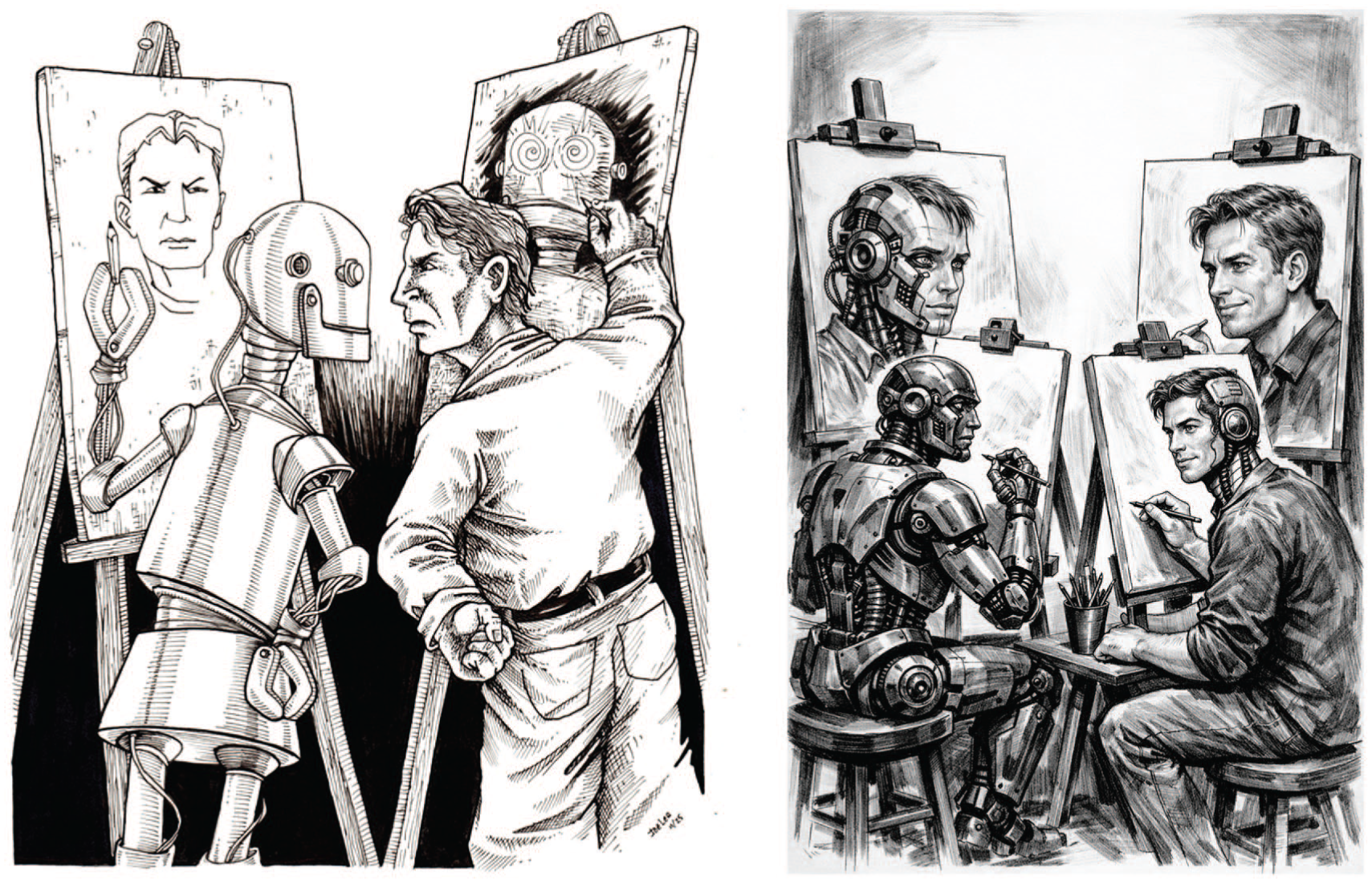
Juxtaposition of a generative illustration creation by a human and machine. A human (Joe Lee; left) and ChatGPT-5.3 (right) were given the same prompt: “Make a black and white illustration appropriate for a magazine of a robot and a human competing in a contest to see who can make a better drawing of each other. So, the robot and human are both looking at each other while also drawing what they see on their own canvas. The robot’s drawing of the human should resemble the human and vice versa, but the robot’s drawing of the human should be distorted in that it looks more robotic than the human actually is. Likewise, the human’s drawing of the robot should be distorted in that it looks more human than the robot actually is. The intention is to show that robots and humans construe each other in ways that are warped by their own perspectives, assumptions, and tendencies.” Relative to humans, AI systems still struggle to produce conceptually coherent creative outputs, as indicated by the human (not the just robot’s drawing of the human) having cyborg components, the overabundance of canvases, and the human apparently drawing a picture of himself rather than the robot.
Reasons for Juxtaposing Human and Artificial Intelligence
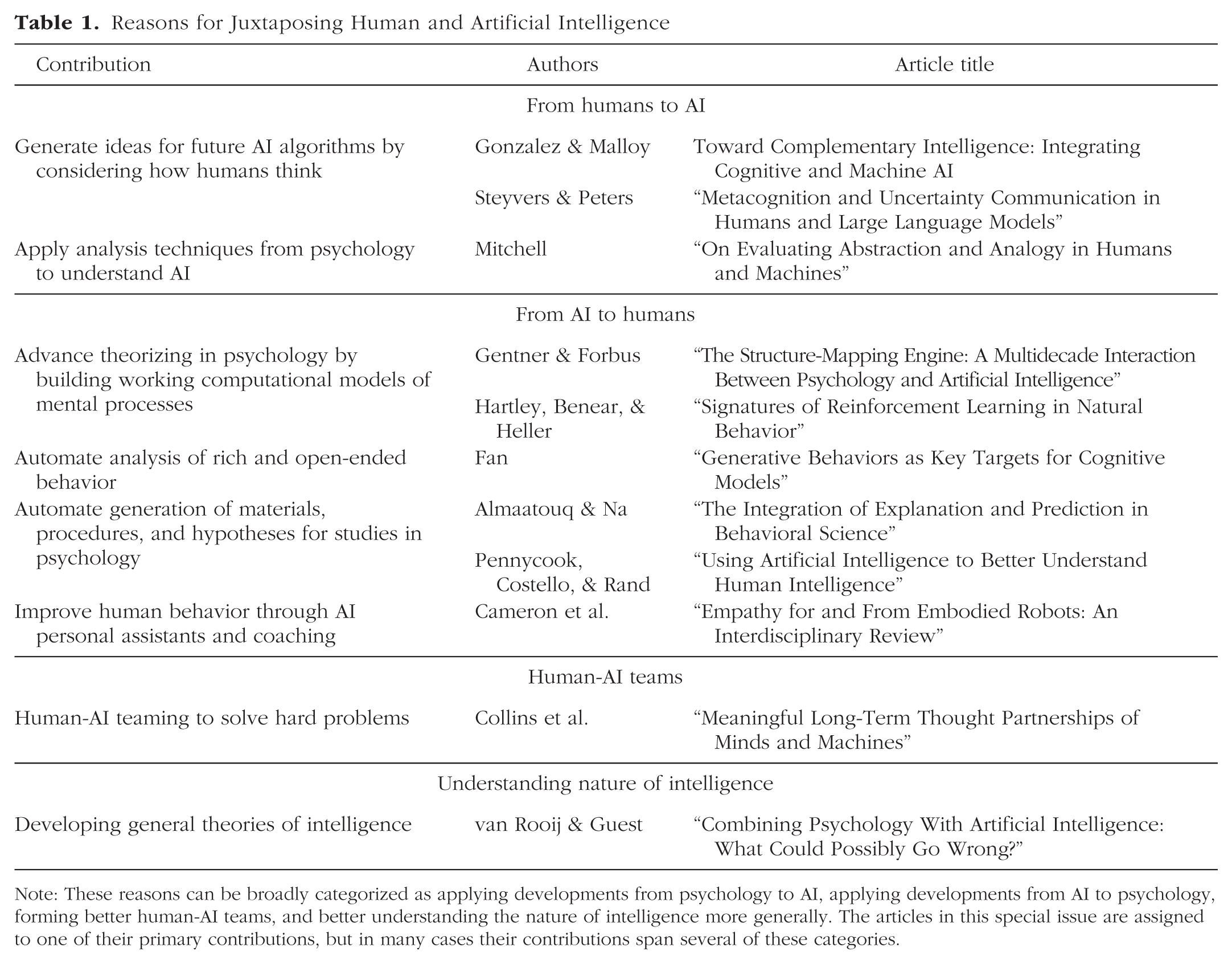
Note: These reasons can be broadly categorized as applying developments from psychology to AI, applying developments from AI to psychology, forming better human-AI teams, and better understanding the nature of intelligence more generally. The articles in this special issue are assigned to one of their primary contributions, but in many cases their contributions span several of these categories.
What Artificial Intelligence Can Offer Human Psychology
Like many powerful tools, recent and future developments in AI have the potential for both serious misuse and profound benefit. Some of their possible disastrous consequences for humans include the atrophy of humans’ cognitive skills if tasks are habitually offloaded onto AIs (Zhai et al., 2024), strain on scarce environmental resources, homogenization of ideas and systematic eradication of individual and cultural differences (Abdurahman et al., 2024), replacement of humans in the workforce, diminishment of people’s sense of purpose, and dehumanization or reduction of humans’ minds (van Rooij & Guest, 2026). Without minimizing these weighty problems, developments in AI also offer psychologists remarkable tools for measuring, modeling, and supporting the human mind. Although many of the risks posed by AI call for societal- and policy-level responses, the majority of the contributions to this special issue have been drawn to examine its positive contributions to human thought and behavior.
Advancing theorizing in psychology by building working computational models of mental processes
AI can advance theories in human psychology by establishing working models of reasoning tasks that may function similarly to human cognition. An AI performing a difficult task well does not, by itself, indicate that it is using mechanisms similar to humans (van Rooij & Guest, 2026). Deep Blue beat the grandmaster Garry Kasparov at chess in 1996 by considering far more moves and having a much larger memory of chess openings. The most successful deep learning systems are trained with more data than a person would get in hundreds of lifetimes. However, if an AI system performs similarly to people across many training scenarios, conditions, and tasks, even showing the same kinds of errors that people show, then it is worth considering that system as a model for how people may be accomplishing the task. The advantages of AI systems as psychological theories are (a) they are concrete, working models that produce outputs that can be quantitatively compared to those produced by people; (b) they force psychologists to be precise and rigorous about the psychological mechanisms and learning environments they are postulating (Almaatouq & Na, 2026); and (c) they ensure that the components and assumptions of a theory behave in the desired manner when they are integrated. Theories in psychology will become increasingly complex as researchers strive to predict people’s real-world behavior in a messy world. AI models provide an approach for managing and harnessing that complexity. To serve as useful psychological theories, AI models must therefore be evaluated not only on their behavioral performance but also whether their underlying mechanisms plausibly correspond to those used by humans.
Gentner and Forbus (2026) present a computational model of human analogical reasoning, a cognitive skill requiring creativity and flexible cognition, and describe its ability to reproduce several empirical results. Although their computational model was explicitly designed to make analogies, Mitchell (2026) assesses the ability of a large language model (LLM) to solve analogies even though it was only trained (on billions of words) to predict what token would occur next. She finds that the LLM is strongly dependent on the familiarity of the elements that make up a problem, and much more so than are humans. One lesson from this work is that even though an AI can solve a task that would be difficult for a human, we should not be surprised if it cannot solve other tasks that a human would find simple. Like Mitchell, Almaatouq and Na (2026) stress the importance of testing AI models with materials on which they were not originally trained, noting that AI models often tend to overfit the training data if they are not explicitly trained in a manner that rewards transfer to novel, previously unencountered situations. At a broader level, Hartley et al. (2026) make a compelling argument that many of the theoretical concepts and algorithms used in the machine learning field of reinforcement learning, including notions of state, action, and reward, are useful not only for understanding people’s behavior in the psychology laboratory but also for explaining and changing their real-world behaviors such as drinking more water, exercising, or washing hands for cleanliness.
Automating analysis of rich and open-ended behavior
AI has recently had a transformative effect on analyzing animal, including human, behavior by automating its classification. Systems such as DeepLabCut (Mathis et al., 2018) can recognize poses and movements with minimal training data as accurately as humans. LLMs can be used to automatically code the mood, emotion, and state of mind of users of social media, with applications in psychology such as monitoring for depressive or suicidal ideation, detecting when students fail to understand, and identifying when social interactions are being degraded by bullying, unnecessary antagonism, or misinformation (Rodríguez-Ibánez et al., 2023). Deep learning methods can analyze the rich and nuanced behaviors of people such as the drawings they make and quantitatively assess their quality, level of detail, similarity to other drawings, and systematic deviations from real-world objects (Bainbridge et al., 2025; Fan, 2026). If care is taken to validate these automatized analyses (Goldstone, 2022), these AI systems can allow psychologists to massively scale up the scope of their research while scaling down costs.
Fan (2026) provides an exciting example of these possibilities by using AI to assess experiment participants’ creative, open-ended responses. While focusing on assessing drawings, she argues that similar methods could be used to assess stories, essays, musical compositions, or textually expressed positions. Pursuing the last of these, Pennycook et al. (2026) describe the use of LLMs to assess the degree to which people’s open-ended expressed opinions are affected by evidence.
Automating generation of materials, procedures, and hypotheses for studies in psychology
AI can be used not only to assess the behavior of experiment participants but also to create the materials used in the experiments. These advances open the door to experiments that are increasingly personalized, adaptive, and optimized. Beyond generating experimental materials and procedures, AI systems may also assist researchers at an even earlier stage of the scientific process by identifying patterns in large data sets and proposing novel hypotheses that might otherwise escape human notice (Ludwig & Mullainathan, 2024). Almaatouq and Na (2026) describe using AI to adaptively create experimental conditions that are particularly diagnostic with respect to leading theories. Cameron et al. (2026) argue that our understanding of human empathy is enhanced by having people interact with robots because the attributes of the robots that elicit empathy can be systematically manipulated. Pennycook et al. (2026) develop LLMs that play the role of interactive interviewers, providing evidence-based and relevant rejoinders to participants’ idiosyncratic conspiracy theories. The generative AIs that Fan (2026) discusses can be used to create drawings for human participants to categorize, judge, and modify. Taken together, these developments signal a shift toward a new generation of experiments that are richly interactive, dialogue-based, and highly responsive to human variation. Realizing these benefits will require careful oversight to ensure that AI-generated materials and procedures do not introduce unintended biases, undesired regularities, or experimenter confounds that could compromise interpretability or replicability.
Improving human behavior through AI personal assistants and coaching
AI-powered personal assistants and coaching systems can help individuals monitor, reflect on, and improve their own behavior. By providing personalized feedback, goal setting, and adaptive support, these systems extend psychological principles of self-regulation and behavior change into daily life. Psychotherapy is increasingly intersecting with AI, shifting from purely human-to-human dialogue toward a continuum of human-machine collaboration that includes automation in evaluation, documentation, training, and even intervention delivery (Imel et al., 2026). Cameron et al. (2026) describe how having people practice empathy with robots might increase empathy among humans. Other applications include increasing healthy eating and exercise behaviors (Hartley et al., 2026), correcting wrong beliefs (Pennycook et al., 2026), and providing in-the-moment advice and motivation during training. Balancing the promise of these applications, it is crucial that such technologies augment rather than replace human-to-human connection, which remains central to psychological growth and well-being.
What Psychology Can Offer AI
The traffic between psychology and AI is two-way. Psychology has much to offer AI in terms of both the development and assessment of AI systems.
Generating ideas for future AI algorithms by considering how humans think
As one example, leaders of the deep learning revolution in computer science have credited research from psychology and neuroscience with inspiring their work on distributed representations, error-driven learning, and layers of attention (Bengio et al., 2021). Even if a machine learning researcher were interested only in developing high-performing systems, it would still behoove them to better understand how humans can reason so flexibly and adaptively. The millions of years that evolution has spent honing our brains can be leveraged by AI researchers as they develop new algorithms that improve on the state-of-the-art systems currently available. The facility with which people use and understand nuanced and complex language, form analogies, create new representations to help them solve problems, generalize their previous training to fit novel situations, use models to explain and understand their world, and create partnerships with each other far exceeds what machines can do. It is unlikely that simply providing existing AIs with more computational layers and more data will bridge that gap (Mitchell & Krakauer, 2023). Incorporating mechanisms gleaned from observing people perform tasks like these is a promising approach to building the next generation of AI (Gigerenzer, 2024). For example, because the most important training procedure for modern LLMs involves predicting next items from previous items, their performance deteriorates far more sharply than people as situations get progressively lower in probability (McCoy et al., 2024; Mitchell, 2026).
The articles in this special issue present several examples of mining for new computational algorithms by close observation of people. Collins et al. (2026) advocate studying human-human thought partners to better understand how humans and AI systems can effectively interact. Gonzalez and Malloy (2026) similarly advocate applying human social learning strategies to improve human-AI interactions and argue that effective AIs will also need to learn using and from people’s world models. Mitchell (2026) and van Rooij and Guest (2026) point out limitations of current AI algorithms relative to people in terms of their creation and use of coherent models and overreliance of training on token prediction tasks. Steyvers and Peters (2026) draw on humans’ well-developed metacognitive skills to assess how AI metacognitive capacities should be improved. These comparisons all point out ways in which psychologists are looking critically beyond the current crop of AIs to inform how future systems should be designed.
Applying analysis techniques from psychology to understand AI
A second application of psychology to AI is to use the methods that it has refined over a century to analyze how AI systems are working and how they can be improved. Even though computers do only what they are programmed to do, one of the things that they can be programmed to do is learn autonomously from their inputs. Given the complexity of their architectures and training data, the reasons for their learned behaviors are often opaque even to their programmers. Fortunately, psychologists have developed sophisticated psychometric assessment techniques that consider errors, response latencies, and how behavior varies as a function of minimally different conditions. Neuroscientists have developed methods for inferring causal mechanisms underlying behavior by lesioning or temporarily impairing brain structures and chemically interfering with or enhancing specific neural processes. Computationally minded psychologists have developed methods for inferring internal representations and cognitive architecture from behavioral data. All three sets of techniques have been put to effective use in better understanding AI systems (Pellert et al., 2024). In this issue, Mitchell (2026) presents methods for examining generalization behavior in AI systems that are informed by psychological tests for transfer of learning from familiar to unfamiliar scenarios. Steyvers and Peters (2026) apply to AI systems the same kinds of techniques that psychologists have used to assess people’s ability to monitor their own knowledge and performance. In short, psychology provides AI research with tools to open its opaque black boxes in much the same way it has long studied the human mind.
Toward a General Understanding of Intelligent Systems
Going beyond the reciprocal benefits that AI and psychology offer to each other, a final reason to bring together human and machine intelligence is that challenging tasks can be better accomplished when humans and AIs are working together. As AI get increasingly proficient at a wide array of tasks, they will become indispensable partners for us. AI systems are already being used to improve expert human medical categorization decisions (Reverberi et al., 2022). To make the most effective human-AI teams, it is important to understand and factor in the strengths and weaknesses of each (Steyvers et al., 2022). A robust result from human teams is that diversity in perspectives, roles, gender, and race promote team performance in real-world situations (Gomez & Bernet, 2019), consistent with theoretical results showing that agents with diverse problem-solving strategies outperform more homogeneous agents (Hong & Page, 2004). Given these empirical and theoretical claims, human-AI teams might be expected to perform well. After all, the ways that AIs perform tasks are less like any human’s methods than any other human. Although the human-AI complementarity of solution methods is potentially advantageous, it comes with the risk that humans will not be able to communicate effectively with AIs, and perhaps not even understand or trust them. Accordingly, an important question for future research is how to create AIs that collaborate well with us, align with our needs, and earn our trust. This is the primary agenda that Collins et al. (2026) tackle, emphasizing the need for AI systems to coordinate and share knowledge with humans if they are ever to be suitable long-term “thought partners” for us. Cameron et al. (2026) describe another key ingredient—mutual empathy. Steyvers and Peters (2026) describe the need for humans and AI to be able to express to each other their own knowledge and uncertainty, requiring them to know themselves. Almaatouq and Na (2026) and Gentner and Forbus (2026) discuss the collaborative benefits of AI systems that can explain their own reasoning to humans. The challenge ahead is not simply to make AIs more capable but to make them better partners to human reasoning, creativity, and problem-solving.
Taken together, the reasons for comparing human and artificial intelligence include benefits for the development of psychology, for AI, and for a society increasingly characterized by human-machine collaborations. Even more broadly, the comparison can help us refine our understanding of the very notion of intelligence—what it means, how it should be assessed, and how it can be best cultivated.
