







Abstract

The kind of text I am concerned with here could have been called hereword (a1100), price (1225), say-well (1362), laud (1384), lof-word (1390), commendation (1393) or precony (1430) in the Middle English period, and laudation (1500), prick and praise (1534), applause (1600), extolment (1604) or eulogy (1725) before, in and after Shakespeare’s time. Today, one’s admiration for an excellent piece of work would probably be expressed – more colloquially – by such adjective combinations as Tiffany-Style design, mega quality, or kicking excitement. As representatives of the semantic concept of praise these words have been retrieved by simply browsing the Historical Thesaurus of the Oxford English Dictionary (HTOED) and are also apt ways of characterizing the outstanding quality of this monumental work, which was awarded the prestigious National Library of Scotland/Saltire Society Research Book of the Year Award.
In what follows it will become clear that I am another ardent fan of this excellent piece of dedicated philological and linguistic scholarship. The HTOED might well be one of the last great reference works available in printed format, which is indispensable for an informed (linguistic) investigation of any (English) language product – historical or contemporary. But I am getting ahead of myself. Let me first outline some facts about the HTOED before I describe its potential for and points of intersection with stylistic research.
The project started in 1965 when Michael Samuels presented to the Philological Society his plans for a historical thesaurus. Under the guidance of extraordinary scholars such as Michael Samuels, Christian Kay, Jane Roberts and Irené Wotherspoon, plus a large, well-led, international thesaurus team of lexicographers, computer staff and data-entry personnel, the HTOED had been compiled at the English Language Department of the University of Glasgow over a period of 45 years before it was published by Oxford University Press in 2009.
The production phase is in part reminiscent of the birth of the Oxford English Dictionary (OED). The HTOED team members also ‘started to transcribe information from the volumes of the first edition of the OED, using paper slips to record a word sense, its part of speech, its date of recorded use and any information contained in OED labels’ (Kay et al., 2009b: xiv). Whether the HTOED contains ‘almost every word in English’ (Kay et al., 2009a: ix) is slightly debatable given the compilation process of the OED, as well as the frequently noted problems with the OED and its biases toward particular source texts, such as Shakespeare (Brewer, 2007; Mugglestone, 2005). But the idea of producing a historical thesaurus of the OED and overcoming the challenge of devising a universal taxonomy was and still is revolutionary, especially because the team managed to arrange the English found in the second edition of the OED into a network of semantic categories and to incorporate the diachronic development of words and concepts. In fact, the HTOED is the first historical thesaurus, and it is in its historical orientation that it goes by far beyond Roget’s (2004 [1852], ed. Davidson) Thesaurus of English Words and Phrases – one of the first English thesauri – and a number of individual works on selected words or groups of words, or thesauri of the language of particular authors (e.g. Spevack’s, 1993 work A Shakespeare Thesaurus) that have been published more recently. With the OED we can trace the meaning of a word. With the HTOED we can now see how a meaning came about and which meanings were among the first to express a particular concept. This is extremely useful because the lexical history of a concept is usually suppressed by the alphabetical structure of a dictionary and one needs a certain amount of expertise to extract this kind of information from dictionaries. As such, the taxonomic classification of the HTOED, or, as Kay et al. (2009b: xiii) call it, the classification of ‘ideas’ and a ‘map’ of the development of words, makes one feel as if ‘one is in a hot-air balloon taking aerial photographs: one instantly spies topographical features and interrelationships that were not previously perceptible’ (Poole, 2009).
The team’s incredible knowledge of the history of English can be seen in the ways the categorization consists of a recursive interplay between partly deductive postulations (initially also based on Roget’s categories) and their reworkings with the input richness of the OED material. Laudably, the thesaurus team also consulted online corpora to evaluate whether a word was still in use. For Old English, additional dictionaries, such as the Toronto Dictionary of Old English, were consulted. There is also an offspring from the categorization of Old English vocabulary which resulted in A Thesaurus of Old English, published in 1995 (Roberts and Kay, 2000 [1995]). Outlining the points of intersection between lexicographical history and word history, Diller (2011) examines the differences between the computerized database of the HTOED (held at the University of Glasgow and partly available online) and the printed volumes. He stresses that these different versions of the HTOED and the third version now linked to the OED complement one another (Diller, 2011: 274). However, he also draws the reader’s attention to editorial changes in the three editions, which testifies that classification is an ongoing process. For example, he critically discusses the fact that the semantic sub-field ‘contempt’ is moved from ‘emotion’ to ‘mental capacity’.
The HTOED consists of 2 volumes. Volume 1 is the thesaurus itself and volume 2 is an index of most of the entries in volume 1. For reasons of space, volume 2 does not contain words that only appear in Old English and phrases of more than four words. These index listings for individual words serve as cross-references between categories and suggest how meanings are linked semantically. Both the book and online access via the OED platform allow for the searching of words and semantic headings, although Old English lemmata are not all part of the online version. The online version gives direct access to the OED and enables the user to see, for example, the polysemy of words, browsing the book is much easier.
There are three major categories forming the semantic core of the HTOED: (I) the external world, (II) the mental world, (III) the social world. The team opted for this broad categorization because, unlike Roget, they wanted to base their classifications on the most readily observable phenomena, such as the sea, the land, the sky, followed by living beings, their characteristics and physical needs. Systems to quantify and measure the world are also included. Category I, ‘the external world’, contains, for example, the broad subcategories ‘the earth’, ‘life’, ‘physical senses’, ‘matter’, ‘existence in time and space’, ‘relative properties’ and ‘the supernatural’. Category II, the smallest of the three categories, contains the broad sub-headings ‘mental capacity’, ‘emotion’, ‘philosophy’, ‘aesthetics’, ‘will/faculty of will’, ‘refusal’, ‘having/possession’ and ‘language’. Section III, which contains vocabulary of people and information about how people organize into social groups, reflects huge changes in social organizations and develops systems like law and morality. This section also lists the referents of the categories ‘leisure’ or ‘entertainment’, which have grown in the modern period. Category I has by far the largest number of meanings. There also seems to be a logical progression because much of the lexis in the second category derives metaphorically from Category I. In contrast, Category III has by far the largest number of sub-categories because of the drastic societal changes in the course of time.
For each section the team developed an individual structure, always guaranteeing a focus on the data. According to Kay et al. (2009b: xviii), ‘[w]ithin this framework, there is provision for seven main category levels and five subcategories, in a taxonomy which begins with the most general ways of expressing a concept and moves hierarchically downwards to the most specific’. In terms of categories and subcategories, the extremely refined classification system is somewhat overwhelming and it can be a challenge not to lose track while searching, not least because the HTOED currently contains 798,000 words organized into 236,400 categories and subcategories. For example, the lemma style alone is assigned to 58 thesaurus classes. But each category has a modern English heading and each entry begins with a fixed numerical code that assigns each entry its place in the semantic and conceptual classification. The semantic category ‘Of/belonging to conversation’, for example, receives the following category designation: ‘02.08.03.07’, indicating that is part of the major category ‘the mind’ (‘02’), and also refers to the subcategory ‘language’ (‘08’). Because of the index already mentioned, one does not need to memorize the taxonomy and the system as such is coherent in itself, despite the subjectivity that had to – at least partially – guide the categorizations. The excellent introduction (including a bibliography) to the HTOED given in volume 1 and the guide provided in a poster format also explain in detail and with many examples the structure of the taxonomies. Furthermore, the taxonomies allow for initial broader searches – for example, for parts of the body – which can then become more precise if a user decides to fully explore the effectiveness of browsing the different categories and their finely tuned nuances.
Kay et al. (2009b: xviii) explain that using the semantic concept of hyponymy turned out to be more fruitful for categorization than that of antonymy. Meanings are grouped according to a loose principle of synonymy, which is very convincing. The categorization of lemmas is bottom-up because the team wanted to adhere to understandable ‘folk taxonomies’ (Kay et al., 2009b: xix). The empirically data-driven categorization is also guided by prototype theory and cognitive semantics. Furthermore, aspects of grammar and transitivity have an impact on sense allocation. With intersecting semantic fields, such as religion, magic and witchcraft, the team appropriately opted for two thesaurus entries (Kay et al., 2009b: xix). Also, the separation of senses is often specified even if the OED suggests otherwise. When the OED has a word that generates a large number of senses or phrases, the thesaurus team omitted the transparent ones; obvious derivations and those that are limitless (e.g. those beginning with the morpheme dis-) are also not covered. OED features of style are included. In other words, what the thesaurus categorizes is how language reflects a topic, not the field itself.
It is fascinating how the reader is guided through semantic changes. A word appears in category (a) then in category (b) but at a later time, which gives evidence of semantic change through a polysemous chain of meaning. The screenshot in Figure 1 from the online version of the HTOED illustrates some of the aspects of the semantic development of the noun humour, which refers to the bodily fluids and medieval humoral theory (1340) and then to the mind and mental capacity (1475).
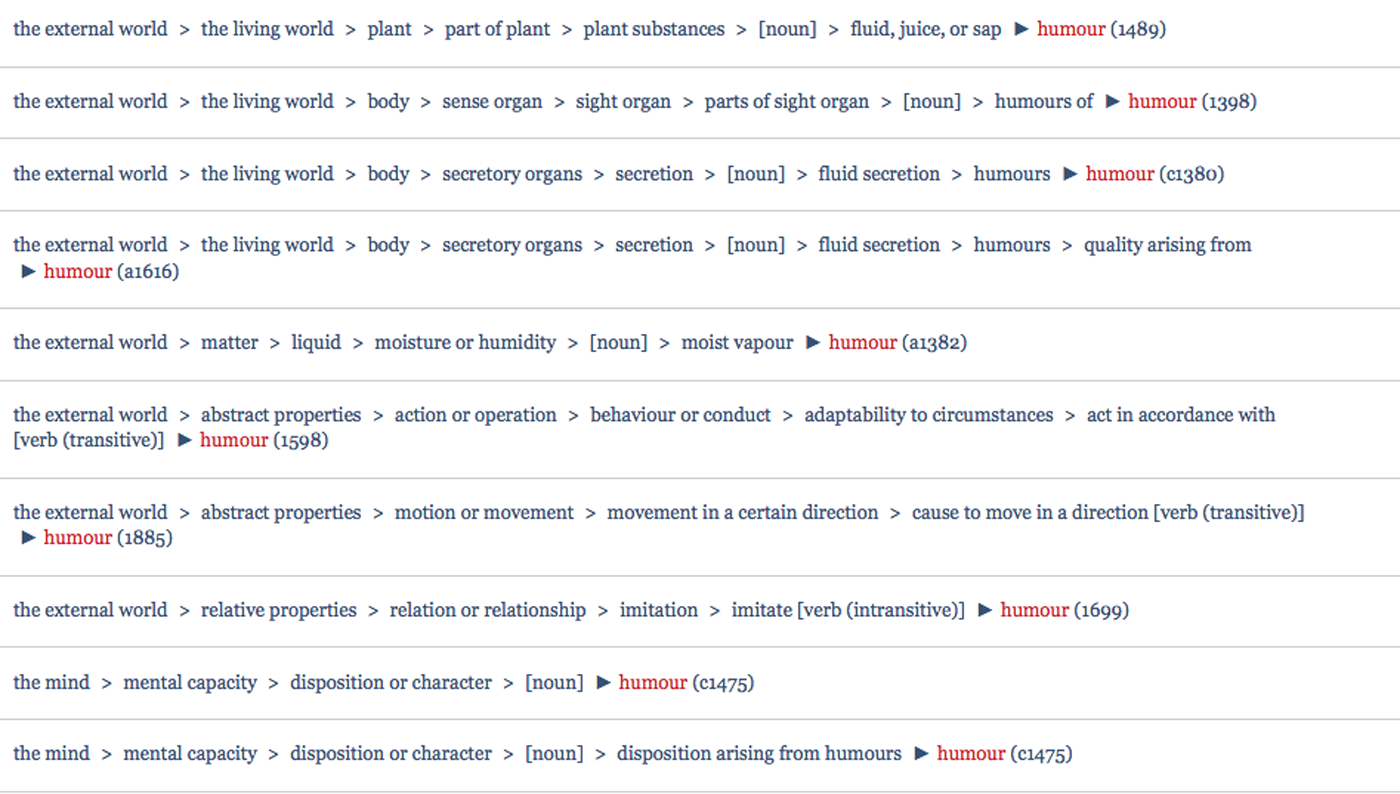
Screenshot from the HTOED online version illustrating selected semantic classifications of humour in OED Online. December 2011. Oxford University Press. 6 January 2012 <http://www.oed.com/browsethesaurus?thesaurusTerm=humour&searchType=words&type=thesaurussearch>
Words that share a high proportion of their meanings are organized according to parts of speech and presented in chronological lists, beginning with noun, adjective, adverb and verb followed by phrase, interjection, conjunction and preposition. The chronologically ordered lists serve the purpose of giving a history, with the dates of occurrence used to express the concept or object stated in the lists’ headings. These lists include losses, additions and straightforward replacements. The HTOED also acts as a thesaurus for any period in the past, so that ‘anyone wanting to know the range of words available to Shakespeare for a particular meaning can consult the appropriate timespan in the relevant sections’ (Kay et al., 2009b: xiv). Search procedures provide conceptual maps of a period, changes of meanings and their redistributions of functions, especially sideway shifts of meanings which involve replacement by more than one word.
It goes without saying that the use of the HTOED can be profitable to users of all kinds, not only linguists. For example, its usefulness to historical novelists or film-makers has been highlighted in a number of newspaper reviews (see Poole, 2009) because the HTOED provides a plethora of words and semantic fields that allow for the creative and historically situated discovery of, for example, 19th-century language usage. But browsing the HTOED reveals other interesting details. Courteous address epithets in the history of English, for instance, comprise the following terms lief (897), sweet (1225), fair (1375), or gentle (1542). Poole (2009) stresses that the HTOED also has encyclopaedic value by listing – among others – names of types of musical pieces through the centuries. The HTOED can also be used as a tool to revitalize one’s writing and to be more eloquent by avoiding the repetition of terms. Lovers of crosswords can exploit that same potential.
The HTOED is also a godsend for scholars from different research areas with (historical) linguistics, anthropology, historians, medical history, history of science, arts, or political science, and, of course, stylistics among them. Recent linguistic studies that draw on the HTOED have broadened the classic historical semantic and lexicographical agenda and focus on such topics as the investigation of metaphors in a historical dimension (Allan, 2008) or the diachronic investigation of particular semantic fields like religious vocabulary or the language of emotions (Diller, 2007, 2011). In other words, the diachronic investigation of phenomena of semantic change is no longer restricted to particular words but extended to whole semantic fields.
Let me exploit reviewer’s privilege to divert into a fuller discussion of how the HTOED may also be positioned within the field of stylistics. The HTOED realizes and reflects several of the major stylistics tenets. It is systematic and detailed. With its focus on a bottom-up methodological orientation, it is data-oriented. Furthermore, it construes the important stylistic bases of meaning as choice, as well as the notion that each choice is stylistic and meaning-making on a paradigmatic and a syntagmatic level, and on a synchronic and diachronic scale. The precise and highly refined semantic categories of the HTOED may, for example, be exploited for tasks within the field of pedagogical stylistics. Such tasks can now go beyond those of simple cloze procedures because complete semantic fields serve as a starting point for a linguistic investigation and exploration of the crucial concept of meaning as choice.
Theoretical issues that deal with changes in the vocabulary, on the one hand, and the functions of words, on the other, have been a guiding aspect of debate in historical semantics and historical pragmatics, and when establishing historical aspects of style. In Busse (2010a), I have argued for a ‘new historical stylistic’ perspective in which the stylistic approach is incorporated into historical data analysis. Language is viewed as an instrument of communication that responds to and is shaped by its users in historical, ideological, social and situational contexts (Taavitsainen and Fitzmaurice, 2007: 32). Historical dictionaries and contemporary sources should be included in the historically informed and situated meaning-making process. The HTOED is a highly apt complement to this comprehensive exercise. For example, a focus on a semantic category systematically identifies a set of terms for a particular category and discloses its social and historical situatedness. The material provided by the HTOED enhances what in historical-pragmatic terms (Jacobs and Jucker, 1995) is called the function-to-form mapping. For example, the HTOED contains a sub-category ‘behaviour and conduct’ which allows us to draw the conclusion that such terms as Sunday-citizen (1598), etiquette (1768) and couth (1863, 1963), diachronically speaking, share a common semantic field. In this vein, etiquetted (1862) can be seen as a near synonym of couth. Despite the fact that some very modern verbs like Google have not been fully integrated into the two versions of the thesaurus, the tree-like structure enables the user to compare the dates of closely related items.
But like genres, word meanings are not static. They can undergo meaning change and show, diachronically and synchronically, variation of usage according to parameters of institutional versus non-institutional, social rank, gender, time, place, level of education, text type, register, and genre. Obvious examples are the meaning change of the adjective gay or that of humour already quoted earlier. As mentioned, searching for the word style in the HTOED reveals that style is used in 58 thesaurus classes, among which are its identification as a surgical instrument, the more familiar sense of styles of clothing, behaviour or conduct, and reference to the style of writing or composition. What in diachronic historical pragmatics is called the form-to-function mapping, that is, beginning one’s investigation with a form – one is familiar with from modern English, for example - and then focusing on its (historical) usages, demands a contextual investigation in context. That is, in order to establish how particular texts mean, it is crucial to understand which choices are made against the background of what could have been chosen by a particular author, and which words from a particular set might seem archaic or colloquial. The HTOED can serve as a reference corpus of this kind and the stylistic concept of foregrounding – with deviation and parallelism at its core – is enriched so that it becomes also a method and a theoretical orientation through the use of the HTOED. Here is another example: the HTOED also reveals to us that the temporal adverb ago rarely collocates with the abstract noun grief, as is the case in Dylan Thomas’s famous poem ‘A Grief Ago’, and that therefore the collocation is foregrounded. A search for the semantic designations of grief in the HTOED also gives us additional meaning-making potential of this rare collocation. It assigns grief to the semantic categories of an ‘abstract capacity’ but also to ‘mental pain or suffering’ referring to ‘sorrow or grief’, ‘regret’, ‘a state of being harassed’ and ‘displeasure’.
To elaborate on my own experience with using the HTOED, I would like to outline additional reasons for incorporating the HTOED in one’s own (stylistic) research. In times of the growing field of historical corpus linguistics and corpus stylistics (Busse, 2010a; Hoover et al., 2007; Mahlberg, 2007; Semino and Short, 2004) where stylistic impact is explored in large corpora through a focus on patterns of language usage of units broader than the word, it may seem initially surprising, if not old-fashioned, to stress the importance of a thesaurus. A thesaurus primarily relies on word-entries and their semantic classifications and not on collocations, lexical primings or clusters measured, described and analysed for their effects on a quantitative level. But any research needs a historically informed, that is, contextualized, interpretation of clusters and collocations in order to establish their meanings. Also, corpus linguistics is lexically based. In order to make use of a corpus and to establish patterns of usage it is first necessary to know the forms one would like to search for in a (historical) corpus and to establish a set of relevant terms. The HTOED and a search of ideas and representative lemmata, as well as phrases and clusters, can help us to enhance these systematic and comprehensive search procedures. In addition, it is essential to know what one is looking for because modern assumptions may lead us astray, and words, as mentioned, undergo changes of meaning. Also, terms that are used today may not have had the same meanings at earlier stages of the English language. It is between the quantitative and the qualitative to establish the relation between frequency of usage and norms of a particular phenomenon and deviations from that norm or convention of usage on a larger scale.
In Busse (2010b), I investigate the forms, frequencies and functions of stance adverbials in a selection of Shakespeare’s plays, that is, in early modern English data. Stance adverbials indicate a speaker’s attitude or opinion and, according to Biber et al. (1999), they can be (a) epistemic, (b) attitudinal, and (c) style adverbials. Examples of epistemic stance adverbials are indeed (doubt and certainty) or in regard of (viewpoint). Attitudinal stance adverbials express the speaker’s attitude towards an evaluation, as in haply, for example. I have suggested a methodological plurality to establish a set of stance adverbials in Shakespeare in order to guarantee that the forms quantitatively searched for in the Shakespeare corpus represent forms used by Shakespeare and at his time. For example, in the 16th and 17th centuries, actually was not an epistemic stance adverbial. Next to the philological work of reading selected numbers of plays as well as the inclusion of historical studies on stance in the history of English, the HTOED is among the sources that help collect a set of these stance adverbials in order to be able to later establish their frequencies, collocations and functions in context.
Among the relevant thesaurus categories from the HTOED are, for example:
the mind > language > statement or declaration > assurance, confirmation or guarantee > certainly, surely, assuredly [interjection] – sooth
courteous actions or expressions
conformity with what is known, truth > truthfulness, veracity
style of language or writing > ornateness > pseudo-archaic style
conformity with what is known – truth – in truth [interjections], – truthfulness, veracity
faithfulness or trustworthiness > fidelity or loyalty > troth
foundation in fact, validity – genuine, real, really and truly, soothfast
the mind > mental capacity > mental acceptance, belief > uncertainty, doubt, hesitation > possibility > possibly [adverb] > by any chance (6)
Under these headings we find the following forms: indeed, troth, by my troth, sooth, in faith, truth, faith, troth, verdad or pardie. These are confirmed in the Shakespeare corpus: ‘Here’s a change indeed! (Othello 4.2.106, emphasis mine), ‘And indeed such a fellow, to say precisely, were not for the court (All’s Well That Ends Well 2.2.12, emphasis mine), ‘Helen, I love thee, by my life I do’ (A Midsummer Night’s Dream 3.2.51, emphasis mine).
This short excursion into the retrieval of historical occurrences of stance adverbials illustrates the extent to which the HTOED can be used for pragma-stylistic investigations. In this vein, it would be useful to incorporate the potential of the HTOED in an even more systematic way by devising a historical semantic automatic tagger, similar to Rayson’s (2007) Wmatrix programme. This would enable the automatic and historically informed annotation of words and clusters to semantic fields, including variation and change of historical (literary) texts, in terms of politeness, speech acts, or expressions of attitude. Dawn Archer and others suggested this in a historical pragmatics panel at the 2011 IPRA (International Pragmatics Association) conference in Manchester in June 2011. One obvious semantic field to be incorporated in the semantic tagger by drawing on the HTOED would be the already mentioned category ‘language’ which semantically classifies referents denoting ‘speech acts’, ‘conversation’, ‘talkative/loquacious’, ‘make a request’, or ‘promise/vow’.
To conclude, like Poole (2009) I would have liked to be able to extract the two volumes of the HTOED from their blue OED slip case more easily, but I agree with him that readers might well want to leave them outside anyway because it is all too easy to end up addicted, checking words all the time. The HTOED is a fascinating, creative hoard of words which shows living language in all its historical and contemporary glory and which – despite the price – I wholeheartedly recommend to all libraries, scholars and students in general, and to stylisticians in particular. It shows the incredibly rich linguistic knowledge of its compilers and makes plain that it is necessary and, of course, fun to explore the history of words and semantic fields. The Glasgow team is currently working on mapping metaphors across time, which is an equally impressive project. Another obvious natural follow-on of the HTOED would be for linguists and lexicographers of other languages to use the Glasgow expertise to produce an equally convincing historical thesaurus from their own major dictionaries. For example, the Brothers Grimm’s Das Deutsche Wörterbuch would be a candidate. The HTOED shows how and why we must attend to the meanings of words and their contexts – past and present – if we want to understand how meaning is created and what the (stylistic) effects of words and their collocations or primings are.