







Abstract
This article argues that quantitative verse can be no more than an intellectual exercise in English because of the language’s strong dynamic accent and tendency towards stress-timing. The case focuses on Tennyson’s experiment entitled ‘Hendecasyllabics’, which he described as being ‘in a metre of Catullus’. The article offers a detailed comparison of the supra-segmental features of Tennyson’s poem and its model and concludes that the English poem lacks an essential component of the Latin metre: a variable relationship between ictus and accent. As a result, Tennyson unwittingly composed lines with a regular accentual configuration, one that English poets had been studiously avoiding for 500 years. In contrast, poets of the Southern Romance languages have cultivated this type of line assiduously, and the article pursues the historical reasons for the divergence. It concludes that the difference is almost entirely due to individual aesthetic choices, and that this line structure, known as the endecasílabo melódico, is a viable option as a verse design for English poets.
Keywords
No English poet was more highly honoured for his talents than Alfred Tennyson (b. 1809, d. 1892), who was made poet laureate in 1850 and raised to a barony in 1884; and foremost among those talents was his skill as a versifier. Tennyson excelled in the crafting of the English metrical canons, the versatile iambic pentameters of poems like Ulysses, and the elegant iambic tetrameters of his masterpiece In Memoriam. 1 He also demonstrated his mastery of very different rhythms, from the insistent trochees of Locksley Hall to the galloping dactyls of The Charge of the Light Brigade. And in his metrically most elaborate poem, Maud, he played most of the tunes allowed by ancient English accentual verse (see Duffell, 2008: 173–176). But Tennyson, like many Victorians, often looked to Greece and Rome for inspiration, and also for prestige (see Waquet, 2001); and thus he came to experiment with English quantitative verse in imitation of Latin models.
One of these experiments has attracted the attention of modern linguistic metrists, a short poem labelled by Tennyson ‘Hendecasyllabics’ and modelled on a favourite metre of the Roman poet Gaius Valerius Catullus (b. c. 84, d. c. 54
I shall begin by analysing Tennyson’s poem and comparing it with his Latin model. This will reveal the features of Latin verse design that Tennyson captured and those he did not, and it will enable me to identify and categorise more accurately the type of metre that resulted. Verse in both classical Latin and English is based upon a ‘binary contrast’ (Jakobson, 1960): the Latin on the distinction between heavy and light syllables (see Gildersleeve and Lodge, 1953: 445–490) and the English upon the distinction between accented and unaccented syllables. I must therefore begin by examining the concepts of both syllable weight and accent.
A syllable’s weight, in any language, depends on the length of time it is perceived to occupy in delivery. The rules for syllable weight are simple: light syllables contain short vowels (in modern linguistics notated V), while heavy syllables contain long vowels or diphthongs (notated VV); but light syllables become heavy (by position) whenever their short vowels are followed by two or more consonants (notated by VCC or VC C). It has been recognised since classical times that light syllables occupy about half the time in delivery taken by heavy ones, and so light syllables are described as being of one mora, and heavy syllables of two. 4
In the discussion that follows I shall use a number of scansion aids: the two weights of syllable will be indicated by the Arabic numerals 1 (mora) and 2 (moras), and any pattern they form will be emphasised by using a smaller font for 1. In the following quoted lines, hyphens have been placed between syllables to facilitate counting, bold typeface indicates heavy syllables, and elided syllables appear in superscript. 5 Two traditional scansion aids will also be used: single slashes will divide the line into feet (the binary contrasts of Jakobson, 1960), which the Ancients equated with bars in music, where an ictus (beat) is contrasted with a non-ictus; and a double slash will mark the principal mid-line word boundary, which in many metres has a mandatory position. To illustrate this notation I shall use three lines (1, 3, and 18) from Catullus’s third Carmen (Fordyce, 1973); its metre is known as the Phalaecian hendecasyllable.
Tu-
Note that all of these lines have a word boundary after syllable 6 but, because four of this poem’s nineteen lines do not, the caesura I have marked represents a preference rather than a rule.
Catullus’s lines thus contain five feet, mostly trochees, in which a heavy syllable precedes a light (2 1); but the second foot is invariably a dactyl, in which a heavy syllable precedes two light (2 1 1). The other sources of rhythmic variety are found in the opening and closing feet of the line: the first may be a spondee (2 2), as in the first two of these lines, or an iamb (1 2), as in the third; and the final foot may be a trochee or a spondee. This variability means that the quantitative formula for Catullus’s lines can be more accurately expressed as: [x x / 2 1 1 / 2 1 / 2 1 / 2 x]. This quantitative formula does not account for another important property of syllables in both Latin and English: they may or may not bear accent.
The rules for the location of accent in Latin were also simple; they are similar to those for its location in English nouns and adjectives. Lexical monosyllables could bear accent but grammatical monosyllables could not; disyllables bore accent on their first syllable; longer words bore accent on their penultimate syllable if it was heavy, but on the antepenultimate if the penultimate was light. The syllables that bear accent in the foregoing three lines are thus not all heavy, nor are they necessarily ictic (bearing the beat). This can be seen clearly in the words ‘mé-
Classical Latin metrics is a highly artificial system, imported from a very different language, Ancient Greek. The earliest Latin verse is in metres that do not seem to be quantitative at all (see Cole, 1969), and the shortage of light syllables in the Latin lexicon set Roman imitators of Greek verse considerable problems. But, most of all, the two languages had very different types of accent. Ancient Greek, like Chinese, had a tonic accent, which is to say that some syllables were delivered with a change of pitch: a rise, which made the syllable oxytone, a fall, which made it barytone, or a rise-and-fall, which made it perispomenon (see Palmer, 1980: 243–245). Unlike their Chinese equivalents, Greek poets ignored this accent in their versifying, and instead differentiated syllables by weight, something of which they were so conscious that they chose different Phoenician characters to represent the long and short forms of two of their vowels (see Palmer, 1980: 201–207).
Like those of many cultures, Greek poets counted syllables as well as contrasting heavy syllables with light (see West, 1982; see also Duffell, 2012). They thus had two, alternative, sources of regularity in their lines: in the Aeolic mode it was the number of syllables (as in Chinese; see Birrell, 1982: 22–25), and in the Ionic mode it was the number of moras (as in Japanese; see Bownas, 1964). The Romans adopted both modes; thus the dactylic hexameter, with its norm of 24 moras, is in the Ionic mode, while Catullus’s Phalaecian hendecasyllable, with its constant of 11 syllables, is in the Aeolic.
6
When Roman poets began imitating Greek metres in the 2nd century
Modern research has improved our understanding of the nature of dynamic accent, or stress, by showing that its acoustic correlates are greater volume, greater duration, and a change of pitch, usually a rise in fundamental frequency (see Fry, 1958). Modern metrists have also confirmed that stress is relative: what matters, both linguistically and metrically, is not that a syllable has a given level of any of these acoustic features, but that some syllables have more stress than their neighbours (see Liberman and Prince, 1977). A whole new discipline of metrical phonology has grown up around the discovery that this hierarchy of stress applies to normal speech (see Hogg and McCully, 1987), and this has led to the coining of the term poetic metre to denote the narrower, but much older, discipline (see Hanson, 1995).
The belief that Latin has always had a dynamic accent is based on a mixture of historical and metrical evidence (see Allen, 1973). The earliest Latin verse shows a preoccupation with alliteration, like that of the earliest Germanic verse, and some scholars have argued that the surviving indigenous metre (the Saturnian) is similarly based on stress. Unfortunately, however, no Roman author made an independent study of Latin accent. Greek definitions of accent were translated faithfully into Latin, noting only the impoverishment of Latin, which had only one accent, the rising, or acute. None of these descriptions explains why classical Latin poets took special care in the placement of this accent in their lines, or why popular verse was not quantitative at all (see Du Méril, 1843). Moreover, speakers of languages with dynamic accents even stronger than Latin, and with a weaker sense of syllable weight, gradually infiltrated the empire, and in the 4th century
Perhaps the strongest evidence for dynamic accent in Latin comes from Greek. By the end of the 2nd century
But, if classical Latin accent was dynamic, then there may be other rhythms in Catullus’s poem besides the quantitative ones. We cannot be sure how strong Latin’s accent was: stress in the Germanic languages is stronger than in the Southern Romance languages, and far stronger than in French, where today it is mainly restricted to the end of phrases (see Ewert, 1943: 104–107). But we know that Latin accent did not operate only phrase-finally because the fifth syllable from the end of the hexameter line is one of those where it was most regulated. The only indication that Latin stress might be as strong as Germanic is that secondary stress was regulated in medieval Latin metres and was strong enough to carry rhyme. Nevertheless, it seems clear that when Tennyson tried to write quantitative verse he was not alone in having to mediate the demands of weight and stress in patterning his language.
Before examining the quantitative experiment that Tennyson described as being in a ‘metre of Catullus’, we can now analyse his Latin model noting both the quantity of its syllables and the placement of its accents. The grave symbol is used in the following to indicate secondary accents in long words; the positions of the accented syllables are given in square brackets, with secondary accents in a smaller font.
Catulli Carmen 5 10 15 Tú- (‘Lament, O ye divine desires and passions, and mortal men who melt in love! My girl’s sparrow is dead, my girl’s darling, whom she loved more than her own eyes. It was honey-sweet and closer to her than a small daughter to her mother. It would lie in her lap for hours, and jump to and fro, piping songs just to please her. Now it walks the dark path whence they say none may return. Shame on you, evil shades of Hell! You devour all things fair, and now you have abducted my beautiful sparrow. O foul deed! O wretched wee sparrow! It’s all your work that my girl’s eyes are swollen and red from weeping.’)
The rhythm of the Greek Phalaecian hendecasyllable derives from an ictus (beat) that falls on syllables 1, 3, 6, 8 and 10. 7 A comparison of ictus with accent in this poem shows that every syllable 10 is accented; that is, accent helps make it more salient than syllables 9 and 11, and this conjunction at the end of the line emphasises the metre’s predominantly trochaic rhythm. But the remaining ictic syllables are no more likely to be accented than the non-ictic: in these 19 lines 24 accents fall on syllables 1, 3, 6 or 8, while 31 fall on 2, 4, 5 or 7. Table 1 gives a detailed comparison.
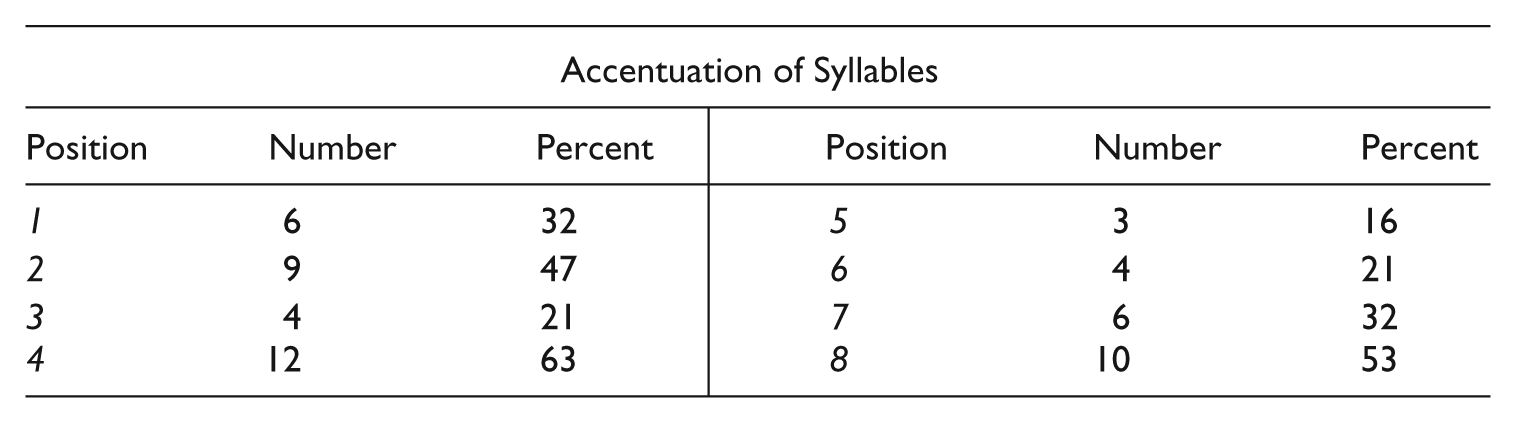
From this we may conclude that Catullus’s Latin captured the Greek metre perfectly: not only are its quantities correct, but the ictus also operated entirely independently from accent. Catullus’s rhythms are indisputably quantitative, regardless of the type of accent classical Latin carried.
The same analysis can be applied to Tennyson’s experiment: Hendecasyllabics 5 10 15 20
A few of Tennyson’s quantities are questionable: he scans ‘me’ and ‘my’ as short throughout and ignores position in ‘that
The poem’s most salient regularity, however, is that of accent: all 21 lines have stress peaks on syllables 6 and 10, and all but one also has a peak on syllable 3. In many lines syllables 1 and 8 are also stress peaks, but the peaks in these positions seem to be optional; when both are peaked, the line has a clearly trochaic accentual rhythm. The only line in Tennyson’s poem in which syllable 3 does not carry a stress peak is line 17. The English poet may have felt that Catullus’s practice sanctioned this exception, because the first two lines of the Latin poem quoted earlier are accented on syllable 2. If we allow this licence, Tennyson’s poem is stress-syllabic as well as quantitative. This ambivalence places it in two quite separate metrical traditions: that of observing quantity in English verse, and that of composing stress-syllabic verse in Europe. I shall attempt to relate Tennyson’s experiment to both traditions, the second of which has been largely ignored by critics of this poem.
Derek Attridge (1974) provides the best modern account of the history of quantitative versifying in English, and although he focuses on one period (the Elizabethan) and one metre (the dactylic hexameter), he makes many valid observations on other periods and metres (1974: 211–217). He shows that the earliest attempts at this mode of versifying suffered from the fact that the Elizabethan English pronunciation of Latin was very different from the Roman. As a result there was no question of following the quantitative pattern by ear: it was an exercise for the eye, which could detect when a vowel was followed by another vowel, or by two consonants, but could not distinguish between long and short vowels (1974: 69–77). The earliest attempts at English quantitative verse thus made the same mistakes; so, for example, the word fly-ing was scanned 1 2 instead of 2 1. But at least the early experiments were authentic in one sense: there was no accentual pattern in their lines.
Attridge shows that it was Sir Philip Sidney (b. 1534, d. 1586) who first managed to get the quantities of the English syllables correct and Thomas Campion (b. 1567, d. 1620) who first began to identify ictus with accent (1974: 133, 173–187). This latter practice was widely adopted and developed further in the 18th century and continued in the19th; its product was verse in stress-syllabic metres with classical templates (1974: 208–211). Thus for example, Latin quantitative dactyls (2 1 1) became English accentual dactyls (1 o o), and Latin quantitative trochees (2 1) became English accentual trochees (1 o). 8 Attridge distinguishes two groups of 19th-century quantitative versifiers: the first filled ictuses with stressed syllables, and all but ignored syllable weight, while the second observed the correct classical quantities in every position in the line as well as making stress ictic. Attridge places Tennyson among the second category (1974: 129 n. 1).
The evidence of the foregoing analysis confirms that Tennyson’s experiment was quantitatively correct and that, save in one line, he made stress ictic. His is thus one of the more successful imitations of classical metres in English. But that success is contingent upon his creating a rhythm accessible to the English ear, while conforming to rules that appeal chiefly to the eye, and beyond that to the intellect. Readers who do not make the intellectual effort to identify the quantitative pattern are left with just the accentual rhythm: that of a line with stress peaks on syllables 3, 6 and 10, often modulated by lesser peaks on syllables 1 and/or 8. Such a line opens with two accentual anapaests (o o 1), and closes in two iambs (o 1), and it has a long and interesting history. Indeed, this accentual configuration is the most important feature distinguishing the English iambic pentameter from the Southern Romance hendecasyllable.
Both these metres began their life in 13th-century Italy and, when Geoffrey Chaucer (b. ?1340, d. 1400) invented the iambic pentameter, he did so by imitating some types of Italian endecasillabo and rejecting others (see Duffell, 2000). His Italian model, the Filostrato (Windeatt, 1974) of Giovanni Boccaccio (b. 1313, d. 1375), employs a line of 11 syllables with an invariable stress on syllable 10; it also has a mandatory mid-line stress before its caesura, either on syllable 4 or 6. Although Chaucer focused his imitation on lines in which no stress peak occurred on an odd-numbered syllable (other than the first), there were many other configurations of stress in Boccaccio’s, and earlier Italian poets’ endecasillabi.
The following six lines from the Filostrato exemplify the configurations of stress that Chaucer selected and the ones he rejected. Because accents serve other purposes in Southern Romance I shall indicate peaks of stress by underlining.
(1) A- (2) Vo- (3) (4) (5) De’ Tro- (6) ((1) ‘Love has banished all my pleasure’; (2) ‘Wanting to hear the truth about the future’; (3) ‘Over the Greeks with great force’; (4) ‘I to summon the muses from Parnassus’; (5) ‘The great burning of Greeks and Trojans’; (6) ‘Under a white veil in a brown garment’.)
Chaucer had long been familiar with the French vers de dix, a line of 4 + 6 syllables, but he had never imitated it in English. The Italian metre he chose to imitate differed from the French by having a predominantly iambic rhythm, and by lacking a mandatory word boundary immediately after its fourth syllable (as in examples (1), (3), (4) and (6) earlier in this article). Chaucer created the iambic pentameter by emphasising both these differences: he boosted the proportion of his lines in which syllables 4 and 5 were part of the same word, and he made his lines more strongly iambic by imitating some variants of Boccaccio’s metre while excluding others. 9 He imitated examples (1), (2) and (3) while avoiding lines like (4), (5) and (6). The three favoured variants share an iambic (o 1) pulse that is at its strongest in example (1). In contrast, the first of the rejected variants (4) has a strong triple-time pulse that I interpret as a dactylic (1 o o) rhythm. Examples (5) and (6) also have openings that are not iambic: I interpret both as opening with two anapaests (o o 1), since the accent on syllable 1 is not as salient as that on syllable 3; but their second half is unmistakably iambic. 10 Examples (5) and (6), of course, with their stress peaks on syllables 3, 6 and 10, have exactly the same accentual rhythm as the lines of Tennyson’s ‘metre of Catullus’.
By imitating some of Boccaccio’s rhythmic variants and avoiding others Chaucer converted the endecasillabo into the iambic pentameter, but the historical development of Chaucer’s new English line was far from straightforward. This line had two regularities: an almost invariable syllable count (10 syllables to the final stress) and a predominantly iambic rhythm, but both were largely lost in 15th-century England. 11 Chaucer’s English heirs abandoned both regularities, composing lines with five stress peaks, rather than 10 syllables, and this change produced rhythms that are only intermittently iambic. 12 Such irregular verse prevailed in England until the rage for the sonnet swept Europe in the 1530s and poets of every nation were reminded of the endecasillabo’s regularities.
The composers of the earliest French sonnets decided to ignore the endecasillabo and employ their own vers de dix of 4 + 6 syllables, which had no marked iambic tendency (see Kastner, 1903: 233–240). And when the Earl of Surrey (b. ?1507, d. 1547) came to compose English sonnets he used an iambic version of this French metre: his versifying differed from Chaucer’s in that Surrey avoided lines with no word boundary immediately after syllable 4. 13 But by 1580 two English poets, Sidney and his friend Edmund Spenser (b. 1552, d. 1599), had begun using the full range of Chaucer’s variants and the iambic pentameter was finally recovered in its entirety. 14 These two Elizabethan poets also followed Chaucer in avoiding lines with stress peaks on 3, 6 and 10, and so this line remained anathema throughout the rest of the iambic pentameter’s history; its future lay in Southern Europe.
The canonical long line of Southern Romance poetry is also derived from the Italian endecasillabo (see Duffell, 1991: 398–406, 494–499); but in this case it is the endecasillabo of Boccaccio’s contemporary Francesca Petrarca (b. 1304, d. 1374): it was further shaped by Cardinal Pietro Bembo (b. 1470, d. 1547) and his Spanish imitator Garcilaso de la Vega (b. 1501, d. 1536). It differs from the metre of Filostrato in one important respect: these three poets avoided the variant with a dactylic rhythm (as in example (4)), reserving it for special effects. This was either because its triple time contrasted too sharply with the duple time that prevailed in other types of line, or because it was too like earlier folk-verse metres that now sounded quaint and mannered. 15 But the canonical endecasillabo of Italy, the endecasílabo of Spain, and the decassílabo of Portugal all allow the line with stress peaks on syllables 3, 6 and 10. It is known as the verso melódico or ‘melodic’ line. 16
If we include those lines with an optional accent on syllable 1, melódicos, make up about 15 per cent of all lines in Garcilaso’s sonnets (Rivers, 1972), and the following are among them: (7) Mas can- (8) O te- (9) Ol-vi- (10) Del a- (11) Yo lo (12) ((7)‘Too weary to have risen’; (8) ‘Or weaving delicate textiles’; (9) ‘Forgetting her death and mine’; (10) ‘Of the bitter memory of that day’; (11) ‘I took it by rare good luck’; (12) ‘Above all, I miss now the light’.)
As Marc Dominicy has shown (2003), more recent Spanish poets have cultivated the melódico not just for the sake of variety, but also for its own merits. This charming rhythm, moving from anapaestic to iambic, gives the endecasílabo a variety that the iambic pentameter lacks. A few English poets have included a line with a stress peak on syllable 3 among their pentameters, but most critics have censured these lines as aberrations and rejoiced in their rarity. Tennyson stumbled on this accentual metre by accident, when he was pursuing quantitative patterns, and the lines he actually produced are hardly distinguished. 17 But any poet wishing to break new ground in English might do worse than start by composing a poem in good melodic hendecasyllables.
The general point to be taken from this analysis of a particular poem is that the density and the salience of stress peaks in English hamper any poet who tries to compose quantitative verse in the language. Regardless of the poet’s intention to compose quantitatively, any pattern that the reader discerns will be accentual. If that pattern differs significantly from the accentual ones with which the reader is familiar, then it will remain a curiosity, unless some poet employs it in a major poem and transforms it into a canon.
Footnotes
Funding
This research received no specific grant from any funding agency in the public, commercial or not-for-profit sectors.