







Abstract
Italo-Brazilian prose texts from São Paulo and Rio Grande do Sul, written from the 1920s until today, either in Brazilian Portuguese with Italian code-switches, or in the Venetian koiné spoken by the Italian immigrants in Rio Grande do Sul, sometimes switching to Portuguese, are an early, but so far largely neglected example of literary code-switching representing the multilingual immigrants’ communities. In a sociolinguistic analysis of these texts I will argue that the conversational functions of literary code-switching, especially in reported speech, are comparable to those found in spontaneous utterances, if considered in a continuum between conceptually oral and conceptually written language (Koch and Oesterreicher, 1985). On the micro-level the stylistic function of code-switching plays a more prominent role in literature than in other genres, but on the macro level this kind of code-switching can also be regarded as a response to bilingual identity. In this respect, literary code-switching is used as an approximation strategy between the two closely related contact languages that gives the minority language prestige and thus contributes to its preservation.
Keywords
1 Introduction
Code-switching in literature, as in life, has always been a result of language contact, mostly due either to individual biographical experiences, to the contact between autochthonous minority languages and their majority counterpart, or to migration processes which have increased considerably in the era of globalization. This growing global mobility is probably the reason why the monolingual bias of the last 150 years associated with the nation state is now ceding to a new awareness, and to the increasing prestige of bi- and multilingual phenomena. Multilingual literature has existed since Antiquity, and flourished in the Middle Ages when certain literary genres were related to different languages, but written language mixing was also quite frequent. 1 However, language contact due to migration processes in multilingual societies is a relatively new topic in multilingual texts which often finds expression in literary code-switching. One early, but so far largely neglected case of literary code-switching representing multilingual immigrants’ communities are Italo-Brazilian prose texts from São Paulo and Rio Grande do Sul, written either in Brazilian Portuguese with Italian code-switches, or in the Venetian koiné spoken by the Italian immigrants in Rio Grande do Sul, sometimes switching to Portuguese. After giving some background information on the history of Italian immigrants in Brazil and their literature and presenting some contextually relevant theoretical considerations on literary code-switching, I will discuss examples of literary code-switching in Italo-Brazilian texts in order to shed light on the relationship between the forms and functions of literary multilingualism and their sociolinguistic implications. To this end, code-switching models originally developed for oral speech and later adapted to the much more widely studied cases of literary code-switching in Hispanic texts in the USA will be applied to selected Italo-Brazilian texts in a slightly modified form. As will be shown, the discourse functions of literary code-switching in both cases resemble each other, indicating that code-switching in literatures of migration is not only used to express a bilingual identity, but also to give the minority languages prestige. This means that, in order to understand the impact of multilingual literature, one must first examine the language contact situation.
2 Italian immigration in Brazil
Italian immigration to Brazil started in 1875 when Italians were called by the Brazilian state to populate the most southern Brazilian region, Rio Grande do Sul, on the border of Argentina and Uruguay. The immigrants came from different north Italian regions, mainly from Veneto (54%), but also from Lombardy (33%), Trentino (7%), and Friuli (4.5%). As a consequence, an internally variable Venetian koiné with Lombardian and Portuguese influences, later called Talián, emerged (Frosi et al., 2010).
It was, however, the city and state of São Paulo that received the highest numbers of Italian immigrants; approximately 800,000 by 1941. As the regional origin of the immigrants was much more diverse (the biggest groups came from Veneto in the North as well as from Campania and Calabria in the South, but also from Central Italy), a remarkably fast process of linguistic and social assimilation began to unfold. In 1940, shortly after migrant languages in Brazil were banned in public during the regime of Getúlio Vargas until 1945, only 12.9% of the Italian immigrants and their descendants in São Paulo claimed they preferred speaking Italian at home, whereas in Rio Grande do Sul 54.3% made the same claim. This may be because the Italian communities in southern Brazil, apart from being more homogeneous in terms of regional origin, were also more isolated and had less contact with the Brazilian population (Pertile, 2009). However, after the Second World War, the Venetian koiné in Rio Grande do Sul remained socially stigmatized as backward, and it is only from 1975, when the 100th anniversary of the first Italian immigrants’ arrival in the region was celebrated and books about their history and culture were published, that a revival of their language can be observed (Frosi et al., 2010). These developments are also reflected through code-switching in Italo-Brazilian literature.
3 Italo-Brazilian literature
In general, Italo-Brazilian literary texts can be divided into two phases: the first, from 1915 to the Second World War, when the migrant languages were banned in public; the second, from approximately the early 1970s onwards, when they began to regain some prestige. In Rio Grande do Sul, in the first phase, Italo-Brazilian literature is based on the Venetian koiné with Portuguese code-switches, while in the second phase we find literary texts written in Brazilian Portuguese with Italian code-switches as well. The latter is also the case for Italo-Brazilian literature from São Paulo in both phases. In order to be able to analyze these instances of multilingual literature resulting from language contact with immigrant minorities, it is necessary to have a closer look at the forms and functions of literary code-switching.
4 Theoretical considerations on literary multilingualism
In recent years, there have been some insightful attempts to categorize different types of literary multilingualism, but the terminology is not always clear. While Kellman (2000) distinguishes between ‘monolingual’ translinguals who write exclusively in their second language and ambilinguals who write in more than one language and produce internally translingual texts, Ette (2005: 21) defines translingualism as a continuous crossing between two or more languages by the same author in one text or different works. In German-speaking scholarship, Kremnitz (2004) introduced the distinction between intratextual and intertextual multilingualism, 2 the latter referring to language choice for different texts, while literary code-switching can only be found in the first. Another distinction needs to be made between intratextual multilingualism, which is used by polyglot writers mainly for aesthetic reasons, and multilingual texts, which reflect societal rather than purely individual multilingualism. This means that the author does not necessarily have to be a part of the speech community he or she portrays, even though this is often the case, but that the characters in a multilingual setting must be (Callahan, 2004: 99). In consequence, the sociolinguistic background is essential for understanding and interpreting code-switching in these kinds of multilingual texts (Gardner-Chloros, 2013).
When comparing literary code-switching to code-switching in everyday conversational exchanges, one clear difference is that everyday code-switching typically occurs in an oral medium (even though this has changed to a certain extent in the age of digitalization, as oral text types like chats do now occur in a written form, too), whereas literary code-switching is by definition written. 3 What needs to be taken into consideration, however, is the distinction between conceptually oral and conceptually written language proposed by Koch and Oesterreicher (1985). While the medium of literary texts is always written, they can be conceived – and even performed, in the case of plays – as oral to a varying degree. This phenomenon has been coined ‘fictional orality’ (Goetsch, 1985), ‘secondary orality’ (Ong, 1982) or ‘staged orality’ (Affolter, 2011), all of which carry the negative connotations of being ‘inauthentic’. 4 Therefore, the more neutral term ‘literary orality’ is used in this article. Goetsch (1985: 210) points out that what we need to pay attention to when looking at literary orality is the mixture of mimetic and stylistic elements and their function, whereas Lubkoll (2008: 391) emphasizes that ‘what is even more important than a realistic representation of orality … is the simulation of an interactive situation’. This is why Affolter (2011: 32 f.) modifies Koch and Osterreicher’s model by including a continuum of reception that highlights the reader’s role. As Jakobson (1960: 351 ff.) points out, the communicative function of language is the same for all types of texts including literature. The interaction between the speaker and the addressee in and outside the text, that is to say the fictive addressee and the implied reader, correspond to Jakobson’s conative function, which is often expressed in vocative and imperative forms. What is also important for literary code-switching, however, further to its purely referential meaning, is what Jakobson calls the emotive or expressive function present in interjections, among others. Appel and Muysken (1987), who linked Jakobson’s model to the discursive functions of code-switching, stressed that the phatic function is related to what Gumperz (1982: 60 f., 98 f.) calls metaphorical code-switching in his early study on code-switching (Appel and Muysken, 1987: 119), namely the use of different linguistic varieties according to their specific connotations or social meaning. The phatic function emphasizes the social meaning of communication and is often found in quotations or formulaic expressions, while the poetic function is about the effects of linguistic form. Even though it is not limited to poetry, it is more prominent in literary texts. As it is mainly expressed in jokes and puns, it is sometimes also called the ludic function (Gardner-Chloros, 2009: 29). Furthermore, the metalingual or metalinguistic function, which can be found in comments on language use, plays an important role not only for oral, but also for literary code-switching (see later). Altogether, these general functions of language are all relevant for written as well as for oral code-switching.
An important difference, however, is that literary code-switching is intentional (Gross, 2000), while this cannot be ascertained for code-switching in spontaneous utterances (Gardner-Chloros, 2009: 77). This means that literary code-switching is always functional in Gumperz’s (1982) terms, that is to say it is not only determined by situational factors such as the topic or the interlocutor, but also serves discourse-strategic functions related to Jakobson’s conceptual framework of language described earlier. Further to its discursive meaning in each individual case, code-switching also has wider societal implications. On a macro-linguistic level, Gumperz (1982: 66) distinguishes between a ‘we-code’ associated with an in-group and a ‘they-code’ related to an out-group, which must be negotiated in every conversation. The relationship between language choice and group identities is also a symbolic one, as languages are associated with certain connotations and prestige. The use of the generally less prestigious minority languages in diglossic situations, and especially in domains in which they are not normally employed, can have political implications as a means of resistance against domination (Gardner-Chloros, 2009: 55, 2013). In addition, code-switching from the minority to the majority language, especially if these are closely related, can be interpreted as an approximation strategy and as a sign of language vitality, as Rindler Schjerve (2004: 16, 27) shows for Sardinian and Italian, because structural adaptations facilitate the transition from one language to the other and thereby the use of both. Similarly, literary code-switching can have an exemplary function, and even more so for non-standardized minority varieties, since written code-switching in contemporary literature is still noteworthy. On the micro-level, however, ‘the question is rather why some things are written in one language and some in another, and why switches occur where they do’ (Gardner-Chloros, 2013: 1101), and how this is related to the wider sociolinguistic context. Therefore specific models of the discourse functions of code-switching need to be taken into consideration.
5 Functions of oral and literary code-switching
There have been various attempts to categorize the conversational functions of oral code-switching based on Gumperz’s (1982) analysis of discourse strategies (Gardner-Chloros, 2009: 69). In an analysis of 30 Chicano prose texts containing switches from English to Spanish, Callahan (2004) shows that the discourse functions of both oral and written code-switching are fundamentally the same, even though some functions such as addressee specification may be less prominent in written discourse than in oral speech, while others seem to be especially frequent in literary code-switching. Altogether, Callahan (2004: 70), elaborating Gumperz’ (1982: 75–82) model, identifies eight discourse function categories relevant for literary code-switching: (1) referential; (2) vocative; (3) expletive (taboo words and euphemisms); (4) quotations; (5) commentary and repetition; (6) set phrases, tags and exclamations; (7) discourse markers; and (8) directives. These can be found both in the dialogic and in the narrative parts of multilingual texts, even though they seem to be more frequent in dialogue. Taking into consideration the seven socio-pragmatic functions of literary code-switching that Montes-Alcalá (2012: 74–75) mentions, also referring to Hispanic texts in the USA, namely (I) lexical need; (II) clarification; (III) stylistic device; (IV) linguistic routines/idiomatic expressions; (V) emphasis; (VI) quotations; and (VII) triggered switches, it becomes clear that most categories overlap (see Table 1).
Functions of literary code-switching.
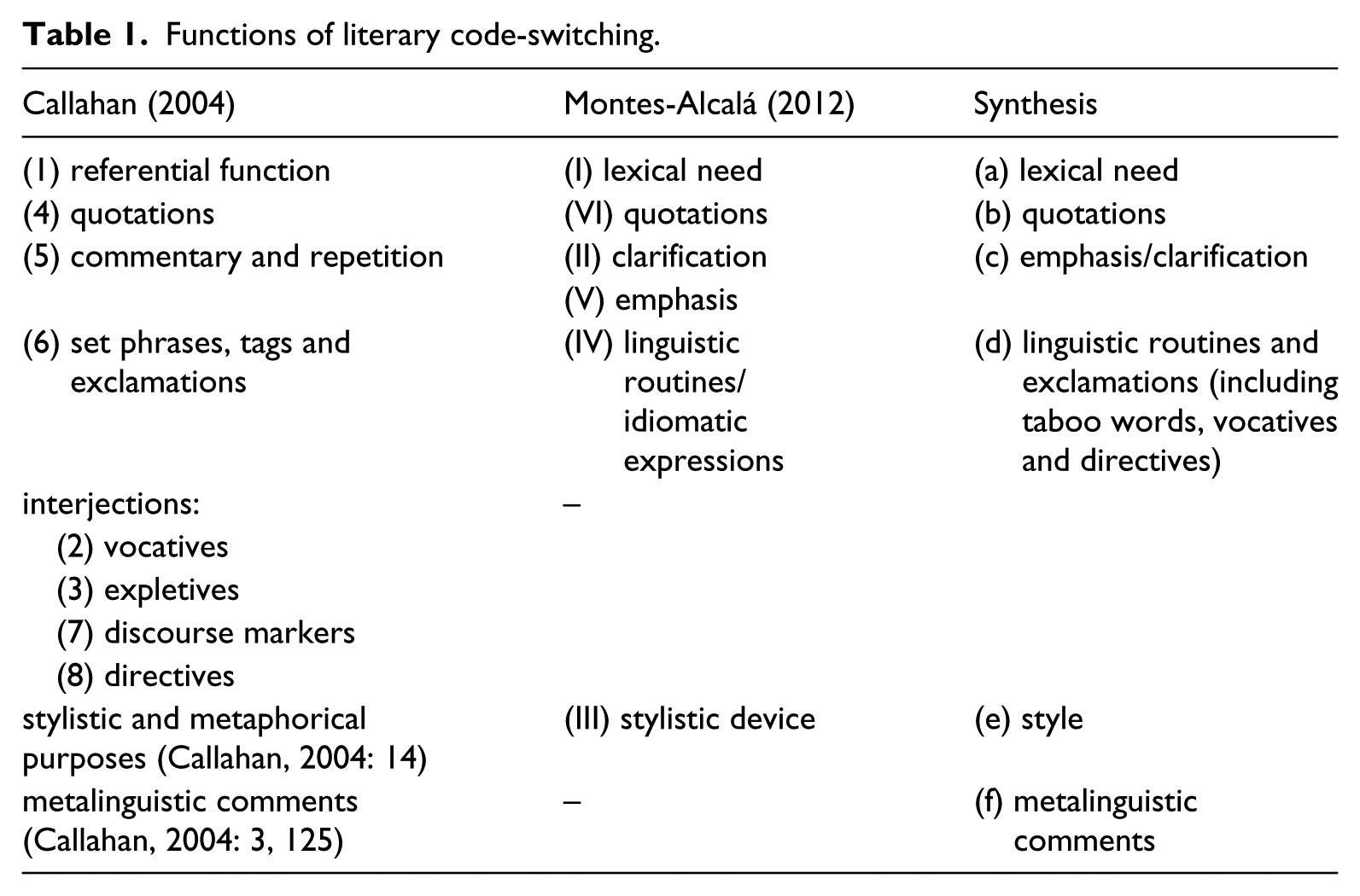
What is particularly notable in Callahan’s model, are the categories of vocatives (2), expletives (3), discourse markers (7), and directives (8), which she classifies as interjections in syntactical terms (Callahan, 2004: 79). While the discourse functions of Callahan’s commentary and repetition (5) correspond to what Montes-Alcalá calls clarification (II) and emphasis (V), Montes-Alcalá’s categories of stylistic device (III) and triggered switches (VII) should not be neglected, either, even though the latter are rather a cause than a function of code-switching. The use of code-switching for stylistic and metaphorical purposes is also mentioned by Callahan (2004: 14). Furthermore, Callahan (2004: 3, 125) emphasizes the use of metalinguistic comments referring to linguistic competence, language choice and generational dynamics, which are also relevant for literary code-switching, even though they do not always correspond.
Combining Callahan’s and Montes-Alcalá’s models, I will apply the following six functional categories for literary code-switching to the literary landscape of multilingual Italo-Brazilian texts: (a) lexical need; (b) quotations; (c) emphasis/ clarification; (d) linguistic routines and exclamations (including taboo words, vocatives and directives); (e) style; (f) metalinguistic comments. Further to the metalinguistic dimension, the conative/directive function, especially relevant for (c) emphasis/ clarification and (d) linguistic routines (vocatives/directives), must also be included in an analysis of literary code-switching. In the dialogic parts of literary texts, it is important to note that there is a double audience for code-switching: the literary addressee in the text and the reader outside the text, so the directive function relates to both. This means that the audience is part of the multilingual communication process and gets involved with the speech community portrayed.
6 Code-switching in Italo-Brazilian texts from Rio Grande do Sul
The most famous example of literary code-switching in Italo-Brazilian texts from Rio Grande do Sul is probably Nanetto Pipetta, nassuo in Itália e vegnudo in Mérica per catare la cucagna (Nanetto Pipetta, born in Italy and come to America to ‘catch’ his fortune) 5 written in Talián with Portuguese code-switches by the Capuchin friar Aquiles Bernardi. First published in serial form in the newspaper Staffetta Riograndense from 1924 to 1925, the stories about Nanetto Pipetta, a prototype of the adventurous if somewhat naive immigrant, appeared as a book in 1937, just before the immigration languages were banned in public in Brazil (see earlier). The collection was re-edited with adaptations to the Brazilian-Portuguese spelling in 1956, and reprinted for the 100th anniversary of the Italian immigration in Rio Grande do Sul in 1975 in its 4th edition, which was soon out of print. Since then, there has not only been a new wave of literary texts in the Venetian koiné from Rio Grande do Sul, there have also been attempts to codify the language through this model. From the 5th edition (1976) onwards, 6 all reprints of Nanetto Pipetta contain an appendix with a grammar and dictionary of the Italo-Brazilian koiné (Gramática e Vocabulário do Dialeto italiano rio-grandense) by the Polish friar Alberto Vitor Stawinski (Bernardi, 1982[1937]: 1). His dictionary, based on the stories of Nanetto Pipetta and providing examples of the Venetian koiné along with translations to Portuguese, was first published independently in 1987. 7
The ongoing popularity of the stories about Nanetto Pipetta, with sequels written up until today, shows the importance of a literary language model. Literature is an important domain for the standardization of language varieties, which gives them new means of expression and, finally, prestige. The role of Italo-Brazilian literature in Rio Grande do Sul can be compared to the case of Italy where the standard language is based on literary works by Petrarch, Boccaccio and later Manzoni. The question about which of the Italian varieties should be the model for the standard (questione della lingua) was first raised by Dante in his essay De vulgari eloquentia (On Eloquence in the vernacular) in the early 14th century. Pietro Bembo subsequently established Boccaccio and Petrarca as linguistic authorities in his Prose della volgar lingua (1525). This is reflected in the first dictionary of the Italian language academy, the Vocabolario degli Accademici della Crusca (1612), which contains mainly voices from these, and to a lesser extent other, 14th-century authors. In the 19th century, the works of the Milanese writer Manzoni, who argued for a literary language oriented towards the contemporary Florentine usage, became the new language model. Nevertheless, the longstanding tradition of literature in the different Italian dialects continued to be strong. It is against this backdrop that the development of the Italo-Brazilian literature and the codification of the Italo-Brazilian koiné through literary works need to be seen.
In the collection of 52 episodes of Nanetto Pipetta we find two ‘brazilianisms’, in other words, one-word-switches from Talián to Portuguese, per page on average, according to the Italian linguist Meo Zilio (2001: 173). While his quantitative analysis remains incomplete, he emphasizes the importance of analyzing them qualitatively, as I will do in this article. According to Meo Zilio, Brazilian-Portuguese ‘borrowings’
8
in Nanetto Pipetta, as he calls them, are used for ‘keywords which combine a linguistic and socio-cultural hybridization’ (Meo Zilio, 2001: 166),
9
that is to say mainly for lexical need and idiomatic expressions. Switches for lexical need and idiomatic expressions mostly occur in intra-sentential code-switching, but when we look at inter-sentential code-switching, the stylistic or ludic function comes into play as well. This is the case, for example, when Nanetto arrives in Brazil and begins to speak in Talián to a native Brazilian, who answers in Portuguese: – Ció Merican, me tólito sú in te la tô barcheta, se mi vegno dô? [Talián] – – No – Sim, eu menar ti lá, mas pagar mim. [simplified Portuguese] – … Orpo come i parla stragno sti mericani! Ma pur ca se intendemo on fiá, basta. [Talián] (Bernardi, 1982 [1924–1926]: 38) – Hi American, will you take me up on your boat if I come down? [Talián] – – Not – Yes, I’ll take you there, but pay me. [simplified Portuguese] – … Damn, how strange these Americans speak! But as long as we understand each other a bit, that’s enough. [Talián]
10
The misunderstanding between Portuguese o que (= what) and Talián oche (= geese) rendered in direct speech clearly has a stylistic/humoristic function, but there is also a metalinguistic comment about the linguistic differences between the immigrants and the natives. Although Brazilians are perceived to speak strangely, mutual intelligibility between the two Romance languages is still possible. What is also notable is the use of deictic expressions (up, down, there) which serve to involve and situate the addressee (reflecting the conative function). It is only through the use and understanding of what is meant by lá (= there) in both languages, namely the Brazilian mainland, by both interlocutors and the reader, that this inter-sentential code-switching works. In addition to the switches into Portuguese in the text, there are also switches to standard Italian which characterize the diglossic situation. While in Italy standard Italian was the language used in formal situations, in the Italian communities in Brazil it was progressively replaced by Portuguese in these domains (Frosi et al., 2010; Pertile, 2009: 101 f.).
In the recent sequels of Nanetto Pipetta, for example Nanetto in Val Véneta by Rafael Baldissera (2003), switches to standard Italian only occur in quotations. While Nanetto speaks Talián, the local authorities (the police, a bank manager, a journalist, and even a thief) are portrayed as speaking and understanding only Portuguese. This leads to some comical misunderstandings, for example, when a reporter is interviewing Nanetto and his fiancée Gelina after a football match: – Vocês pretendem – – Ah, pretendem morar perto do – Te go dito che mi la – Entendi. Vão – Mi no – Muito obrigado, Nanetto, pela atenção. Foi um prazer. [reporter, Portuguese] (Baldissera, 2003: 71) – Are you planning to get married [Portuguese: – We haven’t built a – Ah, you are planning to live near the – I’ve told you that I – I understand. You will – I didn’t – Thanks, Nanetto, for your attention. It was a pleasure.
11
The misunderstandings here arise from a confusion between Portuguese casar (= to marry) and Talián casa (= house), Taliàn farò (= I will make/build) and Portuguese farol (= lighthouse), Talián capir (= to understand) and Portuguese carpir (= to clear a piece of land and prepare it for cultivation), and finally Portuguese várzea (= cultivated plains) and Talián vardea (= watched). The stylistic/ludic function of this inter-sentential code-switching is achieved through plays on the different meanings of similar-sounding words in Venetian and Portuguese, but there is also a metalinguistic comment about the linguistic competence of the interlocutor (‘Gente difissil de capir.’ = a linguistic play on words that means both ‘these people are hard of understanding’ and ‘hard to understand’), dividing a ‘we-group’, speakers – and readers – of Talián, and a ‘they-group’; Brazilian locals who only speak and understand Portuguese.
In another episode, there is a German parson who speaks a mixture of Talián and German which Nanetto does not really understand and which his friend Agostin explains to him in a metalinguistic comment (Baldissera, 2003: 37) 12 . This literary multilingual encounter reflects the language contact situation in Rio Grande do Sul where Italian immigrants live alongside German settlers. Furthermore, intra-sentential switches to Portuguese for lexical need are especially prominent, 13 for example potrero (Port. ‘portreiro’ = paddock), baro (Port. ‘barro’ = clay), simaron (Port. ‘chimarrão’ = maté), etc., but also neologisms which do not appear in the original like camburon (Port. ‘camburrão’ = police van) and camignon (Port. ‘caminião’ = lorry). Since these are one-word switches with some phonological adaptations to Talián (the diphthongs and nasal vowels are simplified, for example), they can be interpreted as borrowings if they are not italicized (like ‘potrero’ in contrast to ‘baro’; Baldissera, 2003: 11). Hence the visual aspect of multilingual texts is also important for interpreting literary code-switching (Sebba, 2012). Altogether, in the stories about Nanetto Pipetta, inter-sentential code-switching occurs only in direct or indirect speech, giving space to different voices and ‘heighten[ing] the orality of the text’ (Callahan, 2004: 134), while intra-sentential switches can also be found in the narrative parts, serving to characterize the (linguistic) environment of the immigrants.
In Italo-Brazilian literature from Rio Grande do Sul from the second phase after 1975, based on Brazilian Portuguese, we can observe similar phenomena. The most well-known example is probably José Clemente Pozenato’s novel O Quatrilho (first published 1985), which was turned into a film in 1995 and nominated for the Academy Award for Best Foreign Language Film. Intra-sentential code-switching to Talián is used mainly for lexical need, for example family names (màma, pupà, nono = mum, dad, grandfather; Pozenato, 2001 [1985]: 5 ff.) and gastronomic terms
14
(taiadele, fogolar, brodo = tagliatelle, hearth, broth; Pozenato, 2001: 19, 25, 84 ff.). Linguistic routines, for example polite phrases (grazie, scusi = thanks, sorry; 2001: 65, 90), idioms (manda chi comanda = who orders, decides; 2001: 84), swear words (Porco Dio, putana, etc. = goddamn, slut; 2001: 162 ff.), exclamations (Ma che! = nonsense!; 2001: 23) and songs (Sul ponte di Bassano;
15
2011: 23) are also used to evoke the Italian immgrants’ ‘lifeworld’,
16
and have an emotive/expressive function. Longer inter-sentential code-switches are attributed to specific characters to characterize their social status, for example in the following conversation between two older Italian immigrants of the first generation during a wedding rendered in direct speech: Beve, compare, che’l vin no fa mal. Hoje é festa … Bravo, compare. Vamos fazer uma bebedeira nós dois. Femo una ciùca, e dopo cantemo. (Pozenato, 2001 [1985]: 22) Drink, my friend, wine does no harm. Today is a feast … Well done, my friend. The two of us will drink together. We will get drunk and then sing.
17
Here, intra-sentential code-switching occurs between the Venetian koiné and Portuguese. As the term ‘compare’ (= friend, companion) suggests, the literary interlocutor is part of the Italo-Brazilian community, and this is further emphasized through the use of third and then first person plural imperatives. Unlike in the texts from the first phase, nearly all code-switches are translated in a footnote, but as the author made clear to me in an interview, this was a decision by the editors in order to address a wider readership. 18
7 Code-switching in Italo-Brazilian texts from São Paulo
When comparing Italo-Brazilian texts from Rio Grande do Sul to those from São Paulo, the most obvious difference is that in the latter, code-switching occurs from Brazilian Portuguese to standard Italian. It is also remarkable that not all authors, especially from the first phase, are of Italian descent. Antônio de Alcântara Machado, for example, who proclaims his short story collection Brás, Bexiga e Barra Funda from 1927 to be the ‘organ of the Italo-Brazilians in São Paulo’ 19 (Machado, 1961 [1927]: 8), is said to have learnt Italian on the streets of the boroughs of the Paulo he describes. In seven of his 11 short stories there are code-switches from Brazilian Portuguese into Italian. These are mainly used by the older generations in the text, and are nearly always in direct speech. They include linguistic routines (greetings, swearwords and exclamations) and quotations, but also metalinguistic reflections, for example in the story Nacionalidade, where the children don’t want to speak Italian with their parents. Many imperatives are used in Italian to involve the audience, but emphasis is also an important function of code-switching here.
In the short story A Sociedade, a word play on the double meaning of sociedade as both ‘society’ and ‘association’ in Portuguese, code-switching is used in direct speech by an Italian immigrant who has become rich through hard work and now wants to start a business corporation with his son’s future father-in-law, who belongs to an ancient aristocratic family: Per Bacco, doutor! Mas io tenho o capital. O capital sono io. O doutor entra com o terreno, mais nada. E o lucro se divide no meio. (Machado, 1961 [1927]: 16) My word, doctor! But I have the capital. I am the capital. You, doctor, just join in with the land, nothing more. And the profits will be divided equally.
20
The Italian exclamation (‘Per Bacco’) at the beginning has an emotive function and puts emphasis on the statement, but the switch to Italian for the first person singular pronoun (‘io’) and later verb form (‘io sono’) also stresses the Italian – or Italo-Brazilian – identity of the speaker, in addition to its stylistic function. As Pincherle (2006: 24) points out, these switches have a performative function and are also used strategically as a sign of the immigrants’ self assurance. Consequently, code-switching serves as an approximation strategy for the two linguistic and cultural systems here, indicating the immigrants’ socio-cultural situation and integration.
In what is probably the most famous Italo-Brazilian novel from São Paulo from the second phase, Anarquistas, graças a Deus (= Anarchists, thank God) by Zélia Gattai from 1979, code-switching is used in a similar way: switches frequently occur in direct speech and are only used by the older generations, but there are also metalinguistic reflections on linguistic conflicts between the generations and the use of the Venetian dialect. Intra-sentential code-switching in the narrative parts is often used for one-word switches due to lexical need, for example gastronomic terms: ‘um delicioso risoto de “funghi secchi” com “zafferano” ou de “tartufi”’ (Gattai, 2003 [1979]: 173). While ‘risoto’ seems to have already been integrated as a loanword in Brazilian Portuguese with a phonological simplification of the double consonant, the quotation marks indicate the Italian one-word switches ‘funghi secchi’ (= dried mushrooms), ‘zafferano’ (= saffron), and ‘tartufi’ (= truffles) which have specific connotations associated with Italian cuisine, even though Portuguese translations exist. However, intra-sentential code-switching also comprises longer quotations and linguistic routines. One chapter is dedicated exclusively to the use of Italian swearwords (‘Blasfêmias e Palavrões’; Gattai, 2003 [1979]: 170–171) with metalinguistic comments on their usage, but Italian exclamations and idiomatic expressions are also quite frequent. Inter-sentential code-switching is always used in direct speech, for example by the first person narrator’s father.
Fai la finita! Dio Cane, non si può più vivere in questa casa! Eu aqui não mando nada … Porca miséria! Tudo tem seu limite! Bichos por toda a parte, dentro e fora … (Gattai, 2003 [1979]: 147; my italics) Stop it! God damn, you can’t live in this house any more. I don’t rule here at all … Bloody hell! Everything has its limits. Animals everywhere, inside and outside …
21
Code-switching has an emotive function here, which is expressed through exclamations and swearwords, but the imperative at the beginning also serves to address and situate the interlocutor. This certainly contributes to the literary orality of the text.
8 Discussion
As we have seen, the linguistic models originally developed for code-switching in oral speech can account for literary code-switching as well. While switches for lexical need generally occur in intra-sentential code-switching and can be found in the narrative as well as the dialogic parts of a text, inter-sentential switches are more typical of direct or indirect speech, and heighten the (literary) orality of the texts. This is especially true of linguistic routines and exclamations that have a directive function, addressing both the literary interlocutor and the reader as a member of the speech community portrayed, either in-group or out-group. Furthermore, the stylistic/ludic function as well as metalinguistic reflections and comments on the language contact situation are highly relevant for literary code-switching, and the visual aspect of multilingual texts is also important for their interpretation.
Altogether, code-switching in Italo-Brazilian literature is used to evoke the immigrants’ lifeworld (lexical need switches), identify the social status of certain characters (linguistic routines) and to involve the audience. Interestingly, there are many parallels to code-switching in contemporary Hispanic literature in the USA which has been studied much more widely. 22 While both Spanish in the USA and Italian in Brazil are migrant languages, Spanish is also a cross-border language in the American Southwest. The influence of Mexican Spanish on Chicano literature is therefore much stronger than language contact between Italy and Brazil. On the other hand, Italian and Portuguese are typologically related Romance languages, and this facilitates mutual intelligibility, but also language change. Another difference is that literary code-switching in Hispanic texts in the USA is more typical of poetry than of prose (Callahan, 2004: 83), while this is not true for Italo-Brazilian literature, where code-switching is much more common in prose texts, especially short stories and novels. This might be due to the fact that, because of their typological similarity, switches from Portuguese to (standard) Italian are more easily understandable for a monolingual Portuguese speaking reader than switches from English to Spanish for an Anglo-American one. However, texts in the Venetian koiné are not easily accessible for a monolingual Brazilian audience, and can only be read by a much more limited in-group minority. Using a non-standardized dialect in literary texts is a challenge in itself (Gardner-Chloros, 2013: 1100), but also gives the minority language, which is often restricted to informal domains, social prestige and can thus contribute to its recognition and preservation.
9 Conclusion
Despite the differences, literary code-switching that reflects language contact in multilingual societies seems to be surprisingly similar in form and function across linguistic and national divides. Even though on the micro level the stylistic/ludic function of literary code-switching plays a more prominent role than in other, non-literary genres, on the macro level this code-switching can also be regarded as a way of expressing bilingual identity. As has been shown in this article, multilingualism itself can gain prestige through literary code-switching, which thus serves as a means of self-determination and resistance of multilingual minorities against the monolingual bias of the majority group. The attempt to maintain linguistic identity through literary code-switching is not limited to Brazil, though, and its theoretical implications can therefore serve as a reference for other, more recent cases of immigration.
Footnotes
Acknowledgements
I am grateful to the editors for their helpful comments on an earlier version of this article.
Funding
This research received no specific grant from any funding agency in the public, commercial, or not-for-profit sectors.