







Abstract
Foregrounding (e.g. Leech, 1965, 1985; Leech and Short, 1981), whereby certain linguistic elements in literary works differ consistently and systematically (Mukařovský, 1958: 44) from norms represented by a particular benchmark, has often been measured using corpus stylistic methods (e.g. Mahlberg, 2013; Stubbs, 2005). While most such studies have focused on works in their original language, this study compares the translation with the original text. More specifically, I explore the stylistic elements identified in Julian Barnes’ novel The Sense of an Ending in both the original and its Italian translation. The study applies notions of tertiary or internal deviation (Leech, 1985) in order to explore to what extent an analysis of keywords and key clusters in Part One compared with Part Two of the target text concurs with the results of the same process in the source text. Corpus stylistic methods were used to identify ‘good bets’ (Leech, 2008: 164) which were then subjected to qualitative analysis. Findings suggest that elements identified as being frequent in Part One of the source text, such as a predominance of ‘uncertain impressionistic perceptions’ (Shepherd and Berber Sardinha, 2013), and an emphasis on first person narration in Part Two, did not play such an important role in the target text, where other elements such as time references and discourse markers of explanation emerged instead. The article concludes that discrepancies between a stylistic description of source and target texts might be due to translating strategies as well as target language conventions.
1 Introduction
Corpus stylistics makes use of corpus linguistic techniques to investigate elements of style. A large number of corpus stylistic studies have analysed the original literary works, examining various aspects such as particular authorial style (e.g. Fischer-Starcke, 2009, 2010; Hoover, 2002; Johnson, 2009; Starcke, 2006) and the function of distinctive language patterns and repetitions (e.g. Adolphs and Carter, 2002; Burrows, 1987; Culpeper, 2002; Hori, 2004; Mahlberg, 2007a, 2007b, 2013; Mahlberg and McIntyre, 2011; O’Halloran, 2007; Semino, 2004; Semino and Short, 2004). Comparative studies involving both the original work (the Source Text: henceforth ST) and its rendering in translation (the Target Text: henceforth TT) have often focused on the similarities and differences between the two texts (e.g. Bosseaux, 2007; Čermáková and Fárová, 2010; Johnson, 2010, 2011, 2014; Mahlberg, 2007b). Common to these studies is their focus on the systemacity of the translation choices.
Unlike those previous works, the aim of the present study is not primarily to compare the translation choices with the corresponding passages in the original text, but to take a Target-oriented approach (Toury, 1995), and consider the TT as an independent entity, a work which exists in its own right. Corpus stylistic methods are used to analyse the Italian translation of Julian Barnes’ novel The Sense of an Ending (2011), translated by Susanna Basso (2013), in order to explore the linguistic elements identified as foregrounded in the text. These findings are then considered in the light of a stylistic analysis of the original English novel, referring also to the findings of previous stylistic work on this text (e.g. Shepherd and Berber Sardinha, 2013).
The notion of foregrounding (Leech, 1965, 1985; Leech and Short, 1981), whereby certain linguistic elements in literary works differ consistently and systematically (Mukařovský, 1958: 44) from norms represented by a particular benchmark, plays an important part in stylistic theory. Leech (1985: 45–50) distinguishes three types of foregrounding: primary, whereby a literary work or body of works is found to deviate from norms inherent in the language generally; secondary, in which a literary work by an author differs linguistically from other works by the same author; and tertiary, or internal deviation, in which the language of part of a single work differs consistently from another part of the same work. The third type of deviation is the focus of the present study, which compares Part One and Part Two of the Italian translation with each other, then Part One and Part Two of the original ST, and finally draws conclusions as to what extent the observations arising from each of the two sets of comparisons concur. What is being investigated is whether a qualitative analysis of the TT achieved with the aid of corpus software resembles a qualitative analysis of the ST, and not whether the individual language choices made in the TT are reasonable equivalents for the ST.
The literary work in question, which won the Booker Prize, is a short novel in two parts, named just One and Two, narrated in the first person by Tony Webster, a recently retired divorcee. Part One relates Tony’s memories of his school years 40 years before, his closest friends and his brief relationship with Veronica Ford. A letter arrives informing him of the unexpected bequest of a sum of money and the diary of his former school friend Adrian Finn, who committed suicide. This event provides the connection between Part One and Part Two of the novel, in which Tony attempts to gain possession of the diary, in the meantime gradually coming to realise that his memories of what happened 40 years earlier are exceedingly subjective.
Previous corpus stylistic work on the original novel (Shepherd and Berber Sardinha, 2013) highlighted the unexpectedly high frequency in Part One of various linguistic structures indicating uncertain impressionistic perceptions (‘seemed’, ‘as if’ clauses, repetition of ‘perhaps’), consonant with the emphasis on a subjective point of view, noting that the second part of the novel deals with abstract concerns such as ‘life’, and drawing attention also to a number of repeated clusters of words which played a significant part in the structure of the novel. These points will be borne in mind when discussing the findings of this analysis.
Below I present the methodology, after which I describe the most relevant findings and discuss their importance.
2 Methodology
Certain types of foregrounding, particularly lexical repetition, have been analysed in literary works with the aid of the semi-automatic extraction of data. These data can help pinpoint likely looking node words, or ‘good bets’ (Leech, 2008: 164; Stubbs, 2005), which may lead to interesting findings once examined qualitatively (e.g. Mahlberg, 2007a, 2007b, 2013). In this study the electronic versions of both ST and TT were queried using WordSmith Tools 6.0 (Scott, 2008). Lists of keywords (words whose frequency is unusually high in relation to some norm) for each of the two parts of the novel in both English and Italian were extracted by comparing Part One with Part Two and vice versa. Both single keywords and two to five word key clusters occurring more than five times (log-likelihood setting, p value 0.01) were extracted. The lexical differences between Part One and Part Two in both TT and ST were taken as pointers towards tertiary deviation and concordances were run of the keywords and key clusters to investigate their use in context.
3 Findings
In this section I shall discuss selected keywords and key clusters 1 of the two parts of the novel, both for the TT and the ST, presented in their entirety for reference in table form in the Appendix for reasons of space.
The keywords and key clusters were intuitively (e.g. Fischer-Starcke, 2010: 66) divided into a number of semantic groups serving a particular functional purpose. The decision to use my own labels for these groups was taken after experiments with automatic semantic analysis procedures such as Wmatrix (Rayson, 2008) resulted in labelling which did not always reflect the function of a group of words and clusters in the context of the novel. 2 I formed the groups on the basis of words and clusters sharing a similar meaning or sense (Baker, 2006: 143) after careful manual examination of concordances. A number of the groups, which we may describe as ‘aboutness indicators’ (Scott, 1999; Scott and Tribble, 2006: 57–60), contained items relevant to the plot of the novel. I labelled these groups participants (including the proper names of characters, generic names and pronominal references); circumstances (including elements of the plot such as what took place, where and how, as well as adjectives which frequently co-occurred with mention of specific characters); abstract concerns (connecting the circumstances of the story with more universal themes, also described by Mahlberg and McIntyre (2011) as ‘thematic signals’); and verbal groups (further categorised according to Process type). Other groups contained elements which could be described as contributing to the narrative strategies which construct point of view (Simpson, 1993: 4ff.). I divided these into time references or narrational elements (including deictic references indicating time as well as explicit indications of point of view); explanatory discourse markers (including explanation or generic indication); conditional/hypothetical/truth markers (including modal operators, hypothetical modal phrases, and verb phrases which contain an element of conditionality, as well as verbs of perception); negation (modal operators expressing negative polarity and adversative conjunctions); and reflexive or personal references (possessive adjectives, pronouns and reflexive pronouns referring to the first person). Since the groupings are not discrete categories, some elements may appear in more than one group.
Below I shall discuss similarities and differences within the two groups between the TT and ST and summarise my findings.
3.1 Part One compared with Part Two
Table 1 in the Appendix shows the key words and clusters for Part One in relation to Part Two. Observations are made below about how the groups are populated in the TT, followed by observations about the same groups in the ST, with a view to focusing each time on differences and similarities between the outcomes of corpus stylistic analysis, and not whether the translation is ‘good’ or not.
Participants
The same characters playing a major role in Part One appear key in both TT and ST, along with the more generic ragazza/girl, padre/father, genitori/parents and a number of pronouns. We may note, however, that the first person singular subject pronoun io is key in the TT and not in the ST. Unlike in English, inclusion of the subject pronoun is optional in Italian, only being required for emphasis. The presence of io in the keyword list suggests then that particular emphasis on the first person is required in Part One, something that has no correspondence in the ST. Reading concordances in Part One of the TT suggests, however, that some of these, as in example (1):
(1) TT: E poi si sbaglia di grosso su Dvorak e Cajkovskij. Senza contare che io potrò sentirmi il mio lp di Un uomo, una donna finché mi pare. E non di nascosto.
(2) ST: Also, she’s completely wrong about Dvorak and Tchaikovsky. What’s more, I’ll be able to play my LP of Un Homme et Une Femme as often as I like. Openly.
are due to calques of the original ST rather than actually necessary in Italian, since there is no indication of emphasis in the ST and thus the subject pronoun io is superfluous here.
Circumstances
Both TT and ST feature words and phrases from the semantic group of education, particularly school and university, which formed the setting for much of Part One. The fixed phrase a letto con (Back Translation (BT): ‘to/in bed with’) in the TT and the keyword sex in the ST are featured due to the repetition of the theme of Tony and Veronica (not) sleeping with each other. While the equivalents pacifico/peaceable, mainly used to describe Tony, emerge in both ST and TT, the TT also has the adjective simpatica (BT: ‘nice’), which in Italian tends to collocate with people, and is used here to describe Veronica. The more generic nice does not emerge as key in the ST.
Explanatory discourse markers
Explanation or generic indication appear to be important in Part One. These phrases are only present in the TT and include expressions such as vale a dire [BT: ‘that is to say’], heralding a personal interpretation of the action for readers, as in example (3). The absence of similar explanatory phrases in the ST suggests that they may be lexicalised differently as in example (4):
(3) TT: Niente che ci distraesse dai nostri doveri umani e filiali, vale a dire studiare, superare gli esami, sfruttare il titolo di studio per trovarci un lavoro
(4) ST: there was nothing to distract us from our human and filial duty which was to study, pass exams, use those qualifications to find a job
Another possible reason for their absence in the ST is that they are examples of explicitation (Baker, 1996: 180) in the TT, 3 as in example (5) below, where there is no lexicalised correspondent in the ST as in example (6):
(5) TT: da noi a scuola non esistevano cerimonie di accoglienza e men che meno l’opposto, vale a dire reclutamenti punitivi.
(6) ST: there was no welcoming ceremony, let alone its opposite, the punitive induction.
Another example is the expression del genere (BT: ‘of the type’), repeated in correspondence with different lexical choices in the ST, as in examples (8) and (10) below:
(7) TT: era l’unica persona di nostra conoscenza che provenisse da una situazione del genere. Il che avrebbe dovuto fornirgli una riserva di rabbia esistenziale incommensurabile,
(8) ST: back then it was ‘a broken home’, and Adrian was the only person we knew who came from one. This ought to have given him a whole storetank of existential rage,
(9) TT: Ma può esistere una perversione del genere? “perchè no?”, domandavo, mentre una mano severa mi bloccava il polso.
(10) ST: But can such a perverse instinct exist? ‘Why not?’ you would ask, as a restraining hand was clamped to your wrist.
Time references or narrational elements
Foregrounded in Part One of the TT are deictic references indicating time such as in seguito (BT: ‘later’). Instead, only one cluster of this type (for a while) appeared key in the ST. Examples (11–12), (13–14) and (15–16) show different lexical or grammatical choices in the ST all rendered as in seguito in the TT:
(11) TT: Perciò, quanto avvenne in seguito mi fece sentire ancora più strano:
(12) ST: So what happened subsequently made me feel all the odder:
(13) TT: In seguito, ripensandoci mi domandai se qualcosa di tanta disinvoltura non mi scandalizzasse in realtà,
(14) ST: Later, looking back, I wondered if something in me wasn’t shocked by this very easiness,
(15) TT: E, in seguito a tale deduzione, invidiammo Adrian ancora di più.
(16) ST: Having made this analysis, we envied Adrian the more.
Key clusters also included explicit indications of point of view such as secondo (BT: ‘according to’). Though the keyness of secondo might be influenced by the polysemy of the Italian word (it also means the ordinal number ‘second’), concordances suggest that there is emphasis in Part One of the TT on some sort of interpretation as in examples (17) and (19):
(17) TT: mia madre chiese: - Secondo te l’ha fatto perché era troppo intelligente?
(18) ST: my mother asked, ‘Do you think it was because he was too clever?’
(19) TT: Adrian, tuttavia, ci esortava a credere nell’applicazione del pensiero alla realtà, secondo il principio che le idee dovessero fare da guida all’azione.
(20) ST: Adrian, however, pushed us to believe in the application of thought to life, in the notion that principles should guide actions.
As in the case of in seguito, the TT uses the same lexical item to translate a number of different lexical and grammatical choices in the original ST.
The TT keyword avremmo (BT: ‘we would have’) is a modal auxiliary marking the future perfect form, the narrative tense showing projection into the future of events in the past so common in this novel. The ST has we would/could (have) (key clusters in the ST) as well as should and we were to, as in example (22) below:
(21) TT: Forse l’assenza di mistero intorno al suo suicidio rese più facile archiviare subito il caso. L’avremmo ricordato per tutta la vita, ovviamente.
(22) ST: Perhaps the lack of mystery about his death meant that his case was more easily closed. We would remember him all our lives, of course.
Conditional/hypothetical/ truth markers
Though a few conditional/truth references are frequent in Part One, we cannot say that this is a major feature in the TT. The only key phrases in the TT which were part of this group are che fosse and non fosse. In Italian, conditionality tends to be expressed through the subjunctive which is formed through the addition of a suffix or by using a modal auxiliary which differs according to number, as in example (23), thus making it unlikely that a single keyword or key cluster indicating conditionality/hypothesis will emerge:
(23) TT: In circostanze diverse, avrei potuto interpretare il commento come una provocazione lanciata a noi tre. E invece provai un fremito di rivincita.
(24) ST: In another mood, I might have taken this as a strike against the three of us. Instead, I felt a throb of vindication.
Instead, a greater variety of elements indicating conditional/hypothetical and truth references are found in the key lemmas and key clusters in Part One in the ST. In line with Shepherd and Berber Sardinha (2013), this study also identified Mental processes of perception as playing an important role in Part One, suggesting that this part contains a highly subjective view of what took place. Examples are the modal operators would, might and perhaps, verbs of perception such as seemed to and it seemed, the prepositional phrase introducing a simile like a, and other key clusters such as could be and you might.
Abstract concerns
Some of these (e.g. letteratura, romanzo in the TT; literature, novel in the ST) pick up a major theme, exemplified in Tony’s musings in Part One about the assumed relevance of the novel and Literature to the lives of the young people, as in example (26):
(25) TT: Ecco un’altra delle nostre paure: che la Vita potesse rivelarsi diversa dalla Letteratura. Prendi i nostri genitori, erano forse materiale letterario?
(26) ST: This was another of our fears: that Life wouldn’t turn out to be like Literature. Look at our parents - were they the stuff of Literature?
As regards the Target Text, the theme of literature emerges as key in Part One and life in Part Two but not the reference to death, which is instead key in the ST. The keyness of death in the ST and not the TT in Part One can be explained by the fact that the ST also uses synonyms of the word in Part Two (example 28) whereas the TT repeats the word ‘morte’, as in example (27):
(27) TT: Era ancora vivo suo padre? Era stata dolce la morte di sua madre?
(28) ST: Was her father still alive? Had her mother’s end been gentle?
Verbal groups
While the items identified as verbal groups in the ST are mainly Mental processes of Perception (seemed, feel) and Cognition (mean, know, read) and Affection (enjoyed), the TT has only one Mental process, senti (BT: ‘hear’), and even this is possibly key because it is used (inappropriately in my view – ben detto!! BT: well said! would have been a pragmatic equivalent) to translate hear, hear literally, as in example (29) below:
(29) TT: Jack rivolse a suo padre, come a dire: Che leccaculo. Ma Mr Ford ridacchiò commentando: - Senti, senti, mozione approvata, concordo, - mentre Mrs Ford mi ringraziava.
(30) ST: Then I caught Jack winking at his father, as if to say: What a creep. But Mr Ford chortled, ‘Hear, hear, motion seconded,’ while Mrs Ford thanked me.
Both Relational processes and Verbal processes are represented across both TT and ST. We may note that the TT but not the ST features chiese (BT: ‘asked’) as key in the Past Historic tense typical of narrative. Another verbal element contributing to the narrative is the modal operator potete (BT: ‘you [pl.] can’), key in the TT because of its usage in Tony’s many appeals to the reader, throughout the novel but particularly in Part One:
(31) TT: Sì, potete dirlo di nuovo: Povero fesso. E hai continuato a pensare che fosse vergine anche mentre ti srotolava un guanto sull’uccello?
(32) ST: Yes, you can say it again: You poor sap. And did you still think her a virgin when she was rolling a condom on to your cock?
The ST does not distinguish explicitly between plural and singular second person pronoun when addressing the reader and the translator is obliged to make assumptions or inferences about the writer’s meaning here (Boase-Beier, 2006: 38). Since this device is used for positioning the reader, the accumulative effect of an intimate conversation, a confession on the part of the narrator character, emerging from the ST is weakened in the Italian by the choice of the plural form in the TT.
Reflexive and personal references
Besides the first person singular subject pronoun io, key in the TT only, as mentioned above, a number of other references to the first person singular including determiners such as possessive adjectives, pronouns and reflexive pronouns are key in both TT and ST.
3.2 Part Two compared with Part One
Table 2 in the Appendix shows the keywords and key clusters of Part Two in relation to Part One, both for the TT and the ST.
The categories of discourse markers and negation show few significant differences within each group as regards rendering in Italian and English, with both TT and ST featuring a number of explanatory and temporal markers. The remaining groups contain a number of differences.
Participants
Besides references to characters appearing mainly or solely in Part Two, the first person pronoun ‘I’ is key in the ST, suggesting more focus on the first person narrator in Part Two in the original. This hypothesis is confirmed by the greater number of key clusters featuring the first person in the Reflexive and personal references section in relation to the same group in Part One. Though the key phrases containing the first person are also numerous in Part Two in the TT, the main difference is, as mentioned in the previous section, that the first person pronoun is key in Part One of the TT.
Circumstances
Containing keywords and clusters such as diario/diary, posta/email, minimarket/shop, this group highlights differences in details concerning the action in Part Two in relation to Part One. Keywords such as paura (‘fear’) and rimorso (‘remorse’) emerge in the TT, suggesting that these feelings play an important role in the chapter, while the ST has different words, though referring to the same semantic sphere: contempt (mainly Veronica’s) and hurt (mainly in concordances about Tony). Investigation shows that both verb (
Conditional/hypothetical/truth markers
There are similarities in both TT and ST, though in order of keyness, the hypothetical e se (BT: ‘and if’) is top of the TT list, whereas it is impossible to identify an equivalent on the ST keyword list. The majority of e se concordances in Part Two are hypothetical ‘what ifs’, as Tony muses about what might have been:
(33) TT: E se mi sbagliassi, invece? E se si potesse, chissà come, sospingere il rimorso controcorrente, trasformarlo in semplice senso di colpa, quindi chiedere scusa e ottenere il perdono? E se uno potesse dimostrare che in fondo non era il bastardo per cui era stato scambiato,
(34) ST: But what if I’m wrong? What if by some means remorse can be made to flow backwards, can be transmuted into simple guilt, then apologised for, and then forgiven? What if you can prove you weren’t the bad guy she took you for,
Abstract concerns
While literature was key in this category in Part One, life is key in Part Two in both TT and ST. Reading the concordances suggests that the dichotomy between reality and fiction might be a leitmotif of the novel. In Part One this focus on fiction is expressed thus:
(35) TT: In un romanzo, Adrian non avrebbe accettato la versione ufficiale dei fatti. Che gusto c’era a disporre di una situazione da romanzo se poi il protagonista non si comportava come avrebbe fatto in un libro?
(36) ST: In a novel, Adrian wouldn’t just have accepted things as they were put to him. What was the point of having a situation worthy of fiction if the protagonist didn’t behave as he would have done in a book?
While in Part Two, concordances of life often draw parallels between fiction and reality as in (38):
(37) TT: con quale frequenza raccontiamo la storia della nostra vita? aggiustandola, migliorandola, applicandovi tagli strategici?
(38) ST: How often do we tell our own life story? How often do we adjust, embellish, make sly cuts?
Tony’s comment in example (38) could indeed be a synopsis of the novel, since he himself has indeed adjusted, embellished and made sly cuts to his own ‘version’ of life throughout.
References to verbal groups
The number of key Mental processes in both TT and ST suggests there is less action and more thought in Part Two, though there seems to be more lexical variety in these processes in the ST than in the TT. As regards Verbal processes, while chiese was key in Part One of the TT, often occurring together with time references in Part One (e.g. chiedere prima: BT: ‘ask first/before’) suggesting a connection with the narrative process, other wordforms of
Reflexive and personal references
The first person narrator’s thoughts play a major role in Part Two, as shown by the number and variety of key clusters of I/me/my, mi/me/mio, as well as his feelings and those of others, exemplified in the frequent repetition of the first person singular subject pronoun and the use of Mental process verbal groups in the first person singular in both TT and ST. However, though there is a predominant focus on the first person narrator’s thoughts and feelings in Part Two, this is rather contradicted in the TT by the unexpectedly high frequency of the first person singular subject pronoun ‘io’ in Part One.
Time references
References to time past (e.g. anni prima, years ago) are key in Part Two in both ST and TT, and though passato (BT: ‘past’) in Italian is both noun and past participle of
3.3 Summary
In the above sections I have discussed keywords and key clusters in relation to whether the same elements appeared in both TT and ST, thus enabling us to focus on what is foregrounded in the two parts of the novel. Corpus investigation helped to highlight elements of the plot such as circumstances, participants, abstract concerns and verbal groups as well as focusing on narrative strategies constructing point of view. It would seem that, by and large, the ‘aboutness indicators’ in both ST and TT are fairly similar, while differences may be found in the elements making up the narrative structure. Though I share the view that translation is essentially a creative undertaking (Boase-Beier, 2011b: 156), it should be remembered that ‘the rendering of place and time, perspective and narrative voice can, and does, vary from source to target text’ (Bernaerts et al., 2014: 204) and thus the translation process can also affect the narrative structure of texts.
Some of the discrepancies may be explained by intrinsic differences between the Source and Target languages. The absence of conditional references in the TT might be because conditional and hypothetical expressions are lexicalised more in English (if, might, perhaps, etc.) whereas in Italian they are expressed through verb-form modality.
Other differences might be due to the translation procedure itself. The frequent use of explanatory phrases, absent in the ST keyword lists in Part One, might be an example of explicitation, listed by Baker among her translation universals (Baker, 1993: 243), and included in the TT either unconsciously or as evidence of an attempt by the translator to clarify meaning left only as inference in the original. The unexpected frequency of ‘io’ might be due to overtranslation, in which Source-language constructions may sometimes be brought into the Target language by the translator, even when they are less than fully natural (Xiao, 2010), as commented above with reference to example (1). Examination of a number of concordances in both ST and TT suggests that the translator keeps very close to the ST and thus we would exclude that an attempt has been made at a ‘creative’ translation here.
4 Conclusion
The study set out to compare the findings of a stylistic analysis of the Target Text with that of the Source Text. Corpus stylistic analyses often involve the use of a reference corpus as a benchmark, which means introducing a different variable to an analysis of the ST and TT. To eliminate as many different variables as possible, a comparison within the text itself was sought, and more specifically a particular type of foregrounding was exploited for this experiment, using the expedient of focusing on tertiary deviation between one part and another, leaving the language and the translator as the only variables.
As regards language, conditionality, as we have seen, tends to be rendered grammatically rather than lexically in Italian so we would not expect a keyword analysis to reveal it. Since Italian is a highly inflected language, a key lemma list might be more useful than a keyword list, which only highlights individual wordforms, while incidences of polysemy would be eliminated through the use of software such as SketchEngine (Kilgarriff et al., 2004) which allows lemma lists differentiated according to part of speech to be extracted. 4 This would allow refinement of a mere keyword analysis.
In more general terms, a major question is whether a keyword analysis is the most appropriate tool with which to uncover the stylistic makeup of a novel such as The Sense of an Ending. The extraction of keywords relies on over- or under-usage of a word in relation to some norm. However, the distinctive style of a novel might not lie in the repetition of certain words. Indeed, as the study showed, certain time phrases were key in the TT because there was less variety in the choices made in Italian than in the different renderings in the ST. Instead, as regards the keyword death and its synonyms in the ST, it was the Target Text which retained the same word throughout the novel and thus morte was not key in either Part. Finally, words which are infrequent in both parts also play a significant part in the novel. The word unrest, for example, appears seven times in the whole novel and in a semi-automatic analysis would not emerge as key. However, I suggest that the effect of the last lines of the work:
(39) ST: There is accumulation. There is responsibility. And beyond these, there is unrest. There is great unrest.
depends on the reader recalling previous references − however infrequent − to the word unrest.
Although corpus stylistics can go a little way towards uncovering the makeup of literary works in general, in the sense of focusing on the language choices and patterns, what makes this particular novel so enjoyable and re-readable is not, I suggest, primarily the creative use of language in itself but the fact that the first person narration gives a highly subjective account of events, with the revisiting of the main character’s memories providing almost a parallel narrative: Tony’s description of what happened compared with what actually took place. A key element to the novel is point of view, indeed, with one meaning being attributed through Ideational rhetoric and another, contradictory, meaning through Interpersonal rhetoric (Leech, 2008: 113). This clash between Ideational and Interpersonal appears to be a recurrent device in Barnes’ work; indeed, Semino (2004) found similar strategies at work when examining the choice and patterning of speech and thought presentation with regard to an early Barnes novel.
Nevertheless, besides helping to identify some of the intrinsic themes and features of a work, the words and phrases discussed in this study have contributed to showing how corpus methods can help to identify elements of a text worthy of further qualitative analysis (Mahlberg and MacIntyre, 2011: 223) and thus provide a useful instrument for awareness-raising among translators and translator trainees in the preparatory stages of literary translations, since it is essential for the literary translator to understand the style of the source text and be able to recreate similar stylistic effects in the target text (Boase-Beier, 2011a: 73), while alerting them to the issue of adaptation according to the requisites of the language in question. Though the aim of this particular study was not to judge to what extent individual translation choices corresponded to the original, a comparison of emerging stylistic features will inevitably give rise to the question of whether or not ‘communicative clues’ (Gutt, 2000: 101ff.) have been retained, since ‘the style of a literary text involves the use of such figures as metaphor, ambiguity, and repeated patterns’ (Boase-Beier, 2006: 30) and ‘[t]he translation of such devices will generally demand greater care in a literary text than in a non-literary text’ (Boase-Beier, 2006: 30). Since literary translation may be described as the translation of style (Boase-Beier, 2006: 112), where a distinctive stylistic feature of the source text or a particular part of it is the foregrounding of certain elements, for example, one would conclude that their equivalents should be recreated in the Target Text.
Footnotes
Appendix
Keywords and key clusters of Part Two in relation to Part One.
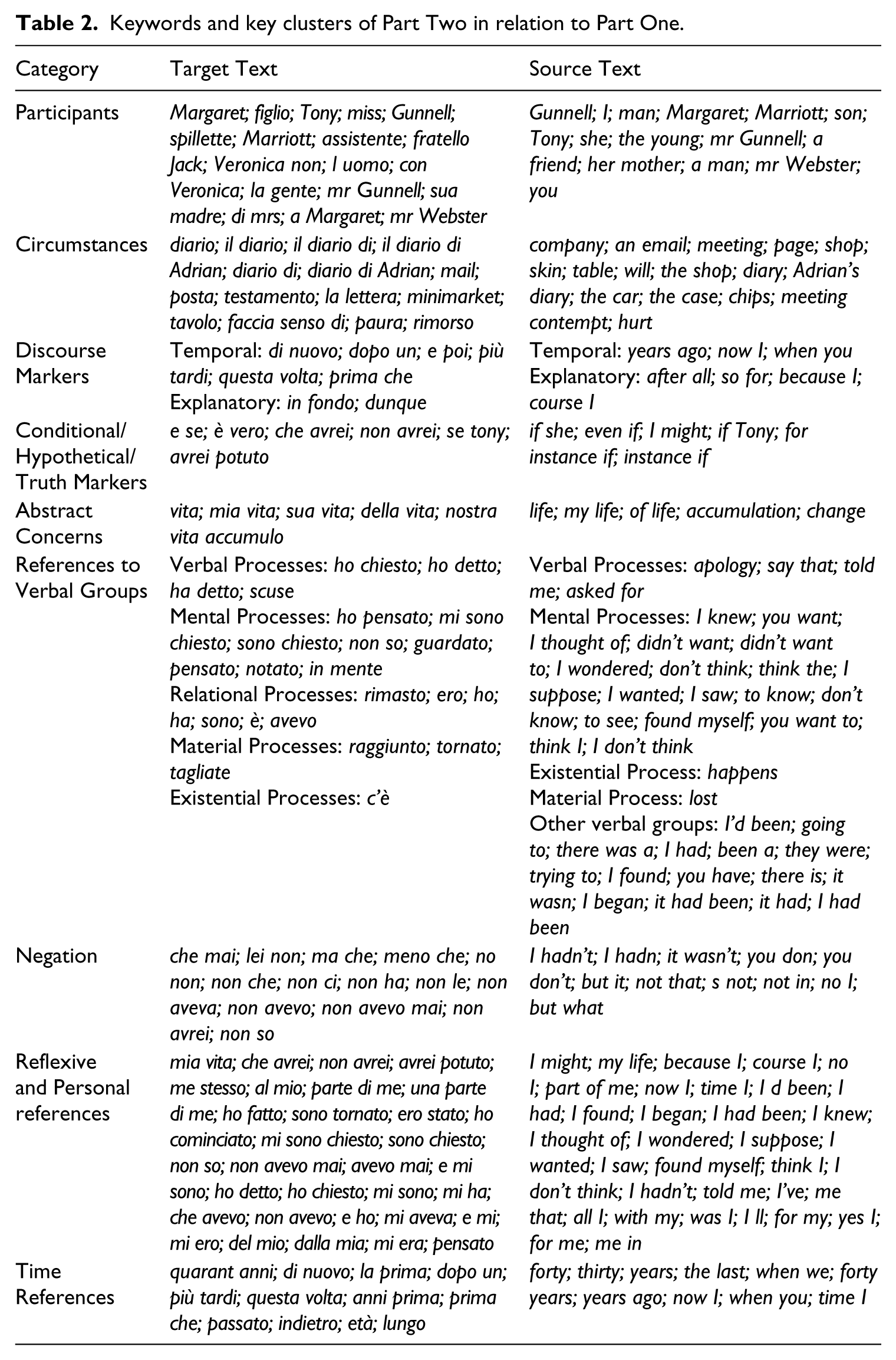
| Category | Target Text | Source Text |
|---|---|---|
| Participants | Margaret; figlio; Tony; miss; Gunnell; spillette; Marriott; assistente; fratello Jack; Veronica non; l uomo; conVeronica; la gente; mr Gunnell; sua madre; di mrs; a Margaret; mr Webster | Gunnell; I; man; Margaret; Marriott; son; Tony; she; the young; mr Gunnell; afriend; her mother; a man; mr Webster; you |
| Circumstances | diario; il diario; il diario di; il diario di Adrian; diario di; diario di Adrian; mail; posta; testamento; la lettera; minimarket; tavolo; faccia senso di; paura; rimorso | company; an email; meeting; page; shop; skin; table; will; the shop; diary; Adrian’s diary; the car; the case; chips; meeting contempt; hurt |
| Discourse Markers | Temporal: di nuovo; dopo un; e poi; più tardi; questa volta; prima che
Explanatory: in fondo; dunque |
Temporal: years ago; now I; when you
Explanatory: after all; so for; because I; course I |
| Conditional/Hypothetical/ Truth Markers | e se; è vero; che avrei; non avrei; se tony; avrei potuto | if she; even if; I might; if Tony; forinstance if; instance if |
| Abstract Concerns | vita; mia vita; sua vita; della vita; nostra vita accumulo | life; my life; of life; accumulation; change |
| References to Verbal Groups | Verbal Processes: ho chiesto; ho detto; ha detto; scuse
Mental Processes: ho pensato; mi sono chiesto; sono chiesto; non so; guardato; pensato; notato; in mente Relational Processes: rimasto; ero; ho; ha; sono; è; avevo Material Processes: raggiunto; tornato; tagliate Existential Processes: c’è |
Verbal Processes: apology; say that; told me; asked for
Mental Processes: I knew; you want; I thought of; didn’t want; didn’t want to; I wondered; don’t think; think the; I suppose; I wanted; I saw; to know; don’t know; to see; found myself; you want to; think I; I don’t think Existential Process: happens Material Process: lost Other verbal groups: I’d been; going to; there was a; I had; been a; they were; trying to; I found; you have; there is; it wasn; I began; it had been; it had; I had been |
| Negation | che mai; lei non; ma che; meno che; no non; non che; non ci; non ha; non le; non aveva; non avevo; non avevo mai; non avrei; non so | I hadn’t; I hadn; it wasn’t; you don; you don’t; but it; not that; s not; not in; no I; but what |
| Reflexive and Personal references | mia vita; che avrei; non avrei; avrei potuto; me stesso; al mio; parte di me; una parte di me; ho fatto; sono tornato; ero stato; ho cominciato; mi sono chiesto; sono chiesto; non so; non avevo mai; avevo mai; e mi sono; ho detto; ho chiesto; mi sono; mi ha; che avevo; non avevo; e ho; mi aveva; e mi; mi ero; del mio; dalla mia; mi era; pensato | I might; my life; because I; course I; no I; part of me; now I; time I; I d been; I had; I found; I began; I had been; I knew; I thought of; I wondered; I suppose; I wanted; I saw; found myself; think I; I don’t think; I hadn’t; told me; I’ve; me that; all I; with my; was I; I ll; for my; yes I; for me; me in |
| Time References | quarant anni; di nuovo; la prima; dopo un; più tardi; questa volta; anni prima; prima che; passato; indietro; età; lungo | forty; thirty; years; the last; when we; forty years; years ago; now I; when you; time I |
Declaration of Conflicting Interests
The author(s) declared no potential conflicts of interest with respect to the research, authorship, and/or publication of this article.
Funding
The author(s) received no financial support for the research, authorship, and/or publication of this article.