







Abstract
Informed by Goffman’s concept of footing, this study seeks to explore the multiple voices and speaking roles that a pamphleteer may assume in the preface of witchcraft pamphlets, along with their pragmatic functions. The study quantitatively and qualitatively analyzes the prefatory section of 13 witchcraft pamphlets, spanning from Elizabethan to Jacobean England (1566–1621). The findings reveal the ways in which pamphleteers consistently shift into and depart from three speaking identities (authorial, interlocutory, and character roles), and different patterns of speaking role inhabitance are witnessed during the periods under study, which in turn makes the prefaces come across in different ways. Such distinct patterns strategically serve to promote the reception, and avoid the refutation, of the main text.
1 Introduction
From a discourse-pragmatic perspective, it has been established that language is a fundamentally dialogic phenomenon (Bakhtin, 1981), and that a text embodies ongoing interaction between writer and reader. What this means is that writers are regarded as not simply producing informative texts, but also using language to construct and negotiate meanings and interpretations with readers. In their management of interaction, successful writers need to shape their texts to the expectations of their audiences by taking up a set of positions in relation to what is said and alternating between them throughout the interaction. This may involve, for example, showing ownership of and taking responsibility for the content they author, reproducing a stretch of discourse that comes from a different source, and displaying explicit recognition of readers by acknowledging and responding to their uncertainties and guiding them to desired interpretations.
One kind of textual genre where such a relational process plays a key role is the preface. Collectively known as ‘paratext’ (Genette, 1997), such items as prefaces, dedications, epilogues, and the like have been argued to be a site of interaction between writer and reader outside of the main text, and found to functionally constitute a highly complex process of mediation between the book, author, publisher, and reader. The paratext, Genette (1997: 2) argues, is a threshold: [A] zone between text and off-text, a zone not only of transition but also of transaction: a privileged place of pragmatics and a strategy, of an influence on the public, an influence that […] is at the service of a better reception for the text and a more pertinent reading of it.
The paratext not only has an informative role, but it can also enhance the reader’s reading experience and help guide them through the main text, hence its interactive role. This observation appears to be valid in historical texts as well (see Smith and Wilson, 2011).
The present research further pursues the issue of interaction in paratexts, and proposes to analyze the prefatory section of Early Modern witchcraft pamphlets, published in Elizabethan and Jacobean England (1566–1621). The analysis is guided by the following questions: (a) what forms does the basic interactional pattern take in such texts and across two historical periods? and (b) what may be the pragmatic functions they serve?
To answer these questions, this study embraces an interactional view of discourse, conceptualizing the preface as not primarily informational (i.e. providing concrete detail about the text and its origins), but rather as an apparatus that provides an interactive framework for engaging readers with a variety of strategies having to do with the content of the book, such as informing, evaluating, persuading, and promoting. However, informed by Goffman’s concept of footing (1981), this study does not reify the identity of pamphleteer (e.g. Chaemsaithong, 2011, 2013; Suhr, 2012), but instead seeks to explore in detail how pamphleteers consistently negotiate meanings by orchestrating and embedding different voices and speaking perspectives in and through a given stretch of prefatory texts, thereby exhibiting complex interactional feats.
As will be shown shortly, the pamphleteers in this study consistently shift into and depart from three speaking identities in their persuasive endeavor (namely, authorial, interlocutory, and character roles) for different pragmatic motivations. Different patterns of ‘speaking role inhabitance’ (Koven, 2002) are witnessed in the periods under study, which in turn makes the prefaces come across in different ways. Such distinct patterns strategically serve to promote the reception, and avoid the refutation, of the main text.
This research contributes to present-day linguistic and literary studies on at least three counts. First, it demonstrates how contemporary discourse approaches can be applied to historical texts and language users. Second, since communicative genres ‘have strong historical associations […] that extend beyond the present setting of production and reception, thereby linking a particular act to other times, place, and persons’ (Briggs and Bauman, 1992: 147–148), our understanding of the interactive nature of the preface genre can be enhanced through an analysis of the formative bodies of discourse. Finally, from a diachronic perspective, this study sheds light on changes in the communicative patterns and pragmatic motivations of Elizabethan and Jacobean pamphleteers.
In Section 2 below, the sociolinguistic context of the texts under investigation is provided, and in Sections 3 and 4 the theoretical framework and data are discussed. Section 5 presents the findings in detail, and Section 6 concludes with some insights into footing shifts and interaction in prefatory texts.
2 Witchcraft pamphlets and their prefaces: sociolinguistic aspects
The so-called classical period of witch craze in Early Modern Europe (1480–1700) not only engendered the tragic executions of 45,000 accused individuals (Levack, 2006: 23), but also gave birth to numerous text types. One type of text that was printed and distributed as a means to inform the public and disseminate stories about witchcraft, which was a concern of English people then, was witchcraft pamphlets. The first surviving pamphlet was produced in 1566, just three years after the criminalization of witchcraft in 1563. This novel type of publication quickly gained popularity, and became one of the primary vehicles that catered for both literate and illiterate readers ‘who would have had neither the access to nor the education for the rare and costly handwritten books of the fifteenth century’ (Clark, 1983: 23).
To satisfy the reading tastes of the intended readers, pamphleteers emphasized and sensationalized moral aspects of the reported events. At the same time, however, the pamphleteers necessarily persuaded the reader to adopt a particular view that they endorsed as the ‘right’ one, and hence the pamphlets can be seen as a means of propaganda with the purpose of influencing a mass audience (Claridge, 2010: 595). Investigating the production of witchcraft pamphlets, Suhr (2011) finds that the pamphleteers seek to influence the reader subtly through gruesome examples and sensational stories, rather than polemical arguments. As reading became a more widespread skill and practice, the generic structure was found to change over the years. For example, illustrations and headings disappeared, as they were perceived as unnecessary.
Virtually all the pamphlets that have survived feature a preface (although in a few pamphlets it has been damaged or lost). The preface is the first place of encounter between the pamphleteers – often anonymous – and the readers, who were socially diverse, including those could not read themselves and those who could not afford to purchase the pamphlets. Here the pamphleteers – aware of such diverse groups of readers – gave explicit or implied advice on how to read the main text, what witchcraft is, who witches are, and how the information contained therein should be processed. The preface, therefore, constitutes a site of persuasive monologue, as Raymond (2003: 95) remarks: Prefaces were a means of courting the reader, necessary not only to enhance sales but to reduce the risk of misreading. Pamphlet authors surrendered themselves to the judgment of the marketplace, and expressed feelings ranging from resentment through humility to resignation.
In this way, the preface functions to ensure that the main text would be understood in a particular way. Through the preface, pamphleteers endeavor to change or strengthen some beliefs as well as to increase the number of readers by conducting interpersonal negotiations and balance claims for the validity of their arguments against the convictions and expectations of their readers. Therefore, the preface can be argued to be dialogic in the sense that although no immediate feedback is expected for any speech acts, it features the pamphleteer’s anticipation of and response to opposing viewpoints, some of which might come from prospective readers, and others from society at large. This is also in accordance with van Eemeren et al.’s view (2007: 10) that an argumentative monologue can be thought of as ‘a critical discussion in which the protagonist has the floor to defend his standpoint while the antagonist’s portion remains implicit.’
In her pilot study of main pamphlet texts, Suhr (2006) finds that there is a paucity of interactive and dialogic devices, such as questions or reported speech, as the content was based on trial documents and third-person narratives. The researcher recently notes that the trial-based pamphlets are likely to sound ‘impersonal,’ whereas accounts in narrative form include interpersonal and emotive language (Suhr, 2012: 131).
Recent linguistic studies on prefatory materials in witchcraft pamphlets have examined linguistic resources that signal writer stance and interpersonal engagement, such as frame markers, code glosses, and evidentials (Chaemsaithong, 2013). Such devices enable the pamphleteers to depict the accused individuals as threats to society, while presenting themselves positively through goodwill (Chaemsaithong, 2011).
While the above studies are insightful and do much to inform the present study, they are only preliminary, based on selected texts from each period, and they focus on specific linguistic devices, such as rhetorical strategies (Chaemsaithong, 2011) and meta-discourse (Chaemsaithong, 2013). More importantly, they assume a monolithic identity of the pamphleteers, but they do not consider how, within the broader role of the writer, the pamphleteers may have taken on and embedded different identities and speaking perspectives. In addition, the loading of these roles can be quantified and compared within and across texts. Thus, while building on previous studies, the present study goes further to explicate the process of relational work by both quantitatively and qualitatively analyzing the interpenetration of multiple voices, and how such voices are employed to structure and organize the discourse of the preface texts. Such a diachronic perspective enables us to understand the writing situations and development of the genre in the periods under study.
3 Theoretical foundations: footing and speaker roles
To examine the ways in which pamphleteers consistently alternate their speaking positions in relation to the material being presented and the interlocutors involved, Goffman’s (1981) concept of footing is a useful point of departure. Goffman notes various deficiencies in the traditional dyadic paradigm for talk, which includes only the categories of speaker and hearer, and proposes that these roles should be decomposed into more differentiated parts. For example, the notion of speaker is decomposed into animator, author, and principal, whereas the notion of hearer is decomposed into addressed and unaddressed recipient. Participants in the aural and visual range of an utterance will assume a particular position from the above set. These refined categories of speaker allow us to distinguish different ways in which a speaker may present herself when producing speech.
Any change in the alignment an individual takes in terms of these speaking positions is reflected in change of footing, which can be defined as a change in the participant’s stance, or projected self. Such shifts in the alignment of speaker to audience occur frequently and continually, and should be taken to be a perpetually recurring feature of natural social interaction. As part of this process, a speaker creates different projections of identity, almost as if involved in a theatrical performance. To signal different speaking positions, an interlocutor may use linguistic cues such as suprasegmental features, syntactic patterns, or different registers or dialects. Take reported discourse as an example: speakers may manipulate grammatical items, such as pronouns, deixis, and verb tenses, in reported speech clauses to distance themselves from the quoted information, and to impart a sense of authenticity to what was originally said.
To illustrate with a contemporary example, the press secretary talking at a White House press conference is the animator, actually speaking the words. At the same time, she is speaking in the name of someone else, the US President, who in Goffman’s term is the principal. And while she may have chosen the words herself, they may also have been chosen by others on the team, so there may be an author distinct from the animator. This example reveals the central idea behind footing: our social identities are not static or structurally determined, but contextually situated and interactionally emergent.
Goffman’s concept of footing can be related to Bakhtin’s (1981, 1986) concept of voicing, which refers to a social role or position that a character enacts. In a similar vein, Hymes (1981) discusses shifts into direct quotation as breakthroughs in performance, regarding them as an important site for the enactment of socially locatable voices, where speakers can incarnate multiple versions of themselves and others. Thus, through the deictic expressions and syntactic patterns a speaker uses, hearers can determine what role the speaker is playing. An important aspect of this is that a speaker will often re-animate the words of other people and, in doing so, will be able to fashion a different persona by taking on a character’s role. In effect, a text becomes intertextual, as it is interpenetrated with multiple voices and displays ‘snatches of other texts, which may be explicitly demarcated or merged in,’ and with which the speaker may further engage by showing (dis)alignment with what was said originally (Fairclough, 1992: 84). Certainly, it is not only in spoken discourse that language users show such shifts in participant roles; written discourse is also multi-voiced and is comprised of multiple role perspectives. One such case is the preface of witchcraft pamphlets.
As illuminating as the notions of footing and voice may be for the analysis of writers’ positions in witchcraft pamphlets, it remains somewhat unclear how to apply them systematically to the study of actual discourse. A few questions may be posed as to what are the precise interactional roles that may emerge in a particular discourse setting, how many roles there are, and what may be the linguistic indicators of different speaking roles for linguists to operationalize. In particular, Levinson (1988: 221) suggests that Goffman’s notion of footing and his proposed set of participant role categories should be integrated into a rigorous analysis of ‘who stands in which when.’ This focus point is in line with Fairclough’s (1995) recommendation that discourse analysts ask the following questions: ‘What are the participants’ voices in the text?’ ‘How are they constructed?’ and ‘What relationships are set up between participants?’ (203).
The above limitations can be addressed by insights from Koven (2002). Synthesizing the notions of footing, voicing, and intertextuality, the researcher provides a theoretical and methodological approach for the analysis of an interlocutor’s interactional roles in discourse. She proposes that an interlocutor takes on three main roles: authorial (or narrator); interlocutor; and character, as well as a combination of these. Each role is signaled by distinct deictic expressions, and is activated to accomplish particular discourse functions. The authorial role, for instance, is taken up to simply present a description of events, showing no overt engagement with the interlocutor. It is in this role that the interlocutor most often describes the plot and characters, and accomplishes most referential work, thereby allowing the interlocutor to linguistically distance herself from the discourse, thereby making the discourse more neutral to what she is presenting. This speaking role is typically marked by the use of past tense narration and an absence of commentary or re-performance of characters’ words.
Writers assume the interlocutory role when they position themselves as their speaking selves and interact with the audience in ways that go beyond simply providing referential information. This may be done by employing first-person pronouns such as I or we, while referring to the reader as you, to position both parties as interactors in that particular context. The verb forms used also indicate that the process of interaction is happening as the discourse is taking place. In this voice, writers may also directly signal to the reader how they evaluate the information being presented, invite them to share their current stance toward the story, and provide guidance about how to process the referential information conveyed in the narrator’s voice. Speech from this role contributes relatively less referential or propositionally explicit information, and the speaker appears more involved in and less neutral with respect to the discourse. Deictic items indicative of this voice include parenthetical remarks, explicit appeals to the interlocutor, or an evaluative comment on the narrative.
Finally, a character role is taken when an author writes in the words of others within the narrated world, for instance, when re-enacting the words of characters in the narrative. A character may be made to speak in a way that contrasts with the authorial or interlocutory style, thereby emerging locally as a particular type of person (or source) in order to create interpersonal involvement with the audience. Here the text is no longer a story, but becomes drama. This role may be performed through direct discourse and indirect discourse. In this voice, personal pronouns, verb tenses, and other deictic terms no longer point to person, place, and time in the current event of speaking, but rather may function to re-present the narrated event of speaking. This linguistic phenomenon has also been referred to as ‘constructed dialogue’ (Tannen, [1989] 2007; Vandelanotte, 2009), as what is reported or direct quotation in conversation is usually not spoken, and is reconstructed to fit the new context.
The above insights address the linguistic shortcomings in Goffman’s framework, and are particularly illuminating for the analysis of interactive speaking roles in witchcraft pamphlet prefaces, for they enable us to capture the subtle complexities of interaction between writer and reader. With a quantitative attention to the way in which a writer assigns different functional weights to each role, it is possible to systematically explore how the pamphleteers may shift between these roles within the same prefatory text and across texts, and how this may have changed through time.
4 Data and methodology
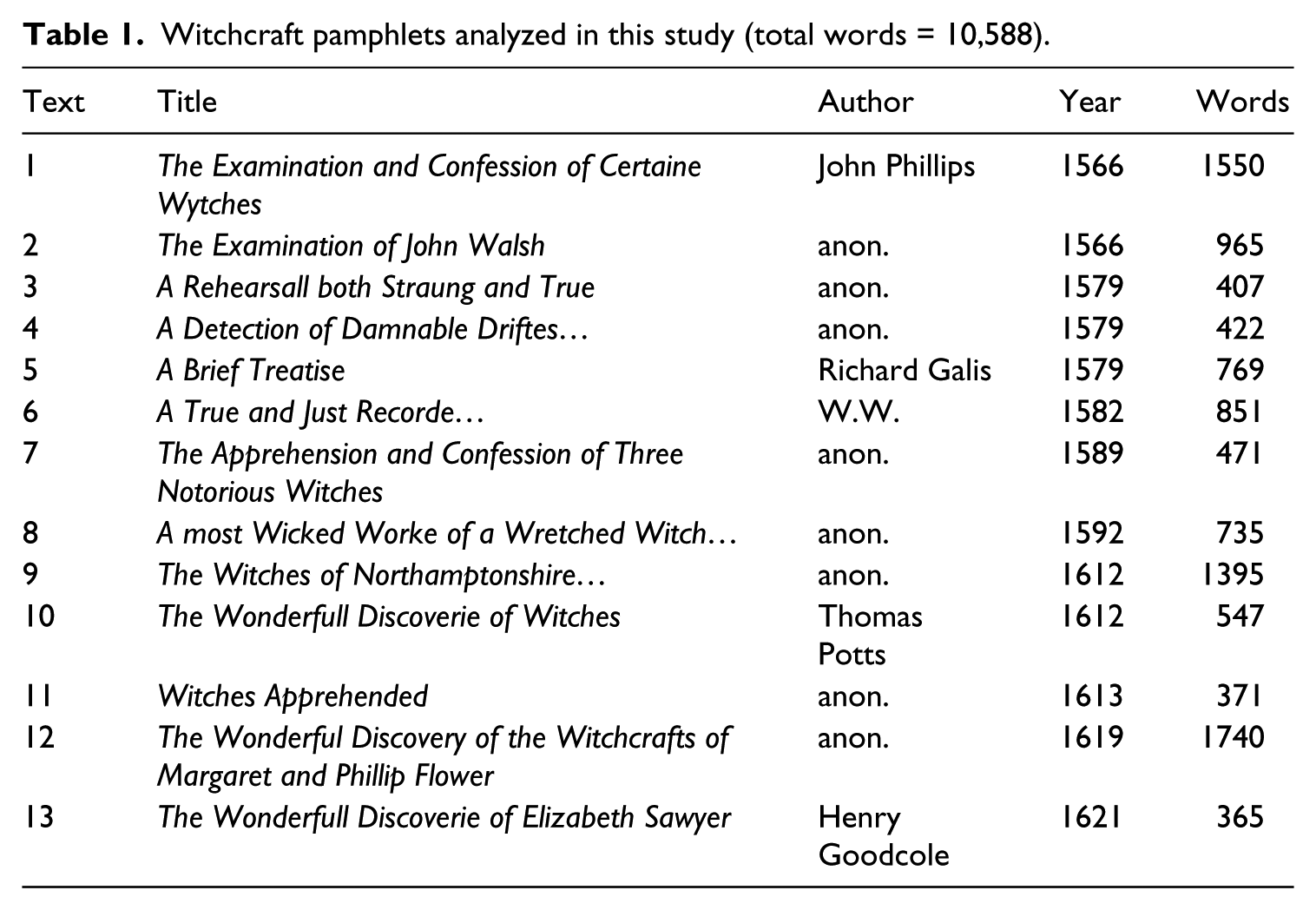
The prefaces of 13 pamphlets that spanned the period from 1566 to 1621 were selected, as listed chronologically in Table 1. The first witchcraft pamphlet was likely published in 1566, and they started to fade out of publication after 1621 (Gibson, 1999: 179, 183; Gibson, 2000: 8). These texts are faithfully reproduced in Gibson (2000).
Witchcraft pamphlets analyzed in this study (total words = 10,588).
Using deictic clues as guidelines, I examined the data in their sentential context to classify the three speaking roles, as described by Koven (2002). The authorial role was coded when the writer described events in ‘then-and-there’ moments, telling the reader what transpired (or what may happen) at a place and time clearly distinct from the current event of speaking. In contrast, the interlocutory role was marked when the writer linked the authorially narrated events to the context of the ongoing interaction in which he was telling the story, thereby revealing the ‘here-and-now’ relationship, attitudes, affects, and identifications with the reader (and with the characters and events in the story). The character perspective was noted when there was an instance of direct, indirect, or free speech reporting. Each clause of reported speech is codable as an instance of character speech.
To compare the loading of the speaking roles across prefaces, I tallied up the frequencies of role performance. Since the prefaces in the corpus are of different length, I standardized the numbers as rates of each role inhabitance per 1000 words (that is, the raw counts in a text are divided by the number of words in that text and then multiplied by 1000). One unit is a clause (including main/subordinate and finite/non-finite clauses) of authorial, character, or interlocutory speech.
The following example shows how the pamphleteer can switch among three speaking roles (the narrator voice appears in plain text, the interlocutory voice in bold, and the character voice in italics): (1) Like unto hym was Pope Gregory the vii. otherwise called Hellybrand (
This excerpt consists mostly of the narrator’s role (8 units), through which the prefacer recounted a story of a Pope involved in witchcraft practices, intended to show the wide spread of such practices even among renowned and respected figures. However, note that the pamphleteer breaks from the advancement of the plot twice: first when he steps into the interlocutory role to enact a parenthetical repair, thereby linking the narrated event to the ongoing context of written interaction (1 unit), and second when he assumes a character’s perspective and reports the words of the cardinal (1 unit).
5 Findings
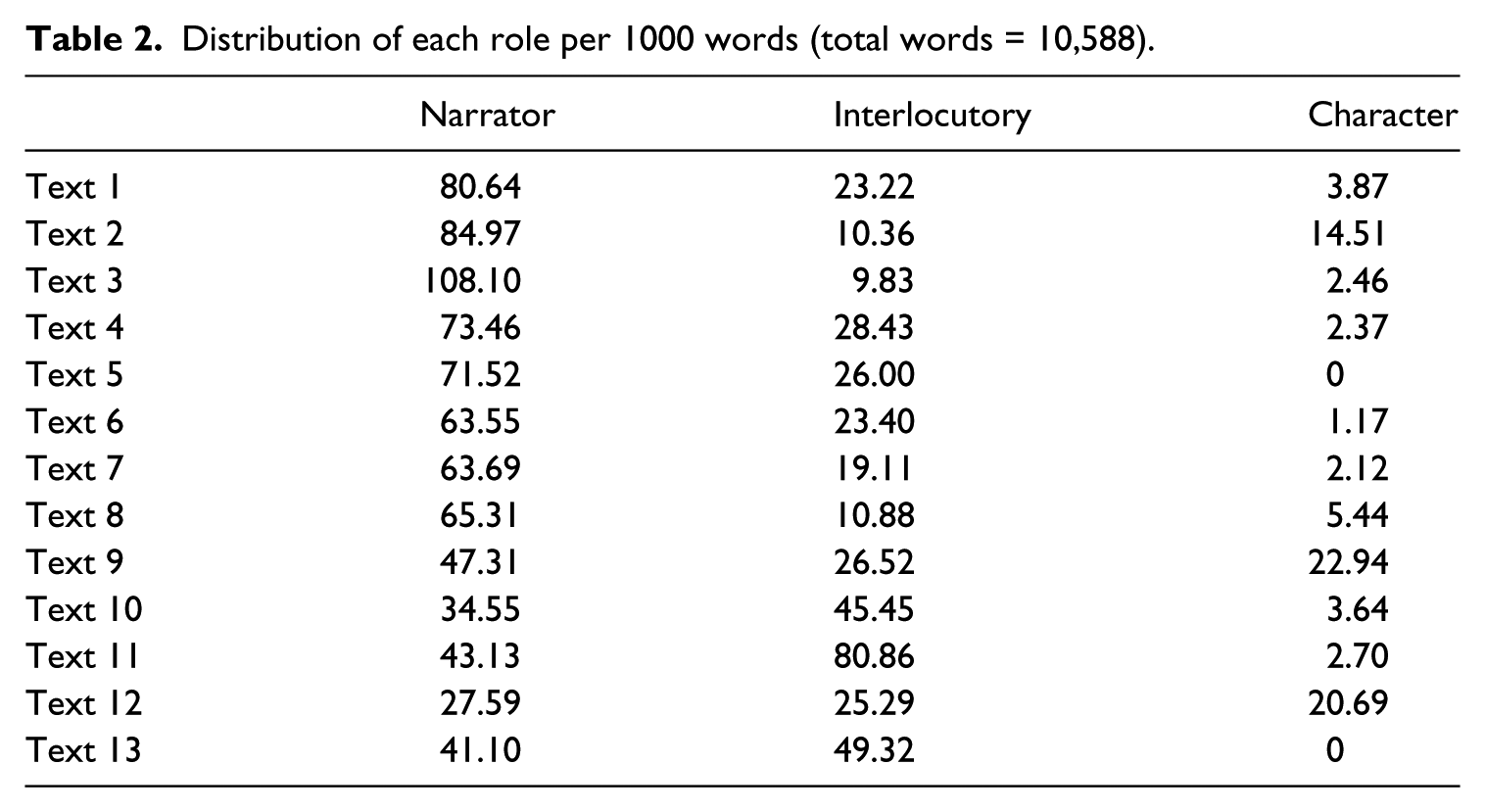
The quantitative findings are shown in Table 2, and illustrated in a line graph in Figure 1 below.
Distribution of each role per 1000 words (total words = 10,588).
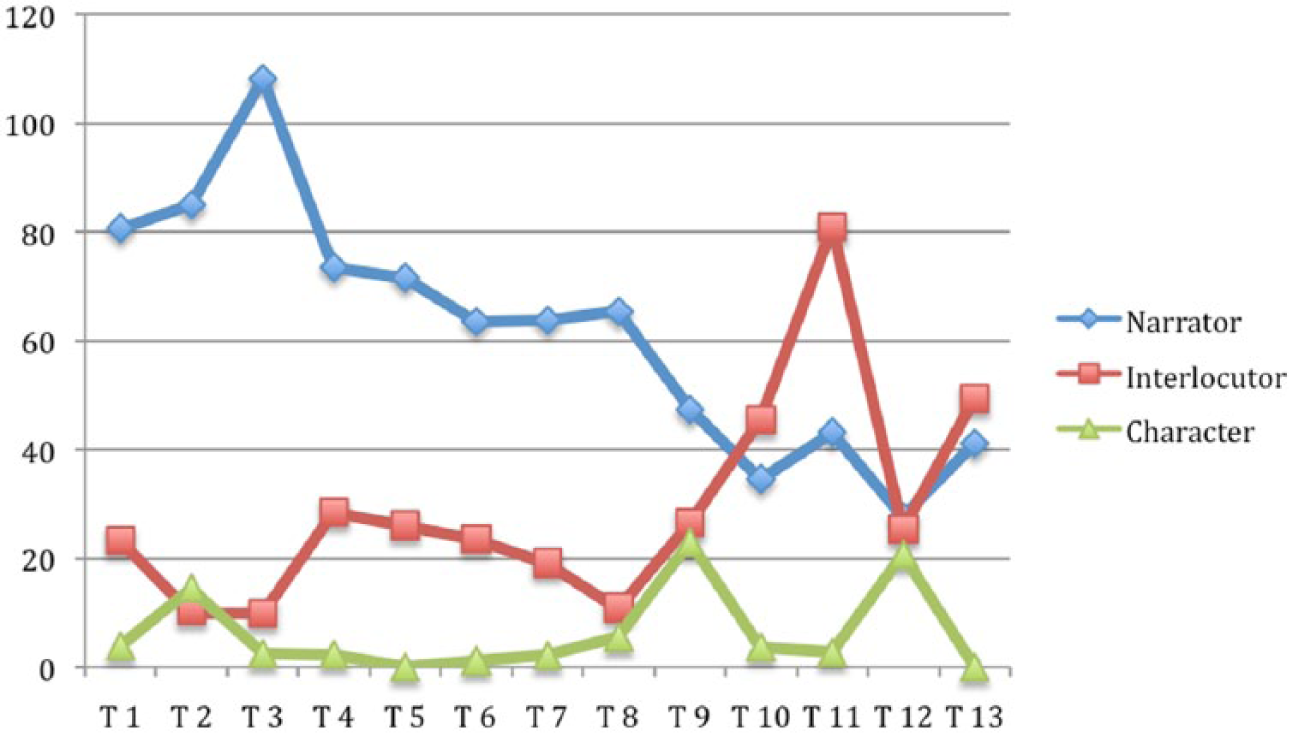
A line graph showing the distribution of each role within and across texts (per 1000 words).
Overall, the use of the narrator voice, while exhibiting some fluctuations across texts, clearly predominated in the Elizabethan period. It started off at around 80 to 85 units per 1000 words in 1566 (Text 1 and Text 2), and rose to a peak of 108.10 units in 1579 (Text 3), before it dropped and leveled off at around 63 to 65 units in the last two decades of the period (Text 6, Text 7, and Text 8). In contrast, the Jacobean period witnessed a marked decline in this voice, starting in Text 9. The highest occurrence did not go beyond 47.31 units. Interestingly, what occurred concurrently with the decline in the narrator role was a rise in the inhabitance of the interlocutory role in the Jacobean period. The shifts into this particular perspective reached a peak of 80.86 units in 1613 (Text 11) and decreased to 25.29 in 1619 (Text 12), before rising to 49.32 units in 1621 (Text 13).
As for the character role, most texts in the Elizabethan period display relatively similar frequencies, around 2 to 5 units per 1000 words, with the exception of Text 2 (14.51 units per 1000 words). This is not surprising because quotations were likely to be strategically inserted at selected moments, for example, when the pamphleteers wished to strengthen their arguments with authoritative evidence, or when they wished to establish an intertextual link to undermine the credibility of that source. A similar pattern can be observed in the Jacobean period, with two exceptions being Text 9 and Text 12, which feature significantly high occurrences of this voice (22.94 and 20.69 units respectively). There are two texts (Text 5 and Text 13) where this role does not materialize at all. These exceptions may be attributed to individual choices, rather than any observable systemic variation. Interestingly, Suhr (2006) finds a similar tendency in the main texts: most pamphleteers preferred to use third-person narrative (while also employing evaluative expressions to modify the accounts, thereby making them persuasive), except when the pamphleteers wished to report the deposition of one witness in a lively way.
The above variation of roles may be argued to be a consequence of the decline in witchcraft beliefs and changes in religious attitudes concerning magic, devil worship, and witches. In contrast to the 16th century, when belief in witches was widely accepted, skepticism was noted to have grown in the 1620s (Sharpe, 1996: 146). Whatever the causes might be, 2 the printing of witchcraft pamphlets was affected when the subject became controversial and was subsequently subject to censure. The pamphleteers must have been aware of such changes, and as a result felt the need to justify their writing or publication, or discuss some controversial issues. The interlocutory voice is best fit for such purposes (see my detailed discussion of each role below).
On closer examination, each speaking capacity is motivated for specific pragmatic purposes, as explicated below.
5.1 Authorial/narrator voice
In this capacity, the pamphleteer takes on responsibility for giving a preview of the narratives to be presented in the main text, or to establish a case that allows the reader to later integrate details into the theme. As can be seen in (2), the pamphleteer assumes the narrator voice to put an entire story in a compact package, which will be expanded on in the content section: (2) The late wofull Tragedy of the destruction of the Right Honourable the Earle of Rutlands Children, who to his eternall praise proceedded yet both religiously and charitably against the offenders, leaving their prosecution to the law and submitting himselfe, and deplorable case to the providence of God, who afflicteth his best servants with punishments, and many times, sendeth extraordinary vengeance as well on the innocent, as the bad deserver, to manifest this glory.
3
(Text 12: 284)
Similarly, in (3) the pamphleteer reveals some demonological assumptions underpinning the work. Witches are projected as both a spiritual and social problem, because witchcraft involves the devil and innocent victims.
(3) Of wrathfull witches this same pamphlet tels, How most of all on simple folke they worke. What wonders to they may atchive by spels, God weede them out in evey cell they lurke, God weede them out, but satan stil doth hatch… (Text 8: 140)
Second, the narrator voice is used to present narratives from other contemporary witchcraft cases. Presenting narratives from a familiar context, the pamphleteer shows evidence of the prevalence of witchcraft practices (or creates an awareness in those readers who were new to the subject matter). Such narratives imply that readers will experience similar outcomes if they practice witchcraft for any purposes. This use of the narrator voice functions as an implicit warning to the reader and, at the same time, lends argumentative support to the case to be presented in the main text. In (4), a reference is made to the subject of Text 11.
(4) The severall and damnable practises of Mother Sutton of Milton Miles in the County of Bedford, and Mary Sutton her Daughter, who were arraigned, condemned, and executed for the same: As also 1612. The wonderfull discovery of Witches in Lancashire, being 19 in number, notorious for many infamed action, and convicted before Sr. James Altham…And so much for the certainty of story, and fearfulnesse of the truth concerning the damnable practises of witches and cunning of the Divell to deceive them. (Text 12: 283–284)
Third, the narrator voice is used to recount stories from outside of the local context (such as the scriptures and historical figures). Such narratives serve to contextualize the narrative of the main text, thereby enabling the reader to relate to it easily, as in (5): (5) He [Satan] is named a Dragon of his pollicie, because that since the time of Adam, among so many thousands, in so many years, there hath been founde none so wise or warie, that could withstand his strategems, but he hath wounded and poisoned them well nighe unto death…He hight [is called] a Lion also of his power, bicause that as the solide bodie of the Lion is powerfull: so especiallie consisteth great strengthe and power in his taile. We doubt not but this adversarie, or Apollyon of ours of himselfe is mightie…yet to make his victorie more sure, and not to faile of his purpose, he useth also the force of his tayle; that is, his inthraled boundslaves, whom he hath sealed to execute his wil and pleasure uppon the harmelesse…(Text 8: 141)
In the above extract, the pamphleteer lists one of Satan’s names and tries to explain its significance, which in turn shows the writer’s demonological underpinning. Witches are constructed as oppressors who, with aid from the irresistible, powerful devil, preyed on the ‘harmless’ people, without any reasonable cause. Towards the end of the extract (‘yet to make his victorie more sure…and pleasure uppon the harmelesse’), the pamphleteer establishes an implicit connection to the main text. As a result, this narrative of Satan as a dragon thematically accords with the main text, which tells of a witch that became irritated by the innocent victim without any just cause.
Finally, the narrator voice is used to construct a narrative involving the pamphleteer himself. Pamphleteers brought in personal aspects outside of the writing context into the preface. This in turn let the reader learn about their identities and motivations for writing, as can be seen in (6): (6) [the pamphlet] describing the strange, cruell and diabolicall tyranny practiced through the little regarde and great necligence of magistrates in these our dayes winking at ye faultes of the offenders which neither regarded the pitteful plaints of the tormented nor the continuall plagues of the tormentor powred out day by day upon their honest and innocent neighboures, some bereft of life, some of their wits, and some of the naturall course of their lims… (Text 5: 53)
Like most prefaces, this extract provides no specific preview of the main text, but is intended to set up a frame of how to interpret the events to be reported in the main text. The legal system, the readers were told, was not effective in preventing the crime. Continuing in the same role, the pamphleteer revealed how he came to compose the pamphlet, in part because of his resentment toward witches. He subsequently contrasts this with his portrayal of himself as a modest writer. In doing so, he could subtly claim that his writing is for the public good and not a product of a hack writer.
All in all, the authorial voice is used to present the narratives about witchcraft practices as if there is no doubt that they did occur, both in local and non-local contexts. While such narratives are not directly about the case to be presented in the main text, they nevertheless serve to provide evidence for the events in the main text, a frame the reader can use to view the main text, and a bridge that connects the pamphleteers’ beliefs and experiences with those of the reader, when the narratives include elements of the pamphleteers’ outside life or when they refer to a religious background that the readers may also share.
5.2 Interlocutory voice
The interlocutory voice, the voice of the present moment, is mainly used to build a relationship between the pamphleteer and readers. It is worth noting that verbs in this voice are mostly in the present tense, and that the pamphleteer often uses first-person pronouns to refer to himself (and also to the readers, in the case of first-person plural pronouns), and second-person pronouns to refer to the readers as participants in the ongoing monologic discourse. First-person plural pronouns are particularly interesting as part of the interactive function of this voice, as illustrated by (7): (7) If we could call to remembrance the manifolde mercies and innumerable benefites which the Almighty hath and daily bestoweth upon us…we are bound to with-draw our filthy affections and naughty dispositions, from the use of such detestable dealinges… (Text 7: 130)
Here, at the very outset of the preface, the pamphleteer establishes a group that includes himself and the readers through the pronouns we and us, guiding them to think along the same lines. By creating a single entity, the pamphleteer can invoke, at least linguistically, a sense of unity between himself and the readers.
Next, the interlocutory voice is characterized by the inclusion of many interactional speech acts such as: (8) a. Well-wishing b. Farewell Thus c. Apologies d. Commands and requests So persever wil e. Advice
Therefore by way of caution,
Therefore, well-wishing, farewell, and apologies such as those in 8 (a, b, c) are solidarity-building devices as they were directed at the addressee’s positive face needs. Commands, requests, and advice, as in 8 (d, e), mainly demonstrate the position of power the pamphleteer occupied. The presence of these speech acts in all of the prefaces likely points to the pamphleteer’s pragmatic awareness of addressing and engaging the reader in the here-and-now moment.
At times some pamphleteers employ questions to index a shift into the interlocutory role, though well aware that the reader is in no position to answer. Some interrogatives function to stimulate interest and action in an issue, or to confirm an existing belief. Interestingly, the answers to these questions are supplied right after the questions. For example, the questions in (9), together with the answers, serve to highlight the pamphleteer’s position on the severity of punishment on witches.
(9) This doubtlesse is no lesse necessarye then the best, that sorcerers, wizzardes…witches…are rygorously punished. Rygorously sayd I? Why it is too milde and gentle a tearme for such a mercilesse generation… And why? Because al the imaginations…are meere blasphemers against the person of the most high God. (Text 6: 75)
Some questions are more expository in nature, functioning to introduce a topic or to provide textual scaffolding. For example, the pamphleteer in (10) is primarily concerned with the problems of understanding witchcraft and endeavored to critically discuss types of witches and witchcraft, rather than just condemning witchcraft like other pamphleteers. In so doing, he theorizes the subject and uses headings in the form of question in his presentation: (10) Behold these acts & scan them well, behold their pervers way: these left ye lord these did his truth […] what tender harte would god renounce, who woulde his gospel leave: what godly one woulde hate his lorde, and unto Sathan cleave (Text 1: 14)
Other questions are intended to problematize an issue. In this case, the purpose is not to provide specific information or an answer to the question, but rather to create an indirect statement through inference. As a whole, they build up an argument in an interactive way, as they assume the reader’s participation in the line of reasoning. This is the case with (11), where it can be inferred from the context that the intention is to convey a negative stance on Satan and witches, instead of information about Satan. The questions therefore effectively contribute to enticing the readers into an agreement.
(11) For what can be more odious or abhominable unto God then the deprivation of his divine power, by yeelding our selves serviles unto sathan for a little worldly wealth, or hatred we have to our neighbours… (Text 7: 130)
This interlocutory voice also contributes to the production of a meta-discourse, as in the following examples: (12) I hold it no wisedome, or labour well spent to travel much therein: (Text 9: 161) (13) To babble and prate much of Christ and hys gospel…& to wante the chefest thing, I meane the frutes of well governed conversacion… (Text 1: 11) (14) In regard whereof I may conclude, that either it must be granted that there are Witches…or else the Oppositors, that being (I suppose) more precise then wise, standing rather upon the singularity of their owne opinions… (Text 9: 160)
Through these metadiscursive expressions, the pamphleteers make the texts more accommodating towards the reader. In these examples, the writer explicitly indicates his stance on the issue (12), provides an elaboration to his idea through the code gloss ‘I mean’ (13), and labels his discursive moves and communicative intentions (14), thereby facilitating the reading experience by providing linguistic guidance through the texts.
Finally, the interlocutory voice is observed where the pamphleteers convey their own mental processes (feeling, thinking, intention, evaluation, etc.). For example, in (15), the pamphleteer attempted to convince the reader about the existence of witches by proffering his opinion in the here-and-now moment, which in turn is subsequently supported by a narrative in the authorial voice (‘which our learned…such offendors’).
(15) Yet mee thinkes that the common experience, which our learned and Reverend Judges of the Land, finde daily in their yeerely Circuites by the convictions of such offendors…might put it out of question, that some such [witches] there be abroad in the world. (Text 9: 160)
In brief, the importance of this interlocutory role inhabitance is that it creates a relationship of various kinds between the pamphleteer and prospective readers, such as a sense of a shared identity, a position of authority (as in the cases of commands, questions, and advice), or an evaluative position.
5.3 Character voice
Speaking from the position of a character, pamphleteers present another way in which more than one voice can be introduced into a text (Zelizer, 1989). This may be achieved through speech reporting. Tannen ([1989] 2007) points out that reported speech is a misnomer: it is in fact constructed dialogue, so-called because when speech uttered in one context is reproduced in another, it is fundamentally changed, even if ‘reported’ verbatim, and in most cases, reported speech is not a report of something that was spoken previously, but it can be of an entirely fictional nature. Nevertheless, casting ideas as dialogue by embedding stretches of conversation in a monologic text is a persuasive discourse strategy because the writer is able to not only bring in external voices so as to manipulate them in support of his arguments, but also to demonstrate what a particular event looks, sounds, or feels like to the reader (Clark and Gerrig, 1990). The discourse in effect comes to be inhabited by words that are ‘half-ours and half-someone else’s,’ thereby making it possible to ‘reveal ever newer ways to mean’ (Bakhtin, 1981: 345–346).
Quotes are mostly used to introduce characters in a narrative so as to increase personalization (rather than to attribute some information to a source, although there are some such instances in my data). This role thus engages the here-and-now reader by dramatizing the exposition of concepts and the presentation of exemplary stories or hypothetical cases.
In my corpus, there are four groups of characters whose voices are reanimated. The first group includes characters in a narrative, as in (16) below. By including their voices, the narrative becomes more lifelike.
(16) But this courtierlike Devil replied and sayd, that he mistook his words, for I sayd not (sayde he) xix. yeares, but I ment xi. Yeares and viii. Monethes, and therefore nowe thou must needs dye. (Text 2: 27)
The second group includes an imagined group of people, as in (17), in which the statement is attributed to ‘some.’ This shows the pamphleteer’s pragmatic awareness of other perspectives in the debate that may stand in opposition to his, and how he responds accordingly.
(17) Some doe maintaine (but how wisely let the wiser judge) that all witchcraft…hath beene and is no more but either mere cousinage…It may be, some will say, what hurt can grow from this opinion? (Text 9: 160)
The third includes personal authorities, such as well-known authors. These characters are an important tool for the pamphleteers, not only to provide context to their arguments, but also to establish and amplify the credibility of their arguments. ‘Ventriloquating’ (Bakhtin, 1981) the voice of authoritative figures allows pamphleteers to recast and explain their words in a way that suits their arguments. In (18), the pamphleteer identifies the source as Pliny, the writer of Naturalis Historia (AD 77–79). Here, an analogy is drawn between Christians and serpents, although in the original source Pliny writes that he has seen serpents and a fire, both walled round by ash leaves, where the serpents would rather throw themselves into the fire than face the leaves.
(18) Plinie writes of some kinde of Serpents that dare not approach the wild Ashtree, nay the sight of it so terrible to them, that they flie from it, and will not draw neer the shadowe thereof, but if they be walled around with fire, they will rather runne through the confusion of themselves then endure it. (Text 11: 267)
Finally, the pamphleteers may cite from impersonal sources, which include quotes (whether attributed or unattributed) based on a proverb as in (19), or from the Bible as in (20). This allows the pamphleteer to call on the authenticity of the information presented and to demonstrate his scholarly expertise in the subject.
(19) Truth in despight of gaine sayers will prevaile, according to that principle: Magna est veritas & prevalebit. (Text 12: 284) (20) Levit. 20.6. If any turne after such as worke with spirits, and after soothsaiers, to goe a whoring after them, then will I set my face against that person… (Text 8: 140)
In sum, the inclusion of character voices lends persuasive power to the pamphleteer for many reasons, including when they wished to utilize the authority of a particular voice, when they wanted to undermine the validity of that voice, and when they presented themselves as someone who had a good knowledge of religious and cultural norms.
6 Conclusion
I have explicated how pamphleteers project different footings in the prefatory section of witchcraft pamphlets, and how these speaking roles vary in two historical periods. Such speaking roles, it is argued, constitute different ways in which the pamphleteers interact and negotiate meanings with the reader.
The quantitative findings show that in the period examined, the pamphleteers varied in the use of speaking roles. In the Elizabethan period the narrator role predominated, while in the Jacobean period it markedly dropped. This decline seems to be counterbalanced by a rise in the interlocutory role. That is, in Elizabethan England, the pamphleteers presented narratives from the scriptures, or from other sources as if they were giving sermons, through the use of the narrator voice, as they were secure in the knowledge that the main text was mainstream, safe, and approved of.
However, in the Jacobean period this assurance disappeared, and it was through the interlocutory voice that the pamphleteers treated the subject more seriously, as if a science. They assumed an interlocutory role to provide the theological underpinnings of the work in an attempt to create an impression of scholarly debate. Some pamphleteers went so far as to use this interlocutory voice to offer a lengthy disclaimer of intent, and explicitly stated their purpose of writing. This tendency can be attributed to a number of political, theological, and intellectual changes in this period (e.g. the scientific revolution, James’ questionable right to the throne, the Protestant Reformation and the responding Catholic Counter-Reformation, class conflict, and a breakdown of the medieval social order), which had a decisive influence on the thinking of the intellectual elite and which ultimately percolated down to influence the thought and behavior of the people at large (Bailey, 2007; Lachmann, 1994; Thomas, 1971). For instance, Thomas (1971) argues in his seminal work that the theological and intellectual developments robbed the old magical systems of their capacity to satisfy the educated elite, and in their efforts to disseminate knowledge to the reading public through manuals and encyclopedias, writers preferred to rationalize many of the old beliefs rather than reject them. Change was not, of course, accomplished overnight. Thus, while writings on magic and witchcraft continued to be produced to cater to a lower-class public, new rationalist attitudes certainly seeped into these publications, which meant that writers needed to invoke scripture and other authoritative sources to validate a specific world view for persuasion. These writers also, at times, opted to re-animate or quote the voices of authoritative sources, personal or impersonal, to support their arguments or to undermine the credibility of such sources. This shift to the character role, however, occurs at low frequencies.
Some insightful observations can be made about the above footing shifts. From a practical and functional perspective, the shifts in speaking roles witnessed across the texts operate as a strategic discursive method to bypass the communicative constraints of written discourse by opening an invisible channel of communication. As is well known, real conversation always occurs in a context and is often deeply embedded in that context, with interlocutors using linguistic cues such as stress and intonation to signal how they talk. In addition, they can get instant feedback on how they talk, for example, through questions or comments, and other non-verbal cues. However, as with all written texts, witchcraft pamphlets were likely to be read in a different context from that in which they were written (perhaps years apart). Feedback was delayed and in fact not likely to be received.
Through their strategic management of different speaking roles, pamphleteers can contextualize their main texts, highlight some information, and anticipate feedback from the reader (and respond to it accordingly). By assuming the position of a narrator, the pamphleteers appear as a neutral, uninvolved storyteller, thereby presenting their stories as if they were indisputable facts. At the same time, however, by incorporating utterances of other people and sources, they could highlight certain parts of a narrative and bolster credibility, adding weight to the story being told. In the same process, they also endeavored to establish a relationship, in the here-and-now moments, with imagined audiences by directly addressing them and pre-empting their negative responses. These speaking roles essentially lend important argumentative power to the pamphleteer, and are likely able to lead the readers to make certain inferences (such as inferences about the religious assumptions or theological underpinnings, or the credibility of the accounts) through these speaking roles. Thus, this study shows that pamphleteers must concurrently present themselves as a particular kind of person in the ‘here-and-now,’ and present referential information in the ‘there and then’ of the story. At appropriate points, they need to evoke some characters in their narratives.
In a more theoretical sense, the three speaking roles appear to constitute a fundamental linguistic structure in this kind of paratext, rendering it not only informative but also interactive. While it can be argued that this same set of speaking roles can be found in other texts of a similar nature (e.g. prefatory texts involving philosophical or religious issues), I would contend that, as the quantitative findings above reveal, each text is unique and differs from others in terms of its speaking role inhabitance patterns, thereby exhibiting different degrees of interpersonal negotiation and engagement with the reader.
The diachronic analysis sheds light on what was going on in the minds of the pamphleteers: the interlocutory position was perceived to be more critical to successful persuasion in the Jacobean period. Thus, to get the main texts accepted, the pamphleteers needed not only to fulfill the institutionalized obligations and expectations of a good writer, but also to be dramaturgically skilled interactants who knew when to enact and portray a particular role, and what indexical clues to choose to signal shifts between such footings. To scholarship on footing in interaction, this study has contributed a linguistically grounded way of identifying speaking roles and a systematic comparison of such roles within and across texts, thereby responding to Fairclough’s (1995) and Levinson’s (1988) urges to explore the issues of ‘whose voices’ and ‘who stands in which when.’
It is hoped that this study provides insights into the monologic genre of the preface and textual studies of witchcraft pamphlets. While this study is based on historical texts, I believe that its merits can be extended to the prefatory genre as a whole. For instance, this research may create implications for examining prefaces in other kinds of text. For future research, a comparative analysis that explores the strategic use of footing in the main text will deepen our understanding and give us a more complete picture of how pamphleteers communicate and interact with readers.
Footnotes
Declaration of Conflicting Interests
The author(s) declared no potential conflicts of interest with respect to the research, authorship, and/or publication of this article.
Funding
The author(s) received no financial support for the research, authorship, and/or publication of this article.