







Abstract
Drawing on concepts from narratology and stylistics, this article examines narrativity and creativity in an interactive oral storytelling context where the teller engages the audience directly in the storytelling process by calling for their outward responses and then incorporating these responses into her representations of events and characters. I analyse one storytelling performance of a contemporary professional storyteller as an example of interactive storytelling and discuss how she established narrativity and displayed creativity in the process of co-constructing an oral story with an adult audience. Challenges an oral storyteller may face in this process are also discussed.
1 Introduction
Unlike oral storytelling through mass media such as radio or television, traditional oral storytelling typically involves a small group of people who are co-present and engaged in the event as well as the moment of telling. This allows audience participation, rendering them ‘the immediate, in-context, situation-embedded nature of the experience’ (Livo and Rietz, 1986: 103), and at the same time makes it possible for the storyteller to respond to the audience or to adjust their telling to the demands of the moment. Given that different kinds of stories can lead to different types of responses from the audience, contemporary professional storytellers have made two broad distinctions – leaning back or hypnotic storytelling vs leaning forward or participatory storytelling (Lipman, 1999; Miller, 1988; Stallings, 1988). Leaning back or hypnotic storytelling is said to ‘transport’ the audience to a ‘storylistening trance’ (Stallings, 1988). Certain genres of stories, such as fantasy and dreamlike stories, are likely to produce such leaning back or trancelike responses. In leaning forward or participatory storytelling, on the other hand, the teller engages the audience directly by calling for their outward responses or contributions to the unfolding narrative (Miller, 1988). Between leaning back and learning forward or participatory storytelling, this article focuses on the latter.
Audience involvement in such participatory storytelling can be in the form of questions or answers to the storyteller, outward verbal predictions of story structure and content or slotting in of content, back-channelling, exclamations, responses to the storyteller’s invitation to make certain sounds or gestures or movements, and so on (Lipman, 1999; Miller, 1988). No doubt oral storytellers make preparations before their live storytelling performances. Nevertheless, during an actual storytelling process preconceived elements such as the event sequence and characters which they have prepared in advance are integrated with emergent dimensions such as the demands of the moment and responses from a particular audience (Lipman, 1999).
Accordingly, for a fuller understanding of how oral storytelling works, specific ways in which an oral storyteller recreates, reconfigures and recontextualizes narrative elements while fitting the contributions of the audience creatively into the preconceived elements need to be examined. To this end, I will draw on some concepts from narratology and stylistics, and explore how an oral storyteller established narrativity and displayed creativity during a live storytelling performance.
2 Oral storytelling, performance and audience
Oral storytelling has been an area of study in folklore research and linguistic anthropology; however, traditional approaches have focused on the collection and analysis of oral tales in their written forms (e.g. Dundes, 1971; Jason, 1977; Propp, 1968). The perspective taken in those studies was mainly textual and rarely about performance. Later approaches developed by Hymes (1975), Bauman (1986) and Fine (1994), among others, call forth attention to oral storytelling as contextualized performance. This shift to a performance-focused perspective on oral storytelling is seen as ‘a radical move which, amongst other things, revalued oral literature significantly’, for ‘what had seemed like fairly simple forms (with trite plots and limited characterization) were revealed as highly complex and creative performances’ (Swann, 2006: 158).
For instance, Finnegan’s (1970/2012) studies of Limba storytelling show how the literary quality in such storytelling is contributed by aspects of the performance event, e.g. the way the storyteller constructs a vivid portrayal of the events and how they enact characters through the use of verbal as well as nonverbal elements. Similarly, Swann’s (2002, 2006) analysis of a performed narrative by a British storyteller and Lwin’s (2010) analysis of a Singaporean storyteller’s performance reveal the interplay among a range of multimodal dimensions (e.g. language, voice and gestures) which contribute to the literary creativity and communicative effectiveness of an oral storytelling performance.
The present study intends to continue in this tradition by examining oral storytelling as a performed narrative, but it also aims to address the contribution of the audience and elucidate the process of establishing narrative and displaying creativity in an interactive storytelling event as a co-creation between the storyteller and audience. Interactive storytelling is when the teller engages the audience directly in the storytelling process by calling for their outward responses and then incorporating these responses into the narrative. In the field of language and literature, there have been studies which take account of the audience/receiver’s responses or contributions in literary reading (Allington and Swann, 2009), linguistic communication (Cook, 2004) and reception of mass media such as film and television (Staiger, 2005). However, parallel studies in the area of oral storytelling are rare. Therefore, I will examine one storytelling performance of a contemporary professional storyteller as an example of interactive oral storytelling and find out how she established narrativity and displayed creativity in the process of co-constructing a participation story with an adult audience. First, the two key concepts, ‘narrativity’ and ‘creativity’, are explained.
Traditionally, specification of narrativity is related to the exploitation and underlining of formal features that can be claimed as characteristics of narrative, such as sequentiality and causality in event descriptions, and the wholeness and coherence of the plot (e.g. see Prince, 1997). More recent studies have emphasized the interplay between a text’s formal features and a recipient’s cognitive processes in specifying narrativity. For example, Herman (2002) reviews traditional narratological models of narrative sequences, and complements them with the concepts of knowledge structures from cognitive science variously termed as schemata, scripts and frames. He contends that narrative must anchor itself in and at the same time deviate from scripts or stereotyped sequences of actions and events. Specifying narrativity is defined as capturing the variable quality of the interplay between the stereotyped sequences of actions and events, and a particular sequence in a narrative. On this basis, narrativity is illustrated as a scalar predicate, with maximal narrativity correlating with sequences which show ‘a proportional blending of “canonicity and breach”, expectation and transgression of expectation’ (Herman, 2002: 91). Such specification of narrativity in terms of the interplay between a text’s formal features and a recipient’s cognitive processes seems to suggest that certain aspects of narrativity refer to a creative component involving what Cook (1994) calls ‘schema refreshment’.
Indeed, schema refreshment has been used as a dimension to explore creativity in the field of stylistics for understanding the characteristics of literariness or literary creativity from the cognitive perspective (e.g. Maybin and Pearce, 2006; Stockwell, 1 2002). Cook (1994) explains that linguistic or text-structural deviation (taken together, referred to as ‘discourse deviation’) interacts with the reader’s existing schemata to disrupt their expectations about objects, people, situation and events, causing schema refreshment – which he considers an essential characteristic of literary creativity. Following Cook (1994), many studies of creativity in stylistics have analysed the language or patterns of formal features and linguistic idiosyncrasies of particular texts. Given that stylistics distinguishes between ‘content’ and ‘style’, and has particular interest in ‘style’ as a choice of form to express ‘content’ (Shen, 2015), the focus on the expression level – such as linguistic patterning or language schemas and structural organization or text schemas – for exploring creativity is warranted in stylistic analyses.
In narratology, a similar distinction between ‘story’ and ‘discourse’ (with ‘story’ referring to the formal content element and ‘discourse’ the expression element or textual realization) has been made (e.g. Chatman, 1980). It should be noted that the term ‘discourse’, used in this sense, specifically refers to the selection of particular textual features (similar to the term ‘style’ in stylistic analyses), and not to language use encompassing factors such as what motivates text production and what the text means to the receiver. When the specification of narrativity in terms of schema refreshment is considered in relation to the narratological distinction of ‘story’ and ‘discourse’, it appears that the focus in specifying narrativity is on the story level, or audience’s world schemas about the content – e.g. ‘a proportional blending of “canonicity and breach” in the event sequence’ (Herman, 2002: 91).
Shen (2015) comments that stylistics and narratology have been developing side by side. Accordingly, the concepts of narrativity and creativity have been studied in parallel in the field of narratology and stylistics, respectively. This study aims to explore how an oral storyteller deals with establishing narrativity (involving schema refreshment through a proportional blending of canonicity and breach at the story or content level), while displaying creativity (involving schema refreshment through linguistic or text-structural deviation at the discourse or style level) during the process of co-constructing a participation story with an adult audience.
3 Analysing narrativity and creativity
Analysis of narrativity will focus on the story or content level. Drawing on the narratological concepts of events and characters, the event sequence making up the storyline will be extracted and examined as to how it manifests narrativity by means of its particular ways of orienting itself towards logical and conventional sequences of events (Herman, 2002) – i.e. particular combinations of stereotypical expectations and non-stereotypical transgressions for a particular audience. Along with sequences of events, configurations and relationships of characters involved in the events will be examined for the extent to which they follow the rules similar to those controlling human behaviour, human thoughts and actions.
Assessment for particular combinations of stereotypical expectations and non-stereotypical transgressions will be based primarily on the analyst’s interpretations of the events and characters extracted from the story text. Interpretations will be made about their potential correspondence or deviation to what are likely to be stereotypical expectations of a particular group or audience. Wherever possible, these interpretations will be supported by observations of the audience’s outward responses (such as laughter, claps, murmurs, spontaneous comments, etc.), as captured in the recording of the actual storytelling performance. Those outward responses from the audience may suggest that certain story contents correspond to or deviate from their expectations.
For the analysis of creativity, the focus will be on the style or expression level. Drawing on insights from stylistics, linguistic patterning and structural organization of the storytelling discourse will be examined. These will include the storyteller’s artful uses of language – e.g. word play, originality of phrasing or inventive recycling/reformulation of a familiar phrase from a different genre or context, repetition and parallelism, exaggeration, selections of intensifying words or expressions (Toolan, 2006). Given the interactive nature of telling a participation story, creativity will be examined as it is observed in the process of how the storyteller elicits audience outward responses and incorporates them into her performed narrative. The analysis will also capture the storyteller’s use of other semiotic systems, namely vocal or voice modulation and visual or gestures, accompanying language. In sum, the storytelling process will be examined as having a certain degree of performance which is subject to evaluation by an audience (Swann and Maybin, 2007; Toolan, 2006).
Taking the analyses of narrativity at the content level (for world schemas) and creativity at the expression level (schemas for text-structure, language and accompanying vocal and visual features) together, this article aims to illuminate the process that goes into co-constructing an oral story as a performed narrative which manifests both narrativity and creativity.
4 Sample analysis and discussion
As an example, I will examine a storytelling performance conducted in English by a professional storyteller, Kiran Shah, 2 for an audience of 20 adults during a Storytellers’ Circle event held recently in Singapore. Storytelling sessions in English, which is the main language of administration in multicultural Singapore, are regularly held at the monthly events of the Storytellers’ Circle (a special interest group under the Society of Reading and Literacy, Singapore) for adults who are interested in learning how to tell stories. These storytelling sessions are highly interactive with the storyteller eliciting responses and encouraging participation from the audience. With the prior permission of the storyteller and audience members, Kiran’s telling of a Lao folktale, including her elicitations and the audience’s outward responses during her storytelling performance, was audio and video recorded. The recordings were then transcribed for the analysis.
The verbal text and features of voice modulation were annotated through the use of typography (see the Appendix for transcription conventions). Voice modulation features include relatively louder or softer volume and higher or lower pitch than surrounding utterances, longer than a regular pause, held vowel/consonant, and emphatic stress (i.e. a mixture of features highlighting the importance of a word on the basis of meaning). As for the visual elements accompanying the verbal text, succinct descriptions were given for the corresponding utterances. Adapting Cassell and McNeill’s (1991: 382–385) typology, the storyteller’s gestures were classified into the five major types.
Mimic gestures: movements of the hands, arms or the body that bear a close formal relationship to the semantic content of the speech (e.g. when enacting or imitating a character’s actions);
Metaphoric gestures: representational gestures like mimic gestures, but corresponding to an abstract idea (e.g. using two hands to depict the scales of justice when saying, ‘decide’);
Propositional gestures: gestures made, for example, to measure a particular space or size (e.g. when the teller says, ‘It was this big’);
Deictic gestures: points indicating objects around the teller or abstract pointing (i.e. points to imaginary objects); and
Beats: rhythmical moves of the hand according to pulsations of speech, indexing the word or phrase it accompanies as being significant
4.1 Narrativity
For the analysis of narrativity, first the events making up the storyline are extracted and listed under the headings of orientation, complication and resolution, following the Labovian structure of oral narrative. How these events actually appear in this particular storytelling and whether they deviate from the typical structure of oral narrative will be examined later for the analysis of creativity in the storytelling discourse.
4.1.1 Events
Orientation: There was a king in Lao who had a love for food. He had lots of food every day.
Complication: He longed for new food as he became sick and tired of the food he had had. He offered one thousand gold coins for anyone who could bring him the most delicious food. People brought all kinds of exquisite and exotic food from different places. The king tasted them and did not find them delicious. One day a man called Shan Mang came. He promised the king that he would bring the most delicious food, on the condition that the king would fast the whole day. The king agreed to the condition. The king had a good meal before going to bed. The next morning the king skipped breakfast. The king skipped morning tea. The king skipped lunch. The king was hungry but waited patiently for dinner at six o’clock.
Resolution: At about six o’clock Shan Mang woke up after sleeping all day. He cooked a pot of rice. He came before the king who was feeling very hungry and annoyed. Shan Mang opened the lid of the pot which was full of steaming plain rice. He asked the king to taste it. The king tasted the plain rice and found it the most delicious. Shan Mang went away with one thousand gold coins.
As can be seen above, the event sequence holds a particular combination of typical and unusual or remarkable elements. It involved certain typical elements – e.g. a king has the luxury to enjoy all kinds and lots of food, he offers a reward for anyone who can bring him the most delicious food, etc. These typical actions are juxtaposed with unusual elements or a twist – e.g. the king finds the plain rice the most delicious and someone who brings only a pot of plain rice (which is deemed as the most ordinary food in the context of people from Lao and Singapore) beats the others who bring all kinds of exquisite and exotic food.
4.1.2 Characters
The two main characters are the king and a subject called Shan Mang. Configuration of the king follows the stereotypical expectations of a king (such as possession of power and wealth), albeit the peculiar trait – i.e. an obsession with food. In addition to the two main characters, the storyline involves other minor characters, ‘people from the mountain’ and ‘people from the ocean’. Configurations of these minor characters simply conform to the familiar behavioural paradigms of a king’s subjects. When their actions in bringing the king all kinds of exquisite and exotic food (typical behaviour expected from a king’s subjects) are juxtaposed with Shan Mang’s action of cooking and serving the king only ordinary plain rice (which is considered unusual or even risky behaviour), the latter gets foregrounded as a remarkable event.
The analysis of events and characters extracted from the story shows that they both manifest the potential for reinforcement and refreshment of world schema for this particular audience. To elaborate, through juxtaposition of typical and unusual/remarkable elements, these story contents could potentially prompt the audience to draw inferences and reflect on the moral of the story. In the process, stereotypical elements could facilitate the audience’s processing of events and characters and reinforce their existing schema. On the other hand, unusual/remarkable elements (e.g. plain rice or what would typically be considered the most ordinary food in their existing schema is more delicious than all kinds of exquisite and exotic food) could trigger schema refreshment, i.e. could prompt the audience to modify their worldviews towards what is considered the most delicious food.
4.2 Creativity
For the analysis of creativity, the structural organization and language as well as vocal and visual features of the actual storytelling discourse or style is examined. The recording of the entire storytelling lasted for 10 min and 35 sec, with the orientation component (lasting 6 min, 09 sec), complication (3 min, 15 sec) and resolution (1 min, 11 sec). While having the orientation, complication and resolution components in the structural organization can be seen as reinforcing the audience’s text schema or expectations of the way an oral narrative would typically appear, a noticeably long component for orientation appears as a kind of text-structural deviation in the style of this particular storytelling performance. Within this long component (see Excerpts 1 to 4), a structural deviation is noted when the storyteller pauses the unfolding of the orientation after her opening lines (lines 2–3) to elicit the audience’s responses or contributions of details.
Excerpt (1) 1 S: ok for this story I want you all to help me it and there is a … 5 but what the what he and because I might forget 10 so
The insertion of the storyteller’s elicitation and audience’s participation is noted as not only a deviation in text-structure but a highly interactive style of storytelling which is worthy of closer examination.
As seen in Excerpt (2), the audience’s responses to the storyteller’s elicitations ‘what do you think this king of Laos loved to wear?’ and ‘what do you think he looked like?’ begin with certain words and phrases which can be seen as examples of recycling (Toolan, 2006) of familiar words and phrases. Those words and phrases suggesting opulence (e.g. fine clothing, a crown, gold and precious stones) are commonly associated with royalty. The comment ‘your stereotyped hero’ (line 50) from an audience member sums up these descriptions of a king which reinforce the language schema or idea of appropriate language forms that the audience would expect for the representation of the king as a character.
Excerpt (2) A1: silk S: 15 ok A1: red S: ~ AA: {laugh} S: and? 20 … A1: S: any particular kind of A1: rubies 25 AA: {laugh} S: ~ ~o:::h … ok anything else? erm … what about … 30 A1: gold S: A1: yeah gold chain gold belt S: ok gold chain ok → Writing down … 35 anything else? A1: shoes? S: ok A1: S: well 40 A1: er leather? S: AA: {laugh} A1: LEATHER S: ok 45 now … what about what do you think he A1: HANDSOME … TALL … CLEAN-SHAVEN AA: {laugh} S: tall handsome clean-shaven → Writing down 50 A1: your stereotyped hero
However, as seen in Excerpt (3), as the audience becomes more involved and ventures into providing responses to the storyteller’s elicitations, their contributions start to include words and phrases, such as ‘potbelly’ (line 51) and ‘twitching eyes’ (line 56), which no longer appear to be common or stereotypical descriptions, but a distinctive representation, of a king.
Excerpt (3) 50 A1: your stereotyped hero A1: POTBELLY AA: {laugh} S: OK … potbelly → Writing down it’s ok very good thank you 55 AA: {laugh} A1: twitching eyes S: er … twitching eyes → Surprised facial expression, writing down AA: {laugh} ((unclear words as many people were speaking at the same time)) 60 A1: AA: ~ o:::h S: ~long flowing robe … ok → Writing down AA: ((unclear words as many people were speaking at the same time)) S: OK 65 AA: {laugh} S: NOW I have to tell you before we can start our and A1: to what? 70 S: HE A1: hence the S: AA: {laugh} S: NOW 75 A: pork AA: {laugh} S: what? A1: rice … vegetables … fruits … MANGOES S: that’s a vegetarian king 80 AA: {laugh} S: anything else? A1: he S: what? A1: mango 85 S: mango, I see ok → Writing down AA: ((unclear words as many people were speaking)) A1: cockroaches AA: {laugh} S: we will stop here 90 AA: {laugh}
Subsequently, as seen in Excerpt (4), through inventive reformulations or incorporations of words and phrases contributed by the audience in her storytelling, the storyteller demonstrates creativity when introducing the king to the audience (lines 92–128).
Excerpt (4) 90 AA: {laugh} S: … THERE WAS ONCE A a ~ AA: ~ hummm 95 S: and he he had AA: ~o:::h 100 S: and he had his dress-maker made he had his dress-maker made him a yes 105 to NOW… o:::h ~ for and 110 AA: {laugh} S: and AA: {laugh} S: yes indeed 115 AND IN he was that AA: {laugh} {claps} 120 … S: NOW … (a but the 125 there was and he would with his
Creativity is seen in the above excerpt in terms of how the storyteller pauses and prolongs the orientation component of narrative organization (i.e. structural deviation) to elicit responses from the audience before weaving in the words and phrases contributed by the audience into her introduction of the main character. While those words and phrases which are commonly associated with royalty become part of her representations of the king’s stereotypical attributes, others which are more distinctive are incorporated into representations of his idiosyncratic traits.
Also seen in Excerpt (4) are the storyteller’s uses of features from different semiotic systems which can be analysed as highlighting devices or elements of evaluation (Labov, 1972).
In terms of language, her selections of intensifying expressions include modifying words such as ‘very’ and ‘rather’.
From the vocal aspect, the use of prolonged vowels (e.g. for ‘very’, ‘tall’ ‘clean’, ‘large’), changes to louder volume and/or higher pitch (e.g. in saying ‘large potbelly’ and ‘his eyes twitched’), and rhythmic drives in long phrases created through strategic emphatic stresses in saying (e.g. ‘rubies and emeralds and sapphires’ ‘breakfast and tea time and lunch and another tea time and dinner and supper’) show her creativity in employing voice modulation to keep the audience engaged throughout the orientation.
Accompanying the above verbal and vocal features are different types of complementing gestures (e.g. beat in saying ‘only’, propositional gesture for ‘large’, and mimic gesture for ‘eyes twitched’).
Putting all these highlighting or texturing devices together, it can be observed that the storyteller’s introduction of the main character breaks away from an otherwise typical and less interesting orientation in this storytelling context. The audience’s outward responses – such as low-pitched exclamations of appreciation ‘hum’ and ‘ooh’, laughter and claps – can be noted as their acknowledgement of the storyteller’s creativity demonstrated through the ways she is able to weave in the audience’s contributions and ‘exploit’ features from the verbal as well as vocal and visual aspects.
The storyteller then moves on to unfold the events leading to the next component – i.e. complication (Excerpt 5), reinforcing the audience’s expectation of the sequencing and structural organization of a narrative.
Excerpt (5) 130 S: now … this is what happened to this king 135 … his HE
In Excerpt (5), through a direct address to the audience (lines 130–133), the storyteller first appeals to the audience’s schema and logical reasoning based on their understanding of the world for appreciating why the character would long for new food. In terms of linguistic patterning, besides the recycling of the common collocation ‘palate’ and ‘jaded’ (line 137, Excerpt 5), her use of parallelism or similar syntactic structure of ‘from___’, complemented with similar deictic gestures of abstract pointing (lines 148–153, Excerpt 6 below) continues to display her artful use of language and accompanying visuals.
Excerpt (6) 145 S: the … ( ( 150 that they had never seen before from the forest → Deictic gesture from the ground → Deictic gesture ( 155 and … it’s ok … not very delicious → Shaking head … this went on
Intensifiers such as ‘all’ (line 154) and ‘quite’ (line 159), reinforced by the vocal features such as a prolonged vowel in ‘all’ and higher pitch with an emphatic stress in saying ‘quite a while’, could heighten the audience’s expectation of a solution and prepare them for the next structural component – resolution.
With the appearance of the other main character (Excerpt 7), the storytelling noticeably begins to include quotations from dialogues between the characters. Representation of the king continues to follow what the audience would expect of someone who loves food. This representation continues to be foregrounded through the storyteller’s use of intensifying expressions, such as ‘rather greedy’ (line 166), ‘a very serious matter’ (line 179) and repetition of the word ‘meals’ in quoting the king’s reaction (lines 170–173).
Excerpt (7) and he said … ‘your majesty 165 but there is (yes yes) said the what is it you AA: ~aaahhh 170 S: (I ( AA: {laugh} S: I must give up … 175 and I … ummm the king it’s a 180 … (ok alright I’ll agree to your condition) so… the
At this point of the storytelling, the audience’s engagement with the unfolding narrative seems to be harnessed by the suspense created through the storyteller’s moment-by-moment representation for the passing of time through the use of phrases and expressions such as (in Excerpt 8) – ‘time for morning tea’ (lines 191), ‘lunch time came’ (line 196), ‘by four o’clock’ (line 201), ‘six o’clock came’ (line 207), ‘six o’clock went’ (line 208). The use of these time phrases and expressions are also complemented with strategic pauses (e.g. in lines 190, 195, 200, 206) from the vocal aspect, which together works to slow down the pace in the unfolding of events and build up the suspense (see Simpson, 2014) while the king waited for the delicious food Shan Mang promised to bring. The storyteller’s well-coordinated use of language and visuals is also seen in how she moves from the use of the phrase ‘little rumble little rumble’ (line 197), while withholding the word ‘tummy’ (counting on the audience’s shared knowledge that it refers to the king’s belly) and substituting it with a deictic gesture pointing to her own belly; and eventually to a full verbal description with a mocking lexical choice ‘tummy’ for an adult king – ‘that tummy of his was rumbling away’ with emphatic stress on the words ‘that tummy’ ‘his’ and ‘rumbling’ (line 202).
Excerpt (8) 185 the next morning he was when he it’s alright he was so it’s alright I can 190 … … this time he felt a it’s 195 … little rumble little rumble → Deictic gesture – point to belly AA: {laugh} S: but the anticipation of 200 … BY o:::h but 205 … (six o’clock came) (and six o’clock went)
The audience’s likely anticipation of the exquisite meal Shan Mang would bring for the king was thwarted by the revelation of his action while the king was waiting (line 211, Excerpt 9).
Excerpt (9) 210 … Shan Mang had he he OH YES I’m 215 … and so … (
… he 220 who was quite ( … (then he 225 (~inside was ( … and 230 and put the and he how AA: {laugh} {claps}
In terms of the text schema, having the resolution component at this point of the storytelling conforms to the audience’s expectation of the structural organization of a narrative. Nevertheless, the moral of the story is left as a kind of gap-filling for the audience’s reflection. As discussed in the preceding analysis of narrativity, the king’s acceptance of plain rice as the most delicious food is highly likely to deviate from the world schema of the audience of this storytelling performance. In the context of Singapore (where the audience of this storytelling performance came from) and Lao (where this particular tale originated), plain rice being the staple food is seen as the most ordinary food for people. Thus, while having the resolution component in narrative organization reinforces the text schema of the audience, its content has the potential for refreshment in the audience’s world schema.
4.3 Narrativity and creativity in oral storytelling
The above sample analysis has revealed how an oral storyteller established narrativity and displayed creativity in the process of telling a participation story to an adult audience. Taking the analyses of narrativity and creativity together, the interaction between the two can be seen in terms of schema reinforcement and refreshment at the content level (i.e. world schemas) for narrativity and at the expression level (i.e. text-structure and language schema) for creativity.
In a live storytelling performance the narrative potential (such as a particular combination of typical and unusual/remarkable elements in the event sequence and characters) is realized into the actual narrativity only when the storyteller is able to make it live (i.e. the audience is able to respond cognitively and emotively through features from different semiotic channels during the storytelling) (Lwin, 2010). In telling a participation story, the audience members can join in and become directly engaged in this process of establishing narrativity, following the storyteller’s elicitations and cues. With responses from the audience creatively incorporated into the narrative, the process of establishing narrativity and displaying creativity becomes an interactive negotiation, or a mutual co-creation, rather than a mere recitation by the storyteller. In other words, narrativity and creativity in such oral storytelling are shared between the teller and audience, since they need to collaborate to move the storytelling forward in the moment of a situated interactive storytelling context.
While the storyteller’s attempts to creatively integrate the audience’s responses into the preconceived narrative elements could appeal to their evaluative or aesthetic judgements and provide them with a pleasurable experience of co-producing the oral story, such attempts could also be fraught with risks to the establishment of narrativity and/or display of creativity. The audience’s contributions or responses to the storyteller’s elicitations can affect the teller’s choice of words and expressions for representations of events and characters and stylistic features of the storytelling. Moreover, the storyteller’s elicitations for the audience’s responses and participation could meet with the refusal to collaborate, and could have made the continuation of storytelling as a collaborative creativity activity problematic. Likewise, attending to the audience’s responses which may appear more unruly than playful or creative (e.g. ‘cockroaches’, line 87, Excerpt 3) could lead to excessive digressions or disrupt the coherence of the plot and affect the establishment of narrativity. Thus, the observations made in the sample analysis also reveal the importance of the storyteller’s control over the pivotal traits of the character (e.g. lines 66–70, Excerpt 3) and the unfolding of events in the complication and resolution components of the narrative. In other words, it highlights the still hierarchically higher position of a storyteller remaining in control of the interactive process even when the audience is allowed to become directly involved in the process of storytelling.
5 Conclusion
In this article, I have drawn on concepts from narratology and stylistics to examine the process that goes into co-constructing an oral story during a live storytelling performance. While the sample analysis and discussion may have shed some light on understanding narrativity and creativity in oral storytelling, the broader socio-cultural dimensions need to be acknowledged. When examining narrativity and creativity, what is considered as schema reinforcement or refreshment will need to be interpreted in the context of a particular culture and a particular storytelling event or performance. Similarly, the collaborative active participation from the audience in contributing their outward verbal responses to the storyteller’s elicitations can also be specific to a particular culture or community of practice (e.g. among those with shared interest). Such contributions of outward verbal responses from the audience may not be seen as a socially appropriate reaction when listening to storytelling in a certain culture or community.
Notwithstanding the call for cultural or communal knowledge, exploring narrativity and creativity in an interactive storytelling performance could help us understand how these contemporary oral storytelling performances are not only a mode of communication manifesting creativity in text-structure organization and language and/or other semiotic systems, but a way of thinking and knowing through the potential for refreshing world schema and modifying a certain pre-existing worldview of a particular audience.
Footnotes
Appendix
Transcription conventions
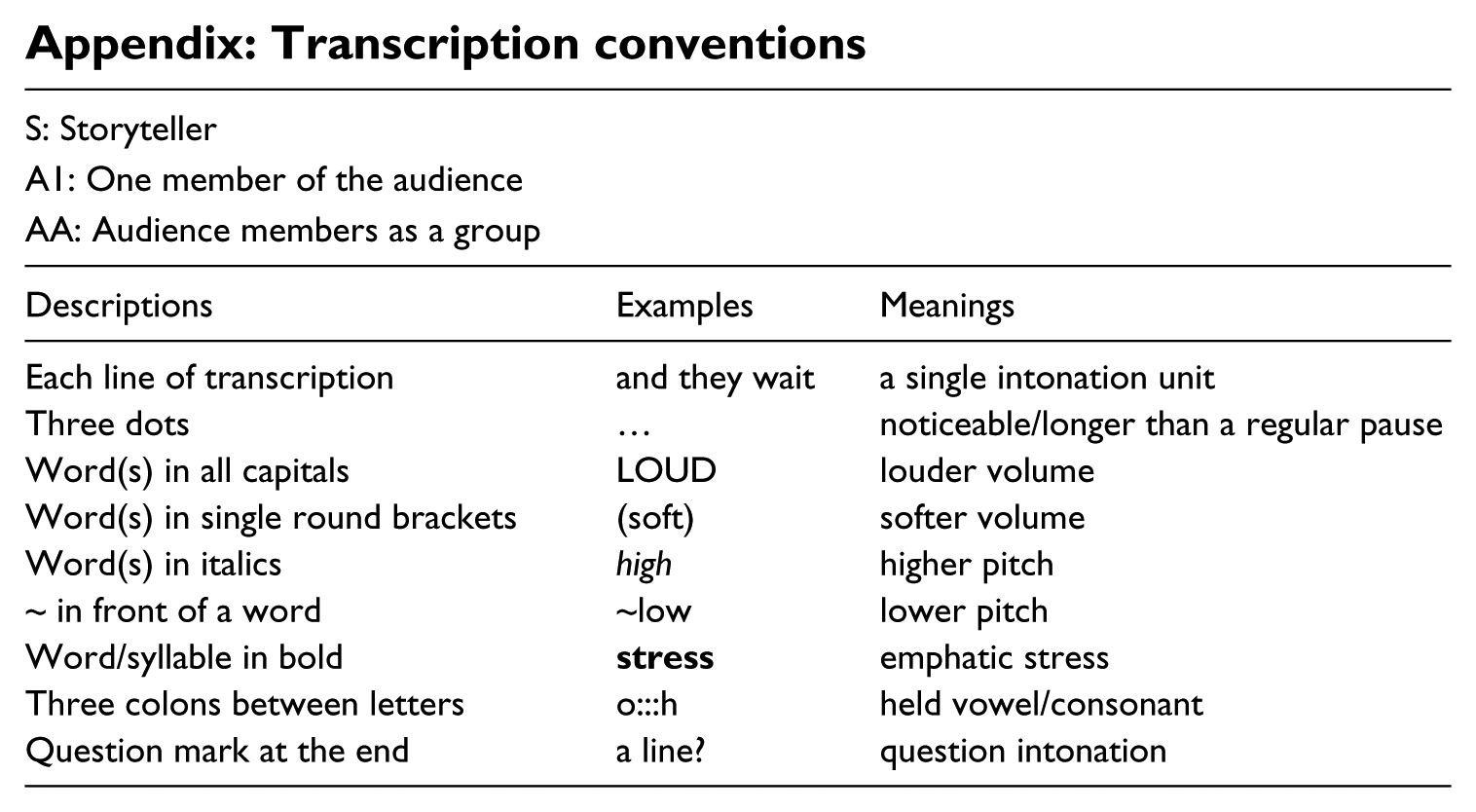
| S: Storyteller | ||
| A1: One member of the audience | ||
| AA: Audience members as a group | ||
| Descriptions | Examples | Meanings |
|---|---|---|
| Each line of transcription | and they wait | a single intonation unit |
| Three dots | … | noticeable/longer than a regular pause |
| Word(s) in all capitals | LOUD | louder volume |
| Word(s) in single round brackets | (soft) | softer volume |
| Word(s) in italics | high | higher pitch |
| ~ in front of a word | ~low | lower pitch |
| Word/syllable in bold |
|
emphatic stress |
| Three colons between letters | o:::h | held vowel/consonant |
| Question mark at the end | a line? | question intonation |
Declaration of Conflicting Interests
The author(s) declared no potential conflicts of interest with respect to the research, authorship, and/or publication of this article.
Funding
The author(s) received no financial support for the research, authorship, and/or publication of this article.