







Abstract
The present study combines literary theory and cognitive psychology to empirically explore some cognitive and emotional facets of poetry reading, exemplified by the reading of three Shakespeare sonnets. Specifically, predictions generated combining quantitative textual analysis according to the Neurocognitive Poetics model with qualitative textual analysis based on the Foregrounding assessment Matrix of sonnets no. 27, 60 and 66 are empirically tested by analyzing 45 subjects’ ratings of the three sonnets. Reflecting the differences in foregrounding potential of the three sonnets found in the textual analysis, we expected to find different reader responses, accordingly. Our dependent variables are well-established categories of emotional evaluation (e.g. valence and arousal) and cognitive, affective and aesthetic aspects of readers’ responses (e.g. liking and understanding) as well as less common ones (e.g. wonder, delight and mental images). The statistical analyses suggest that the type of foregrounding is more important than the number of foregrounded elements. This finding motivated further qualitative exploration of reader responses to open questions regarding mental images and perceived feelings. Comparing the free recall data about the feelings perceived in the sonnets with the ratings data about Valence and Arousal indicated that only the former one reflects a clear distinction between all three sonnets, whereas the readers’ overall evaluations did not sustain this variety of feelings. Multi-method, interdisciplinary research of this kind contributes to improving our understanding of the potentially unique mechanisms involved in poetry reception, and to forming more precise hypotheses for future experimental studies using, for example, eye tracking.
1. Introduction
Empirical studies of literary reading deal with a complex interaction between the reader, the reader’s background knowledge and experience, the multi-layered features of the text, and the physical/embodied and social context within which the reading takes place (e.g. Dixon et al., 1993; Jacobs, 2015a, 2015b; Jakobson, 1960; Kuzmičová, 2016; Kuzmičová et al., 2018; Lüdtke et al., 2014; Mangen, 2016). The ways in which a reader may be inspired or affected by a particular poem is contingent upon textual parameters of the poem as well as readers’ psychological dispositions. In empirical aesthetics in general, as well as in research on literary reading, these two dimensions – the stimulus-driven approach versus focussing on the subjective dimensions of the experience – are often pursued in relative isolation from each other (e.g. Belfi et al., 2018; Dixon and Bortolussi, 2016). In an experiment combining qualitative text analysis with self-report measures tapping into cognitive and emotional aspects of reading, the present study combines these mutually influential aspects of poetry reception with what is often regarded as the most successful and popular example of verbal art – namely, Shakespeare sonnets (e.g. Jacobs et al., 2017; Vendler, 1997).
The qualitative text analysis in the tradition of structuralistic and formalistic accounts (Jakobson and Lévi-Strauss, 1962) consists of systematic, in-depth categorization of types of stylistic features (e.g. similes; parallelisms) at all levels of text as recently suggested by Gambino et al. (2020) in their Foregrounding Assessment Matrix (FAM). This systematic analysis follows the hypothesis that stylistic figures in a poetic text are neither equally nor randomly distributed, but often appear across several layers and levels of the poem, resulting in increased foregrounding (e.g. Jacobs, 2015a; Leech, 1969; Van Peer, 1986). Analysing these distributions, it is possible to assess which mental processes – e.g. imagination and imaging (Magyari et al., 2020), strong affective emotional response (Lüdtke et al., 2014), or personal resonance (Jacobs, 2016; Larsen and Seilman, 1988) – are prompted in association with which (clustering of) foregrounding features (Gambino and Pulvirenti, 2019). Hence, it can be assumed that poems with different foregrounding potential will prompt different types of affective and aesthetic responses. This hypothesis drives the present empirical investigation: readers’ self-reported emotions, mental images, and evaluations in response to three Shakespeare sonnets with different foregrounding potential were first assessed quantitatively, and then analyzed using qualitative methods.
1.1. Aesthetic deviation and foregrounding in literary investigations
A key concept in literary theory, foregrounding derives from an English translation of the Czech term ‘aktualisace’, originally introduced by Mukařovský (1964). It refers to the ways in which literary texts deviate, stylistically, from ordinary discourse: ‘Foregrounding’, says Mukařovský (1964), ‘is the opposite of automatization, that is, the deautomatization of an act; the more an act is automatized, the less it is consciously executed; the more it is foregrounded, the more completely conscious does it become. Objectively speaking: automatization schematizes an event; foregrounding means the violation of the scheme’ (1964: 19). Literary texts are often foregrounded at several levels of discourse (e.g. phonetic, syntactic, semantic), resulting in complex webs of stylistic and semantic ambiguities.
Aesthetic deviation at more than one textual level has been found to enhance a positive effect on attention, liking and recall (e.g. McQuarrie and Mick, 1996; Miall and Kuiken, 1994). Readers consider the foregrounded lines of a poem more likely to be important for its understanding and also tend to recall these parts better than the rest of the poem (Van Peer, 1986). Moreover, it has been found that conspicuous similarity or dissimilarity in sound (e.g. rhyme) influences the readers’ meaning-making process, the emotional reactions, and memory of the poem (for reviews see Blohm, 2020; Jacobs, 2015a). Emotionally, readers find foregrounded sections more striking and evocative of affect (Miall and Kuiken, 1994). In sum, defamiliarization or foregrounding has been found to facilitate aesthetic responses, prompt imagination, and leave in the reader a lingering lyrical sense (Bohrn, Altmann, Lubrich, Menninghaus & Jacobs, 2012; Schrott and Jacobs, 2011, Jacobs and Schrott, 2011).
Together with recent results in cognitive neuroscience, such findings have been integrated in the Neurocognitive Poetics Model of literary reading (NCPM; Jacobs, 2015a, 2015b). The NCPM hypothesizes a dual route processing of literary and poetic texts, based on their ratio of foregrounded and backgrounded elements. Whereas the fluent, immersive reading route is dominated by familiarity and automaticity, the aesthetic route is triggered by foregrounded elements causing the reading to slow down, hence making time for processes supporting reflection and aesthetic appreciation (see also Lüdtke et al., 2014). Poems typically display a wealth of stylistic devices, hence the reading of poetry can be assumed, in principle, to be of an aesthetic kind (for reviews see Jacobs, 2015a, 2015b; Jacobs and Schrott, 2011).
Despite an increasing number of empirical (e.g. Belfi et al., 2018; Fechino et al., 2020; Lüdtke et al., 2014; Menninghaus et al., 2014, 2015; Wassiliwizky et al., 2015; Xue et al., 2019) and computational (Jacobs et al., 2017; Jacobs, 2018a, 2018b; Simonton, 1989, 1990) studies, much is still unknown about the emerging emotional responses and the overall appreciation of foregrounded elements in poems. The present study zooms in on liking and related emotional responses (e.g. arousal, valence). Because liking is an elementary affective decision (Jacobs et al., 2016), it is mainly associated with the aesthetic processing route in the NCPM. We also explore the contribution of mental imagery to readers’ reported understanding of and emotional responses to Shakespeare sonnets. Several studies show that mental imagery correlates with other salient dimensions of literary reader responses, most notably with emotion (Magyari et al., 2020; Krasny and Sadoski, 2008). It is also assumed to co-determine transportation (e.g. Appel et al., 2015)et al. and has been found to play a vital role in readers’ memory of the text (De Koning and Van der Schoot, 2013; Sadoski, 2018). Nevertheless, empirical research assessing mental imagery in the reading of poetry or literary prose is scarce (see Belfi et al., 2018; Hugentobler and Lüdtke, 2021, and Magyari et al., 2020, for recent exceptions). Combining qualitative and quantitative approaches, the aim of the present study is to fill these gaps.
1.2. Liking
The results of Aryani et al. (2016), Jacobs and colleagues (2016, 2018), Lüdtke et al. (2014), and Ullrich et al. (2017) suggest that liking decisions concerning poetry are affected by the entire range of foregrounding features at all text levels (e.g. sublexical phonological, supralexical semantic). But due to dynamic interactions between all or groups of these features, it is virtually impossible to ascertain the relative weight of each feature to liking decisions.
In aesthetic appreciation, liking is considered the most general indicator of positive aesthetic evaluation (Jacobs et al., 2016; Menninghaus et al., 2015). Psychologically it is also related to pleasure and preference, especially in hedonic theories (Berlyne, 1971; Reber et al., 2004). Recent empirical studies find valence and arousal to be key components of liking – distinguishable but interrelated across text levels (e.g. Jacobs et al., 2016). The relation between valence and arousal ratings is usually found to be curvilinear for single words, implying that both negative and positive stimuli are found to be more arousing than neutral ones, whereas negative are also more arousing than positive (e.g. Sylvester et al., 2016). Other predictors of liking reported in rating studies, are typicality, distinctiveness, novelty, familiarity, averageness, prototypicality, and complexity (Faerber and Carbon, 2012).
Based on computational analyses, Simonton (1989, 1990) concluded that the popularity of Shakespeare sonnets can be related to a combination of the specificity-variability, novelty-complexity, and primary process imagery of the verbal material, all of which can be viewed to influence the arousal potential of a poem supposed to drive aesthetic pleasure. Jacobs’ (2018b) advanced computational analyses of the present three Shakespeare sonnets at the sublexical, lexical, interlexical, and supralexical feature levels suggested that sonnet 27 had the highest lexical diversity, eigen similarity, and affective-aesthetic potential. At the same time, it was found to have the lowest arousal and syntactic complexity of the three (27, 60 and 66), hence, theoretically, it would be expected to have the highest aesthetic potential. However, as pointed out by Jacobs (2018b), even such extensive and advanced computational analyses – limited to quantifiable text features and unable to discover, e.g. tropes characteristic of poetry like metaphor or chiasm – must be complemented by qualitative analyses to uncover the full aesthetic potential of a poem.
Relevant hypotheses addressing associations between text characteristics, cognitive and affective processing and liking judgements can be found in foregrounding theory (e.g. Van Peer and Hakemulder, 2006; Van Peer and Chesnokova, 2020), fluency models (e.g. Winkielman et al., 2003) and the NCPM (Jacobs, 2015a, 2015b). Systematically manipulating one single line of a poem in terms of foregrounding, Van Peer and Hakemulder, (2006) asked whether a decrease in foregrounding density also diminished different dimensions of the aesthetic appreciation. They found that the more cognitive aspects of liking (e.g. aesthetic structure) showed an increase in appreciation with increasing degrees of aesthetic deviation. Moreover, ‘surprise effects’ also contributed to the aesthetic appreciation, because the line with a surprising ending was judged the most beautiful one (Van Peer and Hakemulder, 2006). Menninghaus et al. (2015) reported a similar trend using individual parallel structures as well as beauty and succinctness ratings. This type of foregrounding was also found to facilitate cognitive processing as measured by shorter reading times, connecting it to the hedonic fluency model (e.g. Winkielman et al., 2003). This model claims that aesthetic pleasure is a function of processing dynamics. Albrecht and Carbon (2014) summarized empirical results from non-verbal art showing that the more fluently an artistic stimulus is processed, the more positively it is judged. According to Leder et al. (2004), the cognitive mastering of the artistic stimuli results in positive changes of the affective state, leading to a state of pleasure or satisfaction (e.g. Kuchinke et al., 2009). This can be a determining factor in parallel structures, metered language, or rhyme, but at a higher level a novel metaphor obviously requires deeper – and slowed down – cognitive processing as well as increased brain activity (e.g. Forgács et al., 2012). Thus, Miall and Kuiken (1994) found an inverse relation between the amount of foregrounding and reading speed: the more aesthetic deviation, the slower participants read, which suggests that they were more involved in higher-order cognitive and aesthetic processes. Specifically, with regard to valence ratings, Albrecht and Carbon (2014) concluded that processing fluency was an amplifying factor in evaluative judgements. Menninghaus et al. (2015) addressed this issue by differentiating prosodic (perceptual fluency as measured by beauty and succinctness ratings) and semantic processing (meaningfulness). The majority of the rhetorical figures facilitated the former processing, but handicapped the latter.
Analogously, the NCPM (Jacobs, 2015a, 2015b) predicts that foregrounding on different levels (e.g. phonological, morphological, syntactic, semantic) will interrupt processing fluency and slow down the reading. Referred to as the ‘aesthetic route’ (Jacobs, 2015a, 2015b), such defamiliarization is predicted to foster aesthetic liking. Whether and to what extent it also affects higher-order cognitive processing such as understanding, will arguably depend on the foregrounding figures and types: if the reader is not able to make sense out of, for instance, ambiguous literary figures or complex phrases, the outcome may be an increased aesthetic appreciation but without a concomitant increase in understanding. Applying understanding (ease of processing) and concern (meaningfullness) as cognitive predictors of liking, the present study aims to help clarify such still unsettled associations between cognitive and aesthetic aspects of poetry reading.
1.3. Mental imagery
Mental imagery is prompted by features of the text on the basis of which readers come to experience near-sensory phenomena (Kuzmičová, 2014). Despite being a common and much appreciated phenomenon in people’s literary reading experiences, mental imagery has received scant attention in empirical aesthetics, and scholars have typically looked at the reading of prose, rather than poetry (e.g. Magyari et al., 2020). In an early study (Sadoski and Goetz, 1985), participants were asked to read and re-read a short story and rate each paragraph for (i) the degree of mental imagery evoked, (ii) the degree of emotion evoked, or (iii) the importance of the given paragraph for the story as a whole. They found that the imagery ratings were significantly correlated with the emotion ratings, a finding that was later replicated in studies using other stories (e.g. Sadoski et al., 1988). In a follow-up study, Goetz et al. (1991) assessed readers’ imagery and emotional responses to a short story, applying physiological (heart rate) and cognitive (reading time) measures as well as post-reading ratings and free reports on images and emotional responses/affect. Results showed that, analogous to the earlier studies, imagery reports were significantly correlated with the affect reports. Moreover, reading time was found to decrease with increasing affect ratings, in that participants tended to read faster during the passages that were reported as particularly emotionally engaging. This is consistent with the prediction of the NCPM that processing of literary texts along the immersive route tends to be fluent and, hence, faster (Jacobs, 2015a, 2015b). Particularly relevant to the present study, Goetz et al. (1991) argued for the unique contribution of imagery and emotional response reports in reflecting the constructive and dynamic interaction between the text and the reader, hence yielding insights into the reading experience that is difficult to obtain with other, more typically quantitative, measures such as ratings or behavioural (physiological) measures. The open-ended format, also applied in the present study, invites cognitively and emotionally salient responses of a more personal nature, plausibly covering a wider range of experiential outcomes to supplement the quantitative measures.
The above studies all used short stories as stimuli. As narratives and poems differ along a multitude of textual and stylistic parameters, the ways in which readers construct and experience mental imagery during the reading of prose may differ substantially from those of poetry reading. The number of empirical studies assessing mental imagery in poetry reading is small, but a recent study is particularly relevant. Belfi et al. (2018) asked participants to read two distinctly different poetic genres – haiku and (Elizabethan and Petrarchan) sonnets – and rate them on four characteristics: valence, arousal, imagery vividness, and aesthetic appeal. They found that, across participants, imagery vividness was the strongest predictor of aesthetic pleasure, followed by valence and arousal (Belfi et al., 2018).
To capture the associations between the poems’ density of foregrounding and readers’ mental images, we asked our subjects to write down what they remembered about their evoked mental images. To handle the open answers, we developed a coding scheme guided by Kuzmičová’s (2014) phenomenologically inspired typology, comprising two types of referential imagery: Enactment imagery is experienced from an inner perspective (through a character or narrator); it is multimodal, often combining multiple senses. In contrast, description imagery is experienced from an outer perspective. The internal senses are, so to speak, shut off, and the reader’s/imager’s body is situated outside the world described by the text. In description imagery, the verbal medium – the written text – is not felt to be fully transparent, but remains a more or less perceptible mediation or filter between the referential content and the reader. The reader may become aware of the cognitive effort invested in the imaging process, and the image may lack the experiential richness of enactment imagery (Kuzmičová, 2014: 284). Enactment imagery is, therefore, predicted to be experienced as more immersive than description imagery (see Magyari et al., 2020, for an application to prose reading).
1.4. Empirical research on reading of Shakespeare sonnets
Shakespeare’s sonnets are among the most aesthetically successful and appreciated canonized literary works, and they are the object of an immense theoretical literature (e.g. Jakobson and Jones, 1970; Vendler, 1997). The sonnets have several stylistic features which render them particularly suited for multi-method, empirical studies (Jacobs et al., 2017). They are highly conventionalized, displaying a relatively stable and similar surface structure and a typical rhyme scheme, which facilitate empirical and computational comparisons. Aesthetically, the sonnets’ peculiar form, and the interplay of content with metric, phonological, or morpho-syntactic features should evoke strong emotional and aesthetic reader responses due to the way they juxtapose regularity and continuity of form with content-related changes in subject, mood or style (Delmonte, 2016; Jacobs et al., 2017; Jacobs, 2018b). This quality of the sonnets can be quantified at the sublexical, lexical, interlexical, as well as supralexical levels, making them particularly suited for studying poetic effects across all levels of textual processing (Jacobs et al., 2017; Jacobs, 2018b).
1.4.1. Qualitative analysis of three Shakespeare sonnets: Distribution of foregrounding potential
The spatial distribution and the textual range of stylistic devices in poems vary. Some devices may span only a few syllables or words, whereas the textual components of other devices – e.g. metaphors – may be distributed across larger stretches of text. Hence, a foregrounding analysis should be able to assess the potential impact of foregrounding elements that are intertwined and distributed across multiple lines of a poem. The Foregrounding Assessment Matrix (FAM; Gambino and Pulvirenti, 2018, 2019; Gambino et al., 2020) is especially developed to address this challenge. Theoretically, the FAM is based on a combination of classic structuralist theory (Jakobson and Lévi-Strauss, 1962; Lotman, 1977), foregrounding theory as developed in empirical studies of literature (Miall and Kuiken, 1994, 1998; Van Peer, 1986; Van Peer and Chesnokova, 2020) and more recent approaches in the field of (neuro)cognitive poetics (Burke and Troscianko, 2017; Carroll, 2012; Hogan, 2003; Jacobs, 2015a; Nicklas and Jacobs, 2017; Schrott and Jacobs, 2011; Steen, 2004; Stockwell, 2009a, 2009b; Willems and Jacobs, 2016). Inspired by Jacobs’ (2015a, 2015b) so-called 4 × 4 matrix of the NCPM, FAM identifies and highlights foregrounded sublexical, lexical, interlexical, and supralexical features at the phonological, morpho-syntactic and semantic (rhetorical) levels (i.e. figures of sound; figures of speech; figures of thought; Gambino et al., 2020). Whereas empirical research on effects of foregrounding in poetry reading tends to use decontextualized snippets of text (words and/or lines), FAM enables an approach to studying poetry reading with an eye to its multi-layered and often spatially uneven distribution of foregrounded elements, hence more closely resembling the ways in which poetry is read ‘in real life’.
In Gambino et al.’s (2020) original study, FAM was applied to sonnets no. 27, no. 60, and no. 66 (see Appendix). The three sonnets were selected based on their poetic and literary quality, their timelessness, and the degree to which their motifs (love as a tension between body and soul [27]; death as related to time and soul [60]; social evils during Shakespeare’s time [66]) are representative of (European) poetry in general, and of Shakespearean sonnets in particular. Also, the fact that these three do not typically figure among Shakespeare’s most well-known ones makes it less likely that familiarity with the texts will influence readers’ responses. An additional motivation for the text selection was related to the similarity of the three sonnets with respect to meter and rhythm, allowing us to neglect the metric text level in the present analyses.
Gambino et al. (2020) found that the foregrounding elements identified at each of the four textual levels (sublexical, lexical, interlexical and supralexical) were spatially concentrated in what they term density fields – i.e. “‘spots’ of the text in which different kinds of foregrounding […] unite, agglutinate, and combine” (Gambino et al., 2020: 262). Particularly visible for sonnet 60, this can be seen in the spatial clustering of foregrounding elements (FG) related to the key notion of ‘time’ in the poem (see Appendix). Stretched across lines 2, 6-8, and 10, the main topic of time is linked to other semantic foregrounding elements in the text, effectively ‘building the main meaning-making chain’ (Gambino et al., 2020: 274). The word ‘time’ as the centre of gravity of the semantic FGs is being related to: • two similes [Like as / So do, lines 1-2], • one synecdoche [waves / minutes, lines 1-2], • seven metaphors in total [main of light, line 5; maturity, line 6; glory, line 7; crooked eclipses, line 7; his gift, line 8; flourish set on youth, lines 9; delves the parallells in beauty’s brow, line 10; nature’s truth, line 11], • two metonymies [my verse, line 13; his cruel hand, line 14] and • 13 personifications [waves make, line 1; minutes hasten, line 2; minutes contend, line 2, 4; nativity crawls to maturity, line 6; maturity crowned, line 6; crooked eclipses, line 7; eclipses fight, line 7; Time gave, line 8; Time confound, line 8; Time transfix, line 9, Time delves, lines 9, 10; Time feeds, lines 9, 11; nothing stands, line 12; scythe to mow, line 12; verse shall stand, line 13; verse praising, line 14]
It thus represents the absolute key word of the text. ‘Time’ is also underlined as phonological FG at supralexical level because it is linked with an enjambement, marking a particularly ‘dense’ field of the sonnet (Gambino et al., 2020: 274–275).
Whereas sonnet 60 (‘Like as the waves…’) had the most clearly pronounced density field(s) and the most complex metaphorical structure yielding ambiguous semantic relations, the spatial distribution of foregrounding devices was less distinct for sonnets 27 and 66. The ways in which the foregrounding devices on the phonological, morpho-syntactic, and semantic levels overlap between lines and sentences in the sonnet may be described to create a guided path through the highly imaginative and emotionally evocative meaning of the text (Gambino et al., 2020). We anticipated that this elicits a high affective arousal, giving way to an enhanced meaning-making via activation of the slower aesthetic processing route in the NCPM (Jacobs, 2015a, 2015b). We also predicted sonnet 60 to be rated as most difficult to understand because of the complexity of the metaphoric foregrounding and the ambiguous semantic relations. Sonnet 60 also can be considered as having an overall high syntactic complexity: it has the second highest mean phrase density – which serves as a proxy for multiple embeddings – and the highest mean of subordinate conjunctions (‘as’, ‘before’, ‘now’, ‘once’, ‘that’, ‘which’), a proxy for subordination (e.g. embedding of relative clauses) and sentence complexity. This is also exemplified by schemes typical for Shakespeare, for example, the subject-object-verb inversion in line 8: ‘doth now his gift confound’ (Jacobs, 2018b). At the same time, sonnet 60 can be expected to be rated as the most aesthetically valuable because of its entangled metaphorical fields. These can be anticipated to evoke stronger emotional responses and more mental images, thus producing the highest scores on liking and concern.
In contrast, sonnet 27 (‘Weary with toil…’) contains a fine-grained stylistic device called a pangram, that is, using every letter of the alphabet at least once, throughout the poem. Being distributed on the level of letters across the entire poem, this textual feature can be assumed to be too subtle for the reader to notice. Moreover, foregrounding on the semantic level, such as metaphors (e.g. ‘Journey in my head’ [line 3]; ’zealous pilgrimage’ [line 6]; ‘soul’s imaginary sight’ [line 9]) and oxymora (e.g. ‘My drooping eyelids open wide’ [line 7]; ‘Looking on darkness’ and ‘the blind do see’ [line 8]; ‘the sightless view’ [line 10]; ‘black night beauteous’ and ‘old face new’ [line 12] (Gambino et al., 2020: 269) are mainly based on repetitious contrasting of I (my-myself) and thy (thee), with the last line reconciling the tension in ‘For thee, and for myself’. We anticipated that the lack of a clearly emerging pattern of foregrounding elements, combined with the repetitious contrasts in the poem would neither capture nor reinforce readers’ attention, and evoke rather simple emotional reactions.
Finally, in sonnet 66 (‘Tired with all these...’), the main stylistic feature and foregrounding potential is parallelism of syntactic structure. More specifically, this entails the juxtaposition of noun phrase + complement + subject + verb as in ‘Tired with all these, for restful death I cry / ’Tired with all these, from these would I be gone’ (line 13), and the juxtaposition of conjunction + (adject) noun + adverb + verb past particle, as in ‘And purest faith unhappily forsworn / ‘And guilded honour shamefully misplaced’ / ‘And maiden virtue rudely strumpeted’ / ‘And right perfection wrongfully disgraced’ / ‘And strength by limping sway disabled’ (lines 4, 5, 6, 7, 8) (Gambino et al., 2020: 272). Rather than inviting an effect of vivid imagery or surprise, such parallelisms can be assumed to trigger a sense of redundancy and predictability. There is also in sonnet 66 a nearly mechanical contraposition of ‘good and evil’. In the Quantitative Narrative Analysis (QNA) of all 154 sonnets (Jacobs et al., 2017), sonnet 66 was indeed found to be the most repetitive piece of all sonnets, and the one using the least number of words (89) in total. It scored high on both syntactic simplicity and word concreteness, but unexpectedly its surprisal value was high. Based on these stylistic features, we predicted that this sonnet would be rated as the easiest to understand and the easiest to recall, and that it would score lower on liking and emotional engagement ratings. This sonnet is also unlikely to affect the reader by triggering a vivid imaginative response.
1.5. Hypotheses
Our hypotheses are motivated by Gambino and colleagues’ (2020) finding that sonnet 60 is particularly rich in foregrounded elements. Therefore, we expected it to yield different ratings for cognitive and affective processing, compared to sonnets 27 and 66: H1: Sonnet 66 with an apparent lack of density fields will be rated low on liking and emotional involvement. Its specific parallel structure, on the other hand, will trigger higher scores on understanding and recall. H2: Sonnet 60 shows the highest concentration (density fields) of foregrounding elements of the trio. It therefore should be rated low on understanding and recall, but high on liking and emotional involvement. H3: Due to its stylistic complexity and the clustering of foregrounding elements in clear density fields, sonnet 60 should prompt a richer array of mental images, compared to sonnets 27 and 66.
2. Methods
2.1. Participants
45 subjects (24 males), all native English speakers, with a mean age of 33.48 (SD = 12.51, range: 18–68 years) took part in the study for financial compensation (EUR 8 per hour). Based on our control variables – correctly remembered rhyme-pairs and topic of the sonnets – we excluded three subjects: two of them recalled only one rhyme pair correctly (out of 18) and one detected none of the topics correctly.
2.2. Procedure
Participants were recruited via university forums, email lists and direct contacts with English departments at collaborative universities. At the beginning of the session, they were informed about the content and procedure of the study and asked to sign the informed consent. Sessions took place in a quiet room in the presence of a researcher. 1 Participants were allowed to read the poems as many times as they wanted (except for the memory task). All questionnaires were completed on paper. The order of poems was randomized across participants. The procedure took approximately 40–60 min.
2.3. Materials
Rating questions assessing the emotional evaluation (valence and arousal) and the cognitive, affective, and aesthetic reactions of the readers (items 1–8).
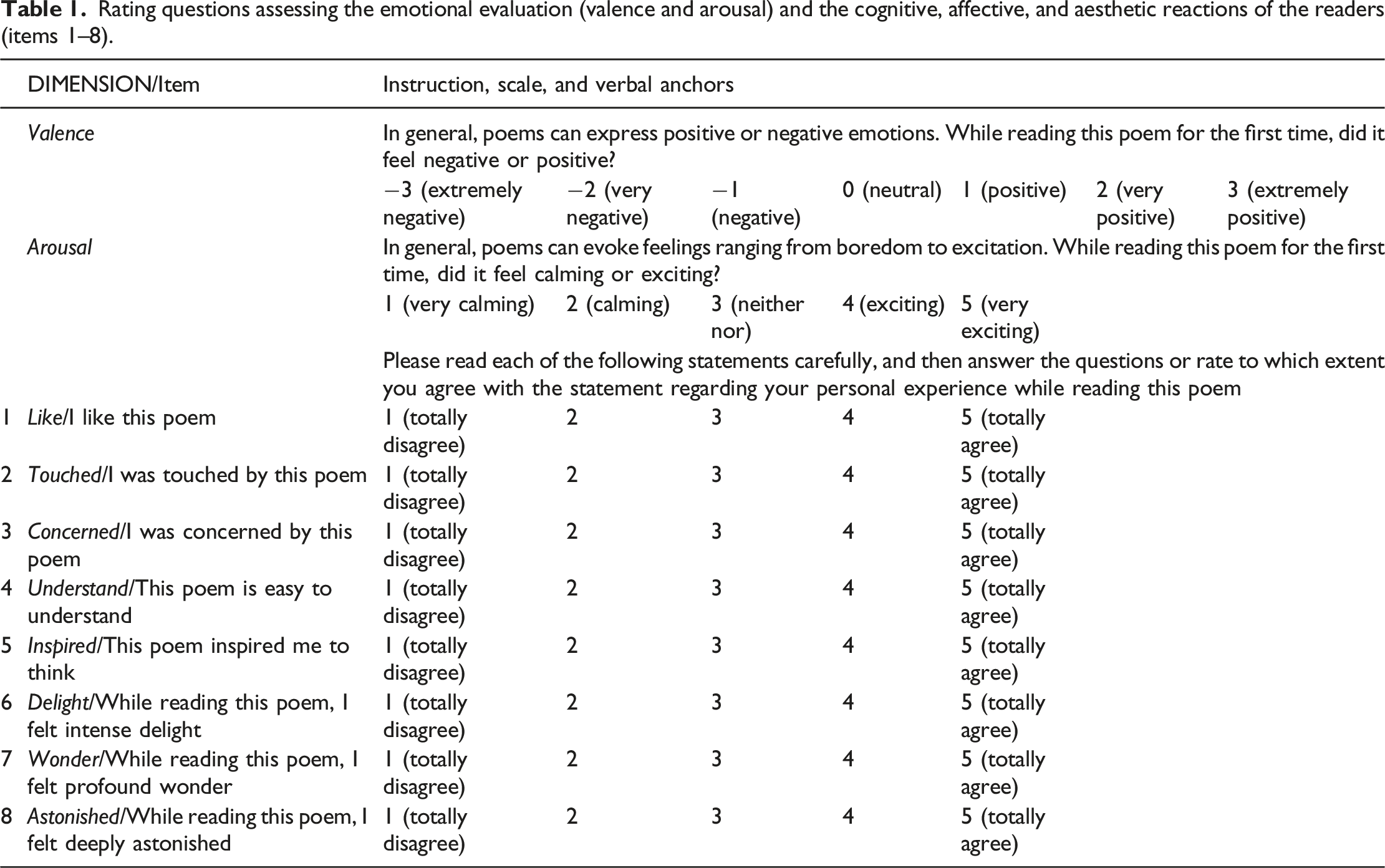
The two items assessing the emotional evaluation of the sonnets measured the classical dimension valence and arousal. Valence was measured with a 7-point scale going from very negative (−3) over neutral (0) to very positive (3). Arousal was measured using a 5-point scaling going from very calming (1) to very exiting (5).
The readers’ response questionnaire contains eight different items. We included items measuring aesthetic evaluation (e.g. ‘I like the poem’), affective reactions (e.g. ‘While reading this poem, I felt intense delight’) and cognitive impact (e.g. ‘This poem is easy to understand’). Participants indicated their agreement with the statements on a 5-point rating scale ranging from 1 = totally disagree to 5 = totally agree (see Table 1 for a full list of items).
Three questions in our questionnaire required the readers to describe, in their own words, (i) the mental images evoked by the poems, (ii) the feelings that are described in the poem (in accordance to a common distinction in music perception it is called perceived feelings, cf. Schubert, 2013), and (iii) the change of the readers’ own feelings during reading (‘Have your feeling changed during reading?’ If your answer is ‘Yes’, please write down how your feelings have changed’). Due to a low response rate (for sonnet 27, 19 (out of 42) participants said ‘Yes’ and provided elaborations, and 17 participants did the same for sonnets 60 and 66), the responses to the third question will not be dealt with in this paper.
3. Analysis and results
First, quantitative methods were applied to test whether our hypotheses considering the differences between the three sonnets are confirmed. Second, qualitative analysis was used to probe deeper into the nature of readers’ responses, and to shed further light on the quantitative findings.
The statistical analysis was performed using IBM SPSS for Windows 22 (IBM Corporation, Armonk, NY). To minimize the number of multiple comparisons, we applied an exploratory principal component analysis to the eight items of our readers’ response questionnaire. The factor loadings of the resulting factors were used to compare the answers to the three sonnets by applying one-way repeated measurement ANOVAs. The later ones were also conducted for the valence and arousal ratings. Moreover, we counted the number of mental images written down by each participant for each sonnet. Again, to compare these simple frequency values we calculated a one-way repeated measurement ANOVA. After each ANOVA we conducted, if necessary, multiple comparisons while applying Bonferroni correction resulting in a critical α = .0167. Before calculating the ANOVAs, each variable was checked for normal distribution. 2 When not given, we used the nonparametric Friedman test and the Wilcoxon test for multiple comparisons. Finally, to relate the emotional evaluation, the readers’ responses, and the number of mental images, we performed Spearman rank correlation between these variables.
3.1. Quantitative analysis
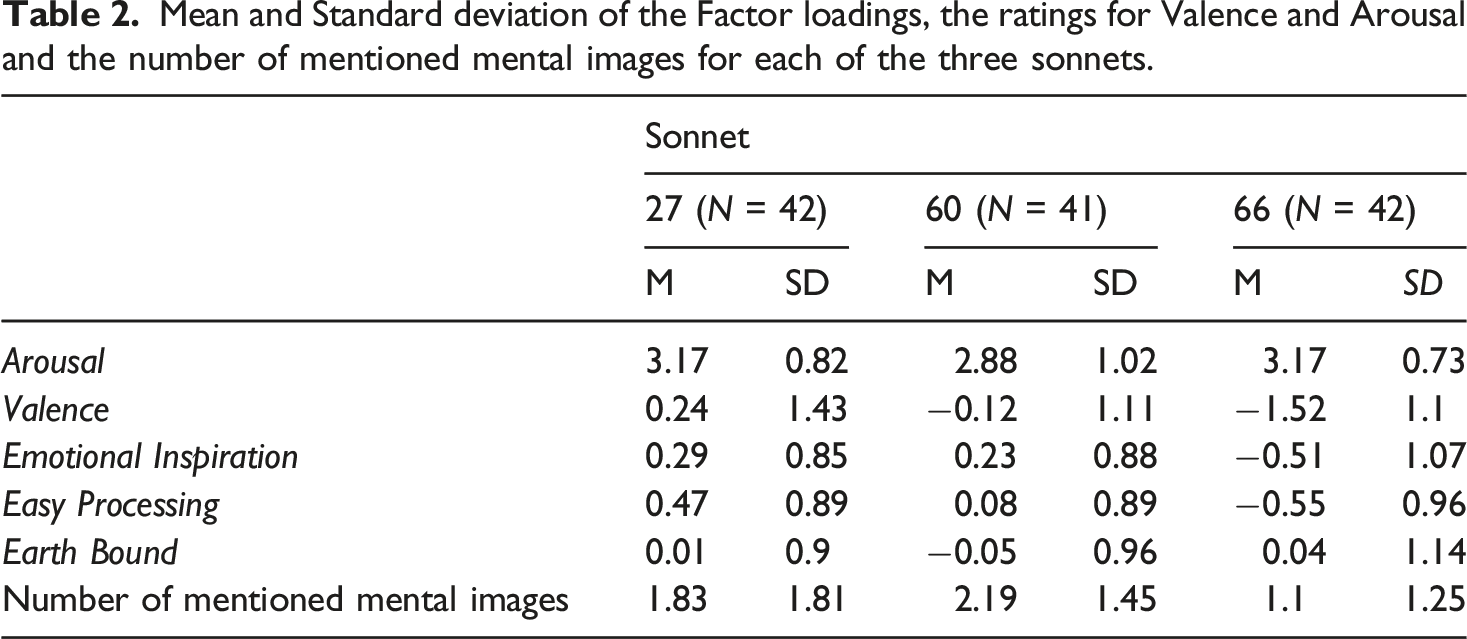
Mean and Standard deviation of the Factor loadings, the ratings for Valence and Arousal and the number of mentioned mental images for each of the three sonnets.
Factor loadings after an oblimin rotation (highest factor loadings are marked with *).
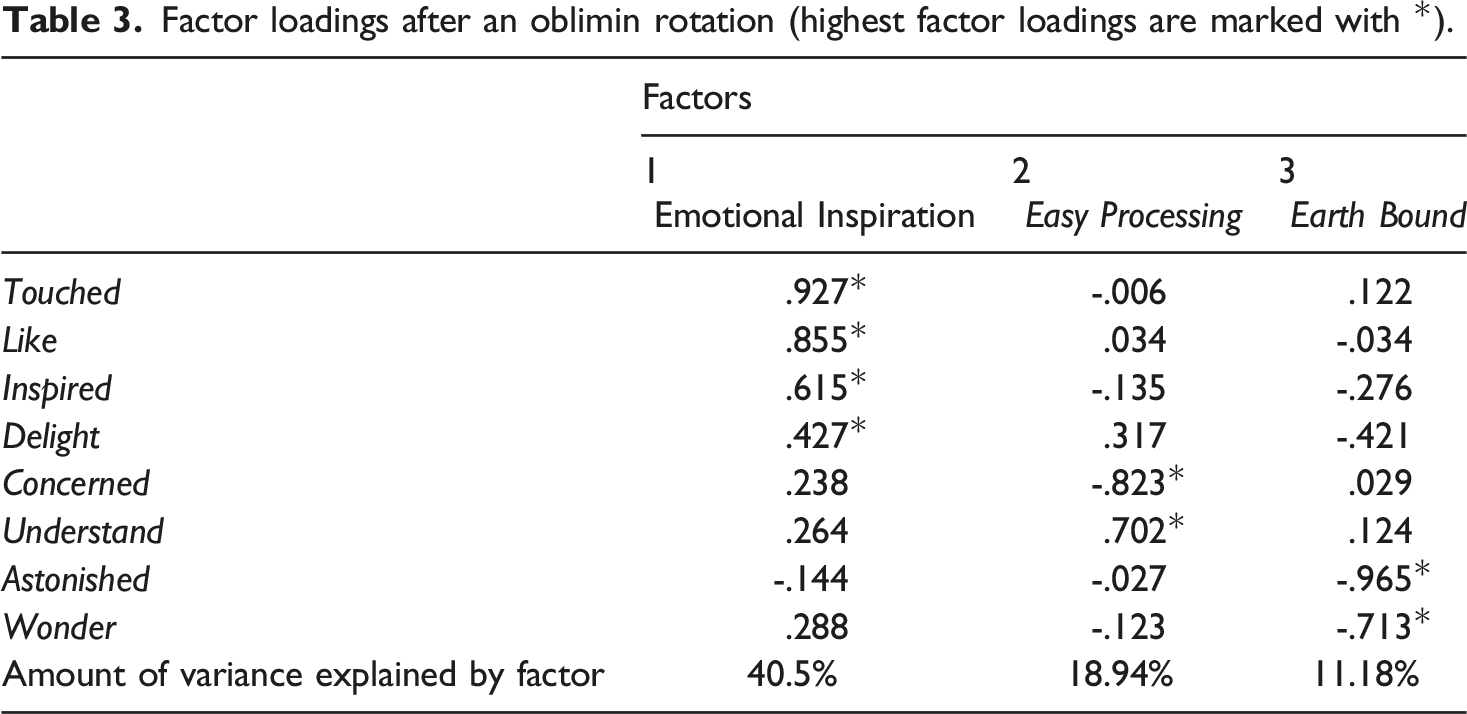
Factor 1 contained the affective aesthetic response items of Like, Touched, Inspired, and Delight. We named this factor Emotional Inspiration. Factor 2 comprising the items Understand and Concerned (−) was coined Easy Processing. Note that this factor refers to the degree of mental effort (concern) the reader puts into understanding the poem, and not whether or not the reader actually understood it (general understanding was assessed by a memory task and by asking participants to select the ‘correct’ topic). Factor 3 consists of the items Wonder (−) and Astonished (−). We named this Factor Earth Bound. 4
The mean factor loadings for each sonnet are reported in Table 3 and Figure 1. We used these loadings to test our hypothesis about readers’ responses reported above. The one-way repeated measurement ANOVA for Emotional Inspiration indicated a clear difference in the affective aesthetic reactions (F(2,80) = 11.47, p < .0001). The post hoc multiple comparisons using Bonferroni correction showed that the factor loading for sonnet 66 was significantly lower compared to the loadings of sonnets 27 and 60 (both t(41) > 3.87, both p < .001) while the factor loadings for the two later sonnets did not differ (t < 1). Also for the second factor Easy Processing we observed a significant difference (F(2,80) = 26.73, p < .0001, see Figure 1). There is a clear linear trend indicating a decrease in the factor loadings from sonnet 27 over sonnet 60 to sonnet 66, for which we observed the lowest factor loadings. The post hoc multiple comparisons indicated significant differences between all sonnets (all t(41) >2.64, all p < .012). For the third non-normally distributed factor Earth Bound, which explained only 11% of the variance in the readers’ response ratings, we observed no significant difference between the three sonnets (χ
2
< 1). Differences among the three sonnets along the three factors representing readers’ cognitive, affective, and aesthetic reactions. Error bars are constructed using one standard error from the mean.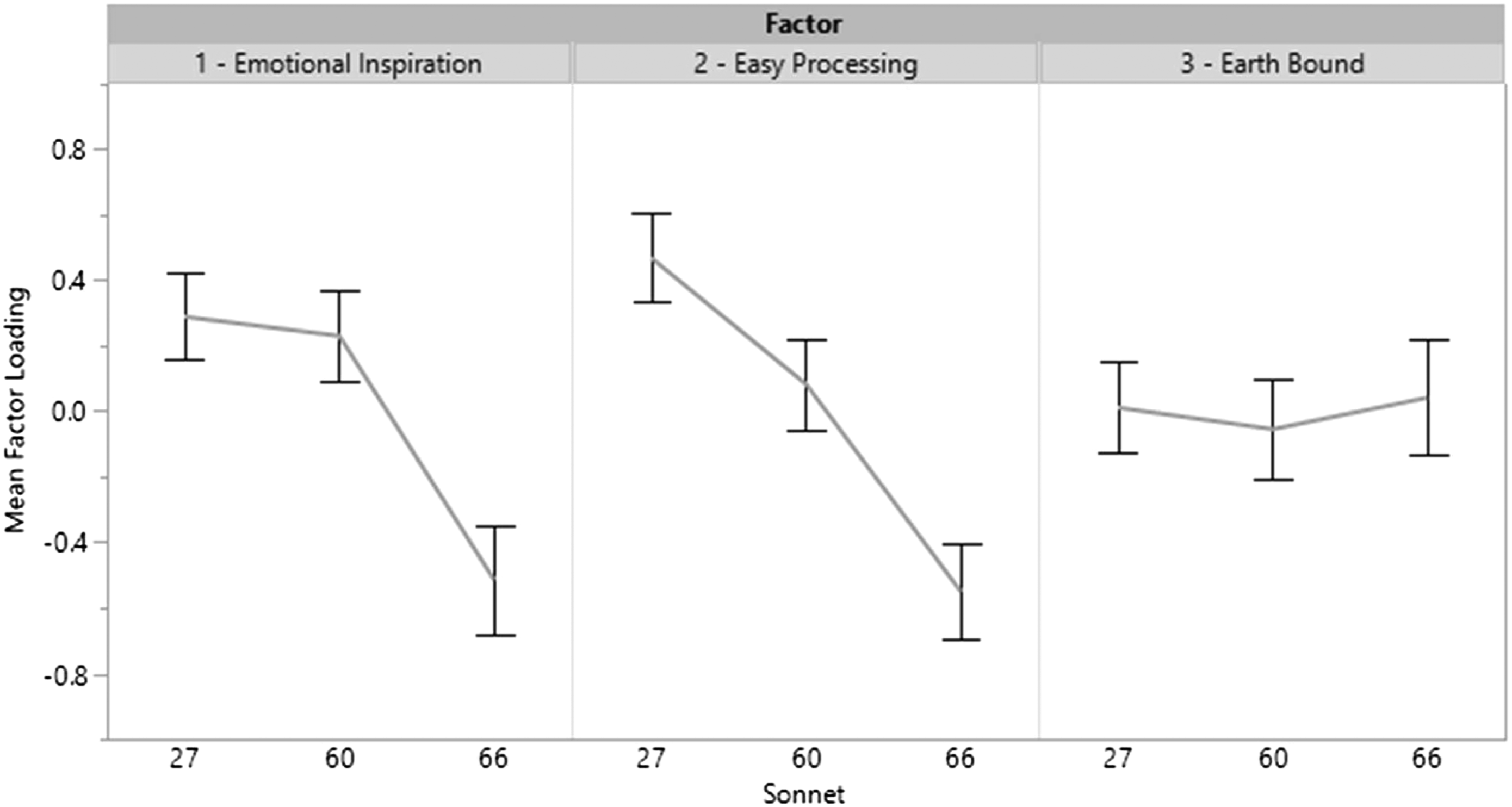
Taken together, the analysis of the factor loadings showed that sonnet 27 scored highest on the factors Emotional Inspiration and Easy Processing. In other words, sonnet 27 is rated the easiest to understand and the one yielding the least concern, and at the same time the one with the highest emotional inspiration. While the qualitative text-based analysis of the sonnets predicted clear differences between sonnets 27 and 60, the quantitative analysis indicated only a clear difference for sonnet 66. This sonnet is the hardest to understand (lowest factor loadings for Easy Processing) and induced the lowest emotion inspiration. In this case, the prediction based on the qualitative analysis of the sonnets was not supported: according to the ratings, sonnet 66 was the most – and not the least – difficult to understand.
To test the third hypothesis, that the richness of density fields, particularly pronounced in sonnet 60, produces more mental imagery, we compared the number of mental images written down as answer to the corresponding open question. The one-way ANOVA indicated a significant difference (F(2,82) = 9.91; p < .001). On average, participants reported the highest number of mental images for sonnet 60, followed by sonnets 27 and 66 (see Figure 2). The post hoc tests confirmed the same pattern as for factor Emotional Inspiration: Sonnets 27 and 60 do not differ significantly from each other (t(41) = −1.46, p = .15), whereas the values for sonnet 66 are significantly lower compared to both sonnet 27 and 60 (t(41) > 2.84, p < .008). Descriptively, this result is in support of H3, because sonnet 60 facilitated the highest number of mental images. However, unlike the qualitative analysis in the FAM (Gambino et al., 2020), the ratings did not statistically differ between sonnets 60 and 27. Differences among the sonnets for the number of mentioned mental images. Error bars are constructed using one standard error from the mean.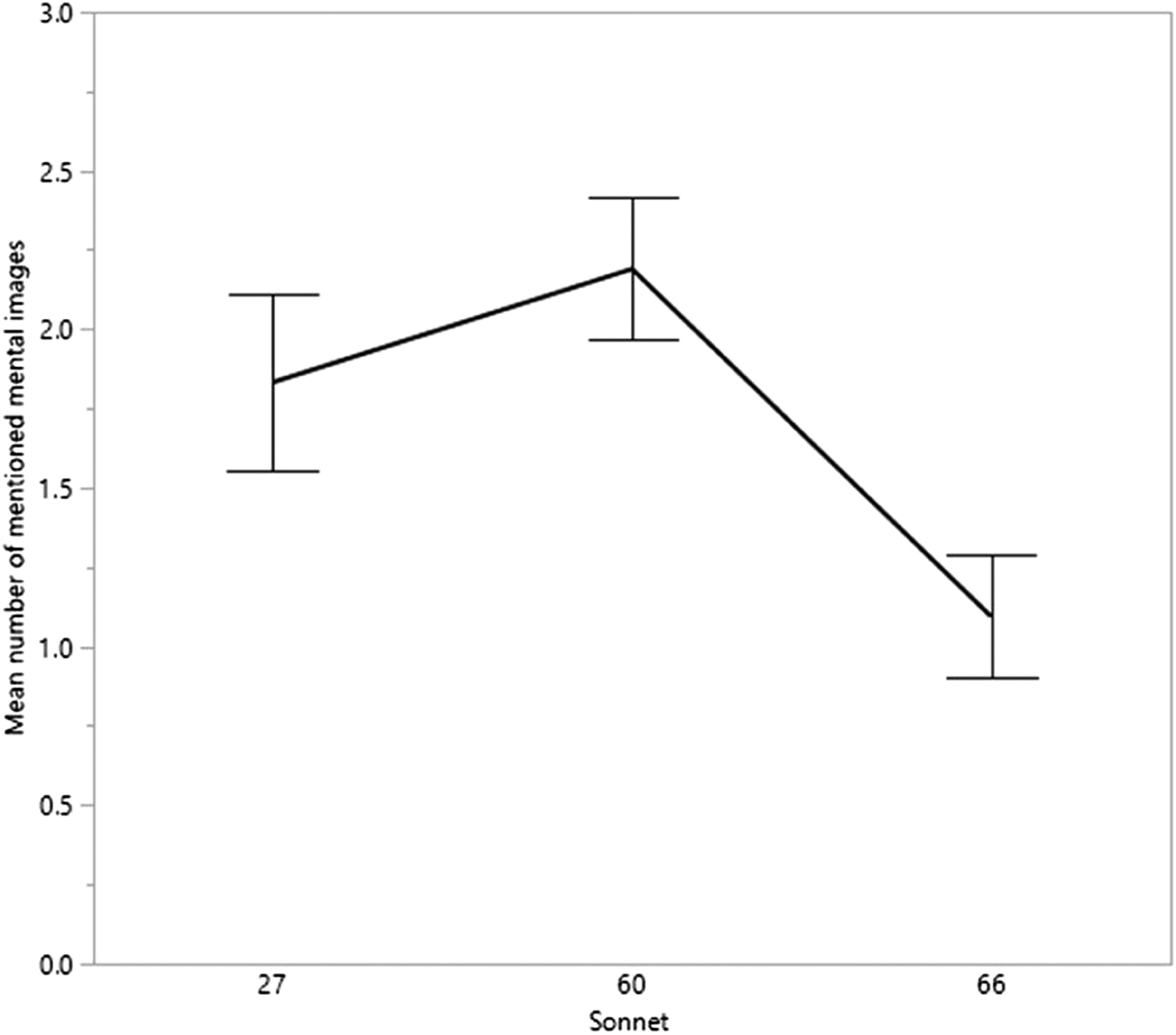
Spearman correlations between the factors, Valence, Arousal, and the number of evoked mental images (N = 126 data points).
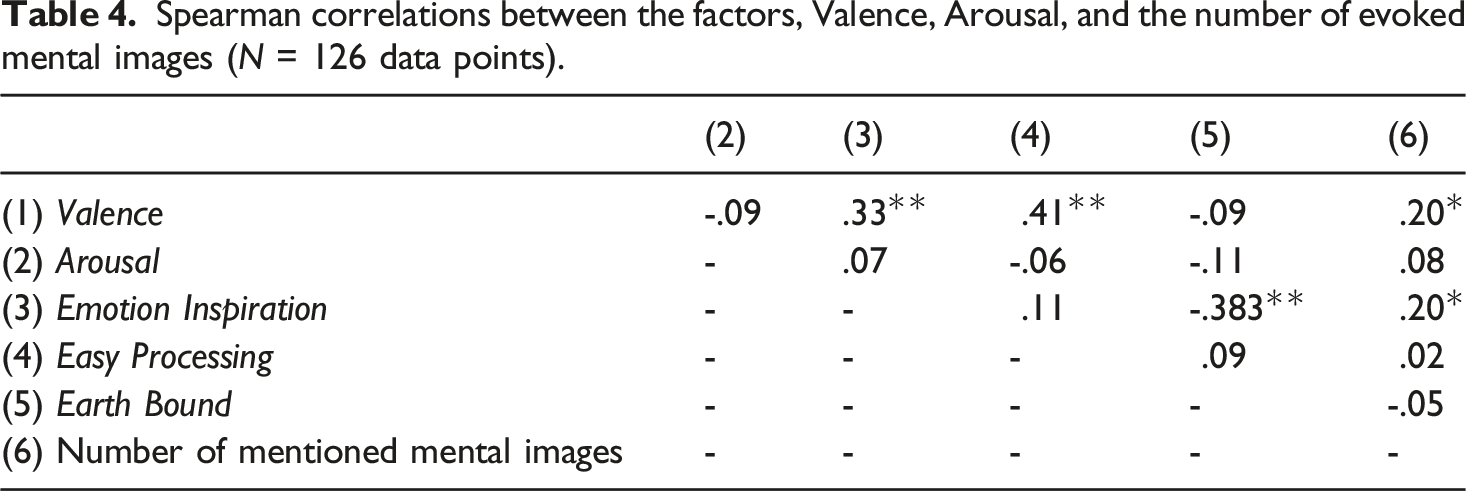
Taken together, the most obvious differences were observed for sonnet 66 compared to 60 and 27, while the differences between the latter two could be observed only for the factor Easy Processing. We can cautiously conclude that what is important is not the number of foregrounded elements, but rather their type. This finding motivated further qualitative exploration of the responses to the open questions in our questionnaire.
3.2. Qualitative analyses
In our qualitative analyses we developed categories from the open answers of (i) the mental images evoked by the poems, and of (ii) the feelings that are described in the poems.
3.2.1 Perceived feelings
Categories of perceived feelings in sonnets 27, 60 and 66 with examples from the open answers mentioned more than 10 times. Words in capital letters refer to the category names identified by the two coders.
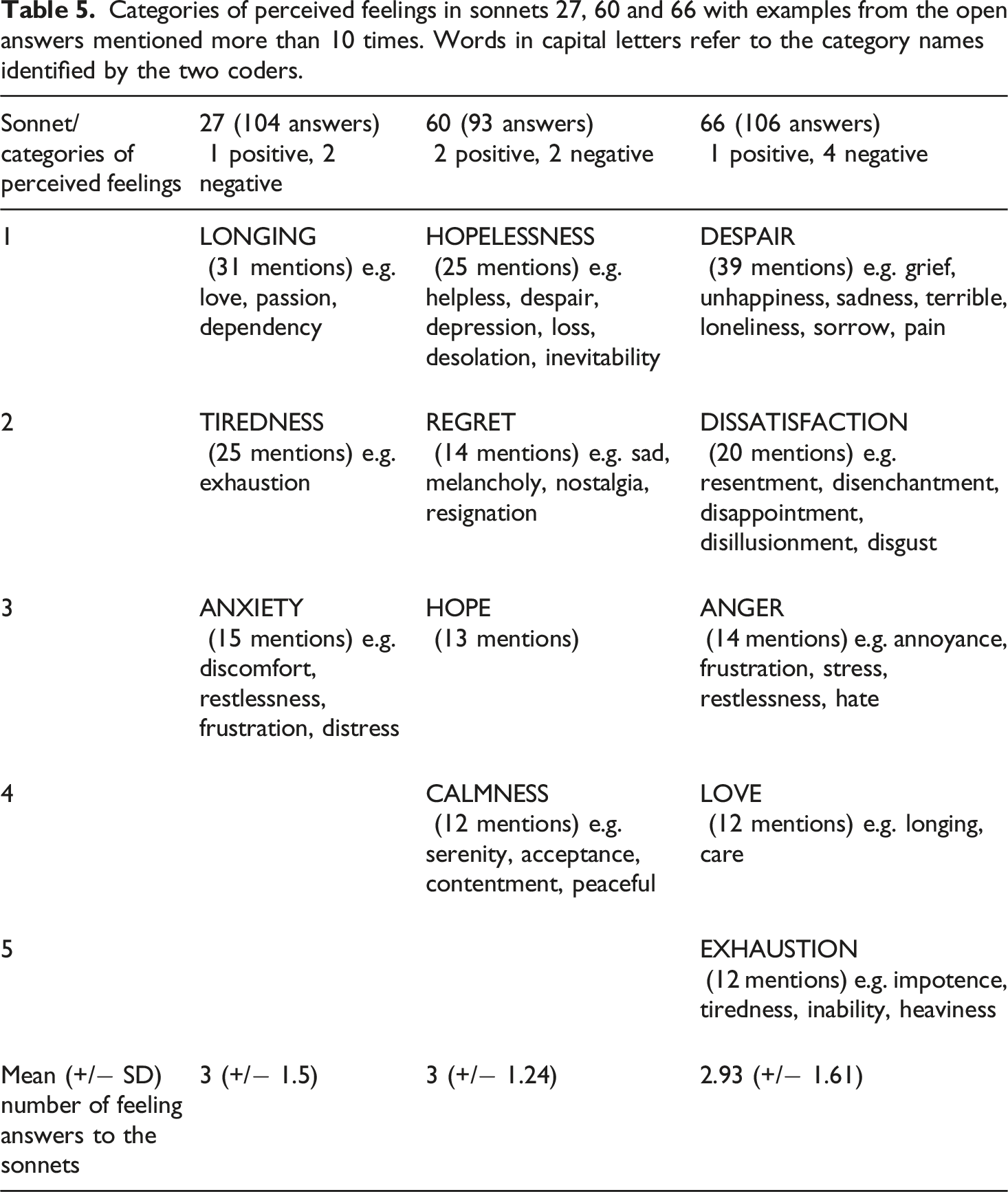
Sonnet 27 displays the most focused presentation of the readers' perceived feelings – i.e. it entails the narrowest array of categories. The negativity of the feelings is highest in sonnet 66, in which four of the five most common perceived feelings, are negative. Note that sonnet 27 was rated the most easily understood and the less concerned, its overall valence rating being rather positive – assumedly partly due to its clearly expressed emotions related to love and longing. Sonnet 66, in contrast, was rated the most negative, the less understood, and also the most concerned. Sonnet 66 also triggered the highest number of perceived feelings. In sonnet 60, there is an explicit oxymoron, uniting the positive and negative poles of the same feeling: the hopeless hope. While this sonnet is rated slightly negative, on the content level of the feelings this can be dissolved into harmony. It is further worth emphasizing the qualitative differences in the types of feelings across the three sonnets: for sonnet 27 they can be named interpersonal (the most frequent category is LONGING), for sonnet 60 they can be termed spiritual (all the categories reflect this: HOPELESSNESS-HOPE, REGRET, CALMNESS), and for sonnet 66 the perceived feelings (e.g. DISSATISFACTION, ANGER, LOVE) can be labelled social. Hence, in light of the participants’ interpretations, and in line with Gambino et al.’s (2020) qualitative analysis, all three sonnets differ qualitatively from each other. Comparing the free recall data about the feelings perceived in the sonnets with the ratings data about Valence and Arousal indicated, that only the former one reflects a clear distinction between all three sonnets, whereas the readers’ overall evaluations did not sustain this variety of feelings.
3.2.2 Mental images
Categories of mental image descriptions in sonnets 27, 60, and 66 mentioned at least eight times.
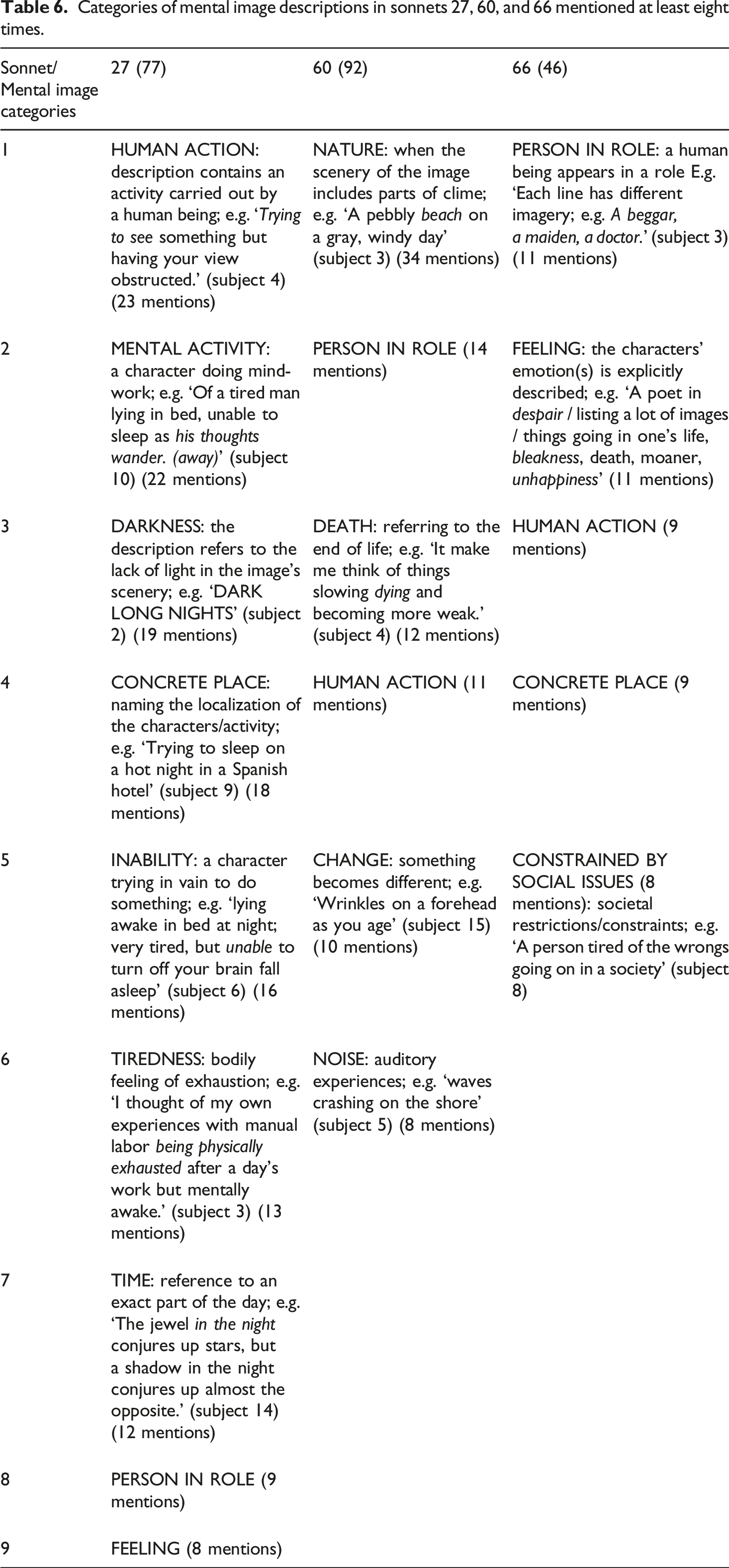
The qualitative analysis revealed that sonnet 60 evoked the most topically focused images (that is, the images could be categorized around the lowest number of topics). Perhaps somewhat surprisingly, the same sonnet also generated the highest number of images; readers might have needed to search for an image to frame the abstract content. Moreover, only sonnet 60 featured sensory modality imagery (Kuzmičová, 2014) among the most frequent categories: the images are rather picture-like impressions (like a kaleidoscope) with the hint of philosophical thoughts without coherent situations. Sonnet 27 prompted the most diverse array of images. A possible explanation for this is the presence of a person in the poem, to which readers can relate and project their own human conditions. Unlike the diversity of descriptions of the mental images, most of them told a story about a man or a couple, which reflected the high understanding of the sonnet with a detailed, coherent situation model. Sonnet 27’s clearly expressed emotions might have helped the readers to form the mental images. Sonnet 66 was the only sonnet that prompted FEELING as a frequent imagery category. This sonnet also evoked the highest number of perceived feelings. However, given that sonnet 66 evoked the lowest number of images of the three sonnets, this prominence of perceived feelings did not seem to support imagery development. The images related to sonnet 66 also have some story-like structure but compared to sonnet 27 the temporal setting and the main character are less concrete. We can conclude that the descriptions of the mental images are qualitatively different across all three sonnets. As for the ratings, our qualitative analysis of the open responses supported the superiority of sonnet 60 regarding the capacity for evoking mental images, assumedly due to its richness in density fields (Gambino et al., 2020) as well as the duality of abstractness and sensuous nature of its content. A summary of the qualitative and quantitative analysis of the readers’ answers in the following discussion section contributes to a deeper understanding of the sonnets’ effects on cognitive and emotional facets of the reading experience.
3. Discussion
We combined a qualitative literary analysis of three sonnets with qualitative and quantitative analysis of reader responses tapping into cognitive and emotional aspects of their experiences after reading. In a previous analysis Gambino and colleagues (2020) showed that sonnet 60 is an outstanding piece among the three due to its more complex usage of tropes and very specific arrangements of foregrounding across lines, clustering in density fields. We assumed that this would result in higher emotional ratings, more evoked mental images, and lower understanding. In the present paper we chose two other sonnets very different in their foregrounding effects, their topics, and argumentative structures to compare readers’ ratings and open answers to the three sonnets. The second focus of the present paper was to provide further results on the emotional experiences and mental imagery of poetry based on subjects’ ratings and open question answers.
First, we wanted to explore whether – similarly to the qualitative analysis – readers’ emotional and cognitive ratings would also differentiate the three sonnets. According to the results of a principal factor analysis, readers evaluated the sonnets on three dimensions: Emotional Inspiration (containing the emotions of like, touched, inspired, and delight), Easy Processing (comprised of easy to understand, and concerned (−); i.e. rather referring to the mental work (concern) required understand a piece of art), and Earth Bound, i.e. whether they felt wonder (−) and/or astonishment (−) during reading. The relatively low number of factors is in accordance with Jacobs et al. (2016) as well as Markovic (2012), who found that liking judgements of visual material could be explained by a two- or three-dimensional space: beauty and roughness in the first case and arousal plus attention (that Markovic [2012] called fascination), appraisal (high cognitive engagement), and a strong feeling of unity with the piece of art in the latter case. Our factors reflect a similar division of the emotional aesthetic experience: Fascination or Beauty (Emotional inspiration in our study), Appraisal (Easy Processing) and the counterpart of spiritual feelings towards the object (Earth Bound).
The Earth Bound factor did not differentiate the three poems from each other, but Emotional Inspiration and Easy Processing clearly differentiated sonnet 66 from the two other sonnets (60, 27): 66 was the least liked piece, the most negative, the hardest to understand, and the most concerned (the most reflected), and together with sonnet 27 the highest in terms of arousing potential. Previously, we hypothesized (H1) that sonnet 66 would be the least liked piece, but the factor Easy Processing contradicted H1 and shed further light on more complex processes regarding the understanding of negatively perceived pieces of art and their impact on our lives. This result seems in accordance with The Distancing-Embracing model of the enjoyment of negative emotions in art reception (Menninghaus et al., 2017) which states that negative emotions are powerful in securing attention (concern?) and intense emotional involvement.
The outstanding quality of sonnet 66 was also predicted by Jacobs (2018b: 192) “Sonnet 66 with its very long first sentence (70 words) and repetitive structure stands out from Table 7 with the highest mean of both phrase density and coordinate conjunctions (e.g. its 10 ‘and’)”.
We expected sonnet 60 to be the most liked, and the least understood, evoking the highest number of mental images (H2 and H3). Our second hypothesis was supported: this sonnet was experienced as being moderately emotionally inspiring, moderately reflecting and understood and less arousing. This could be explained by its positive, spiritual mood, which is reflected in its lowest Earth Bound rate (wonder and astonishment loaded negatively on this factor), and its high surprisal score in Jacobs et al. (2017) QNA’s analysis. 5 The unique characteristics of this sonnet quantitatively appeared only in its capacity to evoke mental images (H3).
In their analysis of German poems by Enzensberger, Aryani et al. (2016) found the direction of the relation between valence and arousal to be negative. This pattern is shown by sonnet 27, which is the least reflected and the best understood but the most arousing and the most liked. There are several potential explanations for this finding: firstly, it could be related to the interpersonal topic and clearly expressed emotions in sonnet 27. This sonnet is also particularly rich in symbolic imagery (Jacobs et al., 2017; Meireles, 2005) and it displays a dynamic emotion potential profile (Jacobs, 2018b, Figure 2), which could also explain this pattern of readers’ responses.
Our main conclusion from the analysis of the ratings is that our assumptions were only partially supported, and that sonnet 66 (and not sonnet 60) was the most outstanding of the three in the readers’ ratings. Further, the rating data did not allow a clear differentiation between all three sonnets. This can be connected to the extensive computational results of Jacobs et al. (2017) suggesting that our three sonnets scored around average with respect to readability, Regressive Imagery Dictionary (RID; Martindale, 1975, 1990) and mood potential (the capacity of a poem to induce either a positive or a negative mood).
The qualitative analysis of the open responses provided a rich and more diverse picture of the distinctiveness of each single poem. The open question regarding readers’ perceived feelings to the sonnets showed that the three sonnets were rather differently interpreted emotionally: in sonnet 27 interpersonal (e.g. LONGING), in sonnet 60 spiritual (e.g. CALMNESS), and in sonnet 66 social (e.g. DISSATISFACTION, ANGER, LOVE) were the most frequent types of emotions reported. This can be a starting point to further explain our rating data: interpersonal feelings between a man and a woman could be the most familiar, easily understood and the most liked emotions for the majority of the readers. These rather unambiguous emotions (sonnet 27 generated the least diverse – most consensual – pool of responses for the perceived feelings) do not carry too much concern, and in contrast with the negative feelings that are also mentioned (tiredness, anxiety) ‘the power of love’ may have dominated the ratings. The rather unequivocal nature of the perceived feelings may have supported the readers’ development of rich, complex, story-like mental images (sonnet 27 prompted the most coherent images yielding the highest number of categories). A possible explanation for this is the presence of a person in the poem, to which readers can relate and project their own human conditions. This can be interpreted as providing a clear and familiar emotional focus, and a space for personalized mental images which may motivate further thinking. This conclusion is supported by Delmonte’s (2016) quantitative analysis of sonnet 27 highlighting that it is characterized by high peak in secondary thought concepts (such as concrete references to time) and relatively good readability.
The number, diversity and intensity of the perceived feelings were the highest in sonnet 66, which was reflected in the ratings by the highest ‘concern’ (and the lowest understanding) scores. However, in accordance with fluency theory, readers do not like to be concerned by a negative piece of art (lowest valence-rating), which is supported by the lowest scores on the Emotional Inspiration (beyond liking) factor. Seemingly, readers felt overwhelmingly negative emotions while reading, and these were hard to form into mental images. This is reflected in the finding that sonnet 66 prompted the lowest number of images. Additionally, the category FEELING, the second most frequent category identified for sonnet 66, could not be found for sonnets 27 and 60. The nature of the emotions in sonnet 66 could play a role in the rather pessimistic evaluation: the impact of larger, societal issues on a person’s life may be profound. At the same time, these are aspects of life that cannot be easily influenced by an individual. Parallelism or repetition did not seem to prompt elaboration. According to Delmonte (2016), sonnet 66 is a negatively marked piece, but does not contain many foregrounded elements which prime these feelings. Apparently, only those who were able to conjure up a mental image, experienced feeling changes in their emotions.
The qualitative analysis revealed that sonnet 60 fruitfully unites the positive and negative pole of the same feeling: the hopeless hope. This seems to give this poem a certain spiritual depth and calls for harmonizing, contemplative feelings. Although sonnet 60 evoked the highest number of mental images, these are also the most topically focused ones. Sonnet 60 is also the only sonnet that evoked images containing sensory modalities. Readers may have felt a need to search for an image to frame the abstract content expressed in sonnet 60. This brings it close to enactment imagery (Kuzmičová, 2014), which is largely considered one of the most aesthetically rewarding experiences. The lowest Earth Bound rating scores and the moderately high Emotional Inspiration support this, as well as the moderate Reflection scores: enactment imagery is felt to occur spontaneously, without much cognitive effort. Hence, in spite of its relatively high syntactic complexity (Jacobs, 2018b) and our finding that it has the most complex metaphorical structure, sonnet 60 is not the least understood, because its content is primed on different figurative levels. The presence of the rather homogenous picture-like impressions of nature in the mental images reflects this. Moreover, as highlighted by Delmonte (2016), sonnet 60 contains a sound structure – obstruents and unvoiced consonants 6 – that goes hand in hand with negatively featured sonnets. The presence-like feature of enactment imagery can provide an explanation for sonnet 60 being the least arousing one.
In sum, qualitatively evaluating the three sonnets on the basis of the readers’ perceived feelings and mental images brought us back to the uniqueness of each sonnet. Besides the structure of foregrounding, the type (and not the valence) of the depicted feelings played a central role in priming the readers’ understanding, forming of mental images, and arriving at an emotional ‘closure’ about the poem.
4. Limitations of this study
We are aware that besides their different foregrounding potentials as assessed by the FAM, the present sonnets differ on other dimensions. Besides, we did not assess the role of expertise and familiarity with typical Shakespearean style of the readers which might have had an effect on their responses. We attempted to choose less well-known pieces to avoid this effect. Our applied methodology is rather exploratory, not suitable for forming causal claims, but it can be a step towards more controlled experiments – e.g. using text manipulation in combination with eye tracking. With the ratings and the open questions, we assessed participants’ verbalized recollection and rememberings of cognitive and emotional aspects of their reading experience, which might differ from the reactions occurred during reading.
5. Concluding remarks
Content-wise, the factors of the readers’ responses to the sonnets clearly show that emotional and cognitive-reflective reactions are differentiated during reading. In the quantitative data we also managed to find support for the idea that the liking of a poem is a rather complex emotional experience, which comprises inspiration, delight and being touched by the work of art, and which can go together with spiritual astonishment. Besides that, our main finding indicate that it is not the number of foregrounded elements, but the type and their spatial concentration, which makes a difference in readers’ understanding, forming of mental images, and arriving at an emotional ‘closure’ about the poem. Moreover, only the analysis of the qualitative data allowed to identify differences between all three sonnets. Future research should therefore not only focus in combining offline and online methods as suggested by Dixon and Bortolussi (2016) but also quantitative and qualitative methods. Here we used quantitative and qualitative offline methods. Upcoming studies should therefore use not only quantitative online methods like eyetracking but also qualitative ones like think-aloud protocols recently used for exploring metacognitive activities like mind wandering (cf. Jordano and Touron, 2018).
Perhaps the most valuable contribution of this study concerns the role of mental images: they seem to support aesthetic feelings and are facilitated by foregrounding. The abstractness and sensory modality of a poem require the reader to form mental images in order to meaningfully relate to the piece of art. Clearly expressed emotions and the presence of a human being in the poem appear to support the reader in conjuring mental images, while too intense negative emotions can block visual mental representations of the poem.
Footnotes
Acknowledgements
The authors would like to thank to Renata Gambino and Grazia Pulvirenti for the valuable discussions preceding this empirical work, and to Frank Hakemulder for his comments on a previous version of this paper.
Declaration of conflicting interests
The author(s) declared no potential conflicts of interest with respect to the research, authorship, and/or publication of this article.
Funding
The author(s) disclosed receipt of the following financial support for the research, authorship, and/or publication of this article: This work was supported by COST Action project, E-READ IS1404 grant.

Notes
Appendix
Density fields as a result of phonological (underlined in light gray), morpho-syntactic (underlined in dashed gray), and rhetoric (underlined in black) figures identified in sonnets 60 and 66 (cf. Gambino et al., 2020)