






Abstract
This article studies the popular children’s book The Gruffalo (1999) written by Julia Donaldson and illustrated by Axel Scheffler. Its popularity is attested to by the fact that the book has sold over 13.5 million copies and has been translated into more than 80 different languages. The question that this article seeks to address is, to what extent has the language and style of The Gruffalo played a part in these commercial and cultural achievements? The article primarily explores the phenomena of meter, rhyme, rhythm and lexical repetition from interrelated linguistic and stylistic perspectives. It also brings these findings into a dialogue with some of the precepts and principles from both classical rhetoric and modern orality theory, especially pertaining to memory and delivery. Having weighed the linguistic evidence, the supposition is put forward that it is highly probable that the motivated language choices that have been made by the author, and the way those choices have been arranged and deployed in the story, have played a substantial role in the book’s success.
1. Introduction
One of the most loved and commercially successful picture books for young children in the English language in the past twenty-five years is The Gruffalo written by Julia Donaldson and illustrated by Axel Scheffler. In 2019, 20 years after its publication, it was reported that it had sold over 13.5 million copies and had been translated into more than 80 different languages. 1 In short, it can be said to be a successful book from both a commercial and a cultural perspective. The question that this article seeks to address is to what extent has the language, rhetoric and style of The Gruffalo played a part in that success. In this article, the background of the author and the texts will be firstly sketched out. The book’s critical reception will then be considered, followed by an appreciation of what the concepts of pictures books and reading aloud entail. Thereafter will come the stylistic analysis itself, where the main focus of analysis will be on rhythm, rhyme and lexical repetition. In the discussion section of the paper that follows, the underlying results of the analysis will be explored within the light of some of the practices and principles from the theory of classical rhetoric and from contemporary orality theory. The article will conclude with signposts towards further stylistic study in this domain and with recommendations as to how stylistic analysis, in the realm of children’s literature, can help address much larger questions of children’s literacy and the general social, emotional and cognitive development of child listeners and readers.
2. The teller and the tale
The writer, Julia Donaldson, and the illustrator, Axel Scheffler, have worked together for more than 20 years and in that time have produced more than twenty best-selling books. 2 The number of books they have sold together runs into the millions. This study will focus on just one iconic book; The Gruffalo from 1999. 3 Donaldson has in her own right been a highly successful children’s author over the past twenty-five years. She has published more than 100 books and many of her works have been translated from English into other languages. She has also written many educational books, mainly on phonics.
The Gruffalo is a short children’s story of approximately 700 words. It has been reported that it took Donaldson 2 years to write, leading one critical voice to note that this is something like 10 words a week. 4 The work is essentially a short tale about a clever mouse who meets and outwits a terrifying Gruffalo. This Gruffalo, however, is not simply a creature in the real world of the story; it has been inadvertently conjured from the mouse’s own vivid imagination. One could say that it is a made-up monster that turns out to be real.
The fable-like story starts with the mouse out walking in a forest. In quick succession he encounters a fox, then an owl and finally a snake. Each of these creatures wants to eat the mouse, but the crafty little protagonist makes up a tale about a fearsome friend that he calls a ‘Gruffalo’. The mouse adds that he will be meeting this friend shortly right here in this very spot. He also tells each of the three animals that the Gruffalo’s favourite food happens to be the animal he is talking to at that moment in time. So, instead of eating the mouse, the fox, owl and snake, in turn, all run away back to their homes in order to avoid the imminent arrival of the terrible Gruffalo. Each time though, no Gruffalo turns up and the mouse continues safely on his journey, that is, until he is confronted by the next predator in line to whom he then retells a slightly adjusted version of the tale as his ‘get out of jail’ card. It is not entirely sure where he is headed in the wood or why. However, this becomes irrelevant, as much to his shock and amazement, he is unexpectedly confronted by a real-life Gruffalo. This invention that he had conceived of in his own imagination is now right in front of him and ready to eat him up, as the mouse turns out to be the Gruffalo’s favourite food. Thinking quickly, the mouse tells the Gruffalo that he himself is the most terrifying animal in the entire wood and as such the Gruffalo should not mess with him. This amuses the Gruffalo somewhat, who is at least 10 times bigger, and he asks the mouse to prove it. The mouse cunningly says, follow me then, and he heads back in the same direction from which he came. In reverse order, the mouse now encounters all of the three predators whom he had previously met: the snake, the owl and the fox. The animals see that he is being accompanied by his ‘friend’ the terrifying Gruffalo. ‘It is true, after all’, the three predators plausibly conclude one after another and they all turn and run away back to their homes for a second time. This impresses the, rather dense, Gruffalo who does indeed believe that the three animals are running away from the mouse and not from him. The mouse, remembering that the Gruffalo intends to eat him, now seizes his moment and confronts the Gruffalo and tells him that he, the mouse, is in fact the scariest creature in the wood and, what is more, his favourite food happens to be Gruffalo or, more specifically, ‘Gruffalo crumble’. This unexpected message sends the dull beast into a state of panic: the Gruffalo has been revealed for what he is, namely, a ‘Bluffalo’, and he turns and runs away back into the heart of the forest. This David and Goliath-like story now ends with the mouse sat on a rock eating a nut. He is comfortable, safe and self-satisfied.
The mouse is described in the inside cover of the book as ‘quick-thinking’. Indeed, the mouse is clever, intelligent and quick-witted, but he is also savvy and cognitively nimble. This cerebral flexibility is what makes him resilient. So whereas he is cognitively lithe and adroit, his antagonist, the Gruffalo, is cognitively lethargic and torpid. The mouse is also a trickster. A trickster is an archetypal character who can cross social and physical boundaries. He inhabits a liminal space, where this shape-shifting character is neither wholly good, nor wholly bad. Tricksters are found in mythologies, folktales and fictions of the world and are therefore collectively recognizable. Famous tricksters from mythology include the Norse god, Loki and the Greek God, Hermes. West African culture has Anansi, the trickster spider and the indigenous peoples of North America have Coyote. Japanese culture has Kitsune (the fox people). 5 The basic rule for being a trickster is, perhaps ironically, that you don’t follow rules and that you deceive far more powerful individuals into getting what you want. Intelligence, creativity and ingenuity are key characteristics. Trickster figures in stories often appeal to readers and listeners. Maybe their status of being not wholly good, yet not entirely bad, is alluring, especially to very well-behaved children who can only dream of transgressing social boundaries. In this sense, tricksters might appear to be ‘cool’ to younger readers.
The opening line that sets the scene of the story is ‘A mouse took a stroll through the deep, dark wood’. Woods and forests in children’s literature are liminal places: always mysterious; potentially perilous. This is especially the case in fairy tales and similar stories: consider, for example, Little Red Riding Hood, Hansel and Gretel but also stories like Tolkien’s The Lord of the Rings. Forests have also been dangerous places for adults and this idea goes back to ancient times. A fitting example is the story of Actaeon, in Greek mythology, who, while out hunting in the forest with his dogs, inadvertently stumbled across Artemis (Diana) bathing naked in a pool. She was so enraged that she turned him into a stag whereupon his own dogs chased and killed him. Even today, forests have a power over us in television series and in films, from David Lynch’s acclaimed series Twin Peaks (1990) to the American films Deliverance (1972) and The Blair Witch Project (1999). The deep dark wood is still very deep and, potentially, very dark. Bruno Bettelheim in his Freudian psychoanalytic work from 1976 writes that ‘since ancient times, the near-impenetrable forest in which we get lost has symbolized the dark, hidden near-impenetrable world of our unconscious’ (94). I would argue that this does not wholly apply to our mouse as he is never really lost; he is just taking a stroll, while at the same time trying to avoid being eaten by both animals in his real world and an imaginary creature that he somehow has conjured into existence by his own verbal incantations.
This idea of the wood being a scary place for young children is amplified visually with Scheffler’s excellent illustrations of the trees, especially the base of the tree trunks and the uprooted trees with their exposed roots. The colour, form and shape of these tree roots are reminiscent of the Gruffalo itself, it is as if the forest has in part spawned the creature, and they serve in the story to foreshadow what is to come. They also provide a reason as to how the mouse gained inspiration to invent the Gruffalo on the spot and to come up with such detailed descriptions pertaining to the creature’s claws, jaws, teeth, nose, knees, toes, etc. We should not forget that in most cases the picture book page may be turned and shown to the child, or children, by the reading parent/caregiver for added extra effect. This is something that needs a little more explanation.
3. Picture books and reading aloud
When we are conducting regular stylistic analysis, we are primarily concerned with reading and how a reader processes language and language patterns, that is, words and sentences, either on the page or screen. Stylistically analyzing a book like The Gruffalo, a picture book, is a broader exercise. This is the case because the core target audience of The Gruffalo consists of children who have yet to learn how to read. Even though children may read the book themselves once they have turned five, as indeed my children did and sometimes still do, it is a book that is primarily meant to be read aloud to pre-schoolers, like most picture books are. This means that in many ‘reading’ events the main processing mode will be acoustic, involving the listening ear, rather than the text-scanning eye. Vision is, of course, also still required. As we have seen, in regular ‘reading aloud to children’ situations, the pictures are also shown to the child/children by a parent/caregiver as the oral recital of the story progresses. With the exception of a few multi-modal novels for grown-ups, that purposefully and playfully combine text and image representations, the domain of the image and the picture in the book-world is firmly the realm of the pre-school child.
Nikolajeva and Scott in their volume How Picturebooks Work (2001) have observed that such books have a dual level of communication; the visual and the verbal (1). Much has been written on the matter of what picture books are and what they do. Indeed the theory behind children’s picture books is deep and broad and can in no way be done full justice here. 6 What I will do therefore is attempt to construct what type of picture book The Gruffalo is by drawing on some of these existing theories and frameworks.
The Gruffalo, I would argue, is a picture book whereby the language and the images are not on an equal footing when it comes to importance. The language is arguably primary. However, it is also not the case that The Gruffalo is merely an illustrated book and the text can exist to its fullest potential without the images. The Gruffalo, therefore, falls somewhere in between these two poles. 7 The story can be recited in a performance setting and owing to the rhythm and rhyme an awful lot can be gotten out of it by an audience. However, the graphics, and especially the depiction of the Gruffalo itself, have, over the years, become iconic. Effective marketing, live performances and vast quantities of merchandising have, of course, played a key role in this. In the past 20 years, the image of the Gruffalo has thus come represent the story. The fact that the creature aligns with the story’s title, even though he is not the true protagonist, has undoubtedly helped to facilitate this development.
If we were to take Goldens’s five-part taxonomy of picture books, we can say that The Gruffalo falls between her categories three and four namely, ‘the illustration enhances/elaborates the text’(category 3) and ‘the text carries the primary narrative and the illustration is selective’ (category 4). 8 Additionally, if we were to apply the word-image dynamics taxonomy developed by Nikolajeva and Scott (2001), then we might say that the story of The Gruffalo is mainly an ‘expanding/enhancing’ picture book. This entails that the visual narrative supports the verbal narrative and that, for almost all the story, the text is not dependent on the images (12).
There is, to my mind, however, one key ‘page turning’ exception, and that is the moment when we, the viewer/listener, see the Gruffalo for the first time. In the illustration, the mouse is depicted strolling on in a relaxed way at the bottom of the page from left to right, while the snake is sloping away from right to left at the top of the page. The moment the viewer sees the Gruffalo is exactly the same time as the mouse sees him. Having left the serpent behind, the mouse says ‘silly old snake, doesn’t he know, there no such thing as a Gruffal …’. We then turn the page to read the last syllable of the word … ‘…Oh’!!
The transposition of the final syllable, the letter ‘o’, in ‘the Gruffalo’, to be replaced with the exclamation ‘Oh!’, works on a homophonic level. It is also humorous, especially for the children who are either reading or listening. However, this is tempered by the image of the grisly Gruffalo, who is bearing down on the mouse across from right to left across a two-page spread. The mouse is forced back in fright and even lifts slightly into the air, as one might also do when coming around a corner and being startled by a huge object standing in front of us. This unexpected confrontation, and especially the reader’s visual apprehension of the curvature of the mouse’s back, as he recoils in terror and is elevated off the ground, may no doubt elicit a cognitive embodied reaction in many a (young) viewer. The activation of mirror neurons may also play a role in this non-conscious reaction and an experience of embodied ‘felt motion’ in viewers. 9
Once the mouse has composed himself, he launches into his pity-filled soliloquy, addressed to himself but picked up and processed by his listening/reading audience. He starts with the rhetorical question … ‘But who is this creature with terrible claws’. This monologue ends up with the mouse repeating most of the ghastly descriptive body-part references that he has previously recited on his journey to ward off the three predators. It ends with the unavoidable conclusion ‘Oh help! Oh no! It’s a Gruffalo!’ Here then, in this instance, the imagery is key, and I expect the story would not work as effectively as it does without Scheffler’s accomplished pen and ink rendition of this frightening creature presented to us in this ingenious page-turning way for maximum surprise effect.
There is also the look of the Gruffalo itself. Both the appearance and the body language of the Gruffalo alter remarkably as the story progresses. We first encounter the Gruffalo visually on the page halfway through the story. His image appears on every page thereafter, on nine occasions in total. When we first encounter him he is thoroughly gruesome. He has staring orange eyes with black pupils placed high and to the left in the eye sockets, leering at the reader in a sideways glance. He also has a black tongue which is hanging from the left side of his mouth dripping with saliva. His arms are held high in attack mode, claws extended. He is also very much on the front foot, moving towards the mouse and causing him to recoil in fear. The second image on the next page is equally menacing as he stands over the mouse and points to him aggressively with an open mouth. However, after the mouse has laid down his challenge, and the return journey has begun, the demeanour and the appearance of the Gruffalo start to change. The third image depicts him almost buffoon-like following the mouse with one arm held aloft, looking at the viewer in a kind of ‘I think I might have an idea’ pose. His pupils gradually get lower in his eyeballs and he becomes less creature and more clown. By the eighth and penultimate image the Gruffalo is seen has placing his hand on his neck/throat area. This is often a non-conscious sign given off to others of being uncomfortable, afraid or threatened. 10 In the last image, he has taken to his heels and in full flight away from the mouse. We often see both eyes of the Gruffalo and they communicate much to us as the viewer. 11
In spite of these impressive illustrations, it is the words in The Gruffalo that primarily carry the narrative. This is exemplified by the significant amount of dialogue in the story. The images principally serve to amplify the language and at no point do they produce alternative information or contradict the text. In the terms of Nikolajeva and Scott (2001) when it come to the word-image relationship, this is primarily ‘complementary’ and at no meaningful time does it become what they refer to as ‘counterpoint’, where gaps are left between word and image as a trigger or an invitation to involve and stimulate the reader’s imagination. 12
Something we have yet to touch on is why do caregivers read aloud to younger children and what effects might reading aloud have on the development of those children? In her work on ‘marketing in children’s literature’ Squires makes the key observation that picture books commonly speak to a double audience, ‘keeping the adult reader entertained alongside the child’ (2009: 187). A similar earlier observation was made by Nikolejava and Scott (2001: 21) when they describe the ‘dual audience’ of picture books, for both the child and the adult. The benefits of reading aloud to children are manifold and they can be generally predicted. For example, it will help to develop a child’s language skills, creativity and imagination and should also enhance a child’s levels of concentration while she/he sits and listens. Moreover, reading a range of books should teach a young child about different topics and reading together should one might hope encourage a thirst for knowledge, as well as creating a strong bond between the child and the parent/caregiver.
Fox in her 2001 book Reading Magic: Why Reading Aloud to Children will Change their Lives Forever has a more direct, economic argument. She reasons in the ‘Foreword’ to her book that reading aloud to babies and young children will make a country better off in the long run, as the financial investment put into improving early literacy levels will prove to be well worth the investment when, as a result, governments in future years have less crime, less employment and fewer people relying on benefits (xii). Although there are too many variables at work here to make this causality argument stick, her case is both persuasive and plausible.
For the sake of practicality therefore, the upcoming analysis of the story will seek to balance the focus both on the readers of The Gruffalo, that is, children above six and their caregivers and also the listeners, that is, those children age five and under. Also given that the focus of this paper is on language and style, it is self-evident that the verbal will play a more significant role in the analysis than the pictorial. It is not the intention to ignore the images or to treat them as mere decoration, so where relevant they will be brought into the analysis. Before embarking on the stylistic analysis, however, it is fruitful to consider some critical appraisals of the story.
4. Reviewer commentary on The Gruffalo
There has been some academic research conducted on The Gruffalo, but none of it has been primarily linguistic in nature. One study, from the field of sports and exercise science by Duncan et al. (2017), looked at how the combination of movement and storytelling activities from The Gruffalo boosts pre-school children’s key motor skills and language ability. Another study, by Wheatley (2012: 72), has investigated the role of audience participation in Donaldson’s approach to writing for children. She makes a number of interesting observations including how children sometimes ‘rock to the rhyming beat’ of Donaldson’s stories when they are read aloud. 13 A third study by Van der Westhuizen (2007) has looked at the psychological concept of self-efficacy and humour in the story within the framework ‘external locus of control vs. internal locus of control’.
Academic research on The Gruffalo may be quite rare, but there have been numerous critical commentaries in the UK national newspapers, and in other periodicals, over the years both on The Gruffalo and on its author. Most of these articles have had a generally positive tone. There have, however, been some dissenting voices. Writer and journalist, Tom Hodgkinson, for example, writing in The Telegraph in 2015, has been critical of the style in The Gruffalo. He makes a number of claims. These include (i) that it does not scan, (ii) that the meter is all over the place, (iii) that the rhyming couplets have no set rhythm and (iv) that the in the story is limited. With regard to word usage, Hodgkinson notes that the word ‘good’ is used incorrectly and also too broadly. How can a mouse look ‘good’, he asks, when what Donaldson means is something like ‘tasty’ and how can the word ‘good’ also be used for a concept like ‘timid’ which appears to occur in the second half of the story? Hodgkinson is also critical of Donaldson only being able to find one adjective to describe the fearful Gruffalo, namely, ‘terrible’. He also suggests that the secret of the book’s success must lie in its bland and unassuming nature. The gist of his ostensible invective, one must conclude, is that The Gruffalo is a terrible story and that Julia Donaldson, who according to Hodgkinson has ‘taken over children’s literature and must be stopped,’ is at best a mediocre writer of children’s stories. If we reflect on the research question in this paper, namely, to what extent has the language, rhetoric and style of The Gruffalo played a part in its success, then, if we base our judgement on a review like this, we can probably conclude that the answer is ‘very little indeed’. But is this a fair assessment, and, perhaps more importantly, is it correct? A deeper analysis of the linguistic features in The Gruffalo will shed more light on this matter.
5. A stylistic analysis of The Gruffalo
As a parent, I read this story aloud to my own children at bedtime, probably hundreds of times, when they were three or four years old, as did my wife. It is unlikely that we were unique in this. I did this until I reached the stage where I no longer needed to physically read the text from the page, since I had somehow memorized most of it without actually trying to. My intuition, as a past declaimer of The Gruffalo, is that what is prominent about this story, stylistically, is on the one hand the rhyme/rhythm/meter and on the other hand the extensive lexical repetition. Indeed, one might argue that had it not been for these linguistic phenomena, I would probably have not been able to memorize and recite the text so effortlessly. Let us therefore start this stylistic investigation then by looking more closely at these particular stylistic features. 14
5.1. What’s in a title?
The stuff of foregrounding rests on the concepts of parallelism and repetition, and sometimes on the strategic deviation from those phenomena in order to highlight erstwhile hidden parts of a message. A first step is to look more closely at the title ‘The Gruffalo’ from the perspective of phonetic patterns. In this proper noun, the sound symbolism, or ‘linguistic iconicity’, is strong. ‘Gr’ is a common, two-letter consonant cluster before onset in English. The sound symbolism is almost imitative in nature. Sadowski (2001: 45) argues that gr-words in English consistently refer to the negative aspects of existence. For this observation he draws on Boulton’s argument that stops and affricates (which of course would include the gr-sound) ‘suggest harshness, violence, cruelty, movement, discomfort, noise, and conflict …’ (1982: 63–64). As Sadowksi further observes, many gr- words in the English language have an Anglo-Saxon origin (40). Some verb forms that employ this consonant cluster include ‘to growl, to groan, to grouch, to grudge, to grimace, to grapple, to grumble to grate and to grind’. These last two examples, to grate and to grind might call to mind the imagery of crushing, biting, chewing, and ultimately, devouring. The consonant-cluster onset letter pair in the word ‘Gruffalo’, and its Germanic origins, calls to mind that other monstrous antagonist English literature, Grendel, the man-consuming giant that Beowulf had to face and defeat in the Old English poem of the same name. There is also the intertextual echo found in the initial syllable ‘gruff’ that links it to another children’s story popular in the English speaking world, namely, the story of the ‘Three Billy Goats Gruff’, an originally Norwegian ‘please-don’t-eat-me-now-but-eat-me-when-I am-bigger’ narrative. From these examples, we might conclude that from a sound symbolic perspective, the name of the villain in the story is fittingly crafted by the author.
5.2 Meter, rhythm and rhyme
Foregrounding abounds in the story on various levels and while reading one can feel the rhythm of the story, so much so, that it becomes nigh impossible to misread the text. There is, it feels, some invisible template at work at some embodied, somatic level that keeps the person who is reading aloud on track. However, not everyone would agree. You may recall that the critic, Hodgkinson, was disapproving of the meter and the rhythm: ‘it has no set rhythm, it doesn’t scan and the meter is all over the place’. Does the stylistic and linguistic evidence support this claim? The text is written in rhyming couplets. The story opens, and mostly continues, in dactylic tetrameter, which has been referred to as quite a rare meter (Carper and Attridge 2003: 93). It consists of a stressed syllable followed by two unstressed ones, essentially, a beat and two off-beats, also known as a ‘falling’ meter. We see a slight difference in the first two lines of each section where the dactyl is delayed by a beat, where, for example, the stress is on ‘mouse’, ‘stroll’, ‘deep’ and ‘wood’ (the line starts with unstressed syllable ‘A’, before the dactyl begins with ‘mouse’ and the meter ends short).
A mouse took a stroll through the deep dark wood
A fox saw the mouse and the mouse looked good
In these opening lines it is more like a delayed dactylic trimeter, but this quickly changes to the full/regular version of this meter:
‘Where are you going little brown mouse?
Come and have tea in my underground house’
And this continues through the main sections of the ‘verse’ parts in the story. The ‘chorus’, as it were, breaks this rhythm.
Silly old fox! Doesn’t he know,
There’s no such thing as a Gruffalo?
With the extensive use of dactylic meter, Donaldson is in good literary company. Not only was the dactyl the favoured meter in ancient Latin and Greek epic, often delivered orally, it also found its way into English poetry. Recall the opening lines in Tennyson’s ‘The Charge of the Light Brigade’.
Half a league, half a league,
Half a league onward
Moreover, in using the dactyl in the tetrametric form, Donaldson is following in a rich practice of English poetic verse, from 17th century songs, through the tradition of ballads and nursery rhymes of the last two centuries. The opening lines to Robert Browning’s famous poem ‘The Lost Leader’ is another example of this meter.
Just for a handful of silver he left us,
Just for a riband to stick in his coat—
Carefully crafted, playful rhyming lyrics, delivered in a tight metrical form like the ones found in The Gruffalo, stay in our heads and indeed in the heads, and the auditory memories, of our children whom we read the story to. In his 2012 book on Shakespeare’s sonnets entitled Why Lyrics Last, Boyd (2012: 4) looks into the question of what pleasures can verse offer aside from narrative. He especially focusses on the ‘patterns of sounds and senses of language’ (10). He concludes that we have a unique human motivation to play with patterns and that playing with patterns begins early and forms an essential part of our rich acquisition of language skills (12–13).
The rhythm in the story is progressive, mimicking the journey. This is aided by the dactylic meter and also content phrases such as ‘on went the mouse’. But there are moments when the momentum is temporarily halted, such as the three occasions in the narrative when the mouse uses the adverbial ‘here’ in ‘here, by these rocks/by this stream/by this lake’. These shifts in temporal/spatial deixis have the effect of drawing the readers’ attention of the importance of the location, perhaps because the reader/listener will be back at this same place on the mouse’s return journey with the Gruffalo. Focussing on the immediate vicinity of the predator’s lair may also convey a felt sense of danger for the young children who are listening or reading.
Playful end-rhymes also abound in The Gruffalo: wood-good; mouse-house; claws-jaws; fox-rocks; sped-said; toes-nose; back-black; snake-lake; stream-cream; toowhoo-flew. Many of these, such a ‘jaws-claws’ and ‘mouse-house’ might be said to be predictable, whereas others such as the literal-sounding ‘toowhoo-flew’ are less so. Donaldson has spoken in the past of how she was inspired to write the story after having read a Chinese folk tale about a tiger. I have not read that Chinese story myself, but to my mind, the plot line of the ‘clever mouse’ also has echoes of Arnold Lobel’s wonderful children’s story Mouse Soup (1983), whereby the mouse that is about to be eaten by a weasel outwits it and finally escapes. The word ‘tiger’ is arguably not an easy term to rhyme with in English, so Donaldson probably had to come up with something else, something unique. Now, the word ‘Gruffalo’ does not rhyme with much either (with the exception of ‘buffalo’), but it does rhyme with the phrase ‘didn’t you know’/’doesn’t he know’, which is a seminal phrase in the story when it comes to driving the plot forward, as it occurs, strategically placed, no less than six times in the story. Did the title of this book come about because of some skilled linguistic ‘reverse engineering’ by the author that started from a key line that was central to the plot of the story? It is not impossible.
There is an interesting end-rhyme scheme that reads: A-A, B-B, C-C-C-C, D-D, E-E, F-F, C-C. This scheme then goes on to roughly repeat itself through the piece. The dactylic metered lines are in the pairs, with the deviation from the meter taking part in the C-C sections, for example, ‘it’s terribly kind of you, Fox, but no …’ (Donaldson and Scheffler 1999) where no clear meter is discernible. This deviation has the foregrounding effect of slowing down the reading and the action, with the potential of bringing increased meaning to the text, and indeed most of these section starts with the mouse speaking. But when the end-rhyme is in full flow it has an anticipatory effect on listeners, facilitated by the simplicity and relative predictability of the lexical items, such as jaws/claws, mouse/house, etc.
5.3. Word choice and lexical repetition
The piece abounds in playful alliteration from the sibilant consonance of ‘scrambled snake’ to the plosive menace of the ‘deep, dark woods’. The story is also laden with concrete nouns, from mouse and fox and snake, to house and rocks and lake, and from eyes and teeth and toes, to wart, knees and nose. Abstract nouns are thin on the ground. Much of the word choice may be predictable, but there are a number of strategically placed exceptions. The words used to describe the animals in potential food-forms are witty and are presented in a humanized cuisine terminology. They also alternate in patterns from cooking process to cooking product. The first three of these share a basic meter: ‘roasted fox’, ‘owl ice-cream’ and ‘scrambled’ snake. This pattern is then broken by the fourth amusing culinary item, ‘Gruffalo crumble’, which is not only foregrounded, but the juxtaposition of a monster and a pastry dish is in some ways oxymoron-like, a kind of ‘Godzilla meets the Great British Bake-off’ (Figure 1). The process-product animal pattern.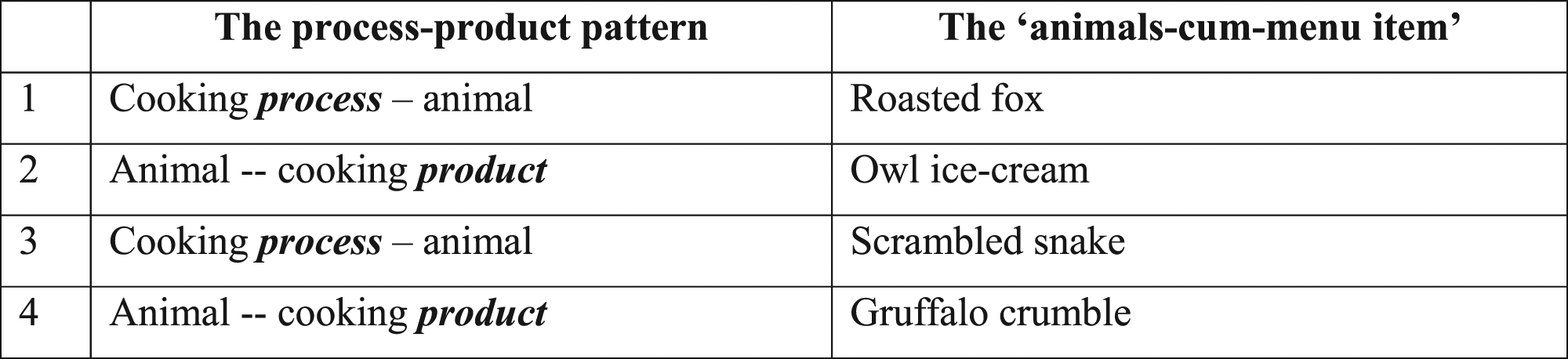
There is also a relevant extra dimension here. The rhetoricians of the classical world knew that when it came to memorizing language for later recital by heart, one had to develop and deploy absurdly vivid image combinations, the more intense, the better, and place these strategically in locations in your so-called ‘memory palace’. 15 The vivacity and absurdity of compounded linguistic phrases such as ‘owl ice-cream’ and ‘Gruffalo crumble’, which are not depicted pictorially in the book, should remain memorable for young listeners and readers in that their auditory presentation meets this classical rhetorical principle.
Moving more centrally to lexical repetition, we saw earlier how Hodgkinson was critical of the language choices in the story. In particular, he was critical of Donaldson only using the word ‘terrible’ as an adjective to describe the Gruffalo, even though this only appears once in an early stanza. 16
He has terrible tusks,
And terrible claws,
And terrible teeth in his terrible jaws.
Young listeners will be drawn to the playfulness of this tri-syllabic word being repeated with its alveolar plosive onset and its rhotic-liquid nucleus and its bilabial plosive and liquid coda. For some younger children, with their bountiful imaginations, the regular plosive sounds on the first syllable may even project the pounding footsteps of the monster moving methodically through the wood. The earlier-mentioned study by Duncan et al. (2017) on how the Gruffalo boosts not just language ability but also motor skills, speaks to the potential of this.
The word ‘terrible’ may also work intertextually reminding the young listener of that other impressive story of monsters Where the Wild Things Are from 1963 written and illustrated by the American children’s author, Maurice Sendak.
The wild things roared their terrible roars and gnashed their terrible teeth
and rolled their terrible eyes and showed their terrible claws
It may be recalled how the journalist and writer, Hodgkinson, was also dissatisfied with the word ‘good’ in The Gruffalo being employed ‘incorrectly’ when better or more appropriate words would have been more suitable. The word ‘good’ occurs on eight occasions in the story. In all cases it is used so that a rhyme can be set up with the word ‘wood’. The ‘good-wood’ combination, with its monophthong /℧/ may work in an engaging way for pre-school listeners rendering it pleasant and euphonic rather than discordant. Of course, we must be careful not to slip into the trap of the phonoaesthetic fallacy, but we are not speaking of adult readers here, but rather primarily of child listeners aged between three and five and, thereafter, child readers above five. In his stylistic work, Verdonk has argued that ‘there is no doubt that from our earliest childhood onward we find great pleasure with playing with the formal structures of language … the use of lexical repetition seems to be central to this language game’ (1995: 7).
Even when it comes to naming, the word ‘Gruffalo’ occurs 29 times in the actual story. That is about 4% of the total word count. In addition, the word ‘mouse’ is mentioned 26 times. Lexical repetition at this level can, if one wanted to, be seen as redundant and therefore poor style. But imagine that we were not to look at this text purely as a children’s story, but rather as a children’s poem, or song, or rhetorical declamation, or oral performance, or indeed all of these blended together into one enactment. Would the so-called dispensable repetition then not become indispensable?
5.4. Plot, narrative and dialogue
The plot structure is simple, yet at the same time seemingly complex. How can this contradiction be accounted for? The simplicity not only lies in the language and meter than underlie the plot, but also in the plot itself. At a basic level we see the mouse travelling from left to right, as it were, past the fox, owl and snake until it reaches the Gruffalo, and then it turns around, and, accompanied by the Gruffalo, it walks back past the snake, owl and fox. It is here that he then frightens off the Gruffalo by threatening to eat him. So from a locative perspective the mouse ends more or less where he began. The trajectory of the action, if we were to consider it only in image-schematic terms, has a basic ‘in-out’ structure. However, in other ways the plot is less simple. The plot does not have a traditional basic plot structure of (i) exposition, (ii) a long period of rising action, (iii) a climax about two-thirds or three quarters of the way in, (iv) a short period of falling action showing the aftermath and finally (v) a resolution. Instead, the story’s rising action is shorter than normal. The point where the mouse sees the Gruffalo, a distinct kind of climax in the story, occurs approximately halfway through the story (at 362 out of 701 words). The falling action is then more or less just as long as the rising action and then just before the resolution there is a second climax to the story when the tables are turned and the mouse threatens to eat the Gruffalo, causing the monster to run away.
This then is no Aristotelian peripeteia plot reversal, but there is a very clever twist in the tale that, as noted earlier, will in all likelihood cause huge astonishment to young listeners and readers and arguably to their reading aloud caregivers too. But there is also another aspect of the story that makes this plotline unusual. The mouse invents the Gruffalo world and the Gruffalo itself. The fox, owl and snake are in the ‘real world’ of the story but the Gruffalo makes a cross-over from the imaginary world in the mouse’s head to the real world in the mouse’s life. If we reflect on the whole, we see that some fairy tale conventions are, if not broken, stretched to their very limits. This may very well result in what is known in schema theory as a ‘refreshment’ moment, namely, the schematic expectations of a hearer/listener get disrupted and as a result the boundaries of the experience become augmented (Cook 1994). 17
A further salient stylistic matter in this text is the notion of speech within narration. The story starts with an omniscient narrator, but who this person or animal is remains unclear. 18 Each short stretch of text is introduced by a narrator reporting in the 3rd person. This is reflected in the use of past tense verbs, for example, ‘a mouse took a stroll …’, ‘On went the mouse …’, ‘they walked some more …’, etc. But these sections only last for one or two lines before a dialogue deploying present tense verbs ensues between two characters in the story, one of which is always the mouse.
In these discursive exchanges between the mouse and the other real-world animals, there is a palpable formality. The three predators all enquire ‘where are you going to, little brown mouse’. This is followed by a seemingly kind invitation from them to ‘come and have lunch’ (the fox), ‘come and have tea’ (the owl) and ‘come for a feast’ (the snake) at their respective homes, that is, in the fox’s underground house, the owl’s treetop house and in the snake’s logpile house. However, there is little kind-heartedness here. Phrases like ‘come and have tea’ appear to be a threat to negative face in the classic Brown and Levinson (1987) sense, since they impede on the addressee’s freedom of action. The ‘invitations’ are also framed as imperative forms, suggesting that there is no mitigation of the face threatening act.
The dialogue is in direct speech, which is almost always supported by reported clauses, as one might expect in a book designed primarily for pre-schoolers. This heterodiegetic narrative mode makes it feel more proximal and immediate to readers and listeners. The main speaking role falls to the mouse and, thereafter, the fox, owl and snake all have substantial speaking roles. Lastly, the Gruffalo has a somewhat minor, but nonetheless important discursive contribution. This division of who speaks and when and how often is not inconsequential in stylistic analysis. It is important for implied meaning and for social relations between the characters. Indeed, and as Gibbons and Whitely have noted, how speech is presented, directly, indirectly or through narrative presentation can ‘… affect readers’ felt sense of the immediacy of the narrative, their judgements about the reliability of characters and narrators, and their interpretation of character and/or narrative voice’ (2018: 96).
When the predators speak in the story, including the Gruffalo, the words are rendered in italics. This typographic deviation is noticeable to a reader, and, more so, since it does not take place when the mouse speaks. Hence, it is not simply an indicator of spoken discourse, but a foregrounded marker of something more significant. In an orality context, it is perhaps a marker for the caregiver who is reading aloud to change her/his register, volume or tone.
There is arguably also a ‘story within a story’ here, namely, the reciting of the descriptive parts of the creature itself, as uttered by the mouse. He does this first fragmentarily, when encountering the three predators. He gives each hunter three or four features of the monster, leaving them to puzzle together what the creature looks like. For example, the fox gets to learn mostly about head-related features, namely, tusks, teeth and jaws (the other being ‘claws’). These attributes are all described as being ‘terrible’. The owl learns of the malformed nature of the beast’s toes, knees and nose. The snake gets to hear of the colours of the monster’s eyes, the wart on his tongue and the prickles on his back. These are all part of the puzzle that the reader is also given. Such is the vivacity of these loathsome body parts that the Frankenstein-like beast starts to emerge in the listener’s or readers’ visual mind’s eye long before he is encountered on the page.
5.5. Character cognition
The trickster mouse is quick-witted and the ogre monster is dull-brained. If we were to consider this state of affairs in terms of the ‘elaboration likelihood model’ from cognitive psychology, then we see that the mouse relies on peripheral (rather than central) processing in this two-systems theory devised by Petty and Cacioppo (1986). This cognitive shortcut can be seen as a neural capacity that aids the ‘fight or flight’ mechanism and by default supports the evolutionary Darwinian system. In the similar work Thinking Fast and Slow (2011), by the psychologist Kahneman, we see that the mouse successfully combines the two: he is fast and automatic (a peripheral processor) when suddenly faced with immediate danger, as occurs on four occasions in the story when he encounters the fox, owl, snake and finally the Gruffalo, but he quickly becomes logical and calculating (a central processor) when he responds to all four threats by turning the tables on his adversaries with his cognitive and linguistic legerdemain. One could say that he turbo-charges the idea of ‘thinking on your feet’ to unprecedented heights. Not only does he buy time, thus allowing himself space to think, he goes onto the offensive and threatens the very predators who sought to devour him.
We see this too when the mouse first draws the monster’s attention to the fact that everyone in the wood is afraid of him and then goes onto the offensive and threatens the Gruffalo by declaring that he is now the one who is hungry, and his favourite food is Gruffalo, or, more specifically, ‘Gruffalo crumble’. The slow-brained Gruffalo repeats the phrase ‘Gruffalo crumble’ and as the penny starts to drop, and against all logic of size and power, he turns and flees. What the mouse has cleverly done is to employ his functional ‘theory of mind’ capacities, something the Gruffalo appears to lack. The mouse understands the Gruffalo’s intentions, his beliefs, desires, emotions and knowledge and he deploys his theory of mind to outwit the Gruffalo and feed into the latter’s own fear of being eaten, as big and terrifying as he is.
However, this ‘intelligence versus stupidity’ model is not as absolute as one might think. If we look at the language produced by these two characters, and by the Gruffalo in particular, we arguably sometimes observe a more mixed picture. For example, the mouse sees off the snake, and the Gruffalo comments on this with the word ‘amazing’. He then sees off the owl and the Gruffalo notes, ‘astounding’. Interestingly, these two polysyllabic utterances by the Gruffalo may reveal an unexpected aspect of the Gruffalo’s mind-style, thus suggesting the plausibility of a higher level of intelligence than first meets the eye. Maybe because the Gruffalo has emerged from the mouse’s exceptional rhetorical cognition, he has retained some of that eloquence. He is, after all, in some sense part of the mouse. There may also be a more practical reason for the Gruffalo’s sudden and unexpected fluency, namely, that the author, Donaldson, who is also an educator, may have purposely included more difficult words in the text for an explicit education/literacy reason. 19
Much more could be said here on language, rhetoric and style in The Gruffalo, but we turn now to the discussion section to explore what all this might mean and where it might lead to. In the upcoming section, I will revisit several of the foregoing stylistic observations, and especially those on rhythm, rhyme, meter and lexical repetition. I will consider them anew through some principles and practices from both the field of orality/vocality theory and the domain of classical rhetoric.
6. Discussion
Let us begin by taking a step backwards. If we were to reflect on our teaching practices, we will realize that when we teach grammar, repetition is often deemed redundant, and frequently considered poor style, and should thus be eliminated. However, when we teach rhetoric, repetition is valued, treasured even, and should thus be encouraged. Rhetorical manifestations of oral and written culture abound with rhetorical repetition and this is even more so in children’s literature, especially children’s poetry. These, however, are not grammatical or style errors as Hodgkinson, the aforementioned critic of Donaldson’s style, appeared to believe. Every act of repetition can be the bearer of subtle differentiations of pleasurable meaning. As Pullinger (2017: 108) puts it, ‘in children’s poetry, repetition is never simply repetition’.
In the bigger picture, strategically-structured repetition helps orators and performers alike to stay on track, as it were. It also creates regular spaces in the production of discourse, where little cognitive effort needs to be placed on the ongoing oral creation and instead cognitive effort can be re-routed to recall the lines of the upcoming text once the repetition section (or chorus/refrain) has ended. In a classical rhetorical sense, such ‘spaces’ can be seen as a moment in the discourse that allows listeners to cognitively engage with what has been said or sung, critically and/or creatively appraising it and even mentally recasting it. Indeed the author of the Rhetorica ad Herennium, written in the 1st century BC, and accredited to Cicero, advises giving as much time to pauses as to each exclamation (1954: 263). In addition to the rhetorical greats of classical antiquity noting this, similar observations have been made more contemporary orality scholars such as Ong (2002) and Collins (2013).
Most figures of repetition in classical rhetoric draw on pathos, the ability to persuade by engendering emotions in listeners. This is also the case when reading a poem aloud. Artistic repetition in art can most certainly lead to the creation of emotion. When one repeatedly re-reads a favourite poem or short story or when one repeatedly watches a favourite TV series or film or when one repeatedly listens to a favourite song or album, not only can high levels of emotive responses be maintained over time, they can even become intensified and enhanced. From the perspective of rhetorical pathos, therefore, repetition in the arts is anything but redundant.
Rhythmic repetition can be found in numerous aspects of poetry, including meter, alliteration/consonance and assonance. As Attridge (1995: 1) has observed, rhythm is critical to the enjoyment of poetry. He refers to it as the ‘engine’ that drives spoken language forward, adding that in order to fully enjoy poetry listeners need to respond and participate in its rhythm. This rhythm also creates a sense of movement and emotion. As Attridge explains, What is distinctive about poetry is its exploitation of the fact that spoken language moves, and that its movements – which are always movements of meaning and emotion at the same time as movements of sound – achieve a varied onward momentum by setting up expectations that are fulfilled, disappointed or deferred (Attridge, 1995: 1).
20
Pullinger poses the question of why is it that children’s poets use so much repetition. She suggests that the dynamics of oral mentality have a significant influence on children’s poetry and that lyric written for children might be seen as a site of interaction for orality and literacy (2017: 82–83). So in view of this, yes, The Gruffalo is loaded with repetition, as was earlier noted, but arguably none of it is as redundant as it might initially appear. Indeed, given the age of the largest part of the audience, namely pre-schoolers with their 4–5 year old theory of mind, one might say that the repetition here is essential.
Much scholarly work has been done on the topic of orality and vocality. First among equals in this field must be Parry’s linguistic and anthological works conducted since the 1920s on the origins of orality theory ranging from a search for the origins of the Homeric epics, to the unravelling of the recital processes of the sagas of Iceland and the Serbo-Croatian heroic songs (see Parry 1971). Parry’s work was extended and deepened by Lord (1960) leading to what many people now view as the ‘Parry-Lord theory’, an idea that both composition and performance in oral cultures relies on ‘standardized formulas grouped around equally standardized themes’. 21 Performers therefore do not need to memorize lines verbatim, as an actor might have to today, but rather these standardized formulaic elements would be recalled and combined anew with each performance. In fact, this is wholly in line with advice given to the young rhetoricians of the classical world before they entered the political area or courtroom to speak deliberatively and/or advocate a case in a seemingly extemporaneous fashion. 22
It can also be argued that Donaldson meets the strategic criteria of oral composition set out in Pullinger (2017: 74–76), who draws on the work of both Ong (2002: 40) and Foley (2002: 48) in that such compositions should be (i) generally formulaic (i.e. repeat elements and have pliable recurrent scenes), (ii) additive in structure (i.e. simple cumulative relationships expressed with simple grammar and syntax), (iii) be full of repetition and copiousness (e.g. ‘backlooping’ using natural (empathic) speech patterns), (iv) be situational (e.g. contexts are never abstract but are embedded in recognizable experiences) and (v) be antagonistic (e.g. there is a polarized world of good versus evil). The Gruffalo meets all these criteria. 23
If we were to reconsider the book, we will see that the story of The Gruffalo is taale that is full of music, of that there can be little doubt. So maybe The Gruffalo isn’t a story in the traditional narrative sense after all? Maybe it does not primarily belong in the category ‘children’s fiction’. Perhaps instead, it is a poem, or a song, or a ballad, or a folk rhyme, a narrative to be declaimed, recited, performed, not read in an act of literary discourse processing. Maybe it is closer in style to the works of Eric Clapton than it is to the works of Eric Carle.
In line with this proposal, imagine if we were to consider The Gruffalo afresh as a children’s song rather than a children’s story: where does that leave the author, Julia Donaldson? Well it turns out that she might actually agree to some extent, were we to be in a position to ask her. It seems that as a young woman she acted, sang and danced and she started her professional career writing songs and busking with her husband. 24 Furthermore, her first published children’s story ‘A Squash and a Squeeze’ (1993) started out life as a song that she wrote and performed together with her husband. If we combine this with her earlier-mentioned love of phonics, we might realize the importance of oral sounds over written words for this author and as a result recast her not exclusively as a teller of tales, for that she most certainly is, but, just as importantly, as a singer of songs. Of course, one swallow doesn’t make a summer, so this hypothesis would have to be tested across the much larger data base of Donaldson’s literary oeuvre.
Critical reviewers that call into question the style and language use of Donaldson might stop and consider that her overuse of lexical repetition, rhythm, rhyme and meter seamlessly matches with the cognitive, social and emotional requirements of her main pre-schooler audience. It is a central principle of classical rhetoric, put forward by Cicero in De Inventione (On Invention, 1949), that an orator must know the nature, desires and make-up of his/her audience in order to be able to effectively move and/or delight them. For all the perceived redundancy in her language use, rhyme and meter, Donaldson is faultlessly attuned to the needs of her main audience.
The story offers young children a window onto the world, a largely unsettling, if realistic, world where wit and guile and the ability to lie to bullies are skills that should be acquired. Resilience and resourcefulness are key. Writing on resilience Coats (2018: 67) notes that the Gruffalo is one of several books that show how less powerful characters can overcome threats and obstacles and that this ‘meets psychological needs for empowerment and growth’ when young children need to stay close to home. One can easily see how the young child being read to can place herself/himself in the shoes, as it were, of the mouse. My children certainly did.
It is important to note that the mouse’s tools of choice are not coercive but persuasive ‘just walk behind me and soon you’ll see’ reasons the mouse. It is not brute force that wins the day for the mouse but nimble thought and eloquent speech. In the mouse’s armoury are on the one hand creative imagination and, crucially, rhetoric, a capability which gives him the ability and the confidence to delivery his message. 25 This is a war won with words, not weapons. If anything, this story should act as signpost to empower children with the ability of creative thinking and the capacity for ethical persuasive speech. Both will build problem-solving confidence in children and, in doing so, will be beneficial in helping them to develop cognitive and emotional resilience to external and internal threats, real or imagined.
The fact that the mouse and the Gruffalo remain enemies at the end of the story and there is no reconciliation is also an important lesson. Children’s stories can also be playfully disquieting and mischievously disconcerting in order to facilitate the creation of resilience strategies. Maybe books like The Gruffalo are just what sections of the current childhood generation needs? As the American rhetoric scholar Kenneth Burke might have said, the book, as a literary artefact, forms part of a young child’s ‘equipment for living’ (1973). A similar observation has been made by best-selling children’s author/novelist and Renaissance literary scholar Katherine Rundell, who asserts that ‘those who write for children are trying to arm them for the life ahead with everything that we can find that is true’ (2019: 4).
We may recall how one critic noted how Donaldson has only written 10 words a week and had taken an age to finish the story. Well, maybe revision inspires excellence and one should go slowly when one needs to get ‘the best words in the best order’ as the Romantic English poet, Coleridge, once famously observed. Every word seems thus meticulously selected. What we are arguably seeing here is the skill of the author manifested in what Verdonk (2002: 6) has referred to as ‘motivated choice’, a fundamental assumption that different lexical choices, lead to different styles that lead to different effects. 26
7. Conclusion
The question that this article sought to address was to what extent have the language and style of The Gruffalo played a part in the huge success that the book has enjoyed. The analytic proofs that have been furnished in the foregoing analysis have hopefully served to show that their role has not been inconsequential. Of course, we must always show caution when making causal arguments, as causality invariably entails complexity and correlations may have alternative explanations. However, I have sought to work towards the most likely explanation, without excluding other important perspectives and options. The case remains open, but sound proofs have been furnished for the case of the importance of language in the success of The Gruffalo.
It is also important to realize that this stylistic analysis has barely scratched the surface of what may be possible in this story when stylistic and linguistic tools are applied more systematically. A deeper engagement with several of the theoretical frameworks, only touched on here would arguably result in a richer analysis. Future research therefore should consider this. There are also other methods, not used in this article that might also result in a more focussed investigation. These include using corpus stylistic/linguistic tools and also eliciting reader responses to gather qualitative data. In short, much is still possible, stylistically speaking, should we dare to take another stroll into the deep, dark wood of the mouse’s fantastic world of the fearsome Gruffalo.
Footnotes
Declaration of conflicting interests
The author(s) declared no potential conflicts of interest with respect to the research, authorship, and/or publication of this article.
Funding
The author(s) received no financial support for the research, authorship, and/or publication of this article.